ADVANTAGES AND DISADVANTAGES OF ARSENAZO III AND
CHLOROPHOSPONAZO III UTILIZATION FOR
SPECTROPHOTOMETRIC THORIUM DETERMINATION
Jozef Uhrovčík
*, Maroš Juraška, Juraj Lesný
Paper was presented at the 4th International Symposium on Trace Elements in the Food Chain, Friends or Foes, 15-17 November, 2012, Visegrád, Hungary.
Keywords:. thorium, Arsenazo III, Chlorophosphonazo III, spectrophotometry, limit of detection (LOD).
The presented work is devoted to the evaluation of important validation descriptors concerning the spectrophotometric determination of thorium using Arsenazo III and Chlorophosponazo III. In diluted hydrochloric acid the complex between Th(IV) and Arsenazo III is formed instantly and remains stable for 25 minutes with constant absorbance. Beer’s law is obeyed in the range from 0.70 to 11.64 mol ∙ L-1. The
molar absorptivity at 660 nm is equal to 9.74(±0.09)∙104 cm−1 mol−1 L (data in parentheses stands for standard deviation). The relevant
relative standard deviations (RSD) reached ±1.48 %, ±4.34 % and ±3.07, respectively. Thorium concentration can be quantified using Chlorophosphonazo III in media of diluted nitric acid. The linear range of the proposed method was from 1.59 to 18.10 mol L-1 of
thorium(IV). The experimentally determined values of molar absorptivity reached ε691 = 3.76(± 0.05)*104 cm-1 mol-1 L. The repeatability
and trueness of determination in the linear range did not exceed ±2.2% and 3.3%, respectively. Color stability of the Th(IV)-Chlorophosphonazo III complex maintained a constant value for at least two hours. LOD and LOQ values for both methods were established applying three approaches – the 3-σ, the ULA2 and the Hubaux-Vos ones.
* Corresponding Authors Fax: +421335921403
E-Mail: [email protected]
[a] Department of Ecochemistry and Radioecology, University of SS. Cyril and Methodius in Trnava, Nám. J. Herdu 2, SK-917 01 Trnava, Slovak Republic
Introduction
Thorium is a naturally occurring radioactive element of extraordinary long lifetime. The most reliable sources of elemental concentrations in earth crust report values representing approx. 6 ppm of thorium in average. Thorium is first of all a worthwhile potential raw material for fissile nuclear fuel production. Taking in account chemical and geochemical determinateness of thorium, the quantification of its concentration in different matrices requires in addition to high accuracy also satisfactory detection limits. The mentioned element can be determined by many instrumental techniques based on different principles including mass
spectrometry with inductively coupled plasma1-2,
electrochemical methods3-6, atomic emission spectrometry
with inductively coupled plasma,7-8 atomic absorption
spectrometry9, chromatography10-13 and others. A necessary
part of most analytical determinations of elements in real matrices is separation and preconcentration. To achieve this goal a number of effective procedures have been
developed14-18. There are many spectrophotometric methods
for thorium determination in environmental samples.19-26
The application of organic reagents for
spectrophotometric determination of thorium is well known and continues to be interesting. Chlorophosphonazo III and Arsenazo III belong to azo-dyes based on chromotropic acids. The reagents have ability to form stable chelates and can work in strongly acidic medium eliminating the chances
of partial hydrolysis of metal ions to be determined. They
are complexing reagents suggested primarily for
spectrophotometric determination of lantanides, actinides
and alkaline earth metals.27
Russian scientists Fadeeva and Alimarin28 have published
the first use of complexing agent Chlorophosphonazo III for spectrophotometric determination of thorium(IV) in diluted
hydrochloric acid media. Extraction of
Th(IV)-Chlorophosphonazo III complex into organic solvent led to an increase of selectivity and sensitivity of the relevant
determination.29-30 In monazite sand samples, the
spectrophotometric determination of thorium using
Chlorophosphonazo III in presence of diluted phosphoric acid was carried out as well. The relative error of the
determination did not exceed 1%.31 While the successful
applicability of Chlorophosphonazo III for
spectrophotometric quantification of thorium(IV) in
different matrices is indisputable, the number of works dealing with detailed evaluation of particular determinations is surprisingly limited. The use of Arsenazo III for spectrophotometric determination of thorium(IV) was described in work of soviet scientist Savvin. Measurements were carried out in presence of diluted hydrochloric acid at
the 665 nm. Molar absorptivity reached the value 1.3*105
L mol-1 cm-1. This method proved to be suitable for the
determination of microgram amounts of Th in minerals and natural waters. The relative error of the determination does
not exceed 4%.32 A rapid and sensitive spectrophotometric
method has been developed for the determination of thorium(IV) using 0.04% Arsenazo-III in a 2M perchloric
acid solution.33 The complex is formed instantly in
perchloric acid and remains stable for 45 minutes with constant absorbance. Beer’s law is obeyed in the range 1 –
60 μg g–1 of thorium(IV) concentration with a molar
absorptivity at 654 nm = 3.07*105 M–1∙cm–1. The foreign
checked. The cations were tested at > 60-fold excess of thorium(IV), Mn(II), Fe(III), Co(II) and Ni(II) interfere negatively, whereas only Ce(III) has increased the absorbance. Among the anions, cyanide, phosphate, thiocyanate and acetate at 150-fold excess of thorium(IV) cause significant interference. However, thorium can be determined in the presence of nitrate, chloride, oxalate, tartrate, ascorbate, thiosulphate and citrate. The method has been applied on certified reference material for thorium determination after extractive separation and the result was
found in good agreement with the certified value.33
The utilization of mentioned complexing agents in question has valuable advantages such as an excellent time stability of the absorbance and a relatively wide linear range, etc. Chlorophosphonazo III and Arsenazo III still have a justified place among the complexing agents utilized in trace analysis and the interest in their analytical applications significantly grows in recent years.
The presented study is focused on the evaluation and comparison of important validation parameters for
spectrophotometric determination of thorium in mol L-1
concentration range using abovementioned reagents.
Material and methods
We performed all measurements using the Cary WinUV 50 (Varian Inc.) spectrophotometer. We used three replicate samples for each absorbance determination and we utilized the average value of the signal versus blank in next computations. The value of the specific conductivity of the
deionized water used in experiments was 0.054 S cm-1. All
reagents used were of analytical grade and all the solutions were prepared in deionized water. Thorium(IV) stock
solution (Fluka Analytical) containing 43.1 mol L-1 was
used. The concentration of solution of the
Chlorophosphonazo III (Dojindo Laboratories) was 0.04% (w./v.) and Arsenazo III (Fluka Analytical) was 0.02% (w./v.). The medium of measured solutions has been adjusted by addition of diluted nitric acid or hydrochloric
acid (Mikrochem) with concentration 10 mol L-1. The
foreign ions stock solutions were prepared by dilution of standard solutions (Fluka Analytical, Merck).
Results and discussion
Arsenazo III method
Thorium stock solution containing up to 11.64 mol L-1 of
Th (IV) was transferred into 10 mL volumetric flask, then 2.3 mL of diluted hydrochloric acid and 2 mL of Arsenazo III solution have been added. The mixture was filled up to the mark with distilled water. After thorough mixing the absorbance at 660 nm against a reagent blank was measured. The upper limit of the linear range was established by
application of QC parameter34 and application of F-test of
significance of quadratic parameter.35 The Beer’s law was
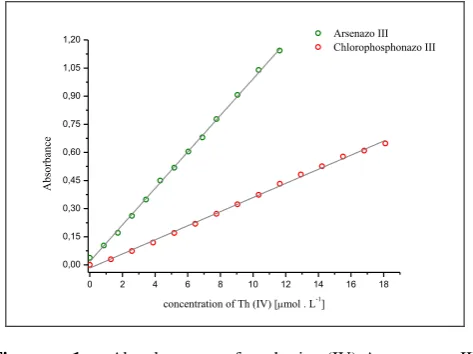
obeyed from 0.7 to 11.64 mol L-1 (Figure 1). Beyond this
value, a significant deviation from the linearity was
observed. The molar absorptivity reached value
ε660 = 9.74(±0.09)*104 cm-1 mol-1 L a (data in parentheses
represents standard deviation).
0 2 4 6 8 10 12 14 16 18
0,00 0,15 0,30 0,45 0,60 0,75 0,90 1,05
1,20 Arsenazo III
Chlorophosphonazo III
A
bso
rb
ance
concentration of Th (IV) [mol . L-1 ]
Figure 1 Absorbance of thorium(IV)-Arsenazo III
(Chlorophosphonazo III) complex as a function of thorium concentration against a reagent blank.
The optical density was found constant only 25 minutes under normal laboratory conditions. A significant decrease in the absorbance was observed only for thorium(IV)
concentration exceeding 6.90 mol L-1 (data not shown).
The values of limit of detection (LOD) and limit of
quantification (LOQ) were calculated by 3-σ,36 ULA237 and
Hubaux-Vos38 approaches as well. In the case of
computation by 3-σ approach residual standard deviation
(sy/x), standard deviation of y-intercept (sb) and standard
deviation of blank (sblank) were applied. Results of these
theoretical computations are summarized in Table 1.
Table 1 LOD and LOQ computed by using three different
approaches. †10 replicate determinations of blank. 3-
sblank†
LOD [μmol L-1]
LOQ [μmol L-1]
0.63 2.07
sy/x LOD [μmol L
-1]
LOQ [μmol L-1]
0.34 1.12
sb
LOD [μmol L-1]
LOQ [μmol L-1]
0.17 0.57 ULA2
LOD (= 0.05) [μmol L-1]
LOQ (= 0.05) [μmol L-1]
0.23 0.68 LOD (= 0.01) [μmol L-1]
LOQ (= 0.01) [μmol L-1]
0.34 1.03 Hubaux-Vos
LOD (= 0.05) [μmol L-1]
LOQ (= 0.05) [μmol L-1]
0.22 0.65 LOD (= 0.01) [μmol L-1]
LOQ (= 0.01) [μmol L-1]
0.31 0.93
The experimentally verified limit of detection and limit of quantification reached the following values: LOD = 0.22
mol L-1 and LOQ = 0.70 mol L-1. The best agreement
between theoretically computed and practically verified values of LOD and LOQ was observed using ULA2 and Hubaux-Vos approaches namely at significance level α = 0.05. The results were satisfactory even in the case of 3-σ
approach application, where sb was implemented into the
Table 2 Obtained data for precision and trueness appraisal concerning the studied method.
Th (IV) concentration
[mol L-1] Relative error [%] RSD [%]
1.30 −3.09 ±4.34
3.88 −0.72 ±1.48
7.76 −2.11 ±3.07
Influence of potentially interfering ions has been checked. The impact of 60-fold foreign ions excess (Th(IV)
concentration 4.31 μmol L-1) is summarized in Table 3. Our
results indicated that U(VI), Co(II) and Ce(IV) caused significant interference.
Table 3 Effect of chosen ions on thorium(IV) determination with Arsenazo III in hydrochloric acid.
Foreign ion Relative
error [%] Foreign ion
Relative error [%] Cu(II)a +3.74 La(III)b +13.25
Zn(II)a +0.37 U(VI)a +57.50
Co(II)a +49.63 Eu(III)a +7.37
Mn(II)a +5.03 Ce(IV)a +36.99
(a) as nitrate (b) as chloride
Chlorophosphonazo III method
Thorium stock solution containing up to 18.10 mol L-1 of
Th(IV) was transferred into 10 mL volumetric flask, then we added 1.5 mL of diluted nitric acid and 0.7 mL of Chlorophosphonazo III solution. The mixture was filled up to the mark with deonized water. After thorough mixing, the absorbance at 691 nm against a reagent blank was measured. The upper limit of the linear range was established by application of QC parameter and application
of F-test of significance of quadratic parameter as in
previous method. The Beer’s law was obeyed from 1.59 to
18.10 mol L-1 (Figure 1). Beyond this value, a significant
deviation from the linearity was observed. The molar
absorptivity was established to be ε691 = 3.76(±0.05) ∙104
cm-1 mol-1 L a (data in parentheses represents standard
deviation). The optical density was found constant at least for 2 hours under normal laboratory conditions within the linear range.
The values of LOD and of LOQ were calculated by 3-σ, ULA2 and Hubaux-Vos approaches as well. Results of these theoretical computations are summarized in Table 4. The experimentally verified limit of detection and limit of quantification reached the following values: LOD=0.55
mol L-1 and LOQ = 1.59 mol L-1. The best agreement
between theoretically computed and practically verified values of LOD and LOQ was observed using ULA2 and Hubaux-Vos approaches namely at significance level α = 0.05. This is due to the fact that the mentioned statistical models take into account the uncertainty of the regression line and multiplying factors are not fixed (as in
3-approach), but their values depend on the design of the
experiment.
Table 4. LOD and LOQ computed by using three different
approaches. †10 replicate determinations of blank.
3-
sblank† LOD [μmol ∙ L
-1]
LOQ [μmol ∙ L-1]
0.12 0.40
sy/x LOD [μmol ∙ L
-1]
LOQ [μmol ∙ L-1]
0.71 0.37
sb
LOD [μmol ∙ L-1]
LOQ [μmol ∙ L-1]
0.40 1.34 ULA2
LOD (= 0.05) [μmol ∙ L-1]
LOQ (= 0.05) [μmol ∙ L-1]
0.53 1.61 LOD (= 0.01) [μmol ∙ L-1]
LOQ (= 0.01) [μmol ∙ L-1]
0.80 2.41 Hubaux-Vos
LOD (= 0.05) [μmol ∙ L-1]
LOQ (= 0.05) [μmol ∙ L-1]
0.52 1.57 LOD (= 0.01) [μmol ∙ L-1]
LOQ (= 0.01) [μmol ∙ L-1]
0.75 2.25
The precision and trueness of the method was examined by 7 replicate solutions. The relevant conclusions are shown in Table 5.
Table 5 Obtained data for precision and trueness appraisal for the studied method.
Th (IV) concentration,
mol L-1 Relative error [%] RSD [%]
6.03 +0.11 ±2.15
10.78 +3.32 ±1.14
16.38 −2.27 ±0.95
The influence of potentially interfering ions was checked. The impact of 50-fold foreign ions excess (Th(IV)
concentration 6.47 mol ∙ L-1) is summarized in Table 6.
It was carried out five replicate determinations for each interfering ion. The average value of three replicate Th-Chlorophosphonazo III absorbances (not containing foreign ions) was taken into account as a reference value. Results indicated that all the studied cations except of Ca(II) caused significant interferences.
Table 6 Effect of chosen ions on thorium determination with Chlorophosphonazo III in nitric acid.
Foreign ion Relative error [%] Cerium(IV) a +26.6(±1.8)
Lanthanum(III) b +78.1(±3.8)
Europium(III) a +22.2(±1.6)
Calcium(II) b −0.4(±1.2)
Uranium(VI) a +38.8(±2.9)
(a) as nitrate (b) as chloride
Conclusions
The studied spectrophotometric methods for determination
of Th (IV) in water solutions using Arsenazo III or
Both reagents are characterized by excellent repeatability of the results expressed by the relative standard deviation, whose value does not exceed the limit of ± 4.4% and also favorable value relative errors (<3%). Some differences
between these two methods can be observed in the time
stability of absorbance. Using Arsenazo III method the time
stability of absorbance is limited to 25 minutes and the
concentration limits 6.90 mol L-1 Th(IV), in contrast use of
Chlorophosphonazo III method extended stability up to two hours within whole linear range. Influence of selected foreign ions for accuracy determination of thorium is not negligible, but after their removal, or masking it would be possible to obtain relevant information about the concentration of Th in some types of real samples. As mentioned before - these complexing agents react with many other elements, and because the content of thorium in environmental samples is very low, it is not possible to use the method described for the direct determination of this element without appropriate separation and preconcentration procedures.
References
1Zheng, Y., Weinman, B., Croninc, T., Fleisher, M. Q., Anderson,
R. F., Appl. Geochem., 2003, 18, 539.
2Grinberg, P., Willie, S., Sturgeon, R., Anal. Chem., 2005, 77, 2432. 3Hassan, S. S. M., Elnemm, M. E., Attawiya, M. A. Y.,
Electroanalysis. 2008, 20, 2063.
4Chandra, S., Agarwal, H., Singh, CH. K., Anal. Sci., 2007, 23,
469.
5Ju-Nan, L., Fe-Yun, Y., Zhong-Min, J., Jun-Jie, F., Microchim.
Acta., 2007, 143, 287.
6Liu, S., Li, J., Xun, M., Gao, P., Anal. Lett., 2003, 36, 1381.
7Ujino, O., Umetani, S., Anal. Chim. Acta,2000, 420, 65.
8Thangavel, S., Dhavile, S. M., Dash, K., Chaurasia, S. C., Atom.
Spectrosc.,2010, 31, 92.
9Castro, M. A., Aller, J. A., McCabe, A., Smith, W. E., Littlejohn,
D., J. Anal. At. Spectrom.,2007, 22, 310.
10Al-Shawi, W. A., Dahl, R., J. Chromatogr. A, 1995, 706, 175.
11El-Dessouky, S. I., Borai, E. H., J. Radioanal. Nucl. Chem., 2006,
268, 247.
12Jackson, P. A., Carnevale, J., Fuping, H., Haddad, P. R., J.
Chromatogr. A, 1994, 671, 181.
13Jaison, P. G., Raut, N. M., Aqqarwal, S. K., J. Chromatogr. A,
2006, 1122, 47.
14Aydin, F. A., Soylak, M., Talanta. 2007, 72, 187.
15Bűyűktiryaki, S., Say, R., Ersőz, A., Birlik, E., Denizli, A.,
Talanta. 2005, 67, 640.
16De Carvalho, M. S., De Domingues, M. L. F., Mantovano, J. L.,
Da Cunha, J. W. S. D., J. Radioanal. Nucl. Chem., 2002, 253, 253.
17Maiorov, V. G., Nikolaev, A. I., Adkina, O. P., Mazunina, G. B.,
Radiochemistry.2006, 48, 576.
18Patkar, N. S., Burungale, A. S., Patil, R. J., RASAYAN J. Chem.,
2009, 2, 825.
19Shiri, S., Delpisheh, A., Haeri, A., Poornajah, A., Khezeli, T.,
Badkiu, N., Anal. Chem. Insights. 2011, 6, 1.
20Chalapathi, P. V., Subba Rao, Y., Jagadeesh, M., Prathima, B.,
Reddy, A. S., Reddy, K. J., Varadareddy, A., J. Chem. Pharm. Res., 2011, 3, 223.
21Chalapathi, P. V., Subba Rao, Y., Jagadeesh, M., Prathima, B.,
Reddy, A. S., Reddy, K. J., Varadareddy, A., Ramesh,G. N.,
Res. J. Chem. Environ., 2011, 15, 579.
22Zhai, Q. Z., Zhang, X. X., Chen, L., Asian J. Chem., 2008, 20,
5187.
23Garg, A., Kakkar, L. R., Proc. Indian Nat. Sci. Acad. Part A.
2007, 77, 27.
24Ghasemi, J. B., Zolfonoun, E., Talanta. 2010, 80, 1191.
25Pouretedal, H. R., Shafiee, B., Keshavarz, M. H., Bulg. Chem.
Commun., 2009, 41, 230.
26Kandil, A. T., Faramawy, H. F., Amin, R. M., Egypt. J. Chem.,
2007, 50, 709.
27Marczenko. Z., Balcerzak, M., Separation,Preconcentration and
Spectrophotometry in Inorganic Analysis (Analytical Spectroscopy Library), 1st Edition, Elsiever, 2000.
28Fadeeva, V. I., Alimarin, I. P., Zh. Anal. Khim., 1962, 17, 1020. 29Chen, J. F., Khalilli, F. I., Mohammed, A. K., Chopin, G. R.,
Anal. Chim. Acta.1994, 284, 593.
30Yamamoto, T., Anal. Chim. Acta. 1973, 63, 65.
31Lukin, A. M., Titov, V. I., Chernyshova, T. V., Evdokimova, N.
N., Zavod. Lab.,1973, 39, 1174.
32Savvin, S., Talanta. 1961, 8, 673.
33Khan, M. H., Ali, A., Khan, N. N., J. Radioanal. Nucl. Chem.,
2001, 250, 353.
34Van Loco, J., Elskens, M., Croux, C., Beernaert, H., Accredit.
Qual. Assur., 2002, 7, 281.
35Araujo, P., J. Chromatogr. B.,2009, 877, 2224.
36Long, G. L., Winefordner, J. D., Anal. Chem., 1983, 55, 712A. 37Mocák, J., Bond, A. M., Mitchell, S., Scollary, G., Pure Appl.
Chem.,1997, 69, 297.
38Hubaux, A., Vos, G., Anal. Chem., 1970, 42, 849.