Multivariable Generalized Predictive Control Using an Improved
Particle Swarm Optimization Algorithm
Moussa Sedraoui and Samir Abdelmalek
Laboratoire (PI : MIS) Problèmes Inverses: Modélisation, Information et Systèmes, Université 08Mai 1945, Guelma, Algérie
E-mail: [email protected]
Sofiane Gherbi
Laboratoire d’Automatique de Skikda (LAS), Université 20 Aout1955, Skikda, Algérie E-mail: [email protected]
Keywords:improved particle swarm optimization, multivariable generalized predictive control, feasible region
Received:November 16, 2010
In this paper, an improvement of the particle swarm optimization (PSO) algorithm is proposed. The aim of this algorithm is to iteratively resolve the cost problem of the Multivariable Generalized Predictive Control (MGPC) method under multiple constraints previously reduced. An ill-conditioned chemical process modelled by an uncertain Multi-Input & Multi-Output (MIMO) plant is controlled in order to verify the validity and the effectiveness of the proposed algorithm. The performances obtained are compared with those given by the MGPC method using the standard PSO algorithm. The simulation results shows that the proposed algorithm outperforms standard PSO algorithm in terms of performance and robustness.
Povzetek: Predstavljena je metoda optimiranja z roji za nadzor s splošnim napovedovanjem in več spremenljivkami.
1
Introduction
Multivariable generalized predictive control (Morari & Lee, 1999) is a very powerful method. It has been the subject of many researches during the last few years and it was applied successfully in industry, particularly in chemical processes. It is based on MIMO predictive model [1], [2] where the expected behaviour of the system can be predicted in the extended time horizon. The MGPC law is obtained by minimizing linear or non-linear criterion (Magni, 1999, Duwaish, 2000). This criterion is composed by the sum of the square prediction errors between the predicted and desired outputs, the weighted sum of the square change-controls (control-increments) and others [3]. The constraints inclusion (as mathematical inequalities type) distinguishes most clearly MGPC from other process control paradigms as suggested in (Richalet, 1993, Qin 1997, Rawlings, 1999). These constraints are imposed in order to ensure a better stability and performance robustness (Al Hamouz and Duwaish, 2000, Imsland, 2005). The MGPC method formulates the constraint optimization problem at every step time for solving the optimal control move vector [4]. At the next sampling time, a new process measurement is received, the process is updated, and a new constraint optimization problem is solved for the next control move vector. An efficient randomized constraint optimization algorithm is suggested to the MGPC method named by
improve the performances of the MGPC method. The first one consists to reduce (if possible) the imposed inequality constraints which are reformulated as boundary constraints. The second one is to resolve the bounds constraints optimization problem by the improved PSO algorithm.
2
Unconstrained MGPC Method
All the considered matrices are in discrete time domain. A CARIMA (Controller Auto Regression Integrated Moving Average) model for an minputs and moutputs multivariable process can be expressed by [8]:
) ( ) ( ) 1 ( ) ( : ) ( )
(q 1 yt B q 1 ut C q 1 t
A
(1) Where
Tm
m y t y t y t
t
y() 1: 1( ) 2() ... ()
Tm
m u t u t u t
t
u() 1: 1() 2() ... () )
(q1
A ,B(q1)and C(q1)are mmmonic polynomial matrices. Set C(q1)equal to the unity diagonal matrix. (t)is an uncorrelated random process and (q1)1q1, this form enables to introduce an integrator in the control law. Without lost of generality one can suppose A as diagonal polynomial matrix.
) (t
yi , ui(t) denotes respectively, the process output and the control input of the channel
number ‘i’. q1denotes the backward shift operator. The role of (q1)is to ensure an integral action of controller in order to cancel the effect of the step varying output in the channel ‘i’.
As in all receding horizon predictive control strategies, the control law provides that, for each channel ‘i’, the control-increment ui(t)which minimizes the following unconstraint cost problem of the MGPC method [8]:
m i N j N j i i i i i i u j t u j t w t j t y J1 1 1
2 2 2 ) 1 ( ) ( ) / ( ˆ : (2) Where ) ( ˆ t j
yi is an optimum j-step-ahead prediction of the system output vector on data up to time t, therefore, the expected value of the output vector at time tif the past input vector, the output vector, and the future control sequence are known. Noting thatyˆi(t j) is depending to the control-incrementuifrom resolving two Diophantine equations (more details are available in the reference [9]).
) (t
wi is the future set-point or the reference sequence for the output yi(t).
i
N2, Nui(with respect:Nui N2i) denotes respectively, the maximum output prediction horizon
(assumed equal toN2) and the maximum control prediction (assumed equal toNu) for each channel
‘i’. idenotes the positive parameter weighting the control input for each channel ‘i’.
3
Classification of Constraints and
Problem Formulation
In constrained control, a set of inequality constraints may be set as addition of the control objective and the variation limits of certain variables to the given ranges:
i i
i v t j v
v ( ) , with i:1,2,..m and
2 1,..., : Ns Ns
j .
Where
) (t j
vi is a variable under restriction,
i
v andviare the lower and the upper boundaries,
1 s
N andNs2are the lower and the upper constraint horizons respectively.
The two main objectives of constrained predictive control are set-point tracking and prevention / reduction of constraint transgressions. These constraints can be imposed (with respect to the time index) on the control-increment vector, or/and on the control vector as follows:
- Constrained on the control-increment:
i i
i u t j u
u
( ) (3) Where i1,2,..m andj0,...,Nu1.
- Constrained on the control:
i i
i u t j u
u ( )
(4) Where i1,2,..m andj0,...,Nu1.
By using:
j k i ii t j u t u t k
u 0 ) ( ) 1 ( : )
( (5)
The control constraints (4) becomes as follow:
j k i i i ii u t u t k u u t
u 0 ) 1 ( ) ( ) 1
(
(6)
The constraints on the control vector and the rate of control changes, with respect to the batch index, can be easily combined together:
inq
inq U B
A (7) Where ) 1 ( ) 1 ( ) ( : 1 ) ( u N m N t U t U t U U u
denotes the design
parameter vector which will be determined later by the PSO algorithm, it contains the future control- increment vector
1
)
(
U t j m of each channel as:
Ainq (4.m.Nu)(m.Nu),
1 ) . . 4 ( mNu inqB are defined by:
) ( ) ( ) ( ) ( : m m m m m m m m inq I tril I tril I diag I diag A Where ) . ( ) . ( )
( mNu mNu m
m I
diag denotes the unity diagonal
matrix, and ( ) (m.Nu) (m.Nu) m
m I
tril denotes the lower triangular matrix of the unity diagonal matrix(Imm).
1 ) ( 1 ) ( 1 ) ( 1 ) ( ) 1 ( ) 1 ( : u u u u N m i i N m i i N m i N m i inq t u u t u u u u BThe cost index (2) can be expressed in matrix form as: 0 1 2 : ) ,
( U t U Q U Q U Q
J T T (8) WhereQ2:GTG, Q1T :2
W
TG and
W
W
Q0: T ) ( ) ( : u u mN N m I
is diagonal matrix weighting the control-increment vector, and ( )1
2 N m
W is the
projected set-point vector.
) ( ) (mN2 mNu
G , ( )1
2
mN are the polynomial matrices which are determined by the recursively resolution of the two Diophantine equations [9].
The cost index (8) and the inequality constraints (7) formulate the following constraint optimization problem as: inq inq T T U B U A Q U Q U Q U t U J : s.t : ) , (
min 2 1 0
(9)
Now, an optimal control vector is given by the PSO algorithm. This algorithm should minimize the objective function (8) under4mNuinequality constraints. The computational requirements of the PSO algorithm depend heavily on the number and the type of the constraints to be satisfied. An efficient off-line constraint PSO algorithm, suggested by Ichirio & al, 2009, can resolve this problem [10]. Unfortunately, this algorithm is difficult to extend to the MGPC method for two reasons: the first one is due to a large dimension of the inequality constraints which needs excessive computation time. The second one is due to a real-time output feedback implementation of the MGPC method which requires a minimum consuming time. To resolve these above problems, the inequality constraints should be reduced, for each step time, and reformulated as bounds constraints type. Only those constraints (which limit the feasible region) must be taken into account. The efficiency of the PSO algorithm can be increased if the superfluous constraints (which do not limit the feasible region) should be eliminated [11]. In this paper we
propose a systematic method that determines the minimum set vector of limiting constraints. The lower and the upper bounds of the feasible region are given as below:
For each channel i:1,,m, the control-increment )
(t ui
is simultaneously constrained by: 1- For the control prediction horizonj0:
) 1 ( ) ( ) 1 ( ) ( t u u t u t u u u t u u i i i i i
i
(10)
It is easy to see that the new lower and upper bounds are determined by: ) ( ) ( )
(t u t v t
vi i i (11) Where } ) 1 ( max{ : )
(t u u u t
vi i i (12) } ) 1 ( min{ : )
(t u u ut
vi i i (13) 2- For the control prediction horizon j1:
) 1 ( ) ( ) 1 ( ) 1 ( ) 1 ( t u u t u t u t u u u t u u i i i i i i i
(14)
The new lower and upper bounds are determined for 1 j by: ) 1 ( ) 1 ( ) 1
(t u t v t
vi i i
(15) Where )} ( )} 1 ( { max{ : ) 1
(t u u u t v t
vi i i i (16)
)} ( )} 1 ( { min{ : ) 1
(t u u ut v t
vi i i i
(17) This procedure is repeated until the control prediction horizonjNu1. Therefore the control-increment
) 1
(
ui t Nu is constrained by the new bounds:
} ) ( )} 1 ( { max{ : ) 1 ( 2 0
Nu
k i i
i u
i t N u u ut v t k
v (18) } ) ( )} 1 ( { min{ : ) 1 ( 2 0
Nu
k i i
i u
i t N u u ut v t k
v
(19) Then, for each step time valuet0,t1,,tmax, the feasible region
m ij N i
i t j v t j u
v t j i D , , 1 1 , , 0 ) ) ( ) ( ( : ) , , (
can be
determined by the following proposed algorithm:
3.1
Reduced constraints algorithm
For each point timet0,t1,,tmax, the feasible region is determined by the followings steps:
[Step 1]: Set the first counter i1which denotes the number of channels, and go to the next step.
[Step 2]:Set the second counterj0which denotes the control horizon prediction, and go to the next step.
[Step 3]:Set the parametershmax0, hmin 0and go to the next step.
[Step 4]:Build the followings ranges: } )} 1 ( { { : max
_ u u u t hmax
} )} 1 ( { { : min
_ u u u t hmin
bound i i i i .
[Step 5]: Calculate the new upper and the new lower bounds which limit the control- increment ui(t j)by:
} max _ min{ : ) ( i
i t j bound
v
} min _ max{ : ) ( i
i t j bound
v
From these above bounds, the feasible region is determined as follow:
) ) ( ) ( ( : ) , ,
(i jt v t j v t j
D i i
[Step 6]:Update the parameters:hmin,hmax as follows )
( max
max h v t j
h i
,
) ( min
min h v t j
h i
,
and go to the next step[Step 7]: Update the second counter j j1and go back to the step 4 ifjNu 1. Otherwise, go to the next step.
[Step 8]: Update the first counter ii1and stop algorithm if i:m
.
Otherwise go back to the step 2. From this above algorithm, the constraint optimization problem (9) under inequality constraints is reformulated as the bounds optimization problem: U U U Q U Q U Q U t U
J T T
U : s.t : ) , (
min 2 1 0
(20)
WhereU , U denotes respectively, the new lower and the new upper bounds vector which limit the feasible region D(m.Nu)2:(U,U), with:
Tm i u i i i N
m v t v t v t N
U
u)1 1,2
.
( : () ( 1) ( 1)
Tm i u i i
i t v t v t N
v U mNu
( 1) 1,2
) 1 ( ) ( : 1 ) . (
From (20), it is easy to see that the inequality constraints number is reduced to mNuconstraints at each step time. This dramatic reduction has a capital importance for the success of the PSO algorithm.
Now, we are able to find the optimal control of the MGPC law. The new constraint optimization problem (20) should be resolved for each step time
max 1 0, , , : t t t
t , its solution vectorU*denotes the optimal design parameter vector. Only the first m rows
of U* is used to obtain the optimal desired control-increment vector of each channel (' i '). The optimal control vector is obtained by adding the previous control vector to the optimal control-increment vector as follow:
) ( ) 1 ( : )
(t u t u* t
ui i i (21)
4
Improved PSO Algorithm [6]
Particle swarm optimization algorithm, introduced first by Kennedy and Eberhart in (1995), is one of the modern heuristic algorithms which belong to the category of Swarm Intelligencemethod (Kennedy, 2001). The PSO algorithm uses a swarm consisting ofNpparticles for each control-increment vector
m ij N
i t j u
u , 2 , 1 1 , 1 , 0 ) ( to
get an optimal solution ui*(t j)which minimizes the optimization problem (20). The position of ( ith) particle
and its velocity are respectively denoted as [12]:
TN i i
i
i t j u t j u t j u t j
u ( ): ,1( ) ,2( ) , p( )
TN i i
i
i(t j): ,1(t j) ,2(t j) , p(tj)
.
Then, the position of the ( ith) particle, ui(tj), is based on the following update law:
for 1,2,max, which indicates the iteration number [12],
i best swarm i i best i i ii c cr H u c2r2, h , u ,
, 1 1 0 1: (22) 1 1 : i i i u
u (23) Where c1and c2are respectively, the cognitive (individual) and the social (group) learning rates and are both positive constants. The value of cognitive parameter
1
c signifies a particle's attraction to a local best position based on its past experience. The value of social parameterc2determines the swarm's attraction towards a global best position.
0
c is the inertia weight factor whose value decreases linearly with the iteration number (Shi & Eberhart, 1999) as [13]:
max min max max 0:
c (24)
Where maxand minare the initial and the final values of the inertia weight, respectively. The values of
9 . 0 max
and min 0.4are commonly used [13]. The random numbersr1,iand r2,iare uniformly distributed in
0,1.
, best i
H andhswarmbest,denotes respectively, the best previously obtained position of the ( ith ) particle (the
position giving the lower value of the objective criterion) and the best position in the entire swarm at the current iteration [10]:
} 0 ), ( { min arg : ,
J u r
H r i u best i r i (25) } ), ( { min arg :
, J u i
h i u best swarm i
(26)
From equation (23), some current position of ( ith)
particle (in each dimension) can exceed the corresponding lower bound or upper bound of the feasible region. Consequently, the given optimal control vector of the MGPC method cannot satisfy some specifications and also some constraints are non-satisfactoriness' in some range time. To avoid, we should improve the convergence of PSO algorithm by adjusting only the corrupted position of ( ith ) particle with the
region around the current established solution, if it is too smaller than the corresponding lower bound, its valuevi
corresponding upper bound, then its value is replaced by
i
v . The proposed modification can be formulated as follows:
Let consider:
) (t j uiq
: The corrupted position of ( ith) particle
given at current iteration :q. )
(t j
vi , vi(t j): The lower bound and upper bound which are determined by the reduced constraints algorithm. So that, the above corrupted position can be adjusted by using the following inequalities:
) ( ) ( : ) ( ) ( ) ( : ) ( : ) ( j t v j t u if j t v j t v j t u if j t v j t u i q i i i q i i q i (27)
Consequently, from the equation (23), the current velocity should be limited by the following bounds:
1 1 q i i q i q i
i u v u
v (28) Now, the modified current positions with their modified velocity are used to improve the next best position and their velocity vector for the next iteration as follow:
q
i q best swarm q i q i q best i q i q i q
i c cr H u c2r2, h , u , , 1 1 0 1 : (29) 1 1 : q i q i q i u
u (30) The improved PSO algorithm consists of the following steps:
4.1
Proposed algorithm
For each step time t:t0,t1,,tmaxthe optimal control-increment is determined by the following steps:
[Step 1]:Determine the lower bound and the upper boundvi(t j),vi(t j)which are corresponding the
design parameter
1 , , 0 :1, , : ) ( u N j m i i t j u
.
[Step 2]: Initialize random swarm positions and velocities:
initialize a population (array) of particles with random positions and velocities (array) from the search domainD:(U,U).
Set the counter1and go to the next step.
[Step 3]: Evaluate the objective criterion (20) and obtain best,
i
H , best,
swarm
h according to (25) and (26).
[Step 4]: Update of a particle's velocity and its position according to (22) and (23).
[Step 5]: Check each parameter of the particle's position by the following corresponding lower bound and upper boundvi(t j),vi(t j). Replace only those exceeding these above bounds.
[Step 6]:Update the counter 1and go back to the step 3 if max. Otherwise, stop algorithm and
take the best position vector as an optimal solution which minimize the constrained optimization problem (20).
5
Simulation Results and Discussion
In this section, a multivariable generalized predictive control method using a modified particle swarm optimization algorithm is applied to a distillation column which is MIMO plant with two input and output vectors (benchmark problem, see [14]). The two inputs are the reflux and the vapour boil up rate and the outputs are the distillate and the bottom product. The results are compared with those given by the MGPC method using the standard PSO algorithm. The mathematical model is given by [14]:
s s
e K e K s s G 2 1 2 1 0 0 096 . 1 082 . 1 864 . 0 878 . 0 1 75 1 : ) ( (31)
0.8 1.2
) 2 , 1 (i i
K , i(i1,2)
0.0 1.0
. Wherei i,K
denotes respectively, the uncertainty temperatures and uncertainty gains of the process.
The time domain specifications are formulated, for the time range t
0,400
minutes, as below:a- For the first set-point reference vector:w
1 0
T , the first and the second output channelsy1andy2must satisfy[14]:(S1):y1(t)0.9in more than 30 minutes.
(S2):y1(t)1.1: the maximum over-shoot corresponding the first output channel cannot exceed 11% for all range timet
0,400
.(S3):0.99y1()1.01: the static error value cannot exceed 1% ( y1()w1() 1%).
(S4):y2(t)0.5: the maximum over-shoot of the second output channel cannot exceed to 50% for all range timet
0,400
.(S5):For t:0.01y2(t)0.01: the static error value cannot exceed 1%. From another word:
% 1 ) ( ) ( 2
2 w
y .
(S6):Closed loop stability.
(S7):Control signals should be limited by
200 200
.(S8):Control-increment signals should be limited by
12 12
.For the set-point reference vector: w
1 0
T, the sampling timeTe 1minute is used to determine a CARIMA predictive model of the chemical process for two followings parameters cases [14]:1 2 , 1 2 ,
1
K andK11.2,K2 0.8,1,2 1.
b-The same previous time domain specifications should be satisfied for the second set-point reference
The MGPC method is tuned by choosing: )
01 . 0 , 6 , 8 ( ) , ,
(N2i Nui i i1,2 at time range t:
0,400
minutes.For each step time: t:t0,t1,,400, the feasible region is determined from the following constraints:
200 )
( 200
2 , 1
5 , ,
0
ij i t j
u .
12 )
( 12
2 , 1
5 , ,
0
ij i t j
u .
From the reduced constraints algorithm (see section 3.1), these above inequality constraints are reduced in order to determine the search spaceDat each step time. The constrained optimization problem is resolved by standard
and improved PSO algorithms according to the following parameters:
- Swarm size: Np:24.
- Maximum iteration: max:100.
- Cognitive and social learning rates: c1c2:1. For the set-point reference vector:w
1 0
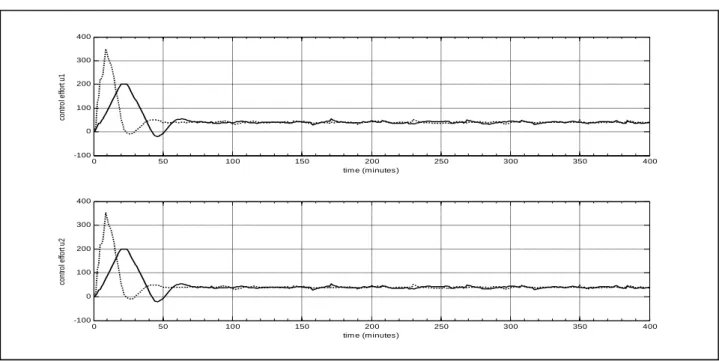
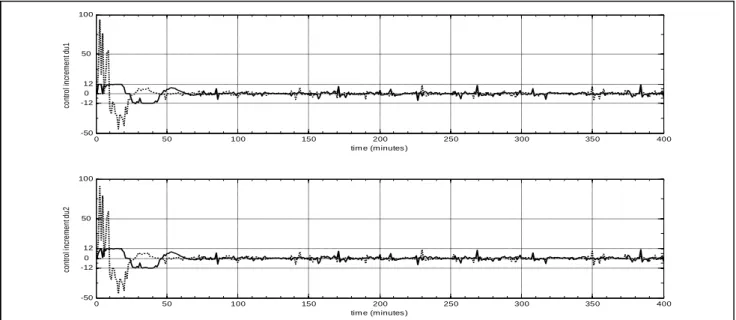
Tand the parameter system’s:K1,2 1,2 1, the figures 1.1 to 1.3 shows the results given by the MGPC method using the standard PSO algorithm (dashed curves), and the MGPC method using the improved PSO algorithm (line curves). The table1 summaries the results obtained by the two algorithms.Figure 1.1: Set-point tracking results with standard and improved PSO algorithms forw
1 0
TandK1,2 1,21.Figure 1.2: Control effort results with standard and improved PSO algorithms forw
1 0
Tand K1,2 1,21.0 30 50 100 150 200 250 300 350 400
0 0.2 0.4 0.6 0.9 1 1.1
tim e (m inutes )
o
u
tp
u
t y
1
0 50 100 150 200 250 300 350 400
-0.2 0 0.2 0.5
tim e (m inutes )
o
u
tp
u
t y
2
0 50 100 150 200 250 300 350 400
-100 0 100 200 300 400
tim e (m inutes )
co
n
tr
o
l e
ffo
rt
u
1
0 50 100 150 200 250 300 350 400
-100 0 100 200 300 400
tim e (m inutes )
co
n
tr
o
l e
ffo
rt
u
Figure 1.3: Control-increment results with standard and improved PSO algorithms forw
1 0
TandK1,2 1,21.Specifications (Sk):
Algorithms: (S1) y1(30)
(S2) (S3)
y1(400)
(S4) (S5)
y2(400)
(S6) stable
/ unstable
(S7) Unsatisfactory/
satisfactory constraints
(S8) Unsatisfactory/
satisfactory constraints
Decision & reasons
max(y1) time max(y2) time
Standard PSO
1.010 1.074 23 1.010 0.343 8 0.006864 stable unsatisfactory
-9.1≤u1≤349.3
-9.9≤u2≤351.4
unsatisfactory -44≤Δu1≤93 -44≤Δu2≤91
Rejected algorithm
(S7),(S8)
Improved PSO
0.990 1.096 40 0.9975 0.4846 13 0.002512 stable Satisfactory
-20.1≤u1≤200
-20.3≤u2≤199
Satisfactory
-12≤Δu1≤12
-12≤Δu2≤12
Accepted algorithm
Table 1: Summary of the results (unsatisfactory performances are in bold) for the nominal model and the set-point
referencew
1 0
T.According to the figure 1.1, we can see that, the tracking dynamic of set-point reference vector found by MGPC method based on a standard PSO algorithm is better than the other algorithm but unfortunately, the time domain specifications: (S7) and (S8) are not satisfied.
In the figure 1.2, the obtained control signals of the MGPC method based on standard PSO algorithm exceed the constraint ranges at t:
5,6,15
minutes such as:3 . 349 ) 9 ( max
1
u and u2max(9)351.4. In addition, the control-increment signals presented in the figure 1.3 also violate the constraint ranges at times:
2 5, 7 11,13 22
:
t minutes.
Consequently, the performance robustness of this method is very poor in comparison with the MGPC method using the improved PSO algorithm which is capable to satisfy all time domain specifications. These results confirm the usefulness and the robustness of the proposed algorithm.
Figures 2.1, 2.2, 2.3 and table 2 give the results of the MGPC method with the following parametric changes in the process:
K11.2,K20.8,1,21
for the set-point reference vectorw
1 0
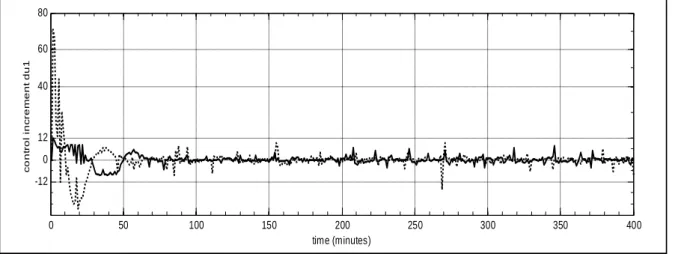
T.According to the figures 2.1 to 2.3, the better results are obtained by the improved PSO algorithm which satisfies all time specifications (S1 to S8). These results can be
explained by the best stability robustness against the process parametric disturbances. Furthermore, the control and the control-increment signals from the standard PSO algorithm show a dramatic oscillation at transient time region and exceed the constraint ranges. In fact, this algorithm cannot fulfill the three followings time domain specifications: (S2) withmax(y1)11.124%, (S7) with
251 max
1
u ,u2max374and(S8)with
76 . 70 4
.
26 1
u , 39.7u2 99.05, which can be explained by a high sensitivity to the parametric process variations. Thus, from these figures and table 2, we confirm the superiority of the proposed algorithm.
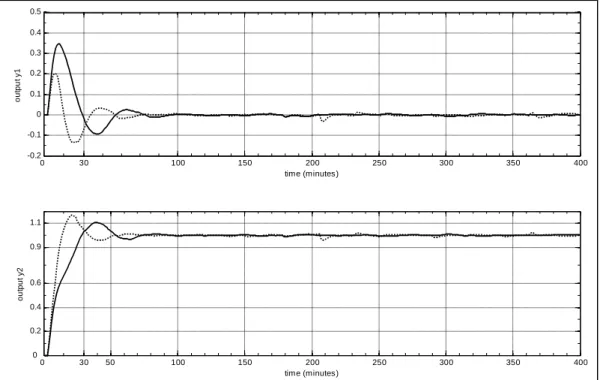
Figures 3.1, 3.2, 3.3 and table 3 give the results of the MGPC method using both algorithms when low gains directions of the process and set-point reference vector
change simultaneously as follows:
K10.8,K2 0.8,1,2 1
,
T
w 0 1 .
0 50 100 150 200 250 300 350 400
-50 -12 0 12 50 100
tim e (m inutes )
co
nt
ro
l i
nc
re
m
en
t d
u1
0 50 100 150 200 250 300 350 400
-50 -12 0 12 50 100
tim e (m inutes )
co
nt
ro
l i
nc
re
m
en
t d
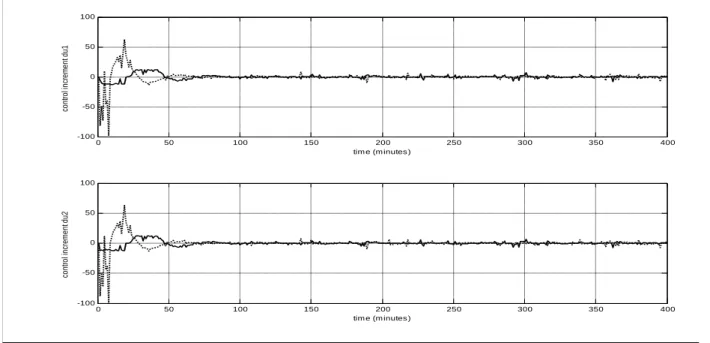
These above figures clearly show the performance superiority of the proposed PSO algorithm over standard PSO. For this case, the time domain specifications: S2 , S7
and S8 are satisfied with the proposed PSO algorithm,
while the same specifications are not satisfactoriness with standard PSO. In addition, the obtained outputs by the standard PSO algorithm converge to the set-point references but unfortunately, two other specifications cannot be satisfied at time t 208 minutes which are:
(S3): y2(208)w2(208) 5%. (S5): y1(208)w1(208) 3%.
6
Conclusion
In this study, we proposed an improvement of the PSO algorithm, it has been introduced and applied to solve the
constrained MGPC problem. In order to find a feasible region, the constraints on the controls and their increments have been previously reduced at each step time, the obtained convergences by improved PSO algorithm are well improved in comparison with the standard PSO algorithm. The efficient of the proposed algorithm is clearly shown and the performances robustness and the stability robustness are guaranteed with little still sensitivity to a set-point references changes and parametric model uncertainties. The results of the proposed algorithm justifies its efficiency and presents quite promising results and can be a subject of an interesting investigations.
Figure 2.1: Set-point tracking results with standard and improved PSO algorithms for w
1 0
Tand
K11.2,K2 0.8,1,21
.Figure 2.2: Control effort results with standard and improved PSO algorithms for w
1 0
Tand
K11.2,K2 0.8,1,21
.0 30 100 150 200 250 300 350 400
0 0.1 0.3 0.5 0.9 1 1,1
tim e (m inutes )
ou
tp
ut
y
1
0 50 100 150 200 250 300 350 400
-0.2 0 0.2 0.4 0.5
tim e (m inutes )
ou
tp
ut
y
2
0 50 100 150 200 250 300 350 400
-200 -100 0 100 200
tim e (m inutes )
co
nt
ro
l e
ffo
rt
u
1
0 50 100 150 200 250 300 350 400
-200 -100 0 100 200 300
tim e (m inutes )
co
n
tro
l e
ffo
rt
u
References
[1] D.W Clarke, C. Mohtadi & P.S Tuffs, Generalized Predictive Control –Part I : The basic algorithm – Part II: extensions and interpretation. Automatica, 23(2), 1987, 137-160.
[2] D.W Clarke & C. Mohtadi, Properties of generalized predictive control, Automatica, 25(6), 1989, 859-875.
[3] P. Codron & P. Boucher, Improvement for multivariable generalized predictive control with multiple reference models. Proc. 12th IASTED International Conf. Modeling. Identification. And Control, Innsbrûck, Austria, Feb.1993.
[4] T.S. Chang & D.E. Seborg, A linear approach programming for multivariable feedback control with inequality constraints, International journal of control 37,1983, 583-597.
[5] M. Zribi, M. Al-Rashed & M. Alrifai. Adaptive decentralized load frequency control of multi-area power systems. Electrical Power and Energy Systems, 27:575583, 2005.
[6] J.P. Coelho, P.B.M. Oliveira & J.B. Cunha. Greenhouse air temperature control using the
particle swarm optimization algorithm. 15th Triennial world congress. Barcelona, Spain. IFAC, 2002.
[7] L.D.S. Coelho & al. Model-free adaptive control optimization using a chaotic particle swarm approach. Chaos, solutions and fractals. Elsevier. 41, 2009, pp2001-2009.
[8] P. Codron & P. Boucher. Multivariable generalized predictive control with multiple reference models: A new choice for the reference model, ECC’93. European Control Conf., June 28- July1993. [9] P. Zelinka, B.R. Ilkiv & A.G. Kuznetsov.
Experimental verification of stabilizing predictive control. Control engineering practice7. 1999, pp 601-610.
[10] I. Maruta, T. Hyoung & T. Sugie: Fixed-Structure
H
Controller: A Meta-Heuristic Approach Using Simple Constrained Particle Swarm Optimization. pp:553-559.Automatica 45(2009).[11] E.F. Camacho. Constrained Generalized Predictive Control, IEEE Transaction on Automatic Control, AC-38 (2), 1993, 327-332.
Figure 2.3: Control-increment results with standard and improved PSO algorithms for w
1 0
Tand
K11.2,K20.8,1,21
.Specifications (Sk):
Algorithms: (S1) y1(30)
(S2) (S3)
y1(400)
(S4) (S5)
y2(400)
(S6) stable
/ unstable
(S7) Satisfactory/ unsatisfactory
constraints
(S8) Satisfactory/ unsatisfactory
constraints
Decision for reasons (Sk)
max(y1) time max(y2) time
Standard PSO
1.061 1.1124 24 0.9953 0.2562 8 0.006142 stable unsatisfactory
-19.2≤u1≤251
-29.4≤u2≤374
unsatisfactory
-26.4≤Δu1≤70.76
-39.7≤Δu2≤99.05
Rejected algorithm (S2),(S7),(S8)
Improved PSO
0.920 1.054 40 0.9953 0.493 12 0.006142 stable Satisfactory
-3.5≤u1≤133.5
-6.4≤u2≤199
Satisfactory
-8.38≤Δu1≤12
-12≤Δu2≤12
Accepted algorithm
Table 2: Summary of the results (unsatisfactory performances are in bold) for the uncertainty model
K11.2,K20.8,1,21
and the set-point reference
T
w 1 0 .
0 50 100 150 200 250 300 350 400
-12 0 12 40 60 80
time (minutes)
c
o
n
tr
o
l
in
c
re
m
e
n
t
d
u
[12] H.N. Al-Duwaish, S.Z. Rizvi & al. PSO based Hammerstein modeling and predictive control of non linear multivariable boiler. Control Engineering practice, pp.1-12, 2010.
[13] S. R. Singiresu: Engineering Optimization: Theory and Practice, Fourth Edition, by John Wiley & Sons, Inc. Hoboken, New Jersey. pp:708-714, & pp:761-768, 2009.
[14] D.J.N Limebeer. The specification and purpose of a controller design case study, IEEE Conf. Decision Control, Brighton, U.K, 1991, 1579-1580.
Figure 3.1: Set-point tracking results with standard and improved PSO algorithms forw
0 1
Tand
K10.8,K2 0.8,1,2 1
.Figure 3.2: Control effort results with standard and improved PSO algorithms forw
0 1
Tand
K10.8,K2 0.8,1,2 1
.0 30 100 150 200 250 300 350 400
-0.2 -0.1 0 0.1 0.2 0.3 0.4 0.5
time (minutes)
o
u
tp
u
t
y
1
0 30 50 100 150 200 250 300 350 400
0 0.2 0.4 0.6 0.9 1.1
time (minutes)
o
u
tp
u
t
y
2
0 50 100 150 200 250 300 350 400
-400 -300 -200 -100 0 100
time (minutes )
c
o
n
tr
o
l
e
ff
o
rt
u
1
0 50 100 150 200 250 300 350 400
-400 -300 -200 -100 0 100
time (minutes )
c
o
n
tr
o
l
e
ff
o
rt
u
Figure 3.3: Control-increment results with standard and improved PSO algorithms forw
0 1
Tand
K10.8,K2 0.8,1,2 1
.Specifications (Sk):
Algorithms:
(S1) y2(30)
(S2) (S3)
y1(400)
(S4) (S5)
y2(400) (S6) stable
/ unstable
(S7) Satisfactory/ unsatisfactory
constraints
(S8) Satisfactory/ unsatisfactory
constraints
Decision for reasons
(Sk)
max(y2) time max(y1) time
Standard PSO
1.046 1.167 21 0.9985 0.202 8 -0.003 stable unsatisfactory
-379.7≤u1≤56 -383≤u2≤55.3
unsatisfactory -97.7≤Δu1≤62.4 -99.2≤Δu2≤62.5
Rejected algorithm (S2),(S7),(S8)
Improved PSO
1.032 1.10 40 1.005 0.345 12 0.0009 stable Satisfactory
-199≤u1≤20.3
-200≤u2≤19.9
Satisfactory
-12≤Δu1≤12
-12≤Δu2≤12
Accepted algorithm
Table 3: Summary of the results (unsatisfactory performances are in bold) for the uncertainty model
K10.8,K2 0.8,1,2 1
and the change set-point referencew
0 1
T.0 50 100 150 200 250 300 350 400
-100 -50 0 50 100
tim e (m inutes )
co
nt
ro
l i
nc
re
m
en
t d
u1
0 50 100 150 200 250 300 350 400
-100 -50 0 50 100
tim e (m inutes )
co
nt
ro
l i
nc
re
m
en
t d