Keystroke Saving in a Language with
Highly Transparent Orthography
Francesco Curatelli
1and Chiara Martinengo
21Department of Biophysical and Electronic Engineering (DIBE), University of Genova, Italy 2Department of Mathematics (DIMA), University of Genova, Italy
This paper proposes a pseudo-syllabic soft keyboard for the Croatian language. The orthogonal keyboard layout makes it possible to improve typing efficiency in terms of keystroke saving, and is based on a highly ordered arrangement of pseudo-syllabic keys. The positions of the consonant and vowel graphemes that constitute a pseudo-syllable are used to access it orthogonally and independently of each other. This allows the user to input a pseudo-syllable with a lower cognitive load than with non-orthogonal 2-D layouts. Moreover, due to the almost perfect transparency of the language, a pseudo-syllable to be input can be accessed fast and with a reduced cognitive load starting from its phonetic sounds. The results of the present study show that the obtainable keystroke savings are comparable with those scored by word prediction tools with one suggestion, i.e., those requiring only a moderate cognitive load by the user.
Keywords: human-computer interaction, soft keyboard, transparent orthography, orthogonal keyboard, keystroke saving
1. Introduction
One of the major research fields in Human-Computer Interaction(HCI)concerns the study and implementation of new text entry meth-ods, which allow users to input morewords per minute(WPM)with hardware or on-screen soft keyboards[13].
Indeed, standard hardware keyboards and touch-screen soft keyboards (where typing is done with a stylus or a finger)allowWPMvalues ex-ceeding 40 and 30, respectively [7]. However, only expert users can achieve these speeds, and anyway typing speeds greatly decrease when mice or pointing devices(such as tracking ball, graphics tablet or eye-tracking) are used [14]. Moreover, non-expert and motor-impaired users
typically obtain significantly lower values; only rarely, Alternative and Augmentative Commu-nication (AAC)users are able to input ( letter-by-letter) more than 10-15 WPM, whereas in many cases, because of the motor impairment, typing speeds can be as low as 1WPMor even less.[20].
Although the use of optimised hardware and soft keyboards increase typing speed[11, 12], only expert users fully exploit this possibility, being able to access keys without the need of visual searching the keys on the keyboard layout. In-stead, all other users typically need a significant time to visually scan the keyboard to access a key. This time is suitably modelled by the Hick-Hyman law: Tv = a+b log2(n), where nis the number of the keys,ais the response time and 1/bis the bandwidth[18].
So, for non-expert and impaired users the best solution is to improve input speed by reducing the number of keys the user has to select to in-put the text. This reduction can be measured as the mean number of key selections needed to input a characterKSPC =#Keys/#Chars[13]. This means that the user is able to input #Chars characters by selecting #Keys < #Charskeys, so obtaining a high keystroke saving rate (or simply: saving rate). KSR=100×(#Chars−
#Keys)/#Chars. Obviously, the standard letter-by-letter input methods are characterised by KSPC=1 andKSR=0.
suggestions are not provided within a window, but displayed as moving texts on the screen area, so that the user selects the desired texts by forc-ing them to pass through a target zone [23]. With prediction tools savings up to 60% can be reached, but only when 5 or more sugges-tions are displayed [21, 19]. Instead, savings up to 37.1% are obtained for English with only one suggestion[19], and similar values (35%)
are obtained with inflected languages, such as Dutch, French, German and Swedish[15]. This limitation cannot be ignored because, in any predictive tool, the higher the number of the proposed suggestions, the higher is the cog-nitive load required by the users, who have to visually scan the suggestion list to find the right word (if any). This is the reason why the highKSRvalues obtainable with prediction tools do not yield comparably high communi-cation rates[20]. In fact, although the adoption of good word prediction systems can be often advantageous, this is not always the case. For example, some studies on the use of query sug-gestions in mobile phones have shown that using suggestions nearly halved the number of pressed key to enter a query, but the corresponding mea-sured time was not reduced at all because of the cognitive load required by the user to read and evaluate the list of suggestions[10].
Another way to increase KSR is to implement on-screen keyboards where the keys do not hold single letters, but syllables or sub-syllables of the target language. This solution can be highly advantageous because a clever choice of the syl-labic entities that are present in the keyboard makes it possible to score high KSR values, which is the main target of any new text en-try paradigm. On the other hand, as just shown for word prediction, keystroke saving is fully exploited if only a moderate cognitive load is re-quired by the user for searching and assembling the sequence of keys in the keyboard layout. This has been the rationale for the introduc-tion of a novelorthogonal keyboardparadigm, which is based on the definition of pseudo-syllables(p-syllables)as basic text entry units[2]. A target p-syllable is accessed by composing, orthogonally and independently of each other, the positions of its consonant and vowel graphe-mes(column and row, respectively), without the need to visually scan the whole keyboard or to memorise it. According to the Hick-Hyman
law, this implies a reduction of the number of the items that have to be inspected or memo-rised and, consequently, of the required cogni-tive load and search time.
This obviously holds for a whichever alphabet-ical language, but especially for languages with transparent orthographies, i.e., with highly reg-ular correspondence between orthography and phonetics. In fact, the presence of an almost one-to-one correspondence between phonemes and graphemes, which is typical of transpar-ent languages, exempts the user from the addi-tional cognitive load that is required to perform the complex sound to text translation needed in non-transparent languages such as English. Moreover, the presence of a direct and intu-itive phoneme to grapheme association makes it possible for an efficient use of the orthogonal keyboard, not only by normal users(expert and non-expert), but also, and mainly, by motor-impaired users and by users who are affected by difficulty in reading and writing(i.e., dyslexia and dysgraphia).
The orthogonal keyboard paradigm has been suitably applied to Italian and Spanish[2], which are two languages with transparent orthogra-phies, and, more recently, also to a highly non-transparent language such as English[3]. In this last case, similar keystroke savings have been obtained with a clever choice of the p-syllable set, which makes it possible to directly input many monosyllabic English words[3].
To this aim, the characteristics of Croatian have been analysed and an orthogonal keyboard lay-out has been designed according to the fre-quency statistics of the language. The suitabil-ity of the proposed layout has been then tested with results that are comparable with those ob-tained with Italian and Spanish keyboards. In Section 2, the main characteristics of the or-thogonal keyboard paradigm are outlined, while Section 3 outlines the statistical analysis of the language and the design of the Croatian orthog-onal keyboard layout. Section 4 outlines the experimental results and conclusions.
2. The Orthogonal Pseudo-syllabic Model
The orthogonal text entry paradigm is based on the definition of a keyboard layout which makes it possible to inputdominantandsubordinate p-syllables. The dominant p-syllables are directly selected without using any shift key, while the subordinate ones need the selection of specific shift keys. Both types are accessible without the need to perform a complete visual explo-ration of the orthogonal keyboard, because the text units are assigned to the keyboard keys so that their horizontal and vertical positions are easily inferrable from the graphemic structure of the related p-syllabic entity. In fact, each column of the keyboard is assigned to a specific consonant grapheme C, which can be either aˆ single consonant or a sequence of consonants denoting (in a transparent language) a single phoneme. Instead, each row is assigned to a specificvowel graphemeV, which can be eitherˆ a single vowel or semi-vowel or a sequence of them. In this way, the p-syllable that contains both the vowel grapheme of row x and the con-sonant grapheme of column y can be accessed by the direct composition of the consonant and vowel positions, which are independent of each other (orthogonal). Anyway, only one action is needed to input dominant or subordinate p-syllables (provided that the related shift key is concurrently selected). All other syllables and pseudo-syllables can be selected with a se-quence of dominant or subordinate p-syllables, so requiring two or(sometimes)more actions. Given a language L, we start by defining the
complete consonant and vowel sets CSL and
VWL, which contain the most used consonant and vowel graphemes Ci and Vi, respectively
(nCS
L = |CSL| andnVWL = |VWL|are the set
cardinalities). The two sets also contain the empty grapheme , so that the x-y grapheme composition can build purely vowel and conso-nant p-syllables too. So, thecomplete p-syllable set PSL (with cardinality nPSL = |PSL|)
con-tains any possible string CiVi and ViCi. The second ones are subordinate p-syllables and are selectable by means of theforward/reverse shift
(FR-Sh).
As already stated, this scheme allows users to access the target p-syllable without the need of visually scanning the whole keyboard or me-morizing it. This implies a reduction of the required cognitive load and search time, due to the smaller number of the items to be consid-ered. Therefore, also non-expert users can ob-tain better access times than with non-ordered p-syllable layouts. It is worth noting that this approach is completely different from the typi-cal approach found in literature, which is based on the selection of several single-letter keys to build syllabic entities[9].
In many cases, the direct use of the complete p-syllable set would yield a too large keyboard layout; when this is the case, the size of the or-thogonal array must be reduced by applying one or more optimisation steps to generate the final orthogonal keyboard layout. First, it can be ver-ified if it is convenient to eliminate columns or rows whose p-syllables have low marginal fre-quencies in the target language(column deletion (CD) and row deletion (RD)). Second, it can be verified if it is convenient to fold columns containing p-syllables with low marginal fre-quencies, by assigning them to other columns
all the other columns of the same cluster ( Col-umn merging (CM)).
When CD and RD optimisations are applied, there is a reduction in the consonant and vowel graphemes, thus two optimised sets for conso-nant and vowel graphemes,CSoL andVWoL, and, consequently, an optimised p-syllable set PSoL are obtained.
Is it worth noting that in defining the orthogo-nal keyboard layout only the optimisation steps should be applied which are strictly needed to obtain a suitable keyboard size for the target lan-guage. As it will be shown in the next Section, Croatian orthography does not require an ex-tensive application of the optimisation steps. In fact, the definition of the orthogonal keyboard will require only the CF optimisation.
3. The Croatian Orthogonal Keyboard
As already stated, we have chosen Croatian be-cause of its almost perfect transparent orthog-raphy. In fact, the native Croatian alphabet is composed of 30 graphemes, with a one-to-one correspondence with the phonemes of the lan-guage: a, b, c,c, ´c, d, dˇ z, d, e, f, g, h, i, j, k, l, lj,ˇ
m, n, nj, o, p, r, s,ˇs, t, u, v, z,z; i.e.:ˇ
a) 22 one-letter graphemes of the English al-phabet(in fact,q, w, xand ydo not belong to the Croatian alphabet);
b) 5 specific one-letter consonants with diacrit-ics(c, ´c, d,ˇ ˇsandˇz);
c) 3 specific two-letter consonants (digraphs)
which denote specific sounds and are treated in all effects as separate letters(dz, lj, andˇ
nj) (they correspond exactly to one-letter graphemes of the Serbian Cyrillic alphabet). This alphabet is also called Gaj’s Latin alpha-bet, after the Croatian linguist Ljudevit Gaj who in 1830 set the Croatian alphabet starting from the Latin alphabet[5]; the only difference from the actual script consisted in the use of a further digraph dj in place of the actual letter d. It is worth noting that the Croatian alphabet is also one of the two scripts used for the Bosnian and Serbian languages; moreover, a reduced version is used for the Slovenian language.
Concerning the missing Latin letters(q, w, xand y), although they are used only to write foreign
words, their increasing presence in modern texts
(such as newspaper articles, textbooks, and so on)has suggested not to discard them from the orthogonal layout. Instead, a notable charac-teristic of the Croatian language is that doubled consonants are very rarely used; for this reason, they have not been included in the orthogonal layout. Finally, the double grapheme qu has been used in place ofqbecause in almost all the words (both Croatian and foreign) the simple consonant q is followed by u. Therefore, the starting (complete) consonant and vowel sets have been defined as follows:
CShr ={ , b, c,c, ´c, d, dˇ ˇz, d, f, g, h, j, k, l, lj, m, n, nj, p, qu, r, s,ˇs, t, v, w, x, y, z,ˇz}
VWhr ={, a, e, i, o, u}
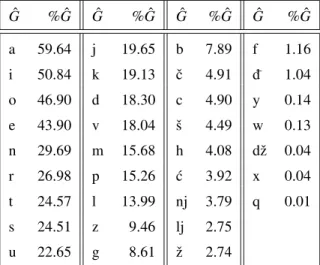
Because |CShr| = 30 and|VWhr| = 6, the re-sulting keyboard would be too wide for an effi-cient use. The reduction of the keyboard width has been done by identifying a suitable set of less frequently used p-syllables and then apply-ing a foldapply-ing optimisation step which sets them as subordinate p-syllables of the orthogonal lay-out. To this aim, we have generated a detailed statistic of the p-syllable frequencies starting from the data present in theCroatian Language Repository - newspapers sub-corpus[8], which gives the relative frequencies of 710,177 differ-ent words in texts taken from Croatian news-papers [1]. In particular, we have taken into account the first 120,000 most frequent words, whose relative frequencies constitute more than 97% of the total word occurrences.
ˆ
G % ˆG Gˆ % ˆG Gˆ % ˆG Gˆ % ˆG
a 59.64 j 19.65 b 7.89 f 1.16
i 50.84 k 19.13 cˇ 4.91 d 1.04
o 46.90 d 18.30 c 4.90 y 0.14
e 43.90 v 18.04 ˇs 4.49 w 0.13
n 29.69 m 15.68 h 4.08 dzˇ 0.04
r 26.98 p 15.26 ´c 3.92 x 0.04
t 24.57 l 13.99 nj 3.79 q 0.01
s 24.51 z 9.46 lj 2.75
u 22.65 g 8.61 zˇ 2.74
Table 1.Single grapheme % statistics.
The CF optimisation defines the final orthogo-nal layouts for the dominant and the subordi-nate p-syllables that require the selection shift CF-Sh beon. As the dominant p-syllables are selectable directly in the layout, they have been chosen according to the frequencies outlined in Table 1 and Table 2, which show very low frequencies for p-syllables involving the con-sonants y, w, dz, xˇ and q. In fact, the relative
frequencies in words of these consonants are strictly less than 0.15%, whereas all other sonants have values greater than 1%. This con-sideration has suggested to select as consonants for the dominant p-syllables the 24 consonants with frequencies exceeding 1%, i.e., all but the 5 consonants above. In this way, the size of the orthogonal keyboard is(nx ×ny) = (25×6), and the 25 columns of the orthogonal keyboard are assigned to the dominant consonants, lex-icographically ordered one after the other(the empty grapheme is put at the beginning, so corresponding to the column of the vowels): , b, c,c, ´c, d, d, f, g, h, j, k, l, lj, m, n, nj, p, r, s,ˇ ˇs, t, v, z,z.ˇ
All other p-syllables, containing the consonants y, w, dz, xˇ and qu, are set as subordinate p-syllables(whose selection requires thatCF-Sh = on)and are allocated to 5 columns.
To render the cognitive task of the user as easy as possible, these 5 consonants have been lexi-cographically ordered one after the other; more-overdzˇandquhave been allocated to columns whose dominant consonants are lexicographi-cally close to their original position in the un-folded configuration:
ˆ
C % ˆCa % ˆCe % ˆCi % ˆCo % ˆCu Cˆ % ˆCa % ˆCe % ˆCi % ˆCo % ˆCu
b 1.13 0.63 2.31 1.21 0.45 n 7.95 3.92 6.65 4.96 1.18
c 0.88 0.73 2.33 0.08 0.21 nj 0.99 1.62 0.58 0.08 0.40
ˇ
c 0.75 1.07 1.10 0.04 0.24 p 1.30 0.51 0.78 5.05 0.67
´c 0.57 1.34 0.71 0.03 0.18 q 0.00 0.00 0.00 0.00 0.00
d 4.28 1.15 2.62 2.34 0.89 r 7.24 4.82 3.97 3.09 1.39
dzˇ 0.00 0.01 0.01 0.00 0.00 s 1.82 2.40 1.06 0.43 2.20
d 0.25 0.37 0.05 0.00 0.33 sˇ 0.43 0.70 0.44 0.03 0.06
f 0.10 0.18 0.35 0.20 0.04 t 4.40 2.48 5.32 3.34 1.31
g 1.29 0.35 0.38 2.15 0.59 v 4.33 2.37 3.26 3.04 0.42
h 0.23 0.13 0.18 0.35 0.07 w 0.03 0.01 0.01 0.00 0.00
j 2.36 11.58 1.38 0.46 1.5 x 0.00 0.01 0.00 0.00 0.00
k 4.06 1.31 1.63 6.37 1.53 y 0.01 0.00 0.00 0.02 0.00
l 3.73 1.29 4.38 2.21 0.84 z 3.73 0.52 0.84 0.32 0.27
lj 0.64 0.90 0.34 0.04 0.45 zˇ 0.55 0.78 0.60 0.00 0.20
m 3.68 1.81 1.73 2.12 0.44
dˇz=> col 6(d),qu=> col 18(p), w=> col 23(v),x=> col 24(z), y=> col 25(ˇz).
This CF mapping yields a subordinate layout in which only 5 columns are assigned; this means that 19 columns are potentially available for the allocation of 19 ×6 = 114 additional strings
(added words). As our aim was to explore the potentiality of the orthogonal paradigm, this ad-ditional improvement has not been addressed in the present work. However, further gains in terms of keystroke saving could be easily ob-tained by allocating, as added words, a suitable set of syllables and words chosen among the most frequent words of the language, by using
the data provided, for example, by the Croatian Language Repository[1].
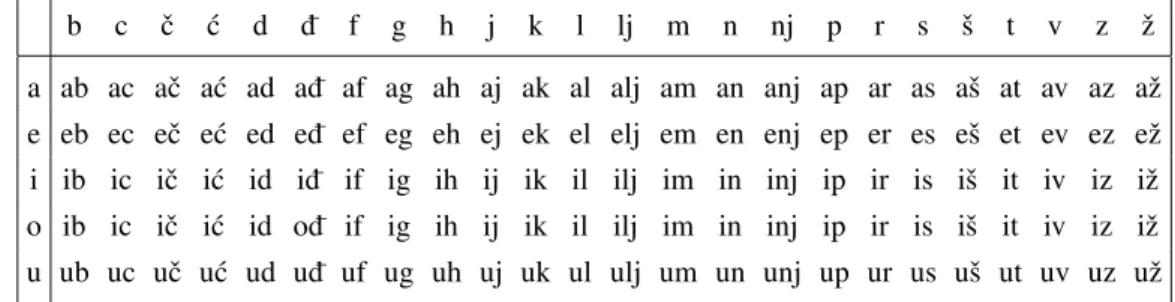
The final keyboard configurations are outlined in Tables 3 to 5. Table 3 and 4 outline the lay-outs of the Croatian orthogonal keyboard for the dominant p-syllables and the reverse sub-ordinate p-syllables with FR-Sh = on, while Table 5 outlines the layout for the subordinate p-syllables withCF-Sh = on.
It is worth noting that the use of dominant and subordinate p-syllables withFR-Sh = onmakes it possible to insert the graphemic sequences VCCV andCVVCwith only two actions. This is very important because in the Croatian lan-guage, as well as in almost all Slavic languages, the first graphemic structure is very frequent.
b c cˇ ´c d d f g h j k l lj m n nj p r s ˇs t v z zˇ
a ba ca ca ´ca da da fa ga ha ja ka la lja ma na nja pa ra saˇ ˇsa ta va za ˇza e be ce ce ´ce de de fe ge he je ke le lje me ne nje pe re seˇ ˇse te ve ze ˇze i bi ci ci ´ci di di fi gi hi ji ki li lji mi ni nji pi ri siˇ ˇsi ti vi zi ziˇ o bo co ˇco ´co do do fo go ho jo ko lo ljo mo no njo po ro so so to vo zoˇ zoˇ u bu cu ˇcu ´cu du du fu gu hu ju ku lu lju mu nu nju pu ru su su tu vu zuˇ zuˇ
Table 3.Croatian orthogonal keyboard for dominant p-syllables.
b c cˇ ´c d d f g h j k l lj m n nj p r s ˇs t v z zˇ
a ab ac aˇc a´c ad ad af ag ah aj ak al alj am an anj ap ar as aˇs at av az aˇz e eb ec eˇc e´c ed ed ef eg eh ej ek el elj em en enj ep er es eˇs et ev ez eˇz i ib ic iˇc i´c id id if ig ih ij ik il ilj im in inj ip ir is iˇs it iv iz iˇz o ib ic iˇc i´c id od if ig ih ij ik il ilj im in inj ip ir is iˇs it iv iz iˇz u ub uc uˇc u´c ud ud uf ug uh uj uk ul ulj um un unj up ur us uˇs ut uv uz uˇz
Table 4.Croatian orthogonal keyboard for subordinate p-syllables(FR-Sh = on).
b c cˇ ´c dˇz d f g h j k l lj m n nj qu r s s t w x yˇ
a ba ca ˇca ´ca dˇza da fa ga ha ja ka la lja ma na nja qua ra sa sa ta wa xa yaˇ e be ce ˇce ´ce dˇze de fe ge he je ke le lje me ne nje que re se se te we xe yeˇ i bi ci ci ´ci dˇˇ zi di fi gi hi ji ki li lji mi ni nji qui ri si si ti wi xi yiˇ o bo co co ´co dˇˇ zo do fo go ho jo ko lo ljo mo no njo quo ro so ˇso to wo xo yo u bu cu cu ´cu dˇˇ zu du fu gu hu ju ku lu lju mu nu nju quu ru su ˇsu tu wu xu yu
4. Experimental Results and Conclusions
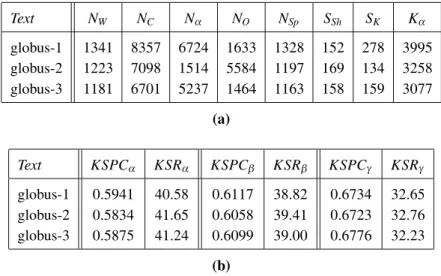
The Croatian orthogonal keyboard has been evaluated by using the following parameters. NW,Nα,NO,NSpare the numbers of words, al-phanumeric, non-alal-phanumeric, and space char-acters in the text; NC = Nα +NO is the total number of characters in the text;Kα is the num-ber of alphanumeric keys typed on the keyboard; SShandSKare the numbers of capital letters and FR-Shshifts.
The typing gains are measured by 3 types of KPSC(keystrokes per character)andKSR(
key-stroke saving rate) parameters. KSPCα =
Kα/Nα is the mean number of the alphanumeric keys to input an alphanumeric character, and KSRα =100×(1−KSPCα)is the percentage of the alphanumeric keys saved by using the orthogonal keyboard.
KSPCβ = (Kα +NO−NSp)/(NC−NSp)is the mean number of the non-space keys to input a non-space character, and KSRβ = 100×(1− KSPCβ)is the percentage of the non-space keys saved by using the orthogonal keyboard. Finally, KSPCγ = (Kα +NO)/NC is the mean number of keys to input a whichever character, andKSRγ =100×(1−KSPCγ)is the percent-age of the keys(of any type)saved by using the orthogonal keyboard.
To test the keyboard layout, some Croatian texts have been automatically analysed to find how much improvement can be obtained with respect to the classical, letter-by-letter approach. The
texts were downloaded from the electronic ver-sions of the popular Croatian magazineGlobus
[6].
The obtained results(outlined in Table 6), show significant keystroke savings (greater than 40.5%) for alphanumeric characters, and only slightly lower values(greater than 38.8%) for non-spaces characters. This means that the ad-ditional use of clever algorithms for the auto-matic addition of spaces could easily improve the already good(greater than 32.2%)keystroke savings obtained for all characters. These re-sults are impressive, especially if they are com-pared with the only slightly better keystroke savings obtained with Italian and Spanish [2]. In fact, these two Neolatin languages are struc-turally characterised by very high frequencies of CV sequences, whereas in Croatian(and in almost all Slavic languages)triple and quadriple consonants sequences occur very frequently. Probably, these high gains can be ascribed to the fact that in Croatian most of the more fre-quent words are monosyllabic words with CV structure. In fact, according to the used Croa-tian Corpus, the ten most frequent words are, in order: je, u, i, se, da, na, za, su, a, od[1]. The obtained keystroke savings are compara-ble with those obtained, for English and highly inflected languages with one-suggestion word prediction tools[19, 15], which, as stated in Sec-tion 1, require only a moderate cognitive load. This is also the case with the orthogonal key-board, which is a text entry method that requires a lower cognitive load than non-orthogonal 2-D
Text NW NC Nα NO NSp SSh SK Kα
globus-1 1341 8357 6724 1633 1328 152 278 3995
globus-2 1223 7098 1514 5584 1197 169 134 3258
globus-3 1181 6701 5237 1464 1163 158 159 3077
(a)
Text KSPCα KSRα KSPCβ KSRβ KSPCγ KSRγ
globus-1 0.5941 40.58 0.6117 38.82 0.6734 32.65
globus-2 0.5834 41.65 0.6058 39.41 0.6723 32.76
globus-3 0.5875 41.24 0.6099 39.00 0.6776 32.23
(b)
layouts. As seen, this is due to the fact that the visual search task and, consequently, the cog-nitive load, can be modelled by using the well established Hick-Hyman law.
Besides the reduction of the cognitive load due to the characteristics of the orthogonal scheme, the question may be raised if the same can be said for an additional reduction due to the transparency level of the target language. Cer-tainly, in a perfect transparent language such as Croatian, as well as almost always in lan-guages such as Italian and Spanish, there is a one-to-one correspondence between phonemes and graphemes. For this reason, the translation task is very simple, and the related cognitive load is low, whereas in English the same task is much more complex, thus requiring a higher cognitive load. But, one may wonder if this re-duction could be accurately measured as a func-tion of language transparency, i.e., by means of some direct or indirect objective measure [17]. At first sight, a possible indirect and objective measure could be the typing speed, since there is an intuitive correlation between WPM and cognitive load. However, there are also other important factors, such as differences in orthog-raphy, grammatical rules and inflection of the languages involved, which do not allow us to tell if this correlation can be accurately mod-elled or not. Thus, the answer to this interesting issue would require specific and detailed expe-riments, which were not among the aims of the present work.
In conclusion, the present study has shown that the orthogonal paradigm is well suited to obtain high keystroke savings for a highly transparent Slavic language such as Croatian. This is a promising result, also because we can argue that this result can be automatically extended to Serbian, due to its almost perfect alpha-betic correspondence and language similarity with Croatian. Thinking along the same lines, it would be useful to explore the application of the orthogonal paradigm to Cyrillic alpha-bets, because of their use in Serbian, Bulgarian, Macedonian, Russian and many other Eastern languages. Another interesting target language is Polish, which is not only a highly transparent language, but is also the most widespread Slavic language written with the Latin alphabet.
References
[1] The Croatian language repository. Inst. of Croat-ian Language and Linguistics, 2006(downloaded: August 2009).http://riznica.ihjj.hr
[2] F. CURATELLI, C. MARTINENGO, A powerful pseudo-syllabic text entry paradigm.Int. Journal of Human-Computer Studies, 64(5), 475–488, 2006.
[3] F. CURATELLI, C. MARTINENGO, English
orthogo-nal keyboard for efficient text entry. Submitted for publication, 2010.
[4] J. J. DARRAGH, I. H. WITTEN, Adaptive predictive text generation and the reactive keyboard. Interact-ing with Computers, 3(1), 27–50, 1991.
[5] L. GAJ, Kratka osnova horvatsko-slavenskog
pravopisanja(Brief basics of the Croatian-Slavonic orthography), Buda, 1830.
[6] Globus magazine, electronic edition, 2009( down-loaded: October 2009). http://www.globus. com.hr/
[7] K. GO, Y. ENDO, A touchscreen software keyboard
for finger typing. InAdvances in Human-Computer Interaction(A. Lazinica Ed.), 2008, pp. 287–296. [8] I. P. JAZBEC, T. STOJANOV, The Croatian Language
Corpus. Presented at theProceedings of the CECL 2006 Conf., 2006, Zadar, Croatia.
[9] A. JOSHI ET AL., Keylekh: a keyboard for text entry
in indic scripts. Presented at theProceedings of the CHI 04 Conf., 2004, Vienna, Austria, pp. 928–942. [10] M. KAMVAR, S. BALUJA, Query suggestions for
mobile search: understanding usage patterns. Pre-sented at theProceedings of the CHI 08 Conf., 2008, Florence, Italy, pp. 1013–1016.
[11] G. W. LESHER, B. J. MOULTON, D. J. HIGGIN -BOTHAM, Optimal character arrangements for
am-biguous keyboards.IEEE Transactions on Rehabil-itation Engineering, 6(4), 415–423, 1998.
[12] I. S. MACKENZIE, S. X. ZHANG, The design and
evaluation of a high-performance soft keyboard. Presented at theProceedings of the CHI 99 Conf., 1999, Pittsburgh, USA, pp. 25–31.
[13] I. S. MACKENZIE, R. W. SOUKOREFF, Text entry for
mobile computing: models and methods, theory and practice. Human-Computer Interaction, 17 (2–3), 147–198, 2002.
[14] P. MAJARANTA, K. R ¨AIHA¨, Text entry by gaze: uti-lizing eye-tracking. InText entry systems: Mobility, accessibility, universality(I.S. MacKenzie and K. Tanaka-Ishii Eds.), 2007, pp. 175–187.
[15] J. MATIASEK, M. BARONI, H. TROSTFASTY, A
multi-lingual approach to text prediction. Presented at the
Proceedings of the ICCHP 02 Conf., 2002, Linz, Austria, pp. 243–250.
[17] P. SCHMUTZ, S. HEINZ, Y. METRAILLER, K. OP -WIS, Cognitive load in ecommerce applications-measurement and effects on user satisfaction. Ad-vances in Human-Computer Interaction,ID 121494, 9 pages, 2009.
[18] R. W. SOUKOREFF, Text entry for mobile systems:
models, measures, and analyses for text entry re-search. M.Sc. Thesis York University,Canada, 2002. [19] K. TRNKA, K. F. MCCOY, Evaluating word
predic-tion: framing keystroke savings. Presented at the
Proceedings of the ACL 08 Conf., 2008, Columbus, USA, pp. 261–264,
[20] K. TRNKA, J. MCCAW, D. YARRINGTON, K. F. MC -COY, User interaction with word prediction: the
effects of prediction quality.ACM Trans. on Acces-sible Computing, 1(3), 17:1–34, 2009.
[21] P. A. V ¨AYRYNEN, K. NOPONENA, T. SEPPANEN¨ , Analysing performance in a word prediction system with multiple prediction methods.Computer Speech & Language, 21(3), 479–491, 2007.
[22] T. WANDMACHER, J. Y. ANTOINE, F. POIRIER
SIBYLLE, A system for alternative communication
adapting to the context and its user. Presented at the
Proceedings of the ASSETS 07 Conf., 2007, Tempe, USA, pp. 203–210
[23] D. J. WARD, A. F. BLACKWELL, D. J. MACKAY
DASHER, A gesture-driven data entry interface for
mobile computing. Human-Computer Interaction, 17(2–3), 199–228, 2002.
Received:October, 2009
Revised:February, 2010
Accepted:March, 2010
Contact addresses:
Francesco Curatelli DIBE–University of Genova Via Opera Pia 11/A 16145 Genova, Italy e-mail:[email protected]
Chiara Martinengo DIMA–University of Genova Via Dodecaneso 35 16146 Genova, Italy
FRANCESCOCURATELLI is a professor of electronics at the Univer-sity of Genova – Department of Biophysical and Electronic Engineer-ing(DIBE), Genova, Italy. His research activities include the study and development of CAD tools, techniques and algorithms for hard-ware/software real-time systems, educational methodologies for teach-ing mathematics to impaired children, human-computer interaction and assistive technology.