Inference and Context: Individual Differences in Interpretation and Integration
By Mary Michael
A dissertation submitted to the faculty of the University of North Carolina at Chapel Hill in partial fulfillment of the requirements for the degree of Doctor of Philosophy in the Department of Psychology.
Chapel Hill 2007
Approved by: Advisor: Professor Peter C. Gordon Reader: Professor Jennifer Arnold
ABSTRACT MARY ANN MICHAEL
Inference and Context: Individual Differences in Integration and Interpretation
Under the direction of Peter C. Gordon
Individual differences in interpretation of ambiguous fronted adjunct sentences were correlated with measures of cognitive ability and reading experience in two experiments. The initial ambiguity was either consistent with a plausible inference or not. Correct interpretation of the inconsistent sentences was found to be
correlated with a number of different cognitive components. Responses following sentences for which the inference was consistent showed few correlations with any of the cognitive components measured. In the second experiment, prior context was either supportive of the inference or neutral; passages that required bridging
inferences were also included for comparison. Again there were few correlations with response. However, there were correlations of reading times with RTs from the lateralized lexical decision task and with a measure of reading experience.
ACKNOWLEDGEMENTS
Many people deserve to be acknowledged for the help that they have extended to make completion of this dissertation possible.
TABLE OF CONTENTS
Page
LIST OF TABLES ………... xiii
LIST OF FIGURES ……….……... xiv
CHAPTER 1. INTRODUCTION ……….. 1
BACKGROUND ……… 3
A. Studies of integration ………... 4
1. Context ………... 5
2. Inference ……….………. 6
3. Priming ……… 8
4. Integration ………... 10
B. Individual differences ………. 12
1. Lexical Access ………. 12
2. Vocabulary ……….. 15
3. Working Memory ………... 16
C. Methodology ………. 18
2. Individual difference measures ……… 22
i. Lexical access ………. 22
ii. Vocabulary and text exposure ……… 27
iii. Working memory ………. 29
iv. Reasoning ……….. 35
v. Speed of Processing ………. 36
2. EXPERIMENTS ………... 39
Experiment 1 ……… 46
Method ……… 48
Participants ……….. 48
Materials and Design ………. 49
Materials ……… 49
Procedure ……….. 49
Tests of Cognitive Processing ………. 50
1. Divided visual field lexical decision task ………... 50
2. Synonym detection ……… 51
3. Aospan ……… 52
4. Author recognition test ………. 52
5. Syllogistic reasoning ………. 52
6. Pattern comparison ……… 53
Edinburgh Handedness Inventory ………... 54
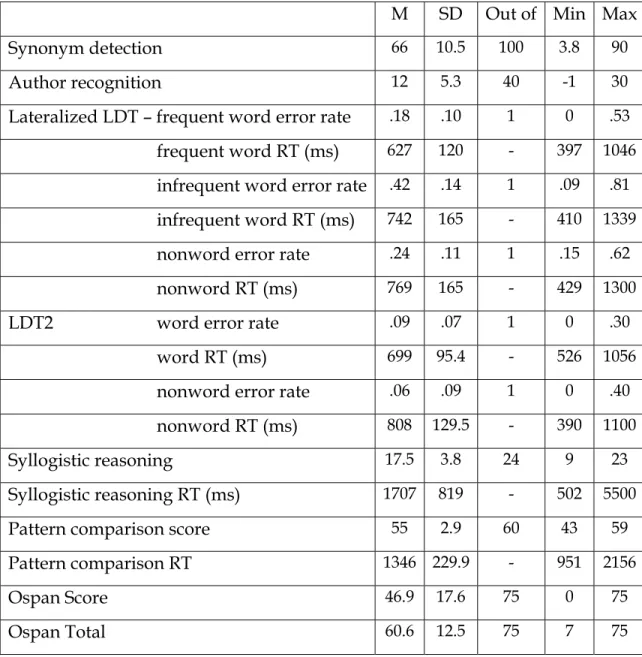
1. Descriptive Statistics ……… 55
Sentence reading and Comprehension ……… 55
Measures of component processes ……….. 56
Lexical decision ……… 57
Lateralization ……… 58
Reasoning and Believability ………... 59
2. Correlations ……….. 59
Lexical decision ……… 61
Differences in lateralization ……… 64
Vocabulary and Reading experience ……… 64
Reasoning and Believability ……… 65
Aospan ……… 65
Speed of processing ……….. 65
3. Modeling ……… 66
Principle components ……….. 66
Factor analysis and structural equation models ………….. 66
Cluster Analysis ……… 70
Discussion ……….. 71
Experiment 2 ……… 75
Method ……… 76
Participants ……….. 76
Materials ………. 77
Procedure ……… 78
Results ……… 79
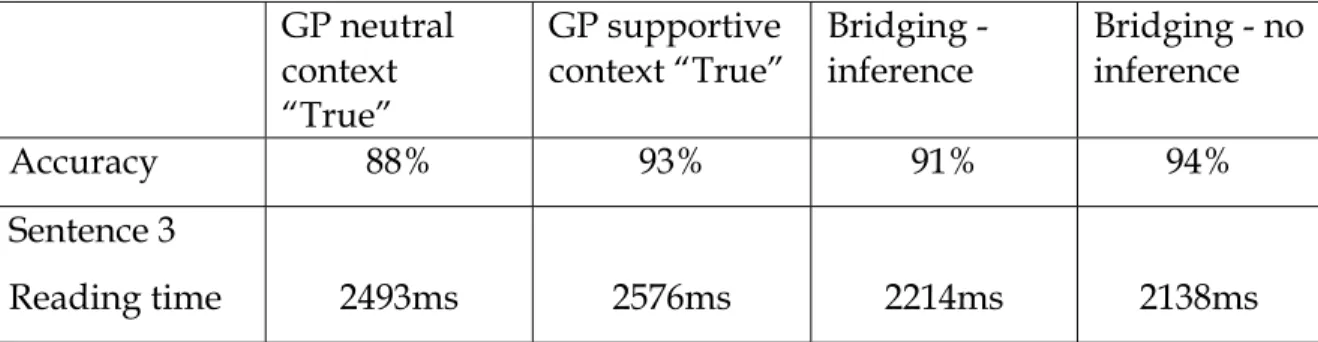
1. Descriptive Statistics ……… 79
Sentence reading and Comprehension ……… 79
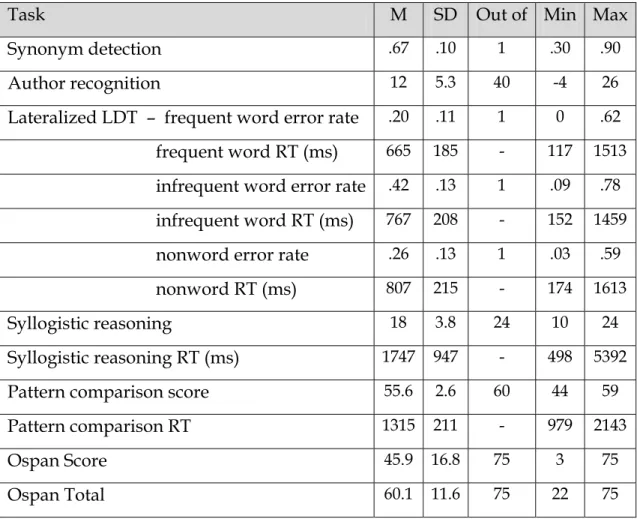
Measures of component processes ……….. 80
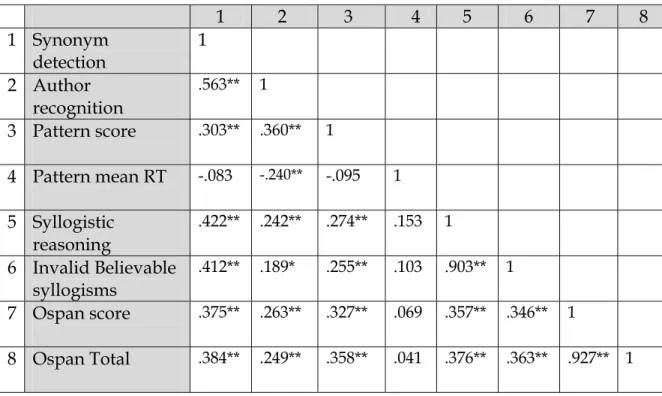
2. Correlations ………... 82
3. Modeling ……… 86 Cluster Analysis ……….. 87
Discussion ……….. 88
3. GENERAL DISCUSSION ……….. 91
The role of higher level cognitive processes ………. 93
The role of lower level cognitive processes ……….. 94
Speed of processing ………. 96
Single or Dual resource for language processing ……… 97
The role of context and integration ……… 98
Effectiveness of Measures ………... 98
Conclusion ………. 99
Figures ……… 102
Appendices ……… 113
LIST OF TABLES
TABLE Page
1. Responses and reading times to garden-path sentences ………. 41
2. Responses and reading times to sentences with prior context ……… 42
3. Responses and reading times to sentences in Experiment 1 ………... 56
4. Descriptive statistics on component measures in Experiment 1 ……... 57
5. Differences in accuracy and response time by side of presentation ……... 58
6. Correlations with response variables for Experiment 1 ………. 60
7. Correlations with reading times for Experiment 1 ………. 62
8. Response accuracy and reading times in Experiment 2 ………. 79
9. Descriptive statistics for component measures in Experiment 2 ………… 80
10. Effects of difference in error rates and RTs in the lateral LDT …………. 81
11. Correlations with reading times for Experiment 2 ………. 83
12. Correlations between tasks in Experiment 2 ……….. 85
13. Response accuracy for different passage types by cluster ………. 87
LIST OF FIGURES
FIGURE PAGE
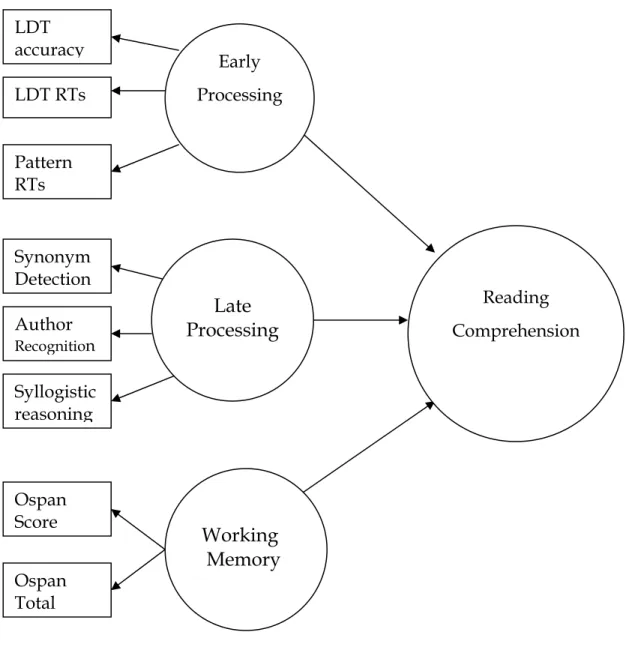
1. Proposed model showing how measures of individual difference
represent the processes involved in reading comprehension ………. 101
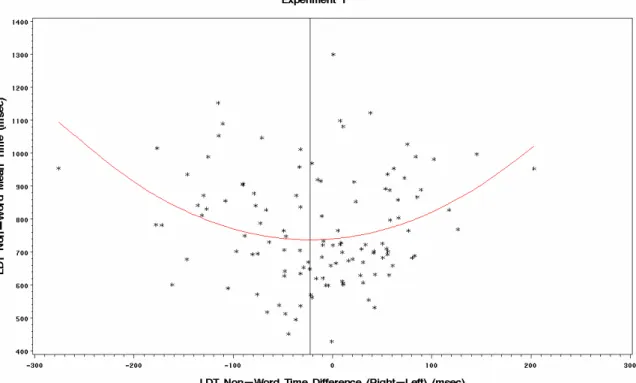
2. Plot of difference in reaction time and reaction time to nonwords in the lateralized lexical decision task for Experiment 1 showing quadratic
model ……….. 102
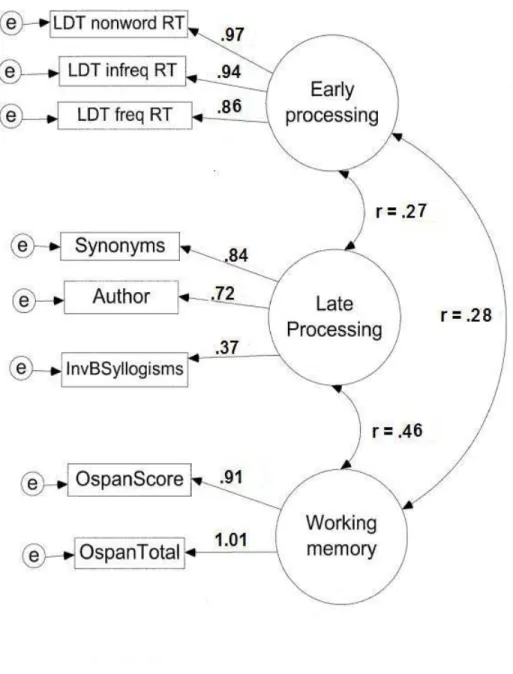
3. Measurement model for Experiment 1 showing factor loadings and
correlations between latent variables ………. 103
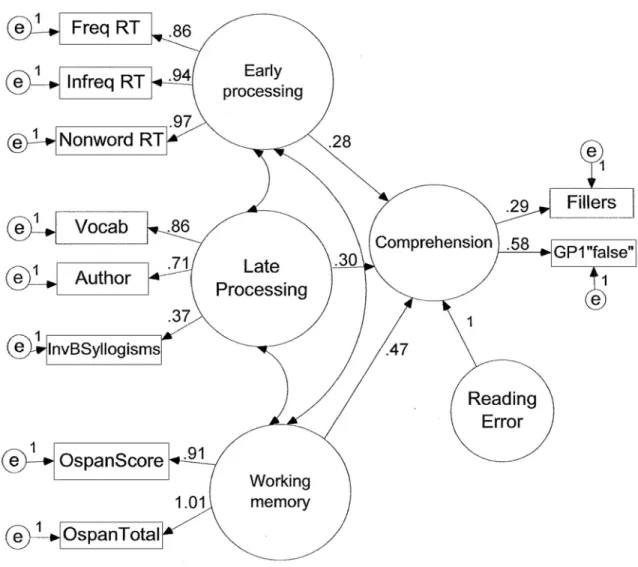
4. Structural equation model for Experiment 1 responses to GP1 and filler
sentences showing standardized regression weights on latent variables … 104
5. Structural equation model for Experiment 1 sentence reading times
showing standardized regression weights on latent variables ……… 105
6. Plots of word RT difference and word RT in the LLDT for Experiment 1
and 2 ………... 106
7. Plot of pooled RTs and RT difference to words in the lateralized lexical
decision task, for Experiment 1 and 2 ……… 107
8. Measurement model for Experiment 2 showing factor loadings and
correlations between latent variables ………. 108
9. Structural equation model for Experiment 2 responses showing factor
loadings on latent variables ……… 109
10. Structural equation model for Experiment 2 reading times to target
CHAPTER 1 INTRODUCTION
Research into the processes involved in sentence reading generally assumes that comprehension and interpretation vary little amongst skilled adult readers. While this is generally true for early reading processes such as word recognition, which become increasingly automatic as readers become more experienced, later interpretive processes show greater variability even among “normal” adult readers (Michael, 2004). These differences of interpretation increase when comprehension of the sentence requires the use of inference or integration of information, either from earlier in the text or from external sources. Readers are known to be inconsistent in the way they use contextual information and also in how they apply inference: they may focus either on what the words mean or on what is meant (Benjamin, 1968).
Interpretation of a text relies on integrating ideas, initially at the superficial text-based and proposition levels to produce a locally coherent
representation, then at the discourse level to create a globally coherent discourse representation (Kintsch, 1998). This later level may include higher-level
although not always completely (Hanna and Daneman, 2004), there are several points at which the later processes of integration and interpretation may break down: initial encoding of relevant information may be inadequate, retrieval or reactivation of that information may fail, or, despite completing the first two processes, readers may fail to integrate that earlier information with the recently read text into a fully comprehensive discourse representation. Recent research (Long and Chong, 2001, and Noordman and Vonk, 1997) has tended to suggest that problems, when they occur, arise specifically at this later stage of
integration, rather than at encoding or retrieval, and the idea of an integration bottleneck has emerged (Oakhill, 1993). Yuill and Oakhill (1991) have suggested that problems faced by children who are poor comprehenders relate to problems in integration. However, research with children by Spooner, Gathercole, and Baddeley (2006) found deficits in memory for text by less-skilled comprehenders but failed to find evidence of differences in the ability to integrate.
When going beyond the literal text to make inferences about the intended interpretation readers of lesser ability may again fail to make full use of all the information available. Deciding which of a range of possible interpretations is the most appropriate requires rapid suppression of those ideas that are
irrelevant. Every word we read has associated with it a flood of information that potentially could be activated. Most of this deluge never reaches
Research suggests that readers of different ability levels differ in the strategies they use to cope with this problem (Stanovich, 1980): able readers may
selectively attend to relevant information, while less able readers fail to inhibit irrelevant information (Engle, Conway, Tuholski, & Shisler, 1995).
This dissertation examines how later processes of inference and
integration vary between competent adult readers and how these differences may relate to individual differences in cognition. Sentences used contained a fronted adjunct ambiguity providing an opportunity to examine the ways in which understanding varies when alternate interpretations are possible. The emphasis is on exploring how differences in these later processes influence comprehension and thus limit the extent to which less able readers are able to go beyond the literal meaning to understand fully what the writer intends. The possible effects of differences at earlier levels of processing on reading and interpretation are also examined. Although I use the terms early and late to describe the processes involved, no strong claims about the temporal sequence are being made, rather early and late refer to lower and higher levels of language representation.
Background
Research into processes of inference and integration during language
inconsistency effects, priming, and integration. A small number of the studies that have explored these issues in reading comprehension have also considered the effect of individual differences. Clearly there are large individual differences in reading ability in the normal adult population. Inferential processes appear to be particularly susceptible to individual differences in reading ability (Murray and Burke, 2003). Differences have also been found in the ability to integrate prior context and in the use of contextual information to support the use of inference (Calvo, 2001).
I discuss the literature describing research into the areas mentioned: first studies of integration, second, the possible role of individual differences in comprehension, and finally, issues of methodology.
A. Studies of integration
Studies using inconsistencies in text provide evidence of how readers process text and integrate new information with old to create a coherent discourse representation. Inconsistencies may take the form of the “Moses illusion” (Erickson and Mattson, 1981) in which participants answer “two”, when asked “How many animals of each kind did Moses take on the ark?”, without
inconsistent with earlier information that has become part of the discourse representation.
1. Context
Albrecht, O’Brien and colleagues (Albrecht & O'Brien, 1993, O'Brien, Rizzella, Albrecht, & Halleran, 1998) performed a series of experiments that explored the way in which distant information is accessed by the reader and the factors that facilitate or limit that process. The main focus of this research was on the elements that contributed to the discourse representation constructed by the reader and how well these were maintained over time and in the presence of contradictory information. For instance, in the case of the burger-eating vegetarian did information that resolved the inconsistency, such as that she occasionally ate fast food when out with friends, reduce the effect or is activation of prior information automatic? Myers and O’Brien (1998) proposed that earlier information “resonated” with the reader but the effects of this automatic
activation could be modulated by a number of different factors that would determine how far slowing occurred. For instance, both intervening information and the nature of the inconsistency can influence the size of the effects on
reading times.
felicitous, as in the use of an appropriately biblical name instead of Noah to complete the “Moses illusion”. Thus, if the vegetarian eats a tuna salad rather than a burger the effect of the inconsistency is less marked, presumably because it seems less inconsistent with being vegetarian. In a series of experiments, Kaup and Foss (2005) explored how readers dealt with different types of inconsistency, relational versus direct, as measured by reading times and detection rates. Contrary to their expectation relational inconsistencies, such as differences of size – smaller rather than larger, caused more slowing and were detected more frequently than direct inconsistencies, for instance of the color of an item
mentioned. Only when participants were directly warned of inconsistencies did the detection rate for the direct inconsistencies of color equal those for the
relational inconsistencies.
When readers have been pretested for reading ability (Long & Chong, 2001, Murray & Burke, 2003), more able readers showed significant slowing in the inconsistent condition, however less able readers showed no effects of inconsistency, so that reading times for the target sentence did not differ significantly by condition. In the study by Long & Chong (2001), participants read passages with target sentences that were locally coherent, but global
target was inconsistent with the character description; this effect was not found for less able readers. Thus it appears that more able readers are aware of the inconsistency and affected by it while less able readers are not.
2. Inference
Research exploring the use of context frequently assumes the use of inference on the part of the reader, about character goals (McKoon and Ratcliff, 1992), causal relations (Rizzella, & O'Brien, 1996), and also on temporal or spatial
relations. Studies using inconsistency have examined how inferences about a character’s goals affect reading of a target sentence when information is
inconsistent with those inferences. Longer reading times have been found for textual inconsistencies both with implicit and explicit information. As with explicit information in the prior context, these effects of implicit information have been found to be modulated by factors such as focus and fit.
The ability to make inferences is known to be an important part of good reading comprehension. Inferential processes appear to be particularly
susceptible to individual differences. Less able readers have more problems with implicit than with explicit information (Oakhill, 1984, Hare, Rabinowitz, &
inferences are also vulnerable. Data from my recent research (Michael, 2004) show that plausible inferences, which might be expected to be made equally by all participants, were made unevenly. Although there may be a normative, or majority, response, there was considerable variability in how sentences were interpreted. In recent research, Murray and Burke (2003) found college-level students, pretested for reading ability, used inference unevenly, with a small proportion of less able readers applying inference hardly at all while some of the others employed it indiscriminately. Is it the ability to make inferences or to decide which inferences are appropriate that is limited in poor comprehenders or are these separable?
Studies that explored individual differences in inferential processing have used a number of different tests to separate groups of different ability. (I discuss details of the tests used below.) Results show that more able readers are more likely to show evidence of the use of inference in the form of slowing, as
described above; however when the level of inference is comparable between groups (Calvo, 2001), because the inference is clear and necessary for
comprehension, more able readers read more quickly and show less need for rereading.
3. Priming
The extent to which prior information effectively primes the reader for new information has generally been tested using a probe task. Priming
the extent to which ideas in the text are activated at different points in the text. Reading is interrupted when a word is flashed on to the screen for recognition. Words that have been effectively primed by the prior context should result in more rapid response rates. Priming shows the extent to which information has been activated or remains active at a given point in the text. Results from both Long & Chong (2001) and Murray & Burke (2003) suggest that disparities between readers of different abilities lie less in memory capacity than in
processing. While readers who are poor comprehenders encode information into memory, as demonstrated by equivalent priming, they fail to make appropriate use of that reactivated material by integrating it into their current discourse representation.
Inhibition has been suggested as an explanatory factor in individual differences in cognition. The ability to inhibit irrelevant information is correlated with measures on the reading span task, designed to measure working memory (WM), (Engle, et al. 1995, Engle, Tuholski, Laughlin & Conway, 1999). Engle and his colleagues found negative priming for information that was task irrelevant by high-span participants, demonstrated by longer response times, suggesting that such inhibition requires active, resource dependent, controlled attention, rather than a passive process of inhibition. The idea that differences lie in selective attention fits with work by Egner and Hirsch (2005), which suggests irrelevant information is encoded into memory, and the mechanism that causes negative priming is one of attention to relevant information following episodic retrieval, rather than inhibition of irrelevant information. In support of this interpretation, negative priming was found to be associated with increased activation of the right dorsolateral prefrontal cortex, a region linked to episodic memory retrieval. Research using ERPs (Perfetti, Wlotko, & Hart (2005) also suggests the role of episodic memory in enhancing semantic memory.
4. Integration1
Experiments that directly explore later processes of integration and
interpretation are few. Vonk and Noordman (1990, Noordman, Vonk, & Kempft, 1992) explored processes of necessary inference, requiring the integration of prior
1 I here distinguish integration, where all the information is available to the reader, from
information. They suggest readers are quite “parsimonious” (p.462) when making such inferences from information in the text, balancing costs and
benefits, and only make those necessary inferences that are either easy or which match their reading goals. Efforts at integrating information are, they suggest, related to the interest or knowledge that a reader has in the subject. In a later study using eye-tracking (Noordman and Vonk, 1997), they investigated the time course of late integration processes in sentences requiring complex inferences following the conjunction because. When the required analytical inference is made online, slowing occurs in processing the final words of the sentence, apparently as part of later sentence wrap up, rather than as part of constructing the earlier more superficial text and propositional-based levels of representation.
There is considerable evidence from a number of sources that while most readers perform the early more automatic processes of comprehension
equivalently, later interpretive processes show more variation (Murray & Burke, 2003). (However, it is possible that the early processes are also more variable than generally assumed.) It is important to understand at what stage in
processing these differences occur and what specific aspect of “reading ability” is causing those differences. This dissertation seeks to clarify how effectively
B. Individual Differences
Research into individual differences in reading comprehension has focused on several possible sources of disparity. Baddeley, Logie, Nimmo-Smith, & Brereton (1985) found that reading comprehension depends on a number of “separable components”, particularly lexical access, vocabulary and WM. Recently these were evaluated in a sentence reading paradigm using
eye-tracking (Calvo, 2001, 2005) and found to correlate with differences in processing at early and late stages of sentence reading. In addition to these three essential functional components, other contributing factors, such as reading experience (Cunningham, Stanovich, & Wilson, 1990) have been considered, and found to be predictive of differences found between normal readers.
1. Lexical access
Lexical access is the speed and accuracy with which a reader identifies a word. There is a significant relationship between word recognition and reading ability. The lexical quality hypothesis (Perfetti & Hart, 2001) focuses on
indisputable that lexical access is required for comprehension and consequently that early processes are critical to later processes. Early phonological awareness is known to be highly predictive of later reading success (Nation and Snowling, 2004). However, as reading skills develop, and word recognition becomes more automatic, skilled readers rely increasingly on the orthographic route to
recognition. Also, the semantic route, which relies in part on contextual clues, becomes increasingly important to understanding of less familiar words (Nash & Snowling, 2006). Differences may arise between skilled and less able readers in their ability to recognize words, in particular in their ability to recognize
irregular or exception words that are not rule-based, as the semantic route becomes increasingly important to reading success. Studies into the sources of individual difference in reading using the lexical decision task (described below) have found that skilled readers are faster and more accurate in identifying low frequency words (Schilling, Rayner, & Chumbley, 1998; Lewellen, Goldinger, Pisoni, & Greene, 1993) and that students who are infrequent readers are slower and less efficient in all components of the task, (Lewellen, Goldinger, Pisoni, & Greene 1993, Chateau, & Jared, 2000).
particularly in all those subtle interpretive processes that help in deciphering humor, irony, indirect requests, and emotional subtext. At its most extreme, failure to engage the right hemisphere in language processing may be related to psychoses, specifically those relating to schizophrenic disorders (Mitchell and Crow, 1995). Damage to the right hemisphere (RHD), arising from neurological insult such as stroke, frequently results in deficits at the discourse level in
interpreting inference and contextual information, as well as broad themes and concepts (Beeman, 1993, Myers and Brookeshire, 1996). RHD is associated with inappropriate use of inference and the inability to make use of context (Bryan, 1988), as well as with difficulty in recognizing appropriate use of inference (Schneiderman, Murasugi, Saddy, 1992).2
In the non-patient population, readers who comprehend well may be more fully/rapidly engaging the right hemisphere in processing text in order to maximize their understanding and resolve areas of ambiguity (Faust & Chiarello, 1998). The right middle temporal region in particular may be important in establishing/maintaining global coherence in discourse (St George, Kutas, Martinez, & Sereno, 1999). It has been suggested that good slow readers have learned to do more consciously what good fast readers do more or less
automatically; thus they require longer reading times, specifically more rereading, to reach a similar interpretation. This implies a more conscious activation of those right brain resources.
More pronounced lateralization of the processes required to understand language might be an important factor in the difference between good and poor comprehenders. If this is the case then, for instance, the two stages of integration may be carried out largely in opposite hemispheres i.e. with good separation. Alternatively, it may be that the important issue is the involvement of and cooperation between the hemispheres; Brysbaert (1994, 2004) suggests that, in many instances, interhemispheric transfer is essential to word recognition. Differences in how language input is processed between the hemispheres could, potentially, be of interest.
2. Vocabulary
Readers who learn to read early and well continue to improve,
particularly in the rate at which they acquire new vocabulary (both understood and produced), at least in part because reading a variety of text gives access to a wider range of unfamiliar words than that obtained through speech
(Cunningham & Stanovich, 1997). Thus scores on vocabulary tests suggest the level of reading experience. Given this relationship, it is unsurprising to find that measures of vocabulary should be strongly correlated with measures of reading comprehension. Calvo (2005) found vocabulary to be correlated with reading time measures that reflect later interpretive processes. Some correlation between vocabulary and lexical access might also be expected, but in practice this relationship is not strong, since ideally such tests tap different types of
vocabulary at age 8 as a predictor of both word recognition and reading comprehension at age 13 and found that, while vocabulary accounted for a significant portion of the unique variance, scores on phonological processing proved a better predictor of later reading success.
3. Working memory
Tests intended to provide a measure of WM capacity and processing also correlate with measures of reading comprehension. Researchers have found that individual differences in working memory demonstrated by these tests are correlated with the ability to selectively attend to relevant information (Engle et al, 1995, 1999), suggesting that attention may be important component of WM measures. As described above, Engle et al (1995, 1999) found that individuals with a high span score on tests of WM showed negative priming of task
irrelevant information, suggesting the use of controlled attention rather than a more or less automatic process of inhibition by which irrelevant information is suppressed. Thus, low span individuals may not have the resources to inhibit irrelevant information, or rather to selectively activate information that is relevant, making the task of integration more difficult. If all associated
executive functioning and their relative importance in driving higher cognitive processes such as reading.
Studies of reading (Murray & Burke, 2003, Calvo, 2001, 2005) have shown that later interpretive processes seem to be influenced by limitations of WM, although it is possible that the relationship is not direct. Whether there may be effects on early processing is unknown, but no clear evidence has been found (to date) of WM effects on early reading processes (Waters and Caplan, 1999).
According to Yuill and Oakhill (1991), it is a deficit in WM that causes children with poor comprehension to produce discourse representations that are less complete and accurate than those of good comprehenders. In particular, poor comprehenders failed to repair inconsistencies once information became available to resolve the difficulty. Such failures may be due less to limits of memory
capacity than of processing ability, but this view is not supported by the work of Spooner et al (2006), which suggests that the problem is primarily one of retention, with poor readers showing less accurate recall. Perfetti (1985) describes less able readers as “losing” information from a recently read discourse more quickly than more able readers.
Following Daneman and Carpenter’s (1980) development of the reading span task (discussed below) numerous experiments have used the task to
above. Vos and Freiderici (2003) have shown differences in ERPs between high and low span participants when reading syntactically difficult or ambiguous sentences. Combining behavioral and ERP data suggests that high-span readers are better able to integrate contextual information online. High span readers also showed separation of these processes from those required to resolve problems of syntax.
Although scores on the reading span task have been found to be
correlated with scores on a reading comprehension task (Daneman & Carpenter, 1980, Whitney, Ritchie, & Clark, 1991), it is not clear exactly what the span task is measuring. Rather than measuring WM, the span task may be considered a measure of attention (Engle et al, 1995, 1999), and of central executive function (Miyake et al, 2000). Other difficulties with the use of tasks designed to test WM, specifically with the reading span task, are discussed in the section on individual difference measures below.
C. Methodology
been used, with an emphasis on those measures that are of interest to the proposed research.
1. Reading time measures
Much of the earlier research into reading comprehension relied on simple measures of reading time such as total times to read a passage or target sentence. These measures have shown significant effects of manipulations of consistency and of different types of inference, but do not allow the locus of difficulty to be isolated. This can be done when using single word presentation such as rapid single-word visual presentation (RSVP), which allows reading times for specific words to be recorded, but in this case normal reading is disrupted. Self-paced reading allows readers to control the rate at which words are presented and thus also enables more natural reading and measures of reading times on specific words. Most recently, the use of eye-tracking allows participants to read normally and provides evidence for the locus of any difficulties and the strategies readers use to recover from them. Using eye-tracking to examine processing during reading (Rayner, 1998) provides a way of comparing reading of very similar texts.
Slowing at any stage in reading is taken to be a measure of difficulty and consequent additional effort such as that needed to make an inference. For instance, elaborative inference was examined by O’Brien and colleagues, (1988):
to quiet her. He looked to see if anyone had seen him. He threw the knife into the bushes, took her money, and ran away.
This required the reader to infer a general concept from a specific one, or the specific from the general. Measures of interest were fixation times on knife. When the verb used was assaulted, rather than stabbed, participants took longer to read the word knife and therefore to make the elaborative inference that a knife had been used.
Calvo (2001) used eye-tracking in experiments to examine whether readers of different ability made equal use of predictive inferences. Participants read passages in which the first sentence provided either a predictive context (1) or a control context (2):
(1) Three days before the examination the pupil went to the library looked for a separate table and opened his notebook.
(2) The pupil, who was a little tired after finishing his examination, forgot his notebook and left it on a table in the library.
This was followed by the continuation sentence that contained the target word, either studied, which could be predicted from the predictive context, or slept (3):
(3) The pupil studied/ slept for an hour approximately.
by shorter reading times in the final phrase of the target sentence, rather than the target word itself. Calvo had divided participants into high and low-span
groups based on a WM test. Differences were found in reading times relative to condition and to group, even though there were no differences between groups in the accuracy of their responses to comprehension questions. High-span readers required less rereading time when an inference was required.
Ashby, Rayner, and Clifton (2004) explored the effect of reading skill on reading measures and found that skilled readers generally read more quickly and were less subject to the effects of frequency than less able readers. Effects of word characteristics such as frequency, predictability, and coherence have been extensively reported (Rayner, 1998), although seldom in the context of individual differences.
Problems with using eye-tracking to examine higher level processes such as inference are demonstrated by the Calvo (2001) study. Even when materials have been designed with the specific goals of the study in mind, localizing the point of difficulty in a process that is likely to influence late reading measures is not always successful.
Both roles were shown to have effects on reading times. Reading times were shorter for words immediately following the connector, but sentence wrap-up times were longer, showing more complete online integration. Longer sentence wrap-up times were associated with greater accuracy in answers to
comprehension questions.
2) Individual difference measures:
The value of examining component measures to studying individual differences in reading comprehension, as suggested by Baddeley et al (1985), has been demonstrated by their use in numerous studies of reading development and disability. Cunningham, Stanovich, and Wilson (1990) used measures of lexical access, vocabulary, WM, reading experience and reading comprehension to explore individual differences in reading ability in a group of introductory psychology students, and recommended this approach to studying differences in how well individuals understand text. Stanovich and West (1998) have also considered individual differences in reasoning ability using a syllogistic reasoning task. Although not directly related to reading comprehension,
reasoning ability could be a component in differences between participants who are more or less likely to make appropriate use of inference.
i.Lexical access
rates, are of interest, and these are found to vary with different experimental manipulations; effects of frequency are notably strong (Chumbley & Balota, 1984), but effects have also been found for rule-based and exception words (Weems & Zaidel, 2004), as well as for neighborhood size (Balota, Cortese, & Sergent-Marshall, 2004) —the number of words that can be created by changing a single letter in a word. The task has been used in a variety of experiments into cognitive processes; in studies of reading using dual-task methodology, LD has frequently been combined with reading a text, in order to give a measure of priming and provide evidence of activation (Long and Chong, 2001) and of inferential processing (McKoon & Ratcliff, 1992, O'Brien, Rizzella, Albrecht, &
Halleran, 1998).
In experiments exploring individual differences in competent adult readers, speed and accuracy on the LDT were found to correlate with both reading comprehension, r = .37, and also with reading span, r = .26, (Dixon, LeFevre, and Twilley, 1988), and with dual task performance, when the task involved naming and probe-detection (Herdman, & LeFevre, 1992); decrements in performance on the dual task, compared with the tasks performed separately, were predicted by scores on both the LDT and a measure of WM.
with gaze duration times during reading, suggesting that effects on the LDT are consistent with effects on early processing in reading. Lewellen, Goldinger, Pisoni, and Greene (1993) also found that students reporting more reading experience and scoring higher in a vocabulary test responded faster and were more accurate in an LDT task, in particular in rejecting pseudohomophones, words that sound like, but do not look like, actual words (e.g. brane and joak).
Chateau and Jared (2000) found that print exposure was related to performance on an LDT in college students, beyond that explained by
comprehension ability. Students who reported higher print exposure responded more quickly and accurately overall and especially to pseudohomophones, while low exposure participants showed larger effects of frequency. Thus, even
students who were successful readers showed differences in efficiency of lexical access that were related to the amount they read.
Debate about the effectiveness of the LDT as a measure of lexical access has focused on a number of issues that have little relevance to the proposed study. However, effects on task performance of meaning related variables such as frequency (Chumbley, & Balota, 1984), congruence, ambiguity, and
Differences in meaning activation between the LDT and a naming task have been demonstrated by comparing the effect of reading pseudohomophones. Such non-words produced faster naming but slower LDT response times than those for pronounceable non-words that are not homophones (Seidenberg, Peterson, MacDonald, & Plaut, 1996).
The use of the Divided Visual Field (DVF) lexical decision task makes a range of additional analyses possible. In this version of the LDT, lexical access is measured by randomly presenting words and non-words to either the right or left visual field. While accuracy and response time may provide evidence for different types of processing, especially for non-words, differences in accuracy and response time between the hemispheres may also be informative; as well as the right hemisphere having an important role in discourse processing (Beeman, 1993), it may maintain alternate meanings, especially in situations where there is ambiguity (Faust and Chiarello, 1998), and perhaps also has better error
monitoring (Iacoboni, Rayman, and Zaidel, 1997) than the left hemisphere. The right hemisphere is thought to be involved in more top-down processing and to make greater use of orthographic and semantic information; the left-brain makes greater use of phonology (Pugh et al, 1996) and is generally quicker and more accurate in word recognition, particularly for rule-based words.
Hemispheric differences may explain the problems that poor
(Long and Chong, 2001) suggests problems are less of access than of integration. However, an alternative explanation is that good comprehenders are more effective in recruiting the right hemisphere and may have less pronounced lateralization of the processes involved in language processing.
Using a DVF lexical decision task (Weems and Zaidel, 2004, Shears and Chiarello, 2003) could potentially provide additional sources of information while still measuring overall response times and accuracy. While it is possible for words to be visible in both visual fields, in practice there is a lack of
behavioral evidence for the use of any overlap. That is, in practice, even when a word falls foveally, there is no evidence that information is bilaterally
represented (Brysbaert, 1994), and thus interhemispheric transfer is required. In order to reduce the possibility of saccades from fixation stimuli, presentation time should be kept short—no longer than 165 ms (Pirrozolo & Rayner, 1980).
To sum up, it may be hypothesized that readers who comprehend well are more fully engaging their right hemisphere in language processing, particularly in later processes of integration and interpretation. Rapid and accurate
responses by readers on LVF presentation of a lateralized LDT are correlated with good (late) comprehension. Such readers cope well with tasks that require either inference or ambiguity resolution or require integration of contextual information. Rapid and accurate responses by readers following RVF
prediction can be made that those readers who respond quickly and accurately to stimuli presented in LVF and thus show less effect of side of presentation will reread less, and thus have shorter total reading times, when presented with complex sentences requiring inference, ambiguity resolution, or monitoring for global coherence, than readers who show larger effects of lateralization.
Lexical access can be tested in a number of different ways apart from LD, including the use reading time measures or an oral word-naming task. A
reading time measure has the advantage that it can be incorporated into other tasks, for instance by measuring reading over part of a comprehension task (Calvo, 2001). Calvo found that reading speed recorded this way was correlated with early reading measures, but not with those late measures that are thought to relate to interpretive processes. Others have found the relationship of reading speed and reading comprehension to be weak (Everett and Underwood, 1994). A measure of lexical access obtained this way is likely to be confounded with other tests and probably measures more than lexical access.
ii. Vocabulary and text exposure
The strong relationship of vocabulary knowledge with reading
reading, read independently for pleasure, and continue to improve, compared to children who have trouble learning to read and thus tend to fall behind.
Vocabulary tests have been a regular component of individual difference testing, mainly in developmental studies of reading in children (Yuill & Oakhill, 1991) and in studies of cognitive aging (Salthouse, 1993) and are considered to relate to crystallized intelligence. There are few studies correlating vocabulary with reading time measures, such as those obtained from eye-tracking; Calvo (2005) showed a measure of vocabulary to be correlated with times required for rereading in sentences requiring inferential processing.
Tests are either of expressive or receptive vocabulary, and frequently ask for definitions, synonyms and antonyms, or analogies, often using sentence
completion or cloze tasks, and multiple-choice questions. The Peabody picture test is frequently, but not exclusively, used for testing receptive vocabulary in children and is generally paired with a test of expressive vocabulary. Salthouse and colleagues (Salthouse, Siedlecki, & Krueger, 2006), in an experiment
In addition to tests of vocabulary, Stanovich et al have developed an author recognition test (1990) to provide a measure of print exposure. Participants are asked to mark the names of 40 popular authors from a list of 80 names. The measure is the number of authors correctly identified, less any identified as authors incorrectly, to discourage guessing. Although a measure of print exposure does not provide a measure of any cognitive component, it does provide a measure of reading experience that may mediate variability in cognitive processes associated with reading.
iii. Working Memory
The need for a reliable test of WM has produced a number of alternatives. The reading span task of Daneman and Carpenter (1980) has been widely used as a way of discriminating between readers of different ability levels in reading and in recall, since it also appears to be a good predictor of readers’ ability to
measure of WM capacity or is it also a measure of processing. The problems relate to the best way to effectively administer, analyze and use the task.
A number of studies, some already mentioned above, have used the task effectively as a means of determining groups. High and low span groups have been found to respond differently in tasks requiring higher cognitive processes such as inferential processes in reading (Calvo, 2001, Linderholm, 2002).
However, other researchers have found problems with applying the task in this way. A serious concern is the limited range in the results that can make it hard to distinguish groups. After studying ways of using the reading span task, Friedman and Miyake (2004a) recommend against using the test to determine groups, in particular to avoid use of a median split. They found that dividing the participants between groups reduced both reliability and predictive power. In addition, they make the case that, where an interaction is expected, any
measurement error would have a disproportionate effect on the analysis of variance, and consequently that methods such as regression and correlation are to be preferred over post hoc division into groups. That said, researchers have had some success with dividing participants into groups, in some cases
Reliability of the task has also been found to be uneven as participants frequently perform more poorly at retest, possibly because of interference (Friedman & Miyake, 2004b). Alternative methods of scoring the task such as counting total words or calculating the proportion of words recalled have produced greater retest reliability (Friedman & Miyake, 2005) and also have the advantage of providing more fine-grained continuous measures. In the latter method forgetting a final word from a set of two sentences has a larger effect on the final score than forgetting a word from a set of five. Both of these scoring measures are best achieved when the complete test is run. Having to take the complete test can be demoralizing for poor testees, so Friedman and Miyake (2005) suggest ordering trials so that short and long blocks are intermixed, allowing for the possibility of success at any stage of the task. The number of sets run at each level of difficulty also produces variability in retest reliability. When three sets were tested at each level reliability was good for scores
calculated using total words and proportion of words (r = .72 for each) but poorer for correct sets (r = .59) and for truncated sets in which participants were allowed to stop once a level had been failed (r = .52). Reliability improves for all methods if more sets are tested at each level, but this substantially increases the time needed and presumably unwanted negative effects on participant goodwill. Finally, the question whether the test is self-administered or
use of strategies to improve recall when the task is self-administered, results were not found to differ significantly (Friedman and Miyake, 2004b).
The interpretation of results and correlations is also complicated by consideration of how well the task may tap central executive function, specifically selective attention, updating and inhibition (Miyake et al, 2000, Engle, et al, 1995, 1999). Redick and Engle (2006) compared tasks designed to test WM with the Attention Network Test and suggest that variation in WM capacity reflects differences in how well individuals are able to direct attention. The importance of efficient updating to maximizing effective reading
comprehension (Miyake et al, 2000) is mirrored in the visual domain. Vogel, McCollough, and Machizawa (2005) stress the importance of individual
differences in how efficiently space is allocated within WM, so that moment by moment only the most relevant information is represented.
and lexical access. A task with less reliance on reading but which still taxes both storage and processing should provide a more specific test of WM.
A number of other tasks have been developed to test WM. Most are versions of the span task (e.g. spatial span tasks, Priti &Miyake, 1996). I do not discuss here all of the alternative tests developed to measure WM but
concentrate on the operation span or Ospan task (Turner and Engle, 1989) and a related automated version of the same task – the Aospan (Unsworth et al, 2005).
In the Ospan task participants are required to solve a series of
mathematical operations and at the end of each set recall in serial order the words presented after each operation. The task takes approximately 20 minutes if experimenter administered. Internal validity and test-retest reliability are high (r = .83). The Ospan task has been used by a number of researchers; Yuill, and Oakhill (1991) used a version to test skills related to reading comprehension in children.
Turner and Engle (1989) have shown that the operation span task was as strongly correlated with reading comprehension measures as the reading span task, while Miyake et al (2000) have shown it to be strongly correlated with processes of updating. Efficiency in updating the information held in WM may explain why performance on these measures is also predictive of reading ability (Daneman and Merikle, 1996).
the end of each set and are required to be at least 85% accurate on the
mathematical operations to ensure this part of the task is being given appropriate attention. Once the answer has been given to the mathematical operation, a letter is presented which must be recalled later by inputting letters from a matrix in the order presented. Although the test is self-paced, limits are set on time allowed for the mathematical operations based on the participant’s own response time. This restricts the time available for rehearsal of the to-be-remembered items. As with the Ospan task, internal validity for the Aospan task is high, as is test-retest reliability (r = .83). Compared to the Ospan task, the automated Aospan task has advantages for administration and, since testees are asked to recall letters and not words, is less likely to be confounded with a lexical access task or with tests of vocabulary.
Scores on the automated span task have been found to correlate with the experimenter administered Ospan and reading span, and to show, by both confirmatory and exploratory factor analysis, moderate correlations with tasks measuring spatial reasoning (Unsworth et al, 2005). This last result provides support for the view (Kane, et al, 2004) that span tasks measure a domain-general component in WM, which may also be predictive of general fluid intelligence. Bunting, 2006, suggests that this component relates to attention, specifically the ability to resist interference, but does not accept its domain generality.
WM, and would also allow the results to be compared with measures of lexical access to check for confounding. Further, if the group approach is preferred, assigning participants to quartiles is more efficient when two tasks are
employed. However, this approach risks over-taxing the participants. iv. Reasoning
How far reasoning ability might be related to reading comprehension is less clear. Reasoning, particularly on a syllogistic reasoning task has been shown to be correlated with scores on the SAT, r = .410 (Stanovich and West, 1998). However, Siddiqui, West and Stanovich (1998) compared a reasoning task with print exposure measures and a test of mental-state verbs, and found that print exposure was a good predictor of verb discrimination but a less effective predictor of reasoning ability. Tests of reasoning ability require responses, normally “True” or “False”, to statements requiring logical reasoning. Stanovich et al (Stanovich & West, 1998, Siddiqui, et al, 1998) used sentences in which the statements were manipulated on believability as well as logical validity (see examples a and b, below).
(a) All mammals walk. Whales are mammals. Therefore whales can walk. (Valid, unbelievable)
(b) All flowers have petals. Roses have petals. Roses are flowers. (Invalid, believable)
conflict with believability. De Neys (2006) found that high span readers showed less effect of a load condition when believability conflicted with the correct response, and were more accurate overall than low span participants. Reading times also tended to be longer for high span readers in the unbelievable
conditions. While this finding suggests a probable correlation of scores on this task with those on a WM task it also would point to a failure of inhibition and thus a possible correlation with False alarms on the LD task. When considering the use of inference, it is possible that participants who score high on the
reasoning task may be less prone to make use of inference in conditions in which its use is not well supported by the text.
v. Speed of Processing
Individual differences in speed of processing have been suggested as a factor in memory control in aging (Salthouse, Siedlecki, and Krueger, 2006), and thus might mediate the cognitive components under consideration in this experiment. Of the tasks used by Salthouse et al to test this hypothesis the pattern
comparison task seemed most appropriate for this experiment, in particular because it shows the least overlap with other tasks.
The role the factors, discussed above, have in influencing comprehension are likely to be interrelated. Thus it is important that tests employed in the
components that are also correlated with the dependent reading measures will suggest a joint role in comprehension for those components. Thus it is likely that vocabulary measures may correlate with the measure of print exposure, while each is also correlated with reading comprehension. Reading experience, as measured by the author recognition test, may also mediate the role of other cognitive components in improving readers’ understanding. In addition,
CHAPTER 2 EXPERIMENTS
For this dissertation I completed two experiments that explored how individual differences in component cognitive processes are related to differences in how inference and contextual information are used in the interpretation of text. Participants were asked to complete several tasks designed to measure individual differences in cognitive processes as well as a reading task in which the meaning of target sentences containing a fronted adjunct clause will be manipulated to make the use of inference more or less plausible. Experiment 1 was expected to show significant relationships between patterns of inference, interpretation and individual difference measures.
Experiment 2 examined more complex inference patterns by embedding target sentences in passages that supplied context that was either supportive or neutral to the inference.
that readers do not consistently arrive at a single interpretation of these “garden path” sentences. Readers’ interpretations were influenced by both syntax and semantics, but also by their use of inference. Christianson et al suggest that differences in interpretation arose because some readers relied on an incomplete process of reanalysis, which they called “good enough processing”: this
explanation was not supported by my research using similar materials. In a series of experiments (Michael, 2004), I have examined reading of sentences (see (1) and (2) below) containing a fronted adjunct clause. Sentences were syntactically ambiguous “garden-path” (GP) sentences or were
disambiguated by punctuation.
(1) As Tom tattooed(,) the girl paced up and down.
(2) As Tom tattooed(,) the girl tried not to move.
These sentences tend to cause readers to make an initial incorrect analysis that the girl is the object of the first verb (V1), tattooed. Thus, in the main clause, at the second verb (V2), (paced or tried in the examples) it becomes clear there is a problem with the initial analysis that needs to be corrected. The syntactic
(3) True or False? Tom tattooed the girl.
Participants were more likely to respond “True” following sentences such as (2). However the effect of the disambiguating punctuation was not significant. There were also overall differences in reading times with longer times for
single-meaning sentences such as (1).
Table 1: Responses and reading times to garden-path and punctuated sentences
Garden-path 1 Garden-Path 2 Punctuated 1 Punctuated 2 Proportion of
responses “True” 19%
66% 16% 72%
Total sentence
reading time 4824ms 4860ms 4300ms 3828ms
This could be interpreted as being the result of a longer process of reanalysis for sentence (1) but an analysis contingent on response showed this was not the case. Reading times for participants making the more common “False” response for (1) and “True” for (2) had similar reading times for sentences of both types.
Differences in overall reading times were accounted for by longer reading times when readers made the less usual responses.
In a later experiment the target GP sentences followed a context sentence that was either consistent (4) and (6) or inconsistent (5) with the most common interpretation of the target sentence.
Supportive of single meaning; single target
(4) Tom started work on the boy's tattoo as his girlfriend watched.
As Tom tattooed the girl paced up and down.
Supportive of single meaning; dual target
As Tom tattooed the girl tried not to move.
Supportive of dual meaning; dual target
(6) Tom started work on the girl's tattoo as her boyfriend watched.
As Tom tattooed the girl tried not to move.
Responses to statement (3) and reading times were influenced by the prior context.
(4) consistent (5) inconsistent (6) consistent Proportion of responses
“True” 15%
29% 88%
Total sentence reading
time for both sentences 9838ms 9963ms 8896ms Total time for target
sentences 2761ms 2794ms 2614ms
Table 2: Responses and reading times to sentences with prior context
As expected, the manipulation of context produced more responses of “True” when the context confirmed the inference in the target sentence (6) and many fewer when it did not. There was also an effect of the prior discourse context on the way in which identical target sentences were read. Reading was particularly slowed in the inconsistent condition, a result expected following the finding of Murray and Burke (2003) that readers are slower when reading a target sentence for which a plausible inference was inconsistent with information from the prior context.
did not result in greater accuracy but was evidence of greater processing
difficulty. This difficulty is especially apparent when reading times for expected and unexpected responses are compared. Rereading and reanalysis appear to be more strongly influenced by how a sentence is understood than by any initial misanalysis or subsequent problems with analyzing syntax; further, making a plausible inference can reduce the need for the reader to reanalyze in this type of ambiguous sentences. Thus, reanalysis is not perfunctory in these cases, and although it may be “good enough” as suggested by Christianson et al (2001), that is because most readers take only as long as is necessary to confirm the
interpretation that they ultimately settle on. There is no evidence, from these results, to suggest that readers who take less time rereading are failing to process completely. Instead, employing inference when it matches input is relatively easy and consequently results in less rereading.
Although the inclusion of a context sentence allowed the examination of reading in situations when the use of plausible inference was inappropriate, the manipulation does not replicate the situation, seen in the earlier experiment, in which a reader fails to make appropriate use of plausible inference. Nor does it explain differences seen in how effectively prior contextual information was employed. The post hoc analysis contingent on response is also problematic.
readers are differentially related to the component processes that contribute to effective reading comprehension. Previous research suggested that these differences were more likely to relate to later processes of inference and
integration; thus differences in interpretation were most likely to correlate with measures of WM and vocabulary. However, there is also some evidence to suggest that the effects of earlier levels of processing should be considered. Participants were asked to complete the reading task followed by a series of tests that have been widely used to measure important components of cognitive function. The tests specifically relating to aspects of reading comprehension are the DVF lexical decision task (LDT) as a measure of lexical access, a test of
than either the reading span or traditional operation span tasks. Letter recognition, which is required for the recall portion of the task, is highly automated even in quite young children, so is unlikely to be confounded with other word related measures.
In addition participants were asked to perform an author recognition task to provide a measure of reading experience, a pattern comparison task, and a test of syllogistic reasoning. Scores on the author recognition task were expected to be related to expected responses, while the test of reasoning may be related to a more conservative style of response, leading to less use of inference and fewer answers of “True”. The pattern comparison task provides a speed of processing measure using simple figures consisting of line segments, and therefore relies on materials that are unlike those used in any of the other tasks.
In Experiment 1, responses to the reading comprehension questions following the target sentences with fronted adjuncts were compared with scores on the tasks measuring individual differences. This allowed correlation of individual differences of interpretation with core cognitive components. Those components found to be of interest in Experiment 1 were further examined in Experiment 2 in which the target sentences were shown with two prior sentences that provided context. The information in the prior context biased readers either to use inference or was neutral in its effect on interpretation of the target
Experiment 2, passages requiring bridging inference provided comparison with the ambiguous fronted adjunct sentences. Together the two experiments provide important information on the cognitive processes that support effective reading comprehension. In doing so, they also cast light on the problems that some adult readers experience.
Experiment 1
The first experiment examined the relationship between selected measures of individual difference and how ambiguous sentences are understood.
Participants were asked to complete a series of tasks, including a reading task that contained the target garden-path sentences and an equal number of
unambiguous filler sentences. Responses to comprehension questions following the garden-path sentences indicated the extent to which participants were
willing to use inferential processes. Responses following the filler sentences gave a measure of reading accuracy. To test individual differences, participants also completed the divided visual field LDT, a simple centrally presented LDT (LDT2), synonym selection, the Aospan task, an author recognition test, the pattern comparison task and a test of syllogistic reasoning. With the exception of the two LDT tasks, each task was selected to test separable components of
cognition—lexical access, vocabulary, WM, and reasoning ability, as well as the experiential factor of print exposure —that each potentially contributes to
reading comprehension is shown in Figure 1. In addition, participants were asked to complete the Edinburgh Handedness Inventory to confirm that all participants are right handed.
In this first experiment the reading task tested how each participant understood sentences of different levels of difficulty and ambiguity. Sentences (1) and (2) (shown again below, without a disambiguating comma) were
presented on the computer. After reading each sentence, participants pressed the space bar to continue to a comprehension question (see (3), below) on the next screen to which participants were asked to respond “True” or “False”. Participants were expected to show a consistent bias towards answering either “True” or “False” depending on the condition: more answers of “False” are expected following sentences such as (1), and more answers of “True” following sentences such as (2).
(1) As Tom tattooed the girl paced up and down.
(2) As Tom tattooed the girl tried not to move.
(3) True or False: Tom tattooed the girl.
Readers who fail to respond as expected, either answering “False” following sentences such as (2), or answering “True” to sentence such as (1), are either failing to make use of inference, or are making inappropriate use of inference when information in the main clause makes the inference implausible. It was expected that there would be a relationship between responses to the
particularly the measure of WM. Previous research has shown that high span readers are more likely to make use of inference in situations where an inference is warranted by prior context and need for coherence (Calvo, 2001, 2005). I hypothesized that the difference in responses that we have seen in previous experiments (Michael, 2004) would be similarly related and that high span readers would make greater use of the relevant of information in the final clause than would low span readers. Using fronted adjunct sentences had a number of advantages over the manipulation used in other experiments that have examined individual differences. The most important is the variability in interpretation, clearly shown by the variability in response found in both my research and in that of Christianson et al (2001), which makes response of particular interest. Previous research has mainly relied on reading times (Calvo, 2001), and accuracy (Long and Chong, 2001) predicated on the assumption that there was a “correct” answer and therefore tended to be subject to ceiling effects.
In addition responses to comprehension questions following the filler sentences, which varied in complexity but were not ambiguous, provided a more general measure of reading accuracy.
Method Participants
Materials and Design
Participants took a series of tests after first completing the reading task, which involved self-paced reading of the experimental sentences and responding to the subsequent comprehension questions. All tests were completed on a computer in a single one-hour session. All parts of the experiment except the Aospan task were linked so that students could work their way through each in their own time. Tasks took from one to twenty minutes. On completion each participant was then asked to complete the Aospan task. Most participants finished the sequence of tests without evident problems.
Materials
There were 36 target sentences identical to those used in prior experiments (see (1) and (2) above). Sentences had been pretested to provide an estimate of mean response using an online web experiment. The sentences were matched for length by number of syllables and, as far as possible, by number of words. The critical word was expected to be the second verb and this was matched for length (mean length 6.5 letters), and for frequency using the Thorndike-Lorge written
frequencies, found in the Medical Research Council database, maintained by UWA. There was a start block of 12 sentences and equal numbers of fillers and experimental sentences during which feedback was provided.
Procedure
pressed the space bar to continue to the next screen, which will show a statement such as (3), to which they responded either “True” or “False.” This response was followed by the next sentence.
Tests of Cognitive Processing
1) Divided visual field lexical decision task
For the lateralized LDT words and non-words were shown in black text on a white background on either side of a central fixation point and were on the computer screen for no longer than 165 ms to limit the opportunity for saccades from fixation (Pirrozolo & Rayner, 1980). The screen refresh rate was set at 85hz. After presentation of stimuli to either the right or left visual field, participants will be required to make a bimanual yes/no response to indicate whether this is a word or not. Both accuracy and response time were measured. The yes/no response was preferred to a go/no go response because of the possible
importance of the latency of response to non-words, in particular from the left visual field (LVF). The bimanual response negates concerns relating to