ELUCIDATING THE NATURE AND DEVELOPMENT OF NEURAL MECHANISMS ASSOCIATED WITH ANXIOUS APPREHENSION AND ANXIOUS AROUSAL ACROSS
ADOLESCENCE
Paul B. Sharp
A dissertation submitted to the faculty at the University of North Carolina at Chapel Hill in partial fulfillment of the requirements for the degree of Doctor of Philosophy in the developmental psychology program in the department of psychology and neuroscience
Chapel Hill 2019
Approved by: Eva H. Telzer
Beth E. Kurtz-Costes Wendy Heller
ABSTRACT
Paul B. Sharp: Elucidating the nature and development of neural mechanisms associated with anxious apprehension and anxious arousal across adolescence
(Under the direction of Eva H. Telzer)
Work on adult anxiety has found that anxious apprehension, marked by chronic worry, and anxious arousal, marked by elevated sympathetic hyperarousal, are instantiated in different neurobiological systems and involve different information processing dysfunctions. However, little is known regarding how these transdiagnostic types of anxiety develop. The present dissertation seeks to apply this transdiagnostic approach to anxiety to the study of adolescent neurodevelopment. Study 1 established that anxious arousal and anxious apprehension are distinguishable via self-report, supporting that these traits are meaningfully different as early as 11 years old. Neurobiologically, anxious arousal positively correlated with dmPFC-amygdala structural connectivity, interpreted as an elevated propensity to amplify anxiety responses, whereas anxious apprehension positively correlated with right iFG structural connectivity, interpreted as reflecting elevated inhibition of immediate threat processing. Evidence was not found for neural correlates of anxiolytic dysfunction in anxious arousal, nor for neural correlates of increased internal mental rehearsal in anxious apprehension. Study 2 built on Study 1 by examining how intrinsic connectivity was related to types of anxiety both cross-sectionally and longitudinally. Study 2 found no evidence that a priori defined functional pathways mapped onto types of anxiety. In contrast, a data-driven approach revealed that functional amygdala
connectivity can predict variation in anxious apprehension in wave 2. Taken together, the present dissertation establishes that anxious arousal and anxious apprehension emerge in early
ACKNOWLEDGEMENTS
It has been a privilege to intellectually pursue what I would have otherwise pursued as a hobby over the past 6 years in graduate school. I tell my friends that are outside of academics that my life is like a treasure hunt. I get to seek, each day, for hidden answers to questions that have as much to do with elucidating my own humanity as they do with explaining extreme forms of mental suffering. It is a gift that I can pursue this exhilarating quest for my career.
However, passion alone didn’t get me to my current state of knowledge and achievement. The countless questions, critiques and advice from other curious minds were essential to my growth as a scientist, scholar, and human being. Another phrase I bring up when I describe what I do to friends and family is that I live in “the world of ideas.” I visited this world for the first time in Illinois. Each week in our clinical seminar we would engage a big question: where is the line between dysfunction and function? What is the logic of proposing and supporting the existence of a diagnostic taxon? What is the difference between neurobiological and
psychological phenomena, and does one cause or underlie the other? It was here, with Wendy Heller as my guide, that I first experienced such an immersive, enriching, and stimulating space for exploring ideas. Sitting in a room with seven motivated scholars, challenging each other to defend our beliefs about fundamental concepts in the study of the human mind, was unlike anything I’d experienced before.
dad was diagnosed with pancreatic cancer in my first year. She supported me to leave the clinical program and her lab to pursue my research interests with Eva because she knew it would be advantageous for my career aspirations. And the greatest gift is that, even though I made that transition from her lab, we remain close personally and intellectually. It is pure fun to explore the world of ideas with Wendy, and I know we will continue to explore together for the rest of my career.
When I made the transition to developmental science, I was so fortunate to work with Eva Telzer. From my first meeting with Eva, I felt her deep enthusiasm for pursuing questions in developmental neuroscience, and I knew we would work well together. That said, when I first started off in her lab, I was unsure how my interests in clinical phenomena would blend with Eva’s interests and those of my other new lab members. But over the past three years, I’ve gotten much closer with Eva and other students in the lab, and am so excited each time we meet and write feverishly on Eva’s beautiful glass board. I’ve learned so much from her, and have gained an appreciation of the connection between her work and my own. One of the best feelings I’ve experienced with Eva over the past 6 years is what I’d call intellectual surprise. It’s the feeling when you connect dots between seemingly disparate and disconnected topics, and are genuinely surprised to stumble on those insights. Working with Eva has deepened and widened my
understanding of anxiety by exposing me to areas I know little about, and inspires me to engage with others outside of my area of expertise.
As I’ve explored the world of ideas, I’ve been lucky to forge many important
the foundation on which all of my current and future work rests. His willingness to engage my many questions as a young scholar in my first year was a sign of his devotion to guiding young scientists, and his genuine interest and curiosity in science. Writing papers with Greg has been a joy, too. Much of my method of meticulously combing through other colleagues’ writing
borrows much from Greg’s style. The long exchanges of comments in the margins of papers have been rich debates; I think of them like modern-day, Renaissance-esque salons. These kinds of exchanges propelled me to tenaciously reach out to other great minds in our field, many of which are listed above. My conversations with Peter, for instance, remind me of those I’ve had with Greg, and I’ve been grateful for them. Moreover, my conversations about the limits and promises of neuroimaging with Brad in the domain of methodology mirror those I’ve had with Greg in the domain of philosophy of science.
In addition to introducing me to many mentors, graduate school brought me in touch with fellow students that I’m thankful to call my friends. Joel and Kathy feel like my adopted brother and sister. My love for them is beyond words. Of course, outside of all the moments of joy, fun, sadness and love we’ve shared together, I’ve also learned so much from them. The many hours of discussing philosophy on Joel’s couch will forever remain a sacred place in my mind and heart. And the many long talks in our office between Kathy and me taught me so much about developmental methodology, social behavior in adolescence, and many other fascinating phenomena. Cultivating deep bonds with these two brilliant and caring individuals has been a true blessing.
counselors helped me climb up to this suspended cargo net in the forest. At first, I was
apprehensive, and felt quite scared to move too much. Then, my counselors urged me to jump, because no matter what I did, they said, the cargo net would catch me. I’ve never been scared to jump and reach for my dreams because of my parents’ love. No matter the outcome, I always know they’ll be there to catch me.
As I approach my dissertation defense, I’m also deeply grateful for my committee
members’ willingness and capacity to provide such clear and thoughtful directions to sharpen my ideas. Indeed, the present document is the culmination of all of the thinking that is a product of my own development, hard work, and the many individuals that have scaffolded such growth.
As my mentors and friends know, I’m quite excited for the next steps of my career. Going to London to study at the Max Planck Centre for Computational Psychiatry is a dream come true. The opportunity to learn how to formalize and experimentally test my incipient ideas of why individuals chronically worry is a gift, and I am both nervous and eager for the
TABLE OF CONTENTS
LIST OF TABLES ... xiii
LIST OF FIGURES ... xiv
CHAPTER 1. INTRODUCTION...1
How to advance developmental mechanistic explanations of the etiology of anxiety .. 1
Evidence that anxiety is not a unitary phenomenon ... 4
Anxious Apprehension ... 5
Anxious Arousal ... 6
Non-human animal work refines an understanding of anxious arousal ... 7
How do these forms of anxiety develop? ... 10
Genetics of anxiety ... 10
Temperament as a precursor to dimensional traits: Behavioral inhibition ... 11
Environmental contributors to the development of anxiety ... 12
Neurodevelopment of anxiety ... 14
Explaining the neural systems implementing types of anxiety requires integrating findings regarding the function and structure of neural circuits ...15
Why parsing anxiety into separable dimensions can improve our understanding of the development of anxiety...18
Two empirical studies to investigate structural and functional neural correlates of anxious arousal and anxious apprehension in early adolescence, and how they change over time...21
Asking longitudinal questions in two ways ... .24
CHAPTER 2. STUDY 1 ... 27
Method ... 31
Participants ... 31
Measures ... 32
Self-reported Anxious Arousal ... 32
Self-reported Anxious Apprehension ... 33
Imaging acquisition ... 33
Quality Control ... 34
Preprocessing ... 34
Cortical parcellation ... 34
Probabilistic tractography and connectome construction ... 35
Connection of interest analyses ... 35
Results ... 36
Descriptive findings ... 36
Self-report findings ... 36
Neurobiological findings ... 37
Discussion ... 40
CHAPTER 3. STUDY 2...44
Methods...48
Participants ... 48
Measures ... 49
Scanning protocol ... 50
Preprocessing ... 50
Data used to estimate intrinsic connectivity: resting-state + multiple tasks... 52
Resting-state scan acquisition ... 52
Social Incentive Delay Task ... 52
Ratings Task ... 52
Cups Task ... 53
Quality control ... 53
Connectome construction ... 53
Self-reported anxious apprehension ... 54
Self-reported anxious arousal ... 54
Self-reported depression ... 55
A priori hypotheses ... 55
Data-driven analyses: nested cross-validated ridge regression ... 55
Results ... 57
Descriptive findings... 57
A priori hypotheses... 58
Amygdala-frontal cortex connections and anxious arousal ... 58
iFG connectivity and anxious apprehension ... 59
Machine learning analyses ... 59
Data-driven analyses involving iFG connections ... 60
Data-Driven analyses involving amygdala connections ... 61
Discussion ... 62
Synthesizing findings from Studies 1 and 2 ... 68
The future of studying the development of types of anxiety ... 72
The developmental neuroscience of anxiety is limited by immature theory ... 72
Acquiring developmental neuroimaging data is necessary to spur progress ... 73
Integrating models from childhood through adulthood ... 74
Combining computational approaches with developmental neuroimaging ... 75
LIST OF TABLES
1. Descriptive Statistics Study 1...36
2. Pearson correlations between selected pathways and types of trait anxiety...38
3. Regression of anxiety types and depression against a priori defined amygdala circuits..39
4. Regression of anxiety types and depression against a priori defined iFG circuits...39
5. Descriptive Statistics Study 2...57
6. Pearson correlations between intrinsic connectivity and types of trait anxiety...59
7. Machine learning results for iFG Connections...61
LIST OF FIGURES
1. Figure 1 - Potential biological reasons that can account for functional connectivity
Chapter 1: Introduction
How to advance developmental mechanistic explanations of the etiology of anxiety
Pathological anxiety is the most ubiquitous form of mental illness, affecting over 1 in 10 individuals globally (Steel et al., 2014) and manifesting in various syndromes, such as
generalized anxiety disorder and panic disorder. There is growing consensus that most forms of pathological anxiety arise from disruptions in normative mechanisms to varying degrees, can be thought of as being dimensionally related to rather than categorically separate from adaptive anxiety, and may be more related to etiological factors than DSM-defined anxiety and fear disorders (Dillon et al., 2014). As such, it is vital to understand how anxiety arises normatively and how such processes go awry across both classically-defined clinical disorders (e.g.,
generalized anxiety disorder) and subclinical but elevated levels of dispositional anxiety (e.g., anxious apprehension; Sharp, Miller & Heller, 2015).
Given that these disorders tend to emerge early in development, it is essential to study anxiety during periods when the internal systems instantiating various types of anxiety undergo changes that precede and may portend dysfunction. Several factors predict the emergence of a range of types of pathological anxiety. For instance, an early marker of reacting negatively to novel stimuli as measured in infancy, termed behavioral inhibition, predicts more complex forms of social anxiety later in life (Fox et al., 2005). Moreover, behavioral inhibition predicts
However, how these etiological factors shift normative processes (accurate threat detection and/or planning to avert negative future threats) into pathological states (perceiving benign or ambiguous stimuli as highly threatening and/or excessive and repetitive worry), remains largely unresolved.
Answering ‘how’ questions in psychology requires mechanistic models (Thomas and Sharp, 2019). How, for instance, inconsistent parenting leads to anxiety in children requires an explanation of how that environmental input (inconsistent parenting) shapes internal processing (aspects of perception, emotion and cognition) to result in a pattern of behaviors and feelings we identify as elevated anxiety. In the present dissertation, I will seek to advance an understanding of the internal processing involved in two types of transdiagnostic anxiety traits and how such processing changes over time by taking a developmental neuroscience perspective. More specifically, I will test hypotheses regarding which aspects of brain structure and function relate to both cross-sectional and longitudinal changes in different types of anxiety. Indeed, this
approach of identifying neural correlates of psychological phenomena has been a useful first step in elucidating how internal processing is implemented1 in human biological systems for a range
of psychological phenomena (Berridge & Robinson, 1998; Livingstone & Hubel, 1984).
If we better understand the biology involved in anxiety, and how it develops, we can learn about how cognitive functions work. Indeed, this is exactly what was done for vision: scientists investigated what kinds of stimuli parts of occipital cortex responded to, and then inductively theorized what types of information processing (e.g., edge detection, color detection) were carried out by those brain regions. Although the effort to reason about information
processing underlying emotional episodes is undoubtedly more difficult than what was done for vision, in principle, the same can be done. As such, the present dissertation will seek to
understand what neurobiological components are related to forms of anxiety in youth, and how these components change over time.
I will first highlight incipient theories about the biological components and information processing functions involved in these types of anxiety from work primarily advanced in adults and non-human animal work. Next, I will demonstrate how applying this transdiagnostic anxiety framework the study of child and adolescent anxiety literature. can begin to make sense of seemingly unexplained findings. Ultimately, I will describe the logic behind two studies that will advance an understanding of how anxious apprehension and anxious arousal develop in
adolescence. Specifically, these two studies will test hypotheses regarding how neurobiological markers are related to anxious apprehension and anxious arousal cross-sectionally and
longitudinally.
Evidence that anxiety is not a unitary phenomenon
Although we have parsed various anxiety disorders in clinical psychology and psychiatry (e.g., specific phobias vs. generalized anxiety disorder), most basic research on anxiety tends to treat anxiety as a unitary construct. For instance, one of the most prominent models of anxiety, the tripartite model (Clark and Watson, 1991), differentiates anxiety from depression in that anxiety involves high physiological arousal and depression is not marked by hyperarousal. As such, it is common to think of physiological hyperarousal as part of the essence of anxiety.
colleagues (1997; 1999; 2000) proposed a framework to differentiate these two dimensional forms of anxiety, now known as anxious apprehension and anxious arousal. A primary goal of Study 1 is to demonstrate that these dimensions are separable in adolescence, and to investigate their neurobiological correlates.
Anxious Apprehension
Anxious apprehension, which is marked by excessive worry, involves increased activation in left inferior frontal gyrus in adults (e.g., Heller et al., 1997, Engels et al., 2007). This finding is important, as this part of the brain contains Broca’s region, which is known from lesion studies to be crucially involved in verbal production (Blank et al., 2002). Indeed, given that most forms of worry involve internal verbal rehearsal of potential negative outcomes, it makes sense that this area of the brain would be overactive in individuals who chronically worry.
More recently, it has been shown that right inferior frontal gyrus is also hyperactive when individuals prone to worry are instructed to worry about versus accept various hypothetical negative outcomes in an fMRI paradigm (Ellard et al., 2017). Theorists have interpreted this activation as being related to an over-engaging of inhibitory functions to compensate perhaps for an initial orienting bias to threat, which is known to occur in high rates in chronic worriers (e.g., Monk et al., 2006). As such, it has been shown in adults that chronic worriers disengage from bottom-up threat signals and instead engage worry to avoid the immediate and intense feelings associated with confronting imminent threat (e.g., Spielberg et al., 2013). Moreover, chronic worriers are also perceptually sensitive to potential threats in their environment, and in
Additional neural correlates of this threat-sensitivity in worriers have been examined in fMRI tasks that require attentional control. Activation in regions involved in attentional control, including left dorsolateral prefrontal cortex and anterior cingulate cortex, are altered for those high in anxious apprehension (Engels et al., 2007). The time-course of activity in these regions suggests that there is an initial failure of cognitive control due to the distracting nature of task-irrelevant threats that is then compensated for by later-engaging of control regions (Sharp, Miller and Heller, 2015).
Anxious Arousal
In contrast to anxious apprehension, anxious arousal is associated with sympathetic hyperarousal and hypervigilance in the presence of mild stressors (Heller et al., 1997; Nitschke et al., 2000). Anxious arousal as measured by the Mood and Anxiety Symptom Questionnaire Anxious Arousal subscale (MASQ-AA; Watson and Clark, 1991) is associated with elevated right hemisphere activity in resting-state EEG, primarily in lateral frontal areas (Nitschke et al., 1999). While state fear engages right posterior regions and networks specialized for monitoring the environment and responding to threat, the biological components of anxious arousal include frontal, temporal, and parietal regions, which are thought to instantiate hypervigilance,
attentional biases, and dispositional tendencies (Burdwood et al., 2016; Compton et al., 2003; Engels et al., 2007; Nitschke et al., 1999).
used Stroop-like paradigms, in which those with high levels of anxious arousal showed
hyperactivity in these temporal regions while attempting to ignore negatively-valenced words. Such findings support the argument that anxious arousal as measured by the MASQ-AA is a trait marked by a lower threshold to engage a fear response when exposed to mildly threatening stimuli.
Non-human animal work refines an understanding of anxious arousal
It is difficult to translate research with non-human animals to our developing
understanding of all types of human anxiety. Two reasons largely justify the claim that such translational work is best-suited for studying anxious arousal and not anxious apprehension. First, anxious apprehension involves complex functions such as imagining future scenarios (e.g., “what will happen if I fail my test”) and creating counterfactual realities (e.g., “if I make a bad joke at the party, then I will be ridiculed”), which are both thought to be uniquely human functions, especially when they involve (as they frequently do) linguistic representations (Mathews, 1990; Sharp, Miller & Heller, 2015; Pearl and Mackenzie, 2018). Second, anxiety is operationalized in non-human animals as elevated sympathetic nervous system (SNS) activity or defensive behavior (e.g., freezing) that indicate elevated SNS activity, both of which, again, are
not elevated in anxious apprehension. Work, however, needs to refine how SNS activity for those with anxious apprehension may differ when threats are imminent, as they may experience
phasic instances of hyperarousal.
such computations need not involve the higher-order cognitive functions that are central to anxious apprehension.
Recent work in rodent optogenetics (using different colored light to activate or inhibit genetically-modified neural circuits in vivo) has made significant strides in identifying neural pathways that can produce and mitigate anxious states. In this work, two basic psychological processes have been theorized to occur sequentially. The first process, called “interpretation”, labels an external stimulus as threatening or innocuous (Calhoon and Tye, 2015). Major nodes of the system implementing this process include the amygdala, the bed nucleus of the stria
terminalis, the ventral hippocampus, and the prefrontal cortex (primarily medial regions).
Specific dynamics within the amygdala and its several nuclei have been associated with different facets of this interpretation subprocess. For instance, activity within basolateral amygdala is thought to realize associations between neutral stimuli (i.e., conditioned stimuli) and subsequent threats and rewards (Janak and Tye, 2015; Maren and Quirk, 2004).
The second process is called “evaluation”. The evaluative subprocess weighs the
evidence signaled by the initial interpretation subprocess in order to either amplify or scale-back the anxious state (Calhoon and Tye, 2015). Medial prefrontal cortex is thought to be a central node in this system, in which the prelimbic, infralimbic, and cingulate cortices and their projections to nodes in the interpretation system implement different functions such as
not homologous circuits in humans high in anxious arousal implement these anxiogenic and anxiolytic functions.
The combination of cellular-resolution and causal manipulation that is possible in rodents but impossible in humans can help the effort to infer exactly what biological dynamics might underlie the spatially and temporally coarse signals we glean from fMRI. Using optogenetics, it has been possible to induce facets of anxiety-related behavior (e.g., freezing) while leaving other behaviors (e.g., avoidance) non-engaged by targeting separable circuit projections (Calhoon & Tye, 2015). Indeed, many neuroimaging and behavioral measures smooth over these differences, as their fine-grained details are either not taken into account a priori (e.g., Jalbrzikowski et al., 2017) or are not detectable when simply correlating behavior with self-reported instances of anxiety (e.g., Robinson, 2012).
Existing data and theory support that the many relationships between neural circuits and the various informational processes and behaviors involved in anxiety reviewed above in non-humans are partially conserved in human adults. In healthy adult non-humans, the structural connectivity between amygdala and dorsal anterior cingulate cortex (part of dmPFC) has been shown to positively covary with trait anxiety (Greening and Mitchell, 2015), whereas the
structural connectivity between amygdala and medial OFC (part of vmPFC) negatively covaries with trait anxiety (Greening & Mitchell, 2015; Kim & Whalen, 2009). Moreover, functional MRI studies of human adults show that amygdala-dmPFC functional connectivity increases as state anxiety is induced (Robinson et al., 2012, 2013, 2014).
connectivity of the medial OFC-amygdala pathway and trait anxiety (e.g., Greening and
Mitchell, 2015), whereas others found a positive correlation between the structural connectivity of the ventral prefrontal cortex-amygdala pathway and trait anxiety (Clewett, Bachman, and Mather, 2014). Moreover, data-driven studies on trait anxiety differ from structural connectivity findings. For instance Liu et al. (2015) found that neither amygdala nor dorsal medial prefrontal cortex connectivity contributed significantly to the classification of trait levels of social anxiety. A goal of studies 1 and 2 is to compare and contrast how structural and functional neural
correlates of different types of anxiety present in early adolescence. How do these forms of anxiety develop?
Anxiety disorders comprise a class of highly prevalent disorders in childhood and adolescence, with estimates that up to 10% of children and adolescents are diagnosed with a form of pathological anxiety (Chavira, Stein, Bailey, & Stein, 2004; Costello at al., 2005). Moreover, high levels of anxiety early in life are predictive of several forms of psychopathology later in life, such as depression and substance use problems (Pine et al., 1998). Adolescence, specifically, is considered a “tipping point” during which the rates of initial onset of pathological anxiety precipitously increase (Dahl and Hariri, 2005).
Genetics of anxiety
There is mounting evidence that a meaningful portion of variation in anxiety is
attributable to genetic differences (Muris, 2006). Indeed, it has been shown that the frequency of reported fears has a heritability estimate of .29 in children ages 8-16 (reflecting the increased phenotypic similarity in monozygotic twins relative to dyzogotic twins; Stevenson, Batten, and Cherner, 1992). Moreover, trait anxiety has been shown to have heritability estimates between 0.3 and 0.65 (Hettema et al, 2001; Kendler, 1999; Scaini et al, 2012; Smoller et al, 2009). That said, the specific genes associated with types of trait anxiety share variance with other stress-related disorders such as post-traumatic stress disorder and depression (Smoller, 2016). This calls into question whether or not part of the set of genes associated with risk for anxiety is indicative of a broader risk factor for internalizing forms of psychopathology (e.g., Kreuger & Markon, 2006).
Temperament as a precursor to dimensional traits: Behavioral inhibition
Some consider the path between genetic diatheses and later-emerging psychopathology to be mediated by a feature of temperament, known more commonly in the human literature as behavioral inhibition, and in the non-human literature as fearful temperament (e.g., Shackman et al., 2013). Children deemed to be high in behavioral inhibition have a fourfold increase in the likelihood of eventually developing an anxiety disorder (Chronis-Tuscano et al., 2009). One of the only longitudinal studies on behavioral inhibition early in life (mean age 6 years, range 5-8 years) found that it predicted social anxiety emerging in childhood (Muris et al., 2011),
However, the relationship between genetic diatheses, behavioral inhibition, and later-emerging anxiety disorders is complex and varies widely across individuals. Evidence suggests that behavioral inhibition does not have a sine qua non (i.e., necessary) genetic diathesis; indeed, behavioral inhibition has been shown to vary meaningfully as a function of environmental input such as parenting (Turner, Beidel & Wolff, 1996). As such, one can think of behavioral
inhibition and its genetic antecedents as influencing baseline risk for problems in anxiety that is then sensitive to environmental input throughout development. Moreover, although the
relationship between behavioral inhibition and social anxiety appears strong early in life, it becomes quite malleable in late adolescence (e.g., 50% of individuals in college who previously endorsed behavioral inhibition earlier in life no longer endorsed it at the time of measurement; Poole, Tang & Schmidt, 2018). The present dissertation will not examine the relationship between behavioral inhibition and the development of types of anxiety. However, the present dissertation may reveal overlap in the neural correlates and information processing functions between behavioral inhibition and types of anxiety in adolescence that can inform future longitudinal projects.
Environmental contributors to the development of anxiety
Myriad environmental factors shape the expression of genetic diatheses, temperament, and other psychological functions that contribute to problems in anxiety throughout
work from Gunnar (1994), Chorpita and Barlow (1998) highlight that experimentally manipulating separation between parents and children elevates stress-responding in relevant hypothalamic circuitry, which over time can increase stress and promote beliefs about the world as uncontrollable. Thus, parents who fail to appropriately attend to their children’s needs (e.g., when they’re distressed) lead children to experience elevated anxiety and a sense of
uncontrollability (Parker, 1983; Sroufe, 1990). This developmental theory comports with modern theories of psychological functions and neural mechanisms of anxiety in adults that pinpoint how various computations about uncertain outcomes (probability of risk, magnitude of risk) are central parts of the mechanism that explains pathological anxiety (Grupe & Nitschke, 2013). Indeed, if one has a core belief that the world is inherently uncontrollable, then estimates of risk probabilities on average, at the very least, will be elevated relative to individuals that conceive of the world as more stable. This developmental theory of uncontrollability as a precursor to
anxiety, however, may be more important for understanding the development of anxious
apprehension than anxious arousal. Indeed, other theories of the development of phobias (high in anxious arousal) focus on observational learning from parents who display signs of anxious arousal in the presence of acute stressors (Gerull & Rapee 2002). Thus, types of learning histories may be central to understanding how anxious arousal and anxious apprehension differentially develop.
contribute to both broad risk for psychopathology and specific risk for anxiety disorders (Kerns & Brumariu, 2014; Sharp, Heller, & Telzer, 2019). Although the present dissertation will not examine these environmental factors, they will be essential in explaining how mechanisms of anxiety are shaped across development.
Neurodevelopment of anxiety
Both genetic and environmental factors shape the development of internal processing involved in types of anxiety. One lens into how such internal processing develops is via an emerging field, developmental neuroimaging (e.g., Telzer et al., 2018). Elucidating the
neurobiological systems involved in anxiety via neuroimaging has produced promising findings that require further investigation. For instance, a consistent finding in the literature is that
reduced amygdala-vmPFC functional connectivity is associated with trait anxiety (Burghy et al., 2012; Hahn et al., 2011; Roy et al., 2013) in adolescence. Additionally, it has been shown that elevated right vlPFC activation, attentional bias to threat, and elevated striatal activation, thought to implement greater sensitization to social reward and punishment, are associated with social anxiety (Guyer et al., 2008). Moreover, we know that generally, adolescence is a period in which prefrontal cortex increasingly shows signs of regulation over subcortical activity, which is interpreted as adolescents gaining a greater capacity for intrinsic emotion regulation (Gee et al., 2013).
Much more work needs to be done in the domain of developmental neuroimaging to further elucidate how pathological anxiety develops in adolescence. Future work needs to
understanding of the neural circuits involved in anxiety from non-human and adult human literature with nascent efforts to delineate neural correlates of anxiety in adolescent humans. Explaining the neural systems implementing types of anxiety requires integrating findings regarding the function and structure of neural circuits
A major goal of the present dissertation is to compare structural and functional neural correlates of types of anxiety in adolescence. Indeed, to understand how a neural system carries out a psychological phenomenon requires characterizing both the neural system’s structure and function. Neural structure can refer to many things about the physical structure of the brain, such as gray matter volume, cortical thickness or how brain regions are interconnected via bundles of axons. For present purposes, I will use neural structure or “structural connectivity” to refer to the axonal pathways, and the strengths of those pathways, that connect neural regions to each other. For instance, if one neural region implements cognitive control2, and another, fear processing,
the strength of the connection between these regions may relate to how well one can regulate fear responding. Indeed this has been shown to be the case in humans using correlational (e.g.,
Greening & Mitchell, 2015) and experimental designs (e.g., Sharp et al., 2018), albeit using coarse-grained techniques such as fMRI relative to more invasive methods in non-human and post-mortem studies that can directly measure neuronal strengths (Miller, McNab, Jbabdi, & Douaud, 2012).
Function, on the other hand, refers to how active (relative to some baseline level of activation) a single region is (e.g., measured with MRI that ostensibly indicates a latent amalgam of neuronal firing of action potentials) or in a more recent neurobiological framework called “connectomics”, to what degree neural activation in one region covaries with neural activation in
2 I use this facile phrenological characterization of the modularity of neural regions for the sake of simplifying the example, even though in reality any complex psychological phenomenon like cognitive control is likely
another region. Since most functions in the brain are thought to involve the collaboration of multiple regions, the field is starting to transition more towards the connectomics framework (Park & Friston, 2013).
Compelling mathematical models of how neural systems are organized and function require both functional and structural information. These models, called neural network models (e.g., Lecun, Bengio & Hinton), involve numbers called “weights” that determine the strength of structural connections between regions. However, the pattern of neuronal firing, or the functional dynamics of the system, is only partly constrained by the weights and organization of structural connections. Indeed, biological evidence of real neural networks have demonstrated that the same structural map of neurons can produce different functional dynamics3 (due to e.g., the
difference between gap junctions and chemical synapses, or the number and kinds of membrane currents; Bargmann & Marder, 2013). Ultimately, it is thought that the pattern of firing,
constrained by structure, is how information is represented and processed in the brain (and abstractions of the brain in neural networks models).
A major first-step in understanding how these complex nonlinear neural systems can carry out psychological processes is through using data-driven, machine learning analyses, which in some implementations are trained on data in order to fit weights to a given neural network. Indeed, this has led to demonstrations of neural networks carrying out mental functions (although arguably dissimilar to how humans implement them; see Lake, Ullman, Tenenbaum &
Gershman, 2017), such as visual and speech recognition, to similar or even greater degrees of accuracy than humans (Graves, Mohamed, & Hinton, 2015; Yamins & DiCarlo, 2016). It is then possible to investigate how the structural weights, organization, and functional dynamics of these neural systems gave rise to the output of the system (e.g., accurately identifying objects). Work on anxiety is just beginning to elucidate the structural and functional connectivity correlates of types of anxiety (e.g., Greening & Mitchell, 2015). Future work must endeavor to integrate findings across functional and structural domains in further elucidate mechanistic models about the underlying structural weights and functional dynamics of neural systems implementing types of anxiey.
Directly comparing structural connectivity to functional connectivity may offer avenues for understanding the neural dynamics involved in anxiety. Unlike structural connectivity that refers to underlying physical connection strengths between two regions, functional connectivity between two regions is influenced by direct and indirect paths between two regions. For
instance, the functional connectivity between amygdala and prefrontal cortex is influenced not only by the structural connectivity between these regions, but also by several longer paths (e.g., amygdala to parietal to prefrontal cortex; Rubinov & Sporns, 2009), as well as potentially by other physiological mechanisms that give rise to synchronous firing (e.g., volume transmission; Anderson, 2014). Knowing what circuit dynamics give rise to functional connectivity measures is a challenge for several reasons (see Mehler & Kording, 2018), yet, this effort is essential to understanding why for instance functional connectivity measures might be better at
distinguishing types of anxiety than structural connectivity measures.
learning tools in a data-driven way. If one does not have strong a priori hypotheses, or
insufficient models of neural mechanisms, machine learning can be used to explore how neural structure, function and their combination can predict variation in anxiety. Thus, one goal of the present dissertation is to integrate knowledge of functional and structural connectivity correlates of types of anxiety in early adolescence, using both a priori hypotheses and data-driven
approaches.
Why parsing anxiety into separable dimensions can improve our understanding of the development of anxiety
The literature review above provides a trove of findings in cognitive, biological and developmental domains regarding what pathological anxiety is, what its causes are, and how they develop over time. Several theoretical and empirical reasons linked to these prior findings
illustrate why parsing anxiety into anxious apprehension and anxious arousal will help to refine our understanding of the development of anxiety disorders.
Perhaps most important, the mechanisms giving rise to anxious apprehension and anxious arousal differ significantly (Sharp, Miller & Heller, 2015), and as such, it is imperative to
improve our understanding of how these types of anxiety emerge developmentally. Even if children show similar levels of behavioral inhibition and threat-sensitivity early in life, why do some end up repetitively worrying while others experience problems in physiological
hyperarousal and defensive preparedness? Given the rise in the incidence of anxiety disorders in adolescence, it is fruitful to explore how and why different forms of anxiety shift throughout adolescence (Beesdo et al., 2007; Roza et al., 2003).
disorder, social anxiety disorder or specific phobia, only those with specific phobia experienced heightened levels of sympathetic nervous activity. Although the authors attempted to explain this unexpected finding by referring to the fact that specific phobia is a “more differentiated taxon” than the other anxiety disorders they studied, their results may be more directly accounted for by the fact that specific phobia comprises higher levels of anxious arousal, whereas the other categories of disorders possess higher levels of anxious apprehension.
This is not an isolated finding in this small body of literature on mechanisms of child anxiety. For example, Albano, Chorpita and Barlow (2003) mention that panic disorder has the highest heritability, whereas GAD has the lowest, but claim that this is best-explained by the contention that “the heritability at the level of disorders is unlikely” (p.308). However, the dual-trait framework of anxiety that differentiates anxious arousal and anxious apprehension may better account for this meaningful difference in heritability. It is known that panic disorder involves high levels of anxious arousal, whereas generalized anxiety disorder involves high levels of anxious apprehension (Sharp, Miller & Heller, 2015). Even if heritability is not explained at the level of disorders, heritability could very-well be explained at the level of transdiagnostic constructs (i.e., cutting across traditional disorder criteria), which in this case include anxious apprehension and anxious arousal. The import of transdiagnostic constructs is garnering empirical support from accumulating evidence within the National Institute of Mental Health’s Research Domain Criteria initiative (Insel, 2014).
worrying about climate change). Importantly, the frequency of personal worries is an important outcome given that the overwhelming majority of instances of pathological worry comprise personal worries (Mathews, 1990). The hypothesis that cognitive development is part of the etiology of pathological worry is further supported by language-dependent neural regions being crucially involved in anxious apprehension (e.g., Heller et al., 1997), as well as the finding of a small but positive correlation between IQ and worry (Penney Miedema, & Mazmanian, 2015). Theorists currently working on a computational model of chronic worrying have proposed that the breadth and depth of mentally simulating the future, a function likely associated with
intelligence, is central to worrying (Bulley, Henry & Suddendorf, 2017; Sharp & Eldar, 2019). It remains unclear, however, at what age worry emerges. It has only been demonstrated that the frequency of worries increases significantly from ages 6 and up, whereas more immediate fears and phobias (high in anxious arousal) dominate in ages 5 and below (Muris & Broeren, 2009). However, there still is likely a range of diversity of the content, scope and functional dynamics of worry across childhood, adolescence and adulthood.
This nascent picture of the development of anxious apprehension differs from what is known about the developmental trajectory of anxious arousal, which may emerge earlier in life. Indeed, behavioral inhibition, which can emerge early in toddlerhood, is associated with elevated sympathetic arousal in response to novelty, a central feature of anxious arousal (Heponiemi, Keltikangas-Järvinen, Kettunen, Puttonen, & Ravaja, 2004; Marshall & Stevenson-Hinde, 1998; Stevenson-Hinde & Marshall, 1999). Moreover, this physiological marker early in childhood prospectively predicts similar differences in adulthood (Bell et al., 1993), suggesting it may be fairly stable over time.
The three goals of the present dissertation are as follows. First, to examine if current biomarkers and psychological indicators of types of anxiety can distinguish anxious arousal and anxious apprehension in adolescence. Second, to extend our understanding of the relationship between structural and functional neural connectivity of both anxious apprehension and anxious arousal in early adolescence. Third, to investigate within-subject changes in types of anxiety by examining longitudinal changes in the neural correlates of anxious apprehension and anxious arousal across 1 year of development in adolescents.
Study 1 is designed to meet goal (1) by investigating the neural and psychological correlates of anxious apprehension and anxious arousal in a sample of early adolescents. The biological correlates of anxious arousal that were tested were informed by non-human
optogenetic studies (a method that can causally manipulate specific neural circuits). Translating these circuit-specific markers of anxiety in non-human animals to the study of human anxiety adds to the growing body of knowledge regarding the neural correlates of anxious arousal. For anxious apprehension, I investigated two hypotheses regarding neural correlates of separable processes involved in anxious apprehension: internal simulation of negative consequences via internal rehearsal (e.g., repeating negative consequences that would happen if I make a faux pas at a party; instantiated in left inferior frontal gyrus) and inhibiting extended processing of mild threat signals (e.g., inhibiting processing of task-irrelevant threatening words such as “death”; instantiated in part in right inferior frontal gyrus). Knowing which (or both) of these processes is most strongly associated with anxious apprehension in early adolescence can add to our
Study 2 will address goals (2) and (3) outlined above. Goal (2), to extend knowledge of the relationship between structural and functional correlates of anxiety in youth, will be
addressed both in hypothesis-driven and data-driven ways. Hypotheses are directly related to those delineated in Study 1, and address whether the structural markers found in Study 1 predict the same relationships in the functional connectivity domain. Given that structure only partly constrains function (see section Explaining the neural systems implementing types of anxiety requires integrating findings regarding the function and structure of neural circuits), Study 2 will also use a data-driven approach to explore what other connections influence the functional connectivity of key regions involved in anxiety types, and to what degree those additional connections improve prediction in the variation of self-reported anxiety.
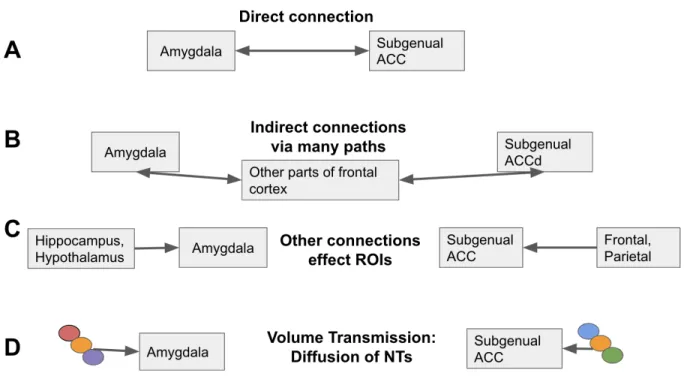
Supplementing a structural connectivity analysis with a functional connectivity analysis can also yield more detail regarding the mechanisms realizing anxiety. For instance, if I establish in Study 1 that the strength of the structural connection between amygdala and subgenual
anterior cingulate cortex (sgACC) positively predicts anxious arousal and I test for the same connection functionally, I can make certain inferences based on the joint results. In Figure 1, the top row, A, represents the situation in which the structural connectivity of a single circuit
Alternatively, there are potentially several meaningful reasons that could explain why I find evidence that structural connectivity predicts anxiety, but functional connectivity does not. One reason, depicted in Figure 1-B, is that indirect pathways between amygdala and sgACC influence functional connectivity between those regions in various ways (some amplifying, some diminishing communication between the two regions), accounting for the overall net
communication pattern being uncorrelated. Moreover, the time-course of activity in each region is potentially also influenced by many other connections (Fig 1-C) e.g., amygdala has with other regions, and with non-axonal functional dynamics (Fig 1-D; e.g., gap junctions and volume transmission; Borroto-Escuela et al., 2015).
Thus, because there could be many possible pathways between the regions that I single out a priori, I supplemented my hypothesis-driven tests involving connections between parts of frontal cortex and amygdala with a data-driven approach. In this analysis, I explored how anxious apprehension and anxious arousal can be predicted when including all amygdala
connections in a single modified regression function. The results of this data-driven approach can add information regarding how circuits other than the direct structural connection between the regions identified a priori might better predict better the relationship between functional connectivity involving key brain regions and types of anxiety. Additionally, this data-driven approach uses a process called cross-validation, in which part of the sample is used to estimate the function relating amygdala connections to anxiety levels, and an entirely independent sample is used to ‘test’ the fit of this function. This method has been demonstrated to be less susceptible to over-fitting one’s data (noise affecting one’s beta estimates, which results in poor
generalization).
Asking longitudinal questions in two ways
Finally, Study 2 will address goal (3) by examining longitudinal relationships between changes in functional connectivity within a subject with changes in self-reported anxiety across one year of development. This is vital to understanding how development impacts the
relationship between anxiety and intrinsic functional connectivity.
One way will be to see if the population-level relationship between anxiety and
A second way to test longitudinal predictions is to see if the relationship between functional connectivity and anxiety types within subjects is different than that found at the between-subjects level. Molenaar and Cambpell refer to this as the homogeneity criterion: that population level statistics are the same as within-individual statistics. When this does not hold, this is evidence that longitudinal analyses are required to estimate individual-level variation, as it may reveal dynamics quite different than the group-level statistics. A standard way to test the homogeneity criterion cannot be executed in the present study, because multiple timepoints must be sampled to fit a random-effects multilevel model. However, as is detailed in Study 2, there may be certain inferences I can make using a method of mapping within-subject changes in the brain to within-subject changes in self-reported anxiety using two timepoints. If brain-behavior changes within individuals differs from single timepoint relations between brain and anxiety measures across individuals in the population, it suggests that individuals differ significantly from each other in terms of how anxiety is implemented and shifts across time.
Concluding remarks
The ultimate goal of my dissertation is to inform an understanding of the mechanisms giving rise to types of human anxiety and their development. As has been recently articulated, mechanisms in psychology are explained through delineating the information processing steps underlying a given function, and demonstrating how such processing is implemented biologically (Montague, Dolan, Friston and Dayan, 2012; Thomas and Sharp, 2018). Together, this enables scientists to grasp structure-function relationships that deviate from 1:1 (which most
Chapter 2: HOW TYPES OF TRAIT ANXIETY ARE INSTANTIATED BIOLOGICALLY IN ADOLESCENCE
Introduction
The endeavor to explain how pathological anxiety develops has seen significant progress over the past few decades in the fields of developmental psychology (Buss & Mcdoniel, 2013) and developmental neuroscience (Pine, 2007). However, much of this work is predicated on conceiving of anxiety as a unitary construct, which contrasts with recent research in adult human neuroscience investigations of anxiety (Moser, 2013; Sharp, Miller & Heller, 2015). Indeed, it has been demonstrated that adult anxiety can be parsed into at least two distinct, transdiagnostic traits, known as anxious apprehension and anxious arousal, that have separate neural correlates and share little variance in their behavioral symptoms. Anxious apprehension is characterized by excessive worry whereas anxious arousal is marked by elevated fear and sympathetic
hyperarousal.
Past work on the development of anxiety is likely biased due to researchers not taking into account these meaningfully different types of anxiety. Indeed, previous unexplained findings in the literature on youth anxiety can be addressed by acknowledging that anxiety is
anxiety disorder comprises high levels of anxious apprehension. Moreover, a recent neurophysiological study of children with various anxiety disorders (generalized, social,
separation) and specific phobias showed that only those with specific phobia displayed elevated sympathetic hyperarousal (Dieleman et al. 2015). This unexpected disparity similarly could be explained by specific phobia comprising high levels of anxious arousal, whereas the other anxiety disorders involving high levels of anxious apprehension.
As such, the present study sought to test hypotheses regarding the self-reported indicators and neurobiological markers of anxious apprehension and anxious arousal in early adolescence, a time-period that has been shown to be a tipping-point in the development of pathological anxiety (e.g., Dahl and Hariri, 2005). I selected a priori defined structural connections from both human and non-human neuroscience research that has begun to elucidate how these forms of anxiety are implemented biologically. I first developed hypotheses about the structure of particular neural circuits for anxious arousal by pulling from non-human rodent neuroscience work on fear and anxiety (e.g., Adhikari et al., 2015). Indeed, the psychological functions thought to be involved in anxious arousal are likely shared, in part, with simpler organisms (Sharp, Miller, & Heller, 2015), which include computations regarding the likelihood of threats in the immediate environment and preparing the body to handle such threats via elevated and preparatory sympathetic arousal. I specifically focused on optogenetic studies within non-human work on anxiety because optogenetics is particularly powerful in its ability to infer causal relations among neural regions. Indeed, optogenetics allows researchers to directly control information flow in the brain between regions using light stimulation.
connection from ventral medial prefrontal cortex (vmPFC) to basomedial amygdala was found to be anxiolytic, whereas the connection between basolateral amygdala and dorsal medial prefrontal cortex (dmPFC) promoted freezing behavior under certain conditions (Adhikari et al., 2015). These findings from rodent optogenetics comport with a rich body of literature on the
relationship between these two amygdalar pathways and elevated state and trait anxiety in both rodents and human adults. Previous molecular neuroscience work in rodents identified anterior cingulate-amygdala structural connections as necessary for instantiating anxiety (Bissiere et al., 2008; Malin, Ibrahim, Tu and McGaugh, 2007). In healthy adult humans, the structural
connectivity between amygdala and dorsal anterior cingulate cortex (part of dmPFC) has been shown to positively covary with trait anxiety (Greening and Mitchell, 2015), whereas the
structural connectivity between amygdala and medial OFC (part of vmPFC) negatively covaries with trait anxiety (Greening and Mitchell, 2015; Kim and Whalen, 2009). Moreover, functional MRI studies of human adults have found that amygdala-dmPFC functional connectivity
increases as state anxiety is induced (Robinson et al., 2012, 2013, 2014). Taken together, there is support that in both rodents and human adults, the amygdala-dmPFC pathway is involved in anxiogenesis whereas the amygdala-vmPFC pathway is involved in anxiolysis.
with inhibiting immediate threat processing brought on by an orienting bias to mild threats, a process involved right iFG (MacLeod, Mathews & Tata, 1986). A set of findings indicate that chronic worriers engage both left iFG at-rest (e.g., Heller et al., 1997) and right iFG when instructed to worry (Ellard et a., 2017).
It is vital to test whether the neurobiological correlates of anxious apprehension and anxious arousal manifest in adolescence prior to the emergence of clinically-relevant
psychopathology, as the results of such studies can help identify biomarkers of psychological dysfunction that precede disease onset and can inform theories regarding the pathophysiology of the disorder. In the present study, I leveraged diffusion-weighted MRI data to examine how different types of trait anxiety, anxious arousal and anxious apprehension, are related to changes in structural connectivity in a sample of nonclinical adolescents.
(Greening & Mitchell, 2015; Vogt and Paxinos, 2014). Indeed, rACC is positioned between limbic and cortical connections and is critical for amygdala-dependent learning (Bissiere et al., 2008). Because of their more precise anatomical designation and because of their nomenclature in the atlas from which I extracted such regions, I will refer to rACC and medial OFC instead of dmPFC and vmPFC, respectively.
For anxious apprehension, instead of measuring the structural connectivity of specific circuits, I instead averaged all connections (called the “weighted degree” of a key region; Rubniov & Sporns, 2009) involving inferior frontal gyrus (iFG), a key region implicated in anxious apprehension in adult neuroimaging work (e.g., Engels et al., 2007). I chose this measure because I did not have pathway-specific information (e.g., amygdala-vmPFC) to pull from, like I did with anxious arousal, and so chose a region-level measure of structural connectivity.
Specifically, I hypothesized that the weighted degree of left and right iFG would be positively correlated with anxious apprehension. These predictions tested two the two hypotheses: (1) that anxious apprehension is positively associated with internal verbal rehearsal of worries (left iFG; e.g., Engels et al., 2007) and (2) that anxious apprehension is positively associated with
inhibiting bottom-up threat signaling (right iFG; e.g., Ellard et al., 2017).
Methods
Participants
54 adolescents participated in the present study. 14 adolescents were excluded from analyses due to corrupted diffusion weighted data (see Quality Control section below). Our final sample included 40 adolescents (21 females; mean age= 13.49 years, range = 12.16–14.78 years). Child ethnicity was reported by parents, and the questionnaire allowed for parents to report being part of more than one ethnicity (i.e., percentages will exceed 100 due to children belonging to more than one group). 10% identified their children as Hispanic (4), 25% (10) identified their children as African American, 70% (28) identified their children as Caucasian, 10% identified their children as Asian (4), 2.5% identified their children as Native American (1), and 2.5% identified their children as “other” (1). Household income was also reported by parents (3 parents chose not to report). The range of annual household income was between 18,000 and 192,000 dollars. The inner quartile range, defined by the 25th, 50th and 75th percentiles, were
35,500, 69,000 and 120,000 dollars, respectively. These are fairly representative numbers of the positively skewed distribution that exists in the general population, with a slightly elevated median income (median income in US = $61,000; Census.gov, 2017). All participants completed a phone screen, during which parents confirmed their child had no history of a clinical diagnosis of mental health disorders, were not taking any psychotropic medications, did not have a learning or developmental disability, and were free of all MR contraindications. All participants provided written informed assent and parents provided informed consent which were approved, along with the entire study protocol, by the Institutional Review Board.
Measures
Participants filled out the mini version of the Mood and Anxiety Questionnaire (Casillas and Clark, 2000), which asks participants to report about their mood and anxiety symptoms experienced over the past two weeks on a 5-point Likert scale. The anxious arousal scale consists of 10 questions measuring sympathetic hyperarousal symptomatology, such as, “my hands were shaky” or “I felt dizzy and lightheaded”. The scale had good internal consistency (Cronbach's a = 0.82). To ensure findings were specific to anxiety, I controlled for depression as measured by the 8-question depression subscale (Cronbach's a= 0.70) on this same measure.
Self-Reported Anxious Apprehension
Typically, anxious apprehension is measured using the Penn State Worry Questionnaire (Meyer et al., 1990). The present dataset used a single item from the Strengths and Difficulties Questionnaire (Goodman, 1997), “I worry a lot.” Although there are known limitations of using single-item measures, a recent large-scale study (n=9,040; Schroder, Clark & Moser, 2017) designed a single-item measure for anxious apprehension for time-limited contexts (large-scale studies, hospital settings). Indeed, Schroder, Clark and Moser (2017) found the item 15 on the PSWQ, “I worry all the time”, was correlated highly with the total PSWQ (r=.82), had a high 1-year test-retest reliability (r=.82). This question has three possible answers: 0 = Not True, 1 = Somewhat true and 2 = Certainly true.
Imaging protocol
Diffusion-weighted imaging (DWI) data were collected using a Siemens 3T Trio MRI scanner and a 32-channel head coil. The acquisitions consisted of 30-direction DTI data with a b-value of 1000 s/mm2 and 2 b= 0 s/mm2 images acquired at the beginning of the run. The
multiband factor of 2 (Auerbach et al., 2013; Setsompop et al., 2012a; Setsompop et al., 2012b; Xu et al., 2013) using the CMRR sequence, and a GRAPPA factor of 2 for parallel imaging (Griswold et al., 2002). In addition to the DTI scan, a structural T1-weighted magnetization-prepared rapid acquisition of gradient echo (MPRAGE) acquisition was acquired with 0.9 mm isotropic resolution, TE of 2.32 ms, TR of 1.9 s, and a magnetization preparation pulse with an inversion time, TI, of 900 ms. Participants lied still in the scanner and watched clips of movies so as to prevent them from falling asleep during the scan. The purpose of this scan was to measure the relatively stable structural connectivity of the brain in key circuits that does not change during the scan. Thus, unlike functional scans, participants could be thinking about anything during this scan.
Quality control
Prior to transforming data and conducting any analyses, each raw DWI file was manually checked to determine if there were artifacts that corrupted> 3 volumes in order to yield high-fidelity tractography results (Oguz et al., 2014).
Preprocessing
Prior to connectome reconstruction, diffusion weighted data were preprocessed by converting DICOM files to NIFTI format, followed by eddy current correction using an affine registration to the b= 0 image (i.e. without gradients). Finally, in preparation for probabilistic tractography, FSL's bedpostx (Behrens et al., 2007) was run, which estimates a probability distribution of primary fiber orientations at each voxel using Markov chain Monte Carlo sampling.
Freesurfer's recon-all (Fischl et al., 1999) were run on each subject's high-resolution T1-weighted structural image. This outputted a cortical parcellation from which regions were defined for subsequent probabilistic tractography. The present analysis used the 68 cortical regions defined by Freesurfer that cover the entire cortex, and 14 from subcortical regions, which comprise an 82-region connectome (Desikan et al., 2006). To prepare these regions for
tractography, each region was registered to diffusion-weighted space, first using Freesurfer's bbregistertool (using FSL's FLIRT initialization) to compute the transformation matrix from diffusion-weighted space to T1 space. This was followed by Freesurfer's mri_vol2vol to bring the Freesurfer parcellations into diffusion-weighted space using the inverse of the previously computed transformation matrix. Bbregister has been shown to improve registration beyond more traditional methods, in which the cost function examines gradient directions and magnitudes across tissue boundaries (Greve and Fischl, 2009).
Probabilistic tractography and connectome construction
FSL's probtrackx2 (Behrens et al., 2007) was used to carry out probabilistic tractography. Each entry in the connectome was normalized by the average volume of each ROI comprising the pathway.
Connection of interest analyses
weighted degree, as mentioned in the Introduction, is the average of all connection densities involving here left and right iFG. Each of these regions was defined by the Freesurfer parcellation according to the Desikan et al. (2006) atlas.
I chose not to control for gender in the regression analyses because I did not have strong
a priori reasons for thinking gender would be a confounding variable of the relationship of interest. A confounding variable must exert a causal effect on both the independent and dependent variable in a regression scheme. Indeed, although I have evidence that gender
influences anxiety (e.g., Lewinsohn et al., 1998) existing literature suggests that the relationship between gender and connectivity depends on the circuits under consideration (Ingalhalikar et al., 2014). Moreover, much of the literature on effects of gender on intrinsic connectiviy comprised unreliable neural data (e.g., 5 minutes of resting-state data; Elliott et al., 2019). Moreover, if neural correlates mediate the relation between gender and behavioral symptoms of anxiety, controlling for gender could remove meaningful variance in the relationship between brain and behavior.
Results
Table 1
Descriptive Statistics Study 1
Measure N Range Min Max Mean Std.
Deviation Skewness Anxious Arousal 40 25 0 25 6.325 6.149 1.253
Anxious Apprehension 40 2 0 2 .73 .847 .574
Depression 40 23 3 26 16.7 5.743 -.303
Descriptive findings
(beta weights) were roughly normal. Indeed, simulation studies have shown that samples as low as 15 from skewed data generate p-values almost identical to those emanating from normal data (Habeck & Brickman, 2018).
Self-report findings
As measured via self-report anxious arousal and anxious apprehension were very weakly associated (r=.052, p=.75). Depression was correlated with anxious arousal (r =.442, p =.004), and negatively related to anxious apprehension, although not statistically significantly (r = -.118, p = .47). There were gender differences in anxious apprehension, in which females had average higher levels than males (t(38)=2.27, p=.02) but not for anxious arousal (t(38)= -.45, p=.65). Neurobiological Findings
I conducted multiple regressions predicting types of anxiety from brain measures. In each regression, I controlled for depression and concurrent types of anxiety, given that we wanted to infer unique effects unrelated to potential covariates. I extracted 4 pathways comprising
amygdala to sub-regions of frontal cortex that I expected to covary with anxious arousal and extracted the weighted degree of left and right iFG that I expected to covary with anxious apprehension. For each structural pathway used to predict types of anxiety, see Table 2.
trending relationship between anxious apprehension and right iFG degree (b=.314, p=.056). See Table 3 and 4 for full results of all 12 regressions.
Table 2
Pearson correlations between selected pathways and types of trait anxiety
Measure L Amyg –
L mOFC R Amyg – R mOFC L Amyg – L rACC R Amyg – R rACC L iFG degree R iFG degree Anxious
Arousal Anxious Apprehension
.058
-.107
-.152
-.194
.466**
-.092
-.031
-.23
.035
.057
-.070
Table 3
Regression of anxiety types and depression against a priori defined amygdala circuits
L Amyg – L mOFC R Amyg – R mOFC L Amyg – L rACC R Amyg – R rACC
Variable B SE(B) β B SE(B) β B SE(B) β B SE(B) β
Intercept 33.53 10.80 9.80 3.16 0.12 0.79 1.42 1.253
Anx Arousal .63 .59 .19 -0.04 0.17 -.038 0.17 0.43 .597** -.01 0.069 -.030
Anx App -3.58 3.88 -.15 -1.56 1.140 -.219 0.18 0.28 .09 -.62 0.451 -.226
Depression -.99 .638 -.28 -.24 .19 -.233 -.019 .05 -.06 .01 .074 .026
Note: Family-wise error corrected *p < .05. **p < .01.
Table 4
Regression of anxiety types and depression against a priori defined iFG circuits
L iFG weighted degree R iFG Weighted Degree
Variable B SE B β B SE B β
Intercept 2823.09 191.70 2340.22 228.53
Anxious Arousal 4.50 10.52 0.08 -12.75 12.54 -.179
Anxious Apprehension 16.82 68.97 .04 162.70 82.23 .314
Depression -6.40 11.32 -.11 16.00 13.50 .21
Note: Family-wise error corrected *p < .05. **p < .01.