Respiratory and Bronchitic Symptoms Predict Intention to Quit
Smoking among Current Smokers with, and at Risk for, Chronic
Obstructive Pulmonary Disease
Anne C. Melzer1,2, Laura C. Feemster1,2, Kristina Crothers1, Shannon S. Carson3, Suzanne E. Gillespie4, Ashley G. Henderson3, Jerry A. Krishnan5, Peter K. Lindenauer6, Mary Ann McBurnie4, Richard A. Mularski4, Edward T. Naureckas7, A. Simon Pickard8, and David H. Au1,2; on behalf of the COPD Outcomes-based Network for Clinical Effectiveness and Research Translation Consortium
1
Division of Pulmonary and Critical Care, University of Washington, Seattle, Washington;2Center of Innovation for Veteran-Centered and Value-Driven Care, VA Puget Sound, Seattle, Washington;3University of North Carolina, Chapel Hill, North Carolina;4Kaiser Permanente Northwest, Center for Health Research, Portland, Oregon;5Population Health Sciences Program, University of Illinois Hospital & Health Sciences System, Chicago, Illinois;6Department of Medicine, Center for Quality of Care Research, Baystate Medical Center, Tufts University School of Medicine, Springfield, Massachusetts;7Department of Medicine, University of Chicago, Chicago, Illinois;
and8Department of Pharmacy Systems, Outcomes & Policy and Center for Pharmacoepidemiology & Pharmacoeconomic Research, College of Pharmacy, University of Illinois at Chicago, Chicago, Illinois
Abstract
Rationale:Smoking cessation is the most important intervention for patients with chronic obstructive pulmonary disease (COPD). What leads smokers with COPD to quit smoking remains unknown.
Objectives:We sought to examine the association between respiratory symptoms and other markers of COPD severity with intention to quit smoking among a cohort of patients with probable COPD.
Methods:We conducted a cross-sectional study of subjects with COPD orfixed airflow obstruction clinically diagnosed on the basis of pulmonary function testing. The subjects were identified in the COPD Outcomes-based Network for Clinical Effectiveness and Research Translation multicenter registry. The primary outcome was the intention to quit smoking within the next 30 days (yes or no), which was examined using model building with multivariable logistic regression, clustered by study site.
Measurements and Main Results:We identified 338 current smokers with COPD via the registry. Of these subjects, 57.4% (n = 194) had confirmed airflow obstruction based on pulmonary function testing. Nearly one-third (29.2%; n = 99) intended to quit smoking in the next
30 days. In adjusted analyses, compared with subjects without airflow obstruction based on pulmonary function testing, subjects with Global Initiative for Chronic Obstructive Lung Disease stage I/II COPD were more likely to be motivated to quit (odds ratio [OR], 1.85; 95% confidence interval [CI], 1.37–2.49), with no association found for subjects with Global Initiative for Chronic Obstructive Lung Disease stage III/IV disease. Among the entire cohort, frequent phlegm (OR, 2.10; 95% CI, 1.22–3.64), cough (OR, 1.74; 95% CI, 1.01–2.99), wheeze (OR, 1.73; 95% CI, 1.09–3.18), and higher modified Medical Research Council dyspnea score (OR, 1.26 per point; 95% CI, 1.13–1.41) were associated with increased odds of intending to quit smoking. Low self-reported health was associated with decreased odds of intending to quit (OR, 0.75; 95% CI, 0.62–0.92).
Conclusions:Frequent cough, phlegm, wheeze, and shortness of breath were associated with intention to quit smoking in the next 30 days, with a less clear relationship for severity of illness graded by pulmonary function testing and self-rated health. Thesefindings can be used to inform the content of tobacco cessation interventions to provide a more tailored approach for patients with respiratory diseases such as COPD.
Keywords:tobacco; cessation; chronic obstructive pulmonary disease
(Received in original form January 25, 2016; accepted in final form June 6, 2016 )
A.C.M. was supported by a National Institutes of Health (NIH) F32 Institutional Award (HL007287) through the Department of Pulmonary and Critical Care, University of Washington. L.C.F. was supported by an NIH National Heart, Lung, and Blood Institute (NHLBI) K23 Mentored Career Development Award (HL111116). Additional support was received through the VA Health Services Research and Development Service. Support for this project was also provided by the NHLBI (grant HL101618) to the COPD Outcomes-based Network for Clinical Effectiveness and Research Translation (CONCERT) group. The views presented are those of the researchers and do not necessarily reflect those of the Department of Veterans Affairs.
This material is based upon work supported in part by the Department of Veterans Affairs, Veterans Health Administration, Office of Research and Development. The views expressed in this article are those of the authors and do not necessarily reflect the position or policy of the Department of Veterans Affairs, the U.S. government, or the NIH.
Author Contributions:A.C.M.: conceived of the research question and performed background reading, analyses, and primary drafting and final revision of the manuscript; L.C.F. and K.C.: participated in finalizing the research question, interpretation of the analyses, and revision of the manuscript; S.E.G., A.G.H., J.A.K., P.K.L., M.A.M., R.A.M., E.T.N., S.S.C., and A.S.P.: created the cohort for analysis and assisted with interpretation of data and revision of the manuscript; and D.H.A.: provided the database for analysis, helped finalize the research question, and assisted in interpretation of the data and revision of the manuscript. Correspondence and requests for reprints should be addressed to Anne C. Melzer, M.D., M.Sc., Minneapolis VA Medical Center, 1 Veterans Way, Minneapolis, MN 55417. E-mail: [email protected]
Ann Am Thorac Soc Vol 13, No 9, pp 1490–1496, Sep 2016 Copyright©2016 by the American Thoracic Society DOI: 10.1513/AnnalsATS.201601-075OC
Tobacco use remains a major contributor to poor health, particularly among older smokers and smokers with chronic obstructive pulmonary disease (COPD) (1). After decades of successful tobacco control policies, the rate of decline in the prevalence of smoking in the United States has slowed (2). One possible explanation is that tobacco use is increasingly
concentrated among patients who are less motivated to quit or are less able to do so with conventional cessation support, making new insights into the factors that prompt a quit attempt a priority.
In previous studies, researchers reported that health concerns play a significant role in the intention and motivation to quit smoking (3, 4), with some indication that respiratory symptoms are particularly important (5). Diagnosis of a smoking-related condition can prompt individuals to make a quit attempt (6). Patients with COPD, one of the smoking-related conditions most directly attributable to tobacco use, are at very high risk for poor health due to ongoing tobacco abuse, including increased risk for lung cancer, worsening lung function, cardiovascular disease (7), and progressive respiratory symptoms. This population has been shown to benefit greatly from smoking cessation (8, 9). Unfortunately, the prevalence of smoking among individuals with COPD remains about twice as high as in the population as a whole (10). However, smokers with COPD have similar quit rates with treatment and a similar number of quit attempts when compared with smokers in general (11).
Despite the importance of cessation among patients with tobacco-related respiratory diseases, factors associated with the intention to quit smoking among patients with COPD are poorly understood. The primary goal of this study was to examine the association of respiratory symptoms, severity of airflow obstruction (AFO), and other markers of COPD disease severity with the intention to quit smoking in a cohort of patients with clinically diagnosed COPD and a subset of patients with confirmedfixed AFO. The Health Belief Model suggests that cues to action are an important part of making a change in health behavior. Therefore, we hypothesized that respiratory symptoms would predict the intention to quit smoking in the near term. Some of the results of this study were reported previously in the form of an abstract (12).
Methods
Design, Participants, and Data Source We conducted a cross-sectional study of patients who were identified as having probable COPD. The complete methods for the identification of the study population have previously been published (13). In brief, potential subjects were selected via probability-based sampling from the COPD Outcomes-based Network for Clinical Effectiveness and Research Translation (CONCERT) DataHub (14). The DataHub comprised 220,000 patients 40 years of age or older identified using a comprehensive electronic health record database from 2006–2010, drawn from seven sites representing academic, private, and integrated healthcare organizations. Patients were identified for inclusion in the database via one of three methods: (1) identification of COPD-related codes in the International Classification of Diseases, Ninth Revision; (2) a medication list that included one or more respiratory-related treatments (short- or long-acting
b-agonists, short- or long-acting
anticholinergics, inhaled corticosteroids, or formulations containing a combination of these medications); or (3) spirometry demonstratingfixed AFO.
A stratified sample of patients was invited to complete an in-person study visit, and they provided written informed consent to participate. Of those who were contacted and eligible (n = 3,350), a total of 1,206 patients (36%) agreed to participate and completed data collection procedures. Trained study personnel administered a questionnaire to collect information on demographics, self-reported comorbid conditions, symptoms, tobacco history, and intention to quit smoking. Patients completed several validated scales for assessment of dyspnea, functional status, and health-related quality of life.
Post-bronchodilator spirometry was performed and interpreted per the American Thoracic Society standards (15), with measurements of height and weight taken at the visit. The presence and frequency of phlegm, cough, and wheeze were assessed by subject report using standardized instruments by asking whether subjects often or usually experienced a given symptom. The instrument was adapted from previously described epidemiologic tools for the
purposes of this study (16). Subjects were limited to patients who identified smoking in the past 30 days (“smokers”). All smokers who completed the study visit were included in the primary analysis, with secondary analysis restricted to subjects withfixed AFO based on post-bronchodilator FEV1/FVC less than or equal to 0.7. All subjects completed and submitted informed consent forms (VA Puget Sound IRB 00207).
Predictors
The exposures included severity of AFO as measured by Global Initiative for Chronic Obstructive Lung Disease (GOLD) stage (17); respiratory symptoms; exacerbation of COPD within the past 3 months; use of home oxygen; and measures of dyspnea, functional status, and self-reported health. We used GOLD stage based on spirometry, rather than the new GOLD classification, because we lacked a full year of history to categorize subjects according to the new GOLD classification and because we wanted to examine exacerbation history and symptoms independently. Our primary measurement of shortness of breath was done using the modified Medical Research Council (mMRC) dyspnea scale (18). The mMRC dyspnea scale is a simple 5-point scale corresponding to activities that provoke dyspnea, with scores ranging from 0 (short of breath only with heavy exertion) to 4 (shortness of breath with dressing or minor activities). Assessment of phlegm, cough, and wheeze was performed using standardized questionnaires as described above.
We measured health status using the self-reported health measure of the EuroQol (EQ)-5D-5L (19), which asks subjects to assign a number to their health, ranging from 0 (worst) to 100 (best). We measured functional limitation using the Patient Reported Outcomes Measurement Information System (PROMIS)-43 scale (20, 21). The PROMIS functional limitation scale is normalized against the general population, with a score of 50
Scores were categorized in tertiles, with the less symptomatic subjects serving as the referent group.
Outcome
We were interested in capturing all smokers who expressed interest in quitting within the next 30 days. Therefore, we assessed intention to quit smoking with a single question,“Are you seriously considering quitting smoking?,”with a response of “yes, within 30 days”considered positive. This query is very similar to the assessment of the preparation stage of tobacco cessation that has been used in a number of studies (24, 25), though our assessment was purposefully more inclusive to better mirror the assessment performed in clinical practice. A statement of intention to quit within the next 30 days has been found to correlate with other markers of motivation and self-efficacy for tobacco cessation (26). While intention and motivation are conceptually different measures, an intention to change is a necessary step in the process of changing a behavior.
Confounders
We selected confoundersa priori, and these included age, race, sex, educational attainment, current smoking intensity, and time spent with other smokers in the home. Because comorbid conditions may influence intention to quit smoking, both independently and through worsening symptoms and frequency of healthcare contacts, we assessed a number of self-reported comorbidities (listed in Table 1) as potential confounders.
Statistical Analysis
We used Stata 13 software (StataCorp, College Station, TX) for statistical analysis. We used chi-square tests andttests to assess unadjusted associations. We performed logistic regression modeling. We built individual models for each symptom and marker of disease severity, adjusted for the confounders listed above, with GOLD stage excluded as a confounder from the model in which it was the primary predictor. Analyses were clustered by site using robust standard errors with a Huber-White sandwich estimator. We assessed each comorbidity for association with the outcome in an individual model, with those attaining a value ofP<0.15 in bivariate models considered for inclusion in thefinal models. Model building was repeated for
the subjects withfixed AFO on spirometry. Anavalue less than or equal to 0.05 was considered significant. No adjustment was made for multiple comparisons. Modelfit was assessed with the Hosmer-Lemeshow goodness-of-fit test and the area under the curve, which ranged from 0.71 to 0.74 for all the models.
Results
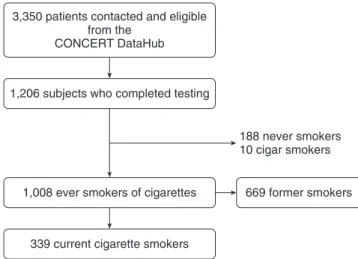
Of 3,350 potential subjects, 1,206 (36%) subjects completed the study visit. Of these 1,206 participants, 338 (28%) identified as current smokers and were included in our analysis (Figure 1). Overall, 29.2% (n = 99) of identified smokers indicated an intention Table 1. Characteristics of current smokers in two motivational stages among a cohort of patients with clinically diagnosed chronic obstructive pulmonary disease
Smokers, Intending to Quit within 30 d?
Variable Yes (n=99) No (n=239) PValue
Age, yr 60.3 (7.4, 44–85) 61.0 (8.25, 42–85) 0.496
Male sex 57 (57.6) 132 (55.7) 0.769
Race
White 61 (61.6) 171 (71.3) 0.213
Black 30 (30.3) 56 (23.3)
Other 8 (8.1) 13 (5.4)
Education 0.436
Less than high school 16 (16.2) 41 (17.3)
High school 21 (21.2) 65 (27.4)
Above high school 62 (62.6) 131 (55.3)
Smoking behavior
Current smoking, cigarettes/d 10.2 (9.1, 1–40) 15.5 (10.7, 1–70) ,0.001 Pack-years 45.3 (32.0, 0.3–171) 49.3 (28.7, 2.6–182) 0.868 Hours with other smokers
in the home
2.3 (4.8, 0–24) 3.3 (6.6, 0–24) 0.164
Symptoms and disease severity
Phlegm most days 56 (56.6) 102 (42.5) 0.018
Cough most days 68 (68.7) 143 (60.4) 0.152
Wheeze often 68 (68.7) 135 (56.3) 0.034
mMRC dyspnea scale* 1.55 (1.06, 0–4) 1.39 (1.05, 0–4) 0.222 Prescribed medications
for breathing
74 (74.7) 169 (70.4) 0.421
Ever prescribed home oxygen 24 (24.2) 37 (15.4) 0.054
COPD exacerbation in the past 3 mo
13 (13.1) 30 (12.5) 0.874
FACIT dyspnea 46.4 (9.32, 27.7–72.2) 45.2 (8.4, 27.7–72.2) 0.245 EQ-5D-5L: self-reported health† 70.9 (18.2, 20–100) 60.0 (20.1, 10–100) 0.037 PROMIS physical function 40.0 (6.4, 26.5–57.8) 40.1 (7.2, 26.5–57.8) 0.931
Self-report of COPD‡ 72 (72.7) 174 (73.4) 0.909
GOLD stage 0.433
Nofixed airflow obstruction 40 (40.4) 105 (44.3)
I/II 43 (43.4) 85 (35.9)
III/IV 16 (16.2) 47 (19.8)
Comorbid conditions
Lung cancer 3 (3.0) 9 (3.8)
Diabetes 17 (17.2) 64 (26.7) 0.062
CHF 18 (18.2) 41 (17.1) 0.808
Stroke 14 (14.1) 38 (15.8) 0.094
Depression 57 (57.6) 127 (52.9) 0.434
CAD 35 (35.4) 89 (37.6) 0.710
Kidney disease 14 (14.1) 47 (19.8) 0.177
OSA 32 (32.3) 51 (21.5) 0.031
Definition of abbreviations: CAD = coronary artery disease; CHF = congestive heart failure; COPD = chronic obstructive pulmonary disease; EQ = EuroQol; FACIT = Functional Assessment of Chronic Illness Therapy; GOLD = Global Initiative for Chronic Obstructive Lung Disease;
mMRC = modified Medical Research Council; OSA = obstructive sleep apnea; PROMIS = Patient Reported Outcomes Measurement Information System.
Values presented are mean (SD, range) or number (percent). Missingness was less than 2% for all variables.Pvalues were calculated using chi-squarettests.
*Missing for four subjects.
†Reported on 0–100 scale, worst to best. ‡
to quit smoking in the next 30 days. In unadjusted analyses, subjects who intended to quit smoking in the next 30 days smoked fewer cigarettes daily, reported more respiratory symptoms, and were more likely to experience sleep apnea. There were no observed differences in dyspnea or physical function, though smokers who intended to quit reported higher self-rated health on the EQ-5D-5L (Table 1).
Association of Symptoms and Disease Severity
In adjusted analyses, GOLD stage demonstrated a U-shaped association with intention to quit smoking. In comparison with smokers withoutfixed AFO on spirometry, subjects with GOLD stage I/II COPD were more likely to intend to quit smoking in the next 30 days (odds ratio [OR], 1.85; 95% confidence interval [CI], 1.37–2.49), whereas subjects with GOLD stage III/IV disease were not (OR, 1.11; 95% CI, 0.66–1.87). Several respiratory symptoms were associated with almost double the odds of intending to quit smoking within the next 30 days: phlegm on most days (OR, 2.10; 95% CI, 1.22–3.64), cough (OR, 1.74; 95% CI, 1.01–2.99), and frequent wheeze (OR, 1.73; 95% CI, 1.09–3.18).
For each point higher on the mMRC dyspnea scale, corresponding to more dyspnea, we found higher odds of intending to quit smoking in the next 30 days (OR, 1.26; 95% CI, 1.13–1.41). Subjects with the lowest self-rated health on the EQ-5D-5L were less likely to intend to quit smoking in both groups (OR, 0.75; 95% CI, 0.62–0.92;
and OR, 0.67; 95% CI, 0.49–0.92) (Table 2). These same relationships were observed among subjects withfixed AFO based on pulmonary function testing, though wheeze was not statistically significant.
Shortness of breath as measured by the FACIT dyspnea scale was not associated with intention to quit smoking, though there was a non–statistically significant trend for an association between intending to quit and more dyspnea (OR, 1.84; 95% CI, 0.92–3.70). Other markers of disease severity were not associated with intention to quit smoking in the next 30 days among the overall cohort, including physical function as measured by the PROMIS physical function scale, exacerbation of COPD within the past 3 months, the use of respiratory medications, and having been prescribed home oxygen at any time. However, among subjects withfixed AFO, use of home oxygen (OR, 1.79; 95% CI, 1.04–3.09) and a moderate but not severe amount of physical limitation based on the PROMIS scale (OR, 2.05; 95% CI,
1.06–3.97) were both associated with increased odds of intending to quit smoking in the next 30 days (Table 2).
Discussion
Within this cohort of current smokers, comprising both those with probable COPD and those with confirmed COPD, near-term intention to quit smoking was associated with symptoms suggestive of chronic bronchitis and shortness of breath, but it was less clearly associated with other
measures reflective of COPD severity. These results were found among the overall cohort with a clinical diagnosis of COPD as well as among the subjects withfixed AFO based on pulmonary function testing. These findings suggest that symptom burden is more highly associated with the intention to quit smoking than with other measures of COPD severity, such as a history of exacerbations, more severe lung disease based on spirometry, or use of home oxygen. More than hospitalizations or the use of medication, frequent symptoms may be socially disruptive and difficult to conceal or ignore.
In previous studies (27–29), patients with bronchitic symptoms such as phlegm, cough, and wheeze realized significant improvements in these symptoms if they were successful at smoking cessation. Patients who are motivated to quit smoking in the setting of these symptoms may therefore be counseled regarding the likelihood of improvement if they are successful.
Typical physician-based tobacco counseling is focused on the“dangers of tobacco use”(30), such as the increased risks for cancer, worsening lung function, oxygen dependence, and death. The Health Belief Model suggests that the motivation to change a potentially dangerous behavior depends on a number of factors, including the patient’s belief regarding susceptibility to a particular health concern (31). While physicians are well aware of the potential long-term risks for their patients, patients may not fully perceive their risk for these future complications. Misinformation on the risks of tobacco use is common among smokers, and it is detrimental to quit attempts (32, 33). However, symptoms that are readily apparent on a daily basis are harder to deny and may therefore lead to more quit attempts.
These data support the use of a tailored approach to tobacco cessation among older smokers with and at risk for COPD, an approach focused on more immediately tangible rewards, and suggest that the most opportune time for providers to discuss smoking cessation may be when patients report cough, phlegm, wheeze, or shortness of breath. Although it is a necessaryfirst step, intention to quit smoking does not necessarily translate into a successful attempt to do so (34). Focusing on symptoms as a motivating factor for a cessation attempt may be beneficial by 1,206 subjects who completed testing
339 current cigarette smokers
1,008 ever smokers of cigarettes 669 former smokers 188 never smokers 10 cigar smokers 3,350 patients contacted and eligible
from the CONCERT DataHub
providing a more immediate, concrete, and positive reason for a behavior change (35). Thisfits within the framework of the“five R’s”of motivational interviewing
(relevance, risks, rewards, roadblocks, and repeat), an evidence-based method designed to help motivate the unmotivated smoker or aid the motivated smoker struggling with turning thought into action (36). Recent data indicate that providers are already much more likely to provide counseling and assistance to smokers with COPD, with undiagnosed or asymptomatic smokers assisted at a much lower rate (37). Although symptoms may provide an excellent opportunity for a clinician to initiate a discussion of smoking cessation, an absence of symptoms does not relieve the clinician from recommending or providing smoking cessation therapies.
We also observed that patients with GOLD stage I/II disease were more likely to intend to quit in the near term than were
those with GOLD stage III/IV disease, and that subjects with the lowest self-reported health were less likely to endorse an intention to quit smoking in the next 30 days. Thefinding that subjects with mild to moderate COPD were more likely than those without AFO to intend to quit smoking was unsurprising.
However, it is concerning that smokers with more severe COPD and subjects with worse self-reported health were less likely to intend to quit smoking. These data are consistent with those in prior studies which showed that older smokers and smokers with COPD were less likely to recognize and endorse the benefits of cessation, and believed that they themselves wouldfind quitting too hard (38–40). We may have identified a subgroup of smokers with COPD at the highest risk of ongoing danger due to tobacco use. Ourfindings persist despite adjustment for heaviness of tobacco use, time spent with other smokers, and
other markers of socioeconomic status. Therefore, the subgroup of smokers with heavy tobacco use, other smokers in the home, and low socioeconomic status in addition to COPD and respiratory symptoms may represent the highest-risk group for ongoing tobacco abuse and warrant further investigation.
An alternative explanation for our findings is that smokers who were more motivated to quit may have stopped smoking at an earlier disease stage, leaving a population of“hard-core”smokers at higher GOLD stages. Again, this underscores the need for tailored treatments for smokers with significant pulmonary disease, aimed at getting them to quit earlier in the disease process. In previous studies examining interventions tailored to older smokers, researchers found improved cessation rates (41). Such personalized materials may be beneficial for patients with lung diseases.
Table 2. Adjusted odds ratios of endorsing intention to quit smoking within next 30 days among current smokers with or without
fixed airflow obstruction, by symptoms and markers of disease severity
Variable All Smokers (n=338) Subjects with COPD Based on PFT (n=194)
OR 95% CI PValue OR 95% CI PValue
GOLD stage
0 (no COPD) Reference — —
I–II (mild to moderate) 1.85 1.37–2.49 ,0.001 Reference
III–IV (severe to very severe) 1.11 0.66–1.87 0.694 0.67 0.38–1.17 0.157
Phlegm most days 2.10 1.22–3.64 0.007 2.41 1.37–4.24 0.034
Cough most days 1.74 1.01–2.99 0.045 2.15 1.06–4.36 0.034
Wheeze frequently 1.73 1.09–3.18 0.023 1.98 0.94–4.18 0.071
mMRC dyspnea scale, per point higher* 1.26 1.13–1.41 ,0.001 1.22 1.05–1.42 0.008
Exacerbation in past 3 mo 0.92 0.63–1.33 0.645 1.62 0.64–4.08 0.308
Prescribed home oxygen 1.85 0.90–3.76 0.090 1.79 1.04–3.09 0.036
Reported physician-diagnosed COPD, emphysema, or chronic bronchitis
0.97 0.69–1.38 0.874 1.34 0.73–2.44 0.348
FACIT dyspnea score†
<40 Reference Reference
40–49 1.35 0.80–2.28 0.264 1.42 0.57–3.53 0.453
>50 1.84 0.92–3.70 0.087 2.00 0.86–4.68 0.105
PROMIS score, physical function‡
>42 Reference Reference
35–42 1.47 0.85–2.55 0.168 2.05 1.06–3.97 0.033
<35 1.12 0.52–2.42 0.775 1.06 0.51–2.19 0.881
EQ-5D-5L, self-reported health, 0–100 from worst to best
>80 Reference Reference
60–80 1.35 0.80–2.26 0.257 1.00 0.70–1.44 0.984
<60 0.75 0.62–0.92 0.005 0.67 0.49–0.92 0.012
Definition of abbreviations: CI = confidence interval; COPD = chronic obstructive pulmonary disease; EQ = EuroQol; FACIT = Functional Assessment of Chronic Illness Therapy; GOLD = Global Initiative for Chronic Obstructive Lung Disease; mMRC = modified Medical Research Council; OR = odds ratio; PFT = pulmonary function testing; PROMIS = Patient Reported Outcomes Measurement Information System.
Models are adjusted for age, race, education, cigarettes smoked daily, GOLD stage, hours spent with another smoker, and comorbidities, clustered by site. Bold type indicates statistically significant values.
*n = 333 and n = 191 for all smokers and subjects with COPD, respectively, due to missingness.
†Normalized against an average of 50, with higher score meaning more dyspnea. ‡
Strengths and Limitations
Our study has several limitations. Inference is limited due to the cross-sectional nature of the data. Smoking status was determined by self-report and was not biochemically confirmed. While information on the number of cigarettes smoked daily was available, additional testing of level of addiction was not performed. The stated intent to quit smoking was measured at a single time point, with the possibility of overreporting due to social desirability. However, recent data suggest that subjects do not frequently overreport a desire to quit smoking, regardless of the modality of measurement (42). Measures of recent exacerbations, comorbidities, and use of oxygen were based on patient report, which may have introduced recall bias by severity of disease. The recall period was within accepted time periods for more accurate recall, and we would anticipate this bias to be nondifferential to our outcome.
Although the subjects who completed the study visit appeared to be representative of the DataHub as a whole, we had a relatively low response rate, which may have introduced selection bias. Subjects who agree to participate in research may differ from the population with and at risk for
COPD overall. We would anticipate that these subjects might be more engaged in healthcare and therefore more likely to report an intention to quit smoking in the next 30 days. However, the proportion of our subjects (28.2%) who indicated an intention to quit smoking in the next 30 days was nearly identical to that found in a national population-based study of subjects with self-reported COPD (37). Finally, we were able to assess only intent to quit smoking, not whether those intentions led to success.
Our study has a number of strengths. We selected patients from a large database across multiple sites and cities, improving the generalizability of the results to the population of smokers with and at risk for COPD. We had access to spirometry, the gold standard for the diagnosis of COPD, as well as to detailed demographic data. Last, we had access to a number of highly validated measures of symptom burden and physical limitation.
Conclusions
Respiratory symptoms consistent with chronic bronchitis were significantly associated with the intention to quit smoking. This suggests that a focus on the
daily experience of smokers—more than on the other downstream complications—may be helpful when encouraging quit attempts for all smokers. This information can particularly be used to help tailor cessation support materials and counseling for symptomatic smokers and smokers with COPD. Addressing tobacco use when respiratory symptoms are present may improve quit rates among a population of chronically ill and potentially recalcitrant smokers.n
Author disclosuresare available with the text of this article at www.atsjournals.org.
Acknowledgment:This material is based upon work supported by the Department of Veterans Affairs, Health Services Research and
Development Service, which provided access to data, office space, and programming and data management. The views expressed in this article are those of the authors and do not necessarily reflect the position or policy of the Department of Veterans Affairs. The authors acknowledge the other member sites of the CONCERT
Consortium, without which this project could not have been completed. D.H.A. has personally reviewed the data, understands the statistical methods employed for efficacy analysis, and confirms an understanding of this analysis, that the methods are clearly described and that they are a fair way to report the results.
References
1 Centers for Disease Control and Prevention, National Center for Chronic Disease Prevention and Health Promotion, Office on Smoking and Health. The health consequences of smoking—50 years of progress: a report of the Surgeon General. Rockville, MD: U.S. Department of Health and Human Services; 2014:171. 2 Jamal A, Agaku IT, O’Connor E, King BA, Kenemer JB, Neff L. Current
cigarette smoking among adults—United States, 2005-2013.MMWR Morb Mortal Wkly Rep2014;63:1108–1112.
3 Hymowitz N, Cummings KM, Hyland A, Lynn WR, Pechacek TF, Hartwell TD. Predictors of smoking cessation in a cohort of adult smokers followed forfive years.Tob Control1997;6(Suppl 2): S57–S62.
4 Duncan CL, Cummings SR, Hudes ES, Zahnd E, Coates TJ. Quitting smoking: reasons for quitting and predictors of cessation among medical patients.J Gen Intern Med1992;7:398–404.
5 Lando HA, Johnson KM, Graham-Tomasi RP, McGovern PG, Solberg L. Urban Indians’smoking patterns and interest in quitting.Public Health Rep1992;107:340–344.
6 Twardella D, Loew M, Rothenbacher D, Stegmaier C, Ziegler H, Brenner H. The diagnosis of a smoking-related disease is a prominent trigger for smoking cessation in a retrospective cohort study.J Clin Epidemiol2006;59:82–89.
7 Curkendall SM, DeLuise C, Jones JK, Lanes S, Stang MR, Goehring E Jr, She D. Cardiovascular disease in patients with chronic
obstructive pulmonary disease, Saskatchewan Canada cardiovascular disease in COPD patients.Ann Epidemiol2006; 16:63–70.
8 Anthonisen NR, Connett JE, Kiley JP, Altose MD, Bailey WC, Buist AS, Conway WA Jr, Enright PL, Kanner RE, O’Hara P,et al. Effects of smoking intervention and the use of an inhaled anticholinergic
bronchodilator on the rate of decline of FEV1: the Lung Health Study.
JAMA1994;272:1497–1505.
9 Anthonisen NR, Skeans MA, Wise RA, Manfreda J, Kanner RE, Connett JE; Lung Health Study Research Group. The effects of a smoking cessation intervention on 14.5-year mortality: a randomized clinical trial.Ann Intern Med2005;142:233–239.
10 Vozoris NT, Stanbrook MB. Smoking prevalence, behaviours, and cessation among individuals with COPD or asthma.Respir Med
2011;105:477–484.
11 Coronini-Cronberg S, Heffernan C, Robinson M. Effective smoking cessation interventions for COPD patients: a review of the evidence.
JRSM Short Rep2011;2:78.
12 Melzer AC, Feemster LC, Crothers KA, Gillespie SE, Henderson AG, Krishnan JA, Lindenauer PK, McBurnie MA, Mularski RA, Naureckas ET,et al. Respiratory symptoms predict motivation to quit smoking among smokers with and without COPD [abstract].Am J Respir Crit Care Med2016;193:A6515.
13 Prieto-Centurion V, Rolle AJ, Au DH, Carson SS, Henderson AG, Lee TA, Lindenauer PK, McBurnie MA, Mularski RA, Naureckas ET,et al.; CONCERT Consortium. Multicenter study comparing case definitions used to identify patients with chronic obstructive pulmonary disease.Am J Respir Crit Care Med2014;190:989–995. 14 Krishnan JA, Lindenauer PK, Au DH, Carson SS, Lee TA, McBurnie MA,
Naureckas ET, Vollmer WM, Mularski RA; COPD Outcomes-based Network for Clinical Effectiveness and Research Translation. Stakeholder priorities for comparative effectiveness research in chronic obstructive pulmonary disease: a workshop report.Am J Respir Crit Care Med2013;187:320–326.
15 Miller MR, Hankinson J, Brusasco V, Burgos F, Casaburi R, Coates A, Crapo R, Enright P, van der Grinten CP, Gustafsson P,et al.; ATS/ERS Task Force. Standardisation of spirometry.Eur Respir J
16 Ferris BG. Epidemiology Standardization Project: II. Recommended respiratory disease questionnaires for use with adults and children in epidemiological research.Am Rev Respir Dis1978;118:7–57. 17 Rabe KF, Hurd S, Anzueto A, Barnes PJ, Buist SA, Calverley P, Fukuchi Y,
Jenkins C, Rodriguez-Roisin R, van Weel C,et al.; Global Initiative for Chronic Obstructive Lung Disease. Global strategy for the diagnosis, management, and prevention of chronic obstructive pulmonary disease: GOLD executive summary.Am J Respir Crit Care Med
2007;176:532–555.
18 Bestall JC, Paul EA, Garrod R, Garnham R, Jones PW, Wedzicha JA. Usefulness of the Medical Research Council (MRC) dyspnoea scale as a measure of disability in patients with chronic obstructive pulmonary disease.Thorax1999;54:581–586.
19 Herdman M, Gudex C, Lloyd A, Janssen M, Kind P, Parkin D, Bonsel G, Badia X. Development and preliminary testing of the newfive-level version of EQ-5D (EQ-5D-5L).Qual Life Res2011;20:1727–1736. 20 Rose M, Bjorner JB, Becker J, Fries JF, Ware JE. Evaluation
of a preliminary physical function item bank supported the expected advantages of the Patient-Reported Outcomes Measurement Information System (PROMIS).J Clin Epidemiol
2008;61:17–33.
21 Cella D, Yount S, Rothrock N, Gershon R, Cook K, Reeve B, Ader D, Fries JF, Bruce B, Rose M; PROMIS Cooperative Group. The Patient-Reported Outcomes Measurement Information System (PROMIS): progress of an NIH Roadmap cooperative group during itsfirst two years.Med Care2007;45(5, Suppl 1):S3–S11.
22 Yount SE, Choi SW, Victorson D, Ruo B, Cella D, Anton S, Hamilton A. Brief, valid measures of dyspnea and related functional limitations in chronic obstructive pulmonary disease (COPD).Value Health2011; 14:307–315.
23 Choi SW, Victorson DE, Yount S, Anton S, Cella D. Development of a conceptual framework and calibrated item banks to measure patient-reported dyspnea severity and related functional limitations.
Value Health2011;14:291–306.
24 DiClemente CC, Prochaska JO, Fairhurst SK, Velicer WF, Velasquez MM, Rossi JS. The process of smoking cessation: an analysis of precontemplation, contemplation, and preparation stages of change.
J Consult Clin Psychol1991;59:295–304.
25 Prochaska JO, DiClemente CC, Norcross JC. In search of how people change: applications to addictive behaviors.Am Psychol1992;47: 1102–1114.
26 Sciamanna CN, Hoch JS, Duke GC, Fogle MN, Ford DE. Comparison of
five measures of motivation to quit smoking among a sample of hospitalized smokers.J Gen Intern Med2000;15:16–23.
27 Buist AS, Sexton GJ, Nagy JM, Ross BB. The effect of smoking cessation and modification on lung function.Am Rev Respir Dis
1976;114:115–122.
28 Krzyzanowski M, Robbins DR, Lebowitz MD. Smoking cessation and changes in respiratory symptoms in two populations followed for 13 years.Int J Epidemiol1993;22:666–673.
29 Willemse BWM, Postma DS, Timens W, ten Hacken NHT. The impact of smoking cessation on respiratory symptoms, lung function, airway hyperresponsiveness and inflammation.Eur Respir J2004;23: 464–476.
30 Abi-Fadel F, Gorga J, Fahmy S. Smoking cessation counselling: who does best–pulmonologists or GPs?Prim Care Respir J2013;22: 17–18.
31 Strecher VJ, Champion VL, Rosenstock IM. The Health Belief Model and health behavior. In: Goschman DS, editor. Handbook of health behavior research. Vol. 1. New York: Plenum; 1997. pp. 71–91. 32 Reimer RA, Gerrard M, Gibbons FX. Racial disparities in smoking
knowledge among current smokers: data from the health information national trends surveys.Psychol Health2010;25:943–959.
33 Donz ´e J, Ruffieux C, Cornuz J. Determinants of smoking and cessation in older women.Age Ageing2007;36:53–57.
34 Borland R, Yong HH, Balmford J, Cooper J, Cummings KM, O’Connor RJ, McNeill A, Zanna MP, Fong GT. Motivational factors predict quit attempts but not maintenance of smoking cessation:findings from the International Tobacco Control Four country project.Nicotine Tob Res2010;12(Suppl):S4–S11.
35 Madson MB, Loignon AC, Lane C. Training in motivational interviewing: a systematic review.J Subst Abuse Treat2009;36:101–109. 36 Lai DT, Cahill K, Qin Y, Tang JL. Motivational interviewing for smoking
cessation.Cochrane Database Syst Rev2010;(1):CD006936. 37 Schauer GL, Wheaton AG, Malarcher AM, Croft JB. Health-care
provider screening and advice for smoking cessation among smokers with and without COPD: 2009-2010 National Adult Tobacco Survey.Chest2016;149:676–684.
38 Rimer BK, Orleans CT, Keintz MK, Cristinzio S, Fleisher L. The older smoker: status, challenges and opportunities for intervention.Chest
1990;97:547–553.
39 Orleans CT, Jepson C, Resch N, Rimer BK. Quitting motives and barriers among older smokers: the 1986 Adult Use of Tobacco Survey revisited.Cancer1994;74(7, Suppl):2055–2061.
40 Wilson JS, Elborn JS, Fitzsimons D.‘It’s not worth stopping now’: why do smokers with chronic obstructive pulmonary disease continue to smoke? A qualitative study.J Clin Nurs2011;20:819–827.
41 Rimer BK, Orleans CT, Fleisher L, Cristinzio S, Resch N, Telepchak J, Keintz MK. Does tailoring matter? The impact of a tailored guide on ratings and short-term smoking-related outcomes for older smokers.
Health Educ Res1994;9:69–84.