FACULTY PERCEPTIONS OF ORGANIZATIONAL CULTURE IN SAUDI ARABIAN SCHOOLS OF NURSING: A MIXED METHODS STUDY
Sanaa Awwad Alsulami
A dissertation submitted to the faculty at the University of North Carolina at Chapel Hill in partial fulfillment of the requirements for the degree of Doctor of Philosophy in the School of
Nursing.
Chapel Hill 2018
Approved by: Gwen Sherwood
© 2018
ABSTRACT
Sanaa Awwad Alsulami: Faculty Perceptions of Organizational Culture in Saudi Arabian Schools of Nursing: A Mixed Methods Study
(Under the direction of Gwen Sherwood)
Schools of nursing worldwide are confronting a growing faculty shortage. As many middle eastern countries, Saudi Arabia is relying on large numbers of mostly expatriate faculty working in nursing schools. Evidence shows that individual from different cultural backgrounds bring with them their own behaviors, expectations, values, and preferences to the workplace. Thus, they have various descriptions and preferences of their current work experience. In Saudi literature, organizational culture of nursing schools and leadership strategies used to manage largely non-Saudi academic environments have not been examined yet. This dissertation hence aimed to examine the perceptions of deans/ directors and multicultural faculty of Saudi nursing schools regarding the organizational culture and leadership strategies used to manage the diverse academic environments, and the influence of faculty diversity on schools’ outcomes. The
Competing Values Framework (CVF) was used to guide this dissertation.
Three papers were produced to reach the overall purpose of this dissertation. The
strategies used currently to manage the diverse academic environments and the influence of faculty diversity on schools’ outcomes. The third paper focused on examining the perceptions of multicultural faculty regarding the existing and preferred organizational culture for Saudi nursing schools and leadership strategies used by deans/ directors. Overall findings of the three papers were that deans/ directors and faculty of Saudi schools of nursing experienced both challenges from working in a multicultural workforce and benefits from its positive impacts on themselves, their students, and the school’s outcomes. The commitment of school leaders toward diversity and using mixed and effective leadership strategies are substantial for creating an inclusive work culture for all faculty through open-communication, institutional involvement, respectful
To my beloved parents, Awwad and Radhyah Alsulami
Thank you very much for teaching me to trust in Allah and to believe in myself. Without your unconditional love, inspiration, and prayers, I would not be here today.
To my sisters, Nada, Samar, Shaimaa, Shatha, and Dana To my brothers, Ahmad, Mashari, and Abdulaziz
Your continued support was inspirational and provided the foundation for my success. To my lovely husband, Wael
I heartily thank you for your patience, understanding, and extremely tolerant during my graduate study. Your sacrifices to see my dream becomes a reality are appreciated forever.
To my daughter, Rateel, and my son, Tamim
ACKNOWLEDGMENT
This ‘long and winding road’ required much help and guidance from many wonderful people!
First and foremost, I would like to thank “Almighty Allah” for giving me the time, opportunity, strength, and privilege to complete this work successfully.
I would like to acknowledge the skilled direction, advice, input, and enthusiastic encouragement of a person who helped me from the very beginning to the end of this journey. My valiant advisor, Dr. Gwen Sherwood, has the ability to guide her advisees on a path to new knowledge and discovery that may not otherwise have been developed. Thank you, Dr.
Sherwood.
I also would like to thank all the members of my dissertation committee for their time and effort. Each member provided me with valuable insights that I will appreciate forever. Thank you very much, Dr. Gwen Sherwood, Dr. Donna Havens, Dr. Cheryl Jones, and Dr. Ruth Anderson from the University of North Carolina at Chapel Hill in the United States, and Dr. Ahmad Aboshaiqah from King Saud University in Saudi Arabia. Without your proper guidance, persistent assistance, and feedback, this dissertation would not have been successfully accomplished.
My appreciation also is extended to all members of the School of Nursing at the
University of North Carolina at Chapel Hill for the culture of caring and support that they have provided me.
I would like to extend my heartfelt appreciation to Umm Al-Qura University for granting me a full scholarship to obtain my PhD. I would also express my special appreciation and thanks to deans/ directors of Saudi Arabian schools of nursing, the recruitment process and data
TABLE OF CONTENTS
LIST OF TABLES ...xii
LIST OF FIGURES ...xiv
LIST OF ABBREVIATIONS...xv
CHAPTER 1: INTRODUCTION ...1
Introduction ...1
Study Aims...7
Definitions of Terms ...7
Theoretical Framework...9
Dissertation Plan...12
REFERENCES ...13
CHAPTER 2: THE EXPERIENCE OF CULTURALLY DIVERSE FACULTY IN ACADEMIC ENVIRONMENTS: A MULTI-COUNTRY SCOPING REVIEW...15
Introduction...15
Method...18
Findings...21
Characteristics of the Studies ...21
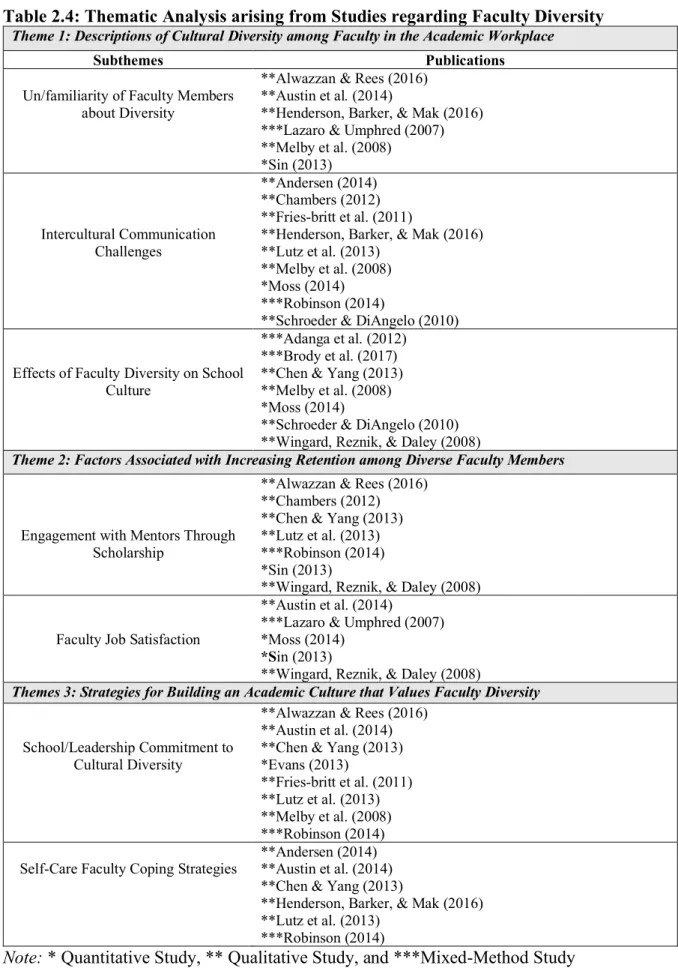
Thematic Analysis ...28
Discussion...36
Conclusion ...38
REFERENCES ...40
CHAPTER 3: DEANS’ PERCEPTIONS OF LEADERSHIP STRATEGIES USED TO MANAGE A MULTICULTURAL FACULTY ENVIRONMENT IN SAUDI ARABIAN NURSING SCHOOLS: A QUALITATIVE STUDY...43
Introduction...43
Method...45
Data Collection …...46
Data Analysis...47
Findings...48
Theme 1: Description of Cultural Diversity in Saudi Schools of Nursing...48
Theme 2: Challenges of Managing a Multicultural Faculty Environment...50
Theme 3: Leadership Strategies Used by Saudi Deans ...52
Theme 4: Impact of Multiculturalism on Nursing Schools...53
Discussion...54
Study Strengths and Limitations ...57
Conclusion ...58
REFERENCES ...60
CHAPTER 4: FACULTY PERCEPTIONS OF ORGANIZATIONAL CULTURE IN SAUDI ARABIAN SCHOOLS OF NURSING: A MIXED METHODS STUDY...62
Introduction...62
Method...64
Recruitment ...67
Data Collection ...69
Organizational Culture Assessment Instrument (Part I) ...69
Open-ended questions (Part II) ...72
Demographic data survey (Part III) ...73
Data Analysis...73
Quantitative Data Analysis ...73
Qualitative Data Analysis ...76
Findings...77
Demographic Data ...77
Quantitative Findings...80
Qualitative Findings...96
Linking Cultural Variables with Thematic Categories ...113
Discussion...120
Merging Quantitative and Qualitative Data: Current and Preferred Organizational Culture ...120
Merging Quantitative and Qualitative Data: Current and Preferred Leadership Strategies ...127
Study Strengths and Limitations ...133
Implication...135
Implications for Practice ...135
Implications for Education ...136
Conclusion ...137
REFERENCES ...139
CHAPTER 5: FINDINGS SYNTHESIS AND IMPLICATIONS ...145
Introduction ...145
First Paper (Chapter 2): “The Experience of Culturally Diverse Faculty in Academic Environments: A Multi-Country Scoping Review” ...146
Second Paper (Chapter 3): “Deans’ Perceptions of Leadership Strategies Used to Manage A Multicultural Faculty Environment in Saudi Arabian Nursing Schools: A Qualitative Study” ...147
Third Paper (Chapter 4): “Faculty Perceptions of Organizational Culture in Saudi Arabian Schools of Nursing: A Mixed Methods Study” ...149
Synthesis of Findings from the Three Papers ...151
Dissertation’s Strengths and Limitations...153
Implications ...154
Implications for Academic Leadership Practice ...154
Implications for Education ...155
Implications for Research ...156
Conclusion ...156
REFERENCES ...158
APPENDIX 3.1. A CONSENT FORM TO PARTICIPATE IN A RESEARCH STUDY...159
APPENDIX 3.2. GUIDE FOR SEMI-STRUCTURED INTERVIEW WITH DEANS OF NURSING SCHOOLS IN SAUDI ARABIA ...160
APPENDIX 4.1. THREE-PART SURVEY ...161
LIST OF TABLES
Table 2.1. Comparisons of Qualitative Studies Related to Faculty Diversity
Across Countries ...23
Table 2.2. Comparisons of Quantitative Studies Related to Faculty Diversity Across Countries ...26
Table 2.3. Comparisons of Mixed-Method Studies Related to Faculty Diversity Across Countries ...27
Table 2.4. Thematic Analysis arising from Studies regarding Faculty Diversity...29
Table 4.1. Demographic Characteristics of Survey Respondents ...79
Table 4.2. OCAI Results ...82
Table 4.3. Mean Scores for Current and Preferred Organizational Culture of Saudi Arabian Nursing Schools ...85
Table 4.4. Pearson Correlation Values Between the Variables of the Current Organizational Culture of Schools of Nursing in Saudi Arabia ...86
Table 4.5. Pearson Correlation Values Between the Variables of the Preferred Organizational Culture of Schools of Nursing in Saudi Arabia ...86
Table 4.6. Means Scores of Current Organizational Culture reported by Faculty in Saudi Nursing Schools by Gender, Age, Nationality, Ethnicity, Educational Background, Professional Rank, and Years of Experience...93
Table 4.7. Means Scores of Preferred Organizational Culture reported by Faculty in Saudi Nursing Schools by Gender, Age, Nationality, Ethnicity, Educational Background, Professional Rank, and Years of Experience...94
Table 4.8. Top ranked current and preferred organizational culture reported by Faculty of Saudi Nursing Schools: Current and Preferred Conditions ...95
Table 4.9. Number of Participants Responded/ Did Not Respond to the Open-Ended Questions ...97
Table 4.10. Categories, Themes, and Codes that represent the Current Leadership Strategies used by Deans/Directors of Saudi Nursing Schools ... 101
Table 4.12. Participants’ Cultural Variables Convergent with Thematic Categories
of Current Leadership Strategies ...116 Table 4.13. Participants’ Cultural Variables Convergent with Thematic Categories
LIST OF FIGURES
Figure 1.1. The Competing Values Framework developed by Cameron and
Quinn (1981) ...11
Figure 2.1. PRISMA Flow Diagram of the Selection Process of the Studies...20
Figure 4.1. The Competing Values Framework...64
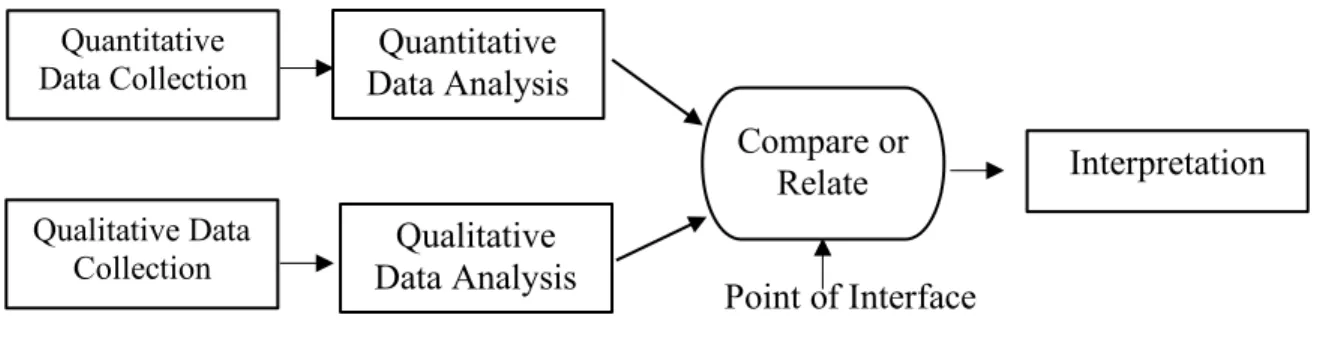
Figure 4.2. Convergent Parallel Mixed Methods Design ...65
Figure 4.3. Individual figures that illustrate the current and preferred values for each of the six categories ...83
Figure 4.4. The overall cultural profile for nursing schools in Saudi Arabia ...84
Figure 4.5. Converged OCAI scores: Faculty perspectives of the current organizational culture ...126
Figure 4.6. Converged OCAI scores: Faculty perspectives of the preferred organizational culture ...127
Figure 4.7. Converged OCAI scores: Faculty perspectives of the current leadership strategies ...131
Figure 4.8. Converged OCAI scores: Faculty perspectives of the preferred leadership strategies ...131
LIST OF ABBREVIATIONS AACN American Association of Colleges of Nursing ANOVA Analysis of Variance
BSN Bachelor of Science in Nursing CDF Culturally Diverse Faculty CVF Competing Values Framework FOC Faculty of Color
GPA Grade Point Average KSA Kingdom of Saudi Arabia MSN Master of Science in Nursing NLN National League for Nursing
OCAI Organizational Cultural Assessment Instrument Ph.D. Doctor of Philosophy
PT Physical Therapy
PRISMA Preferred Reporting Items for Systematic Reviews and Meta-Analyses SON School of Nursing
CHAPTER 1: INTRODUCTION
Faculty members in the schools of nursing in Saudi Arabia are primarily expatriates recruited from other countries. They represent different nationalities, ethnicities, ages, languages, educational backgrounds, academic ranks, and years of experience. The complex diversity represents both challenges and enrichment opportunities. This dissertation proposes to examine perceptions of deans/ directors and faculty for the organizational culture and leadership in their schools of nursing in order to address the shortage of Saudi faculty in Saudi schools of nursing and gain understandings for the organizational culture and the impacts of faculty diversity on school outcomes.
Complex History of Nursing Education in Saudi Arabia
The Ministry of Higher Education in Saudi Arabia officially introduced nursing
education when it established the first Bachelor of Science in Nursing (BSN) program in 1976 at King Saud University in Riyadh, the capital city. Next, two BSN programs were initiated at King Abdulaziz University in Jeddah in 1977 and at King Faisal University in Dammam in 1987 (Aldossary, While, & Barriball, 2008). The first Master of Science in Nursing (MSN) program was introduced in 1987 at King Saud University, the first Saudi graduates with an MSN were in 1989. Education in Saudi Arabia is segregated by gender; therefore, all of the early BSN
doctorate degree in nursing.
Since 1976, the number of nursing schools in Saudi Arabia has expanded to 25 public schools in 2015 which, in turn, has placed a strain on faculty recruitment (F. Aldhofairi, personal communication, June 2, 2017). While many Saudi nurses are studying abroad for graduate degrees considered essential for qualified faculty to meet education standards, schools now rely on recruitment among expatriates willing to move to Saudi Arabia to teach. Nursing education in Saudi Arabia is in English, which is a primary requirement for recruitment. As many as 62.5% of faculty in the top three schools of nursing in Saudi Arabia are from countries other than Saudi Arabia (Zakari, 2012).
Deans and Directors of Saudi Nursing Schools
Deans and directors of nursing schools also represent diversity, including age, gender, academic background, and nationality. A number of Saudi nursing schools are classified as a department within a College of Applied Health Sciences. In 2017, nine of public and private nursing deans/ directors are female (F. Aldhofairi, personal communication, June 2, 2017). The majority of deans who lead Saudi nursing schools have non-nursing undergraduate degrees (A. Aboshaiqah, personal communication, April 2017). To achieve an educational standard that deans should have earned a Ph.D. in nursing, some director positions are held by non-Saudi nursing academicians with a Ph.D. degree.
Saudi Nursing Social Environment
challenging prospects, contributing to a poor image of nurses in the country (Lamadah & Sayed, 2014; Aboshaiqah, 2016). Saudi nurses often worry that they may not be able to get married because they might not have time for the obligations of their family members (Al-Omar, 2004).
Additionally, 98% of Saudi female nurses who participated in the study conducted by El-Gilany and Al-Wehady (2001) stated that they preferred not to care for male patients, which is a cultural obstacle to the nursing profession in Saudi Arabia. Traditionally, some have perceived the role of a nurse as an extension of a “physician’s role”, with little or no role in guiding and coordinating care (Jackson & Gary, 1991), as attitude is slow to change. Thus, Miller-Rosser et al. (2009) reported that nursing in Saudi Arabia is viewed as less important than being a
physician.
Recruitment into nursing remains a challenge resulting in low numbers of students graduating from Saudi schools of nursing (Lamadah & Sayed, 2014). In 2013, only 221 nursing students graduated from nursing schools across different regions of the Kingdom (Aldawsari et al., 2015). Therefore, the nursing workforce in Saudi Arabia, like many other Arabic countries, relies primarily on expatriates who move to Saudi Arabia to work as nurses (Hasan & Gupta, 2013). It is estimated that only 29.1% of the nursing workforce in Saudi Arabia are Saudi nationals (Lamadah & Sayed, 2014). With low graduation rates, there is a small pool for recruiting nurses to study for graduate degrees.
Saudization Program to Improve Nursing Education
Aldawsari et al. (2015) described the role of Saudi government in improving nursing education across the Kingdom. The actions of the Saudi government are helping to motivate and encourage Saudi students to enter nursing schools and succeed as nurses. First, the Saudi
in all occupations, including nursing. The “Saudization” program focuses on offering job options to all qualified Saudi nationals, which was particularly important after many non-Saudi nurses left Saudi Arabia without prior notice during the Gulf War in 1990 (Alshehry, 2014).
The “Saudization” program also aims to enhance the skills and competence level of Saudis before they join the higher education labor force; thus, a Ph.D. scholarship program was started in 1996 to allow Saudi leaders and educators in nursing to study overseas (Aldossary et al., 2008). The most recent international nursing scholarship programs also incorporate
opportunities to earn bachelor’s, master’s, and Ph.D. degrees. According to Alamri (2011), these scholarship programs aim to minimize the shortage of educationally prepared Saudi faculty members. However, according to Alshehry (2014), the process of replacing non-Saudi employees with competent Saudi workers has been slow, growing by only 5% each year.
The process is particularly slow if Saudi nurses face barriers in pursuing a doctoral degree. Alshehry (2014) studied the barriers that face Saudi nurses who want to pursue a doctorate degree and found the following barriers: discouragement by a significant other, parent(s), or employer; family commitments; lack of grants or funding; and concern over returning to work having had little, if any, involvement in any changes that may have occurred during the students’ absence. Third, admission to Saudi nursing programs is currently
actions are intended to improve nursing students’ recruitment and retention (Alshehry, 2014; Alharbi, 2015).
Nursing in Saudi Higher Education
The shortage of Saudi faculty members enhances the competition for Saudi graduates in both clinical and academic settings to continue their education to become faculty in schools of nursing. The goal to introduce more graduate nursing programs in Saudi Arabia, including a Ph.D. program, also increases the pressure to have more faculty members with graduate degrees. Therefore, the current environment of culturally diverse faculty in schools of nursing is expected to continue. Understanding a leader’s role in developing an effective organizational culture is important to be able to recruit and retain adequate faculty, particularly the integration of faculty with diverse backgrounds, education, experience, and perspectives.
Significance of Organizational Culture
With the increase in the number of schools of nursing in the rapidly developing country of Saudi Arabia, the nursing faculty shortage will only increase (Aldawsari et al., 2015). The shortage of faculty in nursing schools is a significant problem that may affect the quality and number of future nurses (Fox, 2015). Currently, most of the faculty members in Saudi schools of nursing come from countries that neighborSaudi Arabia, as well as Asian, African, Western, and European countries. These faculty members work in Saudi nursing schools as lecturers,
professors, assistant professors, and professors, yet the nursing students are all Saudi associate
with instructions in English.
distinguish the two concepts is to understand culture as invisible and climate as a visible aspect of an organization (Gershon, Stone, Bakken, & Larson, 2004; Springer, Clark, Strohfus, & Belcheir, 2012). Springer et al. (2012) described the organizational culture as being invisible, intangible, and the reflection of members’ attitudes and perceptions. In contrast, the
organizational climate was described as visible, including working conditions and interpersonal relationships (Springer et al., 2012).
One of the few studies that focused on the organizational climate of nursing schools in Saudi Arabia found that 62.5% of the nursing faculty who work in the three oldest and largest universities under the Ministry of Higher Education are non-Saudi (Zakari, 2012). The faculty members who participated in Zakari’s study represented different nationalities, ethnicities, ages, educational backgrounds, academic ranks, and years of experience. They bring unique cultural values, beliefs, and ideas to the workplace that may differ from their students, co-workers, and/or employers.
Therefore, the organizational culture of nursing schools in Saudi Arabia differs because each dean/director must manage a diverse faculty. According to Sabri (2004), the values, beliefs, various work styles, and experiences that employees bring to work could influence the way the organizational culture develops. Cameron and Quinn (2006) found that differences among faculty members could fragment an organizational culture, foster conflict, and make it
in order to create an effective organizational culture that can define their nursing schools and distinguish them from other schools. Bellot (2011) asserted that leaders of higher-education institutions play a substantial role in building their own organizational culture, which in turn, presents its own perspectives, sets of values, work styles, and relationships.
Study Aims
The organizational culture of nursing schools, which are comprised of faculty with
diverse cultural backgrounds, has received little or no attention in Saudi literature. Therefore, this study focuses on the deans/ directors; and faculty members’ perspectives of organizational
culture and leadership strategies of the schools where they work. This ground-breaking dissertation will first examine the current literature examining multi-country perspectives of faculty diversity in higher education institutions in multiple countries. The study will also examine the perspectives of deans/ directors and faculty members about the overall
organizational culture of schools of nursing in Saudi Arabia and the leadership strategies used by deans/directors of Saudi schools of nursing in leading a largely diverse faculty environment. The study also examines how the leadership strategies influence and shape the organizational culture.
Definition of Terms
This study uses the terms organizational culture and leadership strategies, defined as follows.
correct way to perceive, think, and feel in relation to those problems.” Other researchers have described organizational culture as a system of shared values, norms, and behaviors that guide members’ attitudes, hold them together, and influence organizational decision-making,
strategies, and performance (Tsai, 2011; Zachariadou, Zannetos, & Pavlakis, 2013; Scammon et al., 2014). This second definition will be the leadership styles, language and symbols, procedures and routines, and definitions of success are also factors that contribute to shaping an
organizational culture (Cameron & Quinn, 2006). Organizational culture is relevant to this study because it will help guide examination the perceptions of deans/ directors and faculty members regarding the organizational culture in nursing schools in Saudi Arabia and the effects of a multicultural environment.
Theoretical Framework
The study was guided by the Competing Values Framework (CVF). Cameron and Quinn (1981) proposed the CVF based on their previous research into the major indicators of effective organizations (Cameron & Quinn, 2006). This framework is a useful model for understanding a variety of organizational and individual phenomena, such as organizational success,
organizational culture, organizational design, leadership roles, information processing, approaches to organizational quality, and management skills (Cameron & Quinn, 2006). The CVF was selected to guide this study because it can be used to examine the existing and
preferred organizational cultures of nursing schools in Saudi Arabia from the perspectives of the culturally diverse faculty members who work in the schools. The framework was also selected to help examining the leadership strategies currently used by the deans/directors of schools of nursing and the leadership strategies that Saudi and non-Saudi faculty prefer.
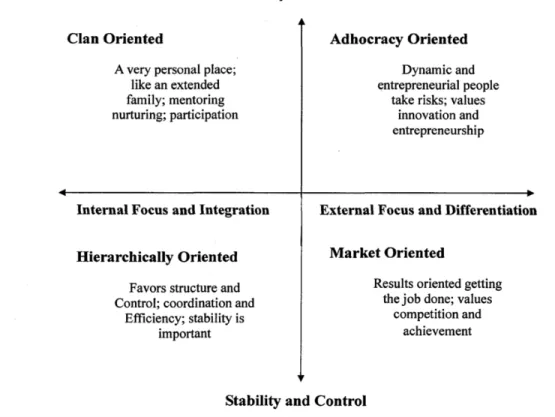
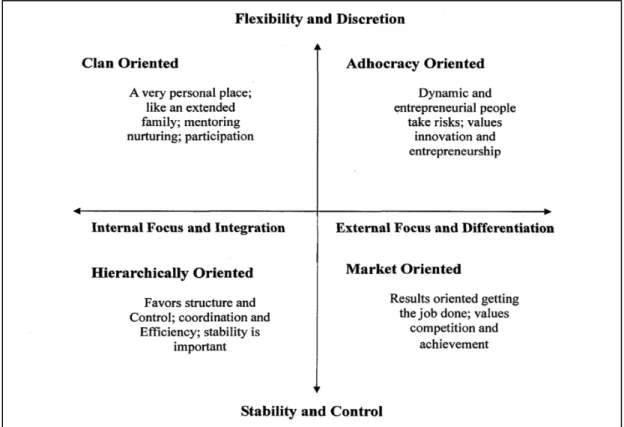
The CVF includes two dimensions: horizontal and vertical axes (see Figure 1.1). The horizontal axis focuses on the internal and external environments, with emphasis on the well-being and development of the organization. The vertical axis focuses on the distinction between the stability and control values versus the flexibility and discretion values, which are related to the organizational structure (Saame, Reino, & Vadi, 2011). Linking these two dimensions generates four major culture types: clan, adhocracy, hierarchy, and market cultures. Each quadrant in Figure 1.1 characterizes one organizational culture. These quadrants were not randomly selected – each one of them represents distinguishable notable characteristics (Cameron & Quinn, 2006).
development. Some of the leadership strategies used in this type of culture are empowerment, team building, and employee involvement. The adhocracy culture focuses on innovation, creativity, and transformation; its leadership strategies are designed to surprise and delight, create new standards, anticipate employees’ needs, provide continuous quality improvements, and find creative solutions. The third type of culture, the hierarchical culture, focuses on
efficiency and following formal rules and policy to keep the organization together and guarantee the work. Leaders in a hierarchy culture typically concentrate on coordination, monitoring, and organizing. Lastly, the market (rational) culture focuses on the external environment and competition. Its leaders are considered hard drivers and competitors at the same time.
Figure 1.1: The Competing Values Framework developed by Cameron and Quinn (1981).
Dissertation Plan
The format for this dissertation was the three-publishable paper option. Chapter 1 is the dissertation research proposal following the School of Nursing Guidelines. Chapters 2, 3, and 4 of the dissertation are structured in three publishable manuscripts. Chapter 2 (paper 1) is a multi-country scoping review that aims to provide a global perspective on the experiences of faculty members from diverse cultural backgrounds who are working in higher educational institutions and explore strategies that promote faculty diversity and contribute to the organizational culture of academic workplaces. Chapter 3 (paper 2) is titled “Dean’s
perceptions of leadership strategies used to manage a multicultural faculty environment in Saudi Arabian nursing schools: A qualitative study.” This study presents results from a pilot study that was conducted in Saudi Arabia to begin to understand the organizational culture in Saudi nursing schools and examine the perspectives of nursing school deans/ directors regarding the leadership strategies they use to manage multicultural faculty environments and how this influences school outcomes.
Chapter 4 (paper 3) presents findings from the mixed methods study that is titled “Faculty perceptions of organizational culture in Saudi Arabian schools of nursing: A mixed methods study.” This study examines faculty perspectives regarding both the current and desired organizational culture of schools of nursing in Saudi Arabia and the current and desired
REFERENCES
Alamri, M. (2011). Higher education in Saudi Arabia. Journal of Higher Education Theory & Practice, 11(4), 88-91.
Aboshaiqah, A. (2016) Strategies to address the nursing shortage in Saudi Arabia. International Nursing Review 63, 499–506
Aldawsari, A., Babenko-Mould, Y., & Andrusyszyn, M. (2015). Transitioning from nursing student to clinical teacher in Saudi Arabia. Journal of Nursing Education and Practice, 6(2). doi:10.5430/jnep.v6n2p76
Aldossary, A., While, A., & Barriball, L. (2008). Health care and nursing in Saudi Arabia.
International Nursing Review 55, 125-128.
Alharbi, H. (2015). A Delphi Study: Exploring Saudi Faculty and Student Perceptions of the Factors Promoting Nursing Student Retention and Success (Doctoral dissertation). Retrieved from ProQuest LLC.
AlOmar, A. (2004). Knowledge, attitudes, and intention of high school students towards the nursing profession in Riyadh city, Saudi Arabia. Saudi Medical Journal, 25 (2), 150 155.
Alshehry, A. (2014). Motivations and barriers for Saudi nurses to pursue a doctoral degree.
Doctoral Dissertations May2014 - current. Paper 548.
Bellot, J. (2011). Defining and Assessing Organizational Culture. Nursing Forum,46(1), 29, 37. Cameron, K., & Quinn, R. (2006). Diagnosing and changing organizational culture: based on
the competing values framework: 3rd ed. (Revised ed.). San Francisco, CA: Jossey Bass. Cejda, D., & Murrary, P. (2010). Hiring the next generation of faculty: New directions for
community colleges. San Francisco: John Wiley & Sons.
Daft, R. (2012). Organization Theory and Design, 11th ed. South-Western, Mason, OH.
Felemban, E., O’Connor, M., & McKenna, L. (2014). Cultural view of nursing in Saudi Arabia.
Middle East Journal of Nursing, 8(4).
Fox, D. (2015). Nursing faculty shortages: Perspectives from Deans and Directors of BSN Programs. Master's Theses and Doctoral Dissertations. Paper 605.
Lamadah, S. & Sayed, H. (2014). Challenges facing nursing profession in Saudi Arabia.
Menaker, R. (2016). Leadership strategies: Achieving personal and professional success.
Medical Practice Management Association. Retrieved from: www.mgma.com Miller-Rosser, K., Chapman, Y., & Francis, K. (2009). The use of oral testimony when
reconstructing nursing history: A Saudi Arabian experience. Singapore Nursing Journal, 36(1), 23.
Pasmore, W. (2014). Developing a leadership strategy: A critical ingredient for organizational success. Center for Creative Leadership. Retrieved from:
https://media.ccl.org/wpcontent/uploads/2016/09/developing-leadership-strategycenter for creativeleadership.pdf
Saame, I., Reino, A., & Vadi, M. (2011). OC based on the example of an Estonian hospital. Journal of Health Organization and Management,25(5).
Sabri, H. (2004). Socio-cultural values and organizational culture. Journal of Transnational Management Development,9(2-3), 123-145. doi:10.1300/j130v09n02_07.
Scammon et al. (2014). Organizational Culture associated with provider satisfaction. JABFM, 27(2).
Schein, E. H. (1987). Defining organizational culture. (2nd ed). Chicago: The Dorsey Press. Springer, P., Clark, C., Strohfus, P., & Belcheir, M. (2012). Using transformational change
to improve organizational culture and climate in a school of nursing. Journal of Nursing Education,51(2), 81-88.
Tsai, Y. (2011). Relationship between organizational culture, leadership behavior and job satisfaction. BMC Health Services Research,11, 98-98.
Zachariadou, T., Zannetos, S., & Pavlakis, A. (2013). Organizational culture in the primary healthcare setting of Cyprus. BMC Health Services Research,13, 112-112
CHAPTER 2: THE EXPERIENCE OF CULTURALLY DIVERSE FACULTY IN ACADEMIC ENVIRONMENTS: A MULTI-COUNTRY SCOPING REVIEW
The American Association of Colleges of Nursing (AACN) describes diversity as a broad range of personal, social, and population characteristics, such as age, ethnic or racial groups, gender, socioeconomic status, geographical location, national origin, language, and work experience (AACN, 2017). Diversity is linked to ways that people act and respond in the
workplace. People from different generations respond differently to various leadership styles and have different learning methods, ethics, professional goals, and expectations as a result of the different events they have experienced during their lifetime (Lutz et al.,2013). Individuals from different cultural backgrounds bring their own sets of attitudes, behaviors, values, and
communication preferences to the workplace (Moss, 2015). With this diversity, individuals also have various perceptions of their work experience within a diverse environment (Whitfield-Harris, 2016). The purpose of this paper is to examine academic environments across the world in the context of faculty diversity and the experiences of faculty members with culturally diverse backgrounds in the workplace.
Academic Diversity: A Global Issue
Schools of nursing worldwide are confronting a growing faculty shortage, particularly nursing faculty with doctoral degrees (Stanley et al, 2007; Moss, 2015). For example, the
National League for Nursing (NLN, 2017) reported that nursing schools across the United States (U.S.) often deny qualified candidates because the schools do not have sufficient faculty
(NLN, 2017). Faculty diversity can be seen as part of the solution to the nursing faculty shortage because hiring under-represented minority faculty members and educators from other countries broadens the scope for available nursing personnel.
Faculty diversity is recognized as crucial to nursing education across different world regions (AACN, 2017; NLN, 2017) both to fill the need for faculty but also to encourage diverse thought. In this growing multicultural world, diversity is recognized as a key variable that is valued for enhancing innovation and ensuring a wide array of perspectives in work teams (Brody et al., 2017). Each participant in a culturally diverse team needs to understand and respect that the perspectives and experiences of others are invited, welcomed, acknowledged, and valued (AACN, 2017). Faculty members who represent cultural differences indeed serve as exceptional educators and role models to nursing students (Minority Nurse Staff, 2013). Nursing students need exposure to a diverse faculty that brings different research perspectives, pedagogy, and experiences to the classroom. When faculty members who represent diverse ethnic, racial, religious, and social groups participate, share their interests, and develop their traditions, an inclusive democracy among faculty, administration, and students will be fostered, and critical and constructive conversations will be valued (Minority Nurse Staff, 2013).
Despite the clear benefits of having a culturally diverse faculty, minority and foreign-born faculty members in nursing schools often face workplace challenges (Moss, 2015). Some of these challenges include micro-aggression from students, coworkers, and administrators,
(Whitfield-Harris, 2016).
Despite these workplace challenges, recognizing the value of an academic environment that includes a culturally diverse faculty is foundational for creating a positive organizational culture for schools of nursing (Brody et al., 2017). Tsai (2011), Zachariadou et al. (2013) and Scammon et al. (2014) defined organizational culture as a system of shared assumptions, values, norms, and behaviors that guide members’ attitudes and hold them together in an organization. Nursing school leaders, e.g., deans and directors, should engage in efforts to recruit and retain faculty members from diverse backgrounds and embrace their differences, not merely tolerate them (AACN, 2017). Zajac (2011) and Whitfield-Harris (2016) recommend several leadership strategies to help diverse faculty members feel that they are part of the work team: creating a supportive work culture, considering the quality of life for faculty members, allowing faculty to participate in decision-making processes, and rewarding teaching and service opportunities that benefit the school and the larger society.
schools. In accordance with the Joanna Briggs Institute’s recommendations, the scoping review was conducted according to the Preferred Reporting Items for Systematic Reviews and Meta-Analyses (PRISMA) guidelines (The Joanna Briggs Institute, 2015).
Method
This scoping review was guided by Arksey and O’Malley (2005) scoping review
methodological framework. Arksey and O’Malley framework includes five steps: (1) identifying purpose/research question; (2) identifying relevant studies; (3) study selection, (4) charting the data, and (5) collating, summarizing, and reporting the results (The Joanna Briggs Institute, 2015). This framework integrates a transparent search strategy and enables an examination of a broad overview of the existent evidence in literature through including a variety of study designs (Crawford et al., 2016). Thematic analysis was employed to produce a synthesis of included studies (Mays et al. 2005). This scoping review thus aims to present the findings of the included studies as they are reported in literature and does not formally assess the methodological quality or risk of bias of the included articles, which is consistent with the guidelines of scoping review (The Joanna Briggs Institute, 2015).
Eligibility Criteria
The scoping review included articles published in the English language reporting original research related to faculty diversity in higher education institutions. Articles were excluded if they focused on the culture of healthcare organizations, were unrelated to the topic or were not original research.
Information Sources and Search Strategy
backgrounds across countries and the effects of faculty diversity on the organizational culture of nursing schools worldwide. This search was limited to studies published in English between 2007 and 2017. The following keyword search terms were combined and used to search the selected databases: academia, cultural backgrounds, cultural diversity, diversity, educators,
expatriate, faculty, school of nursing, as well as medical subject headings (MeSH). For instance, the following search strings were used: (faculty AND Cultur* AND Divers* AND Academ*), (faculty AND expatriate AND academ*), and (Nursing School AND Cultur* AND Diverse Backgrounds AND educators).
Selection of the Studies
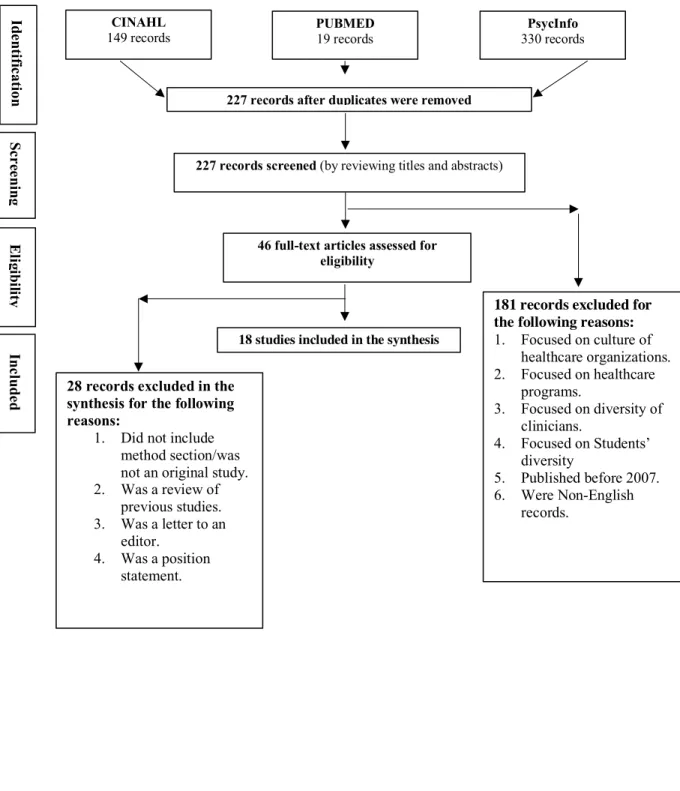
After exporting the search results from the databases to Mendeley and removing duplicates, 226 studies were screened for eligibility according to the inclusion and exclusion criteria by reviewing titles and abstracts to identify studies reporting faculty diversity in higher education institutions. This process eliminated 181 studies that did not specifically meet the inclusion criteria, thereby retaining 46 articles and dissertations. After scanning full manuscripts of each article, 28 studies were excluded because they were a position statement, letter to an editor, a review of previous studies, or not an original study. Thus, 18 eligible studies remained for review. Figure 2.1 presents a PRISMA chart that outlines the search and selection process. Data Collection Process
population; (4) theoretical framework; (5) study design and strengths/ limitations, and (6)
findings. The findings from the included studies were organized and synthesized into appropriate thematic groups using thematic analysis techniques (Mays et al. 2005).
Figure 2.1: PRISMA flow diagram of the selection process of the studies
CINAHL
149 records PUBMED 19 records 330 records PsycInfo
227 records after duplicates were removed
Sc re eni ng Inc lude d El ig ib ili ty
227 records screened (by reviewing titles and abstracts)
181 records excluded for the following reasons:
1. Focused on culture of healthcare organizations. 2. Focused on healthcare
programs.
3. Focused on diversity of clinicians.
4. Focused on Students’ diversity
5. Published before 2007. 6. Were Non-English
records.
46 full-text articles assessed for eligibility
18 studies included in the synthesis
28 records excluded in the synthesis for the following reasons:
1. Did not include method section/was not an original study. 2. Was a review of
previous studies. 3. Was a letter to an
editor. 4. Was a position
Findings Characteristics of the Studies
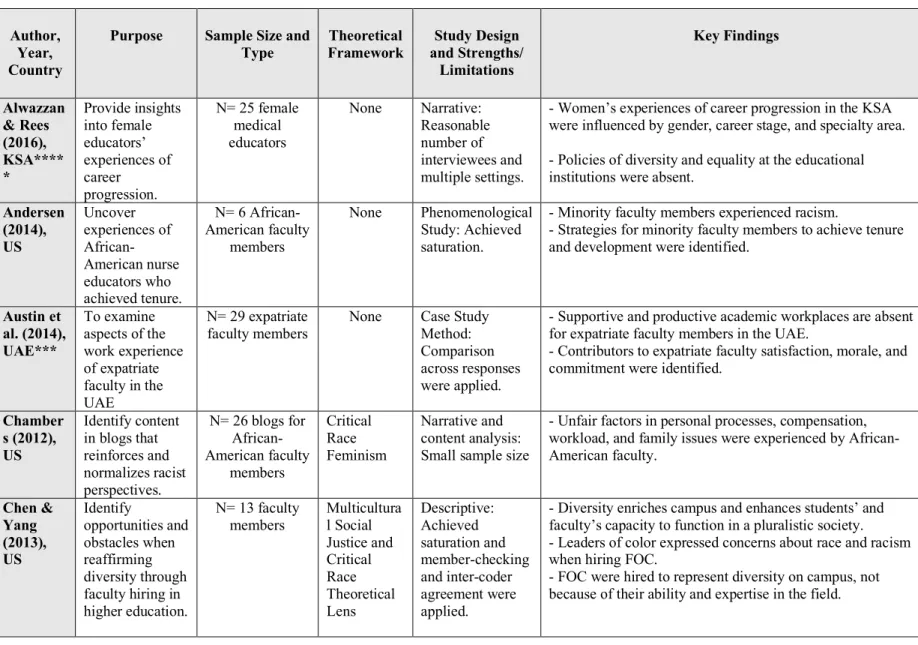
The eighteen studies in the scoping review were published from 2007 through 2017 (Table 1). The sample sizes ranged from 6 to 2,083 participants. The studies reviewed were conducted in the following countries: Australia (n = 1), Kingdom of Saudi Arabia (n = 1), United Arab Emirates (n = 1), and the U.S. (n = 14). The U.S. studies were in different states, including California, Georgia, Maryland, and Texas. Also, one another study was conducted in multiple countries, including Japan, Hong Kong, Thailand, and the United States. Most of the studies included diverse samples in terms of age, gender, ethnicity, nationality, educational background, academic rank, and years of experience. However, only ten of the eighteen studies included nursing faculty. Therefore, the focus of the review was expanded to include other academic health professions settings, such as schools of medicine, physical therapy, and others. Both males and females were included in the studies, except one study conducted by Brody et al. (2017) that included no females and one by Alwazzan and Rees (2016) that included no males . Chambers (2012), Andersen (2014), Lutz et al. (2013), and Robinson (2014) focused only on experiences of African-American faculty members. Fries-Britt et al. (2011) focused on experiences of both African-American and Hispanic faculty members. Melby, Dodgson, & Tarrant (2008) focused on describing the lived-experience of expatriate nurse educators who had taught for a minimum of two years and no more than five years in an East Asian country. In addition to the inclusion of faculty members as study participants, Schroeder and DiAngelo (2010) collected data from staff administrators, Fries-Britt et al. (2011) collected data from administrators of color, and
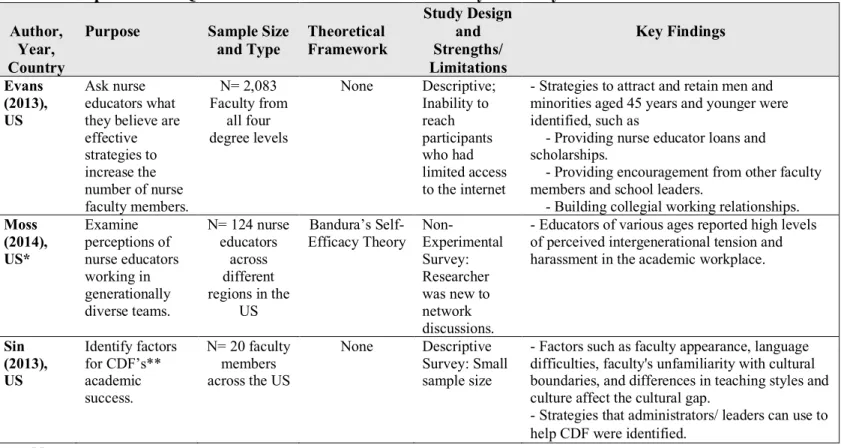
The scoping review includes eleven qualitative studies (i.e., Alwazzan & Rees, 2016; Andersen, 2014; Austin et al., 2014; Chambers, 2012; Chen & Yang, 2013; Fries-Britt et al., 2011; Henderson et al., 2016; Lutz et al., 2013; Melby et al., 2008; Schroeder and DiAngelo, 2010; Wingard et al., 2008), three quantitative studies (i.e., Evans, 2013; Moss, 2014; Sin, 2013), and four mixed-method studies (i.e., Adanga et al., 2012; Brody et al., 2017; Lazaro & Umphred, 2007; Robinson, 2014). Because the majority of the included studies are descriptive studies, each was assessed for risks of bias: sampling approach, response rate, and whether one or multiple settings was/were applied. The studies varied in terms of quality, sample size, number of
23
Table 2.1: Comparisons of Qualitative Studies Related to Faculty Diversity Across Countries
Author, Year, Country
Purpose Sample Size and
Type Framework Theoretical and Strengths/ Study Design Limitations Key Findings Alwazzan & Rees (2016), KSA**** * Provide insights into female educators’ experiences of career progression.
N= 25 female medical educators
None Narrative: Reasonable number of interviewees and multiple settings.
- Women’s experiences of career progression in the KSA were influenced by gender, career stage, and specialty area.
- Policies of diversity and equality at the educational institutions were absent.
Andersen (2014), US Uncover experiences of African-American nurse educators who achieved tenure.
N= 6 African-American faculty
members
None Phenomenological Study: Achieved saturation.
- Minority faculty members experienced racism.
- Strategies for minority faculty members to achieve tenure and development were identified.
Austin et al. (2014), UAE***
To examine aspects of the work experience of expatriate faculty in the UAE
N= 29 expatriate
faculty members None Case Study Method: Comparison across responses were applied.
- Supportive and productive academic workplaces are absent for expatriate faculty members in the UAE.
- Contributors to expatriate faculty satisfaction, morale, and commitment were identified.
Chamber s (2012), US
Identify content in blogs that reinforces and normalizes racist perspectives.
N= 26 blogs for African- American faculty members Critical Race Feminism Narrative and content analysis: Small sample size
- Unfair factors in personal processes, compensation, workload, and family issues were experienced by African-American faculty. Chen & Yang (2013), US Identify opportunities and obstacles when reaffirming diversity through faculty hiring in higher education.
N= 13 faculty
members Multicultural Social Justice and Critical Race Theoretical Lens Descriptive: Achieved saturation and member-checking and inter-coder agreement were applied.
- Diversity enriches campus and enhances students’ and faculty’s capacity to function in a pluralistic society. - Leaders of color expressed concerns about race and racism when hiring FOC.
24 Fries-Britt et al. (2011), Georgia, Maryland , and Texas, US Explore the current racial climate for black and Hispanic faculty members.
N= 33 participants (19 faculty and
14 staff) Hurtago & Colleagues ’ Campus Climate Framework Case Study Method: Multiple sources of data
- Some FOC*** perceived an uncomfortable campus climate. - Administrators struggled to achieve equity and diversity among faculty members.
- Three institutions that participated failed to value the research interests of FOC.
Henderso n, Barker, & Mak (2016), Australia
Gain insight into how academics experience intercultural communication challenges. N= 41 participants (5 clinical nurses, 19 clinical facilitators, 7 nurse faculty, and 10 nursing
students)
None Descriptive: Single Australian university.
- Participants reported difficulty communicating with others from different cultural backgrounds.
- Strategies used to address intercultural communication challenges were identified.
Lutz et al. (2013), US
Understand the experiences and concerns of FOC in nursing academia.
N= 23 FOC None Grounded Theory: Member-
checking was applied.
- FOC felt disappointment as a result of ongoing and pervasive racism and inadequate support.
- Strategies for limiting FOC’s harm and shaping their success were identified. Melby et al. (2008), Japan, Hong Kong, Thailand, and the US Understand the experience of English-speaking Western nurse educators teaching in East Asian countries. N=8 expatriate nurse educators from Western Countries.
None Phenomenology: Clarifications were sought throughout the analysis. An audit trail of decision-making during data collection and analysis.
- The ways of thinking, doing, and understanding among expatriate educators are very different. - Western educators were uncomfortable with the
teacher-oriented approach used by eastern universities.
- Eastern universities did not provide culture-specific training programs for expatriate educators.
- The expatriate educators were struggling to meet the Asian students’ needs.
Schroede r & DiAngelo (2010), Change the climate of whiteness.
N= 8 faculty and staff members
None Descriptive: Applied in a single setting.
- As the number of diverse faculty members increased in organizations, conflict increased.
24
Wingard, Reznik, & Daley (2008), Southern Californi a, US**
Describe URM* faculty
experiences and compare with experiences of non-URM faculty.
N= 30 faculty members (18 URM and 12 non-URM)
None Descriptive: Small sample size in single institution in Southern California
- URM faculty acknowledged difficult experiences with their non-URM colleagues.
- URM faculty were significantly more likely than non-URM faculty to be offered development programs.
Note:
URM*: Under-Represented Minority US**: United States
FOC***: faculty of color
UAE****: United Arab Emirates KSA*****: Kingdom of Saudi Arabia
26
Table 2.2: Comparisons of Quantitative Studies Related to Faculty Diversity Across Countries Author,
Year, Country
Purpose Sample Size
and Type Theoretical Framework
Study Design and Strengths/ Limitations Key Findings Evans (2013), US Ask nurse educators what they believe are effective strategies to increase the number of nurse faculty members.
N= 2,083 Faculty from
all four degree levels
None Descriptive; Inability to reach participants who had limited access to the internet
- Strategies to attract and retain men and minorities aged 45 years and younger were identified, such as
- Providing nurse educator loans and scholarships.
- Providing encouragement from other faculty members and school leaders.
- Building collegial working relationships.
Moss (2014), US* Examine perceptions of nurse educators working in generationally diverse teams.
N= 124 nurse educators
across different regions in the
US
Bandura’s
Self-Efficacy Theory Non-Experimental Survey: Researcher was new to network discussions.
- Educators of various ages reported high levels of perceived intergenerational tension and harassment in the academic workplace.
Sin (2013), US Identify factors for CDF’s** academic success.
N= 20 faculty members across the US
None Descriptive Survey: Small sample size
- Factors such as faculty appearance, language difficulties, faculty's unfamiliarity with cultural boundaries, and differences in teaching styles and culture affect the cultural gap.
- Strategies that administrators/ leaders can use to help CDF were identified.
Note:
US*: United States
Table 2.3: Comparisons of Mixed-Method Studies Related to Faculty Diversity Across Countries Author,
Year,
Country Purpose Sample Size and Type Framework Theoretical
Study Design and Strengths/
Limitations Key Findings
Adanga et al. (2012), US* Update information regarding number and type of faculty diversity programs at U.S. medical schools. N= 124 medical schools
None Mixed methods:
Interviewees may not aware of all programs that target URM** faculty. Searching school websites limited findings.
- Schools with diversity programs are more likely to be ranked in the highest quartile and have a larger faculty than schools without diversity programs.
-Schools with diversity programs are more likely to have mentoring, a positive social climate, and financial programs targeted to all faculty members. Brody et al. (2017), US Share challenges and lessons learned identified by male nurse faculty members.
N= 18 male faculty from 7
cohorts of Robert Wood Johnson Foundation Nurse Faculty Scholars Competing Value Framework Multiple Research Strategies
- Faculty identified diversity in terms of gender, racial, ethnic, religious, perspectives, and conflict that affect organizational culture.
- Faculty described positive organizational culture as inclusive culture that fosters and values diversity.
- Men experienced negative stereotypes and faced discrimination issues from colleagues.
Lazaro & Umphred (2007), US Improve cultural diversity awareness of educators.
N= 12 faculty members of PT*** school
None Mixed-method:
Applied in single academic setting.
- Majority of faculty considered their knowledge of cultural diversity issues to be "inadequate". - Workshops can improve cultural knowledge and cultural awareness. Robinson (2014), US Describe impacts of racism on black faculty members and strategies to foster healthy work settings.
N= 9 black faculty members
None Mixed-method:
Small sample size - After experiencing racism, black faculty members felt anxious, angry, depressed, and experienced negative changes in physical health. - Strategies used by black faculty members to cope with racism were identified.
Note:
US*: United States
URM**: under-represented minority
Thematic Analysis
Data were analyzed from an extensive assessment of the 18 studies and categorized into
three themes: 1) Descriptions of cultural diversity among faculty in the academic workplace, 2)
Factors associated with increasing retention among faculty members from diverse cultural
backgrounds, and 3) Strategies for building an academic culture that values faculty diversity.
Data were further analyzed to identify subthemes providing description and support for each of
the three themes. Table 4 presents a summary of the three themes, the publications that relate to
Table 2.4: Thematic Analysis arising from Studies regarding Faculty Diversity Theme 1: Descriptions of Cultural Diversity among Faculty in the Academic Workplace
Subthemes Publications
Un/familiarity of Faculty Members about Diversity
**Alwazzan & Rees (2016) **Austin et al. (2014)
**Henderson, Barker, & Mak (2016) ***Lazaro & Umphred (2007) **Melby et al. (2008)
*Sin (2013)
Intercultural Communication Challenges
**Andersen (2014) **Chambers (2012) **Fries-britt et al. (2011)
**Henderson, Barker, & Mak (2016) **Lutz et al. (2013)
**Melby et al. (2008) *Moss (2014) ***Robinson (2014)
**Schroeder & DiAngelo (2010)
Effects of Faculty Diversity on School Culture
***Adanga et al. (2012) ***Brody et al. (2017) **Chen & Yang (2013) **Melby et al. (2008) *Moss (2014)
**Schroeder & DiAngelo (2010) **Wingard, Reznik, & Daley (2008)
Theme 2: Factors Associated with Increasing Retention among Diverse Faculty Members
Engagement with Mentors Through Scholarship
**Alwazzan & Rees (2016) **Chambers (2012) **Chen & Yang (2013) **Lutz et al. (2013) ***Robinson (2014) *Sin (2013)
**Wingard, Reznik, & Daley (2008)
Faculty Job Satisfaction
**Austin et al. (2014)
***Lazaro & Umphred (2007) *Moss (2014)
*Sin (2013)
**Wingard, Reznik, & Daley (2008)
Themes 3: Strategies for Building an Academic Culture that Values Faculty Diversity
School/Leadership Commitment to Cultural Diversity
**Alwazzan & Rees (2016) **Austin et al. (2014) **Chen & Yang (2013) *Evans (2013)
**Fries-britt et al. (2011) **Lutz et al. (2013) **Melby et al. (2008) ***Robinson (2014)
Self-Care Faculty Coping Strategies **Andersen (2014) **Austin et al. (2014) **Chen & Yang (2013)
**Henderson, Barker, & Mak (2016) **Lutz et al. (2013)
Theme 1: Descriptions of Cultural Diversity among Facultyin the Academic Workplace
Seventeen studies provided evidence for theme 1: Descriptions of cultural diversity
among faculty in the academic workplace. Participants described faculty diversity from different
points of view, including un/familiarity of faculty members about diversity, intercultural
communication challenges and discriminatory actions perpetrated by dominant colleagues, and
influences of faculty diversity on school culture.
Four qualitative studies, one quantitative study, and one mixed-method study reported
findings about faculty members’ level of knowledge about diversity. These studies showed that
participants identified cultural diversity as differences in age, gender, race, ethnicity, religion,
education, perspectives, values, and/or beliefs. However, the majority of faculty members who
participated in the studies considered their level of knowledge regarding cultural diversity to be
inadequate but acknowledged that such knowledge was important to improving their cultural
knowledge and cultural awareness. Two of the three qualitative studies conducted in middle
eastern countries found similar results and indicated that policies that target diversity and
equality at educational institutions were typically absent (Austin et al., 2014; Alwazzan & Rees,
2016). The faculty members who participated in the quantitative study conducted by Sin (2013)
were unfamiliar with cultural boundaries of other faculty members. Lazaro and Umphred (2007),
Austin et al. (2014), and Alwazzan and Rees (2016) focused on the importance of incorporating
concepts of cultural diversity into school curricula and mission statements in addition to
developing faculty workshops at an interactional level.
Nine of the seventeen studies reporting data for this thematic group discussed
intercultural communication challenges and the discriminatory actions experienced by expatriate
faculty members who participated in these nine studies were from different cultural backgrounds
and countries, all reported unsupportive behavior and attitudes and difficulty in communication
with others from different cultural backgrounds and whose first language was not English.
Faculty members experienced negative reactions to their appearance, race, gender, and age, felt
marginalized by their colleagues for doing community-based research within minority
populations, were not treated consistent with their degree accomplishment, and perceived that
they were not included in decision-making processes (Andersen, 2014; Chambers, 2012;
Fries-Britt et al., 2011; Henderson et al., 2016; Lutz et al., 2013; Schroeder & DiAngelo, 2010).
Moss (2014) conducted a quantitative study that examined the perceptions of nurse
educators working in generationally diverse nurse educator teams and reported that older
educators preferred to work with staff members of their same generation. Generational diversity
among nursing faculty members is increasing; staff members representing as many as four
generations sometimes work together (Moss, 2015). Also, a recent mixed method study by Brody
et al. (2017) that focused on men reported they were negatively stereotyped as not fitting into a
predominantly female profession. As a result of working in a diverse environment, both
expatriate and minority faculty members experienced disappointment, anxiety, anger, and
depression, and reported negative changes in their physical health status (Brody et al., 2017; Lutz
et al., 2013; Melby et al., 2008; Robinson, 2014).
Seven of the seventeen publications reported the effects of faculty diversity on school
culture. Despite the negative experiences faced by some faculty members in culturally diverse
workplaces, the benefits of faculty diversity were also considered. Diversity among faculty
members plays a substantial role in enhancing students’ and faculty’s capacity to function well in
Reznik, & Daley, 2008). Adanga et al. (2012) studied faculty diversity programs that target
under-represented minority faculty at U.S. medical schools and interviewed a key informant
from each school. These diversity programs were designed to target culturally diverse faculty
members and to offer classes and workshops to provide faculty with financial support and help
them develop skills in grant writing, teaching, and mentorship (Adanga et al., 2012). Adanga et
al. (2012) found that schools with diversity programs are more likely to be ranked in the highest
quartile, have a larger faculty than schools without faculty diversity programs, more likely to
have a positive social climate, and offer mentoring and funding programs for all faculty
members.
On the other hand, Schroeder and DiAngelo (2010) and Moss (2014) identified
challenges that diversity contributes to school culture. Schroeder and DiAngelo (2010) found
that, as the number of diverse faculty members increases in a school, incidents of conflict
increase among its team members. Also, faculty of color reported issues related to dominance
while working in a climate of whiteness (Schroeder & DiAngelo, 2010). In an age-diverse team
of nurse educators, Moss (2014) reported high levels of perceived intergenerational tension and
harassment among nurse educators of various ages in the academic workplace, as increasing
generational diversity can reflect differences in values, expectations, and communication
preferences. The conflicts and tensions and their correlation to workplace harassment are crucial
when considering recruitment and retention of diverse nurse educators and potential impact on
shortage of nurses and qualified nurse faculty (Moss, 2014; Schroeder & DiAngelo, 2010).
Theme 2: Factors Associated with Increasing Retention among Diverse Faculty Members
Ten publications reported research data for Theme two, Factors Associated with
importance of engaging expatriate and minority faculty members through contacts with senior
mentors and supporting their scholarship (Alwazzan & Rees, 2016; Chambers, 2012; Chen &
Yang, 2013; Lutz et al., 2013; Robinson, 2014; Sin, 2013; Wingard, Reznik, & Daley, 2008). in
addition to improving their job satisfaction (Adanga et al., 2012; Austin et al., 2014; Moss, 2014;
Wingard, Reznik, & Daley, 2008;). Because minority faculty members reported difficult
experiences with their non-minority colleagues, connecting these faculty members with other
faculty members who understand the dynamics of diversity in the academic workplace and
providing resources such as funding and scholarship are essential to attracting and retaining
minority faculty members (Chambers, 2012; Lutz et al., 2013; Robinson, 2014; Wingard,
Reznik, & Daley, 2008). According to Wingard, Reznik, & Daley (2008), it may be more critical
that under-represented minority faculty members have trustworthy senior mentors than their
colleagues. These mentors should understand their mentoring responsibilities, serve as role
models, and show respect and appreciation for faculty diversity (Andersen, 2014; Sin, 2013). A
qualitative study conducted in Saudi Arabia included only female educators reported that support
from male faculty mentors is a crucial step in closing the gender gap in a non-Western academic
setting and to improve awareness of Saudi faculty about equality and diversity (Alwazzan &
Rees, 2016).
Five of the ten studies that examined factors related to increasing faculty retention in the
academic workplace, discussed the positive relationship between faculty job satisfaction and the
rate of retention (Adanga et al., 2012; Austin et al., 2014; Lazaro & Umphred, 2007; Moss 2014;
Wingard, Reznik, & Daley, 2008; ). Two studies conducted by Austin et al., 2014 and Wingard,
under-represented minority faculty members, which in turn, increased their retention in the
school and helped to mitigate faculty shortage. These faculty development programs/ workshops
discussed in Wingard and colleagues’ study relied on the collaboration between faculty
members. The senior faculty were encouraged to collaborate with juniors on research, critiquing scholarly work, and involve them in circles or to chair conference sessions (Wingard, Reznik, & Daley, 2008). Furthermore, comprehensive workshops should incorporate topics such as
tolerance, respect, empathy, and cultural diversity (Lazaro & Umphred, 2007).
From a different cultural perspective, the majority of expatriate faculty members who
participated in an Emirati qualitative study experienced job dissatisfaction as a result of being
offered only short-term contracts and the absence of other job related elements , such as a
flexible workload, faculty professional development, and funding (Austin et al., 2014). As a
result, Austin et al reported that higher education institutions in the United Arab Emirates report
high turnover among expatriate faculty members. As a counterbalance, Sin (2013) found that
effective mentorship for minority faculty members increases career satisfaction, cooperative
relationships with colleagues, and a sense of commitment to the organization.
Themes 3: Strategies for Building an Academic Culture that Values Faculty Diversity
The third theme emerging from the data is Strategies for building an academic culture
that values faculty diversity. Ten studies conducted in different countries explored the most
effective strategies to build an academic culture that values faculty diversity (Alwazzan & Rees,
2016; Andersen, 2014; Austin et al., 2014; Chen & Yang, 2013; Evans, 2013; Fries-Britt et al.,
2011; Henderson, Barker, & Mak, 2016; Lutz et al., 2013; Melby et al., 2008; Robinson, 2014).
Eight of the nine studies reported the need to implement effective leadership strategies for
environment where minority faculty feel a lack of support. Effective strategies for attracting and
retaining minority and expatriate faculty members include: offering flexible work hours,
providing faculty loans and scholarships, ensuring encouragement from other faculty members
and school leaders, building collegial working relationships, allowing respectful engagement in
committees, and increasing faculty salaries (Alwazzan & Rees, 2016; Austin et al., 2014; Evan,
2013; Lutz et al., 2013). Most importantly, participants in the Chen and Yang (2013) study
considered school leaders’ understanding, respect, and commitment for diversity as first steps
toward creating a supportive work environment for faculty members from different cultural
backgrounds.
Expatriate and minority faculty members reported they often experienced negative
behavior and attitudes and feel academic leaders ignore the negative actions, suppression,
‘humorous’ responses, and aggressive responses on the part of some of their colleagues. six
publications described self-care coping strategies that expatriate and minority faculty members
should use in order to limit harm and improve their success (Andersen, 2014; Austin et al., 2014;
Chen & Yang, 2013; Henderson, Baker, & Mak, 2016; Lutz et al., 2013; Robinson, 2014).
Effective self-care strategies for faculty success are identified as: clarifying and validating one’s
faculty role, navigating the institution’s tenure process, continuing one’s scholarship, being a
role model, and normalizing cultural behaviors to overcome negative situations (Andersen, 2014;
Austin et al., 2014). Lutz et al. (2013) and Robinson (2014) found that faculty of color can limit
harm by taking care of themselves, having personal support, living their values, avoiding those
who portray racism, and seeking clarification during communication. Faculty of color may
sometimes lower their expectations of others by expecting racism (Lutz et al., 2013). For
academic workplace by expecting very little from her colleagues and found that protected her
from getting disappointed.
Discussion
This scoping review examined 18 research studies reporting the experiences of faculty
members from culturally diverse backgrounds, including expatriate faculty and minority faculty
members employed in higher education settings in across the world. Findings were similar
regardless of geography and have the potential to encourage academic societies to recognize and
acknowledge the experiences of faculty members from culturally diverse backgrounds, value
their cultural diversity, and acknowledge their achievements. However, based on the eighteen
research studies included in this scoping review, it is apparent that expatriate and minority
faculty members are not supported in ways that promote their professional growth. Intercultural
communication challenges and tensions exist among faculty members from different cultural
backgrounds in current diverse work environments. These challenges have negatively impacted
job satisfaction levels, which in turn, have forced some faculty members to leave their school
(Austin et al., 2014; Moss, 2014). Critical incidents include discriminatory behavior and negative
stereotypes from colleagues, leaders, and students, limited opportunities for funding, scholarship,
and tenure, and work overload that impacts the faculty member’s health status and his/her ability
to function. Furthermore, according to Chen and Yang (2013), faculty of color felt that they were
hired only to represent diversity on campus, not because of their capability and expertise that
added value to the organization.
Despite the challenges associated with diversity in various academic workplaces, most of
the studies in this review reached a shared conclusion that faculty diversity can benefit all faculty