R E S E A R C H
Open Access
Efficacy, safety and tolerability of GSK2190915,
a 5-lipoxygenase activating protein inhibitor,
in adults and adolescents with persistent asthma:
a randomised dose-ranging study
Richard MA Follows
1*, Neil G Snowise
1,4, Shu-Yen Ho
2, Claire L Ambery
1, Kevin Smart
3,5and Barbara A McQuade
1Abstract
Background:GSK2190915 is a high affinity 5-lipoxygenase-activating protein inhibitor being developed for the treatment of asthma. The objective of this study was to evaluate GSK2190915 efficacy, dose–response and safety in subjects with persistent asthma treated with short-acting beta2-agonists (SABAs) only.
Methods:Eight-week multicentre, randomised, double-blind, double-dummy, stratified (by age and smoking status), parallel-group, placebo-controlled study in subjects aged≥12 years with a forced expiratory volume in 1 second (FEV1) of 50–85% predicted. Subjects (n = 700) were randomised to receive once-daily (QD) oral GSK2190915 (10–300 mg), twice-daily inhaled fluticasone propionate 100μg, oral montelukast 10 mg QD or placebo. The primary endpoint was mean change from baseline (randomisation) in trough (morning pre-dose and pre-rescue bronchodilator) FEV1at the end of the 8-week treatment period. Secondary endpoints included morning and evening peak expiratory flow, symptom-free days and nights, rescue-free days and nights, day and night-time symptom scores, day and night-time rescue medication use, withdrawals due to lack of efficacy, Asthma Control Questionnaire and Asthma Quality of Life Questionnaire scores.
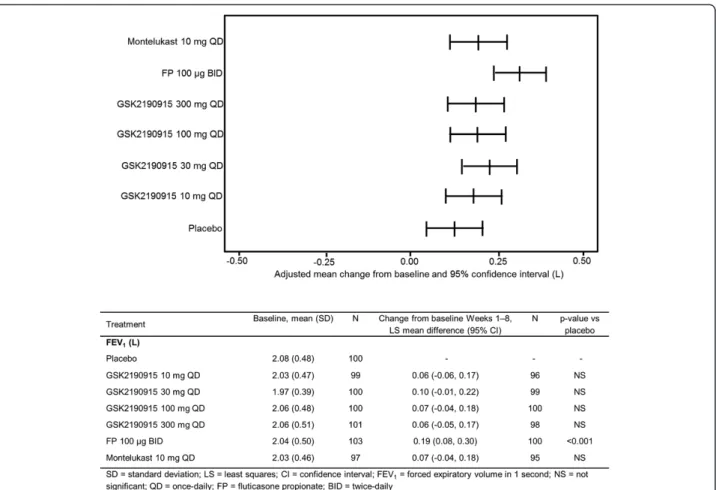
Results:For the primary endpoint, there was no statistically significant difference between any dose of GSK2190915 QD and placebo. However, repeated measures sensitivity analysis demonstrated nominal statistical significance for GSK2190915 30 mg QD compared with placebo (mean difference: 0.115 L [95% confidence interval: 0.00, 0.23], p = 0.044); no nominally statistically significant differences were observed with any of the other doses. For the secondary endpoints, decreases were observed in day-time symptom scores and day-time SABA use for
GSK2190915 30 mg QD versus placebo (p≤0.05). No dose–response relationship was observed for the primary and secondary endpoints across the GSK2190915 dose range studied; the 10 mg dose appeared to be sub-optimal. GSK2190915 was associated with a dose-dependent reduction in urinary leukotriene E4. The profile and incidence of adverse events were similar between treatment groups.
Conclusion:Efficacy was demonstrated for GSK2190915 30 mg compared with placebo in day-time symptom
scores and day-time SABA use. No additional improvement on efficacy endpoints was gained by administration of GSK2190915 doses greater than 30 mg. GSK2190915 was well-tolerated. These results may support further studies with GSK2190915 30 mg.
Trial registration:Clinicaltrials.gov: NCT01147744.
Keywords:GSK2190915, FLAP, Asthma, Efficacy, Safety, Tolerability, Dose-ranging
* Correspondence:[email protected]
1GlaxoSmithKline, Stockley Park West, Uxbridge, Middlesex UB11 1BT, UK
Full list of author information is available at the end of the article
Background
Leukotrienes (LTs) are produced by mast cells, eosino-phils, macrophages and neutrophils in response to aller-gic or inflammatory stimuli [1-3]. They are products of the 5-lipoxygenase (5-LO) pathway of arachidonic acid metabolism and their synthesis is initiated by 5-LO in concert with 5-lipoxygenase-activating protein (FLAP). This part of the pathway divides into two branches: one leading to production of LTB4and the other to the pro-duction of the cysteinyl LTs (cysLTs) LTC4, LTD4 and LTE4, so-called because they contain the amino acid cysteine conjugated to their lipid backbone. The central role of LTs in asthma pathogenesis is well-established as they function as potent mediators of inflammation and airway constriction [4-7]. Concentrations of the products of the 5-LO pathway are increased in patients with asthma of all severities despite treatment with cortico-steroids [8-10], the cornerstone anti-inflammatory the-rapy in asthma.
Leukotriene B4is a potent chemoattractant of neutro-phils [11]. Irrespective of therapy with corticosteroids, LTB4concentrations were increased in the bronchoalveo-lar fluid, sputum and tissue of patients with severe asthma compared with non-asthmatic control subjects and pa-tients with mild-moderate asthma [10,12]. Neutrophil numbers have been shown to increase in patients with severe asthma compared with milder asthma phenotypes, and neutrophilic inflammation is resistant to the effects of corticosteroids [9,12,13]. The cysLTs are potent constrictors of airway smooth muscle, they increase vascular permeability and serve as chemoattractants for eosinophils [4-6]. Cysteinyl LTs are directly involved in bronchoconstriction, airway oedema and mucus secretion, characteristic of the asthmatic phenotype [14]. Inhibition of cysLTs by the administration of the cysLT receptor antagonist montelukast elicits bronchodilatory effects and significantly reduces eosinophil numbers in the peripheral blood and induced sputum of patients with asthma [15]. In addition, administration of the 5-LO inhibitor zileuton to patients with severe asthma led to improvements in lung function [16]. These observations indicate that inhibition of the production of LTs via the two branches of the 5-LO pathway could confer beneficial effects on patients with persistent asthma.
GSK2190915 is a high affinity FLAP inhibitor that attenuates the production of LTs through inhibition of the first step of the 5-LO pathway. In vitro and in vivo studies demonstrated that GSK2190915 reproducibly inhibited the production of both LTB4 and cysLTs [17]. In healthy subjects, GSK2190915 was well-tolerated with a systemic exposure that increased in a dose-related manner [18]. GSK2190915 also demonstrated dose-dependent inhibition of blood LTB4 production and of urinary excretion of the cysLT, LTE4[18]. The primary
objective of the current study was to evaluate the efficacy, dose–response, safety and tolerability of GSK2190915 ad-ministered once-daily (QD) over an 8-week period in ado-lescents and adults with persistent uncontrolled asthma receiving a short-acting beta2-agonist (SABA). The sec-ondary objective of this study was to explore the efficacy of GSK2190915 against established asthma treatments, namely montelukast and the inhaled corticosteroid (ICS) fluticasone propionate (FP).
Methods
Subjects
Subjects aged 12 years or older were eligible for enrol-ment if they had a diagnosis of asthma (as defined by the National Institutes of Health [19]) with a best (the highest of three technically acceptable measurements) pre-bronchodilator forced expiratory volume in 1 second (FEV1) of 50–85% of the predicted normal value, and re-versibility of at least 12% and 200 mL within 30 minutes after inhaled salbutamol/albuterol. The original protocol also allowed males to be recruited to the study. However, the protocol was amended to include only females after findings of testicular toxicity in rats at high exposures of GSK2190915 following 6-month dosing were reported during the conduct of the study. Former and current smokers, with a smoking history of ≤10 pack years, were required to demonstrate a post-salbutamol/albute-rol FEV1/forced vital capacity ratio of >0.70 to exclude subjects with fixed airways. Eligible subjects were re-quired to have been taking a SABA for at least 3 months before screening. They were also required to be able to replace their SABA with salbutamol/albuterol to be used as rescue medication during the run-in and treatment periods. Other permitted medications included stable-dose immunotherapy, intranasal corticosteroids and short and long-acting antihistamines.
hypersensitivity to any beta2-agonist, sympathomimetic drug, intranasal, inhaled or systemic corticosteroid.
Study design
This was a Phase IIb, multicentre, randomised, double-blind, double-dummy, parallel-group, placebo-controlled study that was conducted from January 2010 to October 2011 at 89 sites in six countries (GlaxoSmithKline proto-col: LPA112186; Clinicaltrials.gov registration number: NCT01147744). All subjects provided signed informed consent prior to screening. Local Ethics Review Commit-tees provided approval for the study, which was conduc-ted in accordance with Good Clinical Practice, applicable country-specific requirements and the guiding principles of the Declaration of Helsinki (2008).
Eligible subjects completed a 2-week pre-treatment run-in period during which they were required to attend the clinical unit for assessment of their adherence with an electronic daily diary (eDiary, AM3 device by ERT, Bavaria, Germany). At the end of the study run-in period, subjects were eligible to enter the treatment period if they had a morning pre-dose FEV1 between 50% and 85% of their predicted normal and had either any combination of the daily asthma symptom scores (day-time plus night-time) of ≥1, or used salbutamol/al-buterol on at least 4 days of the last 7 consecutive days of the run-in period.
Subjects were randomised to receive GSK2190915 ta-blets (10 mg, 30 mg, 100 mg, 300 mg) QD (morning), FP 100 μg twice-daily (BID; morning and evening) via a Diskus™/Accuhaler™ (GlaxoSmithKline, Ware, UK) and montelukast 10 mg capsules QD (evening). A double dummy design was used to ensure blinding to treatment (see Additional file 1). Subjects received treatment on an out-patient basis for 8 weeks. Subjects aged 12–14 years were not randomised to the montelukast arm as the 10 mg dose is not licensed for this age group. Randomi-sation was stratified according to subject age and smo-king status. Follow-up took place 1 week after completion of the treatment period. Following their withdrawal, all male subjects were offered a clinical assessment.
Subjects were withdrawn from study medication due to‘lack of efficacy’if they changed their asthma medica-tion, had an asthma exacerbation (defined as worsening asthma requiring any treatment other than rescue sal-butamol/albuterol) or had signs of asthma instability (defined as a fall in clinic FEV1to <80% of value at ran-domisation, peak expiratory flow [PEF] < 80% of the mean run-in value on more than 3 days between con-secutive visits or use of salbutamol/albuterol≥12 inhala-tions/day on more than 2 days between consecutive visits).
Adherence to treatment was assessed from Week 4 until Week 8 (or early withdrawal) by counting returned
tablets, capsules and reviewing the dosing counter on the Diskus/Accuhaler. Allocation to treatment group was determined according to a computer generated sche-dule; numbered containers were used to implement al-location. Neither the subject nor the investigator knew which study medication the subject was receiving.
Efficacy assessments
Assessments of efficacy were based on measures of spi-rometry, including trough FEV1(pre-bronchodilator and pre-dose); parameters recorded in the daily diary inclu-ding symptoms, use of rescue medication and daily PEF; questionnaires including Asthma Control Questionnaire (ACQ)-6 and the Asthma Quality of Life Questionnaire (AQLQ) (+12).
The primary endpoint of the study was mean change from baseline (randomisation) in trough (morning pre-dose and pre-rescue bronchodilator) FEV1at the end of the 8-week treatment period. Changes in FEV1at weeks 1, 2, 4 and 6 were also assessed. Efficacy measures for secondary endpoints recorded by the patients using the daily diary were: mean change from baseline in daily trough (pre-dose and pre-rescue bronchodilator) mor-ning and evemor-ning PEF averaged over the 8-week treat-ment period; mean change from baseline in the percentage of symptom-free days and nights and rescue-free days and nights; mean change from baseline in day and night-time symptom scores; mean change from baseline in day and night-time rescue salbutamol/albute-rol use; withdrawals due to lack of efficacy and mean change from baseline in ACQ and AQLQ scores. In addition, other endpoints were assessed: symptom-free 24-hour periods, rescue-free 24-hour periods, 24-hour period symptom scores and 24-hour SABA use.
All post-randomisation FEV1 measurements were ta-ken within 1 hour of the time FEV1 was measured at randomisation. Before attending the clinical unit for lung function assessments, subjects had to withhold their res-cue medication for at least 6 hours. At weeks 1, 2, 4, 6 and 8, FEV1was measured approximately 24 hours post-morning dose and approximately 12 hours post-evening dose.
Pharmacokinetic/pharmacodynamic assessments
quantification for GSK2190915 was 5 ng/mL and the higher limit of quantification was 5000 ng/mL.
Three spot urine samples were collected at Week 0 and pre-dose on weeks 1 and 8 to determine mean change from baseline in urinary LTE4. Urine samples were analysed for LTE4using a validated analytical me-thod based on solid-phase extraction followed by high performance liquid chromatography with tandem mass spectrometric detection. The lower limit of quantifica-tion for LTE4was 5 pg/mL and the higher limit of quan-tification was 1000 pg/mL.
Safety and tolerability measurements
Safety and tolerability were assessed by monitoring ad-verse events during the treatment period until follow-up, and serious adverse events from screening to follow-up. Adverse events were coded using the Medical Dictionary for Regulatory Activities (MedDRA). Asthma exacerba-tions were recorded. Assessments of liver function, stan-dard laboratory parameters, vital signs (pulse rate and systolic and diastolic blood pressure) and 12-lead elec-trocardiograms (ECGs) were also performed.
Statistical analysis
The primary hypothesis of the study was that FEV1 in the GSK2190915 groups would demonstrate a signifi-cant increase at the end of the 8-week treatment period compared with that in the placebo group. Assuming a between-subject common standard deviation in FEV1of 415 mL, it was estimated that it would be necessary to recruit 630 subjects (90 per group) to provide 89% power to detect a difference (two-sided 5% level) of 200 mL in pairwise comparisons between any GSK2190915 dose group and placebo.
A sequential testing procedure was followed to ac-count for multiplicity from multiple pairwise compari-sons: statistical comparison of the highest GSK2190915 dose with placebo was performed first and subsequent comparisons at lower doses continued in a sequential manner. A 5% level of statistical significance was claimed only if the preceding comparison was significant at the 5% level. Any other test results were not adjusted for multiplicity and any p-value≤0.05 from those testing re-sults was interpreted as nominally significant. Primary efficacy analysis was performed using analysis of covari-ance (ANCOVA) with a last observation carried forward approach used to impute missing data; repeat measures model was also performed for sensitivity analysis.
Secondary efficacy analysis was performed using ANCOVA, except for the comparison between each treatment group and placebo for the number of with-drawals due to lack of efficacy in which a Fisher’s Exact test was used. No multiplicity adjustments were made on the secondary efficacy endpoints. Any p value ≤0.05 was
identified as nominally significant. The comparisons between active treatments were only for exploratory purposes. Population pharmacokinetic analysis of sparse GSK2190915 plasma concentration-time data was per-formed using non-linear mixed effects modelling as was the population pharmacokinetic-pharmacodynamic ana-lysis to assess the plasma GSK2190915 concentration versus urinary LTE4 relationship. Non-quantifiable phar-macokinetic and pharmacodynamic data were treated as missing for the population analysis. No formal statistical analysis was performed on safety data. For all endpoints, data are reported for subjects who received at least one dose of study medication.
Results
Subjects
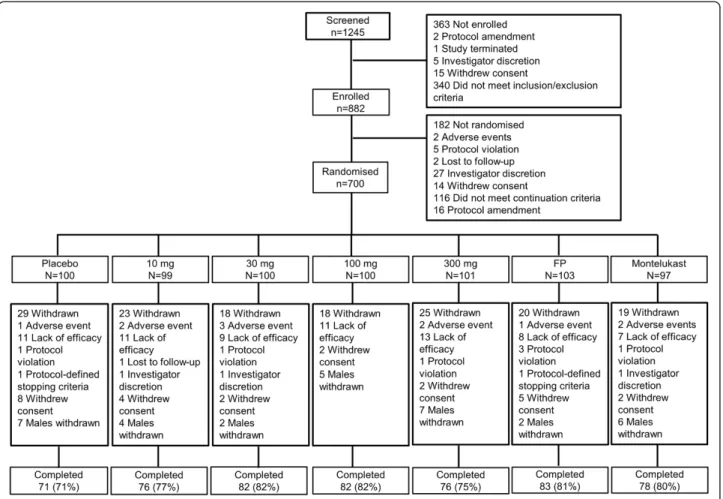
Of 1245 subjects screened, 700 were randomised and 548 completed the study (Figure 1). One hundred and thirteen (16%) subjects, including 56 males, were ran-domised under the original protocol. However, after the protocol was amended to withdraw males and include females only, an additional 587 (84%) female subjects were subsequently recruited. One hundred and fifty-two (22%) subjects withdrew from the study and the most frequent reasons for withdrawal were: lack of efficacy (70 subjects), decision to withdraw all male subjects (33 subjects) and withdrawal of consent (25 subjects). The numbers of subjects in each group withdrawing from the study were similar. Demographic and baseline subject characteristics were well-matched across treat-ment groups (Table 1).
Efficacy
There were no statistically significant differences for any dose of GSK2190915 versus placebo in the secondary end-points of morning and evening PEF, symptom-free days and nights, rescue-free days and nights, night-time symp-tom scores and night-time SABA use (Additional file 2); similar results were observed for montelukast 10 mg QD versus placebo. However, there were nominally statistically significant differences for FP 100 μg versus placebo for symptom-free days and rescue-free days. Nominally sta-tistically significant reductions were observed for com-parisons between GSK2190915 30 mg QD and placebo for the secondary endpoints of day-time symptom scores and day-time SABA use (Additional file 2). Comparisons be-tween montelukast 10 mg QD or FP 100 μg and placebo showed a nominally statistically significant decrease for day-time SABA use (Additional file 2). Total scores for ACQ and total and domain scores for AQLQ were similar for placebo, GSK2190915 (any dose) and montelukast 10 mg QD whilst a nominally statistically significant decrease was observed for FP 100 μg versus placebo (Additional file 2). The percentage of symptom-free hour periods, rescue-free hour periods and 24-hour period symptom scores was similar for placebo,
GSK2190915 (any dose) and montelukast 10 QD. How-ever, the percentage of symptom-free 24-hour periods and rescue-free 24-hour periods was nominally statistically sig-nificantly reduced for FP 100 μg compared with placebo. There were nominally statistically significant decreases for GSK2190915 30 mg QD, montelukast 10 mg QD and FP 100μg versus placebo for 24-hour SABA use. Notable im-provements were observed in the placebo group for all ef-ficacy endpoints.
Pharmacokinetics/pharmacodynamics results
Plasma GSK2190915 levels increased in an approximately dose proportional manner. Geometric mean (inter-subject variability [%CV]) trough plasma GSK2190915 concentra-tions were 29 (73) ng/mL following GSK2190915 10 mg QD, 66 (84) ng/mL following GSK2190915 30 mg QD, 157 (110) ng/mL following GSK2190915 100 mg QD, and 370 (111) ng/mL following GSK2190915 300 mg QD. The sparse plasma GSK2190915 concentration-time data were described by a one-compartment population pharmacoki-netic model. Population mean (%CV) oral clearance was 16 (76) L/hour and apparent volume of distribution was 162 (99) L. Model derived geometric mean (%CV) area
under the plasma GSK2190915 concentration curve at steady-state was 761 (72) ng.hour/mL for GSK2190915 10 mg QD, 2197 (75) ng.hour/mL for GSK2190915 30 mg QD, 6390 (64) ng.hour/mL for GSK2190915 100 mg QD and 19315 (88) ng.hour/mL for GSK2190915 300 mg QD.
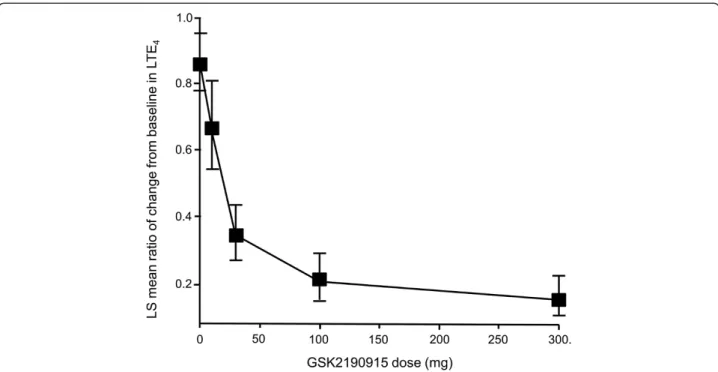
Exposure to GSK2190915 was associated with a de-crease in urinary LTE4 levels (Figure 4). The plasma GSK2190915 concentration versus urinary LTE4 rela-tionship was described by an inhibitory Emaxmodel. The GSK2190915 plasma concentration associated with 50% of maximum (100%) urinary LTE4 inhibition was 33 (113) ng/mL, which equates to a GSK2190915 trough plasma concentration achieved with a dose of 10 mg.
Safety and tolerability
The incidence of adverse events was generally similar be-tween treatment groups (Table 2). The most frequently reported adverse events were headache and nasopharyn-gitis. Four subjects experienced serious adverse events: dislocated joint (n = 1, GSK2190915 10 mg QD), cranial neuritis (n = 1, GSK2190915 30 mg QD), small intestine obstruction (n = 1, GSK2190915 100 mg QD) and injured cartilage (n = 1, FP 100 μg BID); none of the events was considered related to study drug by the investigators and all resolved except the cranial neuritis, which led to sub-ject withdrawal from the study. Eleven subsub-jects were discontinued from the study as a consequence of an ad-verse event. Five of these were considered drug-related:
decreased appetite and nausea (n = 1, placebo), dyspnoea (n = 1, GSK2190915 10 mg QD), extrasystoles and diar-rhoea (n = 2, GSK2190915 300 mg QD) and drug eruption (n = 1, montelukast 10 mg QD). No drug-related adverse events were reported by more than one subject in any treatment group. Fifteen subjects experienced asthma exa-cerbations across all treatment groups except FP 100 μg BID; all episodes were treated with corticosteroids and all exacerbations resolved. One subject became pregnant during the run-in period and was withdrawn before randomisation. No abnormalities in male reproductive health were detected in the follow-up data from the male subjects who participated in the study and underwent follow-up testing. There were no significant or clinically meaningful differences between active treatments and placebo in blood chemistry (including liver function), haematology, urinalysis, vital signs and ECG parameters.
Discussion
Administration of GSK2190915 for 8 weeks led to nume-rical increases in mean change from baseline in trough FEV1 at all doses, although none of these achieved sta-tistical significance compared with placebo. A repeated measures sensitivity analysis of the primary endpoint sug-gested nominal statistical significance for GSK2190915 30 mg compared with placebo. Improvements were ob-served in mean time symptom scores and mean day-time SABA use for GSK2190915 30 mg versus placebo. Table 1 Demographic and baseline subject characteristics
Placebo GSK2190915 10 mg QD
GSK2190915 30 mg QD
GSK2190915 100 mg QD
GSK2190915 300 mg QD
FP 100μg BID
Montelukast 10 mg QD
N = 100 N = 99 N = 100 N = 100 N = 101 N = 103 N = 97
n (%) n (%) n (%) n (%) n (%) n (%) n (%)
Age in years; Mean [range] 42.3 [12–71] 40.0 [12–75] 43.1 [12–73] 42.2 [12–69] 42.2 [12–69] 41.5 [12–74] 44.3 [15–78]
BMI in kg/m2; Mean [range] 27.5 [16–47] 27.5 [17–49] 26.8 [16–43] 27.8 [16–52] 26.9 [19–63] 27.0 [15–55] 27.1 [18–54]
Sex; n (%)
Female 88 (88) 91 (92) 94 (94) 92 (92) 93 (92) 97 (94) 89 (92)
Male 12 (12) 8 (8) 6 (6) 8 (8) 8 (8) 6 (6) 8 (8)
Race; n (%)
White 82 (82) 74 (75) 78 (78) 78 (78) 78 (77) 83 (81) 76 (78)
Black 6 (6) 12 (12) 10 (10) 9 (9) 9 (9) 7 (7) 9 (9)
Other 12 (12) 13 (13) 12 (12) 13 (13) 14 (14) 13 (13) 12 (12)
Smoking-history; n (%)
Never smoked 78 (78) 85 (86) 83 (83) 77 (77) 86 (85) 86 (83) 78 (80)
Current smoker 12 (12) 9 (9) 10 (10) 11 (11) 10 (10) 13 (13) 13 (13)
Former smoker 10 (10) 5 (5) 7 (7) 12 (12) 5 (5) 4 (4) 6 (6)
FEV1in L; Mean [range] 2.0 [1.2–3.7] 2.0 [1.0–3.3] 1.9 [1.1–2.8] 2.0 [1.0–3.5] 2.0 [1.1–3.4] 2.0 [1.0–4.0] 2.0 [0.9–3.5]
% predicted; Mean [range] 68.7 [51–87] 67.7 [50–96] 66.1 [50–85] 67.8 [51–85] 66.8 [51–85] 66.6 [37–85] 69.2 [50–85]
Atopy, n% 22 (22) 30 (30) 31 (31) 31 (31) 35 (35) 35 (34) 34 (35)
Figure 3Sensitivity analysis of primary efficacy endpoint.Repeated measures analysis of change from baseline in trough FEV1(L).
LS = least squares.
No additional benefit was gained by administration of GSK2190915 doses greater than 30 mg. The results ob-tained in this study suggest that a GSK2190915 dose of 10 mg QD may be sub-optimal and furthermore suggest that the FEV1dose–response across the range investigated (30–300 mg) was markedly flat. This was in contrast to the plasma GSK2190915 concentrations that showed increases with dose, and the urinary LTE4 levels that decreased in a dose/GSK2190915 plasma concentration-dependent manner. These pharmacokinetic and phar-macodynamic observations were associated with high inter-subject variability but were comparable to previ-ously reported clinical studies [18].
The results reported in this study population sug-gest that inhibition of FLAP may not provide further
improvement on efficacy endpoints beyond those achieved with cysLT receptor antagonism. However, this requires further evaluation in specifically designed clinical trials. In patients with severe asthma, where neutrophil inflamma-tion plays a significant role in disease pathology, zileuton has demonstrated improvements in lung function. Al-though zileuton is the only LT synthesis inhibitor currently available, its use has been limited by the need to monitor hepatic enzyme levels and the high frequency of dosing [16]. The findings from the current study indicate that GSK2190915 could play a similar role to zileuton in terms of its anti-LT production activity.
Urinary LTE4 levels decreased in a manner dependent on GSK2190915 dose/GSK2190915 plasma concentration, confirming that GSK2190915 is capable of inhibiting
Figure 4Dose–response plot of urinary LTE4.Ratio of mean change from baseline in urinary LTE4. Error bars represent 95% confidence
interval. LS = least squares.
Table 2 Summary of most frequently reported adverse events (>1% of all subjects who received GSK2190915)
Placebo GSK2190915 10 mg QD
GSK2190915 30 mg QD
GSK2190915 100 mg QD
GSK2190915 300 mg QD
Total GSK2190915
FP 100μg BID
Montelukast 10 mg QD
N = 100 N = 99 N = 100 N = 100 N = 101 N = 400 N = 103 N = 97
n (%) n (%) n (%) n (%) n (%) n (%) n (%) n (%)
Any event 20 (20) 25 (25) 20 (20) 20 (20) 24 (24) 89 (22) 25 (24) 24 (25)
Headache 3 (3) 7 (7) 2 (2) 4 (4) 4 (4) 17 (4) 9 (9) 9 (9)
Nasopharyngitis 5 (5) 6 (6) 3 (3) 2 (2) 5 (5) 16 (4) 5 (5) 5 (5)
Cough 1 (1) 2 (2) 2 (2) 2 (2) 2 (2) 8 (2) 3 (3) 1 (1)
Nausea 1 (1) 2 (2) 1 (1) 1 (1) 3 (3) 7 (2) 1 (<1) 0
Oropharyngeal pain 1 (1) 1 (1) 0 2 (2) 3 (3) 6 (2) 1 (<1) 1 (1)
Back pain 0 1 (1) 2 (2) 2 (2) 1 (<1) 6 (2) 0 2 (2)
the 5-LO pathway in subjects with persistent asthma. GSK2190915 achieved 50% of maximum estimated in-hibition of urinary LTE4 at a plasma concentration of 33 ng/mL, which is comparable to the value estimated from earlier studies in healthy subjects (unpublished ob-servations). However, reduced LTE4 was only associated with small and non-statistically significant changes in FEV1from baseline. Thus, the measures of efficacy of the present study failed to demonstrate a dose–response for GSK2190915 on FEV1even though the pharmacokinetic data confirmed that an increase in drug exposure was as-sociated with a dose-dependent decrease in the levels of urinary LTE4.
Previous dose-ranging studies with anti-LT agents have also shown poor relationships between urinary LTE4 concentrations and changes in FEV1[20-22]. A study of MK-0633, a 5-LO inhibitor, showed that inhibition of urinary LTE4of approximately 90% was associated with a relatively modest change in FEV1from baseline: 0.20 L compared with 0.13 L for placebo in change from base-line over the last 4 weeks of a 6-week treatment period [21]. Zileuton led to significant increases in FEV1 after treatment for 4 weeks (change from baseline: 0.32 L; 95% CI: 0.16, 0.48) but the levels of inhibition of urinary LTE4achieved were only 39% [22]. Therefore, the results obtained in our study where inhibition of urinary LTE4 was associated with a small change from baseline in FEV1 (0.13 L for placebo and 0.18–0.23 L for GSK2190915) are consistent with previous studies and support the hypothe-sis that changes in LTE4 and FEV1 may not always be highly correlated.
GSK2190915 was well-tolerated and there were no dif-ferences between treatment groups in the frequency of adverse events. Previous studies of zileuton and MK-0633 suggest that these molecules may have less than optimal safety and tolerability profiles as liver abnormali-ties were identified [16,21]. In one study with MK-0633, a planned extension to the study was terminated prema-turely and the patients discontinued because of apparent dose-related increases in alanine aminotransferase and as-partate aminotransferase levels [21]. No such abnormal-ities were observed in the current study.
As the original protocol allowed recruitment of both male and female subjects, 56 males received at least one dose of study medication. However, interim histopatho-logical assessments of the male reproductive tract from toxicology studies in rats, which were reported during the conduct of the study, revealed testicular toxicity at high exposure levels of GSK2190915. In a proportion of the rats receiving the maximum feasible dose of GSK2190915 (1000 mg/kg/day), testicular atrophy and hypospermia in the epididymides were observed. The reasons behind this finding were unclear at the time and, therefore, it was decided to withdraw all males and
only recruit female subjects for the remainder of the study. Although the study population was predominantly female (92%), the results obtained in the study appear ap-plicable to both genders as, generally, no gender-specific results have been described in asthma treatment.
There is no clear reason that can explain why subjects in the placebo group demonstrated such a high response in the primary and secondary efficacy endpoints. Al-though there were improvements within active treat-ment groups, the placebo response may have limited the opportunity for demonstrating significant changes in the efficacy endpoints for active treatments relative to pla-cebo. It is possible that, as the study population was comprised of subjects with relatively mild asthma con-trolled with a SABA, some subjects improved spontan-eously and others are likely to have benefited from the frequent contact with clinical staff and the greater atten-tion received, which may be particularly relevant in a mild asthmatic population.
It could be questioned why no statistically signifi-cant difference between GSK2190915 and placebo was achieved for the primary efficacy endpoint, particu-larly as the outcome measure defined was the most appropriate for a dose range study in asthma. The ob-served response to FP, the positive control, indicated that the enrolled population was capable of improvement in terms of their lung function response. Furthermore, the study was well designed, incorporated a relatively wide dose range and active comparator and placebo arms were included in the design. It seems to be the case that there are areas in which the design of a randomised trial may re-sult in gaps in the evidence they collect [23]. In particular, randomised trials include tightly controlled and well-characterised populations, tend to be limited in the num-ber of outcomes evaluated and are relatively short in duration [23]. For chronic conditions such as asthma, concerns exist regarding the external validity of the data gathered in randomised trials and the ability to extrapolate these data to the heterogeneous patient population treated in everyday clinical practice.
Conclusions
GSK2190915 for primary and secondary efficacy end-points was comparable with montelukast but less than low dose FP. GSK2190915 was generally safe and well-tolerated. The GSK2190915 30 mg dose appears to be the most appropriate for study in future clinical trials.
Additional files
Additional file 1:Study treatments administered.Table detailing the study treatments administered following the double-dummy design.
Additional file 2:Summary of secondary efficacy parameters.
Summary of the analysis of the secondary efficacy endpoints of the study.
Competing interest
Richard MA Follows, Shu-Yen Ho, Claire L Ambery, and Barbara A McQuade are GlaxoSmithKline employees. Neil G Snowise and Kevin Smart were employed by GlaxoSmithKline at the time the study was conducted.
Authors’contribution
RMAF, SYH and CLA participated in the conception and design of the study, and in the analysis and interpretation of the data. NGS and BAM contributed to the conduct of the study, protocol amendment and the analysis and interpretation of the data. KS contributed to analysis and interpretation of the data. All authors have made critical revisions of draft versions of the manuscript and approved the final manuscript.
Acknowledgements
We thank Marie Duggan for managing the study and Michelle Fry for data management. Justin Cook, PhD, and Severina Moreira, PhD, from Niche Science and Technology (Richmond-upon-Thames, United Kingdom) provided writing and editorial support to the development of this manuscript and were paid for these services by GlaxoSmithKline. This study was funded by GlaxoSmithKline.
Author details
1GlaxoSmithKline, Stockley Park West, Uxbridge, Middlesex UB11 1BT, UK. 2GlaxoSmithKline, 5 Moore Drive, Research Triangle Park, NC 2770, USA. 3GlaxoSmithKline, Gunnels Wood Road, Stevenage Herts, SG1 2NY, UK. 4Current address: Vectura Group plc, One Prospect West, Chippenham,
Wiltshire SN14 6FH, UK.5Current address: Roche Products Limited, 6 Falcon
Way, Shire Park, Welwyn Garden City AL7 1TW, UK.
Received: 11 December 2012 Accepted: 15 May 2013 Published: 17 May 2013
References
1. Funk CD:Prostaglandins and leukotrienes: advances in eicosanoid biology.Science2001,294:1871–1875.
2. Miyahara N, Miyahara S, Takeda K, Gelfand EW:Role of the LTB4/BLT1 pathway in allergen-induced airway hyperresponsiveness and inflammation.Allergol Int2006,55:91–97.
3. Hicks A, Monkarsh SP, Hoffman AF, Goodnow R Jr:Leukotriene B4 receptor antagonists as therapeutics for inflammatory disease: preclinical and clinical developments.Expert Opin Investig Drugs2007,16:1909–1920. 4. Barnes NC, Piper PJ, Costell JF:Comparative effects of inhaled leukotriene
C4, leukotriene D4 and histamine in normal subjects.Thorax1984,
39:500–504.
5. Lewis RA:Leukotrienes and other products of the 5-lipoxygenase pathway. Biochemistry and relation to pathobiology in human diseases. N Engl J Med1990,323:645–655.
6. Wenzel SE:The role of leukotrienes in asthma.Prostaglandins Leukot Essent Fatty Acids2003,69:145–155.
7. Peters-Golden M, Henderson WR:Leukotrienes.N Engl J Med2007,
357:1841–1854.
8. Dworski R, Fitzgerald GA, Oates JA, Sheller JR:Effect of oral prednisone on airway inflammatory mediators in atopic asthma.Am J Respir Crit Care Med1994,149:953–959.
9. Wenzel SE, Szefler SJ, Leung DY, Sloan SI, Rex MD, Martin RJ:Bronchoscopic evaluation of severe asthma. Persistent inflammation associated with high dose glucocorticoids.Am J Respir Crit Care Med1997,156:737–743. 10. Vachier I, Bonnans C, Chavis C, Farce M, Godard P, Bousquet J, Chanez P:
Severe asthma is associated with a loss of LX4, an endogenous anti-inflammatory compound.J Allergy Clin Immunol2005,115:55–60. 11. Afonso PV, Janka-Junttila M, Lee YJ, McCann CP, Oliver CM, Aamer KA,
Losert W, Cicerone MT, Parent CA:LTB4 is a signal-relay molecule during neutrophil chemotaxis.Dev Cell2012,22:1079–1091.
12. Vachier I, Kumlin M, Dahlen SE, Bousquet J, Godard P, Chanez P:High levels of urinary leukotriene E4 excretion in steroid treated patients with severe asthma.Respir Med2003,97:1225–1229.
13. Jatakanon A, Uasuf C, Maziak W, Lim S, Chung KF, Barnes PJ:Neutrophilic inflammation in severe persistent asthma.Am J Respir Crit Care Med1999,
160:1532–1539.
14. From the Global Strategy for Asthma Management and Prevention, Global Initiative for Asthma (GINA); 2011. http://www.ginasthma.org/. 15. Amlani S, Nadarajah T, McIvor RA:Montelukast for the treatment of
asthma in the adult population.Expert Opin Pharmacother2011,
12:2119–2128.
16. Berger W, De Chandt MT, Cairns CB:Zileuton: clinical implications of 5-Lipoxygenase inhibition in severe airway disease.Int J Clin Pract2007,
61:663–676.
17. Lorrain DS, Bain G, Correa LD, Chapman C, Broadhead AR, Santini AM, Prodanovich PP, Darlington JV, Stock NS, Zunic J, King CD, Lee C, Baccei CS, Stearns B, Roppe J, Hutchinson JH, Prasit P, Evans JF:Pharmacology of AM803, a novel selective five-lipoxygenase-activating protein (FLAP) inhibitor in rodent models of acute inflammation.Eur J Pharmacol2010,
640:211–218.
18. Bain G, King C, Schaab K, Rewolinsk M, Norris V, Ambery C, Bentley J, Yamada M, Santini AM, van de Wetering de Rooij J, Stock N, Zunic J, Huitchinson JH, Evans JH:Pharmacodynamics, pharmacokinetics, and safety of GSK2190915, a potent, novel 5-lipoxygenase-activating protein inhibitor.Br J Clin Pharmacol2013,75:779–790.
19. National Institutes of Health (NIH):Guidelines for the Diagnosis and Management of Asthma - Expert Panel Report 3. NIH Publication No. 07–4051.
Bethesda, MD: U.S. Department of Health and Human Services; 2007. http://www.nhlbi.nih.gov/guidelines/asthma/.
20. García-Marcos L, Schuster A, Pérez-Yarza EG:Benefit-risk assessment of antileukotrienes in the management of asthma.Drug Saf2003,
26:483–518.
21. Wasfi YS, Villarán C, de Tilleghem Cle B, Smugar SS, Hanley WD, Reiss TF, Knorr BA:The efficacy and tolerability of MK-0633, a 5-lipoxygenase inhibitor, in chronic asthma.Respir Med2012,106:34–46.
22. Israel E, Rubin P, Kemp JP, Grossman J, Pierson W, Siegel SC, Tinkelman D, Murray JJ, Busse W, Segal AT, Fish J, Kaiser HB, Ledford D, Wenzel S, Rosenthal R, Cohn J, Lanni C, Pearlman H, Karahalios P, Drazen JM:The effect of inhibition of 5-lipoxygenase by zileuton in mild-to-moderate asthma.Ann Intern Med1993,119:1059–1066.
23. Price D, Chisholm A, van der Molen T, Roche N, Hillyer EV, Bousquet J:
Reassessing the evidence hierarchy in asthma: evaluating comparative effectiveness.Curr Allergy Asthma Rep2011,11:526–538.
doi:10.1186/1465-9921-14-54