Digital Library Federation
Council on Library and Information Resources
Washington, D.C.
by William S. Brockman, Laura Neumann,
Carole L. Palmer, Tonyia J. Tidline
December 2001
Scholarly Work in the
Humanities and the
Evolving Information
Environment
ISBN 1-887334-90-4
Published by: Digital Library Federation
Council on Library and Information Resources 1755 Massachusetts Avenue, NW, Suite 500
Washington, DC 20036 Web site at http://www.clir.org
Additional copies are available for $15 per copy. Orders must be placed online through CLIR’s Web site. The paper in this publication meets the minimum requirements of the American National Standard for Information Sciences—Permanence of Paper for Printed Library Materials ANSI Z39.48-1984.
Copyright 2001 by the Council on Library and Information Resources. No part of this publication may be reproduced or transcribed in any form without permission of the publisher. Requests for reproduction should be submitted to the Director of Communications at the Council on Library and Information Resources.
About the Authors
William S. Brockman is Paterno Family Librarian for Literature at Pennsyl-vania State University. Previously he had held the positions of English librari-an librari-and coordinator of the Arts librari-and Humlibrari-anities Division at the University of Illinois at Urbana-Champaign, and reference librarian at Drew University. His research has examined the publication of reference works in the humanities, specifically within the areas of literature and music. Recent research has cen-tered on textual studies and reception studies of James Joyce, on the role of libraries in literary censorship, and on twentieth-century publishing history and literary collecting. Presently he is engaged in a study of the publication history of Joyce’s A Portrait of the Artist as a Young Man and is working on a primary bibliography of the works of Joyce. Since 1990, he has been bibliogra-pher for the James Joyce Quarterly, for which he compiles the “Current James Joyce Checklist.”
Laura Neumann is a usability engineer at Microsoft Corporation. She has a Ph.D. in Library and Information Science from the University of Illinois at Urbana-Champaign and has a background in sociology and cultural anthro-pology. Her research examines how people use, organize, find, and gather information. As part of the Illinois Digital Library Initiative (1994-1998), she studied how scientists and engineers use journal literature in their work. She also studied how scientists and scholars create and organize their personal collections and work space. Her recent research focuses on how humanities scholars accomplish their work through a number of specific practices. Her dissertation is an analysis of humanities scholars’ community of practice and how the community works as an information system. She is interested in finding ways to apply field research and library and information science re-search to real-world problems in the information technology industry.
Carole L. Palmer, the principal investigator on this research project, is assistant professor at the Graduate School of Library and Information Science at the University of Illinois at Urbana-Champaign. Her background is in aca-demic librarianship, and she teaches in the areas of information seeking and use, information services, and library collections. Her research explores how information systems and services can best support the work of researchers. In addition to her studies of the information environments of humanities schol-ars, she is investigating how information practices and knowledge structures affect researchers’ ability to find and integrate information from multiple fields of study. She is also engaged in projects to develop digital libraries and knowledge discovery systems that support and promote diverse research col-laborations. Her recent publications include a series of articles on the infor-mation work of interdisciplinary scientists and humanities scholars. Her book, Work at the Boundaries of Science: Information and the Interdisciplinary Re-search Process, will be published in 2002.
Tonyia J. Tidline received her MLS from Kent State University and is now a doctoral candidate at the Graduate School of Library and Information Science at the University of Illinois at Urbana-Champaign. She has a back-ground in public relations in the arts. Her research interests include informa-tion seeking and use in context, with emphasis on the informainforma-tion processes involved in making and viewing art. She has published papers on the topics of information overload and community information networks.
Contents
Preface ... vi
Acknowledgments ... viii
Introduction ... 1
Present State of Knowledge on Information Use in the Humanities ...2
Project Approach ... 4
Project Findings ... 6
Ways of Reading ... 7
Chaining to Enable Reading ... 9
Collaborative Networking ... 11
Researching and Searching ... 13
Collections as Capital ... 13
Many States of Primary Materials ... 15
Multitude of Sources ... 17
Access Tools for Speed and Scope ... 19
Diverse Skills and Strategies ... 20
Generic Searching Problems ... 22
Browsing across Collections and Tools ... 23
Ways of Writing ... 24
Information Management, Accretion, and Refinement ... 24
Oscillating and Overlapping Synthesis Work ... 26
Trends: The Evolving Information Environment for Humanists ... 28
Conclusion ... 31
References ... 33
Preface
Academic libraries support and promote research, learning, and cultural en-gagement. In carrying out this role, they are inherently Janus-faced. Their gaze in one direction is focused on assembling, curating, and supporting the use of scholarly information; in another, it is fixed on tracking what informa-tion faculty, students, and lifelong learners actually need and on how and where they prefer to discover, locate, and use it.
In recent years, the rapid development of new technologies and the pro-liferation of new information services and sources have changed the informa-tion environment dramatically. Internet search services such as those offered by Google and Amazon have joined library catalogs, archival finding aids, and online databases as vital guides to scholarly information. Reference link-ing services that are enabled by organizations such as CrossRef promise to revolutionize again the means by which scholars and students discover and locate the information they need.
Faculty and students now have more outlets for scholarly material than ever before. Books, journal articles, scientific data, sound and video record-ings, and even some surrogates for archival and rare materials are available online through numerous services, only some of which are offered by or through academic libraries. Online booksellers offer alternatives to brick-and-mortar outlets and to Interlibrary Loan services, and we may soon see much greater use of print-on-demand services. Scholars and students are now able to draw upon an expanding range of reference services, as Internet gateways and “Ask-a” services supplement formal library reference desks and the less formal peer networks upon which faculty and students continue to draw so heavily.
As the scholarly information environment changes, so do the needs, ex-pectations, and behaviors of users. Assessing and responding to those chang-es is chang-essential for the academic library so that it may continue in support of the scholarly mission. The authors of this report have formally examined how humanities scholars conduct and collate their research. The study was based on a small sample of scholars; nonetheless, the results are powerfully sugges-tive of ways in which academic libraries can adapt to and develop in a rapid-ly changing environment. In particular, the findings emphasize how impor-tant it is for libraries to chart their evolutionary course in close consultation with scholarly user communities.
The study leaves little doubt that humanities scholars have adapted well to rapid technical change. It demonstrates the extent to which scholars are able to harness information technologies to tried, tested, and somewhat tradi-tional research functions. Such functions include, for example, keeping abreast of a broad secondary literature that surrounds their fields of inquiry;
Daniel Greenstein
Director, Digital Library Federation
locating, acquiring access to, and using primary resources that are relevant to a particular area of investigation; and developing personal libraries that en-rich and reinforce their scholarship. This finding may have profound implica-tions for the academic library that feels its own efforts to adapt to new tech-nologies are sometimes constrained by faculty who appear to resist change. Working with research faculty, libraries have an opportunity to learn how better to support scholarship with new technologies while encouraging schol-arly adoption and use of those technologies.
Another set of findings is equally potent, even if its precise significance for the library is more difficult to predict. Humanities scholars are used to, and in some cases even prefer, information that is delivered to their desktops. This is especially true with finding aids; humanists expressed a common de-sire for online material that reveals the holdings of research collections and archives worldwide. Humanists are equally enamored of abstract, indexing, and citation services, and perhaps only slightly less so of online journals. Where primary research materials are concerned, however, the scholars have yet to be convinced by digital editions. The scholar’s purview is so typically broad that it defies the narrow boundaries that surround the current genera-tion of digitally reformatted collecgenera-tions.
What lessons might the library draw from this? “Catalog first” might be one. Another lesson might be to emphasize the importance of developing vir-tually integrated services that allow scholars to search across and use geo-graphically disparate digitally reformatted materials as if they made up a sin-gle online collection. Of course, such services require widespread adherence to community-agreed benchmarks that ensure that disparate online collec-tions each attain a minimum degree of persistence and interoperability. Con-sequently, the study encourages libraries to develop and adopt such common standards as a matter of urgent priority. A third lesson might point to digital collections—or virtual uniform collections—that are developed to support specific research aims and thus are formed in close consultation with the scholars who share these aims.
The study is methodologically innovative in ways that should inform supplemental and follow-up investigation. The authors have drawn conclu-sions about the research process through extensive observation of selected humanities scholars at work. By encouraging their subjects to think aloud, the authors have developed a rich profile of the research process. They have also developed indications of scholars’ behaviors and preferences as these re-search processes are conducted in a complex information environment. The prose, peppered liberally with quotations that reflect the subjects’ trains of thought, provides insight into the excitement, frustrations, complexities, and rewards associated with humanities research today.
This study results from the fruitful cross-fertilization between the scholar concerned with aspects of information science and the librarian concerned with delivering operational information services. Clearly the two parties, as well as the professional communities they represent, benefit substantially from this collaboration.
Acknowledgments
We extend our gratitude first to the scholars whose participation formed the foundation of this project. Without their generous donations of time and their insights into their own work, the project could never have proceeded. We thank the University of Illinois at Urbana-Champaign Campus Research Board, whose funding carried our work through the initial phases of data col-lection, and the Digital Library Federation, whose funding allowed the re-search team to continue with data collection and analysis. We are also grate-ful to those who provided constructive criticism of earlier drafts of the report. In particular, Dan Greenstein’s close reading of several drafts and patient en-couragement enabled us to explore implications of our findings. Allen Renear offered valuable comments, and Kathlin Smith’s careful reading clarified nu-merous points.
INTRODUCTION
W
hile digital resources are becoming more visible in the humanities, use of these resources by scholars remains limited. Humanists have come to rely on computers and electronic communication for some of their daily work, but the use of digital information resources has yet to become routine. Digitization projects are bringing texts, data sources, sound, and images to the scholar’s desktop; however, the functions on which research in the humanities depend are neither well understood nor well supported by librarians. Digital libraries are still evolving, and librarians and other information professionals are just beginning to understand and exploit the computer’s ability to assist in the humanities research process.The Scholarly Work in the Humanities Project began in 1999 to examine in detail how humanists work, how they are integrating technology into their work, and how future technologies might offer new opportunities in line with the goals of humanities research. The project was based on the premise that future development of re-search libraries should be informed by the actual practices and needs of working scholars and that it should take into account the value and impact of the technologies that they have adopted thus far. Deci-sions about how to build collections and services in research libraries should be more responsive to the disciplines that have historically depended on library and archival resources, and they should take into account the many types of resources and activities involved in the scholarly process. As Okerson (2000, 690) notes, “Our profession should do what our commercial information suppliers are doing: fo-cus on the users, their needs, their wants, and the practices of using information.” While we need to continue to collect data on the use
The comfortable stereotype of humanists as technophobic is no longer accurate. The availability of text and images in electronic form, coupled with the processing power of modern computers, allow the humanist to explore hypotheses and visualize relations that were previously lost in the mass of information sources (Wulf 1995, 48).
and usability of the resources that libraries already own, it is impor-tant to recognize the limits of that type of evaluation. Use statistics and usability tests are important for judging the effectiveness of deci-sions that have already been made, but they are not good indicators of what is lacking in our current service and collection models. For that, we need a fuller understanding of the use environments of our clientele, particularly those whose work depends most on the future of research libraries.
This report provides a foundation for developing user-based cri-teria for guiding digital library development by articulating what scholars do in the course of their research and how they depend on information to follow their paths of inquiry and write new texts. Through the analysis of scholars’ practices we can conceptualize the type of information environment that would best support their activ-ities and begin to clarify prioractiv-ities for the development of rich infor-mation environments that are responsive to the context of scholarly work.
Present State of Knowledge on Information Use in the Humanities
The process of research in the humanities and the fruits of that re-search are closely intertwined. In fact, the results of rere-search may be inseparable from the activity of research and the writing of its inter-pretation: “In the humanities, in a certain sense, the ‘discoveries’ of re-search inhere in the writing of the ultimate published document” [em-phasis in original] (Bates 1996a, 698).
Stone’s (1982) foundational review of research on the informa-tion needs and uses of humanities scholars asserts that humanists tend to work alone, perform their own literature searches, and rely on browsing. They use a variety of research methods that may be drawn from other disciplines. Their research materials are also di-verse and are drawn from a wide variety of types of resources. They rely on books more heavily than on journals. They need retrospective materials and often prefer to use original documents rather than fac-similes. Writing at the dawn of the adoption of computer technology into humanistic research, Stone noted a lack of adequate bibliograph-ic tools and databases and cautioned that “it may be part of the hu-manistic tradition to be anti-machine” (300). She affirmed that librar-ies are of great importance to humanitlibrar-ies scholars and they are likely to use a variety of libraries. “The links between the subjective views of humanists and librarians and the more objective knowledge pro-vided by research and other forms of systematic analysis are weak,” she adds(304). ”The literature on the whole does not provide librari-ans with clear guidelines as to how they should proceed in terms of meeting the needs of humanities scholars,” she concludes (306).
Wiberley and Jones (1989) followed the research of 11 scholars through the late 1980s and 1990s. Their findings confirmed the spirit of previous research: the scholars relied heavily on libraries, made particular use of special-collections librarians, and used
bibliograph-ic tools to varying degrees. They noted in partbibliograph-icular that “because humanists have well-developed habits for finding information in their specializations, they have little need for current awareness ser-vices that inform them of the latest literature in their areas of exper-tise” (644), and felt that the scholars could have made greater use of the assistance of librarians. The authors’ 1994 follow-up noted the scholars’ sharply increased use of word processing and online cata-logs and limited use of electronic mail. Wiberley and Jones attributed humanists’ slow adoption of technology to “the difficulty of analyz-ing their evidence with readily available software, the rarity of co-authorship, and the abundance of references to the secondary litera-ture in the monographs they read” (506). By the time the third report was published in 2000, use of word processing, online catalogs, and electronic mail was taken for granted. The authors noted the grow-ing importance of primary sources in electronic form but also em-phasized humanists’ frequent use of obscure sources that are unlike-ly to be digitized, and concluded that this argues for the continuing importance of libraries’ maintenance of printed resources.
The Getty Online Searching Project gave a small group of schol-ars an opportunity to do an unlimited number of searches of the full-text and bibliographic databases in DIALOG over a two-year period in the early 1990s (Bates, Wilde, and Siegfried 1993; Siegfried, Bates, and Wilde 1993; Bates, Wilde, and Siegfried 1995; Bates 1994; Bates 1996a; Bates 1996b). Bates and her associates noted that the search terms used most heavily by humanists were names, places, titles of works, and other proper nouns; that scholars did not make frequent use of online searching; and that they saw online techniques as sup-plementing, but not replacing, their usual research methods. Perhaps most telling is Bates’s conclusion that scholars in the humanities con-tinued to identify citations to secondary materials via books and arti-cles, reviews, and recommendations from colleagues (1994, 334). She concluded that small, specialized electronic bibliographies would meet scholars’ needs better than would large, discipline-oriented da-tabases.
More recent work tends to avoid overstating humanists’ use of electronic resources. Manoff (1997) criticizes the Getty study because it focused on DIALOG, and few of its databases were relevant to the needs of humanists at that time. In interviews with humanities facul-ty members at a major universifacul-ty, Massey-Burzio (1999) found a strong ambivalence among humanists toward technology in general. She found that frustrations with equipment were mingled with com-plaints that resources available on the Web or through other electron-ic means were poorly organized. Humanists also reportedly found fault with the instability of electronic texts and were uncomfortable reading long passages on a monitor. Antipathy toward electronic ma-terials focused on the inferior quality of reproduction of printed and visual materials on the screen and on the absence of context that would be readily apparent in a printed publication. The scholars did, however, appreciate the ability to perform word searches.
Weintraub’s comments of two decades ago may continue to hold true: “Humanists are probably the most book-bound creatures in the world of scholarship. . . . Their most fundamental work depends on the availability of original texts” (1980, 25). However, Sweetland’s assertion that “humanities scholars tend to be uncomfortable with technology” (1992, 786) is no longer the case. Although some of the timidity reported by Bates and Wiberley in the use of electronic re-sources remains, much academic discourse and administrative com-munication take place electronically. Few writers prefer a typewriter to a computer, and virtually all library catalogs are at least partially available only electronically (Wiberley and Jones 2000). “Humanities scholars are beginning to make use of new information technologies while continuing to rely heavily on practices and materials that pre-date digital systems” (Palmer and Neumann forthcoming [b]).
The results presented here update our understanding of how hu-manities scholars conduct research. They provide a fresh look at the role of information in the practice of scholarship and new insights into how scholars are using technologies and the effect that they are having on their research. In contrast to many previous investigators, we have not focused on derivative elements of scholarly work, such as the types of search terms or information sources favored by schol-ars. Moreover, we have not aimed to analyze broadly the nature of research throughout the humanities. Instead, we examined scholarly work practices in relation to projects being carried out by a sample of humanities scholars and concentrated on the activities and resources required in their work. We found that this narrowing of scope rein-forces the broader conceptions of humanities research, for the issue of context remains paramount. The processes of reading and search-ing, developing context, and rereading and researching are at the heart of humanities scholarship. They are the means by which we may also explore the role of libraries as providers of texts and other scholarly resources. By identifying salient features of the contempo-rary work of scholars, we provide benchmarks that research libraries can use to make informed judgments about how to support and en-hance the process of scholarship.
The study employed three general lines of questioning:
• How do humanities scholars think about, organize, and perform their research?
• How are information sources used throughout the research pro-cess?
• How do electronic information sources affect work practices? In addition, we were interested in two specific questions related to research library collections and services:
• What functions and characteristics make one resource better than another?
• How can the traditional role of the library as a repository for printed works be reconciled with the provision of virtual, unlocat-ed resources?
We designed the study to explore the perspectives and informa-tion behaviors of scholars in the humanities. Qualitative methods are the most appropriate means for gathering this type of information about individuals or groups, but the demands of collecting and ana-lyzing such data limit the number of participants that can be includ-ed in the sample. Although the study did not aim to fit the criteria of statistical generalizability, we believe that the sample is not unique to the particular time and place in which the research was performed. The scholars and the departments in which they work are typical of those found in large research-oriented universities. The library col-lections at their home institutions are rich in current and retrospec-tive materials, and the electronic resources available to them are sim-ilar to those at most peer universities. To ensure breadth and depth in the study, we employed several methods of data collection, and this triangulation allowed us to base our assertions on a broad and varied set of data. For these reasons, we believe that our results are representative of the research practices of scholars in similar situa-tions.
To assemble a pool of participants, we sent letters of invitation to full-time faculty at the University of Illinois at Urbana-Champaign in the departments of Classics; English; Comparative Literature; Span-ish, Italian, and Portuguese; French; German; and Music. From these departments we secured the participation of 29 volunteers. Some participants held joint appointments in Women’s Studies and Afri-can-American Studies, or had administrative appointments in addi-tion to their faculty responsibilities. We diversified the group of par-ticipants by adding four humanities scholars from similar
departments at the University of Chicago. The final sample of 33 scholars consisted of 16 full professors, 9 associate professors, and 8 assistant professors. Among their wide-ranging interests were nine-teenth-century English poetry and painting; ancient Greek poetry and modern opera production; ancient language translation; mad-ness in fourteenth- and fifteenth-century drama and culture; femi-nism and German cinema; linguistic analysis and feminist theory; plagiarism and influence during the Renaissance; knowledge pro-duction in the ancient world; and early twentieth-century African-American poetry. Among our participants we found little overlap in subject area concentration but much consistency in approaches to research and information seeking and use. It is possible that the indi-viduals who volunteered for the study tended to be more engaged with libraries and electronic resources than is the typical humanities scholar; however, we do not view this as a shortcoming, because our goal was to learn about the variety and importance of information activities in relation to libraries and information systems, not to char-acterize humanities scholarship as a whole or to profile an ideal scholar.
One of the significant accomplishments of this project was the development and testing of new combinations of qualitative meth-ods for studying scholarly work. Data collection was conducted at two levels. First, we carried out two rounds of semi-structured inter-views with all 33 participants. The interinter-views centered on scholarly activities and the information practices and resources associated with these activities. Second, we conducted more extensive case studies of five of the scholars. The interviews from the larger sample provided a broad perspective from scholars across disciplines. The case studies allowed us to explore finer aspects of work process and technology use. The sequence of data collection techniques applied was as follows:
1. project-based semi-structured interviews 2. selected case studies
a. search session observation b. document analysis and interview c. workspace observation
3. follow-up semi-structured interviews
The data gathered included more than 70 separate incidents, each of which lasted at least one hour. The observation sessions usu-ally lasted two hours. Further discussion of our data collection and analysis techniques is provided in the Appendix.
Previous work on the research practices of humanities scholars has differentiated research work from the activities of keeping current and preparing to teach classes. We found, however, that the latter activities are an important complement to research and that the three types or work are, in the perceptions of scholars themselves, inextri-cable and complementary. Research is a process of contextualization and distillation; its scaffolding develops in collaboration with its structure. Therefore, while our study focused on the research pro-cess, the results presented here are not exclusive to research work. In examining the day-to-day practices of our study participants, we documented the activities and resources involved in the overall scope of scholarly work.
We present our findings by highlighting key types of scholarly practices, elaborating on particular activities and the supporting base of information resources for each activity. Quotations taken from in-terviews with scholars participating in the case studies are interwo-ven with the description and analysis. The four types of activities identified—reading, networking, researching, and writing—were ongoing and interrelated processes in the work routines of the schol-ars. For example, reading involves wide reading, iterative reading, and chaining, which rely on libraries and archives, personal collec-tions, and bibliographic lists, respectively. These practices simulta-neously depend on the practices and resources involved in network-ing, researchnetwork-ing, and writing. In understanding the scholarly
enterprise that our future libraries will need to sustain, it is necessary to recognize not only the centrality of certain activities and resources but also their interdependence.
Ways of Reading
The commonplace that humanities researchers read widely continues to hold: “The scholar who claims to be current and knowledgeable in a field must have read closely and be intimately familiar with a large number of particular works” (Bates 1996a, 699). Scholars spend a large percentage of their time reading. In fact, they perceive a real danger in not reading. Scholars reported that they do background reading (textbooks), comprehensive reading (everything possible), continual reading (simultaneous and associative), and that they “read around” a period or a person. They read books and related pri-mary material closely—“for detail” and to become “immersed” in their area of inquiry. Scholars read in different media, but rarely read extended texts directly from a computer screen. Even old library cat-alogs, “the really old, icky, hard to read, nasty catcat-alogs,” contain valuable information. Reading should not be thought of as a single or homogeneous activity.
When I plan my day, or when I decide to read something, that decision is always linked with the exact way I am going to read it. For instance, . . . if I only need to extract certain pieces of specific information, I prop it up next to my computer and type . . . If, on the other hand, I really have to study, learn, and absorb what’s in it, I make a photocopy and I write in the margin. And I underline, too. But I almost never underline without writing in the margin. . . Otherwise, I can find myself simply underlining, rather than absorbing. . . .Writing in the margin really helps to go back and put things together. Then, if I am reading whole books, for general knowledge, I’ll schedule that for reading at home, after dinner in the living room on my sofa. In fact, I’ve thought . . . at times when I have a backlog of that kind of reading to do, that I wish I had an easy chair here. There is still another way; sometimes I do prop up a book by the computer and type extensive notes, as opposed to a few things. . . . the equivalent of about this much [gestures] for every page, and then I put a page key in the margin. And I end up with a multipage digest of a book. It’d be 10, 20 pages, or something like that.
As this excerpt demonstrates, note taking is an integral part of reading. Scholars produce extensive marginal notes, annotating pho-tocopies or personal copies or attaching adhesive notes to a text. Each scholar has his or her own way of integrating handwriting and computer work. Most scholars use word processing programs to some degree for digesting or transcribing notes and for sketching out preliminary ideas in conjunction with reading.
Primary materials are read and reread to learn them as well as possible and to be able to set them into context—historical, authorial,
generic, or cultural. Reading can be related to a specific research project: “If Jonson is writing trickster comedies, you read as many trickster comedies as you can to see how he is engaged in it,” noted one. Sometimes this setting into context integrates the reading of pri-mary and secondary materials. A scholar who had just edited an edi-tion of a Renaissance play reported, “I tried to read as much as I could—literally, everything that’s ever been published about that play, and doing stage history and all the rest of it.” On the other hand, reading of primary materials can be done as a general profes-sional activity. One scholar reported, “A lot of what I do involves in-tensive reading of whatever primary materials have survived from early medieval [cultures]. . . . I don’t know if I have a particularly systematic way of doing it, I just collect everything if possible and read through it.” The solitary activity of reading limits scholars’ use of research assistants. When they do use assistants in the reading process, it is generally to cast a wide net to review relevant second-ary literature that the scholar may then read closely.
Wide reading is at the heart of much humanities research. Sec-ondary materials are read for background information, to gain awareness of current research in a field, to identify references to re-lated research, and, most importantly, to find a source of inspiration. Reading is also a means of keeping current. Most scholars whom we interviewed cited several core journals that they read regularly; most maintain personal subscriptions to a limited number of journals. However, many reported being frustrated at their inability to keep up with the plethora of critical and historical writing in their fields of interest, which limits the scope of current awareness reading. Inter-disciplinary topics require wider general reading than do those in a single discipline.
Libraries are not generally considered to be places in which read-ing takes place—except, of course, in collections with restricted circu-lation, such as archives and rare-book rooms. However, libraries are important for the reviewing and skimming activities involved in wide reading. Scholars use materials in the library and borrow books from it on a regular basis. They value the current journal shelves and the title page services provided by the library. This interest in current awareness speaks to the potential of new types of selective dissemi-nation of information (SDI) services that could allow researchers to request user-defined alerts by title or area of interest in defined time intervals.
Scholars build their own personal libraries to support not only particular projects but also general reading in their field. They buy or make photocopies of materials when possible so they can consult them frequently, mark passages, and write annotations on them. When moving into a new field, they add to their collections, usually concentrating on primary texts. One scholar stated that once the standard editions in a field have been bought, there is no need to buy further; another reported spending $3,000 to $4,000 a year on books. Scholars develop private collections from a need for sheer accessibili-ty (e.g., facsimiles of distant manuscripts) or convenience
(photo-copies that are portable and may be annotated). They take pride in their collections; one referred to his personal library as a “credential catalog.” Despite the privacy of such personal collections, there re-mains a potential role for libraries in helping scholars build their per-sonal collections. For example, on-demand digitization services (ap-plied within fair use standards of copyright law) could take the place of some photocopying or book buying and give scholars more flexi-bility with the texts that they purchase.
Chaining to Enable Reading
Humanities scholars establish a context for their research by reading widely, and the demand for such a context is what makes footnotes and subject bibliographies important tools for humanities research-ers. Bibliographic listings, particularly those found in scholarly books and journals on target topic areas, are the scholar’s most trust-ed tools for developing chains of reading. Scholars perform directtrust-ed “digging,” “raiding,” and “mining” of other peoples’ bibliographies to shorten research time and keep up in their fields.
In contrast to the prospective direction encouraged by the Arts and Humanities Citation Index, scholars characteristically trace refer-ences retrospectively. It is not the simple fact of citation that is impor-tant but its placement—embedded in the text at the back of a book as part of a list of references, or in a footnote to an item against which the text can be tested. The literature on footnote chaining by humani-ties scholars largely fails to mention the qualitative evaluation that is integral to this practice: Who wrote the piece? Where was it pub-lished? Is it any good? Chaining helps scholars maintain a conceptu-al network of the field into which they envision their own work be-ing placed.
You really kind of owe it to the profession to know everything that has been said, and to test your ideas against it, and to give credit to those who have said the same or similar things before, and to explain how you agree or disagree or differ with them. And then also to give the readers of your scholarly article or book some perspective on what others have said. I know a lot about who’s strong and who’s good, I have really now a good instinct, and I am not interested in 50 items. I am interested in going immediately to the strongest items, which is maybe one reason why I don’t use the MLA Bibliography when I have a clearly defined project. I have spent my life evaluating not just literary criticism, but history and anthropology, and so . . . either it is because I know the journals that have the best articles, I know the presses that publish the best things, I know the people that are most reputable. And hence, for me, that is . . . why it is very valuable to go to a very strong recent book on the topic. . . . I start with their footnotes that lead to other footnotes. Now this may seem ludicrous, but . . . it actually enables me to skim off the top the very best things.
To supplement the tracking of isolated footnotes, scholars may use a system of triangulation, according to which the same item cited in several distinct sources carries more weight than does a single ci-tation.
If somebody that you’re interested in quotes something and you haven’t seen it yet, you go and you find it, and then it quotes something else, and eventually you find that the circles start closing. And then when you realize that the new thing that you’ve just found is quoting only the old ones that you’ve read already, you start to realize, “I do have this under my belt now. I’m getting there.”
Footnote chasing can be challenging. Some scholars encountered mistakes in references, which are seemingly simple annoyances that can lead to complex problems.
You know, the weirdest thing about all of this is that the reference that initially sent me to this project was a quotation from Cherry about people going and visiting the monuments in Saint Paul’s. And it is supposed to be on page 390. I mean, the modern book says this quotation is supposed to be from Cherry, page 390. And I have looked at it like three times and have gotten really frustrated, because it is clearly not on page 390. So I am going to let that go. Now . . . I need to do the kind of thing that really just takes a lot of time, which is [to] just look for interesting passages, but it’s . . . an 800-page book, no a 900-page book. It’s a little hard. 390, what would that be a typo for . . . 320? 39 is the introduction. . . . Well, I’ll check it though [flips to that page and begins looking in that area]. Hm. 41 [finds it and laughs]. Yeah, 41.
Some situations have simple solutions; others do not. For in-stance, a scholar was trying to follow a trail of a manuscript that was unavailable to her in any form. She knew that the most definitive source on it was an eighteenth-century catalog. She had seen this cat-alog and believed that it was in the library’s collections, but she could not find any record of it in the card or online catalog. She turned to other catalogs that might have mentioned another source of information on the manuscript, but found that the shelf number cited for the manuscript made no sense in comparison with descrip-tions of this particular library’s manuscript holdings. After two hours of searching, she did not have an answer to her question. The source of her problem could have been an error in the original cita-tion; on the other hand, what she sought could just have been an eso-teric text in a relatively unknown collection. But at the point at which the observation ended, she had no way of knowing that. Footnote chasing, a seemingly trivial search strategy, can be anything but trivial.
Bibliographic lists are heavily used by researchers but underused by content providers. Author-created bibliographies are essential pathfinders through the mass of scholarly knowledge and evidence. Scholars work back and forth among multiple bibliographies and
often repeat or recompile the bibliographic work of others. Some scholars are beginning to use quasi-footnote chasing techniques on the Web to trace “mentions” of terms using search engines or search-ing available full-text documents for keywords. The prominence of chaining behavior points to the potential of reference linking services that allow scholars to move from the reference (whether cited in on-line book, journal, or database) to the underlying text (if available online), or to the library catalog, OCLC WorldCat, and other catalogs to locate a physical copy.
Collaborative Networking
Closely related to footnote chasing is the maintenance of collegial networks for correspondence and collaboration. Previous research in this area has underestimated the importance of collaboration by hu-manities scholars. Research projects in the social sciences and hard sciences are commonly funded and executed by a team and present-ed in articles coauthorpresent-ed by team members. By contrast, individuals write virtually all articles and books in the humanities. This has giv-en rise to the impression that humanities scholars work alone. And in some senses, they do. Reading is a solitary activity, as is, generally, searching databases or browsing. Circulation of drafts, presentation of papers at conferences, and sharing of citations and ideas, however, are collaborative enterprises that give a social and collegial dimen-sion to the solitary activity of writing. At times, the dependence of humanities scholars upon their colleagues can approach joint author-ship of a publication.
The “grapevine,” as one scholar termed it, is crucial for supply-ing references to recent books or articles that might not yet be in-dexed or cited. One respondent noted the importance of maintaining contact with colleagues in different disciplinary communities. The scholars discussed various levels of interaction, citing instances in which colleagues had provided extensive comments on drafts of pa-pers, offered suggestions for further avenues of research, or supplied them with bibliographic citations.
A lot of the mechanisms of vetting are actually also teaching mechanisms, I think. That is, you write a paper for a conference, and they say “I’ll accept it if you shorten it,” or “I think this is the strongest part of the argument, why don’t you bring that out?” and they suggest additional resources. The conference which I go to annually and has made me engage more with [my research] is a very progressive conference in which people circulate papers in advance, and in some cases comment on them in advance. There is some sort of more collaborative movement going on.
Moreover, there is a sense of generational obligation to assist younger scholars.
The older people who are . . . at my level now were extremely encouraging. They wanted new younger people in the field; they were very supportive. They would help you by helping to place
your conference paper, by inviting you to a conference, by asking you to publish an article in something they were doing. And of course I am trying to . . . turn around and do that for people who are not as senior as I am right now.
This high level of interaction offers intellectual challenges be-yond what one encounters solely in writing or in library research.
After you give a talk, there are all sorts of questions. And I think the less people know about the field, the more interesting the questions. Because they’re sort of challenging. They don’t ask you any standard question. They ask you what they find interesting or odd about your work. And that always makes you think of something new, see it in another way.
The rise of e-mail has fostered collaborative practice among hu-manities scholars. “It’s a kind of a sorority,” one scholar explained in reference to a closely knit group with whom she regularly communi-cates. Most scholars reported frequent use of e-mail, although several avoided using it at home, finding that it intrudes on their private lives. They associated it with administrative communication that was more appropriate to the campus office. “I don’t need that every day, because e-mail is chatter. I get into chattering doing it, and I like that sometimes, but it’s distracting. Why have it in the place where I’m really writing?” asked one. Other factors that limit the use of elec-tronic communications were its occasional inappropriateness for for-mal communications and the lack of connectivity in some interna-tional locations. Nonetheless, the scholars praised the speed of e-mail and the ease with which it enabled them to transfer bodies of text. One participant recounted learning of a scholar at a different institu-tion who was working in a field of interest.
So I sent him an mail right then and there. I found out his e-mail address by using the Internet, and I told him what I have told you. I said, “there must be some discipline of linguistics that concerns itself with this.” And he wrote back that same day and he said, “You are absolutely right. I am attaching a file with a 500-item bibliography in the field of intonational phonology.”
E-mail is also favored for frequent back-and-forth exchanges, such as collaborative authorship, or for communication with pub-lishers during editing of a publication.
We found less enthusiasm for electronic discussion lists. Scholars relied on such lists more to gain current awareness of broad aspects of their fields or to identify other scholars working in the same field rather than to track particular topics or publications. “There is an awful lot of chaff in addition to the kernels of substance,” asserted one. Another agreed, but felt that belonging to a discussion list that included nonacademics could offer a sense of what people in the larger world were thinking. “But I wouldn’t go to that listserv to find out what people are doing in scholarship, necessarily. I would use a journal, go to a conference, that kind of thing.” Others were more
strident in their criticism: “They tend to get very petty and caught up in stupid details. . . . It can be quicksand to your time and energy,” complained one. Several, including one moderator of his own dis-cussion list, disdained the practice of posting factual or bibliographi-cal queries, feeling that scholars should do their own research.
It is not clear how libraries can assist in scholarly collaboration, because e-mail and discussion lists tend to take place in personal net-works that derive from association within particular scholarly com-munities. Nonetheless, the fact that humanities scholars do work to-gether in closely defined areas among like-minded specialists is an argument for supporting the development of customized subject portals tailored to those communities and for broadening services beyond the virtual campus to the larger community of those who share a similar discourse.
Researching and Searching
Humanists define the word “research” in different ways; in fact, a single person will use the term in varying senses, depending upon the circumstances. On the one hand, research is seen as an activity that precedes writing. In this case, information seeking is primarily purposive, although it may have an exploratory element. It is the thing that takes humanists to libraries and that defines what one does in a library—a literature search, a search for factual or historical information, or a search for primary sources and archival texts. The same sense can be used to refer to research done at home with a per-sonal library or a database. In a second sense, research blends into writing. This occurs when it incorporates the deliberation on prima-ry and secondaprima-ry texts into the final product. This sense is often used in an institutional setting to distinguish the work that faculty hu-manists do beyond their teaching. The subsections that follow report on important facets of researching in the first sense of the term. Collections as Capital
When the scholars in our study spoke of libraries, they conceived of them first as collections and second as places in which research—in the purposive sense—takes place. The scholars prized the collections at the institutions with which they were affiliated; several talked about them as the envy of their colleagues elsewhere. Such collec-tions drew them to their universities and enable them to pursue high-level research. All the scholars reported using local libraries to some degree. They turn to the library after their personal collections and describe themselves as “heavy users,” “knowing their way around,” or using the library in “great bursts.” Computers and on-line access are distinct in their minds from collections, which encom-pass documents that may range from musical manuscripts to CD-ROMs to newspapers to novels. The digital materials that are available are not “prized” in the same way as are print collections. The print collection is invaluable because of its physical volume and its potential for browsing.
Although a few participants said that they did not perform his-torical research, all used particular hishis-torically based library collec-tions in some part of their work. The local availability of relevant pri-mary source collections is surprisingly good for many and “hit or miss” for others. With some exceptions, primary sources are inti-mately linked with the collections in which they are held. Despite numerous projects under way to post finding aids to special collec-tions on the Web, none of the scholars reported having consulted them. Scholars identified collections through colleagues’ suggestions or by making informed guesses as to where collections of relevance might be located and then corresponding with the presumed reposi-tory. This was true more often in regard to European than to Ameri-can institutions, because the former are more likely to be of regional significance. One scholar specifically cited the use of World of Learn-ing to identify likely repositories.
The strong collections of manuscript catalogs and guides to ar-chives are a critical foundation for the research that scholars conduct at distant sites. Scholars must travel regularly to work with materials in numerous libraries, archives, and museums. “If everyone goes to this collection, then I know I must go,” asserted one scholar. National and international travel was about equal across the group, and prominent U.S. research collections and regional and national librar-ies abroad were frequently mentioned destinations. Researchers ded-icate weeks, summers, and entire sabbaticals to site visits. Trips can add up to years for some projects, as scholars return to the same col-lections multiple times to fill in gaps or extend the original project. Most trips require extensive preparation, but some are relatively un-defined. As one scholar noted, “I don’t know exactly what’s there, but I know there will be something.”
Research at distant collections is hard intellectual work, and it can be expensive and mundane. While many scholars talked about the necessity of handling and studying original documents, some have grown weary of the travel and tedious work. As one participant stated, “You know, there is nothing like being there. But don’t get me wrong. It’s not easy.” They spend time collecting piles of photocopies or “suitcases full of microfilm,” that constitute their “work for the year.” At some institutions there may be restrictions on access and use of materials. The “red tape” involved in working with special collections is “tiring,” and library hours and staff shortages limit what can be accomplished in a day’s work, especially in European libraries. Laptop computers and handheld devices have been a boon to those who use archives with restrictions on photocopying.
Surely this is an area in which libraries could provide better ser-vice. Moreover, there is evidence that the scholars underestimate what could be done on their behalf by librarians and staff at distant libraries. That scholars will continue to travel to collections is a giv-en, but the digital services that libraries can provide to support dis-tance research can be substantial. The Digital Library Federation’s registry of digital projects and the continued production of Web-based finding aids are areas of development that can reinforce the
role of libraries and their subject specialists in the online environ-ment. Scholars’ slow adaptation to using finding aids, noted above, could be mitigated by a different approach to online finding aids: “People research and read differently on the Web than they do when sitting with an illustrated catalog or finding aid at a reading desk. Descriptive practices need to be reconceptualized for presentation online” (Smith 2001, 20).
Many States of Primary Materials
Humanities scholars are interpreters of documents—documents that may include videotapes or musical scores or clay tablets. Primary materials are the focus of many humanists’ work; secondary texts inform that work. Throughout the research process, scholars main-tain a conceptual and procedural distinction between primary and secondary texts, though this distinction may blur from time to time. Traditional searches in libraries or databases can venture in a variety of directions: biographical, historical, critical, textual, or archival. These avenues can cross each other and traverse the theoretical boundary between secondary and primary sources.
Although most primary sources are in text form, other types of materials, such as films, paintings, and various artifacts, are central for some scholars. Even when research is focused on one particular text, the questions asked of this text often require interaction with an array of other primary works—bodies of literature published during a given time period or a trail of scattered manuscripts, letters, dia-ries, and archival records. Some projects require that the scholar ex-amine original documents firsthand. The case study interviews re-vealed the excitement, and physical rigor, of digging through piles looking for evidence.
Archival work is the . . . grunge work of research. . . I was looking at court accounts, and looking for payments to people, to artists, for having built a stage or having designed a costume—that kind of thing. And then, Christian IV’s letters, thankfully, they’re quite well indexed, for names, not necessarily for things. So I intensely studied his letters over a time period where I thought there would be preparations for this wedding . . . and kind of hooked into it that way. But the archival sources I used in here . . . that was just real—in German you’d say Sitzfleisch. Sitting on your rear and digging through stuff. And some of it was real ugly. And some of these things have been, well, not bound together, but put together in these big piles. And I remember one time, sitting in the Royal Archives, and a guy said “Oh, there’s a wash basin around the corner. You can use it.” And I thought, why is he thinking I need to use a wash basin? So I walked around the corner and they have a mirror and I had dirt balls on my face from reading—you know, dust balls, because people hadn’t been reading these court accounts for a long time, and I’d gotten dirt all over my face!
Some projects permit the use of facsimiles or microfilm. The scholars whom we studied used commercially available microfilm sets as well as custom-made and archival films. One researcher ex-pressed dissatisfaction with the illogical sequence of titles in large microfilm sets that, he maintained, are driven by the demands of mass production rather than by those of intellectual content. We heard ambivalent comments regarding microfilm. Some scholars complained of the erratic quality of microform readers, the poor quality of films, and the difficulties in reading microfilmed newspa-pers and other complicated images. Those whose research involved details of printing history, such as bindings, watermarks, or marginal notes in various colors of ink, were disappointed with the quality of most microfilm copies. But others also expressed appreciation for the portability and reproducibility of microfilms, which enabled research on texts that would be otherwise inaccessible for follow-up consulta-tion. A surprising find was that several of the scholars owned their own microfilm readers and regularly borrowed films or maintained their own small collections.
At the time interviews were performed, the scholars all had ac-cess to a number of full-text databases published by Chadwyck-Hea-ley, the Women Writers Online project from Brown University, and full-text journals from Project Muse and JSTOR. Few scholars men-tioned using these full-text resources, but those who did were ex-tremely pleased with them. They particularly appreciated products that provided access to primary sources. In addition to the use made of the large commercial databases, a few scholars recounted using small, noncommercial Web-based projects devoted to individual au-thors.
The thoroughness with which searching is possible across any of the corpora covered by these databases means that once they have been recognized by a group of researchers in a particular field, their use is obligatory. This suggests that in developing their own online information services (e.g., user profiling, online reference) and infor-mation sources (e.g., finding aids, digitized special collections), digi-tal libraries need to work with individual senior scholars from repre-sentative research communities. Libraries that can cooperate on projects being done by established figures in the academic fields are likely to be more effective than those that do not. In addition, pro-moting full-text resources will require more than simply announcing their availability.
Information professionals generally feel that resources made available electronically will become more visible, and therefore more widely used, than other resources. Our observations indicated that this already happens with the existing differences in accessibility. Upon finally locating a needed resource after some 15 minutes of searching in the online catalog, and then seeing that it was on micro-film, a respondent exclaimed “Oh, [expletive], it’s microfilm! But I will put it down and see if I have any other ideas.” He continued searching until he was able to find what he needed in print. Another scholar spent a good deal of time trying to find a less-optimal
re-source in order not to have to wait for an item to be brought out of storage. Media and ease of access will continue to be key factors in how scholars choose materials.
Scholars also spend a good deal of time locating and exploring items that may not be central to the project at hand but that are po-tentially useful or that might promote creative thinking. In one ob-servation, a scholar worked in a rare-book room, where she spent several hours poring over a late-Renaissance text about funeral statu-ary. She skimmed through the volume and made notes about what portions of the text to photocopy from the microfilm version. She did not yet have a clear idea of how she would use the text in her project, and she was watching for things of general interest to her.
Oh, wow. This is really interesting [laughs]. But completely irrelevant. I’ll have to copy it, anyway. . . . You know he’s very nervous about the fact that all of these monuments are from the era when everyone was Catholic. I already told you that. But he is talking here about these monks who abuse men’s wives. What is that doing in here? I don’t know, but we’ll have to take a copy of that if we have enough change. It connects to Measure for Measure, another play by Shakespeare. Okay, that was a little bit of an aside.
In working through this book, this scholar had at least three ses-sions reviewing it in the rare-book room and two sesses-sions using a microfilm machine to photocopy pages from it. In a document-analy-sis interview focused on the paper produced during this research project, she explained the importance of going through primary sources carefully and using historical materials, even if they are pe-ripheral to the project under way.
I was just interested in it. I mean, it is later than the text I am writing about. In strictly historicist terms, it is not relevant. But it just seemed really interesting. I was just amazed that this book existed. So, there, I think, you can put that at the opposite side from the “Oh, let’s slap in some Foucault to let him explain it for me.” But the [rare book] thing, that is more like a real scholarly thing to me.
Multitude of Sources
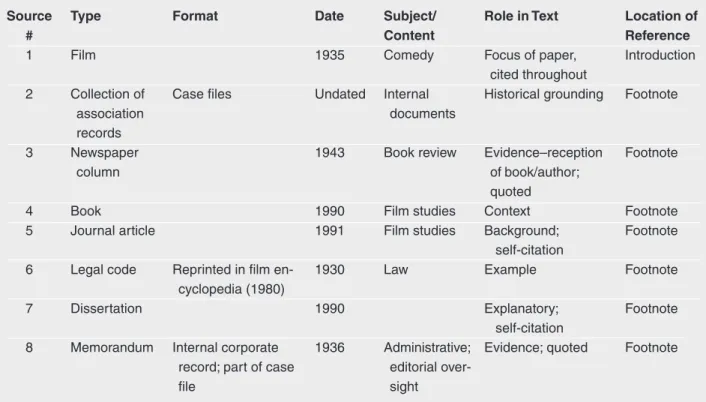
Because humanistic expression exists in biographical, bibliographi-cal, social, and historical contexts, research in any of the humanities may employ a wide variety of types of sources. Although scholars in the interviews described a range of resources upon which they drew, our document analyses showed that in terms of type, age, and sub-ject, even more varied sorts of materials were being used. For exam-ple, one scholar talked about standard items such as monographs, journal articles, and edited volumes, but also cited an edited collec-tion of letters, seventeenth-century festival books, a seventeenth-cen-tury school yearbook, entries in dictionaries and encyclopedias, a library catalog, and paintings and etchings. It was surprising to see
the many types of sources that were brought together in a single pa-per and the broad range of subjects and disciplines represented, even in the case of scholars who did not appear to be particularly interdis-ciplinary in their research. Such wide-ranging research implies a need for libraries to do much more to assemble information resourc-es in a way that allows scholars to search across them, rather than digging down into separate, exclusive “silos”—some accessed through the online public access catalog (OPAC), others through a database, and still others through finding aids.
The scholars used their sources in a broad range of ways. An item could be used as “data”—a central item that is analyzed in the text. Referenced works might also be “evidence”—items used to sup-port or show agreement for a scholar’s analysis. Even an unsuccess-ful search may be noted as negative evidence. Sources used as exem-plars were also common. Other uses of citations were to note facts (e.g., used to structure a time line), to point to items that contained further information on the topic, and to indicate the source for a framework of analysis or theory. The case-study document-analysis interviews also identified “absences”—materials that were used but not explicitly referenced or sources that the scholar would have liked to use. When asked what was essential to the paper, one scholar ex-plained that she had never directly cited a book that had provided inspiration for her paper.
And one of those actually got cut out of the footnotes, which is bad, and that is a book by Jonathan Bate called Shakespeare and Ovid. At the point I was just cheating to make the length limit. That reference will go back in. So that was a really central book that didn’t show up.
Scholars talked about leads or work that could not be pursued because of time limitations.
But, again, there are some cases where, if you want to write an article about something, you can’t just go reedit all of Alcuin in order to enable it. And I wouldn’t have the time, anyway. With world enough and time, I would have gotten the manuscripts of Alcuin’s texts and checked them against the printed edition just to make sure there was never any variation, but . . .
The trade-offs made as a result of limitations of time and space are not usually visible in the articles themselves, yet they are choices that are made all of the time.
We found that the truism that humanities scholars prefer books to journals is an oversimplification at best; in fact, it may be down-right wrong. The specific uses that scholars in the humanities make of books, as opposed to journals, are not easily defined; the distinc-tion that some have seen among formats is less vital than is the dis-tinction among activities. Many browse through both bookshelves and periodical shelves to keep current or gain exposure to new ideas, and the type of analysis performed on primary texts is by no means reserved for books. In some cases, the age of historical secondary
sources allows them to be considered as primary. As more texts be-come available in electronic form, searches and readings that have been common in the analysis of primary texts may be frequently ap-plied to secondary materials.
Access Tools for Speed and Scope
The humanists in our study were seldom seeking a definable fact. Often they sought a critical perspective that they might find relevant or stimulating.They take for granted the electronic versions of stan-dard reference works, such as indexes to periodicals and bibliogra-phies of primary works and online library catalogs. All scholars use some combination of these sources regularly. Most prefer electronic tools because of the speed and ease of searching.
All the scholars whom we interviewed were familiar to some de-gree with the primary indexing and abstracting sources in their fields, such as the MLA International Bibliography, RILM Abstracts of Music Literature, or the International MedievalBibliography. The Nation-al Union CatNation-alog and OCLC WorldCat were mentioned several times for two particular applications. One application was to locate specific items in other libraries; the other was to get a general sense of the previous secondary literature when engaging in research in an unfa-miliar field. Three scholars talked about Voice of the Shuttle as the Web site that provided them with the most valuable links. Six cited Amazon.com as an important resource for developing basic bibliog-raphies and for keeping up with new publications—even more scholars cited WorldCat. Other reference works, printed and electron-ic, that were mentioned included American National Biography, Arts and Humanities Citation Index, Humanities Index, Bibliography of British History, Dictionary of National Biography, New Grove Dictionary of Mu-sic, and Westlaw.
Beyond the major tools, the group made reference to few specific titles. Among the traditional kinds of reference works mentioned were concordances, primary bibliographies, dictionaries, quotation books, and directories. Most important to our scholars were special-ized resources in their subfields, such as an index to first lines of manuscript Latin texts. Our data also verify what previous research has asserted about the age of scholarly resources: older materials continue to be used and valued by humanities scholars.
Frequently, the scholars cited titles erroneously or confused ti-tles; one, for example, made reference to the “Humanities Citation In-dex.” Such minor errors are common among librarians as well. It matters little when one heads for a familiar shelf or a set of volumes of the same color to which one has become accustomed. In an online environment, however, these secondary, nonbibliographic clues are absent. Several scholars reported that when online searches were me-diated by librarians, it sometimes was not apparent which database they were searching, or how. Such an issue points to the need for landmarks that can help guide scholars to appropriate materials and for “smart” search tools that use thesauri to expand search terms or that can build profiles to help users with searches based on their known behaviors and preferences.
Diverse Skills and Strategies
Paralleling the different levels of certainty in using databases was a disparity among the scholars in searching abilities. Some were quite conscious, or self-conscious, about what they perceived as a lack of searching skills. Some recited the widely held perception that skills in using electronic resources are generationally based; however, it seemed to us (though we never asked scholars’ ages) that age had little to do with skill. Few of the scholars knew thoroughly the scope and functions of the important abstracting and indexing services in their fields. For instance, several had confidence that a search of the
MLA International Bibliography would offer them comprehensive cov-erage of the secondary literature on a given topic in literature, but seemed unaware of that resource’s scanty coverage in such areas as edited volumes of essays or book reviews. They understandably en-countered problems when they attempted to employ search strate-gies appropriate to one source when searching another. For example, in describing the online catalog of his university’s library, one schol-ar reported that seschol-arching phrases enclosed in quotation mschol-arks was more effective than searching keywords, but he was unaware that the particular catalog did not include the former feature. There is an important role for libraries and database producers in ironing out the heterogeneity of user interfaces to provide common visual and func-tional features across a range of information sources and services.
In contrast to the general level of confusion about the scope and function of systems, we observed the humanists using a variety of sophisticated searching techniques, such as applying the subject headings assigned to a catalog record to locate related works, limit-ing online searches to fields, or uslimit-ing Boolean combinations. The scholars perceived online searching as a transaction radically distinct from the interactive approach to research through footnotes and reading, in which context is evident. A few scholars used both the printed and online versions of the MLA Bibliography. One consulted the online version to make a “pass to see what’s out there,” but pre-ferred the printed volumes for “in-depth” research. Another appreci-ated the importance of serendipity—the “associational work” possi-ble with the printed version: “With the electronic version your eye can’t mistakenly. . . fall on something that turns out to be relevant in an odd way,” said one interviewee. Searching for unindexed terms stymied at least one scholar who was unaware of how to consult the thesaurus. “I had heard of the work, but I couldn’t get the MLA Bibli-ography to give it to me.” Some scholars view searching as a mechani-cal procedure—more than one used the phrase “plugging in” to de-scribe online searching, as if the process were akin to inserting a coin into a slot machine in hope of hitting the jackpot.
All of the scholars used online catalogs, which are now the only means of access into modern collections at research libraries. None-theless, some retained an appreciation for the card catalogs and book catalogs that may include supplementary information, such as full titles of older books or notes on the occasion for composition of a particular text. One pointed out the constraints that standardization