Towards Using Web-Crawled Data for Domain Adaptation
in Statistical Machine Translation
Pavel Pecina, Antonio Toral, Andy Way
School of Computing Dublin City Universiy
Dublin 9, Ireland
{ppecina,atoral,away}@computing.dcu.ie
Vassilis Papavassiliou,
Prokopis Prokopidis, Maria Giagkou Institute for Language & Speech Processing
Artemidos 6 & Epidavrou 151 25 Maroussi, Greece {vpapa,prokopis,mgiagkou}@ilsp.gr Abstract
This paper reports on the ongoing work fo-cused on domain adaptation of statistical machine translation using domain-specific data obtained by domain-focused web crawling. We present a strategy for crawl-ing monolcrawl-ingual and parallel data and their exploitation for testing, language mod-elling, and system tuning in a phrase--based machine translation framework. The proposed approach is evaluated on the domains of Natural Environment and Labour Legislation and two language pairs: English–French and English–Greek. 1 Introduction
Performance of a statistical machine translation (SMT) system usually drops when it is applied on data of a different nature than that the system was trained on (Banerjee et al., 2010). As any other machine-learning application, SMT is not guaran-teed to perform optimally if the data for training and testing are not identically (and independently) distributed, which is often the case in practice. The main problem is usually vocabulary coverage: spe-cific domain texts typically contain a lot of special vocabulary that is not likely to be found in texts from other domains. Problems are also caused by divergence in style or genre, where the difference is not only in terminology but also in grammar.
In order to achieve optimal performance, an SMT system must be trained on data from the same domain, of the same genre, and the same style as that it is applied on. For many domains, such training resources (monolingual and parallel data) are not available in large enough amounts to train a system of a sufficient quality. However, even small amounts of such data can be used to adapt
© 2011 European Association for Machine Translation.
an existing (general-domain) system to the partic-ular domain (Koehn and Schroeder, 2007). If the data is not available at all, a possible solution is to exploit publicly available data from the web.
In this work, we present a strategy for crawling domain-specific texts from the web and their ex-ploitation for domain-adaptation in a phrase-based statistical machine translation (PB-SMT) frame-work. At the current stage, we focus on two re-sources: in-domain parallel data for parameter tun-ing and in-domain monoltun-ingual data for language model training. As part of our approach, we also create domain-specific test sets. The evaluation is carried out on the domains of Natural Environment (env) and Labour Legislation (lab) and two lan-guage pairs: English–French and English–Greek.
The remaining part of the paper is organized as follows. After an overview of related work, we dis-cuss the possibility of adapting a general-domain SMT system to a specific domain by using various types of in-domain data. Then, we describe our baseline SMT system and the web-crawling strat-egy for monolingual and parallel data. Finally, we report on the results, make conclusions and outline the future directions of our work.
2 Domain adaptation in SMT
Domain adaptation is an active topic in SMT. It was first introduced by Langlais (2002) who in-tegrated in-domain lexicons into the translation model. His work was followed by many others. Eck et al. (2004) presented a language model adaptation technique applying an information re-trieval approach based on selecting similar sen-tences from available training data. Hildebrand et al. (2005) applied the same approach on the translation model. Wu and Wang (2004) and Wu et al. (2005) proposed an alignment adaptation approach to improve domain-specific word align-ment. Munteanu and Marcu (2005) automati-cally extracted in-domain bilingual sentence pairs Mikel L. Forcada, Heidi Depraetere, Vincent Vandeghinste (eds.)
languages (L1–L2) sentence pairs L1 tokens / vocabulary L2 tokens / vocabulary English–French 1,725,096 47,956,886 73,645 53,262,628 103,436 English–Greek 964,242 27,446,726 61,497 27,537,853 173,435
Table 1: Europarl corpus statistics for relevant language pairs. from large comparable (non-parallel) corpora to
enlarge the in-domain bilingual corpus. Koehn and Schroeder (2007) integrated in-domain and out-of--domain language models as log-linear features in the Moses (Koehn et al., 2007) PB-SMT system with multiple decoding paths for combining multi-ple domain translation tables. Nakov (2008) com-bined in-domain translation and reordering mod-els with out-of-domain modmod-els also into Moses. In this work, log-linear features were derived to dis-tinguish between phrases of multiple domains by applying data source indicator features. Finch and Sumita (2008) employed a probabilistic mixture model combining two models for questions and declarative sentences with a general model. They used a probabilistic classifier to determine a vector of probability representing class membership.
Domain adaptation of SMT can be approached in various ways depending on the availability of domain-specific data and their type. If the data is available, it can be directly used to improve com-ponents of the MT system: word alignment and phrase extraction (Wu and Wang, 2004), language models (Koehn and Schroeder, 2007), and transla-tion models (Nakov, 2008), usually by merging the data with general-domain data or by training new models and using them together with the general--domain ones in the log-linear framework. If the data is not available, it can be extracted from a pool of texts from different domains (Eck et al., 2004; Hildebrand et al., 2005) or even from the web, which is the case in this work. We crawl mono-lingual data for language models and parallel data to improve parameter tuning. The crawled parallel data is also used to create domain-specific test sets. 3 Baseline system
Our baseline system is MaTrEx, a combination-based multi-engine architecture developed at Dublin City University (Penkale et al., 2010) ex-ploiting aspects of both the Example-based Ma-chine Translation (EBMT) and SMT paradigms. The architecture includes various individual sys-tems: phrase-based, example-based, hierarchical phrase-based, and tree-based MT. In this work, we only exploit the SMT phrase-based component
of the system which is based on Moses, a well--known open-source toolkit for SMT. In addition to Moses, MaTrEx provides a set of tools for easy--to-use preprocessing, training, tuning, decoding, postprocessing, and evaluation.
3.1 General-domain data
As for other data-driven MT systems, MaTrEx re-quires certain data to be trained on, namely parallel data for translation models, monolingual data for language models, and parallel development data for tuning of system parameters. Parameter tun-ing is not strictly required but has a big influence on system performance. For the baseline system we decided to exploit the widely used data pro-vided by the organizers of the series of SMT work-shops (WPT 2005, WMT 2006–2010)1: the
Eu-roparl parallel corpus (Koehn, 2005) version 5 as training data for translation models and language models, and WPT 2005 test set as the development data for parameter optimization.
The Europarl parallel corpus is extracted from the proceedings of the European Parliament. For practical reasons we consider this corpus to con-tain general-domain texts. Version 5 released in Spring 2010 includes texts in 11 European lan-guages including all lanlan-guages of our interest (En-glish, French, and Greek; see Table 1). Note that the amount of parallel data for English and Greek is only about one half of what is available for En-glish and French. Furthermore, Greek morphol-ogy is more complex than French morpholmorphol-ogy so the Greek vocabulary size (count of unique lower-cased alphabetical tokens) is much larger than the French one (see Table 1).
The WPT 2005 dev set is a set of 2,000 sentence pairs available in the same languages as Europarl provided by the WPT 2005 workshop organizers as a development set for the translation shared task. Later WMT test sets do not include Greek data.
3.2 System setting
For training the baseline MT system, all train-ing data is tokenized and lowercased ustrain-ing the standard Europarl tools.2 The original
(non-1http://www.statmt.org/ 2http://www.statmt.org/europarl/
language dom websites docs sentences tokens vocabulary new vocab. sample size / accuracy % English env 146 505 53,529 1,386,835 33,400 10,276 224 92.9 lab 150 461 43,599 1,223,697 25,183 6,674 215 91.6 French env 106 543 31,956 1,196,456 36,097 9,485 232 95.7 lab 64 839 35,343 1,217,945 23,456 5,756 268 98.1 Greek env 112 524 37,957 1,158,980 55,360 17,986 227 97.4 lab 117 481 34,610 1,102,354 52,887 16,850 219 88.1
Table 2: Web-crawled monolingual data statistics. lowercased) versions of the target sides of the
parallel data are kept for training the Moses re-caser. The lowercased versions of the target sides are used for training an interpolated 5-gram lan-guage model with Kneser-Ney discounting using the SRILM toolkit (Stolcke, 2002). Translation models are trained on the relevant parts of the Europarl corpus, lowercased and filtered on sen-tence level; we kept all sensen-tence pairs having less than 100 words on each side and with length ratio within the intervalh0.11,9.0i. Minimum error rate training (Och, 2003, MERT) is employed to opti-mize the model parameters on the development set. For decoding, test sentences are tokenized, low-ercased, and translated by the trained system. Let-ter casing is then reconstructed by the recaser and extra blank spaces in the tokenized text are re-moved in order to produce human-readable text. 4 Acquisition of in-domain resources 4.1 Web crawling of monolingual data
Our workflow for acquiring in-domain monolin-gual data consists of the following steps: focused web crawling, text normalization, language identi-fication, document clean-up and near-duplicate de-tection. For focused web crawling, we adapted the open-source Combine3 crawler, which
inter-acts with a text-to-topic classifier. Each web page visited by the crawler is classified as relevant to the domain with respect to a topic definition pro-vided by the user. We used lists of tripletshterm, relevance weight, topic classias the basic entities of the topic definition. During crawling, a rele-vance score sfor each web page is calculated as in the formula below (N is the amount of terms in a topic definition;wt
i is the weight of termi;wlj is
the weight of locationj;nij is the number of
oc-currences of termiat locationj;lj is the number
of words at locationj). s=XN i=1 4 X j=1 nijwtiwlj lj 3http://combine.it.lth.se/
We adopted Ardö’s (2005) approach in consid-ering four discrete locations in a web page (ti-tle, metadata, keywords, and plain text) and ex-perimentally setting the corresponding weights for these locations to 10, 4, 2, and 1. If the score is greater than a predefined threshold, the web page is classified as relevant to the specific domain and the links of the page are extracted. Finally, the crawler follows the extracted links to visit new pages.
To construct the list of triplets of the topic defini-tion, we selected English, French, and Greek terms (both single and multi-word entries) from the do-mains with identifiers 52 (Natural Environment) and 44 (Employment and Working Conditions) of the Eurovoc thesaurus v4.3.4 For each language,
we extracted 209 terms for theenvdomain and 86 for thelab domain. The weights assigned to the terms were signed integers indicating the relevance of each term to a topic-class. Topic-classes corre-spond to possible sub-categories of the domain.
The other input for the crawler is a list of seed URLs relevant to the domain. The seeds for the env domain were selected from relevant lists in the Open Directory Project,5 a repository
main-tained by volunteer editors. For thelab domain, similar lists were not so easy to find. We there-fore adopted a different method, namely using the BootCat toolkit (Baroni and Bernardini, 2004) to create random tuples (i.e. n-combinations of terms) from the terms included in the topic defi-nition. We then ran a query for each tuple on the Yahoo! search engine,6kept the first five URLs
re-turned for each query and finally constructed the seed list with these URLs.
Normalization, the next step in the workflow, concerned encoding identification based on the content_charsetheader of each document, and, if needed, conversion to UTF-8. Language identifi-cation was performed by a modified version of the n-gram-based Lingua::Identify7 tool, which was
4http://eurovoc.europa.eu/
5http://www.dmoz.org/Science/Environment/ 6http://www.yahoo.com/
languages (L1–L2) dom websites documents sentences all / filtered / sampled / corrected English–French env 6 559 16,487 13,840 3,600 3,392
lab 4 900 33,326 23,861 3,600 3,411 English–Greek env 6 151 4,543 3,735 3,600 3,000 lab 4 125 3,094 2,707 2,700 2,506
Table 3: Web-crawled parallel data statistics. used to discard documents not in the targeted
lan-guage. Web pages often need to be cleaned from “noise” such as navigation links, advertisements, disclaimers, etc. (a.k.a. boilerplate), which are of limited or no use for the purposes of training an MT system. Such noise was removed by the Boil-erpipe tool (Kohlschütter et al., 2010).8 The
fol-lowing step in the workflow involved applying the SpotSigs algorithm (Theobald et al., 2008) to de-tect and remove near duplicate documents.
The collections consisted of documents origi-nating from as many different web sites as pos-sible, in order to avoid bias to the language of specific sites. Documents originating from bilin-gual web sites were excluded, as these sites were used for the acquisition of the parallel data (Sec-tion 4.2). The only postprocessing steps performed on the monolingual data prior to SMT training were tokenization and sentence boundary identifi-cation by the Europarl tools.
The statistics of the data are provided in Ta-ble 2. The vocabulary column contains the amount of unique lowercased alphabetical tokens (words) in each data set and the new vocabulary column then shows counts of such tokens not appearing in the Europarl corpus. The ratio of new vocabulary is around 30% for all these data sets, which is en-couraging, as by using them a better coverage of in-domain test sets can be expected. To evaluate the crawler’s accuracy, we asked two native speak-ers for each language to classify a sample of the crawled data (selected to achieve at least a ±5% confidence interval at a 95% confidence level) as out-domain or in-domain. The accuracy measured on documents judged as in-domain by both evalu-ators ranges from 88% to 98% (details in Table 2).
4.2 Web crawling of parallel data
The workflow for acquiring in-domain parallel data consisted of the following steps: first, web sites containing texts in targeted domains and pairs of languages were manually identified from the pool of web sites collected during the phase of monolingual data acquisition (Section 4.1). Pages
8http://code.google.com/p/boilerpipe/
from those sites were then used as seed URLs and the crawler was constrained to follow only links internal to each site. This constraint was applied in order to force the crawler to stayon the selected multilingual web sites. Each web page visited by the crawler was classified as relevant with respect to a bilingual topic definition. After following the normalization and language identification steps de-scribed in Section 4.1, we end up with in-domain EN–FR or EN–EL subsets of websites mirrored locally. The next step concerned using Bitextor (Esplà-Gomis and Forcada, 2010),9an open source
tool that uses shallow textual features to decide which documents could be considered translations of each other, and to identify pairs of paragraphs from which parallel sentences could be extracted.
The next steps of the procedure aimed at iden-tification of sentence pairs which are likely to be mutual translations. In each paragraph pair we applied the following steps: identification of sen-tence boundaries by the Europarl sensen-tence splitter, tokenization by the Europarl tokenizer, and sen-tence alignment by Hunalign,10a widely used tool
for automatic identification of parallel sentences in parallel texts. For each sentence pair identified as parallel, Hunalign provides a score which reflects the level of parallelness, the degree to which the sentences are mutual translations. We manually in-vestigated a sample of sentence pairs extracted by Hunalign from the pool data for each domain and language pair (45–49 sentence pairs for each lan-guage pair and domain), by relying on the judge-ment of native speakers, and estimated that sen-tence pairs with a score above 0.4 are of a good translation quality. In the next step, we removed all sentence pairs with scores below this threshold. Additionally, we also removed duplicate sentence pairs. The filtering step reduced the number of sen-tence pairs by about 15–20% (details in Table 3).
4.3 Manual corrections of parallel data
The translation quality of the parallel data obtained by the procedure described above is not guaranteed
9http://bitextor.sourceforge.net/
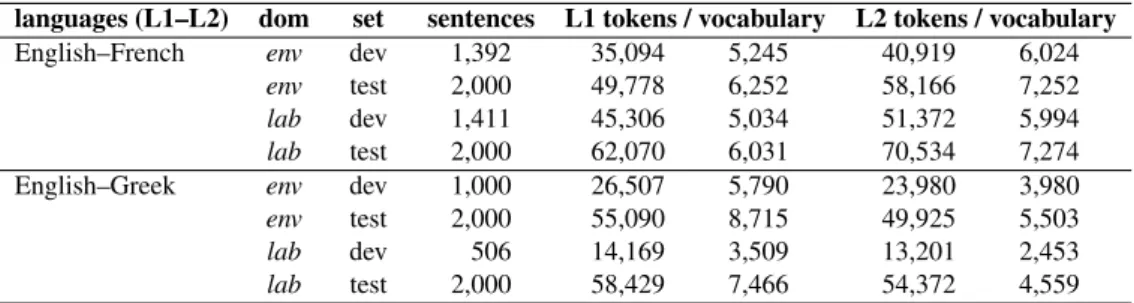
languages (L1–L2) dom set sentences L1 tokens / vocabulary L2 tokens / vocabulary English–French env dev 1,392 35,094 5,245 40,919 6,024
env test 2,000 49,778 6,252 58,166 7,252 lab dev 1,411 45,306 5,034 51,372 5,994 lab test 2,000 62,070 6,031 70,534 7,274 English–Greek env dev 1,000 26,507 5,790 23,980 3,980 env test 2,000 55,090 8,715 49,925 5,503 lab dev 506 14,169 3,509 13,201 2,453 lab test 2,000 58,429 7,466 54,372 4,559
Table 4: Development and test data set statistics. in any sense. Tuning the procedure and focusing
on high-quality translations is possible but leads to a trade-off between quality and quantity. For trans-lation model training, high transtrans-lation quality of the data is not as essential as for parameter tuning and testing. Bad phrase pairs can be removed from the translation tables based on their low translation probabilities. However, a development set contain-ing sentence pairs which are not exact translations of each other might lead to sub-optimal values of model weights which would harm system perfor-mance. If such sentence pairs are used in the test set, the evaluation would clearly be very unreliable. In order to create reliable development and test sets for each language pair and domain, we per-formed the following low-cost procedure. From the data obtained by the steps described in the previous section, we selected a random sample of 3,600 sentence pairs (2,700 for English–Greek in the Labour Legislation domain, for which no more data was available) and asked native speakers to check and correct them. The task consisted of:
1. checking that the sentence pairs belonged to the right domain,
2. checking that the sentences within a sentence pair were equivalent in terms of content, 3. checking translation quality and correcting (if
needed) the sentence pairs.
The goal was to obtain at least 3,000 correct sen-tence pairs (2,000 test pairs and 1,000 development pairs) for each domain and language pair; thus the correctors did not have to correct every sentence pair. They were allowed to skip (remove) those sentence pairs which were misaligned. In addition, we asked them to remove those sentence pairs that were obviously from a very different domain (de-spite being correct translations). The number of corrected sentences obtained is shown in the last column of Table 3. As the final step, we took a ran-dom sample from the corrected sentence pairs and
selected 2,000 pairs for the test set and left the re-maining part for the development set.
During the correction phase, we made the following observations: 55% of sentence pairs were accurate translations, 35% of sentence pairs needed only minor corrections, 3–4% of sentence pairs would require major corrections (which was not necessary to do in most cases, as the accurate sentence pairs together with those requiring mi-nor corrections were enough to reach our goal of at least 3,000 sentence pairs), 4–5% of sentence pairs were misaligned and would have had to be translated completely (which was not necessary in most cases), and 3–4% of sentence pairs were from a different domain. The correctors confirmed that the process was about 5–10 times faster than trans-lating the sentences from scratch. Detailed statis-tics of the test and development sets obtained by the procedure described above are given in Table 4. 5 Experiments and results
The described approach was evaluated in eight different scenarios involving: two language pairs (English–Greek, English–French), both translation directions (to English and from English), and the two domains (Natural Environment, Labour Leg-islation), using the following automatic evaluation measures: WER, PER, and BLEU (Papineni et al., 2002), NIST (Doddington, 2002), and METEOR (Banerjee and Lavie, 2005).
The baseline MT systems (denoted asv0) were evaluated using these test sets and results are shown in Table 5. The BLEU, METEOR, PER, and WER scores are percentages; WER and PER are error rates; OOV (out-of-vocabulary) is a ratio of unknown words, i.e. the occurrence of words which do not appear in the parallel training data and thus cannot be translated. The scores among different systems are not freely comparable but they give us some idea of how difficult translation is for particular languages or domains.
languages dom BLEU NIST METEOR PER WER OOV English→French env 28.03 7.03 63.32 63.70 46.71 0.98
lab 22.26 6.27 56.73 69.93 50.06 0.85 French→English env 31.79 7.77 66.25 57.09 40.02 0.81 lab 27.00 7.07 59.90 61.57 43.24 0.68 English→Greek env 20.20 5.73 82.81 67.83 54.02 1.15 lab 22.92 5.93 87.27 65.88 52.21 0.47 Greek→English env 29.23 7.50 60.57 54.69 41.07 1.53 lab 31.71 7.76 62.42 52.34 38.37 0.69
Table 5: Baseline MT system results (all scores except NIST are percentages). The baseline MT system was trained solely on
out-of-domain data (parallel, monolingual, and de-velopment data from Europarl). First, we exploited the in-domain development data and used it in the first modification of the baseline system (v1) in-stead of the out-of-domain (Europarl) data. In this case, the individual system models (translation ta-bles, language model, etc.) remained the same, but their relative importance (optimal weights in the SMT log-linear framework) was different.
The in-domain monolingual data could be ex-ploited in two ways: a) to join the general-domain data and the new in-domain data into one set, use it to train one language model and optimize its weight using MERT on the in-domain devel-opment data. b) to train a new separate lan-guage model from the new data and add it to the log-linear framework and let MERT optimize its weight together with other model weights. We tested both approaches. In systemv2we followed the first option (retraining the language model on an enlarged data) and in system v3 we followed the second option (training an additional language model and optimizing).
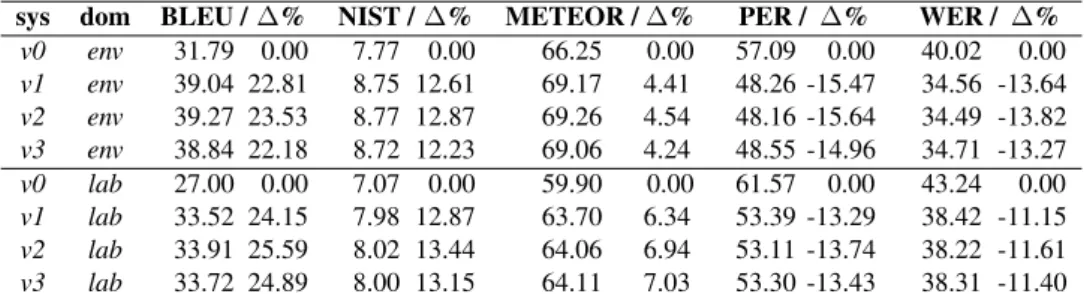
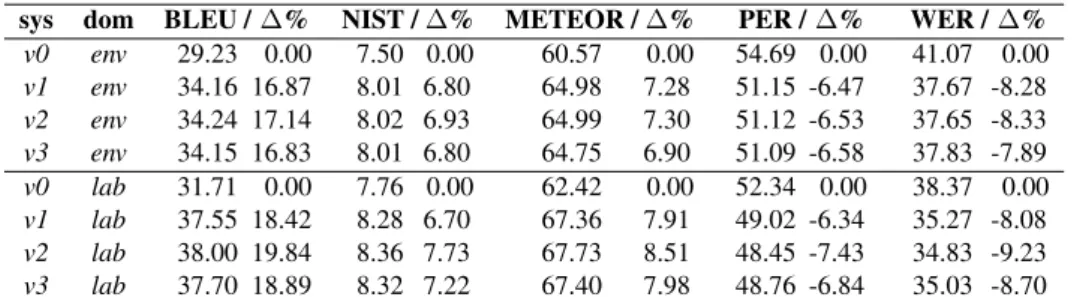
All evaluation results are presented in detail in Tables 6 to 9. Each table compares the perfor-mance of all systems (v0–v3) in one translation di-rection. The comparison between the scores ofv0 andv1 tells us the importance of using in-domain data for parameter optimization. The improve-ment in terms of BLEU varies between 16% and 48% relative, which is quite substantial, especially given the fact that this modification requires sev-eral hundreds of sentence pairs only.
The comparison between v1 and v2/v3 shows the effect of using additional in-domain data for language modelling, which turned out not to be very substantial in most scenarios. With only one exception (see below), the BLEU scores improved by less than 1 point. This observation is not very surprising given the fact that the general-domain translation models were not enhanced in any way
and thus the new in-domain language models had only limited room for improvement: the high OOV rates remained the same. After improving the translation models which (hopefully) will decrease the OOV rates, the language models might have a better chance of contributing to improved scores. The only exception was the translation from En-glish to Greek for the Labour Legislation domain, for which the BLEU score increased massivelly from 28.79 to 33.43 points (Table 8). This is prob-ably due to the richer morphology of Greek as the target language and the relatively low OOV rate on the Labour Legislation data; here, the performance improved even if the OOV rate did not change.
An analysis of the differences between the re-sults ofv2andv3could explain the difference be-tween using in-domain monolingual data in one language model (together with general-domain data) vs. using two separate models (general--domain plus in(general--domain). However, due to the fact that the addition of in-domain monolingual data did not lead to any significant improvement in MT quality, the differences are not really mea-surable. It is likely that this situation will change after improving the translation models by adding in-domain parallel data.
6 Conclusion and future work
In this work we described our first steps towards domain adaptation of statistical machine transla-tion based on data obtained by domain-focused web crawling. We evaluated four SMT systems in eight scenarios and tested the impact of two types of web-crawled language resources (in-domain parallel development data, in-domain monolingual training data) on the MT quality. In terms of au-tomatic evaluation measures, the effect of using in-domain development data for parameter opti-mization in SMT is very substantial, in the range of 16–48% relative improvement. The impact of using in-domain monolingual data for language
sys dom BLEU /∆% NIST /∆% METEOR /∆% PER / ∆% WER / ∆% v0 env 28.03 0.00 7.03 0.00 63.32 0.00 63.70 0.00 46.71 0.00 v1 env 35.81 27.76 8.10 15.22 68.44 8.09 53.78 -15.57 40.34 -13.64 v2 env 36.13 28.90 8.14 15.79 68.40 8.02 53.14 -16.58 40.07 -14.22 v3 env 36.32 29.58 8.19 16.50 68.50 8.18 52.82 -17.08 39.62 -15.18 v0 lab 22.26 0.00 6.27 0.00 56.73 0.00 69.93 0.00 50.06 0.00 v1 lab 30.84 38.54 7.42 18.34 62.94 10.95 57.99 -17.07 43.11 -13.88 v2 lab 30.18 35.58 7.31 16.59 62.86 10.81 59.05 -15.56 43.81 -12.49 v3 lab 30.12 35.31 7.28 16.11 62.88 10.84 59.48 -14.94 44.24 -11.63
Table 6: Evaluation results: English→French.
sys dom BLEU /∆% NIST /∆% METEOR /∆% PER / ∆% WER / ∆% v0 env 31.79 0.00 7.77 0.00 66.25 0.00 57.09 0.00 40.02 0.00 v1 env 39.04 22.81 8.75 12.61 69.17 4.41 48.26 -15.47 34.56 -13.64 v2 env 39.27 23.53 8.77 12.87 69.26 4.54 48.16 -15.64 34.49 -13.82 v3 env 38.84 22.18 8.72 12.23 69.06 4.24 48.55 -14.96 34.71 -13.27 v0 lab 27.00 0.00 7.07 0.00 59.90 0.00 61.57 0.00 43.24 0.00 v1 lab 33.52 24.15 7.98 12.87 63.70 6.34 53.39 -13.29 38.42 -11.15 v2 lab 33.91 25.59 8.02 13.44 64.06 6.94 53.11 -13.74 38.22 -11.61 v3 lab 33.72 24.89 8.00 13.15 64.11 7.03 53.30 -13.43 38.31 -11.40
Table 7: Evaluation results: French→English. modelling cannot be confirmed where a system has
a high OOV rate, which can be minimized only by improving the coverage of the translation models. Our future work will focus on crawling more paral-lel data and enhancing the translation models. Re-sults of tests of statistical significance will also be provided.
7 Acknowledgements
This work is supported by PANACEA, a 7th Framework Research Programme of the European Union, contract number 7FP-ITC-248064.
References
Ardö, Anders. 2005. Focused crawling in the ALVIS semantic search engine. InProceedings of the 2nd European Semantic Web Conference, pages 19–20, Heraklion, Greece.
Banerjee, Satanjeev and Alon Lavie. 2005. METEOR: An automatic metric for MT evaluation with im-proved correlation with human judgments. In Pro-ceedings of the ACL Workshop on Intrinsic and Ex-trinsic Evaluation Measures for Machine Transla-tion and/or SummarizaTransla-tion, pages 65–72, Ann Ar-bor, Michigan.
Banerjee, Pratyush, Jinhua Du, Baoli Li, Sudip Naskar, Andy Way, and Josef van Genabith. 2010. Com-bining multi-domain statistical machine translation models using automatic classifiers. InAMTA 2010: The Ninth Conference of the Association for Machine Translation in the Americas, pages 141–150. Baroni, M. and S. Bernardini. 2004. Bootcat:
Boot-strapping corpora and terms from the web. In
Pro-ceedings of the 4th Language Resources and Evalu-ation Conference, pages 1313–1316, Lisbon. Doddington, George. 2002. Automatic evaluation
of machine translation quality using n-gram co-occurrence statistics. In Proceedings of the sec-ond international conference on Human Language Technology Research, HLT ’02, pages 138–145, San Diego, California.
Eck, Matthias, Stephan Vogel, and Alex Waibel. 2004. Language model adaptation for statistical machine translation based on information retrieval. In In-ternational Conference on Language Resources and Evaluation, Lisbon, Portugal.
Esplà-Gomis, Miquel and Mikel L. Forcada. 2010. Combining content-based and url-based heuristics to harvest aligned bitexts from multilingual sites with bitextor. The Prague Bulletin of Mathemathical Lin-gustics, 93:77–86.
Finch, Andrew and Eiichiro Sumita. 2008. Dynamic model interpolation for statistical machine transla-tion. In Proceedings of the Third Workshop on Statistical Machine Translation, StatMT ’08, pages 208–215, Columbus, Ohio, USA.
Hildebrand, Almut Silja, Matthias Eck, Stephan Vo-gel, and Alex Waibel. 2005. Adaptation of the translation model for statistical machine translation based on information retrieval. InProceedings of the 10th Annual Conference of the European Association for Machine Translation, pages 133–142, Budapest, Hungary.
Hua, Wu, Wang Haifeng, and Liu Zhanyi. 2005. Align-ment model adaptation for domain-specific word alignment. In43rd Annual Meeting on Association for Computational Linguistics, ACL ’05, pages 467– 474, Ann Arbor, Michigan, USA.
sys dom BLEU /∆% NIST /∆% METEOR /∆% PER / ∆% WER / ∆% v0 env 20.20 0.00 5.73 0.00 82.81 0.00 67.83 0.00 54.02 0.00 v1 env 26.18 29.60 6.57 14.66 84.19 1.67 60.80 -10.36 49.10 -9.11 v2 env 26.50 31.19 6.63 15.71 84.35 1.86 60.65 -10.59 48.76 -9.74 v3 env 26.41 30.74 6.57 14.66 83.85 1.26 60.58 -10.69 48.99 -9.31 v0 lab 22.92 0.00 5.93 0.00 87.27 0.00 65.88 0.00 52.21 0.00 v1 lab 28.79 25.61 6.80 14.67 87.91 0.73 58.20 -11.66 46.43 -11.07 v2 lab 33.43 45.86 7.33 23.61 88.94 1.91 54.93 -16.62 43.77 -16.17 v3 lab 34.03 48.47 7.44 25.46 88.94 1.91 54.37 -17.47 43.25 -17.16
Table 8: Evaluation results: English→Greek.
sys dom BLEU /∆% NIST /∆% METEOR /∆% PER /∆% WER /∆% v0 env 29.23 0.00 7.50 0.00 60.57 0.00 54.69 0.00 41.07 0.00 v1 env 34.16 16.87 8.01 6.80 64.98 7.28 51.15 -6.47 37.67 -8.28 v2 env 34.24 17.14 8.02 6.93 64.99 7.30 51.12 -6.53 37.65 -8.33 v3 env 34.15 16.83 8.01 6.80 64.75 6.90 51.09 -6.58 37.83 -7.89 v0 lab 31.71 0.00 7.76 0.00 62.42 0.00 52.34 0.00 38.37 0.00 v1 lab 37.55 18.42 8.28 6.70 67.36 7.91 49.02 -6.34 35.27 -8.08 v2 lab 38.00 19.84 8.36 7.73 67.73 8.51 48.45 -7.43 34.83 -9.23 v3 lab 37.70 18.89 8.32 7.22 67.40 7.98 48.76 -6.84 35.03 -8.70
Table 9: Evaluation results: Greek→English.
Koehn, Philipp and Josh Schroeder. 2007. Experi-ments in domain adaptation for statistical machine translation. In Proceedings of the Second Work-shop on Statistical Machine Translation, StatMT ’07, pages 224–227, Prague, Czech Republic. Koehn, Philipp, Hieu Hoang, Alexandra Birch, Chris
Callison-Burch, Marcello Federico, Nicola Bertoldi, Brooke Cowan, Wade Shen, Christine Moran, Richard Zens, Chris Dyer, Ondˇrej Bojar, Alexandra Constantin, and Evan Herbst. 2007. Moses: open source toolkit for statistical machine translation. In Proceedings of the 45th Annual Meeting of the ACL on Interactive Poster and Demonstration Sessions, ACL ’07, pages 177–180, Prague, Czech Republic. Koehn, Philipp. 2005. Europarl: A Parallel Corpus
for Statistical Machine Translation. In Conference Proceedings: the tenth Machine Translation Summit, pages 79–86, Phuket, Thailand.
Kohlschütter, Christian, Peter Fankhauser, and Wolf-gang Nejdl. 2010. Boilerplate detection using shal-low text features. In Proceedings of the 3rd ACM International Conference on Web Search and Data Mining, pages 441–450, New York.
Langlais, Philippe. 2002. Improving a general-purpose statistical translation engine by terminological lexi-cons. InCOLING-02 on COMPUTERM 2002: sec-ond international workshop on computational termi-nology - Volume 14, pages 1–7, Taipei, Taiwan. Munteanu, Dragos Stefan and Daniel Marcu. 2005.
Improving machine translation performance by ex-ploiting non-parallel corpora. Comput. Linguist., 31:477–504.
Nakov, Preslav. 2008. Improving English-Spanish sta-tistical machine translation: experiments in domain adaptation, sentence paraphrasing, tokenization, and
recasing. InProceedings of the Third Workshop on Statistical Machine Translation, StatMT ’08, pages 147–150, Columbus, Ohio, USA.
Och, Franz Josef. 2003. Minimum error rate train-ing in statistical machine translation. In41st Annual Meeting on Association for Computational Linguis-tics, ACL ’03, pages 160–167, Sapporo, Japan. Papineni, Kishore, Salim Roukos, Todd Ward, and
Wei-Jing Zhu. 2002. BLEU: a method for automatic evaluation of machine translation. In 40th Annual Meeting on Association for Computational Linguis-tics, ACL ’02, pages 311–318, Philadelphia, USA. Penkale, Sergio, Rejwanul Haque, Sandipan Dandapat,
Pratyush Banerjee, Ankit K. Srivastava, Jinhua Du, Pavel Pecina, Sudip Kumar Naskar, Mikel L. For-cada, and Andy Way. 2010. MaTrEx: the DCU MT system for WMT 2010. InProceedings of the Joint Fifth Workshop on Statistical Machine Trans-lation and MetricsMATR, pages 143–148, Uppsala, Sweden.
Stolcke, Andreas. 2002. SRILM-an extensible lan-guage modeling toolkit. InProceedings of Interna-tional Conference on Spoken Language Processing, pages 257–286, Denver, Colorado, USA.
Theobald, Martin, Jonathan Siddharth, and Andreas Paepcke. 2008. Spotsigs: robust and efficient near duplicate detection in large web collections. In Pro-ceedings of the 31st Annual International ACM SI-GIR Conference on Research and Development in Information Retrieval, pages 563–570, Singapore. Wu, Hua and Haifeng Wang. 2004. Improving
domain-specific word alignment with a general bilingual cor-pus. InProceedings of the 6th Conference of the As-sociation for Machine Translation in the Americas, pages 262–271, Washington, DC.