AUSTRALIAN JOURNAL OF BASIC AND
Open Access Journal
Published BY AENSI Publication
© 2016 AENSI Publisher All rights reserved
This work is licensed under the Creative Commons Attribution International License (CC BY). http://creativecommons.org/licenses/by/4.0/
To Cite This Article: R.Kannadasan, A.Krishnamoorthy, Automatic Parking System. Aust. J. Basic & Appl. Sci.,
Rfid Based Automatic Parking System
R.Kannadasan, A.Krishnamoorthy, N.Prabakaran
School of Computing Science and Engineering
Address For Correspondence:
N.Prabakaran, School of Computing Science and Engineering Vellore Institute of Technology,Vellore,India
A R T I C L E I N F O
Article history:
Received 04 December 2015 Accepted 22 January 2016 Available online 14 February 2016
Keywords:
RFID,LED,microcontroller,car,traffic.
The aim of this project is to develop RFID based automatic parking system. The
increasing the efficiency of existing manual parking systems and reducing their operation cost by reducing personnel requirement, cost of operation, processing speeds at check
etc. This would help in tackling the increasing demand for parking facilities by decreasing capital requirement per car slot. It will also provide a platform for monitoring parking demand at different times of the day. This pattern is useful for future parking plannin
range the de-humidifier is switched on, if it goes below the boiler is turned on.
I. Related Work: A. Car parking:
Car parking is a ubiquitous feature of urban landscape. With growing number of cars the demand for car parking has also increased manifold. And this demand is going to increase even further. To tackle such a scenario there is a need of improving both the q
the latter. To improve efficiency of a car parking the focus is put on minimising the time taken at check
AUSTRALIAN JOURNAL OF BASIC AND
APPLIED SCIENCES
ISSN:1991-8178 EISSN: 2309-8414 Journal home page: www.ajbasweb.com
2016 AENSI Publisher All rights reserved
This work is licensed under the Creative Commons Attribution International License (CC BY). http://creativecommons.org/licenses/by/4.0/
R.Kannadasan, A.Krishnamoorthy, N.Prabakaran, K.Naresh, V.Vijayarajan, G.Sivashanmugam
Aust. J. Basic & Appl. Sci., 10(2): 186-191, 2016
Rfid Based Automatic Parking System
N.Prabakaran, K.Naresh, V.Vijayarajan, G.Sivashanmugam
School of Computing Science and Engineering Vellore Institute of Technology,Vellore,India-632014
School of Computing Science and Engineering Vellore Institute of Technology,Vellore,India-632014
A B S T R A C T
As of now there are around one billion motorized vehicles all around globe. This creates the need for efficient parking systems. But present parking system have many problems such as high operation cost, inefficient management of vehicles, time consuming process of issuing tokens and collecting money. Thus we are trying to resolve above stated problems by RFID based automatic parking. It uses a microcontroller along with sensing circuits monitoring entry and exit of vehicles. The vehicles are allowed entry only when they swipe a valid RFID tag at the gate. An account in central database is maintained corresponding to every valid RFID tag. It enables us to monitor and store the time of entry and exit of vehicle. Each parking slot will have an IR sensor to monitor whether it is empty or filled and will update the central database and display unit in real time to help guide the cars. A two dimensional array of LED lights give the status of parking slots viz green for empty and red for filled. This database can also be analysed to find patterns in parking demand. This system allows automatic authorization of vehicles. Check
handled in a fast manner without having to stop the cars so that traffic jam problem will be avoided during these processes. It will record time in hours for which each vehicle using the parking space and compute the money to be deducted from corresponding account. Vehicle owners will not have to make any payments at each check
faster traffic flow will be possible. These processes allow parking system to work efficiently and require less personnel to manage the parking. Thus the cost of operating the parking system is significantly reduced..
INTRODUCTION
The aim of this project is to develop RFID based automatic parking system. The objective of the system is increasing the efficiency of existing manual parking systems and reducing their operation cost by reducing personnel requirement, cost of operation, processing speeds at check-ins and check-outs, vehicle queue length uld help in tackling the increasing demand for parking facilities by decreasing capital requirement per car slot. It will also provide a platform for monitoring parking demand at different times of the day. This pattern is useful for future parking planningturned on and similarly if the humidity goes above the optimum
humidifier is switched on, if it goes below the boiler is turned on.
Car parking is a ubiquitous feature of urban landscape. With growing number of cars the demand for car parking has also increased manifold. And this demand is going to increase even further. To tackle such a scenario there is a need of improving both the quantity as well as efficiency of a car parking. We are focusing on the latter. To improve efficiency of a car parking the focus is put on minimising the time taken at check
G.Sivashanmugam, Rfid Based 632014
As of now there are around one billion motorized vehicles all around globe. This creates the need for efficient parking systems. But present parking system have many problems such as high operation cost, inefficient management of vehicles, time rocess of issuing tokens and collecting money. Thus we are trying to resolve above stated problems by RFID based automatic parking. It uses a microcontroller along with sensing circuits monitoring entry and exit of vehicles. The only when they swipe a valid RFID tag at the gate. An account in central database is maintained corresponding to every valid RFID tag. It enables us to monitor and store the time of entry and exit of vehicle. Each parking slot itor whether it is empty or filled and will update the central database and display unit in real time to help guide the cars. A two dimensional green for empty and red for lso be analysed to find patterns in parking demand. This system allows automatic authorization of vehicles. Check-ins and check-outs will be handled in a fast manner without having to stop the cars so that traffic jam problem will rocesses. It will record time in hours for which each vehicle using the parking space and compute the money to be deducted from corresponding account. Vehicle owners will not have to make any payments at each check-out thus a ssible. These processes allow parking system to work efficiently and require less personnel to manage the parking. Thus the cost of operating
objective of the system is increasing the efficiency of existing manual parking systems and reducing their operation cost by reducing outs, vehicle queue length uld help in tackling the increasing demand for parking facilities by decreasing capital requirement per car slot. It will also provide a platform for monitoring parking demand at different times of the day. This turned on and similarly if the humidity goes above the optimum
check-outs, reducing personnel involvement in check-ins and check-outs, using the reduced load on personnel in operations to boost their involvement in quality control and safety supervision. To do all this we can incorporate RFID technology in the car parking which will increase efficiency by reducing processing time, vehicle queue length and personnel requirement. It will also provide a method to monitor parking traffic using the accumulated data and analysis of this data to achieve useful conclusions and patterns. Such patterns are useful for urban planning and management.
B.Maintaining the Integrity of the Specifications:
There have already been many attempts of using RFID in car parking systems. They all have certain variations to suit the local needs and constraints. Based on variations in the constraints these systems have significant differences in their design and engineering standards.
Basically, an RFID system consists of an antenna, a transceiver and a transponder (RF tag). There are many different types of RFID systems in the market categorised on the basis of their frequency ranges viz. low-frequency (30-500 kHz), mid-low-frequency (900 kHz-1500MHz) and high-low-frequency (2.4-2.5GHz). Antennae are available in a variety of shapes and sizes. And tags can be classified as read-only, write-once and full read-write or passive-active. There are other variations in data capacity, form factor, range and cost of tags as well as transducers.
C.Base:
The RFID based automatic parking system is an independent system in itself and does not depend on any service from any external system. All the functions needed is performed by one or other component of the system itself and all the inputs and outputs concerned with our system is handled by various components of the system itself like sensors, display, processor, buzzer, transducer etc. Thus the RFID based automatic parking system is totally self-contained.
The components of the system with their corresponding functions are as follows:
• Microprocessor: It takes all the inputs it receives from RFID transducer and IR sensors and processes them based on algorithms stored and provide the corresponding output to the LED and display. It also provide necessary input to the central database e.g. check-in time, check-out time and corresponding user identity. All the inputs, processing and output happen in real time.
• IR Sensor: It is placed at every parking slot to monitor its status in real time i.e. if it is empty or filled. It passes on this input to the microprocessor which then processes it to provide information for LED display component and central database.
• RFID Transducer: It reads information from the passive RFID tags used in the system. This input is passed on to the microprocessor which processes the passed-on information and checks validity of the card and then undertake necessary action like recording the corresponding check-in or check-out time with the user id.
• RFID Tag: The RFID tags or tokens used here are type 0 passive tags which are read-only. Each tag represents a unique identity number that corresponds to a unique user. The central database as well as the microprocessor has the list of all the valid RFID tags issued to various users. Only these tags can be accepted for entry and they are carried with the vehicle itself.
• Buzzer: Each time a RFID tag is swiped at the RFID transducer a piezo-buzzer sounds a buzz. This is done to ensure that the user as well as the system is aware if RFID tag has been successfully read or not.
• LED: These bidirectional LEDs act as display unit. They give the status about validity of the RFID tag swiped at the transducer viz. green for valid tag and red for invalid tag. They also show the real time status of the parking slots based on the input received from IR sensors placed at each slot viz. green for empty and red for filled. Their arrangement is similar to that of the parking slots inside the parking area to give an easy to understand graphical representation. This is useful in guiding the vehicles to empty spots in an optimal manner.
• Central Database: The central database keeps the list of valid RFID tags and their corresponding users. It stores their personal information as well. Second function of central database is to store a list of corresponding check-in time, check-out time and user id for data analysis. Thirdly it maintains a real time status of parking slots.
The principal external interface used here are the arduino software platform. Any normal computer with minimum 256 MB RAM and Windows 7 equipped with USB to serial driver will be sufficient to manage the system
is to monitor the parking slots at any point of time and develop a central database to keep track of vehicles and analyse for any patterns
Fig. 1: RFID basic structure
II. Technical Specification:
Operating specifications for computing device are as follows:
• Processor: 1GHz
• Memory: 1GB RAM
Performance specifications for microprocessor ATmega328 are as follows:
• Operating Voltage: 5V
• Input Voltage (Recommended): 7-12V
• Input Voltage (Limit): 6-20V
• Flash Memory: 32 KB
• Memory: SRAM of 2KB and EEPROM of 1KB
Operating specifications for RFID are as follows:
• Operating Temp: -20°C to 60°C, Storage Temp: -40°C to 85°C
• Humidity: 98% Non-condensing Dust & Water IP68, works in outdoor environment
• Frequency:125KHz
• Range :10 cm
III. Working Principle:
The design of the system is broken into modules as follows:
A.RFID Scanning:
In the RFID based Automatic Parking System the EM-18 RFID reader which operates at 125 KHz is installed at the entry gate. The vehicles are fitted with the RFID tag also operating at 125KHz.When the vehicles approach the entry gate their RFID tag is scanned by the RFID reader and transmitted to central database. Based on validity of the tag scanned, the user may be allowed or denied entry by signaling a green or red light respectively.
B.Parking slot monitoring:
Every parking slot is equipped with Infrared proximity sensor. These are used to monitor the real time status of each of the parking slots by continuously checking for presence of vehicle chassis above them. They continuously report slot status i.e. empty or occupied to the microprocessor. This status information is used by the display system to control the LED with minimum delay. The sensor works in range of average vehicle chassis height around 10cm and is calibrated for background infrared noise.
C.Status Display System:
Based on the information available from Infrared sensors placed at each parking slot, the status display system will show which parking slots are vacant and which are occupied. For this purpose it uses LED lights. A glowing LED depicts that the corresponding slot is occupied.
D.Central Database:
corresponding RFID card will be used to operate the account and its services like getting in and out of the parking and will be used to monitor all the activities related to that specific account such as taking check-in and check-out time and billing. It can also be used to find any patterns in parking demand.
E.Online Portal:
The central database will be put online using a “Wamp” server and car owners can use it to check their parked cars or empty parking slots available. They can view their check-in and check-out timings and monitor their bills. Online portal can also be used for help and contact information.
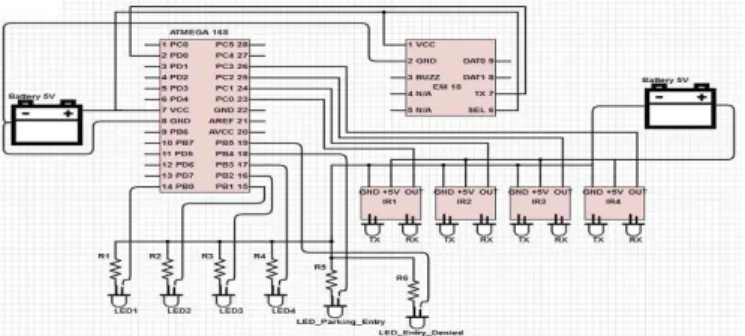
The circuit diagrams of various components used in the system and we get the following parameter
• Voltage: DC5V
• Electrical current:<50MA
• Operating frequency:125KHZ
• Read distance:10 cm
Fig. 2: Circuit diagram for EM-18
Iv. Result:
A step-by-step approach in designing the microcontroller based system for the measurement and control of temperature and humidity is followed. The results obtained from the measurement have shown that the system performance is quite reliable and accurate. This system requires a number of hardware components, properly integrated in accordance with their specifications. The system requires a continuous and reliable power supply provided to them.
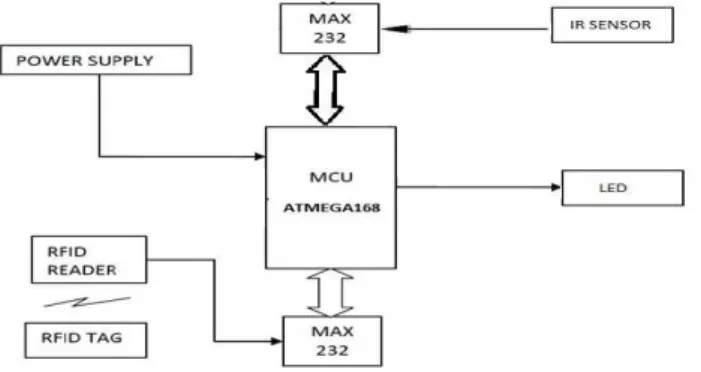
Fig. 3: RFID Based Automatic Parking system
The data collected by the IR sensors and RFID reader is processed and manipulated at various stages by different softwares and it is finally being used to interact with the database to display various necessary functionalities on the online platform which is running on the ‘Wamp’ server.
The intermediate stages are:
The data from the sensors is being processed by the Atmega168 microprocessor and output is being sent to a serial monitor window of Cool Term software.
Cool Term serial window enables us to capture the output from the microprocessor and save it to a text file. The text file saved is being used by the PHP code for the online portal to perform various functionalities and display status and log information. The functionalities provided by online portal are shown by snapshots in project demonstration section and the PHP code is attached in the appendix.
Engineering Standards:
ISO-15961/62 - Data protocols and encoding ISO-15963- Unique Tag Id
IEEE 1394 is being used for USB to serial communication.
ISO 20473:2007 specifies the division of optical radiation into spectral bands for optics and photonics. It does not apply to lighting or telecommunication applications.
IEEE 830 is used for preparing report.
Design constraints:
Limited Range of RFID Transducer:
The RFID transducer is placed to read the RFID tag from the vehicles entering or leaving the parking. But the range of RFID transducer used here is 10 cm only. Therefore, drivers will have to drive quite close to the transducer to allow it to read the tag.
Parking Slot Monitoring:
The IR sensors used to monitor parking slots in real time are placed in the middle of parking slots. But if a vehicle is improperly parked such that it partially covers two adjacent slots then sensors can give wrong status to the system. In such a case both the slots should become unusable but either only one or even both the slots will be shown as being empty. So the drivers need to properly park their vehicles inside the marked lines.
Other constraints are as follows:
Economic:
The system should not exceed cost of Rs. 4000 for a prototype module handling 4 car slots. Each additional slot should not exceed the cost of Rs. 200.
Environmental:
The system should not cause pollution or damage environment by releasing harmful solid, liquid and gaseous waste. Also the radio frequency used must not cause harmful radiation or disturb animals, birds, insects etc.
Ethical:
The system should maintain privacy of the individual and follow codes of ethical sharing of collected data. The data collected regarding check-in and check-out timing of individuals as well as their personal details should not be shared with unauthorised parties. They should only be shared with law enforcement agencies and courts on their demand and following legal and standard procedure.
Health and Safety:
The system should not cause any health related problems especially related to electromagnetic radiation, or pollution of immediate environment by solid, liquid or gaseous waste. It should also be safe to handle and should not cause electric shocks, cuts from sharp edges, burns from heated components etc.
Tradeoffs: Cost versus Range of Sensors:
High power active sensors using better class of RFID tags and higher frequency transducers can function at a very large range but they are costlier than low frequency passive RFID tags which function in a smaller physical range. Due to focus onmaking the system cost effective and only a slight increase in inconvenience due to decrease in range, we are using passive RFID tags.
Information Storage in Tags versus Information Storage in Central Database:
Using “read-write” tags the user information and account balance can be stored in the tag itself but these tags are costlier and there is risk to data privacy as any transducer working on the same frequency can read it. Using “read-only” tags that only contain a unique ID which has corresponding user information and account balance in central database helps maintain privacy and security.
Conclusion:
REFERENCES
Dusyant Pande, Jeetender Singh Chauhan and Nitin Parihar, 2013. The Real Time Hardware Design to Automatically Monitor Light and Temperature, International Journal of Innovative Research In Science, Engineering and Technology, 2: 5.
Clerk Maxwell, J., 1892. A Treatise on Electricity and Magnetism, 3rd ed., vol. 2. Oxford: Clarendon pp: 68-73.
Jacobs, I.S. and C.P. Bean, 1963. “Fine particles, thin films and exchange anisotropy,” in Magnetism, vol. III, G.T. Rado and H. Suhl, Eds. New York: Academic, pp: 271-350.
Elissa, K., “Title of paper if known,” unpublished.
Nicole, R., “Title of paper with only first word capitalized,” J. Name Stand. Abbrev., in press.
Yorozu, Y., M. Hirano, K. Oka and Y. Tagawa, 1987. “Electron spectroscopy studies on magneto-optical media and plastic substrate interface,” IEEE Transl. J. Magn. Japan, 2: 740-741 [Digests 9th Annual Conf. Magnetics Japan, p. 301, 1982].
Young, M., 1989. The Technical Writer’s Handbook. Mill Valley, CA: University Science.