M E T H O D O L O G Y
Open Access
Optimal scheduling strategy for virtual
power plants based on credibility theory
Qian Ai
*, Songli Fan and Longjian Piao
Abstract
The virtual power plant (VPP) is a new and efficient solution to manage the integration of distributed energy resources (DERs) into the power system. Considering the unpredictable output of stochastic DERs, conventional scheduling strategies always set plenty of reserve aside in order to guarantee the reliability of operation, which is too conservative to gain more benefits. Thus, it is significant to research the scheduling strategies of VPPs, which can coordinate the risks and benefits of VPP operation. This paper presents a fuzzy chance-constrained scheduling model which utilizes fuzzy variables to describe uncertain features of distributed generators (DGs). Based on credibility theory, the concept of the confidence level is introduced to quantify the feasibility of the conditions, which reflects the risk tolerance of VPP operation. By transforming the fuzzy chance constraints into their equivalent forms, traditional optimization algorithms can be used to solve the optimal scheduling problem. An IEEE 6-node system is employed to prove the feasibility of the proposed scheduling model. Case studies demonstrate that the fuzzy chance strategy is superior to conservative scheduling strategies in realizing the right balance between risks and benefits.
Keywords:Credibility theory, Distributed energy resource (DER), Scheduling strategy, Uncertain factors, Virtual power plant (VPP)
Introduction
Nowadays, due to the rising prices of fossil fuels and the threat of climate change caused by greenhouse gases, distributed energy resources (DERs) have drawn wide-spread attention because of their clean and renewable
characteristics [1–3]. However, the output of DERs is
fluctuating and unpredictable. As the penetration of intermittent renewables in the grids is increasing grad-ually, more technical challenges need to be addressed
in the schedule and control of their operation [4–7].
Meanwhile, the liberalization of the electricity market makes DERs inevitable. However, the small capacity, intermittent output and the lack of appropriate inter-action with the system operator are the biggest barriers ahead of DERs for participation in the electricity market. To solve these problems mentioned above, the DERs could be aggregated as an entity which can be-have like a conventional generator, naming the virtual power plant (VPP) [8–10].
In [11, 12], a VPP is defined as a coalition of DERs in-cluding distributed generations (DGs), storage devices, and interruptible loads. Considering the characteristics of each DER and the impact of network, VPPs generate one unit portfolio which can be utilized to offer services to the system operator, and even to make contracts in the wholesale market. Therefore, by introducing the concept of the VPP, the visibility and controllability of DERs for system operators will be improved
consider-ably, just the same as the conventional transmission–
connected power plants.
To realize the concept of the VPP, scholars around the world have done lots of studies on VPPs in many aspects
[13–17], including VPP modeling methods, negotiating
behaviors in the market, bidding strategies, reliability evaluation, management systems, and so on. Among them, the optimal scheduling strategy of DERs in the VPP is a hot topic. Reference [18] proposed a non-equilibrium model which takes into account the supply and demand balancing constraint and security constraint of VPPs. On this basis, the strategy proposed in [19] considered the effect of reliability and determined the optimum hourly operating strategy of DERs by applying
* Correspondence:[email protected]
Department of Electrical Engineering, Shanghai Jiao Tong University, Shanghai 200240, China
the Monte Carlo simulation method. However, these scheduling strategies are based on the deterministic mar-ket prices. Considering the uncertainties in prices, [20] developed a new risk constrained scheduling for VPPs to help the aggregator bid in the day-ahead market.
However, the optimal bidding strategy of those re-searches mainly focused on maximizing the VPP’s profit in different types of markets. With regard to reserve level, these methods spare large capacity as recovery to balance the supply and demand. Although the system stability can be guaranteed in this deterministic way, the obtained scheduling results are always inevitably conser-vative. Actually, more benefits can be gained via redu-cing the reserve capacity appropriately.
This paper proposes a fuzzy chance-constrained sched-uling model to provide solutions for the optimal schedul-ing strategy for VPPs based on credibility theory. In this model, as the prediction errors of renewables are char-acterized as fuzzy parameters, the related constraints correspondingly contain fuzzy variables which need to be tackled properly. By introducing the concept of the confidence level, the feasibility of the conditions where the fuzzy chance constraints can be satisfied is quanti-fied, so as to characterize the risk tolerance of VPPs. The proposed fuzzy chance model is difficult to solve due to the incorporation of fuzzy variables. By trans-forming the constraints containing fuzzy variables into their equivalent forms, the chance constraints are con-verted into deterministic constraints which consider the fuzzy risks (or reliability) as well. Then traditional optimization algorithms can be utilized to solve the optimal scheduling problem, in order to achieve a com-promise between risks and benefits.
The rest of the paper is organized as follows: the theoretical basis of this paper is presented in Credibility theory and fuzzy chance-constrained programming, in-cluding credibility theory and fuzzy chance constrained programming; the proposed VPP scheduling strategy based on credibility theory is demonstrated in VPP scheduling strategy based on credibility theory; solution methods used in this paper are stated in Methods; case studies and discus-sion are given in Case study; and finally, the concludiscus-sion is drawn in Conclusions.
Credibility theory and fuzzy chance-constrained programming
Distinguished from the conventional power plants, the scheduling of VPPs is required to deal with a number of uncertain variables from renewables and loads. The common ways to process those uncertain variables are categorized into determinate and indeterminate methods. Determinate method is to set plenty of reserve aside in order to guarantee the reliability of operation. However, this approach is too conservative to coordinate the risks
and benefits of VPP operation. More benefits can be ob-tained by ignoring the small probability events and making decisions within the scope of risk tolerance [21]. The fuzzy chance-constrained programming method proposed in this paper is one kind of inde-terminate scheduling strategy.
In this approach, the decision result is allowed to vio-late the constraints which contain fuzzy variables, but the feasibility of satisfying the constraints should be no less than the preset confidence level. The confidence level is a concept which reflects the risk tolerance of the system, or the reliability requirements of the system when facing uncertain variables. In conclusion, the optimal fuzzy chance-constrained scheduling strat-egy is a compromise between risks and economic profits. Credibility theory provides theoretical support to solve the confidence level problem of the fuzzy chance strategy decision, which greatly contributes to the development and improvement of the fuzzy chance programming theory.
Credibility theory
The concept of the fuzzy set theory was initiated by Zadeh via the membership function [22]. In order to measure a fuzzy event, the possibility measure is pro-posed. Since then the possibility theory has been stud-ied by many researchers. Although the possibility measure has been widely used, it does not possess the self-duality property. Thus, if the possibility measure equals one it does not mean the event will happen definitely, while the event may happen even though the possibility measure is zero. So the solution to the fuzzy decision problem has been a mathematical con-undrum for a long time.
Credibility theory was propounded by Liu in 2004 as a branch of mathematics for studying the fuzzy behavior [23]. It establishes a complete axiomatic system which is parallel with probability theory in dealing with uncer-tainty. Based on five axioms mentioned in [23], a cred-ibility measure is defined.
According to Liu [23], the following five axioms should hold to ensure that the number Cr(A) has certain mathematical properties.
Definition 2.1:
Axiom1: Cr{Θ} = 1;
Axiom2:Cr is non-decreasing, i.e., if A⊆B, there is always Cr{A}≤Cr{B};
Axiom3: Cr is self-dual:∀A∈P(Θ), Cr{A} + Cr{Ac} = 1; Axiom4:∀Ai∈{Ai| Cr{Ai}≤0.5}, there is Cr Uf iAig∧ 0:5¼ supiCr Aif g.
Axiom5: LetΘ1,Θ2,...,Θnbe the nonempty sets
corresponding to that Cr1, Cr2,..., Crnsatisfy the axioms as
Then, we have Cr{(θ1,θ2,...,θn)} = Cr1{θ1}∧
Cr2{θ2}∧...∧Crn{θn} for each (θ1,θ2,...,θn)∈Θ.
whereΘis a nonempty set; P(Θ) is the possibility set of
Θ;the element of P(Θ) is a fuzzy event; A is the subset
ofΘ; Cr(A) is a non-negative number indicating the credibility of Event A which will occur; and ^ repre-sents the minimal operator.
Accordingly, the credibility measure describes the cred-ibility level of a fuzzy event; parallel with the confidence level in probability theory, it satisfies the self-duality. It means that the event whose credibility measure is 1 will definitely occur, and similarly, the event whose credibility measure is 0 will never happen. So credibility theory solves the confusion caused by a subordinate degree, and provides theoretical foundations for the fuzzy decision.
In the fuzzy decision of VPP scheduling, some defini-tions and theorems of credibility theory are utilized, as listed below:
Definition 2.2(Membership Function): The member-ship functionμ(x) of the fuzzy parameterξis defined as:
μð Þ ¼x Posfθ∈Θjξð Þθ ≤xg ð1Þ
Definition 2.3 (Credibility Measure): The credibility measure can be obtained from the membership function, which is named as the credibility inversion theorem:
Crfξ∈Ag ¼ supμð Þx x∈Aþ1−supμð Þxx∈Ac
2 ð2Þ
Fuzzy chance-constrained programming
Fuzzy chance-constrained programming refers to a type of decision-making problem which contains fuzzy pa-rameters. The forward-looking decision results of this problem may not satisfy the constraints with fuzzy pa-rameters to some extent, but the possibility of satisfying the constraints should be no less than the pre-specified confidence level. The general form of the fuzzy chance-constrained programming problem is:
maxf
Crfðx;ξÞ≥f≥α
Crgiðx;ξÞ≤0;i¼1;2;⋯;n≥β
8 < :
ð3Þ
wherexis the decision vector;ξis the fuzzy parameter vector; gi(x,ξ)≤0 is the ith constraint; α is the
confi-dence level of the object function; β is the confidence
level of the fuzzy constraint. The decision vector x is
feasible only when the credibility of gi(x,ξ)≤0 is no less
than β. Additionally, the optimal solution can maximize the object functionfat the confidence level ofα.
VPP scheduling strategy based on credibility theory
Traditional VPP scheduling strategy
The primary objectives of the VPP optimal scheduling problem are various, such as minimizing the cost of pro-ducing energy, or maximizing the profits of VPPs. In this paper, the priority of VPP operation is to make use of the renewable energy resources (RES), and based on this, the objective function is to minimize the costs of con-ventional unit generation and the interruptible load.
minf ¼X
T
t¼1 XNG
i¼1
JGið Þ þt uiðt−1Þuið ÞSUt ið Þt
½ þXNDR
j¼1 JDRjð Þt
( )
ð4Þ
JGið Þ ¼t uið Þt aiPGi2þbiPGiþci
ð5Þ
JDRjð Þ ¼t djPDRjujð Þt ð6Þ
where JGi(t) is the operational cost of uniti at time t;
SUi(t) is the start-up cost of the unitiat timet;ai,bi,ci
are the coefficients of the operational cost of the uniti;dj
is the coefficient of the cost by curtailing the loadj; PGi
is the output power of the uniti;PDRj is the virtual
gen-eration via curtailing the load; ui(t) is the binary state
variable of the unit iat time t: it equals“1” if the uniti is on at timet, and equals“0”if the uniti is off at time t. Similarly,uj(t) is the binary state variable of the loadj
at time t. NG andNDR are the numbers of conventional
units and loads in the demand response respectively. The constraints considered in this model are presented as follows:
1) Supply–demand balancing constraint
XNG
i¼1
PGið Þ þt XNDR
j¼1
PDRjð Þ þt PRESð Þ ¼t PLð Þt ð7Þ
2) System reserve constraint
XNG
i¼1
Pmax Gi þ
XNDR
j¼1
Pmax
DRj þPRESð Þt ≥PLð Þ þt R tð Þ ð8Þ
3) DG constraints
uið Þt PminGi ≤PGið Þt ≤uið Þt PmaxGi ð9Þ
−RDi≤PGið Þt −PGiðt−1Þ≤RUi ð10Þ
4) Interruptible load constraint
ujð ÞtPminDRj≤PDRjð Þt ≤ujð Þt PmaxDRj ð11Þ
wherePRES(t) is the power generated by renewables at
capacity for the fluctuation of load and renewables at time t; PminGi and PmaxGi are the minimum and the
max-imum output limit of the unit i respectively; RUi and
RDiare the ramp-up rate and the ramp-down rate of the
unit i; PminDRj and PmaxDRj are the minimum and maximum allowed curtailed value of the loadjrespectively.
Fuzzy chance-constrained VPP scheduling
The fuzzy parameters of VPP scheduling strategy come from the unpredictable output of renewables in VPPs [24]. Accurate mathematical expressions of those uncer-tain characteristics should be established, which are the foundations for the uncertain scheduling strategy. The main characterizing methods include modeling output of renewables and modeling their predicted errors. In this paper, the modeling of the forecast errors is consid-ered to describe the fuzziness of renewables instead of modeling the output. The modeling of renewables out-put will make three constraints containing fuzzy vari-ables, which are the supply–demand balance constraint, the spinning reserve constraint, and the static security constraint. If the predicted value is regarded as a deter-ministic value and the prediction error is utilized to de-scribe the fuzziness of renewables, only the spinning reserve constraint should be considered.
The percentage of renewables prediction error is de-fined as
ε%¼PRES−PFRES
PF RES
100% ð12Þ
where PRES and PFRES are the real value and the fore-casted value of the output respectively.
The membership function of the prediction error is:
μ¼
1
1þσ ε
Eþ
2; ε>0
1
1þσ ε
E‐
2; ε≤0 8
> > > > > > > < > > > > > > > :
ð13Þ
whereE+and E−are the average values of positive and
negative prediction errors obtained from statistics, re-spectively;σis the weighting factor.
According to credibility theory, the credibility measure of the fuzzy parameterξcan be expressed as:
Crðξ≤εÞ ¼
1− 1
2½1þσ ε
Eþ 2
; ε>0
1
2½1þσ ε
E−
; ε≤0 8
> > > > > > < > > > > > > :
ð14Þ
Thus, according to credibility theory, the spinning reserve constraint of the traditional scheduling model
Fig. 1Wiring Diagram of the VPP
Table 1Parameters of conventional generators
Node a b c Pmax
G PminG RU(RD)
1 0.1 13.5 176.9 220 100 55
2 0.1 32.6 129.9 100 10 50
should be changed into chance constraints containing fuzzy variables.
Cr X
NG
i¼1
uið ÞtPmaxGi þ
XNDR
j¼1
ujð ÞtPmaxDRjþPFRESð Þtð1þξÞ≥PLð Þ þt R tð Þ
)
≥α
(
ð15Þ
where α is the credibility level, which represents the reliability level of the reserve constraint. In the realistic
problem,αshould be more than 0.5.
According to the equivalent theorem of credibility the-ory, (15) can be transformed into an equivalent form as indicated in (16):
PLð Þ þt R tð Þ−PFRESð Þt −
XNG
i¼1
uið Þt PmaxGi − XNDR
j¼1
ujð Þt PmaxDRj
PF RESð Þt
≤Kα
ð16Þ
Kα¼ infKjK¼μ−1ð2 1ð −αÞÞ;∀α≥0:5 ð17Þ
The equivalent form of the fuzzy chance constraint can be further deduced to the following forms:
XNG
i¼1
uið ÞPt maxGi þ XNDR
j¼1
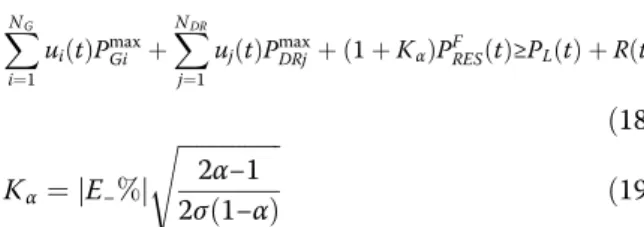
ujð ÞPt maxDRj þð1þKαÞP F
RESð Þt ≥PLð Þ þt R tð Þ
ð18Þ
Kα¼jE−%j
ffiffiffiffiffiffiffiffiffiffiffiffiffiffiffiffiffi 2α−1 2σð1−αÞ s
ð19Þ
It can be proved thatKαis a monotonously increasing
function. Equation (18) illustrates the links between the confidence level of the fuzzy constraint and spinning re-serve allocation when taking the fuzziness of RES pre-dicted error into account. It shows that to improve the confidence level of the spinning reserve constraint, a greater spinning reserve should be allocated. The form of the formula is similar to the traditional spinning re-serve constraint. Thus, the model can be easily solved by correcting the reserve levels using the regular optimization algorithm with the coefficientKα.
Methods
As introduced above, once chance constraint is trans-formed into its crisp equivalent, traditional optimization methods can be employed to solve the scheduling prob-lem. Based on the natural selection and genetic manipu-lation, genetic algorithms (GAs) are heuristic random searching methods, and they possess excellent robust-ness and commonality. However, there are some short-falls in the original GA, e.g. the slow convergence speed, falling easily into the locally optimal solution, and so on. A self-adaptive GA method was introduced to improve the performance. The probabilities of crossover and mu-tation for each generation are adaptively determined, which can overcome the premature convergence and the slow convergence speed in later evolutionary processes.
The crossover and mutation operators are two im-portant genetic operators. In this paper, the crossover
Fig. 2Forecasted Output of the Wind Farm in 24 h
Table 2Load data of the VPP in 24 h
Time Load Time Load Time Load Time Load
1 175.2 7 173.4 13 242.2 19 246.0
2 165.2 8 177.6 14 243.6 20 237.4
3 158.7 9 186.8 15 248.9 21 237.3
4 154.7 10 206.9 16 255.8 22 232.7
5 155.1 11 228.6 17 256.0 23 195.9
operator adopts double-cut-point crossover and the mu-tation operator is implemented through power disturb-ance. The crossover and mutation probabilities adopt self-adaptation mechanism and they will adjust adap-tively according to the values of the fitness function [25], as shown in (20) and (21):
Pc¼
Pc2−
Pc2−Pc3
ð Þ f′−favg
fmax−favg ; f
′≥f
avg
Pc1−
Pc1−Pc2
ð Þf′−fmin favg−fmin ;f
′<f
avg 8
> > > > < > > > > :
ð20Þ
Pm¼
Pm2−
Pm2−Pm3
ð Þ f′−favg
fmax−favg ; f
′≥f
avg
Pm1−
Pm1−Pm2
ð Þf′−fmin favg−fmin ;f
′<f
avg 8
> > > > < > > > > :
ð21Þ
wherePcandPmare the crossover and mutation
prob-abilities respectively; fmax, fmin, favg are the maximum,
minimum, and average fitness;f′is the greater fitness of the two individuals for genetic operation. Therefore, the superior individual with greater fitness is more likely to be reserved and the inferior individual tends to be trans-formed into a new one. The improved method could guarantee the population diversity and accelerate its convergence; furthermore, it could avoid the phenomena of premature and slow convergent speed in the later stage of evolution.
Case study
To evaluate the proposed approach, two test systems are studied. At first, a small VPP consisting of three conventional generators, one 50 MW wind farm and loads (conventional and interruptible) is employed. Then a system consisting of 10 generators and one wind farm is implemented to show the effectiveness of the proposed model.
Test systems
The structure of the proposed VPP is shown in Fig. 1. The parameters of the generators and loads in 24 h are indicated in Tables 1 and 2. The wind farm is integrated into the system at Node 4, and its forecasted output in 24 h is shown in Fig. 2. The load at Node 1 is the inter-ruptible load which can be curtailed if necessary. The curtailed load can be regarded as virtual power which can be adjusted continuously and provide the spinning reserve. Its virtual generation capacity ranges from 10 MW to 40 MW. The cost paid for the curtailed load is 45 $/MW.
The parameters of the self-adaptive GA are set as
follows: the population size Np= 30; maximum
itera-tions Nite=300; Pc1= 0.85, Pc2= 0.5, Pc3= 0.2, Pm1= 0.09, Pm2= 0.05, Pm3= 0.01. Considering the stochas-tic nature of GA, 20 test trials were conducted for each case.
Results and discussion
The scheduling model, consisting of (4)–(7), (9)–(11), and (18)–(19), is solved by the self-adaptive GA method in Methods. Apart from the data described in Test sys-tems, different confidence levels are also applied, ranging from 0.6 to 0.9, in steps of 0.1. The corresponding costs for satisfying the fuzzy chance spinning reserve constraint are listed in Table 3, including start-up cost, operation cost, cost of curtailing load, and total cost. In addition, the solutions of the fuzzy chance model are compared with those of the traditional deterministic model.
From Table 3, the total costs vary under different confi-dence levels; especially when α= 0.6, α= 0.7, α= 0.8, α= 0.9, the total cost are 146,033 $, 146,015 $, 146,124 $, 146,122 $, respectively, which are all less than the cost in deterministic model. It can be inferred that the proper se-lection of confidence levels will help achieve a tradeoff between economy and reliability. However, as the credibil-ity level is increasing gradually from 0.6 to 0.9, the opti-mized results (i.e., the total costs) in Table 3 do not show
Table 5Wind power and the load of the VPP in 6 h
Hour 1 2 3 4 5 6
Wind Power/MW 42 63 70 60 58 40
Load/MW 1036 1110 1258 1406 1480 1628
Table 3Optimal solutions compared between deterministic and fuzzy chance-constrained model
Cost/$ α= 0.6 α= 0.7 α= 0.8 α= 0.9 Deterministic model Start-up cost
of units
400 400 200 161 387
Operation cost 143,380 144,681 144,280 144,341 144,300 Cost of curtailing
load
2253 934 1644 1620 2333
Total cost 146,033 146,015 146,124 146,122 147,020
Table 4Optimal solutions without curtailing loads
Cost/$ α= 0.6 α= 0.7 α= 0.8 α= 0.9 Deterministic model Start-up cost
of units
400 400 200 200 200
Operation cost
145,854 145,865 146,080 146,096 146,287
a clear monotonic feature. It should be noted that this does not mean that the results of the fuzzy chance model based on credibility theory are confusing. It is because the results are interfered by the demand-side resources.
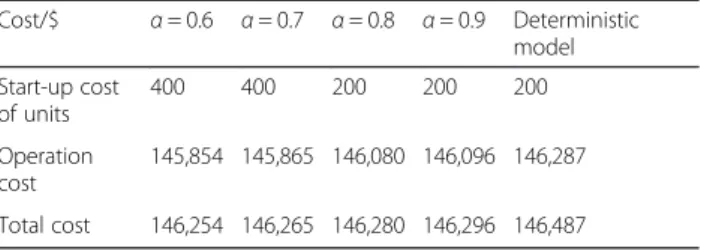
If the loads are not allowed to be curtailed, the effect of the interruptible load on the solutions will be ex-cluded. Then the total cost of VPP operation in different confidence levels will be 146,254 $, 146,265 $, 146,280 $, 146,296 $ and 146,487 $ respectively, showing a clear monotonously increasing trend, just as shown in Table 4. This is because, as the credibility level increases, VPP operator needs to spare more reserve capacity to guaran-tee the growing reliability requirement. Undoubtedly, that would lead to the rise of the total cost. Meanwhile, it is obvious that the total costs in model without curtailing loads are higher than those in original model through com-paring the values in Tables 3 and 4. Therefore, the intro-duction of the demand response (or interruptible loads) helps to improve the economy of the whole system, which is consistent with the current research results.
Furthermore, these results stimulate VPP to incorporate demand response and chance constraint programming into its operation strategy.
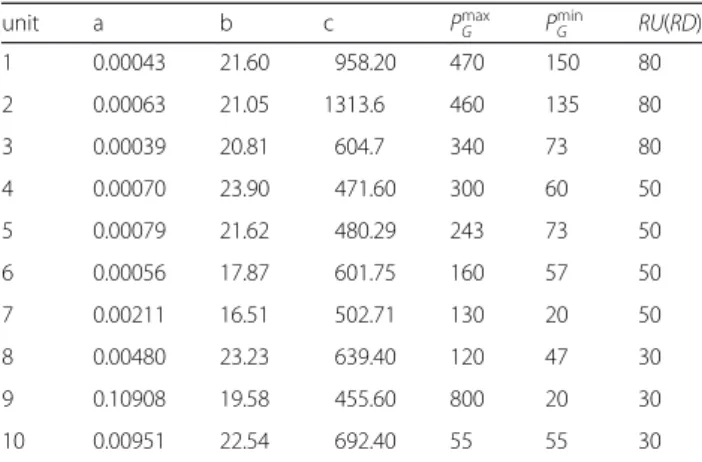
To further confirm the effectiveness of the proposed fuzzy chance model, the operation strategy of a larger VPP system in 6 h is tested. In order to exclude the im-pact of the interruptible load cost, loads in this system do not participate in the operation. The forecasted out-put of the wind farm and loads is shown in Table 5, and the parameters of the 10 generators are listed in Table 6.
The operational costs of VPPs under different confi-dence levels are depicted in Fig. 3, which are the same as the results in [24], except that confidence levels are
set as 1−α in this paper. Figure 3 shows the
corre-sponding cost is increasing when the credibility level rises from 0.6 to 0.9. It is because the confidence level represents the reliability of VPP operation. To reduce the risk resulting from the unpredictable output of re-newables, more spinning reserves are required, which will definitely increase the operational cost. The two case studies prove that the proposed model can put forward an optimal operation strategy which can reach the bal-ance between economy and risks/reliability.
Conclusions
VPP is a promising way to integrate the DERs into the power system. As the output of DERs is usually unpre-dictable, the scheduling of VPPs has to deal with a num-ber of uncertain variables, which is a fuzzy programming problem. To realize the proper balance between benefits and risks, credibility theory is introduced in the optimal scheduling strategy for VPPs in this paper, thereby pro-posing a fuzzy chance scheduling model. The concept of the confidence level can quantify the possibility of satis-fying the fuzzy chance constraints, which represents the
Fig. 3Total Cost of the VPP under Various Confidence Levels
Table 6Parameters of conventional generators
unit a b c Pmax
G PminG RU(RD)
1 0.00043 21.60 958.20 470 150 80
2 0.00063 21.05 1313.6 460 135 80
3 0.00039 20.81 604.7 340 73 80
4 0.00070 23.90 471.60 300 60 50
5 0.00079 21.62 480.29 243 73 50
6 0.00056 17.87 601.75 160 57 50
7 0.00211 16.51 502.71 130 20 50
8 0.00480 23.23 639.40 120 47 30
9 0.10908 19.58 455.60 800 20 30
risk tolerance of VPPs. Further, through transforming the fuzzy chance constraints into their equivalent forms, the conventional optimization algorithms can be utilized to solve the optimal scheduling problem. The case study proves that the operational cost of VPPs will increase when the confidence level increases. That is to say, un-necessary costs can be reduced when the risk of VPP op-eration is within tolerance.
Acknowledgment
This work is supported by the National Natural Science Foundation of China (No. 51577115). Meanwhile, the authors would like to thank the editor and reviewers for their sincere suggestions on improving the quality of this paper.
Authors’contribution
QA and SF carried out the study of virtual power plants,and drafted the manuscript. All authors read and approved the final manuscript.
About the authors
Q. Ai received the B.S. degree in electrical engineering and automation from Shanghai Jiao Tong University, Shanghai, China, in 1991 and M.S. degree in electrical engineering from Wuhan University, Wuhan, China, in 1994 and Ph.D. degree in electrical engineering from Tsinghua University, Beijing, China, in 1997. After spending one year at Nanyang Technological University, Singapore and two years at University of Bath, UK, he is currently a professor at Shanghai Jiao Tong University, Shanghai, China. His research interests include load modeling, smart grid, and intelligent algorithms.
S. L Fan received the B.S. degree in electrical engineering and automation from Sichuan University, Chengdu, China, in 2013. She is currently pursuing the Ph.D. degree in electrical engineering at Shanghai Jiao Tong University, Shanghai, China. Her research interest include virtual power plant operation and optimization.
L. J Piao received the B.S. and M.S. degree in electrical engineering from Shanghai Jiao Tong University, Shanghai, China, in 2012 and 2015, respectively. He is currently pursuing the M.S. degree in electrical engineering at Shanghai Jiao Tong University, Shanghai, China. His current research interests include multi-agent system in smart grids, and electric vehicle coordinated charging using game theory.
Competing interests
The authors declare that they have no competing interests.
Received: 12 May 2016 Accepted: 16 May 2016
References
1. Bamberger Y, Baptista J, Belmans R. et al. (2006).Vision and Strategy for Europe’s Electricity Networks of the Future: European Technology Platform Smart Grids[R]. Office for Official Publications of the European Communities. 2. Coll-Mayor D, Paget M & Lightner E. (2007). Future intelligent power grids:
analysis of the vision in the European Union and the United States[J].Energy Policy, 35(4), 2453–2465.
3. Wang C, & Li P. (2010). Development and challenges of distributed generation, the micro-grid and smart distribution system [J].Automation of Electric Power Systems, 2, 004.
4. McDermott TE, Dugan RC. (2002). Distributed generation impact on reliability and power quality indices[C]//Rural Electric Power Conference, 2002. IEEE: D3-D3_7.
5. Newman DE, Carreras BA, Kirchner M. et al. (2011). The impact of distributed generation on power transmission grid dynamics[C]//System Sciences (HICSS), 2011 44th Hawaii International Conference on. IEEE: 1–8. 6. Gomez JC, Vaschetti J, Coyos C. et al. (2013). Distributed generation: impact
on protections and power quality[J].Latin America Transactions, IEEE (Revista IEEE America Latina), 11(1), 460–465.
7. Fahim SR, Helmy W. (2012). Optimal study of distributed generation impact on electrical distribution networks using GA and generalized reduced gradient[C]//Engineering and Technology (ICET), 2012 International Conference on. IEEE: 1–6.
8. Braun M, & Strauss P. (2008). A review on aggregation approaches of controllable distributed energy units in electrical power systems[J].
International Journal of Distributed Energy Resources, 4(4), 297–319. 9. Mohammadi J, Rahimi-Kian A, Ghazizadeh MS. (2011). Joint operation of wind
power and flexible load as virtual power plant[C]//Environment and Electrical Engineering (EEEIC), 2011 10th International Conference on. IEEE: 1–4. 10. Pudjianto D, Ramsay C, & Strbac G. (2007). Virtual power plant and system
integration of distributed energy resources[J].Renewable Power Generation, IET, 1(1), 10–16.
11. Pudjianto D, Ramsay C, Strbac G. et al. (2008). The virtual power plant: Enabling integration of distributed generation and demand[J].FENIX Bulletin, 2, 10–16. 12. Saboori H, Mohammadi M, Taghe R. (2011). Virtual power plant (VPP),
definition, concept, components and types[C]//Power and Energy Engineering Conference (APPEEC), 2011 Asia-Pacific. IEEE: 1–4.
13. El Bakari K, Kling WL. (2011). Development and operation of virtual power plant system[C]//Innovative Smart Grid Technologies (ISGT Europe), 2011 2nd IEEE PES International Conference and Exhibition on. IEEE: 1–5. 14. ZdrilićM, PandžićH, Kuzle I. (2011). The mixed-integer linear optimization
model of virtual power plant operation[C]//Energy Market (EEM), 2011 8th International Conference on the European. IEEE: 467–471.
15. Salmani MA, Tafreshi SMM, Salmani H. (2009). Operation optimization for a virtual power plant[C]//Sustainable Alternative Energy (SAE), 2009 IEEE PES/ IAS Conference on. IEEE: 1–6.
16. Ruiz N, Cobelo I, & Oyarzabal J. (2009). A direct load control model for virtual power plant management[J].Power Systems, IEEE Transactions on, 24(2), 959–966.
17. Mashhour E, Moghaddas-Tafreshi SM. (2009). Trading models for aggregating distributed energy resources into virtual power plant[C]// Adaptive Science & Technology, 2009. ICAST 2009. 2nd International Conference on. IEEE: 418–421.
18. Mashhour E, & Moghaddas-Tafreshi SM. (2011). Bidding strategy of virtual power plant for participating in energy and spinning reserve markets—Part I: Problem formulation[J].Power Systems, IEEE Transactions on, 26(2), 949–956. 19. Soltani M, Raoofat M, Rostami MA. (2012). Optimal reliable strategy of virtual
power plant in energy and frequency control markets[C]//Electrical Power Distribution Networks (EPDC), 2012 Proceedings of 17th Conference on. IEEE: 1–6. 20. Taheri H, Ghasemi H, Rahimi-Kian A. et al. (2011). Modeling and optimized
scheduling of virtual power plant[C]//Electrical Engineering (ICEE), 2011 19th Iranian Conference on. IEEE: 1–6.
21. Xue Z, Li G, Zhou M. (2011).Credibility theory applied for estimating operating reserve considering wind power uncertainty[C]//PowerTech, 2011 IEEE Trondheim. Trondheim, Norway: IEEE, 1–8.
22. Zadeh LA. (1965). Fuzzy sets[J].Information and Control, 8(3), 338–353. 23. Liu B. (2006). A survey of credibility theory[J].Fuzzy Optimization and
Decision Making, 5(4), 387–408.
24. Xin A, & Xiao L. (2011). Dynamic economic dispatch for wind farms integrated power system based on credibility theory[J].Proceedings of the CSEE, 31(S1), 12–18.
25. Kuang H, Jin J, & Su Y. (2006). Improving crossover and mutation for adaptive genetic algorithm[J].Computer Engineering and Applications, 12, 93–99.
Submit your manuscript to a
journal and benefi t from:
7Convenient online submission
7Rigorous peer review
7Immediate publication on acceptance
7Open access: articles freely available online
7High visibility within the fi eld
7Retaining the copyright to your article