International Journal of Advanced Research in Computer Science RESEARCH PAPER
Available Online at www.ijarcs.info
Addressing Sensor Interoperability Problem using Fingerprint Segmentation
Varnika
M.Tech ScholarDepartment of Computer Science and Applications Kurukshetra University
Kurukshetra, India
Chander Kant
Assistant ProfessorDepartment of Computer Science and Applications Kurukshetra University
Kurukshetra, India
Abstract : The advances in sensor technology allow us to acquire fingerprint data of a person through variety of fingerprint sensors. With the advancing technology, it is common to replace older designs with newer ones. So, it is possible that the sensors used at the time of fingerprint enrollment and identification may be different. Interoperability refers to the system’s ability to work with various set of devices. There should be interoperability between sensors otherwise the performance of recognition system will be affected. In this paper fingerprint sensor interoperability problem is addressed using fingerprint segmentation. Segmentation is one of the most important phases in recognition of any biometric modality. It is the process of separating the foreground (which contains the information) and the background (which is basically the noise in the image). The devices available today generally work accurately if the image is acquired from a certain sensor. The problem occurs if the acquiring device is changed and the background of the image can wrongly be labeled as foreground in the segmentation process. This problem is discussed and a solution to overcome this problem is presented in this paper.
Keywords: Background Component, Biometric System, Fingerprint Sensors, Foreground Component, Segmentation, Sensor Interoperability.
I.INTRODUCTION
In today’s digital world, the technology is advancing and our society has become electronically connected through internet and digital devices. It has become crucial to provide a highly secure and reliable environment. Biometric is increasingly used in number of applications where identity assessment of persons is needed. Biometric Technology refers to the technique of identifying an individual based on their distinguishing biological characteristics. These characteristics can be behavioral (like voice, gait, gesture, keyboard typing, signature etc.) and can be physiological (like fingerprint, hand geometry, face, retina, iris of a person etc.). A biometric system can either be a verification system i.e. ‘whether the person is who that he/she claims to be’ or an identification system i.e. ‘whether the person is identified as an authorized person’ [1]. There are various benefits of using Biometric technology like fraud detection, improved security but despite of these, various challenges are also faced by biometric systems. Sensor Interoperability is one of the very challenging problems for biometric systems. The sensor interoperability issues arise when a biometric sensor is replaced without recapturing the corresponding biometric data.
Fingerprints of a person are the oldest biometric identifiers and are most widely used for authentication purposes. Segmentation is one of the most crucial steps in fingerprint recognition process. Segmentation is defined as the process of partitioning an image into multiple segments. In fingerprint segmentation, there are usually two segments or components i.e. the foreground and the background. The foreground is that component of the captured image which is formed when finger skin comes in contact with fingerprint sensor and the rest portion of the fingerprint image is the background area. Thus, it is crucial to effectively segment
fingerprint patterns from the background for the captured image so that reliability of feature extraction process can significantly be improved. The two most important that are needed to be considered while segmenting an image are:
• Do not remove any part of the foreground component of the image.
• Most of the parts of background component should be removed.
If the above mentioned points are not satisfied or if an important feature from the foreground component of the image is removed then the other processing stages like feature extraction, matching process etc. will also be affected and thus, we will not be able to get reliable results. There are basically two image segmentation approaches:
• Pixel-Based approach (P-B): In this approach, the pixels are classified into foreground and background components based upon the pixel features, but this method requires more computational effort because here each and every pixel is examined [ 2,3,4].
• Block-Based Approach (B-B): In this approach, the image is divided into non-overlapping blocks of same size and these blocks are classified as foreground or background blocks based upon, block-based features. But, this approach is less accurate as compared to P-B approach [5,6,7,8,9 ].
The features are generally used in fingerprint segmentation are coherence, mean, standard deviation (variance), frequency domain etc.
pixels or blocks to identify new pixels or blocks to be classified as foreground or background component.
Interoperability is how system works when different set of devices are used. Sensor Interoperability in biometric systems is the ability of the system to adapt to the data acquired from variety of sensors [10]. Today, most biometric systems are designed with the assumption that the data collected for enrollment and for identification or verification of biometric trait of a person is obtained from same type of sensor [11]. According to [12], there are many face verification algorithms that makes it mandatory to capture the images with same camera. But it is not guaranteed that same sensor that has been used for the enrollment of the modality will also be used during recognition process. The sensors used in the system greatly affect the captured raw data. If the nature of this data is affected, then it will also affect the feature set. Thus, the matching score will be subsequently affected and the performance of the matcher decreases. Different types of sensors induce different types of variations in the data such as variations in the resolution of the image, sensor area, sensor’s position with respect to the user, gray level, distortion effects etc. Since the matching module cannot handle variations in the feature set, there will be an impact on the matching scores if different sensors are used during enrollment mode and recognition mode. In [10], authors used two different sensors (optical sensor and solid state capacitive sensor) for capturing the fingerprint image and obtained significantly different images.
[image:2.595.324.552.251.490.2]For a secure and reliable access, biometrics is now being used at variety of places. Due to this rapid growth in the usage of biometric systems in various fields, there is a diverse set of sensors available in the market which emphasizes the importance of sensor interoperability in biometrics. For example, to capture iris images, sensors used are distance based and wavelength based [13]. Similarly, signature of a person can be captured through various electronic devices like pen table, grip pens, smart phones, Personal Digital Assistants (PDAs) etc. People can use any of the available sensors to interact with the biometric system which is good for the consumers. Moreover, with the increasing number of new sensors, old ones are to be replaced with new ones and it is not feasible to re-enroll the modalities every time the sensor changes. Thus, if a biometric trait is enrolled with one device is matched with the data captured from other device then there will be chances of getting error if interoperability issue is not considered. The figure below shows the variations in the captured fingerprint image of a person when taken using different fingerprint sensors. These fingerprint images are taken from open fingerprint database FVC2004 where the fingerprint of a person is captured using different sensors as shown in fig. 1. Thus, the acquired images should be properly segmented so that no background component of the image could wrongly be considered as foreground and thus should not affect the other processing stages of fingerprint recognition process.
Figure 1. Fingerprint Patterns of a person taken using Optical Sensor "V300" by CrossMatch, Optical Sensor "U.are.U 4000" by Digital Persona,
Thermal Sweeping Sensor "FingerChip FCD4B14CB" by Atmel respectively.
II.FINGERPRINT ACQUIRING TECHNOLOGY
A. Fingerprint
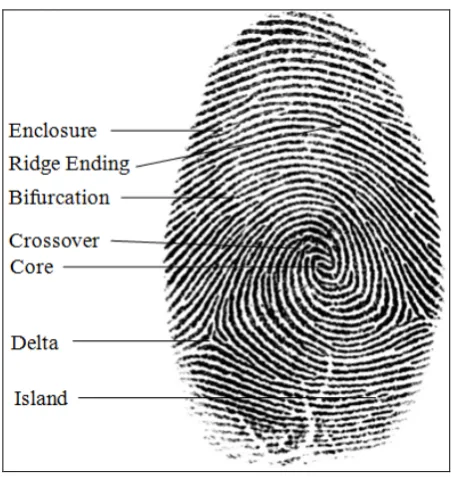
Fingerprint recognition is one of the oldest and the most publicized human identification process. Fingerprint of each and every person is unique and remains the same in their entire life (only grows to adult size). Finger skin is made of friction ridges which are created during the fetal live and are in genetically defined shape. Fingerprints are basically the impressions of these friction ridges of the finger. The three basic fingerprint ridge patterns are arch, loop, and whorl. On the basis of these patterns the identities of individuals can easily be differentiated. There exist some discontinuities in ridge flow pattern that are called Minutiae points and these minutiae points are considered for human identification. The figure below illustrates fingerprint minutia points.
Figure 2. Fingerprint Minutia Points
• Ridge Ending: Points where the ridge stops.
• Core: This is the inner point of the fingerprint. It centers the whorls, loops, or arches.
• Bifurcation: It is the point where one ridge gets divided into two.
• Dot: It is a very small ridge.
• Island: This ridge is slightly longer than dot.
• Bridge: It is a smaller ridge that joins two longer adjacent ridges.
• Crossover: It is the point where two ridges cross each other
• Enclosure: It is formed where a ridge bifurcates and again joins to form single ridge.
• Delta: It centers the triangular series of ridges.
B. Fingerprint Sensors
Fingerprint sensors are used to detect the minutiae points i.e. ridge ending, bifurcation, dot or an island [14]. Various types of fingerprint sensors available today are shown in fig. 2 [15, 16] and explained below:
[image:2.595.46.270.694.741.2]
which are still used in some applications. In this technique, firstly the finger is smeared with ink and then the finger is pressed against a paper to get the patterns of valleys and ridges on a paper. This is then converted into digital form by means of paper scanner. It is simple but slow technique.
• Optical Sensors: Optical sensor captures a digital image of the fingerprint usi placed on the touch surface which is the top layer of the sensor. A light-emitting phosphor layer is used below it that illuminates finger surface. A charged couple device is used to capture the light reflected from the finger and thus visual image of the fingerprint is captured.
• Solid State Sensors: These are silicon based sensors and that consists of an array of pixels where each pixel is itself a tiny sensor. So, this has reduced the problem of size as these can be easily implemented in cell phones, laptops etc.
[image:3.595.42.274.357.615.2]• Ultrasound Sensors: It works on the principle of acoustic signals. This consists of 2 components- transmitter and receiver. The acoustic signal is generated by the transmitter is sent to the finger surface. The receiver detects the echo when the signal bounces off the fingerprint surface. This echoed signal is used to determine the fingerprint pattern. This method can image the fingerprint even through a thin layer.
Figure 3. Types of fingerprint sensors
III.RELATED WORK
Problem of sensor interoperability cannot be solved by using only common biometric data exchange formats. There are various works that points out the importance of sensor interoperability in biometric system as discussed below:
The matching performances of a fingerprint system when different types of sensors were used was analyzed [10]. They considered that the issue of interoperability is related to the variations induced in the feature set when different sensors are used for sensing. The experiment was conducted using 2 different fingerprint sensors i.e. Optical sensor and
solid-state capacitive sensor. The Equal Error Rate (EER) of 23.13% was reported when matching images are acquired by Optical and Solid-State sensors while EER was 6.14% and 10.39% when using only Optical and Solid-State sensors, respectively. It was also reported that the optical sensors results in the extraction of more minutiae points as compared to solid-state sensor.
The authors in [17] analyzed image quality of the fingerprint images. The fingerprints of 494 participants were taken using 4 different biometric fingerprint devices. 10 fingerprints of each of 494 participants were collected and the data was taken twice per person: one used at the time enrollment and other for authentication or identification. They found that the genuine matching scores were higher when same device was used to capture the samples compared with the case that different devices were used. It was also found that the FRR was affected when data capturing devices were different. It was also reported that the similarity scores were much more sensitive to the quality of the captured data when devices used for sensing were different than when same device was used.
Emanuela Marasco, Luca Lugini, Bojan Cukic, Thirimachos Bourlai [18] proposed a classification scheme that combines the extracted features and match scores. Approximately 500 subjects were taken and the data was captured using 4 different optical sensors and scanned rolled ink prints to evaluate classification performance of a set of fingerprints. The experiment shows a significant impact on match rates when the interoperability is low. The approach used reduces the cross-device match error rates by a large margin.
Ruben Tolosana, Ruben Vera-Rodriguez, Javier Ortega-Garcia, Julian Fierrez [19] analyzed the problem of device interoperability for dynamic signature verification. The authors proposed a two-staged approach: the first was preprocessing stage where the data captured from different devices is processed and the signals were normalized in similar ranges, the second stage was based on feature selection where the selection of best features which were robust in conditions when different devices were used occurs. They applied these two stages on global features based and time function based systems and concluded that there was an average improvement of 40.5% EER in global features based and 14.0% EER in time function based systems. Finally, fusion of global features based and time function based systems was done and by applying their proposed approach there was an improvement of 27.7% EER as compared to best performance of time function based system.
The relationship among individual sensor and features is discussed in a paper [20]. The impact of feature selection on sensing device interoperability in biometric systems is illustrated in it. The experiment in the paper shows that different features put different sensor interoperability on different sensors. They argued that sensor interoperability results mainly because of two factors: one is due to inherent performances gap between two sensing devices and second factor is performance drop caused due to coordinating two sensors.
finger boundaries were used to localize ROI. It was found that this method extracts ROI accurately from the images acquired using multiple sensors.
The authors in [22] proposed a compensation algorithm to improve sensor interoperability for fingerprint recognition. Two methods: Common resolution method and Relative resolution methods were proposed for compensating resolutions of fingerprint images that were acquired by different sensors. The average EER of 8.62% improved to 5.37% by applying Relative resolution compensation and improved to 6.37% by Common resolution compensation method.
IV.PROPOSED WORK
The fingerprint sensors available today usually produces fingerprint images with different characteristics which prevent them from being interoperable. Sensing mechanism of each device is different and images with different sizes, resolution, feature distribution, gray level are produced. The fingerprint segmentation techniques used today generally works well if the image is taken from a particular sensor only and that’s why when the sensor is replaced, sensor interoperability issue occurs. This is because techniques used to segment images typically use a fixed threshold value that may not work for the images taken with different devices. Moreover, with the existing methods, the separation of foreground and background component of the image may be confused because of different image qualities (when the images are taken using different sensors). The inappropriate image segmentation affects the processing of other stages also which leads to undesirable results. In this work, an approach to address sensor interoperability issue using fingerprint segmentation is presented. The approach avoids the requirement to change the model when the sensing devices changes. The approach follows a procedure that enhances and segments the image depending upon the image characteristics only irrespective of the sensor from which it’s been taken. It does not require the use of a fixed threshold value to segment the foreground component of the image from the background component.
A. Database
[image:4.595.319.552.57.97.2]The database used is an open database ‘FVC2004’. The database contains four subdatabases. In this work, the images from three subdatabases are taken. These subdatabases contain the fingerprint images captured using three different sensors: Optical Sensor "V300" by CrossMatch, Optical Sensor "U.are.U 4000" by Digital Persona and Thermal Sweeping Sensor "FingerChip FCD4B14CB" by Atmel. The database and the sensor are illustrated in table below:
Table 1. FVC2004 Fingerprint Databases
Database
Sensor
Type
Image
Size
Resolution
DB1 Optical
Sensor
640x480 (307 K pixels)
500 dpi
DB2 Optical
Sensor
328x364 (119 K pixels)
500 dpi
DB3 Thermal
sweeping Sensor
300x480 (144 K pixels)
512 dpi
B. Proposed Algorithm Scheme
During the analysis phase, the experiments were done to analyze the distribution of various image features and it was analyzed that fingerprints that were taken from the same subdatabase (mentioned previously) were consistent in the distribution of features. It was also analyzed that the feature distribution of fingerprint of a person taken from different subdatabases were inconsistent. By analyzing these experiments, it was found that a particular threshold value can’t be used to segment images taken from all the subdatabases. The proposed procedure to segment fingerprint images is given below:
1. Acquire the fingerprint image, ‘I’. 2. Determine the image contrast value, ‘C’.
3. Partition ‘I’ into non-overlapping (W*W) blocks. 4. Compute the gray level variance ‘V’.
5. Apply Power Law Transformation to enhance the image depending upon its ‘V’ and ‘C’ values.
6. Compute the intensity value ‘IV’ of the transformed image ‘T’.
7. Separate each pixel (i,j) of the image ‘T’ into two segments.
If T(i,j) >= IV then
Assign the pixel a value ‘1’. Else
Assign the pixel a value ‘0’.
8. This matrix containing 0’s and 1’s is the segmented image, ‘S’.
V.RESULTS
A. Gray-Scale Variance
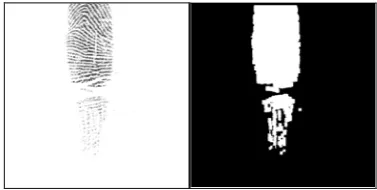
[image:4.595.342.531.525.620.2]From the results of gray level variance computation, it is found that the variance at right regions of the image is been identified. The figure below shows original images and their variance images.
Figure 4. Original Image taken from DB1 and its variance image
[image:4.595.341.533.649.755.2]B. Image Enhancement
[image:5.595.324.550.127.328.2]Enhanced image gives comparatively more detailed information than the non-enhanced image. Power Law transformations were applied to enhance the image. The enhancement of each image taken from a particular device is different. The enhanced images are illustrated in figures below:
[image:5.595.62.254.170.265.2]Figure 6. Original Image taken from DB1 and its enhanced image
Figure 7. Original Image taken from DB2 and its enhanced image
C. Segmentation
[image:5.595.62.254.294.396.2]Segmentation of the image is the ultimate result. The figures presented below illustrate the enhanced images along with their segmented image that contains required fingerprint area only. The proposed procedure correctly separates the required fingerprint area from the background of the image and can be used further processing.
Figure 8. Enhanced Image of the image taken from DB1 and its segmented image
Figure 9. Enhanced Image of the image taken from DB2 and its segmented image
D. Histograms
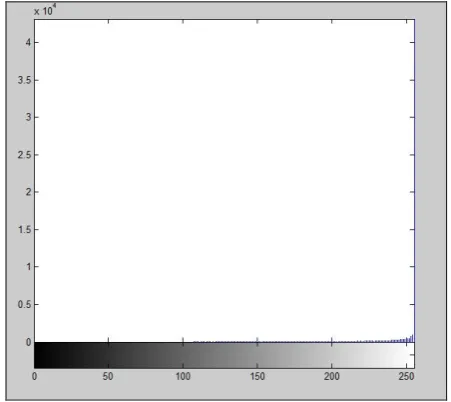
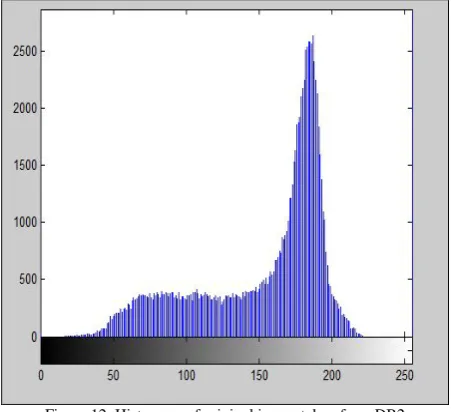
Histograms of original image and segmented images were constructed and it is found that histograms of the segmented images are similar and intensities lie in the range 0-1 as shown below:
[image:5.595.324.550.352.563.2]Figure 10. Histogram of original image taken from DB1
[image:5.595.57.259.649.753.2]Figure 12. Histogram of original image taken from DB2
Figure 13. Histogram of segmented image of the image taken from DB2
VI.CONCLUSION
In this paper, a segmentation approach is presented to segment the images accurately when the image is captured using various sensors. This prior knowledge of labeling foreground and background is not required in this method unlike various existing methods. It enhances and segments the image depending upon their image characteristics only and can work well even if the sensor from which the image is captured is replaced. The advantage of this technique is that it doesn’t require changing the threshold used to segment the image or retraining the classifier if sensor used to acquire the image is changed. The proposed technique improves sensor interoperability in fingerprint sensors. Thus, if fingerprint acquiring sensor is replaced in future, sensor interoperability will not be there. The proposed approach can improve interoperability among fingerprint sensors. In the future the approach can be enhanced to be applied on other biometric sensors.
VII.REFERENCES
[1] Renu Bhatia, “Biometrics and face recognition techniques,” International Journal of Advanced Research in Computer Science and Software Engineering (IJARCSSE), vol. 3, issue 5, pp. 93-99, May 2013.
[2] A. Bazen and S. Gerez, “Segmentation of fingerprint images,” Workshop on Circuits Systems and Signal Processing (ProRISC ’01), pp. 276–280, 2001. (Article in workshop proceedings)
[3] C. H. Wu, S. Tulyakov, and V. Govindaraju, “Robust pointbased feature fingerprint segmentation algorithm,” International Conference on Advances in Biometrics (ICB ’07), vol. 4642, pp. 1095–1103, 2007. (Article in conference proceedings)
[4] Y. L. Yin, Y. R. Wang, and X. K. Yang, “Fingerprint image segmentation based on quadric surface model,” Audio- and Video Based Biometric Person Authentication (AVBPA ’05), vol. 3546, pp. 647–655, 2005. (Article in conference proceedings)
[5] N. K. Ratha, S. Chen, and A. K. Jain, “Adaptive flow orientation-based feature extraction in fingerprint images,” Pattern Recognition, vol. 28, no. 11, pp. 1657–1672, 1995. [6] E. Zhu, J. Yin, C. Hu, and G. Zhang, “A systematic method for
fingerprint ridge orientation estimation and image segmentation,” Pattern Recognition, vol. 39, no. 8, pp. 1452– 1472, 2006.
[7] X. Chen, J. Tian, J. Cheng, and X. Yang, “Segmentation of fingerprint images using linear classifier,” EURASIP Journal on Applied Signal Processing, vol. 2004, no. 4, pp. 480–494, 2004.
[8] M. U. Akram, S. Nasir, A. Tariq, I. Zafar, and W. S. Khan, “Improved fingerprint image segmentation using new modified gradient based technique,” Canadian Conference on Electrical and Computer Engineering (CCECE ’08), pp. 1967–1972, 2008. (Article in conference proceedings)
[9] F. A. Afsar, M. Arif, and M. Hussain, “An effective approach to fingerprint segmentation using fisher basis,” in Proceedings of the 9th International Multi Topic Conference (IMTIC ’05), pp. 1–6, 2005.
[10] Arun Ross, Anil Jain, “Biometric Sensor Interoperability: A Case Study In Fingerprints,” Appeared in Proc. of International ECCV Workshop on Biometric Authentication (BioAW), Springer, vol. 3087, pp. 134-145, May 2004. [11] Anil Jain, Arun A. Ross, Karthik Nandakumar, Introduction
to Biometrics, Springer, Chapter 1, pp. 37.
[12] Phillips, P.J., Martin, A. Wilson, C.L., Przybocki, M, “An introduction to evaluating biometric systems,” IEEE Computer 33, pp. 56–63, 2000.
[13] Gursimarpreet Kaur, Dr. Sheetal Verma, Dr. Chander Kant Verma “Classification of fingerprint, iris and facial sensors,” IJSRD - International Journal for Scientific Research & Development, vol. 2, issue 03, ISSN (online): 2321-0613, 2014.
[14] Shweta Gaur, Mannish Thakker, “Biometric recognition techniques: a review,” International Journal of Advanced Research in Electrical, Electronics and Instrumentation Engineering (IJAREEIE), vol. 1, issue 4, pp. 282-290, October 2012.
[15] Salil Prabhakar, Alexander Ivanisov, and Anil Jain, “Biometric recognition: sensor characteristics and image quality,” IEEE Instrumentation & Measurement Magazine, pp. 1094-6969, June 2011.
[16] Davide Maltoni, Dario Maio, Anil Jain, Salil, Handbook of Fingerprint Recognition, Chapter 2.
[18] Emanuela Marasco, Luca Lugini, Bojan Cukic, Thirimachos Bourlai, “Minimizing the impact of low interoperability
between optical fingerprints sensors,”
September 29 2013-October 2 2013.
[19] Ruben Tolosana, Ruben Vera-Rodriguez, Javier Ortega-Garcia, Julian Fierrez, “Preprocessing and feature selection for improved sensor interoperability in online biometric signature verification,” IEEE, vol. 3, pp. 478-489, May 2015. [20] Chunxiao Ren, Yilong Yin, Jun Ma, Gongping Yang,
“Feature selection for sensor interoperability: a case study in fingerprint segmentation,” IEEE International Conference on
Systems, Man and Cybernetics, pp. 5202-5207, October 11-14, 2009. (Article in conference proceedings)
[21] Lu Yang, Gongping Yang, Lizhen Zhou, Yilong Yin, “Superpixel based finger vein roi extraction with sensor interoperability,” IEEE International Conference on Advances in Biometric (ICB) 2015, pp. 444-451, May 19-22, 2015. [22] Jihyeon Jang, Stephen J. Elliott, Hakil Kim, “On improving