Quality of Service Evaluation of a Deployed 3G Data
Network for a Campus wide e-Learning Platform
Kwame A.P Agyekum
Kwame Nkrumah Univ. Scienceand Technology, Ghana
Eric T. Tchao
Kwame Nkrumah Univ. Scienceand Technology, Ghana
Emmanuel Affum
Kwame Nkrumah Univ. Scienceand Technology, Ghana
ABSTRACT
In Ghana, the increase in the adoption of e-learning methodologies is improving the way teachers and students interact. With the combination of internet, multimedia and network technologies, e-learning is changing typical teaching and learning using its methodologies to improve access to education on many university campuses. A third generation (3G) data network has been deployed on Kwame Nkrumah University of Science and Technology (KNUST) campus with the aim of improving connectivity for students and lecturers to enable them access an implemented e-learning platform anywhere on the university campus. This paper evaluates the Quality of Service (QoS) provided by the 3G cellular data network. It addresses the gap between the technical capabilities and the QoS experienced by students and teachers who use the 3G network to access the platform. The analysis in the paper is based on live data which were collected on the network. An Analytic Hierarchy Process (AHP) methodology has been used to assess the QoS based on selected Key Performance Indicators (KPIs).
Keywords
e-Learning; Quality of service; Network Connectivity; Third Generation; Analytic Hierarchy Process.
1.
INTRODUCTION
E-Learning refers to the use of Internet technologies to deliver a broad array of solutions that enhance knowledge and performance [1]. E-Learning can be used by institutions to improve the efficiency and effectiveness of educational interventions in the face of the social, scientific, and pedagogical challenges. Whiles the use of ICTs have enabled effective and highly reliable online education in many European countries, the same cannot be said for many Sub-Saharan African countries. Some institutions in the sub-region are however making strides to incorporate ICTs in their course delivery. Some universities in Ghana have made some progress in building network infrastructure and acquiring computers, but integrating technology into the teaching and learning process has been a challenge [2]. Kwame Nkrumah University of Science and Technology (KNUST) in Ghana, realizing the enormous potential of e-learning as against the university’s ever increasing student population has chosen to adopt e-learning as platform to transform KNUST into a modern citadel of academic knowledge in all spheres of science, humanities, business and more [3]. As such, an e-learning platform based on Moodle has been implemented using a 3G network on KNUST campus to enhance the teaching and learning process.
Research has shown that the critical factors affecting learners’ satisfaction with e-Learning system implementation includes learner computer anxiety [4], instructor attitude toward
e-learning [5], e-e-learning course flexibility [6], e-e-learning course quality [7], perceived usefulness [8], and perceived ease of use [9]. Authors in [3] indicated that the sustainability and user acceptance of the implemented e-learning model on KNUST campus will directly depend on the means of access, quality and the network performance since most of the users will be computer literate and technologically inclined. As such, measurement of network performance and Quality of Service (QoS) assessment of the data network is crucial.
Quality of Service (QoS) in communication networks is defined as the capability of the network to provide a satisfactory service which includes voice quality, signal strength, low call blocking and dropping probability, high data rates for multimedia and data applications [10]. For data services, QoS depends on the following factors key performance indicators (KPIs);
Throughput - The rate at which packets go through the network. Maximum rate is always preferred.
Delay - This is the time which a packet takes to travel from one end to the other.
Packet Loss Rate - The rate at which a packet is lost.
Packet Error Rate - This is the errors which are present in a packet due to corrupted bits.
Reliability - The availability of a connection. The authors in [11] presented a methodology for evaluating the QoS provided by a cellular network for background services such as e-mail and text messaging based on data collected from drive testing. The data obtained from the drive testing were used to evaluate different drive routes on a UMTS network. Since their approach is bounded to a single UMTS, their methodology cannot be used universally on different networks. In [12], the authors presented a QoS assessment methodology for cellular communication networks based on data collected through drive testing. QoS assessment for both the circuit switched and packet switched of parts the network was studied. The end goal of the proposed methodology was QoS comparison between cellular networks implementing different cellular technologies. However, the authors failed to provide QoS measurements as a function of both voice and data services simultaneously.
This research surveys the network performance and measures the KPI parameters of the data network. An appropriate QoS evaluation methodology has been used to specify the KPI and results presented.
2.
QoS EVALUATION METHODOLOGY
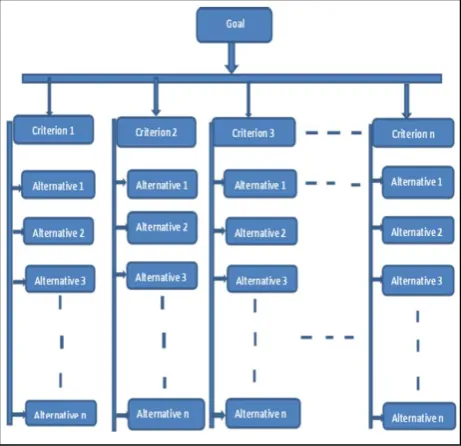
We employ the use of an analytic hierarchy process [13] which uses a multiple criteria decision making method. The process employs a procedure of multiple comparisons to rank alternative solutions to a multi objective decision problem. In AHP, a problem is structured as a hierarchy with the goal to be achieved at the top of the hierarchy, criteria at lower levels of the hierarchy, and finally decision alternatives at the bottom of the hierarchy. The used methodology is shown in Figure 1The various alternatives in the hierarchy are systematically evaluated by comparing them to one another with respect to the criteria. Each of the criteria is also compared with the goal. In making these comparisons, data collected about the alternatives is used. This process results in a comparison matrix:
𝐴
=
𝐶
1𝐶
2𝐶
3⋮
𝐶
𝑛𝐶
11
𝐶
2𝐴
12𝐴
211
𝐶
3𝐴
13… 𝐶
𝑛⋯ 𝐴
1𝑛𝐴
23⋯ 𝐴
2𝑛𝐴
31𝐴
32⋮
⋮
𝐴
𝑛1𝐴
𝑛21
⋯ 𝐴
3𝑛⋮
⋮ ⋮
𝐴
𝑛3⋯ 1
(1)
To do the analysis, the data collected about the alternatives is compared to some standard or threshold values and a number or numbers picked from a scale shown in Table 1.
This scale is then used to create the comparison matrices in (1). The comparison matrices are normalized to obtain a normalized comparison matrix:
𝐴
𝑛𝑜𝑟𝑚=
𝐴
𝑖1𝐴
𝑛 𝑖=1 𝑖1⋮
⋯
𝐴
𝑖𝑛𝐴
𝑛 𝑖=1 𝑖𝑛⋮
⋮
𝐴
𝑛1𝐴
𝑛 𝑖=1 𝑖1…
𝐴
𝑛𝑛𝐴
𝑛 𝑖=1 𝑖𝑛
(2)
Where
𝐴
𝑖𝑗=
𝑎𝑖𝑎𝑗
𝑊 = 𝑤1=
𝐴
𝑛 𝑖=1 1𝑖
𝑛 𝑤2=
𝐴
𝑛 𝑖=1 2𝑖
𝑛 . . 𝑤𝑛=
𝐴
𝑛 𝑖=1 𝑛𝑖
𝑛 (3)
Where 𝑎𝑖is the scale value of the ith criterion or alternative and 𝑎𝑗 is the scale value of the jth criterion or alternative.
𝐶𝑖is the ith criterion or alternative, 𝐴𝑖𝑗 is the comparison of
the ith criterion (alternative) with respect to the jth criterion (alternative) and n is the number of criteria or alternative to be evaluated.
Once all weight eigenvectors in the evaluation problem have been computed, they are multiplied together to get the rank or final scores of the alternatives. For example, if a problem has M alternatives and N criteria, then it is required to construct N judgment matrices (one for each criterion) of order MxM and one judgment matrix of order NxN.
Assuming the weight eigenvector of alternative comparison with respect to each criteria is 𝑊𝑖𝐴 (where i=1, 2, 3…. n) and 𝑊𝑖𝐶is the weight eigenvector of criteria comparison with
respect to the goal, then the final score of the goal at the top of the hierarchy can be obtained from:
𝑊1𝐴
𝑤1
𝑤2
𝑤3
⋮ 𝑤𝑛
𝑊2𝐴
𝑤1 𝑤2 𝑤3 ⋮ 𝑤𝑛 . ... . ... . . . .
𝑊𝑛𝐴
𝑤1 𝑤2 𝑤3 ⋮ 𝑤𝑛 ×
𝑊1𝐶
𝑤1 𝑤2 𝑤3 ⋮ 𝑤𝑛 (4)
To obtain the final score of the goal we let 𝑊𝐴 = 𝑊𝑖 , 𝑊𝐶 =
𝑊𝐴 and define 𝑆𝑖 as the overall score for alternative i, where i represents the ith element of the vectors 𝑊𝐴 and 𝑊𝐶 . 𝑆𝑖 then is
calculated as:
Scale
Description
9 Far better than the threshold
8 Much better than the threshold
7 Better than the threshold
6 Slightly better the threshold
5 About the same as the threshold
4 Slightly worse than the threshold
3 Worse than the threshold
2 Much worse than the threshold
1 Far worse than the threshold
Table 1 Proposed pair – wise comparison scale [13]
𝑆𝑖= 𝑊𝑖 𝑊𝐴𝑖 (5) 𝑛
𝑖=1
Once overall scores are computed for all alternatives, the highest score is identified as the alternative providing the best goal, followed by the second highest score and so on.
3.
SURVEY AREA
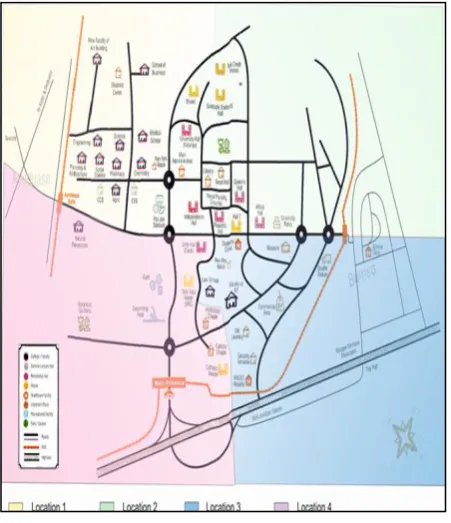
The evaluation process entailed collection of parameter measurements within the university campus. The population size of KNUST is about 25,000 and covers a 5 sq km area. The campus environment was divided into four locations as shown in Figure 2. The areas comprise:
Location 1 – Lecture Halls
Location 2 – Residential area (staff and students)
Location 3 – Commercial area
Location 4 – Main entrance area
Data on Key Performance Indicators such as latency, jitter, loss and throughput was collected within the measurement areas for 14 days.
4.
ANALYSIS OF RESULTS
The first step in using AHP is to decompose the problem into a hierarchy as shown in Figure 3. Our main goal is to evaluate the QoS of the data network and this is located at the top of the hierarchy. The criteria to help us achieve our goal are the KPIs (Latency, Jitter, Loss and Throughput) so they are located just below the main goal. Location 1, Location 2, Location 3 and Location 4 are the alternatives we are considering and are located below the criteria.
.
The collected data will be compared to ITU’s threshold values of QoS parameters or KPIs for advanced web browsing summarized in Table 2. The comparison is done using the proposed pair – wise comparison scale shown in Table 1.
Latency (msec)
Jitter (msec)
Loss (%) Throughput (kbs)
250 30 0 512
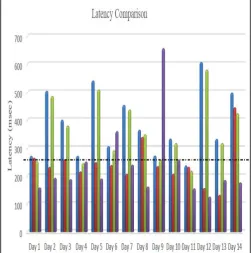
The results of the field measurements are summarized in Table 3 and Figure 4
From Figure 4, it is seen that the highest and lowest throughput were recorded at Locations 3 and 1respectively. The next step was to create the comparison matrices required using the pair – wise comparison scale in Table 1. The comparison matrices to be created are summarized in Tables 4-7; Table 4 and 5 summarized the KPI average values and the criteria comparison matrix respectively.
Location 1
Location 2
Location 3
Location 4
Latency(msec )
384.49 243.09 361.14 234.79
Jitter(msec) 85.31 73.43 67.05 64.70
Loss(%) 2.17 1.66 1.53 1.15
Throughput(k bs)
[image:3.595.308.542.73.287.2]515.38 754.20 796.93 794.61 Table 2 ITU threshold values of QoS parameters [14]
Figure 2 Layout of survey area
Figure 3 AHP Diagram for the Study
[image:3.595.55.281.340.602.2]The values of Table 4 are used to carry out criteria versus criteria pair-wise comparisons for each location based on the scale to obtain the comparison matrix in Table 5. A value of 3 was given to latency due to the fact that its value is worse than the threshold value that we were comparing it to. Jitter and loss have value of 2 because their values are much worse than their respective threshold values. Throughput on the other hand was given a value of 7 since its value is better than the threshold value. Table 5 is then normalized using (2).
The results of the evaluation are shown in Figures 5-8
Latency Jitter Loss Throughput
305.88 72.62 1.63 715.28
3 2 2 7
Criteria Latency Jitter Loss Throughput
Latency 1.0 1.50 1.50 0.43
Jitter 0.67 1.0 1.0 0.29
Loss 0.67 1.0 1.0 0.29
Throughput 2.33 3.5 3.5 1.0
Total 4.67 7.0 7.0 2.0
Latency Jitter Loss Throughput
Latency 0.21 0.21 0.21 0.21
Jitter 0.14 0.14 0.14 0.14
Loss 0.14 0.14 0.14 0.14
Throughput 0.50 0.50 0.50 0.50
Latency 0.21
Jitter 0.14
Loss 0.14
[image:4.595.39.275.87.328.2]Throughput 0.50
Table 4 KPIs Average Values
[image:4.595.328.487.274.365.2]Table 5: Criteria versus Criteria Comparison Matrix
[image:4.595.49.262.391.439.2]Table 6 Criteria versus Criteria Normalized Matrix
[image:4.595.309.561.405.659.2]Table 7: Eigenvector for Criteria Comparison Matrix
Figure 4 Summary of KPI at respective locations
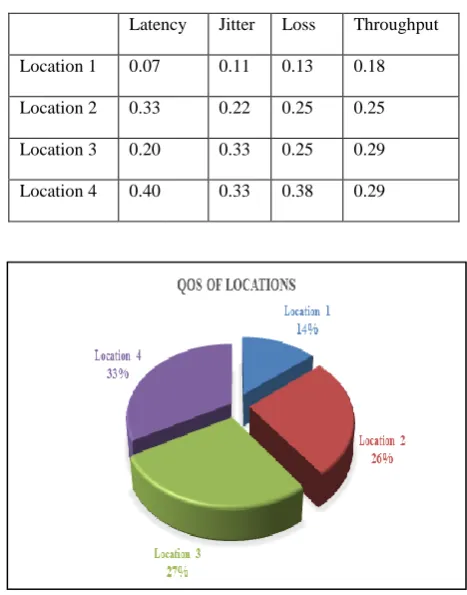
[image:4.595.48.291.478.632.2]The final AHP of the problem can be computed from the results above using (5). The results of the eigenvector in Table 8 give the QoS of 3G data network in terms of the four locations shown in Figure 9.
The results in Figure 9 is the unified measurement of the perceived QoS by users on the e-learning platform at different locations within the university campus. The QoS results show the priorities in increasing order as 0.138, 0.260, 0.268 and 0.328 for Location 1, Location 2, Location 3 and Location 4 respectively. This means that with respect to the measured data on the KPIs that we were considering, the network performs better in Location 4, followed by Location 3, Location 2 and Location 1. This study therefore appears to confirm the widely held perceptions by most students that, the network performs badly whenever they try to access the platform in the lecture theatres or their halls of residence. These two locations are the most congested locations on KNUST campus and is therefore not surprising that the QoS value recorded in these locations especially location 1 is low with respect to the other locations.
It is recommended that the allocated bandwidth and number of channels for the sectors serving this location should be increased in order to maintain the long term sustainability of the e-learning platform.
5. CONCLUSION
In order to maintain the advantages administrators, lecturers and students on campus derive from the e-learning platform which includes:
Accessibility and availability of courses 24 hours daily
Removal of geographical barriers
Latency Jitter Loss Throughput
Location 1 0.07 0.11 0.13 0.18
Location 2 0.33 0.22 0.25 0.25
Location 3 0.20 0.33 0.25 0.29
[image:5.595.49.294.71.274.2]Location 4 0.40 0.33 0.38 0.29 Table 8 Eigenvector matrices for KPIs
[image:5.595.317.551.138.436.2]Figure 6 KPI measurements summary: Jitter
Figure 7 KPI measurements summary: Loss
[image:5.595.50.299.309.500.2]Figure 8 KPI measurements summary: Throughput
[image:5.595.55.299.533.722.2] Reduction in the cost of delivering teaching and learning
Increased interaction of students and lecturers
Material availability both online and offline
Improved computer and internet skills of learners and lecturers
Accessibility to a wide array of learning resources via the web.
This paper has used an analytical hierarchical process to compare user experience with the 3G data network which was used to implement the e-learning platform at multiple locations to determine the location that provides the best QoS based on users’ perception of quality. An increase in bandwidth and the use of efficient resource allocation schemes have been recommended in order to improve the network connectivity of the data network.
6. REFERENCES
[1] Muhsin, H., “The Using of E-Learning Techniques to Improve the Medical Education”, 3rd International Conference on Information & Communication Technologies: from Theory to Applications, Damascus, 2008,pp.1-5
[2] Awidi, I.T, “Developing an e-learning Strategy for Public Universities in Ghana”, EDUCAUSE Quarterly Vol. 31 No. 2, EDUCASE, 2008, pp. 66 – 69
[3] John serbe Marfo and Robert Kabutey Okine:, “Implementation of e-Learning in Ghanaian Tertiary Institutions (A Case Study of KNUST)”; [Online http:// dspace.knust.edu.gh, accessed on 12/02/2014]
[4] Arbaugh, J. B. (2002). Managing the on-line classroom: a study of technological and behavioral characteristics of web-based MBA courses. Journal of High Technology Management Research, 13, 203–223.
[5] Arbaugh, J. B., & Duray, R. (2002). Technological and structural characteristics, student learning and satisfaction with web-based courses–An exploratory study of two on-line MBA programs. Management Learning, 33(3), 331–347.
[6] Aronen, R., & Dieressen, G. (2001). Improvement equipment reliability through e-Learning. Hydrocarbon Processing, 47–57.
[7] Barbeite, F. G., & Weiss, E. M. (2004). Computer self-efficacy and anxiety scales for an Internet sample: testing measurement equivalence of existing measures and development of new scales. Computers in Human Behavior, 20, 1–15.
[8] Berger, N. S. (1999). Pioneering experiences in distance learning: Lessons learned. Journal of Management Education, 23, 684–690.
[9] Sun, P. -C. et al., What drives a successful e-Learning? An empirical investigation, Computers & Education (2007), doi:10.1016/j.compedu.2006.11.007
[10]Lawrence Oborkhale, Apkar Salatian and Gregory Onoh. “A Quantitative Approach for Evaluating QOS in Wireless Cellular Networks using the Analytic Hierarchy Process Method”, 2012 International Conference on System Engineering and Modeling (ICSEM 2012), IPCSIT vol. 34, 2012
[11]Weissberger I., Kostanic I., Otero, C.E., “Background Service QoS in a UMTS Network,” Proceedings of IEEE Southeast Con, 2010, pp. 230 – 233
[12]Kostanic I., Mijatovic N., Vest S.D.,“Measurement Based QoS Comparison of Cellular Communication Networks”, In proceedings of 2009 IEEE International CQR Workshop, Naples, FL, May 2009.
[13]Saaty, T.L, “The Analytic Hierarchy Process-What It Is and How It Is Used.” Math. Modelling, 9, (1987), 161-176.