2017 2nd International Conference on Artificial Intelligence and Engineering Applications (AIEA 2017)
ISBN: 978-1-60595-485-1
Research on Task Allocation Based on Quantum
Particle Swarm and Hybrid Algorithm of Cuckoo
YUNZHI ZHANG, GANG WANG and TAO LI
ABSTRACT
Aiming at the tracking task and interception task in air defense antimissile operations, a mathematical model of cooperative combat assignment is constructed. By using the global searching ability of the cuckoo algorithm and the fast and efficient local search ability of the quantum particle swarm algorithm, the framework and process of hybrid optimization, based on quantum particle swarm optimization and the cuckoo, are designed. Finally, an example is given to demonstrate the rationality of the task allocation model and the effectiveness and superiority of the proposed algorithm. It provides a method and reference for solving the problem of air defense antimissile assignment.
KEYWORDS
Cuckoo algorithm, Quantum particle swarm algorithm, Task allocation.
INTRODUCTION
The task assignment problem of air to air missile defense is a nonlinear combinatorial optimization problem, which belongs to the NP complete problem. At present, the algorithms for solving the task assignment problem mainly include the traditional mathematical method [1, 2] and the intelligent algorithm [3, 4]. Intelligent algorithms have advantages in dealing with complexity problems. At present, the research of task allocation algorithm is mainly through the improvement of intelligent algorithm and hybrid optimization, and achieved good results [5, 6].In this paper, a mathematical model of task allocation is constructed in combination with the tracking task and interception task in the air defense antimissile process. By using the global searching ability of the cuckoo algorithm and the efficient local search ability of the quantum particle swarm algorithm, the optimization algorithm model is constructed. Finally, the effectiveness and superiority of the model and algorithm are verified by simulation analysis.
_________________________________________
TASK ALLOCATION MODEL OF AIR DEFENSE ANTIMISSILE OPERATIONS
Combat Mission Decomposition.
With the continuous development of network operation and the continuous improvement of weapon performance, the interception of target can be decomposed into tracking task and interception task. Specific description is as follows:
1, ,...,2
,
,
D Ln i i i
T t t t t t t (1)
Among them, ti represents the combat task of targetTi, and D i
t represents the tracking task of the targetTi,
L i
t means intercepting targetTi, nindicates the number of intercepted targets.
Objective Function Analysis.
There are m units of fire which represented by a set asW
w w1, 2,...wm
, if iw W
, there will be a capability vector is represented as
D, L
i i i
B b b , In this
collection, the vector D i
b represents the tracking capability of the fire unit wi when tracking the target Tj, the vector
L i
b represents the interception capability of the fire unit wi when tracking the target Tj . Because the fire unit intercepts targets differently, the capability of fire unit is an n-dimensional vector. The variable n is used to represents the number of targets.
Due to the separation of tracking and interception tasks, we will define variables to model task allocation.
Definition 1: Tracking advantage: The variable D
T indicate the ability to track target, which relate to the variable D
i
b .expressing as follows:
( )xij
D D
ij i
T b (2)
So, the integrated tracking advantages for target D j
T express as:
1 1
, 1
ij
m x m
D D
j i ij i
i i
T w T w
(3)Definition 2: Kill probability: The variable L
T indicate the ability to destroy the target, which relate to the D
i
b and biL. Expressing as follows:
yijL D L
ij j ij
T T b (4)
So, the integrated kill probability for target L j
1
1 (1 ) ik m y L L j ij i T T
(5)Definition3: Task risk ( )R t
Mission risk represents the threat of an attack by a weapon system while executing its mission. The Thji indicates targetTj threat to weapon systemwi, and the TVJ indicates the threat to the defensive area. So the risk of performing tasks is:
1
( ) ij
m x
j ji j
i
R t Th TV
(6)In summary, according to the principle of maximum revenue expectation, the objective function of task allocation is constructed:
1 1
1
1
1 (1 )
max ij ik ij m m x y D L
i ij ij
n i i m x j ji j i
w T T
Th TV
(7)At the same time, in the task allocation process, the following conditions need to be fulfilled:
1) D j
T ,The weapon system tracking capability must meet the minimum . 2) L
j
T ,The interception capability of the weapon system must meet the minimum.
3) _
1 n
M A X D E T ij i j
x N
, The number of tracking tasks can’t exceed the maximum.
4) _
1 n
M A X D E T ij i j
y M
, The number of interception tasks can’t exceed the maximum.
QUANTUM PARTICLE SWARM OPTIMIZATION AND CUCKOO OPTIMIZATION ALGORITHM
Quantum Behaved Particle Swarm Theory.
Among them, the position vectors and the velocity vectors of the particles are
1, 2,...,
i i i iD
x x x x and Vi
v vi1, i2,...,viD
respectively, and then the optimal solution is obtained by many iterations. The renewal process of particles is:
1
1 1 2 2
k k k k k k
id id id id gd id
v v c r p x c r p x , k 1 k k, 1, 2,..., . 1, 2,...,
id id id
x x v i m d D (8) Among them, is inertia weight, k is evolution algebra, c1andc2 are learning
factor, r1andr2are random number between [0, 1].
In order to solve the discrete optimization problem and improve the global optimization ability of the algorithm, a quantum particle swarm algorithm ([7]) is proposed:
1
1 2
k k k k k k
id id c pid xid c pgd xid
2
1 1,
0,
k id
id
if randon x
otherwise
(9)
2 2
cos , sin , 1
id id id id id id
The meaning of c1andc2 is the same as that in PSO. id Is the quantum bit deflection angle, the specific content reference [7], here no longer details. In additionid min,max, and min,max 0, 2 min,max[0, / 2] .
Cuckoo Algorithm.
The main idea of the cuckoo algorithm is that it generates candidate nest by Levy flight path and update the current position of the nest by the elitist strategy. Finally, the location of nest can reach or close the global optimum [8].In process of looking for the nest, Based on the above three principles, the update formula of location and path is given as following:
(t 1) ( )t ( ) 1 2
i i
x x L ,i , ,,n (10) The location of the nest is represented by the variable ( )t
i
x , and in this variable, the “i” is the nest location and the “t” is the breeding times; the symbol of “”is instead of point-to-point multiplication; the variable “a” is the step length; L( ) is the random step following Levy distribution. After using the formula to update the location, comparing random numbers of r[0,1] with the probability of pa, if the equation of r pa is right, the variable
( 1)t i
Analysis of Hybrid Optimization Algorithm.
The quantum particle swarm and the cuckoo hybrid algorithm (CS-QPSO) are optimized by classification. By using the global optimization of the cuckoo and iterating the certain algebra, the optimal individuals in each population are formed into the initial population of the QPSO algorithm, and the local search is optimized quickly. Its algorithm, structure and process are shown in Fig. 1 and Fig. 2.
SIMULATION ANALYSIS
Suppose there are 10 targetsT T1, ,...,2 T10 in a particular air defense operation.
We have weapon systemW
w w w w w1, 2, ,3 4, 5
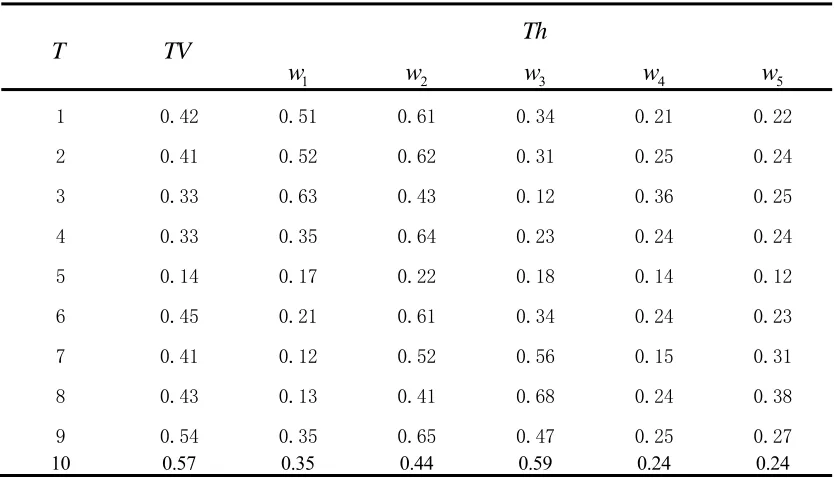
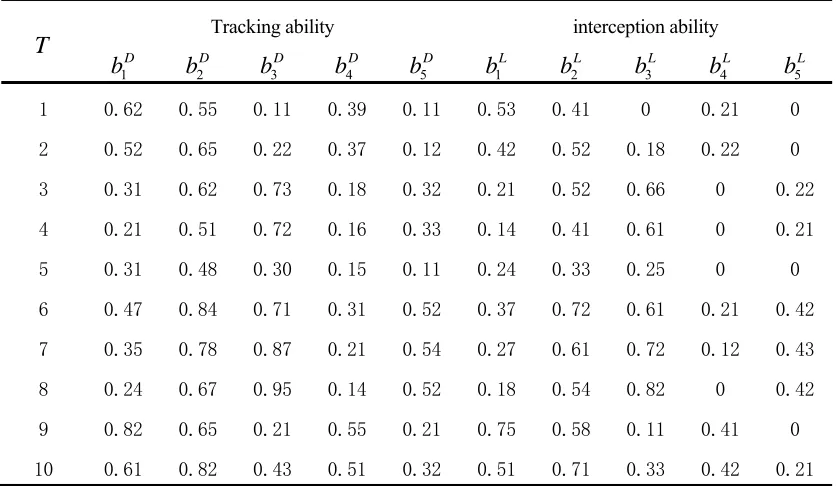
around our target area. Thetracking channels for each weapon system are {3,4,4,3,3}, and the intercept channel is {3,2,2,4,4}. Assuming the ability to track and intercept targets, the requirements are (0.5,0.5) . According to the target recognition result and threat assessment method, the threat degree of incoming target to each weapon system is obtained, as shown in table 1. The target tracking ability and interception capability of each weapon system are shown in table 2.
[image:5.612.89.506.483.722.2]Figure 1. Schematic diagram of CS-QPSO algorithm.
TABLE 1. THREAT LEVEL OF ATTACK TARGET.
T TV Th
1
w w2 w3 w4 w5
1 0.42 0.51 0.61 0.34 0.21 0.22
2 0.41 0.52 0.62 0.31 0.25 0.24
3 0.33 0.63 0.43 0.12 0.36 0.25
4 0.33 0.35 0.64 0.23 0.24 0.24
5 0.14 0.17 0.22 0.18 0.14 0.12
6 0.45 0.21 0.61 0.34 0.24 0.23
7 0.41 0.12 0.52 0.56 0.15 0.31
TABLE 2. CAPABILITY OF THE WEAPONS SYSTEM TO TARGET.
T Tracking ability interception ability
1
D
b 2D
b 3D
b 4D
b 5D
b 1L
b 2L
b 3L
b 4L
b 5L
b
1 0.62 0.55 0.11 0.39 0.11 0.53 0.41 0 0.21 0
2 0.52 0.65 0.22 0.37 0.12 0.42 0.52 0.18 0.22 0
3 0.31 0.62 0.73 0.18 0.32 0.21 0.52 0.66 0 0.22
4 0.21 0.51 0.72 0.16 0.33 0.14 0.41 0.61 0 0.21
5 0.31 0.48 0.30 0.15 0.11 0.24 0.33 0.25 0 0
6 0.47 0.84 0.71 0.31 0.52 0.37 0.72 0.61 0.21 0.42
7 0.35 0.78 0.87 0.21 0.54 0.27 0.61 0.72 0.12 0.43
8 0.24 0.67 0.95 0.14 0.52 0.18 0.54 0.82 0 0.42
9 0.82 0.65 0.21 0.55 0.21 0.75 0.58 0.11 0.41 0
10 0.61 0.82 0.43 0.51 0.32 0.51 0.71 0.33 0.42 0.21
TABLE 3. TARGET ALLOCATION SCHEME BASED ON THREE DIFFERENT OPTIMIZATION ALGORITHMS.
T P1 P2 P3 P4 P5 P6 P7 P8 P9 P10
CS-QPSO 1 1 2 2 3 3 3 3 1,2 2 2 2 3 3 3 3 1 1 2 2
QPSO 1 1 2 2 2,3 3 3 3 2 2 2 2 3 3 3 3 1 1 1 1
CS 1 1 2 2 2 2 2 2 2 2 3 3 3 3 3 3 1 1 1 1
0 10 20 30 40 50 60 70 80 90 100 0
0.5 1 1.5 2 2.5 3 3.5
仿真代数
方案适
度
应
算法
QPSO
混合优化算法
QGAPSO
算法
[image:6.612.86.507.365.665.2]QGA
Figure 3. Comparison of Fitness between Three Algorithms.
it may fall into local optimum, and the scheme is less adaptive. The hybrid algorithm, based on CS-QPSO combines the advantages of the two algorithms, can guarantee the quality and convergence speed of the solution, so that the task allocation scheme has high operational effectiveness.
SUMMARY
In this paper, a mathematical model of task allocation is constructed in combination with the tracking task and interception task in the air defense antimissile process. By using the hybrid optimization model of the cuckoo algorithm and the quantum particle swarm algorithm, the global search and local convergence of the algorithm are realized. The effectiveness and superiority of the model and algorithm are verified by simulation analysis. However, there is lack of systematic research on the task allocation model tracking task and the determination of the interception task capability requirements, pending further improvement.
REFERENCES
1. Wang Guannan, Chen Langzhong, Li Weimin. Mixed air defense missile group target assignment model [J]. Electro Optics and Control, 2007, 14 (1): 19-21.
2. Ma Fei, Cao Zeyang, Liu Hui. Research on dynamic target allocation strategy based on Nash equilibrium [J]. Modern Defense Technology, 2010, 38 (6): 81-84.
3. Zne-Jung Lee, Su Shun-Feng, Chou-Yuan Lee. Efficiently Solving General Weapon-Target Assignment Problem by Genetic Algorithms with Greed Eugenics [J]. IEEE Journal on Systems, man, and Cybernetics-Bart B: Cybernetics. 2003, 33(1):119-120.
4. Chang Tianqing, white, Wang Qinzhao. Niche genetic algorithm for weapon target assignment problem of tank units [J]. Journal of the Academy of Armored Forces Engineering, 2012, 26 (1): 44-49.
5. Liu Haixiao, Mou Liang, Zhang Weiming. Optimization method of WTA problem considering attack of accused node based on SPSO [J]. Fire and command and control, 2011, 36 (8): 36-39. 6. Lin Yutian. Study on improved particle swarm optimization algorithm and its applications [D].
Shanghai: East China University of Science and Technology, 2012.
7. Wu Jianhui, et al. Particle swarm immune algorithm for multiple population and its application in function optimization [J]. Computer Research and Development, 2012, 49 (9): 1883-1898.