ISSN: www.jatit.org E-ISSN:
442
NEW VARIABLE NEIGHBORHOOD SEARCH
METHOD FOR A TWO LEVEL CAPACITATED LOCATION
ALLOCATION PROBLEM
A.AIT BASSOU1, M.HLYAL2, 3A.SOULHI, 4J. EL ALAMI,
1,2,3,4 LASTIMI LAB, Med V University, EMI School, Rabat, Morocco 2 School of Textile and Clothing - (ESITH), Casablanca, Morocco 4 Prof, Med V University, High school of technology EST, Salé, Morocco
3 Prof, High School of Mineral Industry, Rabat, Morocco
E-mail: 1[email protected], 2 [email protected], , 3[email protected], 4[email protected]
ABSTRACT
The distribution network design is placed as strategic choice that have an influence either in the commercial issue as the tactical action or in operational management of the supply chain. Numerous economical decision problems concern selecting and or locating certain facilities to satisfy, efficiently, a given demands points. This article aims to provide a resolution for a facility location allocation problem in a distribution network. We focus on the choice of stores locations. These are designed to meet customer demands. Indeed, we consider the majority of economic parameters to fulfill a model of the distribution network, similar to a Two Level Capacitated Location Allocation Problem TLCLAP. A new Variable Neighborhood Search approach is proposed to resolve the problem.
Keywords: Variable Neighborhood Search, Supply Chain Management, Location-Allocation Problem.
1. INTRODUCTION
Actually, the effective movement of goods from raw material plants to processing facilities is acute in today especially in a competitive environment. Approximately, 10% of the gross domestic product is dedicated to supply related activities[1].
Now, customers have become more and more demanding and getting better informed and constantly looking for the best price / quality ratio in their favor, while demanding more services which are incorporated in the acquired product[2]. Aforementioned research has often talked about retailing as being one of the important challenges of doing business in emerging markets[3].
The supply chain has market power and practices markup pricing[4]. So, the decision to open a store is of strategic decision which has a direct impact on profitability and success[5]. Although the estimates of market needs and trade policy are vital in interesting a large number of customers and increase market shares[6], customer requirements and constant search for best quality, price and
service to the customer are also important factors [2]. This has pushed companies to review their competitive strategies to innovate constantly in order to differentiate themselves from competitors[7].Several studies emphasize the critical importance of logistics as a competitive advantage that has its direct impact on the service provided to customers (performance level rays, service boxes, product availability,). Performance on these aspects improves satisfaction and perception of the image of the store[8] .
Similarly, adopting a multichannel distribution strategy in emerging markets seems a crucial point in the overall firm’s business strategy[9]. Also, customer proximity, interactions with the large-scale distribution which is particularly related to the localization strategy and response to demand fluctuations play a strategic role for the company[10].
2. LITERATURE REVIEW
ISSN: www.jatit.org E-ISSN:
443 proposed was to minimize the distance between the warehouse and the different sites. The international warehouse location problem is very complex due to the increase of environmental variability and increasing the number of variables involved in an international market [11].
An important model of problem of location of an unlimited store capacity in the network design using linear programming integer variables was formulated in [12]. Thus, they have shown the impact of the design of the transportation network in the optimum location of warehouses. The problem was finding the network design and the list of locations of warehouses that minimize the total cost system: the cost of building a warehouse, transportation costs, etc.
An approximate model using a linear programming model in a deterministic environment (all prices are deterministic) was the subject of research carried out in [13]. These researchers have listed many factors to consider in locating warehouses and the objective of their model is profit maximization. In addition, the formulation of their problem includes the fact that clients are in different countries and the possibility of holding stocks in warehouses. The authors did not include the investment decisions and the cost of transportation. This problem can determine the countries in which it is best to locate these warehouses, the quantities to be produced for these warehouses and quantities to be shipped from these warehouses to customers.
In this context, a model for warehouse distribution and production was suggested in [14], The authors shows that the extension of the problem of backhaul can be used as an analogy. It suggests a model for the international warehouse location problem. Although this problem refers to geographically dispersed customers, it does not include international problems. Another model of production-distribution for the multinationals which minimize the total cost using a linear mixed-integer variables program was developed by [15].
A most researches are conducted in a field of dynamic location models. In general, the location decisions of a point in a network are made for the long term. Depots, distribution centers, transshipment points are used for a period of time. In addition, the factors that influence this decision may vary with time. Particularly, the demand and cost structures can vary, but the relocation and / or resizing of a warehouse may change with a significant cost. Also, to deal with such a problem,
were the dynamic location and allocation models developed? Dynamic location models have been suggested in [16],[17] ,[18]. In the same research field, a method of dynamic programming to determine the list of Pareto optimal solutions was given by [19]. An important study of dynamic location problems and a broad overview of their mathematical formulations and case studies was the subject of [20].
The models for the problems of probabilistic location are also given in literature. In practice some data entries that fall within the localization model is subject to variability. An analysis of the localization of models with a tail formation: an arrival process of customers given by distribution functions, waiting times for allocation of the request, an approximated Service time was introduced in [21]. A variant of the p-median problem with the use of stochastic data has been exposed in [12], demand and the weights of the arcs are assumed to be random variables. Thus, under certain assumptions, a finite number of state graphs with known probabilities can be listed. The purpose of the model is to minimize the sum of the weighted distances. Other stochastic models exist: in [22] a branch and cut with a stochastic algorithm application was developed. Unfortunately, the stochastic models require a large number of data to empirically determine a distribution. And usually, this information is not available for strategic localization problem of equipment. Probably calculator's computational solutions, supported by the sensitivity analysis for some scenarios are useful.
ISSN: www.jatit.org E-ISSN:
444 improvements of the design, or by the installation of facilities which are nearest to the clients.
3. METHOD
This section aims to provide a brief introduction to explain issues related to the location of stores in large retails. This is a pure strategic decision which must take into account several economic and financial parameters. For example we can shed lights on the customer demand (the concentration on demand in a given geographical area), the potential of the company are reflected in its ability to conquer a new market to gain a considerable market share and to be able to compete with other businesses. The majority of the methods which are used for the optimal location of shopping centers is based on the analysis of the distribution of potential customers in a given area (example: City). Among the theoretical methods are gravitational models, the interactive model of competition which seeks to locate the nearest point of sales which can attract most of the customers.
The origin of the location-allocation models are found to the problem of Alfred Weber1: "how to
locate a production facility to minimize the weighted distance between the center and the sources of raw materials?" The principle of location-allocation models is that: "we will determine all the available sites simultaneously with the assessment of the application by the sites in a given geographical area and we will select the site (or sites) that optimize performance of the firm which will create new stores.
Thus, the purpose of location-allocation models is to optimize the number and location of the points of sale; the allocation of consumers towards these points of sale in order to determine the supply capacity of these points of sale. In our case, we have considered the optimized design for a global network of large-scale distribution. This article is the extension of research conducted by [25] that allows the location of new warehouses on existing network.
In this research, we begin by analyzing the location of store without competition. We suppose that a firm operate alone on the market. The problem can be described as a capacitated p-median
1
FRIEDRICH , ’’Theory of the Location of Industries’’, University of Chicago Press, 1929
problem (CPMP). Indeed, such problem seeks to solve the optimal location of p facilities, considering distances and capacities for the service to be given by each median [26]. An extensive bibliography of related problems, and also a set of test problems are given in [27].
In our case, we continue with the research conducted in [25], which addresses the issue for the two level capacitated facility location allocation, using an efficient Genetic Algorithm for resolution.
3.1. PROBLEM DESCRIPTION
We consider a retail company that wishes to open a new store in a given region where customers and other similar retail facilities of its competitors are present. Thus this company should take in account the customers demand represented by a demand points, with each demand point representing the customers located in a small area surrounding it. Also, The Company must consider the cost of supplying its stores. Indeed, the transportation cost between its warehouses and shops must be reduced.
Each facility has an attractiveness ratio that is represented by a combination of several criteria, in particular:
Quality of existing infrastructure; Economic environment;
Ease of doing business; Political/social environment;
Availability of finance/financial environment.
3.2. PROPOSED MATHEMATICAL MODEL
The mathematical model of store location is considered as a binary integer-programming problem. The following notations are introduced to formulate the mathematical model.
Let:
i: Index for demand point, }
{1, 2, 3,...n
i∈D=
j: Index for store to locate, }
{1, 2, 3,...m
j∈S=
k: Index warehouse, k∈W={1, 2,3,...l }
j
I : Facility setup cost for facility, j∈S
i
d : Demand at demand point,i∈D Dj: The total Demand at store j∈S with
j i i ij
D =
∑
d Xjk
C : Transportation cost from warehouse
k∈W and demand point,i∈D
ij
Q : Cost of service level to satisfy demand
ISSN: www.jatit.org E-ISSN:
445
j
A : Attractiveness measure of facility
j∈S
j
Γ : Capacity of the store,j∈S
{
1 int0if demand po iis assigned to store j
ij otherwise
X =
{
10if store j is assigned to warehouse k
jk otherwise
Y =
{
10if store j is opened
j otherwise
Z
=
To be faithful to the real world of retail domain, we assume that n>m>l; however,
m>p
We assume that the fixed cost to establish a new store in j depend on facility attractiveness. In fact, accordingly to this model and using the terminology defined in [28], each facility has a known attractiveness level. It is possible to imagine a link between attractiveness and cost facility establishment. Indeed, we can see this link across the Return On Investment (ROI) parameter. If a facility has a high attractiveness rate, the investment made for establishing this facility will have a significant ROI. Thus, we can write:
, 0 j j I where A δ δ
= ∈R>
As proposed in this equation, when attractiveness is high, the cost of establishing a facility will be reduced. However, if a facility have a minimum attractiveness rate the ROI will be most important thus the cost will be great. The problem presented is a variant of Two Levels Capacity Location Allocation Problem (TLCLAP) presented in [25] . Since we have two levels in the distribution network and we also have the capacity constraint.
The model can be formulated as follows:
1
min j jk. j. jk ij ij (1)
j
j S k W j S i D j S
Z C D Y Q X
A δ ∈ ∈ ∈ ∈ ∈ + +
∑
∑ ∑
∑∑
Subject to: 1 (2) ij j SX j S
∈ = ∀ ∈
∑
1 (3) jk k WY k W
∈ = ∀ ∈
∑
(4) j j SZ p j S
∈
= ∀ ∈
∑
(5)
i ij j
i D
d X j S
∈
≤ Γ ∀ ∈
∑
{ }
, , 0,1 (6)
ij jk j
X Y Z ∈
The objective function (1) is to minimize the total cost for a given firm, the cost for establishing a store and the cost due to a level service that should be in a given facility. Constraints (2) guarantee that each demand point is assigned to some facility. Constraints (3) ensure that any store should be served by a warehouse. Constraints (4) means that the number of opened facility is exactly equal to p.
Constraints (5) ensure that the total demands assigned to a store j do not exceed its capacity. Constraints (6) provide the binary condition.
3.3. Variable Neighborhood Search(Vns) For
The TLCLAP Problem
In this section, we describe the components of our proposed VNS heuristics for the TLCLAP : the solution representation, the initialization process, the local search neighborhoods the shaking step. We also discuss a modification of the heuristic that allows us to solve the TLCLAP problem.
3.3.1. Basic Variable Neighborhood Search
As capacitated p-median is considered as a NP-hard problem [26],[29], we propose a metaheuristic to solve the proposal model. In fact, we use a Variable Neighborhood Search (VNS) that is considered as a metaheuristic for solving mathematical optimization problems. This metaheuristic was introduced in [30]. The fundamental idea is a systematic change of neighborhoods in two stages:
−Local search: when a local minimum is determined;
−Shaking: when escaping local minimum. Let us denote by:
max
,
1,....
k
N k
=
k
a finite set of pre-selected neighborhood structures;( )
k
N x
the set of solutions in the k thneighborhood of
x
,wherex
is defined as a solution inX
that represent the feasible set given by the set of constraints over the solution space.the algorithm of basic VNS is given bellow:
Algorithm 1: basic VNS
Initialization:
• Select the set of neighborhood structures
max
,
1,....
k
N k
=
k
• Find an initial solution
x
ISSN: www.jatit.org E-ISSN:
446 While (
Stop
condit=false)1
k
=
Begin
Repeat Shaking:
− Generate a point
x
'
at random from the k th neighborhood ofx x
, '
∈
N x
k( )
Local search:
− Apply some local search method with
x
'
as initial solution;
− denote with
x
"
the so obtained local optimum;Move or not:
− If the local optimum
x
"
is better than theincumbent
x
then• move there(
x
"
=
x
),• continue the search with
N k
1(
=
1)
Else
1
k
= +
k
Until (k
=
k
max )End
The stopping condition can be, for example, a maximum execution time or a maximum number of iterations or maximum number of iterations since the best improvement.
As we have two levels in our problem, the VNS algorithm can be applied in two parallel phases. First, to the location of stores and allocating demand points to its stores, then for the allocation of stores to their corresponding warehouses.
3.3.2. Resolution approach
Let us denote by:
Ω
: The Solution space;:
Ω →
l
, the objective function;Ψ ⊂ Ω
: A feasible solution set given by problem constraintsThe problem of mathematical optimization is defined as follow:
( )
{
}
min
l
x x
,
∈ Ψ
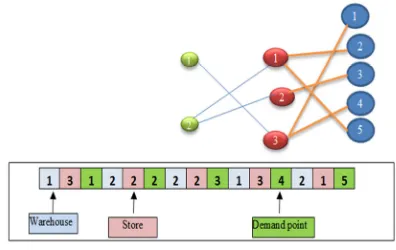
For resolution, we choose the same encoding used in the article [25]. Indeed, this encoding allows not only to observe some problem constraints, but also to have a unique form including all decision variables. Figure 1 shows the
[image:5.612.326.524.136.261.2]solution encoding, we suppose that we have n=5, m=4, l=2, p=3.
Figure 1: Solution Representation
To optimize the execution time, we will achieve an algorithm that will create the solution space that will contain all feasible solutions. Indeed, encoding solution allows to quickly having a solution space. The chosen approach is built around a method that creates a sub-cluster which represents the first level in the distribution network between warehouses and stores.
The choice of the initial solution is important for every local search heuristic method. That’s why we propose an efficient method for generating initial solutions.
3.3.3. Initial solution procedure
We can define the steps of generating the solution space as follows:
1. Choose randomly from S stores given in the model, p stores that will be retained in the problem;
2. To perform the sub-cluster, we affect the store to its corresponding warehouse, so that the cost of transport between these two facility is minimum;
3. Assign each sub-cluster at a particular demand point to build the solution according to store capacity and attractiveness parameter.
At step 1, we can define a fitness function, as an analogy with Genetic Algorithms method. This function will serve for the choice of the store.
So, let us define, j
1
1
j j
f
A
=
+
Γ
as a fitnessISSN: www.jatit.org E-ISSN:
447 wheel selection as an operator for having the store. The selection of a store j will be with the
probability:
1
j j m
j j
f
p
f
=
=
∑
.
3.3.4. Local searchers
The local search is an important step for the success of any VNS algorithm. It proceeds from an initial solution and using a sequence of local changes, improves the value of the objective function until a local optimum is reached. VNS systematically uses the idea of change of neighborhood during the search in a dynamic way.
For similar problems to TLCLAP, some local research approaches are adopted. We can report in this context, the approach used in [31], based on three types of local search: Allocate, Locate and Alternate. Based on this approach, we can use only the allocate an locate procedure since the representation allows to easily have a local search by changing cluster position or changing the p store elected in the solution representation. However, the allocate and locate procedures are so particular.
•Allocate:
The demand point in the solution presentation can change the position to another cluster, where the store capacity allows that. According to the example in figure 1, we will observe the store 1 and 2:
1 5 1, 1 is the remaining
capacity at the store 1.
d q with q
Γ = +
2 2 3 2, 2 is the remaining
capacity at the store 2.
d d q with q
Γ = + +
If q2≥d5, then we can affect the demand point 5
to store 2, indeed we will replace the store 1 in the last cluster by 2.
In addition to this new solution we can also having:
whereq1≥d2+d3, we can affect the demand
point 2 and 3 to store 1, indeed we will replace the store 2 in the second and third cluster by 1.
We can observe that the choice of store 1 and 2 is due to the fact that the two are attached to the warehouse 2. In this way we will not have to make warehouse assignments in the first network level.
In the case that the allocation procedure does not allow to have feasible solutions, especially for the
first network level, procedure termination requires making reallocations of warehouse, so we will be based on the transport costs between store and warehouse only for modified clusters.
•
Locate:Since the selection of stores is performed using the function fitness, we can, once again, generate other stores using the best fitness value for stores that are not open. So, suppose that
f
j' is maximumwhere j' is a store initially not selected, and
f
j isminimum where jdenotes the store in the initial
solution x with the lowest fitness value. We
substitute the store j' by j in in all clusters.
Finally, we conclude with the allocation of warehouses in the first level. In this way, the probability of having infeasible solutions is reduced.
By this way of building local search, it will bring up two versions of VNS. Indeed, for the first version, called VNS1, we will consider the approach "Locate". Moreover, for the second version, called VNS2 the "Allocate" approach is applied.
•Shaking procedure
To implement a VNS algorithm we should define a neighborhood structures. Thereby, based on research works conducted in [32], neighborhood structures can be conceived as below: The kth neighborhood of solution
x
, denoted by Nk( )x ,is defined as a set of solutions in which k elements in
ℵ
( )
x
are replaced by kelements from\ ( )
S ℵ x , where ( )ℵ x is a set of all selected store
in the network
card
( ( ))
ℵ
x
=
p
. For the example given in figure 1, ( ) {1, 2,3}ℵ x = .In the Shaking step, we generate a random assignment from the kthneighborhood of the current solution. As we try to test the response time, the stopping condition is a maximum number of iterations since the best improvement.
Algorithm 2 gives the approach for application the VNS for the problem TLCLAP.
ISSN: www.jatit.org E-ISSN:
448
•
best improvement
=
false
;
;While (
best improvement
=false)l
= ∞
Begin
Repeat
− Generate
x
'
,x x
, '
∈
N x
k( )
− Apply some local search method with
x
'
as initial solution;
− set
x
"
as local optimum forx
'
; − Ifl x
( ")
>
l
(x)
then•
x
"
=
x
• continue the search with
N k
1(
=
1)
Else1
k
= +
k
Until (k
=
k
max )( ")
l
=
l x
End
( is min) then
if l best improvement =true
4. COMPUTATIONAL RESULTS
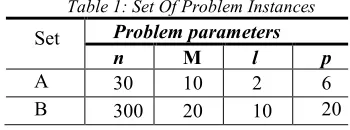
The proposed heuristic was tested on two sets of problem instances A and B. Each set have 10 instances established according to input data. Table 1 shows the detail of all sets. Computational experiments were carried out on a Intel i5 2.53GHz. The software was coded in C#. In order to analyze the performance of the proposed simulation embedded VNS, the said separate sets of experiments have been performed. First, to evaluate the performance of the proposed VNS under two versions VNS1 and VNS2, its performance was compared with exact results obtained using CPLEX
implemented with the same computer
performances.
[image:7.612.308.563.169.389.2]For tests, we generate random data that contains store capacity, transportation cost
Table 1: Set Of Problem Instances
Set Problem parameters
n M l p
A 30 10 2 6
B 300 20 10 20
The results are provided for two VNS versions VNS1 and VNS2 compared to results obtained by CPLEX, thus, we can calculate the Generalized Assignment Problem Gap value in each instance. Tables 2, 3, 4 and 5 shows the counts and
computation times for the various components of the VNS versions over all the instances of each set.
Table 2: Results For Set A Of Problem Instances
VNS1 VNS2
Instance Optimal
Cost Gap(%)
CPU time (Sec)
Optimal
Cost Gap(%)
CPU time (Sec)
1 2 036,00 1,69 0,14 2 014,00 0,61 0,12 2 2 012,00 0,11 0,32 2 039,00 0,12 0,2 3 2 040,00 1,89 0,3 2 014,00 0,48 0,48 4 2 018,00 5,64 0,52 2 000,00 1,11 0,64 5 2 019,00 3,40 0,5 2 009,00 0,65 0,55 6 2 016,00 3,00 0,96 2 002,00 0,58 0,96 7 2 005,00 3,36 0,98 2 039,00 0,39 1,12 8 2 036,00 0,13 1,2 2 038,00 0,06 0,96 9 2 010,00 1,16 0,9 2 030,00 0,16 1,26 10 2 027,00 2,40 1,3 2 040,00 0,60 1,5
Best 2 005,00 0,11 0,14 2 000,00 0,06 0,12
Avg 2021,90 2,28 0,712 2022,50 0,48 0,779
In table 2, we can see that the CPU time given, respectively by VNS1 and VNS2 are close (0,712 for VNS1 and 0,779 for VNS2), but the Gap value for VNS2 is reduced compared to Gap value for VNS1.Also, average best objective function value remain approximately the same.
Table 3: Results For Set B Of Problem Instances
VNS1 VNS2
Instance Optimal Cost Gap(%) CPU time (Sec)
Optimal
Cost Gap(%)
CPU time (Sec)
11 2 026,00 40,89% 3,41 2 027,00 4,79% 4,65 12 2 006,00 7,25% 4,16 2 024,00 2,44% 4,8 13 2 036,00 2,00% 5,28 2 000,00 1,20% 4,29 14 2 001,00 4,54% 4,08 2 013,00 1,40% 5,1 15 2 026,00 5,96% 6,3 2 001,00 2,36% 5,25 16 2 034,00 1,25% 5,04 2 018,00 0,19% 5,76 17 2 014,00 15,43% 6,66 2 032,00 4,60% 4,07 18 2 014,00 0,05% 5,32 2 017,00 0,03% 4,56 19 2 024,00 16,29% 6,63 2 009,00 4,87% 4,68 20 2 022,00 0,85% 6,4 2 004,00 0,48% 5,2
Best 2 001,00 0,05% 3,41 2 000,00 0,03% 4,07
[image:7.612.106.281.598.663.2]ISSN: www.jatit.org E-ISSN:
449 The results of set B confirm the increase of the Gap value for the VNS1, when the Gap value for VNS2 remains substantially invariable.
The results given in Table 3, allow saying that the gap value becomes, again, great for VNS1 compared to the previous results. The average CPU time in VNS2 is reduced compared to that of VNS1.
5. DISCUSSION
The present study was concerned, in most general terms, with how location allocation in a TLCLAP is carried out, in particular with the using an adapted metaheuristic to give resolution. Indeed, a new VNS algorithm is used as a new kind of approximate algorithm which basically tries to combine basic VNS methods to a special mechanism inspired by Genetic Algorithm. The aim is efficiently and effectively exploring a search space.
The result obtained by the proposed VNS approach seems to be efficient to resolve the TLCLAP. It allows having a good solution in a short time, regarding to similar NP-Hard problem. Also, for the small instant we can use either VNS1 or VNS2. However, the VNS2 remain the efficient algorithm for the important instances.
Furthermore, the comparison of this result with that of the genetic algorithm in [25], appears quite significant in terms of computing time. The power of the proposed VNS is due to several factors. First, the solution representation that allows to keep feasible solutions and to build a good space solution, based on fitness function inspired by the genetic algorithm. Secondly, the approach set out for having initials solutions is very effective. Finally, the generation of neighborhoods and local search approach are used to run the VNS in a reasonable time.
These results, then, constitute support for the view that adaptive metaheuristic gives a best result regarding to the problem[33].
6. CONCLUSION
The design and management of a distribution system is one of the most critical problems in logistics and in facility management. This paper deals with the so called facility location allocation problem, i.e. with the simultaneous decisions regarding the design and management of a distribution network. However, the said network
refers to a two level capacitated location allocation problem. Because through three components (Warehouses, Stores and demand point), we can say that we have two levels in the network, furthermore we consider at the same time the store capacity for facilities. The problem is an NP-hard, combinatorial optimization problem suitable for solving by a metaheuristic. Here we develop an effective VNS heuristic for solving the TLCLAP.
The proposed VNS is an effective response to the need of location stores and their allocation to several demand point. The optimization process is based on the determination of the solution encoding that allows having an admissible solution to the problem. In this context, a suitable method is used to generate an initial solution, based on fitness value of facility.
In addition, a shaking approach is proposed to fulfill the proposed VNS. Besides, local’s searches given in this paper results in two versions of VNS algorithm. An application of the introduced model and resolution is presented with a discussion of the obtained results. They demonstrate the efficacy of the VNS2 based on allocation criterion. Further research can be achieved on the application of this model taking in account the probabilistic demand.
REFERENCES
[1] D. Simchi-Levi, E. Simchi-Levi, and P. Kaminsky, Designing and managing the supply chain: Concepts, strategies, and cases. McGraw-Hill United-States, 1999.
[2] D. J. Bowersox, D. J. Closs, and T. P. Stank, “Ten mega-trends that will revolutionize supply chain logistics,” J. Bus. Logist., vol. 21, no. 2, pp. 1–16, 2000.
[3] W. Reinartz, B. Dellaert, M. Krafft, V. Kumar, and R. Varadarajan, “Retailing innovations in a globalizing retail market environment,” J. Retail., vol. 87, pp. S53–S66, 2011.
[4] A. Ahmadi-Javid and P. Hoseinpour, “A location-inventory-pricing model in a supply chain distribution network with price-sensitive demands and inventory-capacity constraints,” Transp. Res. Part E Logist. Transp. Rev., vol. 82, pp. 238–255, 2015.
[5] G. Turhan, M. Akalın, and C. Zehir, “Literature Review on Selection Criteria of Store Location Based on Performance Measures,” Procedia - Soc. Behav. Sci., vol. 99, pp. 391–402, Nov. 2013.
ISSN: www.jatit.org E-ISSN:
450 Building and Environment, vol. 42, no. 2. pp. 884–892, 2007.
[7] J. Vogel, Service Management:Strategic Service Innovation Management in Retailing. Springer New York, 2012.
[8] O. Bouzaâbia and S. Boumaiza, “Le rôle de la performance logistique dans la satisfaction des consommateurs: Investigation dans la grande distribution,” La Rev. Gest. Organ., vol. 5, no. 2, pp. 121–129, Dec. 2013.
[9] V. Kumar, S. Sunder, and A. Sharma, “Leveraging Distribution to Maximize Firm Performance in Emerging Markets,” J. Retail., 2014.
[10] Ó. ́ González-Benito, P. A. Muñoz-Gallego, and P. K. Kopalle, “Asymmetric competition in retail store formats: Evaluating inter- and intra-format spatial effects,” J. Retail., vol. 81, no. 1, pp. 59–73, 2005.
[11] K. Bhutta, “International facility location decisions: a review of the modelling literature,” Int. J. Integr. Supply Manag., vol. 1, no. 1, p. 33, 2004.
[12] M. Daskin and P. Jones, “A New Approach to Solving Applied Location/AIIocation Problems,” Comput. Civ. …, vol. 8, 1993.
[13] C. Canel and B. M. Khumawala,
“International facilities location: A heuristic procedure for the dynamic uncapacitated problem,” Int. J. Prod. Res., vol. 39, no. 17, pp. 3975–4000, Jan. 2001.
[14] C. Dhaenens-Flipo, “Spatial decomposition for a multi-facility production and distribution problem,” Int. J. Prod. Econ., vol. 64, no. 1, pp. 177–186, 2000.
[15] Z. M. Mohamed, “An integrated
production-distribution model for a multi-national company operating under varying exchange rates,” Int. J. Prod. Econ., vol. 58, no. 1, pp. 81–92, 1999.
[16] D. A. Schilling, “DYNAMIC LOCATION
MODELING FOR PUBLIC-SECTOR
FACILITIES: A MULTICRITERIA
APPROACH*,” Decis. Sci., vol. 11, no. 4, pp. 714–724, 1980.
[17] D. Erlenkotter, “A comparative study of approaches to dynamic location problems,” Eur. J. Oper. Res., vol. 6, no. 2, pp. 133–143, 1981. [18] T. J. Van Roy and D. Erlenkotter, “A
dual-based procedure for dynamic facility location,” Manage. Sci., vol. 28, no. 10, pp. 1091–1105, 1982.
[19] T. S. and M. Hale, “Location Science Research : A Review,” pp. 21–35, 2003.
[20] A. B. Arabani and R. Z. Farahani, “Facility
location dynamics: An overview of
classifications and applications,” Comput. Ind. Eng., vol. 62, no. 1, pp. 408–420, 2012.
[21] O. Berman, R. C. Larson, and S. S. Chiu, “Optimal server location on a network operating as an M/G/1 queue,” Oper. Res., vol. 33, no. 4, pp. 746–771, 1985.
[22] I. A. Martínez-salazar, J. Molina, and F. Ángel-bello, “Solving a bi-objective Transportation Location Routing Problem by metaheuristic algorithms,” Eur. J. Oper. Res., 2013.
[23] A. Lüer-Villagra and V. Marianov, “A competitive hub location and pricing problem,” Eur. J. Oper. Res., vol. 231, no. 3, pp. 734–744, 2013.
[24] R. Aboolian, O. Berman, and D. Krass, “Competitive facility location and design problem,” Eur. J. Oper. Res., vol. 182, no. 1, pp. 40–62, 2007.
[25] M. Hlyal, A. A. Bassou, A. Soulhi, J. El Alami, and N. El Alami, “Designing A Distribution Network Using A Two Level Capacity Location Allocation Problem: Formulation And Efficient Genetic Algorithm Resolution With An Application To A Moroccan Retail Company,” J. Theor. Appl. Inf. Technol., vol. 2072, no. 2, 2015.
[26] S. L. Hakimi, “Optimum locations of switching centers and the absolute centers and medians of a graph,” Oper. Res., vol. 12, no. 3, pp. 450–459, 1964.
[27] I. H. Osman and N. Christofides, “Capacitated clustering problems by hybrid simulated annealing and tabu search,” Int. Trans. Oper. Res., vol. 1, no. 3, pp. 317–336, 1994.
[28] T. Drezner, “Optimal continuous location of a retail facility, facility attractiveness, and market share: an interactive model,” J. Retail., vol. 70, no. 1, pp. 49–64, 1994.
[29] M. R. Garey and D. S. Johnson, “Computers and intractability: a guide to the theory of NP-completeness. 1979,” San Fr. LA Free., 1979.
[30] N. Mladenović and P. Hansen, “Variable neighborhood search,” Comput. Oper. Res., vol. 24, no. 11, pp. 1097–1100, 1997.
ISSN: www.jatit.org E-ISSN:
451 [32] K. Fleszar and K. S. Hindi, “An effective
VNS for the capacitated p-median problem,” Eur. J. Oper. Res., vol. 191, no. 3, pp. 612–622, 2008.