TM
USER'S GUIDE
X LT8 6 T.M.
8080 to 8086 Assembly Language Translator
USER'S GUIDE
Copyr ight
©
1981 Digital Research, Inc.P. O. Box 579 801 Lighthouse Avenue Pacific Grove, CA 93950
(408) 649-3896
TWX 910 360 5001
COPYRIGHT
Copyright ~ 1981 by Digital Research. All rights reserved. No part of this publication may be reproduced, transmitted, transcribed, stored in a retrieval system, or translated into any language or computer language,· in any form or by any means, electronic, mechanical, magnetic, optical, chemical, manual or otherwise, without the prior written permi ssion of Dig i tal Research, Post Office Box 579, Pacific Grove, California, 93950.
This manual is, however, tutorial in nature. Thus, the reader is granted permission to include the example programs, either in whole or in part, in his own programs.
DISCLAIMER
Dig i tal Research makes no representations or warranties with respect to the contents hereof and specifically disclaims any implied warranties of merchantability or fitness for any particular purpose. Further, Dig i tal Research rese rves the right to revise this publication and to make changes from time to time in the content hereof wi thout obligation of Digital Research to notify any person of such revision or changes.
TRADEMARKS
CP/M is a registered trademark of Digital Research. CP/M-86, CP/NET, LINK-SO, MP/M, MP/M-86, RMAC, XLT86 and PL/I-80 are trademarks of Digital Research. Z80 is a registered trademark of Zilog, Inc.
The XLT86 User's Guide was prepared using the Digital Research TEX-80 Text Formatter and was p r i n ted i n t h e U nit e d S tat e s 0 f Am e ric a by
Commercial Press/Monterey.
*************************************
*
First Printing: September 1981*
FOREWORD
~LT86T.M·is a Dig i tal Research software product that aids in the translation of 8080 assembly language programs to equivalent 8086 programs. XLT86 takes the CP/M® and MP/lviT
.M. environment into
account, so that translated programs operate properly under both CP/M-86 T.M. and MP/M-86T
.M.• XLT86 can also be used as a teaching tool
by examining the output when XLT86 is appl ied to existing 8080 programs. Unlike other 8086 ttanslators, XLT86 uses global data flow analysis techniques to determine 8080 register usage and reduce the number of generated 8086 instructions.
The XLT86 translator is available for operation under CP/M and MP/M for the 8080, 8085, and Z80® microprocessors with a minimum 40K Transient Program Area (TPA). XLT86 requires a 64K CP/M system to effectively translate any significant 8080 programs. Using a 4Mhz Z80 microprocessor, XLT86 translates programs at approximately 120 to 150 lines per minute, depending upon backup storage access speed. XLT86 is written in PL/I-80T.M. and thus can be adapted for
use on computer systems that support Subset G. Specifically, XLT86 is a va i 1 able fo r c ross-deve 1 opment 0 n the Dig i tal Equipment
Corporation VAX 11/750 or 11/780 minicomputer, operating with the standard DEC VMS software. However, programs are supplied in machine code form, so it is not necessary to own PL/I-80 or any of
its subsystems to operate XLT86.
The XLT86 system components, including the files XLT86.COM, XLTOO.OVL, and XLTOl.OVL, are distributed in IBM-compatible single density disk form. Before operating XLT86, copy these system components to a working disk and save the distribution disk for archive purposes. If the working disk medium can be dismounted, i t must be marked with the notice shown below to properly comply with the Software License Agreement:
Copyr ight
©
1981 Digital Research, Inc.TABLE OF CONTENTS
1 The Translation Process
1.1 Input and Output Files
1.2 Translation Phases
2 Translation Parameters
2.1 Parameter Syntax
·
.
.
· ·
·
·
2.2 The B (Block Trace) Parameter
·
2.3 The C (Compact) Parameter
·
·
·
2.4 The J (Jump) Parameter
·
·
2.5 The L (List) Parameter
· · ·
·
2.6 The N (Number) Parameter
· ·
·
2.7 The R (Return) Parameter
· · ·
2.8 The S (Segment) Parameoter
·
· ·
2.9 The 80 Parameter
·
. .
· ·
·
·
2.10 The NO Parameter
·
·
· · ·
3 Translated Program Format and Content 3.1 Translated Program Format.
3.2 Translated Program Content
4
XLT86 Error Messages·
·
·
·
·
·
·
·
·
·
·
·
·
· ·
·
·
·
·
· ·
· ·
·
·
·
4.1 Psuedo-assembly Process Error Messages
4.2 Translate-86 Error Messages •
APPENDIX
·
· · ·
·
·
· · ·
· · · ·
·
·
· ·
· ·
·
·
· ·
·
·
·
·
· · ·
·
·
·
· ·
·
· · ·
· · ·
· · ·
·
A Sample Program Translations
.
. .
.
.
.
. .
.
.
.
. .
.
.
1
2
5
6
8
9
9
9
10
10
10
11
13
15
25
26
SECTION 1
THE TRANSLATION PROCESS
1.1 Input and Output Files
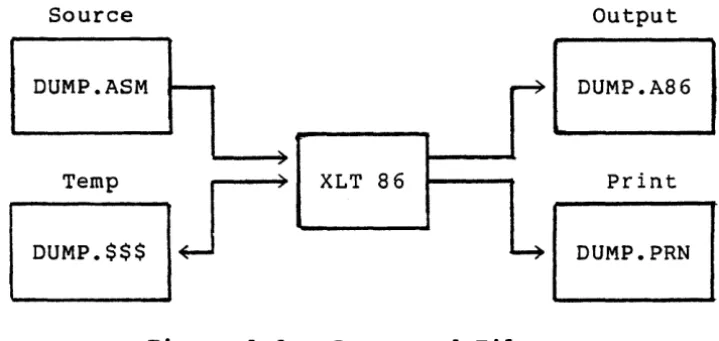
XLT86 reads an 8080 program from a file with type ASM and produces a file of type A86 containing the equivalent translated 8086 assembly language program. The filename for the 8080 source program, as well as filenames for all output files from XLT86, is taken from the command line typed by the operator. For example, the console command:
XLT86 DUMP
executes the XLT86 program using the file "DUMP.ASM" as input. The translation produces the output file "DUMP.A86".
The 8080 source program must be in a form acceptable to the standard Digital Research assembly language translators ASM, MAC, or RMAC. XLT86 processes cond i tional assembly statements, and produces an output program that results from evaluation of the particular conditions included in the 8080 program. However, macro definitions, macro invocations, and repeat loops are not altered in the translation. To properly translate programs that include macros or repeat loops, first assemble the programs under MAC or RMAC to produce a printer listing file of type PRN. Rename this PRN file to type ASM and edit the file to remove the beginning column positions, resulting in a file acceptable as input to XLT86. The A86 output file is now in a form acceptable to the Digital Research ASM86 assembler, requiring little or no modification for execution under CP/M-86 and MP/M-86.
XLT86 produces two additional files: a PRN file and a $$$ file. A file of type PRN contains error lines and messages along with optional listing and trace information. The PRN file is in a form suitable for listing on the system printer and contains embedded form-feed and tab characters. A temporary file of type $$$ is also created during translation. This temporary file is automatically deleted upon normal completion of XLT86.
XLT86 User's Guide 1.2 Translation Phases
1.2 Translation Phases
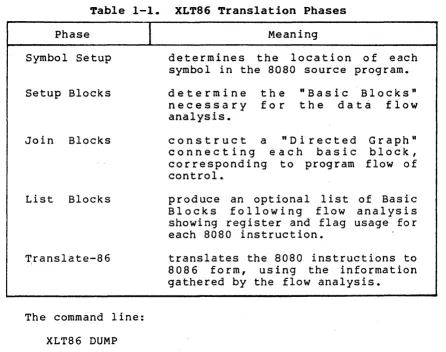
The translation itself takes place in five phases. Each phase has a specific name that appears at the console during translation so that the operator can monitor the progress of XLT86. Table 1-1 lists the phase names.
Table 1-1. XLT86 Translation Phases
Phase
Symbol Setup
Setup Blocks
Join Blocks
List Blocks
Translate-86 1
The command line:
XLT86 DUMP
1
Meaningdetermines the location of each symbol in the 8080 source program.
determine necessary analysis.
the for
"Basic Blocks" the data flow
construct a "Directed Graph" connecting each basic block, corresponding to program flow of control.
produce an optional list of Basic Blocks following flow analysis showing register and flag usage for each 8080 instruction. .
translates the 8080 instructions to 8086 form, using the information gathered by the flow analysis.
activates the XLT86 translator using the DUMP.ASM program as input. The default action of XLT86 prints the name of each phase at the console as the translation proceeds, as shown below.
Symbol Setup Setup Blocks Join Blocks List Blocks Translate-86
All Information Presented Here is Proprietary to Digital Research
[image:9.613.77.523.156.508.2]XLT86 User's Guide 1.2 Translation Phases
[image:10.618.136.496.141.312.2]The files processed by the "XLT86 DUMP" command are shown in Figure 1-1, below.
Source Output
DUMP.ASM - DUMP.A86
....
DUMP.$$$
I
XLT 86~~
Print Temp
DUMP.PRN
Figure 1-1. Processed Files
All files are placed on the drive specified by the operator as the prefix on the source filename. In the above example, all files are placed on the current default drive, which must also contain the XLT86 program along with its overlays. An alternative form:
XLT86 B:DUMP
SECTION 2
TRANSLATION PARAMETERS
2.1 Parameter Syntax
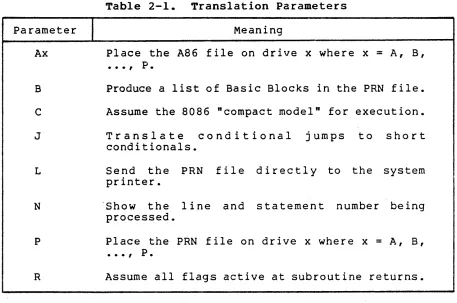
Several XLT86 parameters can be included in the command line by the operator or embedded within the 8080 source program to control the translation process. Parameters are grouped together into a parameter list enclosed within square brackets:
[pI p2 pn]
where pI through pn denote one or more parameters optionally separated by blanks. When included on the command line, the XLT86 invocation appears as follows:
XLT86 filename [pI p2 ••• pn]
When included within the source program, the opening bracket of the parameter list must begin in the first column position. The parameters denoted by pI through pn are one or two character sequences in upper- or lower-case, with optional intervening blanks, as listed in Table 2-1, below.
Pa rameter
I
AxB
c
J
L
N
P
R
Table 2-1. Translation Parameters Meaning
Place the A86 file on drive x where x
=
A, B,••• , P.
Produce a list of Basic Blocks in the PRN file. Assume the 8086 "compact model" for execution. Translate conditional jumps to short conditionals.
Send the PRN file directly to the system printer.
'Show the line and statement number being processed.
Place the PRN file on drive x where x
=
A, S,••• , P.
[image:12.612.85.542.407.710.2]XLT86 User's Guide 2.1 Parameter Syntax
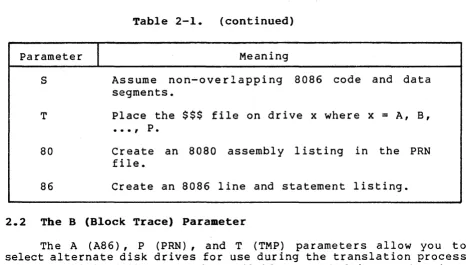
Parameter
I
S
T
80
86
Table 2-1. (continued)
Meaning
Assume non..;..overlapping 8086 code and data segments.
Place the $$$ file on drive x where x = A, B,
••• , P.
Create an 8080 assembly listing in the PRN file.
Create an 8086 line and statement listing.
2.2 The B (Block Trace) Parameter
The A (A86) , P (PRN), and T (TMP) parameters allow you to select alternate disk drives for use during the translation process when only limited disk space is available on each drive. Otherwise, disk drives are selected as described above.
The B (Block Trace) parameter provides a trace in the PRN file showing register usage information collected by the data flow analyzer. This parameter is not normally selected since the trace information is of no particular value unless you are interested in detailed register usage. The B parameter trace consists of a sequence of register usage tables for each Basic Block in the form shown below.
Block At 011E (subr), A86 = 083F
Entry Active: B-D-HL-AOZSPI Exit Active: BCDEHL---Istmt#1 opcode uses I op 1 vI 1 v2 1 opcode kills I live regs
231---AOZSPI IpUSHI pswl 241---A--- IMOV
I
EI 25\--- IMVII
CI 261--- ICALLl000511--- IB-D-HL-A----AI---E--- IB-DEHL---051-C--- IBCDEHL---\---
IBCDEHL---The Basic Block address in the original 8080 program is listed and the type of block is identified. The block type is "subr" for subroutines, "code" for main-line code, and "data" for data blocks. The A86 address is an approximation of the corresponding 8086 address used to determine short and long branch jump ranges. The remaining information shows register and flag use at block entry and at each instruction within the block. The registers and flags are displayed as a vector of letters and hyphens, where each letter represents the presence of a register or flag in the display, and each hyphen signifies that the corresponding register or flag is
[image:13.613.70.536.52.317.2]XLT86 User's Guide 2.2 The B (Block Trace) Parameter
absent in the vector. Given that all registers and flags are present, the display appears as follows:
BCDEHLMAZOSPI
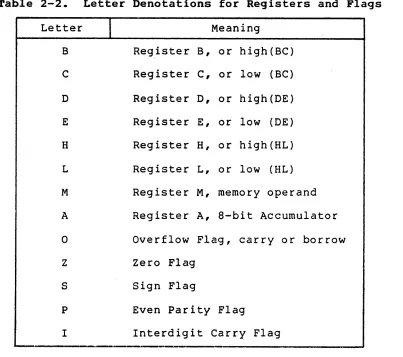
Table 2-2 lists the letter denotations of the above display.
Table 2-2. Letter Denotations for Registers and Flags
Letter
t
MeaningB Register B, or high(BC) C Register C, or low (BC) D Register D, or high(DE) E Register
E,
or low (DE) H Register H, or high(HL)L Register
L,
or low (HL)M Register M, memory operand A Register A, 8-bit Accumulator
0 Overflow Flag, carry or borrow Z Zero Flag
S Sign Flag
P Even Parity Flag
I Interdigit Carry Flag
The reg isters act i ve upon entry are listed first. In the example shown above, the data flow analysis has determined that the B, 0, and HL registers, along with all flag registers, are in use upon entry to the block. The active registers following this block are then listed, consisting of the BC, DE, and HL register pairs. Then each instruction in the Basic Block is given, with a preceding statement number that can be cross-referenced with the 8080 source program. The instruction itself is listed with the hexadecimal values of its two optional parameters.
[image:14.612.115.518.164.521.2]XLT86 User's Guide 2.2 The B (Block Trace) Parameter
Graph corresponding to the 8080 source program. Again, the information collected by the flow analyzer is optionally displayed using the B parameter. This display is not required for normal operation of the translator.
2.3 The C (Compact) Parameter
The C (Compact) parameter causes XLT86 to generate 8086 machine code using the "Compact Memory Model" described in the CP/M-86 System Guide. Under normal circumstances, XLT86 assumes the "8080 Memory Model" where code and data segments overlap. To accomplish this overlap of segments, the program is analyzed to determine Basic Blocks that contain code and data. The program is assumed to begin with a code segment and, if a data segment is encountered as defined by a sequence of OS, DB, or OW statements, XLT86 produces the following statements that provide the proper transition:
L@n EQU DSEG ORG
$
Offset L@n
Similarly, the transition from a data segment back to a code sequence is marked by the generated statements:
L@n EQU CSEG ORG
$
Offset L@n
where L@n is a sequentially generated label. The labels are generated as required by XLT86, taking the form:
L@l L@2 L@3 L@4 L@32767
Enabling the
"e"
parameter prevents the code and data segments from overlapping. In this case, the transition from code to data and data to code is marked by eith~rDSEG or
CSEG
respectively. See also the description of the S (Segments) parameter. When enabled, the S parameter completely overrides the C parameter.
XLTS6 User's Guide 2.4 The J (Jump) Parameter
2.4 The J (Jump) Parameter
The J (Jump) parameter enables the short jump analysis option of XLTS6. When enabled, XLTS6 translates SOSO conditional jumps to either short conditional jumps or negated short conditional jumps followed by short unconditional jumps, depending upon the byte count to the target of the jump. That is, a "JZ x" instruction becomes either
or
JZ x
x:
JNZ L@n JMPS
x
L@n:
The first case results if the label "x" is within the range of a short jump, while the second form results from a target label beyond the range of a short jump. The J parameter is enabled by default, and should be disabled using the NOJ form described below only if you want to manually edit your conditional jumps following program translation.
2.5 The L (List) Parameter
The L (List) parameter sends the listing file directly to the system printer, thus avoiding the intermediate PRN file. The system printer, or printer driver, must handle form-feeds (ctl-L) and tabs '. (ctl-I) to every eighth column position. If your printer does not properly support these characters, you can leave the L parameter disabled and use the CP/M PIP utility command form:
PIP LST:=filename.PRN[TSF]
wher~ the PIP parameter "TS" expands tabs to blanks at every eighth column, and the "F" parameter deletes the form-feed character on transmission.
2.6 The N (Humber) Parameter
XLT86 User's Guide 2.7 The R (Return) Parameter
2.7 The R (Return) Parameter
The R (Return) parameter overrides the default assumptions about register usage at the end of a subroutine. XLT86, by default, assumes that all registers are in use at the end of a subroutine in the absence of additional information. This is a safe, but possibly res tr icti ve, assumption that might cause more 8086 code to be generated near the return statements of each subroutine. If you know that the entire 8080 program being translated contains subroutines that do n~t return flag registers, then you should include the R parameter in the command line to reduce the amount of generated code.
Al ternat i vely, you can precede the return statemen ts of var ious subroutines wi th II [R]" parameters when they do not return flag
registers, as long as balancing "[NOR]" parameters, described below, are included to return to the default assumptions, where necessary.
2.8 The S (Segment) Parameter
,The S (Segment) parameter informs XLT86 that the or ig inal source program contains embedded CSEG and DSEG directives that delimit the code and data segments. In this case, XLT86 makes no attempt to derive the code and data segment information and, instead, assumes that the CSEG and DSEG directives passed through to the 8086 program correctly define the appropriate segments. The S parameter is automatically set when the source program contains ASEG, CSEG, or DSEG directives, and completely overrides the effect of the C (Compact) parameter.
2.9 The 80 Parameter
The 80 parameter causes XLT86 to produce a pseudo-assembly listing of the original 8080 source program, giving the source line and statement number along wi th the assembled machine code location.
If the B parameter is simultaneously enabled, additional Basic Block information precedes e~ch straight-line code segment. When both 80 and
B
are enabled, the trace appears as shown below:---
Basic Block (2) OllEPredecessors: 0119 0111 0105 0100 Successors 0125
Reg's Killed: -C;...E---Reg's Used ---AOZSPI 22 22 OllE pr:
23 23 OllE push psw
24 24 OllF mov e,a
25 25 0120 mvi c,lst
26 26 0122 call bdos
XLT86 User's Guide 2.9 The 80 Parameter
Each Basic Block of the listing is preceded by the Basic Block Header consisting of the location (OllE in the example above) , a set of predecessor blocks where the program flow of control comes from
(Ol19, 0111, 0105, and 0100), and a set of successor blocks where
program flow could continue (0125, above). The set of registers killed are listed, along wi th the set of registers used by the operation codes within the block. No global data flow information is displayed in this trace (see the B parameter described earlier) •
2.10 The NO Parameter
The two character sequence "NO" preceding the B, C, J, L, N, R, 5, 80, and 86 parameters negates the effect of the parameter once it has been set. Further, the A, P, and T parameters are ignored when they occur within the source file and are effective only on the command line. The parameters B, C, J, L, N, R, 5, 80, and 86 parameters, along with their negated forms, can occur in the command line or within the source program. When they occur within the program, they apply to the segment of code following their occurrence. Assuming that the default drive is d, where d is a valid drive code A, B, ••• , P, the default values assumed for each parameter are identical to the complete, but redundant, command line shown below:
SECTION 3
TRANSLATED PROGRAM FORMAT AND CONTENT
3.1 Translated Program For.at
XLT86 constructs the 8086 program from the original 8080 program by first analyzing the program register usage. Then, using the collected information, XLT86 translates each label, operation code, and ope rand expression into an equivalent 8086 program segment. In performing the translation, XLT86 uses as many program fragments from the original 8080 source program as possible. These program fragments include labels, expressions, and comment fields. Due to differences in assembly language formats, however, labels and expressions might be altered somewhat to maintain their original meaning.
The translation occurs line-by-line, where each 8080 source line may contain several statements delimited by exclamation symbols. XLT86, however, always generates a single statement per output line. The output line includes an optional label in column one, followed by a single tab character. The translated operation code field is placed immediately following the tab character. If the operation code has one or two operand fields, another tab character is included and the operand fields are inserted. The operand fields themselves are constructed by either translating 8080 registers to their 8086 equivalents, or through the construction of an expression that is the translation of the original form. If a comment field is present in the source program, it is copied to the 8086 program intact with sufficient leading tabs to position the comment to column forty, if that position has not already b~en
reached. Comments beginning in column one are reproduced without leading tab characters. Further, comments that begin in column one with the character
"*"
are started, instead, by the two character sequence";*"
to maintain compatibility with ASM-86.For pseudo-assembly purposes, the assumed origin of the 8080 program is OlOOH, corresponding to the base of the TPA under CP/M. This assumed origin rasolves label addresses during pseudo-assembly and does not normally affect the translation process. However, if an ORG statement is encountered at the beginning of the program before any code or data is encountered, the program origin is set to the value given in the operand field of the ORG statement.
Program-relative operand references, along wi th absolute addresses, are allowed in the source program. In this case, XLT86 generates a label of the form "L@n" at the target location. For example below, the 8080 instruction sequence shown to the left results in the 8086 program shown to the right:
NOP NOP JMP $-2
L@l: NOP NOP
XLT86 User's Guide 3.1 Translated Program Format
Similarly, the absolute 8080 assembly language shown to the left below results in the program shown to the right:
ORG 300H
NOP L@l:
ORG 300H NOP
NOP NOP
JMP 300H JMP L@l
In this case, the ORG statement is necessary to override the default assumption •
. From this last example, it appears that XLT86 is capable of translating 8080 programs produced through disassembly. Unfortunately, disassemblers cannot generally distinguish between code and data areas. If the code and data sections can be separated into distinct areas, where the code is disassembled with absolute address operands and the data areas consist of OS, DB, and OW operations, then XLT86 performs the translation.
Operand fields are translated according to their context and, for notational purposes, we make the following definitions.
Table 3-1. Operand Field Abbreviations Abbreviation
I
Definitionib immediate byte operand (MVI A,ib) iw immediate word operand (LXI H,iw) mb byte in memory (STA x)
mw word in memory (LHLD x) mn near memory (CALL x) rb byte in register (ADD B) rw word in register (DAD B)
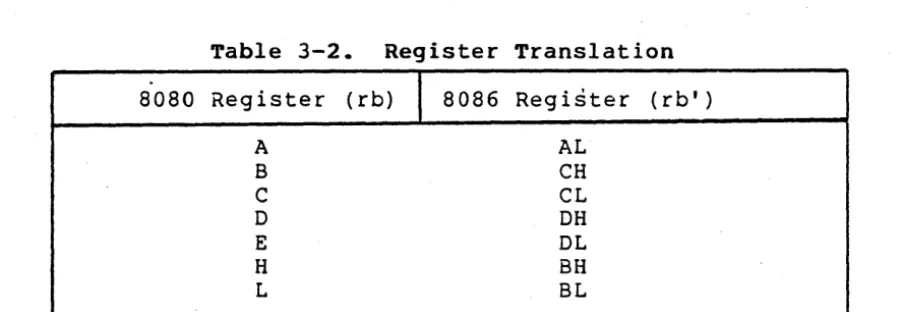
The translation of an expression is denoted by a prime (') following the expression type. Thus, ib is translated to ib', iw to iw', and so forth. Register translation takes place according to the following table.
Table 3-2. Register Translation 8080 Register (rb)
I
8086 Register (rb')A B C
o
E HL
AL CH CL DH DL BH BL
All Information Presented Here is Proprietary to Digital Research
[image:21.623.74.544.352.721.2] [image:21.623.85.536.563.719.2]XLT86 User's Guide 3.1 Translated Program Format
The M (Memory) register has no direct equivalent in the 8086 environment, so XLT86 produces an "equate" statement in the following form at the beginning of each program.
M EQU Byte Ptr O[BX]
Thus, the M register remains unchanged in the translation with the assumption that the BX register contains the offset to the proper memory location.
The 16-bit register pair translation occurs as shown in Table 3-3, below.
Table 3-3. 16-Bit Register Translation
8080 Register
PSW B D H SP
( rw) f 8086 Register (rw')
AX
ex
DX BX SPThe 8080 PSW and 8086 AX reg ister have a loose correspondenc e depending upon register usage at the time of translation. The exact correspondence is defined below under the PUSH and POP operators.
3.2 Translated Program Content
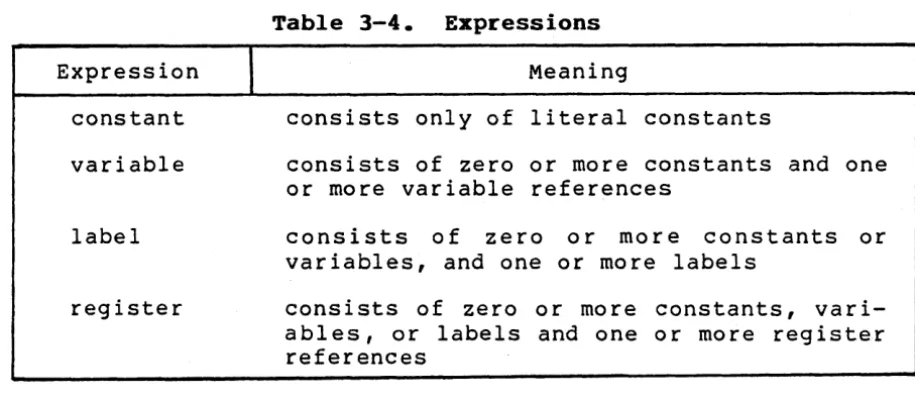
Expressions are normally composed of literal constants, data variable references, program label references, and register references. XLT86 computes the type of each expression as the translation proceeds, resulting in one of the followng expressions.
Expression
l
constant
variable
label
register
Table 3-4. Expressions
Meaning
consists only of literal constants
consists of zero or more constants and one or more variable references
consists of zero or more constants or variables, and one or more labels
[image:22.618.145.468.230.349.2] [image:22.618.78.536.515.715.2]XLT86 User's Guide 3.2 Translated Program Content
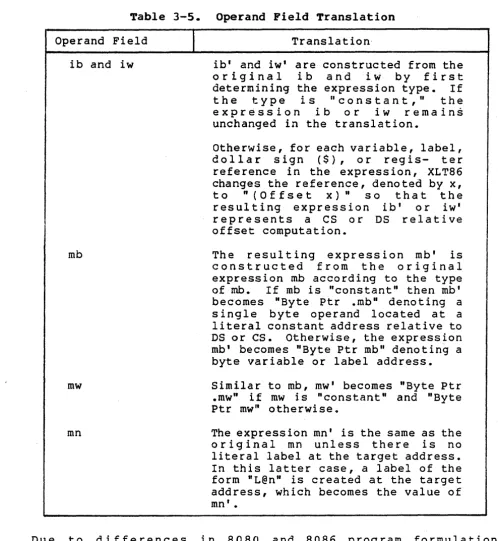
The translation of ib, iw, mb, mw, and mn is described in Table, 3-5, below. This translation takes place after XLT86 scans the expression to determine its type, as described above.
Table 3-5. Operand Field Translation
Operand Field
t
ib and iw
mb
mw
mn
Translation-ibl and iw' are constructed from the
original ib and iw by f i r s t determining the expression type. If the type is "constant,1I the
expression ib or iw remains
unchanged in the translation.
Otherwise, for each variable, label, dollar sign ($), or regis- ter reference in the expression, XLT86 changes the reference, denoted by
x,
to "(Offset x) II so that the
resulting expression ib' or iw' represents a CS or DS relative offset computation.
The resulting expression mb' is constructed from the original expression mb according to the type of mba If mb is "constant" then mb' becomes "Byte Ptr .mb" denoting a single byte operand located at a literal constant address relative to DS or CS. Otherwise, the expression mb' becomes "Byte Ptr mb" denoting a byte variable or label address.
Similar to mb, mw' becomes "Byte Ptr .mw" if
mw is
"constant" and "Byte Ptr mw" otherwise.The expression mn' is the same as the original mn unless there is no literal label at the target address. In this latter case, a label of the form "L@n" is created at the target address, which becomes the value of mn' •
Due to differences in 8080 and 8086 program formulation requirements, not all valid 8080 expressions can be successfully converted to valid 8086 expressions. Thus, you must be aware that additional editing is required if your translated program produces errors during assembly with ASM-86. In particular, expressions that use arbitrary operations upon constants, variables, labels, and
All Information Presented Here is Proprietary to 'Digital Research
[image:23.617.45.543.119.660.2]XLT86 User's Guide 3.2 Translated Program Content
registers are unlikely to assemble correctly under ASM-86, or any other assembler that uses the Intel conventions.
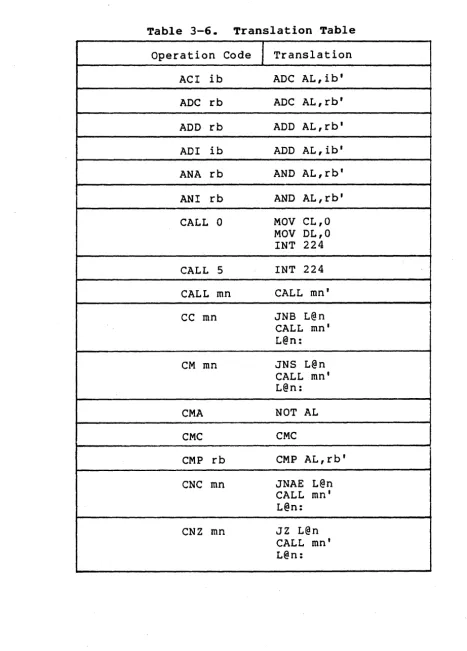
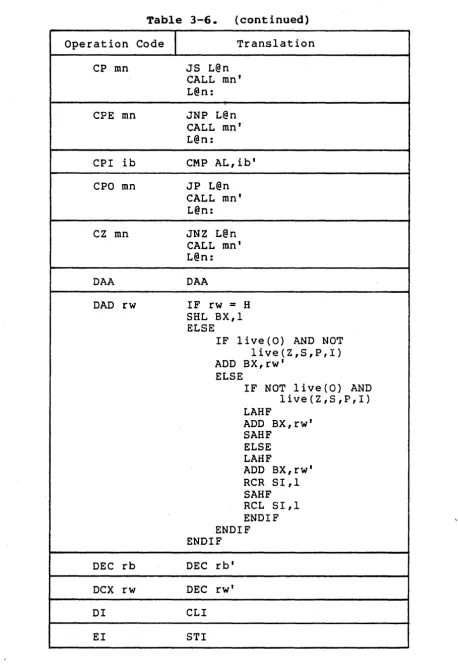
In the translation table given below, the 8080 operation code is shown to the left, with the translated 8086 code sequence shown to the right. In many cases, the registers that are live at the point where the 8080 operation code occurs determine the exact sequence of code that is generated. In these cases, the alternative forms are given separately. Conditional assembly notation specifies the alternative forms, with the introduction of the following two pseudo-functions:
live(rl,r2, ••• , rn) and
short (mn' )
The "live" function takes a variable number of register arguments and results in a TRUE value if one or more of these registers is live at the point of translation. Otherwise, the "live" function results in a FALSE value. In the Section 2 example for the B
parameter, statement 24 (MOV E,A) has the live register set given by the vector:
B-DEHL---so that
live(B,C,D) = TRUE and live(A,O) = FALSE
The "short" function is used in the translation of conditional jump instructions where the value of short(mn') is TRUE if the target of the translated jump address mn' is within the range of a conditional jump, or if the
"J"
parameter is enabled. Otherwise, short(mn') results in a FALSE value. XLT86 also uses the notation in Section 2 for label generation. The form "L@n" represents labels produced sequentially, starting at n=
1, used in the translation of conditional calls, returns, and conditional jumps outside the range of an 8086 conditional transfer. The CC (Call if Carry) operator, for example, translates to a jump conditional to a generated label followed by a direct call. The generated label is then inserted, as shown in the expansion of the 8080 instruction CC SUBR:JNB CALL L@I:
L@l SUBR
Table 3-6 gives the translation of each operation code. Note in particular that the following BDOS entry operations:
CALL 0 CALL 5 JMP 0 JMP 5
XLT86 User's Guide 3.2 Translated Program Content
Table
3-6.
Translation TableOperation Code
I
TranslationACI ib ADC AL,ib'
ADC rb ADC AL,rb'
ADD rb ADD AL,rb'
ADI ib ADD AL, ib'
ANA rb AND AL,rb'
ANI rb AND AL,rb'
CALL
a
MOV CL,OMOV DL,O INT 224
CALL 5 INT 224
CALL mn CALL mn'
CC mn JNB L@n
CALL mn' L@n:
CM mn JNS L@n
CALL mn' L@n:
CMA NOT AL
CMC CMC
CMP rb CMP AL,rb'
CNC mn JNAE L@n
CALL mn • L@n:
CNZ ron JZ L@n CALL mn' L@n:
All Information Presented Here is Proprietary to Digital Research
[image:25.621.53.521.73.724.2]XLT86 User's Guide 3.2 Translated Program Content
Table 3-6. (continued)
Operation Code
I
TranslationCP mn JS L@n
CALL mn' L@n:
CPE mn JNP L@n
CALL mn' L@n:
CPI ib CMP AL,ib'
CPO mn JP L@n
CALL mn' L@n:
CZ mn JNZ L@n
CALL mn' L@n:
DAA DAA
DAD rw IF rw
=
H SHL BX,l ELSEIF live(O) AND NOT live(Z,S,p,r) ADD BX,rw'
ELSE
IF NOT live(O) AND live(Z,S,p,I) LAHF
ADD BX,rw' SAHF
ELSE LAHF
ADD BX,rw' RCR SI,l SAHF RCL SI,l ENDIF ENDIF ENDIF
DEC rb DEC rb'
DCX rw DEC rw'
DI CLI
[image:26.617.75.533.57.724.2]XLT86 User's Guide 3.2 Translated Program Content
Table 3-6. (continued)
Operation Code
I
TranslationHLT HLT
IN ib IN AL,ib'
INR rb INC rb'
INX rw IF NOT live(Z,S,P,I) INC rw'
ELSE LAHF INC rw' SAHF ENOIF
JC mn IF short(mn')
JB mn' ELSE JNB L@n JMPS mn' L@n: ENOIF
JM mn IF short(mn')
JS mn' ELSE JNS L@n JMPS mn'
L@n: ENOIF
JMP 0 MOV CL,O
MOV OL,O INT 224
t
RET
JMP 5 INT 224
RET
JMP mn JMPS mn'
JNC mn IF short{mn')
JNB mn' ELSE
JNAE L@n (
JMPS mn' L@n: ENOIF
All Information Presented Here is Proprietary to Digital Research
[image:27.617.52.561.51.731.2]XLT86 User's Guide 3.2 Translated Program Content
Table 3-6.
(continued)
Operation Code
r
TranslationJNZ mn IF short (mn' ) JNZ mn'
ELSE JZ L@n JMPS mn' L@n: ENDIF
JP mn IF short(mn') JNS mn'
ELSE JS L@n JMPS mn' L@n: ENDIF
JPE mn IF short(mn') JPE mn'
ELSE JNP L@n JMPS mn' L@n: ENDIF
JPO mn IF short(mn') JPO mn'
ELSE JP L@n JMPS mn' L@n: ENDIF
JZ mn IF sho rt (mn' ) JZ mn'
[image:28.617.78.537.50.717.2]XLT86 User's Guide 3.2 Translated Program Content
Table 3-6. (continued)
Operation Code
I
TranslationMVI rb, ib MOV rb',ib'
NOP NOP
ORA rb OR AL,rb'
ORI ib OR AL,rb'
OUT ib OUT ib' ,AL
PCHL JMP BX
POP rw POP rw'
IF rw
=
PSW AND live (O,Z,S,P,I) XCHG AL,AHSAHF ELSE
IF rw
=
PSW AND live(A) XCHG AL,AHENDIF ENDIF
PUSH rw IF rw
=
PSW AND live{A) LAHFXCHG AL,AH PUSH AX XCHG AL,AH ELSE
if rw
=
PSW LAHFXCHG AL,AH PUSH AX ELSE PUSH rw' ENDIF ENDIF
RAL RCL AL,I
RAR RCR AL,I
RC JNB L@n
RET L@n:
RET RET
RLC ROL AL,I
All Information Presented Here is Proprietary to Digital Research
[image:29.620.39.572.46.718.2]XLT86 User's Guide
3.2 Translated Program Content
Table
3-6.
(continued)Operation Code
I
Translation
RM
JNS L@n
RET
L@n:
RNC
JNAE L@n
RET
L@n:
RNZ
JZ L@n
RET
L@n:
RP
JS L@n
RET
L@n:
RPE
JNP L@n
RET
L@n:
RPO
JP L@n
RET
L@n:
RRC
ROR AL,l
RST ib
INT ib
lRZ
JNZ L@n
RET
L@n:
SBB rb
SBB AL,rb'
SBI ib
SBB AL, ib'
SHLD mw
MOV mw' ,BX
SPHL
MOV SP,BX
STA mb
MOV mb' ,AL
STAX rw
MOV DI,rw'
MOV [01] ,AL
STC
STC
SUB rb
SUB AL,rb'
[image:30.615.72.527.60.731.2]XLT86 User's Guide 3.2 Translated Program Content
Table 3-6. (continued)
Operation Code
I
TranslationXCHG XCHG BX,DX
XRA rb XOR AL,rb'
XRI ib XOR AL,ib'
XTHL MOV BP,SP
XCHG BX, [BP]
All Information Presented Here is Ptoprietary to Digital Research
[image:31.615.60.550.60.731.2]SECTION 4
XLT86 ERROR MESSAGES
4.1 Psuedo-assemb1y Process Error Messages
XLT86 issues error messages that fall into two categories: those produced by the pseudo-assembly process, and those produced during translation. Errors in the first category are not considered fatal, but are simply annotated in the source listing file following the line in which the error occurs. If errors are present, the message:
Number of Errors: n
is displayed at the console following the pseudo-assembly. Examine the PRN file to determine if the errors are significant. Error messages take the form:
**
error: e**,
Near twhere e is one of the error codes, and t is a program element near the position where the error occurred. Table 4-1 lists the error codes.
Error Code Bad Flag Balance
Boundary
Convert
End-Line
Exp Ovfl
Gtr 7
Table 4-1. XLT86 Error Codes
I
Meaninginvalid parameter list [pl ••• pn] Unmatched right parenthesis or missing trailing string quote.
Invalid program boundary, usually results from a branch to the middle of an instruction.
Cannot convert an operand to internal form.
The end of a program line contains extraneous characters.
Expression stack overflow; the ex-pression is nested too deeply.
[image:32.617.60.537.362.723.2]XLT86 User's Guide
Error Code
Gtr 255
Mov M,M?
No Comma
No Value
Not Impl
Phase
Str Len
Value
I
4.1 Psuedo-assembly Process Error Messages
Table 4-1.
(continued)Meaning
An expression produced a value greater than 255, where a value from
0-255 is required.
The source line contains the invalid instruction MOV M,M.
Missing comma where comma is
required.
A label or variable was encountered that does not have an assigned val ue.
The instruction or directive is not implemented in XLT86.
A label or variable has a different val ue an two passes through the source program.
A string was encountered that exceeds the capac i ty of XLT86, check fo r missing right quote mark.
The value produced by an expression is not compatible with the context in which it occurs.
4.2 Translate-86
ErrorMessages
The Translate-86 phase also produces a limited number of error messages. All errors produced by this phase are fatal, and cause immediate termination of XLT86. Table 4-2 lists these error messages.
All Information Presented Here is Pr~prietary to Digital Research
[image:33.617.9.548.51.733.2]XLT86 User's Guide
4.2
Translate-86 Error Messages
Table 4-2. Translate-86 Error Messages
Error Message
J
Bad Oper
Not BOOS
Phase (B)
Phase (S)
Meaning
Invalid 8080 operation code was
e n co u n t ere d d uri n 9 t r ansI a t ion;
probably due to bad disk I/O
operation.
Check for hardware
controller faults.
A
CALLor JMP occurred below the base
origin of the program where the
target is not OOOOH (warm boot) or
0005H
(BOOSentry).
The Di rected Graph does not
correspond to the source program at
the Basic Block level;
usually due
to a hardware malfunction.
The Di rected Graph does not
correspond to the source program at
the statement level; usually due to
a hardware malfunction
An error produced by Translate-86 is accompanied by the console
error message:
Fatal Error (See PRN file)
to indicate that such an error occurred.
4.3 Memory Overflow
The XLT86 program occupies approximately 30K bytes of main
memory. The remainder of memory, up to the base of CP/M, stores the
program graph that represents the 8086 program being translated.
The error message:
ERROR
(7)"Free Space Exhausted"
is issued if the program graph exceeds available memory. A 64K CP/M
system allows translation of 8080 programs of up to approximately
6K.
[image:34.620.73.530.72.370.2]APPENDIX A
SAMPLE PROGRAM TRANSLATIONS
The DUMP.ASM program presented here and normally included as a sample assembly language program with CP/M illustrates the translation process. The XLT86 command line:
XLT86 DUMP [8086]
pr'oduces the first example shown below. The "80" parameter selects the 8080 program listing option, while the "86" parameter selects the 8086 listing option. XLT86 places full lines of dashes ("----") between the Basic Blocks in the 8080 listing. This translation of the DUMP program, however, requires modification to run under CP/M-86. In particular, the DUMP.ASM program contains initialization code that saves the entry SP (statements 34 to 37) and resets the SP to a local stack (statement 39). The return statement following the FINIS label (statement 95) returns control to the CCP.
To perform an exactly equivalent sequence of operations, you must also save the stack segment register (55) upon entry to the DUMP program, and restore this value before executing the return. Further, the simple RET operation must be replaced by a Far Return (RETF) to balance the original Far Call from the CCP. A simpler solution is to eliminate the initialization code (statements 33 through 39) and use the CCp's buil t-in 96 byte stack. Control returns to theCCP by executing a RETF at statement 95. If you want to use a local stack, set the SS register to the value of D5 upon entry, and set SP to the Offset of 5TKTOP. Control returns to the CCP through execution of function call #0 in place of the RET in statement 95, as follows:
MOV CL,O MOV DL,O INT 224
The second listing shows the Basic Block information collected by the flow analyzer, and produced by the command line:
XLT86 DUMP [B]
where the "B" parameter selects the Basic Block trace. Under normal circumstances, either of the commands shown below are sufficient and reduce the amount of trace information:
XLT86 DUMP [N] or
XLT86 User's Guide Appendix A Sample Program Translations
The first command is used only with a CRT-type device where the carriage-return character does not cause an automatic line-feed (see the description of the "N" parameter).
1 2 3 410 5 6 7 8 9 10 11 12 13 14 15 16 17 18 19 20 21 22 23 24 25 26 27 28 29 30 31 32 33 34 35 36 37 38 39 40 41 42 43 44 45 46 47
1 0100 2 0100 3 0100 4 0100 5 0100 6 0100 7 0100 8 0100 9 0100 10 0100 11 0100 12 0100 13 0100 14 0100 15 0100 16 0100 17 0100
18 01QO
19 0100 20 0100 21 0100 22 0100 23 0100 24 0100 25 0100 26 0100 27 0100 28 0100 29 0100 30 0100 31 0100 32 0100 33 0100 34 0100 35 0103 36 0104 37 0104 38 0107 39 0107 40 010A 41 010A
42 010D 43
OlaF
44 0112 45 0112 46 0112 47 0115
i i i i i i i BOOS CONS TYPEF PRINTF BRKF OPENF READF i FCB BUFF i i CR LF i FCBDN FCBFN FCBFT FCBRL FCBRC FCBCR FCBLN i i i
FILE DUMP PROGRAM, READS AN INPUT F
COPYRIGHT (C) 1975, 1976, 1977, 197 DIGITAL RESEARCH
BOX 579, PACIFIC GROVE CALIFORNIA, 93950
ORG EQU EQU EQU EQU EQU EQU EQU EQU EQU 100H 0005H 1 2 9 11 15 20 5CH
aOH
iDOS ENTRY POINT iREAD CONSOLE
iTYPE FUNCTION
iBUFFER PRINT ENTRY iBREAK KEY FUNCTION iFILE OPEN
iREAD FUNCTION
iFILE CONTROL BLOCK iINPUT DISK BUFFER
NON GRAPHIC CHARACTERS
EQU ODH iCARRIAGE RETURN
EQU OAH iLINE FEED
FILE CONTROL BLOCK DEFINITIONS
EQU FCB+O iDISK NAME
EQU FCB+1 iFILE NAME
EQU FCB+9 iDISK FILE TYPE (3 EQU FCB+12 iFILE'S CURRENT REE EQU FCB+15 iFILE'S RECORD COUN EQU FCB+32 ;CURRENT (NEXT) REC EQU FCB+33 iFCB LENGTH
SET UP STACK
LXI H,O
DAD SP
ENTRY STACK POINTER IN HL FROM THE SHLD OLDSP
SET SP TO LOCAL STACK AREA (RESTORE
LXI SP,STKTOP
READ AND PRINT SUCCESSIVE BUFFERS CALL SETUP ;SET UP INPUT FILE
CPI JNZ
255 ;255 IF FILE NOT PR OPENOK ;SKIP IF OPEN IS OK
FILE NOT THERE, GIVE ERROR MESSAGE
LXI D,OPNMSG
CALL ERR
All Information Presented Here is Proprietary to Digital Research
XLT86 User's Guide 48 49 50 51 52 53 54 55 56 57 58 59 60
48 0118
49 011B 50 011B 51 011B 52 0110 53 0120 54 0120
55 0123 56 0123 57 0123 58 0124
59 0127 60 0128
Appendix A Sample Program Translations
JMP FINIS iTO RETURN
i
OPENOK: iOPEN OPERATION OK, SET BUFFER INDE
MVI A,80H
STA IBP iSET BUFFER POINTER
i HL CONTAINS NEXT ADDRESS TO PRINT
i
GLOOP:
LXI H,O iSTART WITH 0000
PUSH CALL POP JC H GNB H FINIS
iSAVE LINE POSITION
iRECALL LINE POSITI iCARRY SET BY GNB I
---61 62 63 64 65 66 67 68 69 70 71 72 73 74 75 76 77 78 79 80 81 82 83 84 85 86 87 88 89
61 012B 62 012C 63 012C 64 012C 65 0120 66 012F
67 0132 68 0132
69 0135 70 0135 71 0135
72 0138 73 0138 74 0139
75 013C 76 013C 77 013D
78 0140 79 0141
80 0144 81 0144 82 0145 83 0147
84 014A 85 014B
86 014E
87 0151 88 0151 89 0151
i i i i i NONUM: i FINIS:
MOV B,A
PRINT HEX VALUES CHECK FOR LINE FOLD
MOV A,L
ANI OFH iCHECK LOW 4 BITS
JNZ NONUM
PRINT LINE NUMBER
CALL CRLF
CHECK FOR BREAK KEY CALL BREAK
ACCUM LSB
=
1 IF CHARACTER READYRRC iINTO CARRY
JC FINIS iDON'T PRINT ANY MO
MOV CALL MOV CALL INX MVI CALL MOV CALL JMP A,H PHEX A,L PHEX H
A,' ,
PCHAR
A,B PHEX
GLOOP
iTO NEXT LINE NUMBE
XLT86 User's Guide Appendix A Sample Program Translations
90 90 0151 i (NOTE THAT A JMP TO OOOOH REBOOTS)
91 91 0151 CALL CRLF
---92 93 94 95 96 97 98 99 100 101 102 103 104 105 106 107 108 109 110
I I I
112 113 114 115 116 117 118 119 120 121 122 123 124 125 126 127 128 129 130 131 132
92 0154 93 0157 94 0158 95 0158 96 0159 97 0159 98 0159 99 0159 100 0159 101 0159 104 015C 105 015E 106 0161 109 0164 110 0165
I I I 0165
112 0165 115 0168 116 016A 117 016B 118 016E 121 0171 122 0172 123 0172 124 0172 125 0174 126 0177 127 0179 128 017C 129 017D 130 017D 131 017D 132 017D 133 017F 134 0181 135 0184 136 0184 137 0186 138 0189 139 0189 140 0189
i i i i i BREAK: i PCHAR: i CRLF: i i PNIB: i i i
P10: .
LHLD OLDSP SPHL
STACK POINTER CONTAINS CCP'S STACK RET iTO THE CCP
SUBROUTINES
iCHECK BREAK KEY (ACTUALLY ANY KEY
PUSH H! PUSH Dl PUSH Bi ENVIRONMENT MVI C,BRKF
CALL BDOS
POP Bl POP 01 POP Hi ENVIRONMENT RE RET
iPRINT A CHARACTER
PUSH HI PUSH Dl PUSH Bi SAVED
MVI C,TYPEF MOV E,A CALL BDOS
POP Bl POP Dl POP Hi RESTORED RET MVI CALL MVI CALL RET iPRINT ANI CPI JNC A,CR PCHAR A,LF PCHAR NIBBLE OFH 10 P10
IN REG A iLOW 4
LESS THAN OR EQUAL TO 9 ADI '0'
JMP PRN
GREATER OR EQUAL TO 10 ADI 'A' - 10
BITS
XLT86 User's Guide Appendix A Sample Program Translations
133 141 0188 PRN: CALL PCHAR
134 142 018E RET
135 143 018F i
136 144 018F PHEX: iPRINT HEX CHAR IN REG A
137 145 018F PUSH PSW
138 146 0190 RRC
139 147 0191 RRC
140 148 0192 RRC
141 149 0193 RRC
142 150 0194 CALL PNIB iPRINT NIBBLE
---143 144 145 146 147 148 149 150 151 152 153 154 155 156 157
151 0197 152 0198
153 019B
154 019C 155 019C 156 019C 157 019C 158 019E
159 01A1
160 01A2 161 01A2 162 01A2 163 01A2 164 01A5 165 01A7
i ERR: i i i GNB:
POP PSW
CALL PNIB
RET
iPRINT ERROR MESSAGE
D,E ADDRESSES MESSAGE ENDING WITH ..
MVI C,PRINTF iPRINT BUFF
CALL BOOS
RET
iGET NEXT BYTE
LDA IBP
CPI 80H
JNZ GO
---158 159 160 161 162 163 164 165 166
166 01AA 167 01AA 168 01AA 169 01AA
170 01AD 171 01AE
172 01B1 173 01B1 174 01B2
i i i i READ CALL ORA JZ
ANOTHER BUFFER
DISKR
A GO
iZERO VALUE IF READ
iFOR ANOTHER BYTE
END OF DATA, RETURN WITH CARRY SET STC
RET
---167 175 01B3 i
168 176 01B3 GO: iREAD THE BYTE AT BUFF+REG A
169 177 01B3 MOV E,A iLS BYTE OF BUFFER
170 178 01B4 MVI D,O iDOUBLE PRECISION I
171 179 01B6 INR A iINDEX=INDEX+1
172 180 01B7 STA IBP iBACK TO MEMORY
173 181 01BA ; POINTER IS INCREMENTED
174 182 01BA i SAVE THE CURRENT FILE ADDRESS
175 183 01BA LXI H,BUFF
XLT86 User's Guide Appendix A Sample Program Translations
177 185 01BE i ABSOLUTE CHARACTER ADDRESS IS IN HL
178 186 01BE MOV A,M
179 187 01BF i BYTE IS IN THE ACCUMULATOR
180 188 01BF ORA A iRESET CARRY BIT
181 189 01CO RET
---~--- ---182 183 184 185 186 187 188 189 190-191 192 193 194 195 196 197 198 199 200 201 202 203 204 205 206 207 208 209 210 211
190 01Cl 191 01Cl 192 01Cl 193 01Cl 194 01C2 195 01C5 196 01C5 197 01C8 198 01CA 199 01CO 200 01CO 201 01CE 202 OICE 203 01CE 206 0101 207 0104 208 0106 209 0109 212 010C 213 0100 214 010D 215 0100 216 01F3 217 0213 218 0213 219 0213 220 0215 221 0217 222 0217 223 0217
i SETUP: i i OISKR: i i SIGNON: OPNMSG: i IBP: OLOSP: i i
iSET UP FILE
OPEN THE FILE FOR INPUT
XRA A iZERO TO ACCUM STA FCBCR iCLEAR CURRENT LXI O,FCB
MVI C,OPENF CALL BOOS
255 IN ACCUM IF OPEN ERROR RET
iREAO DISK FILE RECORD PUSH HI PUSH 01 PUSH B LXI O,FCB
MVI C,REAOF CALL BDOS
POP Bl POP Dl POP H RET
FIXED MESSAGE AREA'
RECO
DB 'FILE DUMP VERSION 1.4$' DB CR, LF, I NO INPUT FILE PRESEN
VARIABLE AREA
OS 2 iINPUT BUFFER POINT OS 2 i ENTRY SP VALUE FRO STACK AREA
OS 64 iRESERVE 32 LEVEL S
---212 224 0257 STKTOP: 213 225 0257
214 226 0257 END
XLT86 User's Guide 1 1 2 3 4 5 6 7 8 9 10 11 12 13 14 15 16 17 18 19 20 21 22 23 24 25 26 27 28 29 30 31 32 33 34 35 36 37 38 39 40 41 42 43 44 45 46 47 48 49 50 51 52 53 54
o
1 2 34
5 6 7 8 9 10 11 12 13 14 15 16 17 18 19 20 21 22 23 24 25 26 27 28 29 30 31 32 33 34 '35 36 37 38 39 40 41 42 4344
45 46 47 48 49 50 51 52 53 54 M i i i i i BDOS CONS TYPEF PRINTF BRKF OPENF READF i FCB BUFF i i CR LF ; i FCBDN FCBFN FCBFT FCBRL FCBRC FCBCR FCBLN ; i i i OPENOK:Appendix A Sample Program Translations
EQU Byte Ptr O[BX]
FILE DUMP PROGRAM, READS AN INPUT FILE AND COPYRIGHT (C) 1975, 1976, 1977, 1978
DIGITAL RESEARCH
BOX 579, PACIFIC GROVE CALIFORNIA, 93950 ORG EQU EQU EQU EQU EQU EQU EQU EQU EQU 100H 0005H 1 2 9 11 15 20 5CH 80H
NON GRAPHIC CHARACTERS EQU ODH
EQU OAH FILE EQU EQU EQU EQU EQU EQU EQU
CONTROL BLOCK DEFINITIONS FCB+O FCB+l FCB+9 FCB+12 FCB+15 FCB+32 FCB+33 SET UP STACK MOV BX,O ADD BX,SP
iDOS ENTRY
iREAD CONSO iTYPE FUNCT iBUFFER PRI iBREAK KEY iFILE OPEN ;READ FUNCT iFILE CONTR ;INPUT DISK
iCARRIAGE R iLINE FEED
iDISK NAME iFILE NAME iDISK FILE iFILE'S CUR iFILE'S REC iCURRENT (N iFCB LENGTH
ENTRY STACK POINTER IN HL FROM THE CCP MOV Word Ptr OLDSP,BX
SET SP TO LOCAL STACK AREA (RESTORED AT FIN MOV SP,(Offset STKTOP)
READ AND PRINT SUCCESSIVE BUFFERS
CALL SETUP iSET UP INP
CMP AL,255 ;255 IF FIL
JNZ OPENOK iSKIP IF OP
FILE NOT THERE, GIVE ERROR MESSAGE AND RETU MOV DX,(Offset OPNMSG)
CALL ERR
JMPS FINIS iTO RETURN
iOPEN OPERATION OK, MOV AL,80H
MOV Byte Ptr IBP,AL iSET BUFFER HL CONTAINS NEXT ADDRESS TO PRINT
XLT86 User's Guide 55 56 57 58 59 60 61 62 63 64 65 66 67 68 69 70 71 72 73 74 75 76 77 78 79 80 81 81 81 82 83 84 85 86 87 88 89 90 91 92 93 94 95 96 97 98 99 100 101 101 101 102 103 104 104
55 i
56 GLOOP:
57
58 59 60 61
62 i
63 i
64
65
66
67 i
68
69 i
70 i
71 72 73 74 75 76 77 78 79
80 NONUM: 81 81 81 82 83 84 85 86 87 i
88 FINIS: 89 90 91 92 93 94 95 96
97 i
98
99 i
100 BREAK: 101 102 103 104 105 106 107
Appendix A Sample Program Translations
PUSH CALL POP JB MOV PRINT CHECK MOV AND JNZ PRINT CALL BX GNB BX FINIS CH,AL HEX VALUES FOR LINE FOLD
AL,BL AL,OFH NONUM LINE NUMBER
CRLF
CHECK FOR BREAK KEY CALL BREAK
iSAVE LINE
iRECALL LIN iCARRY SET
iCHECK LOW
ACCUM LSB
=
1 IF CHARACTER READYROR AL,l iINTO CARRY
JB FINIS iDON'T PRIN
MOV AL,BH
CALL PHEX
MOV AL,BL
CALL PHEX
LAHF INC SAHF MOV CALL MOV CALL JMPS BX
AL,' • PCHAR AL,CH PHEX GLOOP
END OF DUMP, RETURN TO CCP
iTO NEXT LI
(NOTE THAT A JMP TO OOOOH REBOOTS)
CALL CRLF
MOV BX,Word Ptr OLDSP
MOV SP,BX
STACK POINTER CONTAINS CCP'S STACK LOCATION
RET iTO THE CCP
SUBROUTINES PUSH PUSH PUSH MOV INT POP POP BX DX CX CL,BRKF 224 CX DX
iCHECK BREA
i ENVIRONME
All Information Presented Here is Proprietary to Digital Research
XLT86 User's Guide 104 105 106 107 108 108 108 109 110 I I I 112 112 112 113 114 115 116 117 118 119 120 121 122 123 124 125 126 127 128 129 130 131 132 133 134 135 136 137 137 137 137 138 139 140 141 142 143 143 143 144 145 146 147 148 149 108 109 110 I I I 112 113 114 115 116 117 118 119 120 121 122 123 124 125 126 127 128 129 130 131 132 133 134 135 136 137 138 139 140 141 142 143 144 145 145 145 145 146 147 148 149 150 151 151 151 152 153 154 155 156 157 ; PCHAR: ; CRLF: ; ; PNIB: ; ; P10: PRN: ; PHEX: ; ERR: ;
Appendix A Sample Program Translations
POP RET PUSH PUSH PUSH MOV MOV INT POP POP POP RET BX BX DX CX CL,TYPEF DL,AL 224 CX DX BX
MOV AL,CR
CALL PCHAR
MOV AL,LF
CALL PCHAR
RET AND CMP JNB LESS ADD JMPS AL,OFH AL,10 PI0
THAN OR EQUAL TO 9 AL, , 0 '
PRN
GREATER OR EQUAL TO 10 ADD AL,'A' - 10 CALL PCHAR
RET LAHF XCHG PUSH XCHG ROR ROR ROR ROR CALL POP XCHG SAHF CALL RET AL,AH AX AL,AH AL,l l\L,l AL,l AL,l PNIB AX AL,AH PNIB
; ENVIRONME
;PRINT A CH
i SAVED
RESTORED
iPRINT NIBS ;LOW 4 BITS
iPRINT HEX
;PRINT NIBS
iPRINT ERRO D,E ADDRESSES MESSAGE ENDING WITH "$"
XLT86 User's Guide 150 151 152 153 154 155 156 157 158 159 160 161 162 163 164 165 166 167 168 169 170 171 172 173 174 175 176 177 178 179 180 181 182 183 184 185 186 187 188 189 190 191 192 193 194 195 195 195 196 197 198 199 199 199 200 158 159 160
161 i
162 GNB: 163
164 165
166 i
167 i
168 i
169 170 171
172 i
173 174
175 i
176 GO: 177 178 179 180
181 i
182 i
183 184 185 186 187 188 189 190 ;
191 SETUP: 192 193 194 195 196 197 198 199 200
201 i
202 DISKR: 203 204 205 206 207 208 209 210 211 212
Appendix A Sample Program Translations
INT 224
RET
iGET NEXT B MOV AL,Byte Ptr IBP
CMP AL,80H
JNZ GO
READ ANOTHER BUFFER
CALL DISKR
OR AL,AL iZERO VALUE
JZ GO iFOR ANOTHE
END OF DATA, RETURN WITH CARRY SET FOR EOF STC
RET
MOV DL,AL
MOV DH,O
INC AL
MOV Byte Ptr IBP,AL POINTER IS INCREMENTED
SAVE THE CURRENT FILE ADDRESS
MOV BX,BUFF
ADD BX,DX
iREAD THE B iLS BYTE OF iDOUBLE PRE iINDEX=INDE
iBACK TO ME
ABSOLUTE CHARACTER ADDRESS IS IN HL
MOV AL,M
BYTE IS IN THE ACCUMULATOR
OR AL,AL
RET
OPEN THE FILE FOR INPUT
XOR AL,AL
MOV Byte Ptr .FCBCR,AL
MOV DX,FCB
MOV CL,OPENF
INT 224
255 IN ACCUM IF OPEN ERROR RET
PUSH BX
PUSH DX
PUSH CX
MOV DX,FCB
MOV CL,READF
INT 224
POP CX
POP OX
POP BX
RET
iRESET CARR
iSET UP FIL
iZERO TO AC iCLEAR CURR
iREAD DISK
All Information Presented Here is Proprietary to Digital Research
XLT86 User's Guide Appendix A Sample Program Translations
200 212 L@l EQU $
200 212 DSEG
200 212 ORG Offset L@l
201 213 ;
202 214 ; FIXED MESSAGE AREA
203 215 SIGNON DB 'FILE DUMP VERSION 1.4$'
204 216 OPNMSG DB CR,LF,'NO INPUT FILE PRESENT ON DIS
206 218 ; VARIABLE AREA
207 219 IBP RS 2 iINPUT BUFF
208 220 OLDSP RS 2 iENTRY SP V
209 221 ;
210 222 ; STACK AREA
211 223 RS 64 iRESERVE 32
212 224 STKTOP RS 0
213 225 ;
214 226 END
L I S T
o
F BAS I C B L 0 C K SBlock At 0005 (subr), A86 = 0005
Entry Active: Exit Active:
---Istmtil opcode uses 1 op 1 vI 1 v2 1 opcode kills I live regs
Block At 0100 (code), A86 = 0100
Entry Active: BCDE---A--- Exit Active:
BCDEHL-A---Istmtil opcode uses 1 op I vI 1 v2 I opcode kills I live regs
341--- ILXI
I
HIOOOOI----HL--- ISCDEHL-A---351----HL--- IDAD I spi I----HL--O---- IBCDEHL-A---371----HL--- ISHLDI02151 1--- IBCDEHL-A---391--- ILXI I MI02571--- IBCDEHL-A---411--- ICALLIOICll 1---IBCDEHL-A---Block At OIOD (code), A86 = 0115
Entry Active: BCDEHL-A--- Exit Active: BCDEHL-AOZSPI
Istmtil opcode uses I op I vI I v2 I opcode kills I live regs
421---A--- ICPI
I
FFI 431---Z--- IJNZ 1011BIBlock At 0112 (code), A86 = 011C
I---OZSPI IBCDEHL-AOZSPI 1 1--- IBCDEHL-AOZSPI I
Entry Active: BC--HL-AOZSPI Exit Active: BCDEHL-AOZSPI
Istmtil opcode uses 1 op I vl 1 v2 1 opcode kills I live regs
XLT86 User's Guide Appendix A Sample Program Translations
Block At 0118 (code), A86 = 0122
Entry Active: BCDEHL-AOZSPI Exit Active: BCDEHL-AOZSPI
Istmt#1 opcode uses I op I vI I v2 I opcode kills I live regs
481--- IJMP 101511 1--- IBCDEHL-AOZSPI I
Block At OllB (code), A86 = 0125
Entry Active: BCDE----OZSPI Exit Active: BCDEHL-AOZSPI
Istmtil opcode uses I op I vI I v2 I opcode kills I live regs
511--- IMVI 1 AI 801---A--- IBCDE---AOZSPI 521---A--- ISTA 102131 1--- IBCDE---AOZSPI I 541--- ILXI I HIOOOOI----HL--- IBCDEHL-AOZSPI I
Block At 0123 (code), A86
=
012DEntry Active: BCDEHL-AOZSPI Exit Active: BCDEHL-AOZSPI
Istmti/ opcode uses I op I vI I v2 I opcode kills / live regs
571----HL--- IPUSHI HI 581--- ICALLIOIA21
Block At 0127 (code), A86
=
01361--- IBCDEHL-AOZSPI I 1--- IBCDEHL-AOZSPI I
Entry Active: BCDE---AOZSPI Exit Active: BCDEHL-AOZSPI
Istmtil opcode uses I op 1 vI
I
v2 I opcode kills 1 live regs591--- IPOP I HI 601---0---- IJC 101511
Block At 012B (code), A86
=
0141I----HL--- IBCDEHL-AOZSPI I 1--- IBCDEHL-AOZSPI I
Entry Active: -CDEHL-A--- Exit Active: BCDEHL-AOZSPI
Istmt#1 opcode uses I opl vI I v2 I opcode kills / live regs
611---A--- /MOV BI 641---L--- IMOV AI 651---A--- IANI I OFI 661---Z--- IJNZ 101441
Block At 0132 (code), A86
=
014CAIB--- IBCDEHL---LI---A--- IBCDEHL-A---I---AOZSPI IBCDEHL-AOZSPI 1--- IBCDEHL-AOZSPI
Entry Active: BCDEHL-AOZSPI Exit Active: BCDEHL-AOZSPI
Istmt#1 opcode uses I op 1 vl,1 v2 I opcode kills I live regs
681--- ICALLt01721 1--- IBCDEHL-AOZSPI
All Information Presented Here is Prop~ietary to Digital Research
XLT86 User's Guide Appendix A Sample Program Translations
Block At 0135 (code), A86 = 014F
Entry Active: BCDEHL-AOZSPI Exit Active: BCDEHL-AOZSPI
'stmtil opcode uses I op 1 vI I v2 I opcode kills 1 live regs
711--- ICALLI01591
1---
IBCDEHL-AOZSPI IBlock At 0138 (code), A86
=
0152Entry Active: BCDEHL-A-ZSPI Exit Active: BCDEHL-AOZSPI
Istmtil opcode uses 1 op I vI 1 v2 I opcode kills I live regs
731---A--- IRRC! 1 741---0---- IJC 101511
Block At 013C (code), A86
=
015AI---AO---- IBCDEHL-AOZSPI 1
1---
IBCDEHL-AOZSPI IEntry Active: BCDEHL--OZSPI Exit Active: BCDEHL-AOZSPI
Istmtil opcode uses I op I vI 1 v2 1 opcode kills I live regs
761----H--- IMOV I AI 771--- ICALLI018FI
Block At 0140 (code), A86 = 015F
HI-~---A--- IBCDEHL-AOZSPI 1
1---
IBCDEHL-AOZSPI 1Entry Active: BCDEHL--OZSPI Exit Active: BCDEHL-AOZSPI
Istmtil opcode uses 1 op ! vI I v2 I opcode kills I live regs
781---L--- IMOV I AI 791--- ICALLI018F!
Block At 0144 (code), A86 = 0164
LI---A--- IBCDEHL-AOZSPI I
1---
IBCDEHL-AOZSPI IEntry Active: BCDEHL--OZSPI Exit Active: BCDEHL-AOZSPI
Istmtil opcode uses I op ! vI 1 v2 1 opcode kills I live regs
811----HL--- iINX
I
HI 821--- IMVI I AI 831--- ICALLI01651Block At 014A (code), A86 = 016C
I----HL--- IBCDEHL--OZSPI 1 201---A--- IBCDEHL-AOZSPI I
1---
IBCDEHL-AOZSPI IEntry Active: BCDEHL--OZSPI Exit Active: BCDEHL-AOZSPI
Istmtil opcode uses I op I vI I v2 1 opcode kills I live regs
84IB--- IMOV I AI 851--- ICALLlolaFI