THE CONSTRUCTION OF PERFOMANCE APPRRAISAL
PATTERN FOR COLLEGE PE TEACHERS BASED ON AHP
1
ZHENYU TANG,2WEI YANG
1
Heilongjiang Bayi Agricultural University, Daqing 163319, Heilongjiang, China
2 Dalian University of Technology, Dalian 116024, Liaoning, china
E-mail: [email protected] , 2 [email protected]
ABSTRACT
There’re certain deficiencies in the existing studies on performance appraisal pattern for college PE teachers, which are embodied in the following: the indicators of performance appraisal lack pertinence; the quantitative studies on the indicators of performance appraisal are insufficient; the results of the appraisal are short of necessary feedback and reasonable application. This paper conducts research on performance appraisal pattern for college PE teachers. The result reveals that three dimensions and ten specific indicators are included in the performance appraisal pattern for college PE teachers, which are: teachers’ demonstrating performance, including four items: industriousness and dedication, professional ethics, model standard as well as working attitude; teaching ability performance, containing: teaching efficiency, professional competence and management ability; teaching improvement performance, consisting of: learning ability, teaching and research achievement and communication and cooperation. Meanwhile, according to the practical application, AHP is used for weight calculation of all the indicators in the pattern. The pattern overcomes the problems that exist in other approaches like excessive subjectivity, obscure boundary between qualitative index and quantitative index, and chaotic weight.
Keywords: PE, Teachers, Performance, Pattern
1.
INTRODUCTIONThe performance appraisal of teachers’ work refers to the process of analyzing and evaluating the teaching staff’s performance according to the systematic indicators set by the school administrative department, which is based on collecting all aspects of related teachers’ working information on their behaviors, procedures and results[1]. The appraisal of college teachers’ performance consists of teaching activities, scientific research, students’ activities and public-spirited activities [2]. It is a measure to control the performance, and can be incentive to improve the teachers’ personal development as well as their comprehensive quality. The existing appraisal methods mainly include: comments approach, means-oriented approach and icon assessment approach. They are primarily qualitative appraisal which lays particular stress on the evaluators’ subjective and lacks persuasion. In consideration of the different occupational characteristics between PE teachers and teachers of other subjects, the performance appraisal of college PE teachers in China at present phase is facing these problems, including: the indicators of performance appraisal
lack pertinence; the quantitative studies on the indicators of performance appraisal are insufficient; the results of the appraisal are short of necessary feedback and reasonable application. Therefore, it is significant to carry on research on the performance appraisal of this special group, which can also further broaden the academic studies on performance appraisal. This paper re-clusters the interior structure of index collection on the basis of the theoretical indicators of performance appraisal of college PE teachers through exploratory factor analysis. And with the help of confirmatory factor analysis, a pattern for performance appraisal of college PE teachers is constructed. AHP is applied to design the weight of all indicators, which provides theoretical pattern and references for the scientific performance appraisal of college PE teachers.
2.
BASIC THEORETICAL FOUNDATIONrealization of organization targets through technology core or provide it with necessary materials or service indirectly.” Murphy believes that task performance makes the accomplishment of the responsibilities and tasks prescribed in the working instructions indispensable [3]. Based on learning and training theories, Fleishman classified personal performance. He put forward four ways to affirm the dimension of working performance, which are behavior anchored, behavior requirement, ability and the characteristics of tasks [4]. As the studies penetrate, people gradually pay close attention to the effect of relationship on working performance. Relationship performance refers to the kind of performance that can eliminate the contradiction and conflict emerged in the process of creating task performance, reduce the interpersonal transaction cost between people, organizations and thus improve the organization efficiency.
There mainly are two types of studies on the performance pattern at this phase. The first type is latent variable pattern. The latent variables are a conclusion of the characteristics of all the working performance. So they can describe the characteristics of all kinds of work. The working performance pattern proposed by Campbell in 1990 is an example of this type, which regards working performance as a three-dimensional function. Three dimensions are descriptive knowledge, procedural knowledge and skills as well as motivation [5]. They further raised eight elements of performance from three aspects, which are: particular task performance of the position, unspecified task
performance of the position, literary and oral communication, efforts, obedience to discipline, convenience and supervision provided for groups and colleagues, leadership and management. The second type is the analyzing pattern of the relationship among the components of performance, to know more about performance. The three-dimensional classification advocated by Katz and Kahm in 1978 is the representative of this type [6]. Katz and Kahm held the idea that performance is of three aspects: joining the organization and remaining there, achieving or surpassing the performance criteria prescribed for the staff by the organization and proceeding extra unset activities like cooperating with other members. In this pattern, the second and third behaviors are extremely important because they distinguish between the important behaviors required by the organizations and the initiative ones.
3.
STUDY ON THE PERFORMANCE APPRAISAL PATTERN OF COLLEGE PE TEACHERS3.1. Selection of the Indicators for the Pattern
[image:2.612.99.520.503.566.2]According to the present results of the research and combining expert interviewing method, ten experts were involved in a two-round questionnaire with Delphi Method, and finally the collection of indicators for performance appraisal was confirmed (see Table 1).
Table 1: A Statistical Table of Indicators for Performance Appraisal of College PE Teachers
virtue ability diligence achievement
political consciousness professional standards working attitude teaching efficiency
model standard communication and cooperation diligence and dedication teaching and research achievement professional ethics learning ability obedience to the law scientific achievement
management ability
3.2. The Construction of the Pattern
Discrimination analysis on the items is to observe whether the differences between the two groups’ average scores of each question are significant, i.e. whether significant differences exist in the value of Critical Ratio (CR) [7]. The indicators whose value of CR isn’t of significant difference should be deleted. According to the investigation results provided by the panel, the questionnaires were made up of those indicators and designed as Liker scale. 25 PE teachers were extracted from the same college. Grades were given to the prominent teachers’ (the teachers entitled Prominent Teacher and Top Teacher) performance and ordinary
teachers’ performance respectively. By item analysis, for three indicators: “political consciousness”, “obedience to the law” and “scientific achievement”, no significant differences exist between the two groups. Thus those three were deleted. Ten items were included in the final questionnaires of appraisal indicators for college PE
teachers’ performance. Altogether 135
Analysis on the reliability and validity of the questionnaires was made with the help of SPSS 19.0. The results show that the value of Combat’s α of the integral questionnaires is 0.782, which means the questionnaires have gained ideal reliability. The
value of KMO is 0.755. The concomitant probability given by Barlett Test of Sphericity is 0.00, which is less than 0.05, the significance level. It is appropriate for factor analysis. The final result of factor analysis is shown in Table 2.
Table 2: Factor Loading Matrix of College PE Teachers’ Performance Appraisal
Component 1 Component 2 Component 3
diligence and dedication 0.719 teaching efficiency 0.722 Learning ability 0.763 professional ethics 0.677 professional standards 0.561 teaching and research achievement 0.617 model standard 0.500 management ability 0.442 communication and cooperation 0.469 working attitude 0.435
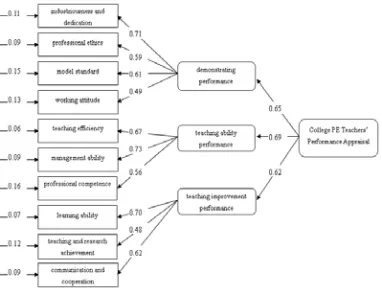
Three factors are extracted in the construction of the pattern with factor analysis. The variance of factor 1 is 33.69%. The variance of factor 2 is 25.13%. And the variance of factor 3 is 12.77%. The proportion of the total variance of three factors is 71.59%. The first dimension is named teachers’ demonstrating performance, including four items: industriousness and dedication, professional ethics, model standard as well as working attitude. The second dimension is called teaching ability performance, containing: teaching efficiency, professional competence and management ability. And the third dimension is teaching improvement performance, consisting of: learning ability, teaching and research achievement and communication and cooperation.
[image:3.612.97.522.176.247.2]LISREL 8.70 is applied to conduct CFA of the pattern through structural equation model with the questionnaires. The estimate of parameter of the verification model is revealed in Figure 1. The test result of the fitting degree of the pattern is shown in
[image:3.612.326.517.306.452.2]Table 3, which indicates that every index of fitting test is within the permissible scope and the fitting degree of this pattern is relatively ideal.
Figure 1: CFA of the Pattern of College PE Teachers’ Performance Appraisal
Table 3 Fitting Test of Pattern of College PE Teachers’ Performance Appraisal evaluation index of fitting test measured value standard
P
value 0.071P
>0.052
/
C
df
1.704C
2/
df
£ 3.0RMR
0.251 the less the betterSRMR
0.070SRMR
p 0.080GFI
0.882GFI
f 0.85,the larger the betterAGFI
0.873AGFI
f 0.85, the larger the betterNFI
0.922NFI
f 0.90NNFI
0.879NNFI
f 0.85CFI
0.909CFI
f 0.90RMSEA
0.047RMSEA
p 0.05The CFA result of college PE teachers’ Competency based on their auto gnosis manifests
[image:3.612.99.519.532.693.2]reasonable. The pattern with three-dimensional hierarchical structure made up of personal abilities, characteristics, interpersonal communication, teaching organization and quality can reflect the requirement of the appraisal of college PE teachers’ performance well. But considering the nature of college PE teachers’ work, the weight of each index should be different.
3.3. The Confirmation of Index Weight
At present, there are two ways to screen indexes. One is objective selection method. This method embodies the technical feasibility of the index system to achieve the design goal. It mainly screens fairly important factors through statistics of all factors. The second way is to make selections subjectively. This method reflects the non-substitutability of value judgment and experience evaluation in the studies of social economic problems. Its core idea is to judge the importance of the indexes by consulting related experts and eliminate the indexes with less weight in accordance with certain criterion. Subjective selection can take full advantage of the experts’ experience to make the decided evaluation index more reasonable.
AHP is a decision-making way to make qualitative analysis and quantitative analysis on the basis of resolving the relevant decision elements into object level, criteria level, scheme level and so on. This method was proposed by famous American operational researcher Dr. Thomas Saaty in the 1970s [8]. It is a concise, practical and valid way of system analysis and evaluation with the combination of qualitative and quantitative analysis. It combines qualitative and quantitative analysis and utilizes the decision makers’ experience to judge the relative importance of the criteria of whether all the measured goals can be achieved, which can be effectively applied to the projects that are difficult to solve completely with the quantitative method. This way neither seeks
advanced mathematics purely nor emphasizes action, logic and inference unilaterally, but combines qualitative and quantitative ways organically, which helps to resolve complicated system and change the decision problems that are hard to be quantified with multiple targets and criteria into multi-level problems with simple target. After confirming the quantitative relationship of the elements at the same level related to the elements at the upper levels through pair wise comparison, simple arithmetical operation is proceeded in the end.
3.3.1 Constructing Hierarchical Structure Model of Object Level, Criteria Level and Scheme Level
Object level (M): College PE teachers’ performance, standing for the confirmed general object, i.e. the problems to be solved.
Criteria level (Z): Demonstrating performance, teaching ability performance and teaching improvement performance, indicating the specified basic criteria to achieve the general object, used to describe general contents.
Scheme level (F): Industriousness and dedication, professional ethics, model standard, working attitude, teaching efficiency, professional competence, management ability, learning ability, teaching and research achievement and communication and cooperation, meaning the solution obtained by detailing each criterion in criteria level.
3.3.2 Confirming the Ratio Scale and Average Random Coincidence Indexes
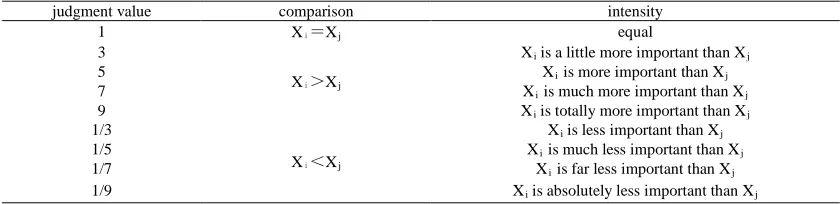
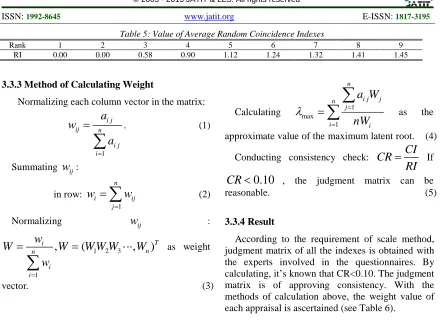
[image:4.612.99.519.606.708.2]In order to quantify the judgment, according to the importance of indexes, 1-9 scale method is introduced. The accessor method is shown in Table 4. Average random coincidence indexes RI are in Table 5. Judgment matrix is set up in accordance with ratio scale.
Table 4: The Valuation Standard of AHP Appraisal Scale
judgment value comparison intensity
1 Xi=Xj equal
3
Xi>Xj
Xi is a little more important than Xj
5 Xi is more important than Xj
7 Xi is much more important than Xj
9 Xi is totally more important than Xj
1/3
Xi<Xj
Xi is less important than Xj
1/5 Xi is much less important than Xj
1/7 Xi is far less important than Xj
1/9 Xi is absolutely less important than Xj
Table 5: Value of Average Random Coincidence Indexes
Rank 1 2 3 4 5 6 7 8 9
RI 0.00 0.00 0.58 0.90 1.12 1.24 1.32 1.41 1.45
3.3.3 Method of Calculating Weight
Normalizing each column vector in the matrix:
1
i j
ij n
i j i
a
w
a
==
∑
. (1)Summating
w
ij:in row:
1
n
i ij
j
w
w
=
=
∑
(2)Normalizing
w
ij :1 2 3
1
,
(
,
)
Ti
n n
i i
w
W
W
W W W
W
w
==
=
⋅⋅⋅
∑
as weightvector. (3)
Calculating max 1
1
n
i j j n
j
i i
a W
nW
λ
==
=
∑
∑
as theapproximate value of the maximum latent root. (4)
Conducting consistency check:
CR
CI
RI
=
If0.10
CR
<
, the judgment matrix can bereasonable. (5)
3.3.4 Result
According to the requirement of scale method, judgment matrix of all the indexes is obtained with the experts involved in the questionnaires. By calculating, it’s known that CR<0.10. The judgment matrix is of approving consistency. With the methods of calculation above, the weight value of each appraisal is ascertained (see Table 6).
Table 6: A Statistical Table of the Distribution of Index Weight in the Pattern
appraisal indicators weight of each item at criteria level Weight of each item at scheme level
Industriousness and dedication
0.40
0.11
professional ethics 0.08
model standard 0.08
working attitude 0.13
teaching efficiency
0.36
0.19
professional competence 0.10
management ability 0.07
learning ability
0.24
0.08
teaching and research achievement 0.06
communication and cooperation 0.10
According to the weight value of each index, teaching efficiency, working attitude and industrious and dedication rank top three. Among the 10 indicators contained in the four aspects: virtue, ability, diligence and achievement in this pattern, “ability” gets the total points of 0.35, which is of the highest weight. “Achievement” gets 0.25, which ranks the second. Considering that the weight of teaching efficiency in achievement reaches 0.19, it is believed that in some degree teaching efficiency decides the appraisal of teachers’ achievement. And diligence ranks the third with virtue ranking the fourth.
4.
CONCLUSION [image:5.612.113.510.408.525.2]performance, consisting of: learning ability, teaching and research achievement and communication and cooperation. Meanwhile, according to the practical application, AHP is used for weight calculation of all the indicators in the pattern. The results prove that teaching efficiency, working attitude and industrious and dedication rank top three, especially the teaching efficiency has absolute influences on the appraisal of teachers’ achievements, as well as the most influential indicator of college PE teachers’ performance appraisal. The pattern breaks the appraisal model in four dimensions existing in comments approach and means-oriented approach, pays special attention to the internal rules of the theoretical indicators as well as designs the weight of each specific index with AHP in accordance with their actual internal laws, which overcomes the problems that exist in other approaches like excessive subjectivity, obscure boundary between qualitative index and quantitative index, and chaotic weight and can provide theoretical pattern and references for the scientific performance appraisal of college PE teachers.
REFERENCES:
[1] [1] Liu Changhui, “Problems Existing in the Performance Appraisal of College Teachers in China and Countermeasures”, Education Exploration, Vol.10,2012,PP.79-80.
[2] [2] Guo Zhifeng, “Thoughts on Performance Appraisal of College Teachers”, Master,
Vol.10,2012,PP.199.
[3] [3] Murphy, K R, &Sharella A H. , “Implications of the multidimensional nature of job performance for the validity of selection tests: multivariate frameworks for studying test
validity” Personnel Psychology,
Vol.50,1997,PP.823-854.
[4] [4] Fleishman E A, “Development of a behavior taxonomy for describing human tasks: Acorrelational-experimental approach ”,
Journal of Applied Psychology, Vol.51, 1967,PP.1-10.
[5] [5] Campbell, J P., Mccloy, R. A, Opper, S. H. &Sager, C. E. “A theory of performance. In N. Schmitt &W: C. Borman (Eds.), Personnel selection in organizations ”,San Francisco: Josses-Bass, 1993,PP.71-98.
[6] [6] Feng Ming, “A Frontier Theoretical and Empirical Study on Human Resource
Management”, Chongqing: Chongqing Press,
2003.
[7] [7] Zhang Liwei, Mao Zhixiong. “Handbook of Scientific and Common Psychological Scale”,Beijing: Beijing Sport University Press,
2004.
[8] [8] Lu Yaobin. “Project Management-- Process, Method and Practice”, Dalian: Dongbei University of Finance & Economy Press, 2008, PP. 39-42.
[9] Zhang Yunliang, Cui Degang, Liu Chunming, “Comparison among performances predictions for 29th Beijing Olympic Games track and field”, Journal of Tianjin Sport College, Vol.23, No.5, 2008, pp.430-432.
[10] Zhang Yunliang, “Prospect of global competitive sport after 29th Beijing Olympic Games”, Journal of Wuhan Sport College, Vol.31, No.1, 2009, pp.4-8.
[11] Gaojie, “Professionalism—real selection for 21st sport teachers education”, Weekly Examination literature forum, Vol.2, 2007, pp.115-116.
[12] Fanqun, “Situation in performance evaluation for managers in colleges and universities and creative analysis”, Modern education science, Vol.4, 2009, pp.73-76.
[13] Liangyu, Liangjuan, “Thinking in performance evaluation for teachers in colleges and universities”, Heilongjiang Education, Vol.11, 2007, pp.85-87.
[14] Li Zhihe, Wu Fengli, Zhang Shengtai, et al., “Example study of performance check for researches in colleges and universities”,
Modern education technology, Vol.8, 2009, pp.16-20.
[15] Yangbo, Xu Simao, “Thinking in performance evaluation of sport teachers in colleges and universities”, sport literature search, Vol.18, No.4, 2010, pp.128-131.
[16] Zhang Yunliang, “Study of China performance evaluation for fundamental track and field coach”, China Sport Science and Technology, Vol.46, No.6, 2010, pp.3-7.