MAR-APRIL 2017, VOL- 4/30 www.srjis.com Page 4695 A STUDY OF IMPLEMENTATION AND CHALLENGES OF CONTINUOUS AND
COMPREHENSIVE EVALUATION AS MENTIONED IN RIGHT TO EDUCATION
ACT, 2009 AMONG MUNICIPAL CORPORATION PRIMARY SCHOOL
TEACHERS OF DELHI
Charu Sethi1 & Alka Muddgal2, Ph. D. 1
Research Scholar, Amity Institute of Education, Amity University Uttar Pradesh.
2
HOI, Amity Institute of Education, Amity University Uttar Pradesh.
The present article is an attempt to study the implementation and challenges of Continuous and Comprehensive Evaluation placement of children as mentioned in Right to Education Act, 2009 among MCP School Teachers of Delhi. The study is descriptive survey. The data was collected from 120 in-service teachers teaching in Municipal Corporation Schools of Delhi. A questionnaire comprising of open ended questions was prepared for studying the implementation and challenges of the teachers regarding Continuous and Comprehensive Evaluation enrolment of children as mentioned in the RTE Act. The data collected was systematically tabulated and was analysed qualitatively. The findings of the study showed that there is a wide gap between policy interventions and how it is actually perceived and implemented in the field.
Continuous and Comprehensive Evaluation (CCE) refers to a system of school based
evaluation of student that covers all aspects of student development. It is a developmental
process of student which emphasizes on two fold objectives. These objectives are continuity
in evaluation and assessment of broad based learning and behavioural outcomes on the other.
The term ‘continuous’ is meant to emphasise that evaluation of identified aspects of students ‘growth and development’ is a continuous process rather than an event, built into the total
teaching-learning process and assessment, frequency of unit testing, diagnosis of learning
gaps, use of corrective measures, retesting and feedback of evidence to teachers and students
for their self evaluation. The evaluation is a continuous and on-going process, spread over
and beyond the entire span of academic session.
The ‘Comprehensive’ component of CCE takes care of assessment of all round development of the child’s personality. It includes assessment in scholastic as well as co-scholastic aspects
MAR-APRIL 2017, VOL- 4/30 www.srjis.com Page 4696 of Pupil’s growth. The other ‘C’ in CCE is ‘Comprehensive’ component of assessment.
Comprehensive component means getting a sense of ‘holistic’ development of child’s
progress. Progress cannot be made in a segregated manner, that is, cognitive aspects,
personal-social qualities, etc. The teacher designs activities based on expected learning
indicators. These activities need to be of varied nature. Through these questions/activities the
teacher would assess the learners and that data would be one kind of summative data of a
lesson/theme. Such assessment data must be recorded by the teacher. These data would give
‘comprehensive’ picture of child’s learning and development. This data would help to know
to the assessment of learning among children.
CCE covers both the scholastic and co-scholastic aspects of the students’ growth and
development. Since abilities, attitudes and aptitudes can manifest themselves in forms other
than the written word, the term refers to application of variety of tools and techniques (both
testing and non-testing) and aims at assessing a learner’s development in areas of learning.
The major emphasis of CCE is on the continuous growth of students ensuring their
intellectual, emotional, physical, cultural and social development and therefore it will not be
merely limited to assessment of learner’s scholastic attainments. CCE uses assessment as a
means of motivating learners to provide feedback and do not follow up to further improve
upon the learning in the classroom and to present a comprehensive picture of a learner’s
profile.
In the context of RTE Act, Continuous and Comprehensive Evaluation refers to continuous
check of learner’s development and learning so that all children can realise their potential.
The Act suggests that all children can learn, and school must ensure that they achieve the
desired levels of learning with every child realising his/her potential.
Right of Children to Free and Compulsory Education Act, 2009 (RTE Act, 2009), has been
implemented since April 2010. The Act requires that CCE be implemented for each child till
the completion of elementary schooling. Thus, CCE is a mandatory requirement under RTE
which is to be implemented in true spirit. In implementing CCE, the role of teachers becomes
central.
The RTE Act prohibits any public examination up to Class VIII and promotes ‘no detention’
policy. The implementing of no-detention policy should not lead to absence of
teaching-learning in schools. On the contrary, CCE play as a powerful instrument in respecting the
intent of RTE on the one hand and ensuring learning for all children on the other hand, as
MAR-APRIL 2017, VOL- 4/30 www.srjis.com Page 4697 feedback for further improvement. CCE in turn would encourage all to focus on child’s
progress with her/his own performance over time.
Objectives of the Study
To study the strategies adopted by MCP School teachers for implementation CCE as
mentioned in RTE Act.
To identify the challenges faced by MCP School teachers in implementing CCE as
mentioned in RTE Act.
To explore the measures for bridging the gap in implementation of RTE Act.
Methodology
Descriptive survey method was used for the study. A sample of 120 in service teachers
teaching in MCP schools of Delhi was selected.
For implementation, challenges and suggestions of the Continuous and Comprehensive
Evaluation, an open ended questionnaire was prepared for the teachers, which included
questions related to; views of the teachers regarding CCE, strategies adopted by the teachers
for the implementation of CCE, problems and suggestions given by teachers with reference
CCE.
The data collected through questionnaire was put to content analysis.
Results and Discussion
Findings of the study, showed that twenty two percent (22%) of teachers responded that
Continuous and Comprehensive Evaluation was considered as assessment of over-all
development of personality of the child and 15% of teachers mentioned that CCE helps in the
all- round development of the child. Around 15 % of teachers responded that, with the help
of CCE various skills of the students were highlighted and 8% of teachers agreed that
students can be evaluated at their own pace with the help of CCE. Eighteen percent (18%) of
teachers accepted CCE as an evaluation criteria of curricular and co- curricular activities.
Whereas, 8% of teachers responded that it cannot help in learning of the students. Remaining
MAR-APRIL 2017, VOL- 4/30 www.srjis.com Page 4698 Figure 1 Views of teachers regarding continuous and comprehensive evaluation
Regarding implementation of CCE, Seventeen percent (17%) of teachers were practicing
regular tests in the name of continuous assessment of the subjects. ‘Continuous Evaluation‟ was considered by teachers as a regular conduct of ‘tests’. „Comprehensive Evaluation’ was
considered as combination of curricular and co-curricular activities in evaluation process.
Twenty five percent (25%) of teachers evaluate these dimensions; Language, Mathematics,
EVS, Science, and Social Sciences in curricular/ scholastic activities and Arts Education,
Health and Physical Education, and Work Education, in co-curricular/ co-scholastic
activities. Whereas, National Curriculum Framework, 2005 places Art education, health and
physical education, work education also as curricular areas.
Other fifty percent (50%) of teachers responded that CCE was used as formative and
summative assessments, which were taken in the form of oral or written tests. Remaining
18% of teachers have reported conduction of experiments in the classroom, giving projects
and assignments for the evaluation of the child.
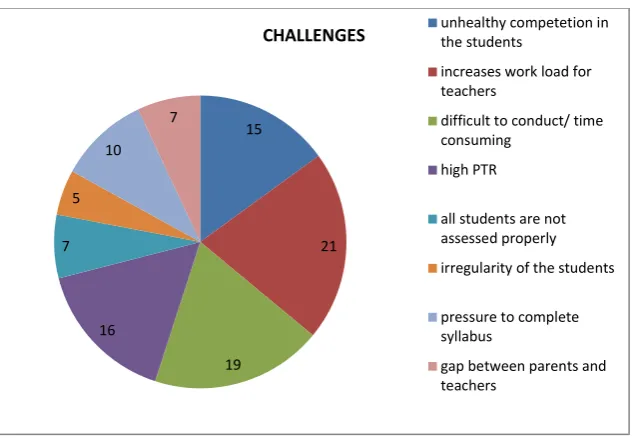
For the challenges in implementing CCE, nineteen percent (19%) of teachers responded
that CCE was a difficult task, as it was time consuming and multiple activities cannot be
conducted in classrooms. Twenty one percent (21%) showed their helplessness in matching
up with unrealistic expectation and felt extremely burdened. On the contrary, CCE aimed at
reducing the teacher’s burden. It places the collective responsibility of implementing CCE on
various stakeholders i.e. administrators, parents, children and teachers. But due to the gap
between parents and teachers as mentioned by 7% of teachers, the burden of CCE had
increased on teachers. It can be said that CCE was misunderstood as the sole responsibility of
a teacher. Ten percent (10%) of teachers responded that they were not able to complete
15
8
22
14 18
8
15
CCE
helps in all round development
each child can be measured at his/her own pace
assessment of overall personality of the child
various skills of students are highlighted
evaluation of curricular and co- curricular area
children cannot learn by filling up assignments
MAR-APRIL 2017, VOL- 4/30 www.srjis.com Page 4699 syllabus due to the tedious evaluation criteria and 7% of teachers responded that they were
not able to assess all the students. Evaluation was equated as record keeping exercise for
teachers. As a result of this, teachers were highly confused and they complained about being
engaged in compiling the assessment records/data of CCE during their teaching-learning
time, resulting in the loss of time meant for ‘actual’ teaching-learning. Fifteen percent (15%)
of teachers responded that CCE increase the unhealthy competition among children. The
spirit of CCE is to enhance student learning both through process of assessment and
evaluation. It compares the performance of a child with her/his previous performance, instead
of comparing her with her peers. Irregularity of students (5%) and high PTR (12%) were also
[image:5.595.140.459.275.494.2]major challenges in the implementation of CCE as reported by the teachers.
Figure 2 Challenges in implementing continuous and comprehensive evaluation
Suggestions given by teachers for successful implementation of CCE included; 22 % of
teachers believe that appropriate pupil teacher ratio (PTR) was important for keeping a record
of every child in the classroom. Fifteen percent (15%) of teachers responded for the provision
of essential facilities in schools and other 15% teachers agreed that increase in regularity of
the students was very important for the evaluation of the each child. Thirty percent (30%) of
teachers responded that they require training for the understanding of the evaluation
techniques of CCE for their implementation in the classrooms. Eighteen percent (18%) of
teachers suggested a concept of resource room, which can be incorporated in the schools,
where all the resources are kept and used by the teachers.
Conclusion
With regard to evaluation methods, the investigator found that the schools were following
CCE, as they have understood it. The methods adopted by most of the teachers for continuous
15
21
19 16
7 5
10 7
CHALLENGES unhealthy competetion inthe students
increases work load for teachers
difficult to conduct/ time consuming
high PTR
all students are not assessed properly
irregularity of the students
pressure to complete syllabus
MAR-APRIL 2017, VOL- 4/30 www.srjis.com Page 4700 evaluation were; unit test, monthly test, half yearly examination, annual examination etc. that
CCE was used as formative and summative assessments, which were taken in the form of oral
or written tests.
Evaluation was equated as record keeping exercise for teachers. As a result of this, teachers
were highly confused and they complained about being engaged in compiling the assessment
records/data of CCE during their teaching-learning time, resulting in the loss of time meant
for ‘actual’ teaching-learning. The investigator observed that there is a wide gap between
policy interventions and how it is actually perceived and implemented in the field.
The spirit of CCE is to enhance student learning both through process of assessment and
evaluation. It compares the performance of a child with her/his previous performance, instead
of comparing her with her peers. The actual motive behind CCE as a way to assess the child’s
understanding and ability has been taken over by mechanical activities of doing some
projects.
BIBLOGRAPHY
Best and Kahn, (2006). Research in education. (10th Ed.) New Delhi: Prentice Hall.
G.S. Shivkumar, (2013), “Challenges in Implementing the RTE Act, Journal of Dialogues on Education, ISSN 2278-2435.
Kumar. S, (2012), “Recent Reforms in Education in India –Achievements And Unfinished Tasks”, International Journal of Social Science & Interdisciplinary Research Vol.1 Issue 8, ISSN 2277 3630.
Mahapatra .P, (2013), “Deciphering the Issues and Challenges Related to Right to Education Act 2009: A Critical Study”, International Journal of Advance Research, IJOAR .org ISSN 2320-9151.
National council of Educational Research and Training (2014), What is RTE? Some ways of making Education accessible. A handbook for teachers, Edited by Santsoh Sharma.
Pandey. S, (2013), “An exploratory study on the apprehensions and implementation of Right to Education Act, 2009”, Journal of Dialogues on Education, ISSN 2278-2435.
Plessis. P, et.al, (2007), “The right to education: are we facing the challenges?”, Educational Research and Review Vol. 2, ISSN 1990-3839.
Rathore. B, (2012), “Challenge in Primary Education”, Research Expo International Multidisciplinary Research Journal Available online at www.researchjournals.in Volume – II , ISSN : 2250 – 1630.
Seema .O, (2013), “Implementing Right to Education: Issues and Challenges”, Research Journal of Educational Sciences, Vol1, ISSN2321-0508.
Uma, (2013), “Right to Education (RTE): A Critical Appraisal”, IOSR Journal of Humanities and Social Science (JHSS), Volume 6, ISSN: 2279-0837, ISBN: 2279-0845.
WEBSOURCES
www.unesco.org www.unief.org www.ncpcr.gov.in