ISSN: 1992-8645 www.jatit.org E-ISSN: 1817-3195
114
A NEW CONSTRUCTION FOR RESIDENTIAL BUILDING
(HOSTEL) BY FOCUSING ON GREEN BUILDING
STRATEGIES
1MF BAHAROM, 2A.EMRAN, 3A. AB RAHMAN, 4M.F SULAIMA, 5ZH BOHARI, 6MH JALI
Faculty of Electrical Engineering, Universiti Teknikal Malaysia Melaka,
Hang Tuah Jaya, 76100, Malacca, Malaysia
Email: [email protected]
ABSTRACT
These building constructions are normally does not follow the green building strategies and it increases the environmental problem and global warming in the future. This report was written to deliver an overview of the installation of electrical equipment based on Green Building Index (GBI) for the residential construction of the building (hostel). Therefore, in this report the development and designing of a new green building construction (hostel) by focusing the green building strategies in term of energy efficiency performance is proposed in order to better development of green building to have a great life for environment and human in this world. The result of the project is to analyze the lighting system and calculate the electrical load by using Dialux software. For the conclusion, this project describes the basic study of indoor lighting performance at the hostel for the residential building development. Besides, the use of recycling and green plant for the projects can decrease the impact on the environment.
Keywords
:
Green buildings strategies, Residential construction, Energy efficiency1. INTRODUCTION
Global warming is affecting whole over the world where the average temperature of the Earth's atmosphere has increased compared to the 19th century [1]. Thus, the global solutions are required in order to face the challenges to planet, particularly on climate change and sustainable economic development. The major part of this global problem is construction sector, which is consumed about 40% of the world’s energy, 12% of it is water and also gives 40% of the waste directed to landfill [1].
The construction industry is one of the most important industries that have been impregnable the economic development of any country. This is because; the nature of construction activities can change the natural landscape. For example, the Japanese construction industry is focused on
decreasing environmental impact through
extending infrastructure service life by increasing the sturdiness and considering life-cycle cost [2]. Although the significance of sustainable building was widely acknowledged, there are some
researches that have been conducted in this specific area, specifically in respect to the developing countries like Malaysia [3].
The Green Building Index is Malaysia’s
overall rating system for assessing the
environmental design of Malaysian buildings based on the main criteria which is Energy
Efficiency, Indoor Environment Quality,
Sustainable Site Planning and Management, Materials and Resources, Water Efficiency, and
Innovation. This Green Building Index,
developed by PAM (Pertubuhan Arkitek Malaysia / Malaysian Institute of Architects) and ACEM
(the Association of Consulting Engineers
Malaysia).
A Green Building is a structure that is designed, built, renovated, operated, or re-used in an ecological and resource efficient manner. Sustainable development is maintaining a delicate balance between the human need to improve lifestyles and feeling of well-being on one hand,
and maintaining natural resources and
ISSN: 1992-8645 www.jatit.org E-ISSN: 1817-3195
115 The use of energy in buildings has increased in recent years because of the growing demand in energy used for heating, ventilating and air conditioning (HVAC) and lighting in buildings [10]. ‘Green building’ methods use design and construction techniques to reduce the energy use and corresponding environmental impact of buildings [13]. Energy efficiency is energy intensity, which, in simple terms, refers to the use of less energy to provide the same level of energy service or to do more work with the same unit of energy [10]. Besides, it will bring a lot of benefits for long term application and gives a lot of saving in ROI [15].
2. GREEN BUILDING INDEX (GBI)
2.1 Green Building Index (Residential)
Based on Yan Ji and Stellios Plainiotis (2006): Design for Sustainability. Beijing: China Architecture and Building Press, building is the structure and process that is environmentally responsible throughout a building life cycle from sitting to design, construction, maintenance, operation, modification, and deconstruction. Furthermore, green building design involves finding the balance between construction of building and sustaining environment. This requires close collaboration of the design team, the architects, the engineers, and the client at all project stages. Green building is also known as a high performance and sustainable building [5].
[image:2.612.306.534.68.141.2]The Green Building practice expands and complements the classical building design concerns of economy, utility, durability, and comfort.
Table 1: Comparison between “Green Building” and “Non-Green Buildings” [5]
Building Type Green Buildings Non-Green buildings Energy
consumption Low High
Indoor Environment Quality
Very good Good
Emission Low High
Waste
Management Highly Efficient Efficient
Building Material Environmentally Friendly Not Environmentally Friendly Project
Practices Sophisticated Normal
Feasibility >5% than
Threshold Threshold
The GBI rating is based on six criteria and the points that shown in Table 2.
Table 2: Assessment Criteria for Overall Points Score [5]
PART ITEM MAXIMUM
POINT
1 Energy Efficiency 23
2 Indoor Environment Quality 11 3 Sustainable Site Planning & Management 39
4 Material &
Resources 9
5 Water Efficiency 12
6 Innovation 6
TOTAL SCORE 100
Points gained in these criteria will mean that the building will likely to be more environment-friendly. Under the GBI assessment framework, points will also be awarded for achieving and
incorporating environment-friendly features
which are above present in industry practice. Buildings will award Platinum, Gold, Silver or certified ratings depending on the total score achieved (see Table 2) [6].
Table 3: Green Building Index Classification [6]
POINTS GBI RATING
86+ points Platinum
76 to 85 points Gold
66 to 75 points Silver
50 to 65 points Certified
Based on Green building fever fast
spreading in Malaysia, Business Times, by
ISSN: 1992-8645 www.jatit.org E-ISSN: 1817-3195
116 developments being associated with prestige. At the moment, many developers see green certifications for their buildings as a quick ticket to bigger profit and a mean to raise the gross development value of their projects [14].
Daylight makes an important contribution to the lighting of an interior and may provide
supplementary illumination for substantial
periods in some buildings. The major factors affecting the daylighting entering the building depend on the depth of the room, the size and location of windows and roof lights, the glazing system and any other external obstructions. [12] High performance green building require close integration of building systems with a special focus on energy, daylighting, and material analysis during their design process [16].
To achieve the GBI ratings, one of the processes is using DIALux software. The lighting strategies will be divided by seven zones of lighting. Each of the zones will have the control circuit to enhance the energy saving consumption.
2.2 DIALux
[image:3.612.321.529.476.571.2]DIALux is available to users all over the world and used globally in light planning, in the continuous development of the programmer consideration has to be given to different styles of planning. People will be able to plan the lighting that will use in a room, scene or building by using this DIALux. This Dialux will be able to calculate and visualize the daylight, as well as letting plan of the lighting vision, plan the color and intensity of the lights that will be used, position on the project the emergency lighting, with the right legal number of luminaires, and many more [7].
Table 4: Visual evaluation of lighting systems in workplace [7]
Concept Description Evaluation
Light level
Whether it is dark or light in the room or at the workplace?
Dark - light
Light Distribution
How is the light distributed in the room or at the workplace?
Varied – equally
Light Colour Is the light
colours Warm – cold
experienced as warm or cold?
Colour
How are the colours and objects viewed?
Distorted – natural
Glare Does unpleasant
glare occur?
Troublesome – not noticeable
Shadow Whether they are
hard or soft? hard – soft
Reflections
Whether they are instance or diffuse?
Intense - diffuse
From the Software DIALux, “By planners
for planners,” DIALux determines the energy of
light solution based on the supports in complying with the respective national and international regulations. To create lighting, AutoCAD plan is very useful to facilitate the work.
2.3 AutoCAD
According to “Autodesk, Inc".
FundingUniverse. Lendio. 2012. Retrieved 29
March 2012. AutoCAD is a commercial software application for 2D and 3D computer-aided design (CAD) and drafting available since 1982 as a desktop application and since 2010 as a mobile web and cloud-based app marketed as AutoCAD 360. AutoCAD was used across a wide range of industries, by the professionals. It is supported by 750 training centers worldwide as of 1994.
Figure 1: Design Layout with Electrical Installation
ISSN: 1992-8645 www.jatit.org E-ISSN: 1817-3195
117 communities to not only benefit the building itself, but also the community that uses it. The design strategies are the main point to make this objective achieved.
3. DESIGN STRATEGIES
Design lighting system, the information that should be compile are length and width of the room, height of floor cavity, height of the ceiling cavity height of the room cavity and surface reflectance. There are two methods for the design lightning system procedure, manual calculation and using software.
Number of lamps
! "#$ %& (1)
Room Index - . , /, 0 (2)
The lightning design lumen (LDL) is the value of the lumen for any type of lamps. This value usually will be prepared by the supplier for the lamps in the brochure or others medium or can be refer from the JKR standards.
Room Cavity Ratio (RCR) =
. 1 2334 56789: ;<8=>9 ?<@=9>/A8B9> 0
?<@=9> A8B9> (3)
LLF = BF RSDD LLD LDD (4)
No. of Luminaires = B<C8D<B EF48@6@G< D334 6D<6
EF4<@ H<D EF48@68D<C 5I ??J (5)
The parameter to measure the Light Lost Factor (LLF) also considered. Here, Ballast Factor (BF) set to 95%, Room Surface Dirt Depreciation (RSDD) set to 97%, Lamp Lumen Depreciation (LLD) set to 85% and Luminaire Dirt Depreciation (LDD) set to 90%. These parameters stated above will be used to evaluate the lighting performance in order to achieve energy saving criteria. For the daylight factor, the energy saving type for the hostel can achieve minimum 1.0 percent, thus more than 75 percent of the habitable rooms have been achieved [9].
4. RESULTS
The design of the lobby is one of the most parts that should be considered. Lobby is the place where it occupied by the people. Therefore, a large area is needed for the users to do their work comfortably. The area of the lobby is 26.78ft x 45.44ft for the overall indoor lobby area. The design is drawn in AutoCAD software
where it helps in designing the electrical system in order to ensure that the installation look smart and well-organized. The AutoCAD layout plan is implemented with a number of lamps for analysis. One way to demonstrate energy efficiency in lighting design is to show a luminous efficacy of luminaries. The efficacy of luminaires could be achieved by careful selection of lamps, control gear and power factor correction equipment.
In the general areas of the existing hostel,
the conventional T12, 38 mm diameter,
fluorescent lamps are used. But, in the green building hostel area energy efficient luminaires with T8 lamps with electronic control gear have been used in the first floor area, such as in the toilet, storage and switch room. T8 luminaires consume 25% less energy in giving the same light output as the T12 lamps. T8 lamps use greater phosphor technology such that they can produce the required light output from a smaller surface area and smaller diameter. A smaller diameter lamp consumes lesser energy, which in turn enables more efficient production of light within the lamp.
Most every hostel has a standard 40 watt T12 lamp on standard magnetic ballast and uses 172 watts of energy. The same installation with T8 lamps and new electronic ballast uses 112 watts of energy, which is a 35% reduction in energy usage. To retrofit an existing fixture with the new ballasts is a simple process that requires very basic wiring knowledge. By removing two T12 ballasts, replace with the one T8 ballast, and replace old lamps with new ones in the same sockets. Not only a 35% reduction in energy consumption, but also a dramatic difference in light output will be seen. The Standard T12 lamp produces 2,650 initial lumens per lamp. The standard T8 produces 2,800 initial lumens per lamp, 6% brighter. But the standard T12 lamp produces 2,300 design lumens and the T8 produces 2,660 design lumens.
In this project, there are two types of lamps will be analyzed. All type of this lamp is selected from Philips Lighting Company catalogue. The lamps are:
1. Pentura Mini LED
ISSN: 1992-8645 www.jatit.org E-ISSN: 1817-3195
[image:5.612.333.510.175.320.2]118 lighting is bright and uniform light with good color rendering. Pentura Mini LED is very easy to install, even where space is limited, e.g. under shelves in shops, and over worktops and workstations in the home and home office. Power cable, mounting clips and connection accessories are also supplied. Thin end-caps minimize black spots between the products, enabling consumers to create a continuous light-line.
Figure 2: Pentura Mini LED
This Pentura Mini LED has a unity correction factor. It consists of luminous flux of 800 lm and the luminaire wattage of 10.5 W.
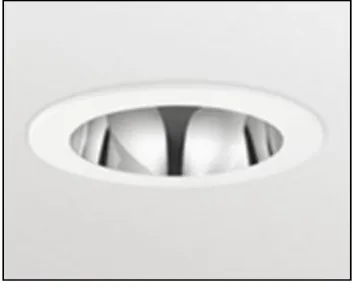
2. GreenSpace
This lamp has high efficiency and sustainable LED solution. For the starting investment and the cost of the installation during its lifetime, people want an appropriate balance
between these two things. Greenpeace is a cost efficient and sustainable downlight that used to replace conventional CFL downlights in general lighting applications. It features the delivering consistent light output, stable color achievement and high color rendering.
Figure 3: GreenSpace Lamp
This GreenSpace lamp has a unity correction factor. It consists of luminous flux of 1100 lm and the luminaire wattage of 15 W.
Figures below show the other result for the comparison between two lamps in every single part at the hostel:
[image:5.612.119.263.209.335.2]ISSN: 1992-8645 www.jatit.org E-ISSN: 1817-3195
119
Lighting Distribution Color Rendering
Principle Office
Toilet
Corridor
ISSN: 1992-8645 www.jatit.org E-ISSN: 1817-3195
120
M&E
Washing room
Lighting Zone by DIALUX simulation:
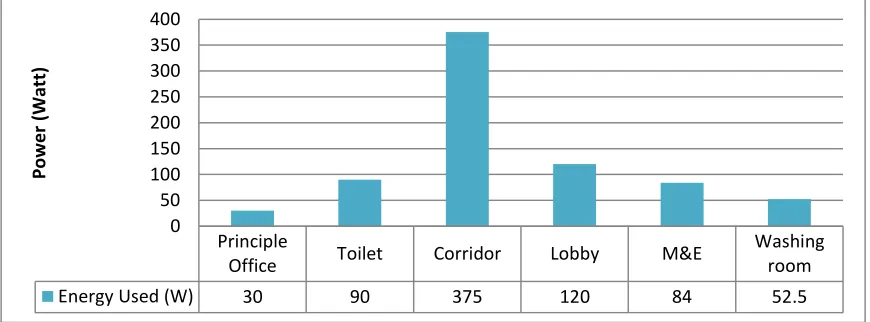
The lighting strategies will be divided by seven zones of lighting. Each of the zones will have the control circuit to enhance the energy saving consumption. The lobby area is the major part of assessment; this area had been consumed 120.0 watt by considering 1.69 W/m² at 71.21 m² for ground area. In principle office area, the total energy usage is 30.0 watt at 1.76 W/m² in 17.06 m² for ground area. In addition, toilet area consumed 90.0 watt at 6.88 W/m² in 13.08 m² for ground area. Corridor area consumed 375.0 watt at 1.56 W/m² in 240.64 m² for ground level. M&E
room consumed 84.0 watt at 1.25 W/m² in 67.36 m² for ground area. Meanwhile the washing room consumed 52.5 watt at 1.48 W/m² in 35.54 m². The remaining zones area will reflect the low energy consumption within the range of 0 to 10.5 watt where by 20% of saving area. All the lighting been used is compiled for MS 1525:2007
standard to enhance the energy saving
[image:7.612.91.526.559.720.2]achievement. LED lighting is used to minimize the energy to improve energy efficiency in the hostel. The LED implementation will not reduce the capital cost due to installation, but it will give a better result in term of return of investment ROI.
Figure 4: The Energy Used In Every Area In The Hostel
Principle
Office Toilet Corridor Lobby M&E
Washing room
Energy Used (W) 30 90 375 120 84 52.5
0 50 100 150 200 250 300 350 400
P
o
w
e
r
(W
at
ISSN: 1992-8645 www.jatit.org E-ISSN: 1817-3195
121 Based on the result in Figure 4 above, the critical area is corridors which use 375.0 watt, but not all of the lights used at one time. So, for the critical area in the hostel, lobby is the most critical part because this area had been consumed 120.0 watt and lobby is the most widely used by public for meeting. In this project, the lamp that used for lobby is green space lamp which has luminous flux of 1100 lm and the luminaire wattage of 15 W. This is because, by using this type of lamp not only reduces the quantity of the lamp that will be used but also can saving more energy efficiency compered if used T12 or T8 fluorescent lamps.
Daylight Factor:
Daylighting is distinguished as a light source by its unique, continuously varying color and distribution during the course of the day. Daylighting can contribute greatly to human satisfaction. It provides comfort, a distinctive ambience and a means of defining architectural
spaces. Daylight factor is expressed as a
percentage of the ratio of internal illumination falling on the work plane divided by the external illumination on a horizontal plane under an overcast sky. The daylight factors need to be considered to enhance the electrical energy efficiency performance in enclosed space area.
The lighting design stage will begin with the proper planning from the building electrical plan. The building space and room concept will determine the lighting application that can be applied. Normally, the luminaires calculation will be conducted to determine the average luminaries for particular room or application that has been tested. Energy-efficient hostel building designs often use natural daylight to reduce the energy needed to light a building. Natural light has also been proven to have a positive effect on student performance.
Based on the lighting simulation, the suitable lighting fitting can be chosen by
considering lux and energy consumption
elements. As shown in Figure 2 and Figure 3, both lamps shows different luminaries as Pentura Mini LED lamps gives a low luminaries level compared to the GreenSpace lamps. This is because the lighting been used is compiled for MS 1525:2007 standard to enhance the energy saving achievement. LED lighting is used to minimize the energy to improve energy efficiency in the hostel.
Heating, Ventilation, And Air Conditioning (HVAC)
Some energy efficiency upgrades can improve occupant health by enhancing indoor air quality. Installing energy recovery ventilation equipment, for example, can reduce infiltration of air contaminants from outdoors while significantly reducing heating, ventilation, and air conditioning (HVAC) energy loads [11].
Area Calculation Horse power type
LOBBY (10.40 x 22.97 x 25) + (3 X 400) = 7172.2 btu 745 W
OFFICE (15.30 x 22.51 x 25) + (2 x 1000) + (3 x 400) =11810.1 btu 1117.5W
ROOM 1 (8.21 x 11.03 x 25) + (1 x 1000) + (1 x 400) = 3663.9 btu 745 W
ROOM 2 (8.25 x 11.03 x 25) + (1 x 1000) + (1 x 400) = 3674.9 btu 745 W
PRINCIPLE ROOM (16.74 x 10.99 x 25) + (1 x 1000) + (1 x 400) = 5999.3 btu 745 W
DISCUSSION ROOM
(10.99 x 21.07 x25) + (10 x 400) = 9788.9 btu 745 W
PRINCIPLE - LIVING ROOM
(17.59 x 13.87 x 25) + (2 x 1000) + (4 x 400) = 9699.3 btu 745 W
PRINCIPLE-BEDROOM
(18.91 x 11.07 x 25) + (2 x 1000) + (2 x 400) = 8033.3 btu 745 W
FELO-LIVING ROOM
(13.60 x 13.87 x 25) + (1 x 1000) + (4 x 400) = 7315.8 btu 745 W
FELO- BEDROOM (18.86 x 13.09 x 25) + (1 x 1000) + (2 x 400) = 7971.9 btu 745 W
ISSN: 1992-8645 www.jatit.org E-ISSN: 1817-3195
122 Table above shows the area and type of air conditioner (horse power) that should be used in this project. Office area used the higher horse power which is 1.5hp compare to the others area only use 1 hp. In order to reduce cooling load, many improvement should be made outside of the HVAC system. For example, by using reflective windows on the south and west sides of the buildings, it will receive direct solar. Other than that, temporary plastic films also can be installed on the inside of the frame of any window. When installed on poorly performing windows, these films will reduce heat loss by 25% to 40%. By balancing the cost of the windows with the potential savings, this option can be a more economic option for reducing the energy needs of larger buildings.
5. CONCLUSION
For the conclusion, this project describes the basic study of indoor lighting performance at the hostel for the residential building development. The basic study of illumination is conducted through calculation by using illuminance formula which has been used nowadays. The number of luminaires can be obtained by installing energy saving tube/bulb at particular room in the building. It is shown that the LED lamps with less wattage can also brighten the room with the illuminances that is fixed in the IES Standards Illumination Level. The DIALux software also been used in this paper to evaluate the lighting effect for each room in the building by using a false color rendering method.
Besides, by focusing in indoor lighting, the performance of energy saving can improve the appearance and environmental quality while increasing sense of comfort for people who stay indoors. Nowadays, the buildings (hostel) on campus are gradually turned into the state of Green Buildings. Not only planting green plants and used simple water saving equipment, people can put more equipment that effectively mitigates the negative effects on the environment.
Thus, it will not only save the world, but also provides students more healthful and comfortable environment to learn. Therefore, from the information above, green buildings have many advantages for the environment. By proceeding the development of Green Building, a student may have a great chance to live in a natural and healthful environment in the future.
REFERENCES:
[1] [1 The Green building explanatory Booklet,
2012.
[2] M. Henry, and Y. Kato. Perspectives on
sustainable practice and materials in the
Japanese concrete industry. J.Mater. Civil
Eng. 2012, 24(3): 275-288.
[3] C. A. Boyle. Sustainable buildings.
Proceedings of the Institution of Civil
Engineers Engineering Sustainability,158
March 2005 Issue ES1, 2005, pp. 41–48.
[4] “Green Building Index,”
http://www.greenbuildingindex.org/, 2013.
[5] Yan Ji and Stellios Plainiotis (2006): Design
for Sustainability. Beijing: China Architecture and Building Press. ISBN 7-112-08390-7
[6] Charles J. Kibert, Sustainable Construction:
Green Building Design and Delivery. John
Wiley & Sons, Oct 3, 2012.
[7] “Software DIALux. By planners for
planners.”
http://www.dial.de/DIAL/en/dialux.html,
2014.
[8] “Green building fever fast spreading in
Malaysia,” Business Times, by Francis Dass,
November 27, 2013.
[9] MF Baharom, AM Kassim, R Omar, MK Nor, ZH Bohari, MF Sulaima, WM Bukhari, KB Mohamad, NS Jalil, “Performance Study on Energy Efficiency by Considering Energy Saving Strategies for Restaurant Type Focusing at Indoor Lighting,” Australian Journal of Basic & Applied Sciences, Vol. 2, February 1, 2014.
[10] Bell, J. and Burt, W. (1995) Designing
Buildings for Daylight. The Building
Research Establishment (BRE- BR288). [11] “A Guide to Developing and Implementing
Greenhouse Gas Reduction Programs,”
http://www.epa.gov/statelocalclimate/docume nts/pdf/k-12_guide.pdf, 2011.
[12] CIE Technical Report. (1994) Guide to
Recommended Practice of Daylight
Measurement. Commission Internationale De L'eclairage (CIE 108–1994).
[13] “Green Building Retrofits – Decreasing the demand from HVAC systems,” by Melissa C. Lott, October 4, 2011.
ISSN: 1992-8645 www.jatit.org E-ISSN: 1817-3195
123 [15] MF Baharom, MH Jali, MNM Nasir, ZH
Bohari, SA Tarusan, MH Misran,
“Performance study in energy efficiency on variable speed drive, VSD design for serting high lift pumping station,” IEEE pages 328-331, May 27,2014.
[16] Korkmaz, S., Messner, J., Riley, D.,
and Magent, C. (2010).
”High-Performance Green Building Design Process
Modeling and Integrated Use of
Visualization Tools.” J. Archit. Eng., 16(1),
![Table 1: Comparison between “Green Building” and “Non-Green Buildings” [5]](https://thumb-us.123doks.com/thumbv2/123dok_us/8909998.958782/2.612.306.534.68.141/table-comparison-green-building-non-green-buildings.webp)
![Table 4: Visual evaluation of lighting systems in workplace [7]](https://thumb-us.123doks.com/thumbv2/123dok_us/8909998.958782/3.612.321.529.476.571/table-visual-evaluation-lighting-systems-workplace.webp)