Capturing and Sharing War Memories
Introduction
This paper presents a system developed for capturing and sharing war related memories. In the context provided by a fortnight exhibition dedicated to the 60th anniversary of the end of the World War II, we
designed and
implemented a system aiming towards building a digital repertoire of local memorabilia.
The paper is organized along four sections introducing the relevant aspects related to collective memories and memory technology. The last two sections offer the presentation and a user study of this system for gathering and sharing collective war memories.
Collective Memories
Although the common approaches to the study of memory-related processes were traditionally focused on the individual, the social character of memory has a long standing acknowledgment in the humanities. In fact, in the last two decades there has been a growing interest in collective memory which spans psychology, history, communication and philosophy [2].
When memories relate to significant events impacting on an entire group or community and are shared amongst that group, they become collective. Each individual has their own memories about particular aspects of reality, but it is the event itself that triggers and causes these memories to be gathered, so that each personal memory becomes a facet of the collective one [6], [10].
Memory Technologies
The work for designing and developing memory technology can be broadly seen as covering two distinct areas: personal memory archives and computer supported collaborative work (CSCW).
Much research has focused on investigating ways of capturing and sharing autobiographical or personal memories. The impact of episodic memories on one’s life has been largely acknowledged by research into (i) the design and development of technologies for Corina Sas
Computing Department Lancaster University Lancaster, LA1 4WA, UK [email protected]
Alan Dix
Computing Department Lancaster University Lancaster, LA1 4WA, UK [email protected]
Nigel Davies
Computing Department Lancaster University Lancaster, LA1 4WA, UK [email protected]
capturing the significant experiences or memories [8] or (ii) the continuous capturing of lifelong personal experience [5]. When designing and developing such systems we need to address the challenges arising from the richness and narrative aspects of episodic memories.
The research on technologies for group memories has been triggered by the demands of CSCW [3]. Efforts have been made in capturing and organizing memories belonging to the experts in an organization with the purpose of providing tools for supporting organizational goals [1]. Such repositories of expertise are focused mainly on memories for procedural knowledge.
Somewhere in between personal episodic memories and procedural group knowledge there have been attempts to augment human memory [4] particularly by providing electronic memory aids [9].
Less work has focused on designing usable systems for gathering collective episodic memories. Such technologies for memory will support the development of digital lieux de mémoire [7] which will have a fourfold benefit. First, since digital memories can be stored and replicated, they transcend both time and space, and so can be accessed by users anytime, anywhere. Second, building on this, sharing memories is an interactive experience which can connect people. Third, sharing memories facilitates an emotional reassessment through the alteration of the emotional print associated with individual memories. Fourth, digital memories archives can support both the process of capturing the group memories and the subsequent access to them. These corpora of shared experiences are valuable learning resources for users’ reflection on
the past and planning for the future. Furthermore, researchers can use these corpora to understand human behavior and social events.
Case study:
Capturing and sharing war memories
Probably the most significant events triggering powerful collective memories are those related to wars. Wertsch [10] identifies two ways of commemorating wars: through permanent memorials or through temporary museum exhibitions which can be travelling or stationary. We would like to extend this typology with “digital commemoration” which offers permanent memorials which are also accessible in different locations.
The significance of war memories cannot be overstated and this explains the efforts deployed for capturing memories triggered by the World War II., especially first hand memories of people witnessing this war. One such example is the BBC’s growing archive of digital wartime memories recorded through a website [11].
In contrast, our system was deployed at a place and a moment which coincide with the 60th anniversary of the end of the World War II. This deployment was conducted at the Brewery Arts Centre in Kendal, UK as part of their “Forties Fortnight” celebration of the 1940s. In this way, it became an integral part of the exhibition dedicated to this event. The system consisted of several interactive technologies.
was entirely user driven through a simple touch-screen interface (fig. 1).
Figure 1: Video diary recording corner
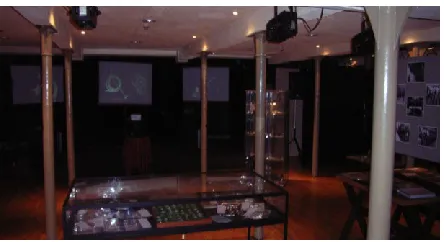
[image:3.792.207.428.152.288.2]Video diaries thus created were then made available to other visitors in two ways. Firstly, they were scheduled as part of a multi-screen projector system running in the centre of the exhibition (fig. 2).
Figure 2: Multi-screen projector
[image:3.792.200.422.369.490.2]Secondly visitors to the exhibition could browse through captured diaries stored on a locally accessible web site (fig. 3).
Figure 3: Browsing and watching the videos
As a result of these diaries the exhibition evolved over time to include progressively more user generated content from visitors. The projectors also displayed content from various films of the era and images generated by a piece of interactive art created by a local arts collective: .:The POOCH:. http://www.thepooch.com (fig. 4). The latter allows the visualisation of the “aura” of the person/object interacting with objects on the table or with the table itself.
[image:3.792.492.699.393.520.2]Evaluation
During the fortnight, there were 1723 visitors attending the exhibition. A peak was registered in the middle of the period: only on Sunday the exhibition welcomed 45% of the people visiting it during the entire fortnight. The average number of visitors for the rest of the days was 72.
The deployment was evaluated through observation and questionnaires. The latter were left at the entrance in the exhibition and people were encouraged to fill them in. In this way, 36 completed questionnaires were collected. This visitors’ sample was gender-balanced, e.g. 53% male, within an age range 18-83, and a median of 53 years old. More than half of these visitors (66%) declared that they have a basic or intermediate level of computer experience.
The visitors’ satisfaction was high both with the system in general (median = 4 out of 5) and with each of its components: recording the videos (median = 4.42), browsing and watching them on the mini-mac displays (median = 4.16), watching the presentations on the large screens (median = 4) and Kirlian table (median = 4). Visitors found the exhibition informative, innovative, interesting and appealing.
Design challenges
The main design challenge was addressing the needs of at least two distinct groups of users: elderly with very limited computer experience and whose war narratives are to be captured (mostly providers of content) and children coming in large groups organized by their schools (mostly consumers of content).
INTERACTIVITY
The four system components were designed to ensure a balance in terms of interactivity. Browsing and watching the videos on the mini-mac displays or watching them on the multi-screens is a non-interactive experience during which users are merely consumers of content. On the other hand we have Kirlian table and the video diary. The former is an interactive component that captures the images generated on the table surface. However, the most interactive component is that for recording the videos of people telling their war stories. The level of control that the users have with this component is high, both over the technology and the content recorded through it. Users can choose to share their stories on the mini-mac displays or on the multi-screens. This increase control over the recorded content had to be enabled because recorded videos can raise sensitive issues regarding narrators’ anonymity and privacy. In this way the last two system components enable users to become producers of content which can be shared on the first two components. The shared content can be consumed both individually and in groups, e.g. a family watching it together and discussing about it.
MEMORY PROMPTS
CONTENT
The Brewery deployment thus featured content from many different sources in a wide range of distributed across multiple machines connected by a specially installed local network. During the exhibition the management of the content proved to be a great challenge. Specifically, we ended up with at least two different versions of each piece of content (one for the web site and one for the projection system).
COMPUTER EXPERTISE
The video diary was the least used system component. Probably the deployment of technology was intimidating at first glance, but those who used it found it easy. People usually needed invitation and assistance in using the system. We also noticed a phenomenon of social facilitation, people were more inclined to use the video dairy component when they could see others using it. Browsing the videos on the mini-mac displays required a minimum level of expertise in interacting with computers, and did for most of the visitors it did not raise difficulties.
The system introduced in this paper offers support in the process of capturing and sharing collective memories. Together with the solutions proposed, several questions have raised, particularly related to addressing the challenges mentioned above.
References
[1] Ackerman, M.S. Augmenting organizational memory: a field study of answer garden. ACM Transactions on
Information Systems16, 3 (1998), 203-224.
[2] David, M. and Edwards, D. (eds). Collective Remembering. Sage, London, 1990.
[3] Cole, R. and Xiao, Lu. A Review of Human Memory, SIGCHI Bulletin Archive 37, 2 (2005).
http://bulletin2.sigchi.org/archive/2005.2/book_review_hu man_memory/index.html
[4] Fass, A., Forlizzi, J. and Pausch, R. MessyDesk and MessyBoard: two designs inspired by the goal of improving human memory. Proc. Designing interactive systems: processes, practices, methods, and techniques, ACM Press, (2002), 303-313.
[5] Gemmell, J and Sundaram, H. (eds.) Proc. Continuous archival and retrieval of personal experiences,ACM Press, (2004).
[6] Halbwachs, M. The Collective Memory [1951]. Harper and Row, New York and London, 1980.
[7] Nora, P. (ed). Les Lieux de memoire. Paris: Editions Gallimard, 1984-1992. (trans. Realms of Memory: The Construction of the French Past.) Columbia University Press, New York, 1996-1998.
[8] Stevens, M.M., Abowd, G.D., Truong, K.N., Vollmer, F. Getting into the Living Memory Box: Family archives & holistic design. Personal and Ubiquitous Computing7, 4 (2003), 210-216.
[9] Szymkowiak, A., Morrison, K., Gregor, P., Shah, P. Evans, J., Wilson. A. A memory aid with remote
communication using distributed technology. Personal and Ubiquitous Computing 9, 1(2005), 1-15.
[10] Wertsch. J. Voices of Collective Remembering.
Cambridge University Press, Cambridge, 2002.
[11] BBC: WW2 People’s War.
http://www.bbc.co.uk/dna/ww2/
Acknowledgments