2018 International Conference on Information, Electronic and Communication Engineering (IECE 2018) ISBN: 978-1-60595-585-8
Deep Learning-based New Methods of Images Processing for
Criminal Investigation
Min TU
1and Fang-qiang ZHONG
21Jiangxi Police College, Nanchang, Jiangxi, 330100, China
2Nanchang University , Nanchang, Jiangxi, 330100, China
Keywords:Deep learning, Image of criminal investigation, Face recognition, Pedestrian detection.
Abstract. Image processing has been widely used in criminal investigation. However, the robustness and real-time is contradictory for image processing of criminal investigation. To address the issue, we propose a new idea that images of criminal investigation are proceed by using deep learning networks. On the one hand, it is necessary to extract complex image features from the original image; on the other hand, deep learning is able to efficiently improve recognition ratio of objects. Based on these advantages, we propose the applications of deep learning in face recognition and pedestrian detection for criminal investigation. The simulation experiments show that the proposed method are able to quickly recognize face, and detect multi-pedestrian under complex environment, which is the basis of improving clear-up rate.
Introduction
Currently, public safety has become a key area for construction in all countries. However, monitoring and photographing can only obtain massive amounts data of images and video, but it lack of effective and intelligent algorithms to analysis so much data. How to effectively use the massive amount of data which obtained from different camera and photo tools every day is a major challenge for public safety[1] .At present ,The main issues of the image processing of criminal investigation can be divided into the following categories: image blurring problems, which are difficult to effectively recover blurred images due to the rapid movement of the target (such as a vehicle) and the inevitable wind .in addition, for the images got in smoggy weather, how to make the images clearly is a problem. For fast-distant shooting of face and license plates, how to quickly and accurately identify is a problem. For multiple pedestrian targets in a complex environment, the problem that how to correctly detect and identify also needs to be resolved. There are a large number of image and video processing algorithms applied in industry and life, but it is difficult to get great results in criminal investigation image applications. Because the environment has a large impact for that. for example, Although the current face recognition algorithm can achieve a recognition rate of 99.9% in an ordinary indoor, the face recognition of criminal investigation is less than 50%.
Deep Learning
Deep Learning[2-3] originates from the research of artificial neural networks and is a new field in machine learning research. Data is abstracted at a high level by using complex structures or the multiple processing layers of multiple nonlinear transformations. It forms a more abstract high-level to represent attribute or feature by combining low-level features to discover the data’s representation in distributed feature. It is a method of Characteristic learning based on data.
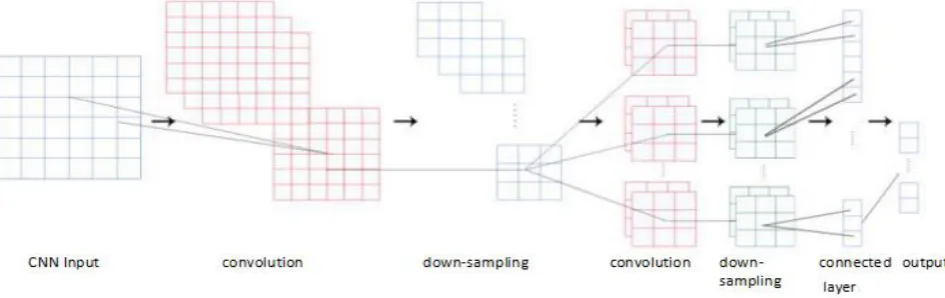
frontier subject for The Informatization of Police. Typical framework of deep learning show at Figure.1(Convolution neural network)
Figure 1. The Framework of Convolutional neural network.
A New Method of Criminal Investigation Image Processing Based on Deep Learning
Face Recognition in Criminal Investigation Based on Deep Learning
In recent years, scholars have introduced deep learning into face recognition systems, combined with the training of a large number of face samples, which has greatly improved the ability in accuracy and generalization of face recognition algorithms. The face recognition technology based on deep learning mainly involves key technologies such as Face Detection, Face Tracking, Face Critical Point Location, Face Recognition, and Face Properties Extraction.
Based on the existing technology, the environment of the image of criminal investigation is comple x and the face is affected by the environment. We have studied a face recognition method based on deep learning [6]. it proposes a new automatic coding method to make the traditional alternating multipliers are optimized. It makes the original energy is decomposed into sub-units and the assignment is optimized. This method utilizes an unsupervised Characteristic learning method. In training,X = [𝑥1,…𝑥2] ∈ 𝑅𝑚×𝑛 denotes the number of samples are n in 𝑅𝑚.𝑊𝑑 = [𝑤𝑑1, … 𝑤𝑑𝑘] ∈
𝑅𝑚×𝑘 is a learning dictionary, Z = [𝑧
1, … 𝑧𝑛] ∈ 𝑅𝑘×𝑚 meaning Rare Coding Vector, 𝑊𝑐 is a latent weight matrix, so for each the input sample 𝑥𝑗 can be approximated by 𝑊𝑑𝑍𝑗. The encoding function
f(𝑥, 𝑊𝑐) is obtained from the mapping of X → Z, and 𝑊𝑐 = [𝑤𝑐1, … 𝑤𝑐𝑘], so for the simulated and reconstructed samples can be estimated using X ≈ 𝑊𝑑𝑍, and 𝑊𝑑, Z, and 𝑊𝑐 can be optimized. the formula is as follows:
𝑎𝑟𝑔min𝑊𝑑,𝑍,𝑊𝑐
1
2‖𝑋 − 𝑊𝑑𝑍‖𝐹
2 + 𝜆‖𝑍‖
1+𝛼2‖𝑍 − 𝑓(𝑋; 𝑊𝑐)‖𝐹2 (1)
The constrainted condition is that ‖𝑊𝑑𝑡‖2
2≤ 1, i = 1, … k, λ > 0 indicates a Rare Coding Vector, α indicates a Penalty Parameter, ‖∙‖𝐹 indicates a Frobenius norm, and ‖∙‖1 indicates The sample-by-sample norm, in this experiment, the parameters are set as follows:f(𝑥; 𝑊𝑐) =
(1 + 𝑒𝑥𝑝−(𝑊𝑐𝑋))−1, 𝛼 = 1.Using multiplication method in the alternating direction proposed in literature to optimize the matrix Z, the above problem is simplified as follows :
min: f(𝑍) + 𝑔(𝑌) (2) The constrainted condition is that Z − U = 0, and the expressions of f(Z) and g(Y) in formula (2) are as follows:
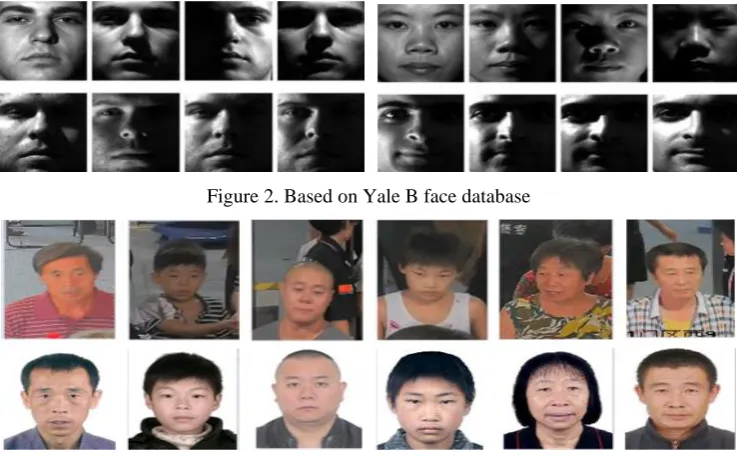
[image:2.595.63.536.116.265.2]𝑔(𝑌) = 𝜆‖𝑍‖1 (4) In subsequent iterations, 𝑊𝑑 and 𝑊𝑐 are evaluated and optimized using stochastic gradient descent to complete the final design of deep neural network. This method is applied to the test set of standard face database (such as the Yale B face database, as shown in Figure 2). The results of recognition are significantly improved compared to the classical subspace [5] and the local feature algorithm[6]. We apply this algorithm to face recognition in the image of criminal investigation, and achieved a good recognition effect in practical application. For the face image which shooted by the actual surveillance camera, we use the network system to recognize the face. The result is shown in Figure 3.
[image:3.595.113.482.195.423.2]
Figure 2. Based on Yale B face database
Figure 3.The result of Face Recognition Based on Deep Learning in Actual Environment.
(the face image which shooted by the monitors in first line, and the human face that is identified from the database by the system in second line)
The above results show that the face recognition algorithm that based on deep learning can accurately identify face in complex environments and improve the robustness of previous algorithms and ensure the speed of lock target in criminal investigation cases to accelerate the detection of cases.
Pedestrian Detection Based on Deep Learning
Pedestrian detection is a special branch of target detection include classic algorithms such as HOG, DPM, and ACF proposed for pedestrians [7-8].R-CNN (Region-based Convolutional Neural Networks) is the first truly industrial-grade solution that includes R-CNN, SPP-net, Fast R-CNN, Faster R-CNN, R-FCN, YOLO, and SSD. it is one of the mainstream pedestrian detection algorithms. Erhan et al. proposed a multi-target detection method based on deep neural network. The method firstly uses the saliency detection of the image to obtain a significant target, and constructs a plurality of target templates in an agnostic manner based on a single deep neural network. Based on the idea of the algorithm, we apply the algorithm to target detection in the image of criminal investigation. The advantage of the given algorithm is that it firstly regards the target detection as a regression problem of multi-objective coordination, and then gives a confidence score for each predicted target network to determine whether the predicted target is a true goal. the objective function of algorithm is :
𝐹match(𝑥, 𝑙) = 12∑ 𝑥𝑖,𝑗 𝑖𝑗‖𝑙𝑖 − 𝑔𝑗‖22 (6) The Loss function can be expressed as:
𝐹conf(𝑥, 𝑐) = − ∑ 𝑙𝑜𝑔(𝑐𝑖,𝑗 𝑖) − ∑ (1 − ∑ 𝑥𝑖 𝑗 𝑖𝑗)𝑙𝑜𝑔(1 − 𝑐𝑖) (7) Therefore, the optimization of the objective function can be expressed as:
𝑥∗ = arg min
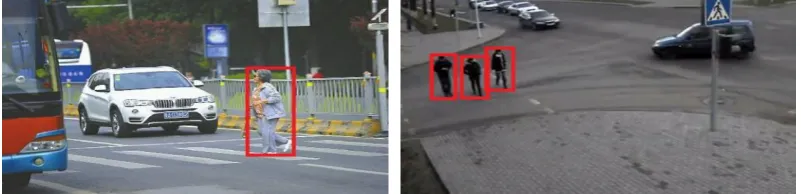
𝑥𝐹(𝑥, 𝑙, 𝑐) (8) According to ∑ 𝑥𝑖 𝑖𝑗 = 1, 0 ≤ 𝑥𝑖𝑗 ≤ 1 we can get the partial derivatives of l and c respectively to obtain the finally optimized result. According to the given depth network, we applied it to pedestrian detection of video surveillance. The results are shown in Figure 4.
[image:4.595.98.499.222.319.2]
Figure 4. The multi-target pedestrian detection based on deep neural network.
As can be seen from Figure 4, the deep neural network not only can effectively detect a single target in the image, but also can achieve multi-target detection in the image and meet the real-time requirements of the system.
Summary
Aiming at the shortcomings of traditional processing algorithms of image and video in criminal investigation’s analysis, this paper proposes a new thinking of image processing to criminal investigation based on deep learning. The new method uses convolutional neural networks for face recognition and pedestrian detection in criminal investigation. On the one hand, it uses convolutional neural networks to increase the accuracy of existing face recognition algorithms by using multi-level operations. On the other hand, it uses deep networks to solve a important problem that achieve the multi-objective detection in criminal investigations. the method is of great significance for the use of Criminal Investigation Image Analysis Technology to increase the rate of cracked cases. Because the algorithm does not require complicated feature extraction and model matching operations, it can meet the real-time requirements of criminal investigation.
Acknowledgement
The research is supported by Research and Development Emphasis Plan Projects of Science and Technology in Jiangxi Province, the electronic data trajectory analysis in Cloud computing environment (No. 20161BBE50044) . Also thanks to Opening Project of Collaborative Innovation Center for Economics crime investigation and prevention technology, Jiangxi, China (No. JXJZXTCX-023).
References
[1] WuShaoZhong. Clustering analysis based on counter-terrorism intelligence in potential terrorist discovery techniques [J]. Police technology, 2016 (6) 17-21.
[2] Hinton G E, Salakhutdinov R R. Reducing the dimensionality of data with neural networks [J]. Science, 2006, 313 (5786): 504-507.
[4] Phillips P J, Flynn P J, Scruggs T, et al. Overview of the face recognition grand challenge [C]// IEEE International Conference on Computer Vision and Pattern Recognition, 2005, 1: 947-954.
[5] Wang X, Tang X. A unified framework for subspace face recognition [J]. IEEE Transactions on pattern analysis and machine intelligence, 2004, 26 (9): 1222-1228.
[6] Aslan M S, Hailat Z, Elafif T, et al. Multi-Channel Multi-Model Feature Learning for Face Recognition [J]. Pattern Recognition Letters, 2016. 85 (1): 79-83.
[7] Gavrila D M. A bayesian, exemplar-based approach to hierarchical shape matching [J]. IEEE Transactions on Pattern Analysis and Machine Intelligence, 2007, 29 (8): 1408-1421.
[8] Tuzel O, Porikli F, Meer P. Pedestrian detection via classification on riemannian manifolds [J]. IEEE transactions on pattern analysis and machine intelligence, 2008, 30 (10): 1713-1727.
[9] Lei T, Fan Y Y. Noise gradient reduction based on morphological dual operators [J]. IET Image Processing, 2011, 5 (1): 1-17.