Performance and Security Measure of Highly Performed
Enterprise Content Management System
Sonika Tyagi
B.E.Comp Engg(PG Student), MGM’Scet NAVI-MUMBAI
Mumbai University,India
S.D.Sawarkar
PhD Computer
Principal DMCE,NAVI-MUMBAI Mumbai University,India
Prashant Lokhande
M.E.Computer Engg MGM’Scet NAVI-MUMBAI
Mumbai University,India
ABSTRACT
“ENTERPRISE CONTENT MANAGEMENT SYSTEM” (ECMS) is an extension to CONTENT MANAGEMENT SYSTEM (CMS). In this paper we will see the performance measure and security measure of website that is developed and hosted using three different platform, One website we have made in LIFERAY(open source enterprise content management system) and MYSQL as database, Second we have made using JSP and MYSQL as database run on the free web space, third we have made again using JSP and MYSQL as database but we have bought web space from provider .We will compare all three websites to see which one has the better efficiency or which can handle the better stress using the webstress tool developed by us, for the performance measure of all three websites. We have evaluated the performance by considering following parameter 1)Performance Test 2) Stress Test 3) Ramp Test and security measure by considering following parameters 1) SQL INJECTION 2) CROSS-SITE SCRIPTING on the above three websites
General Terms
Enterprise Content Management System, Web Stress Tool, Content Management System, Liferay Enterprise Content Management System
Keywords
CMS, DMS, ECMS, LMS, WCM, WECM
1.
INTRODUCTION
ECMS is an extension to the CMS, nowadays there are many different existing ECMS in the market available, but the
AxCMS.net is the one of the world‟s first ECMS. AxCMS.net is an award-winning, multilingual and multi-site compatible solution completely free of charge. The way organizations conduct business has evolved since the first ECM systems began appearing on the market twenty-plus years ago. The tools and technologies we rely upon to meet our business objectives have become more powerful and integrated, revolutionizing the way we communicate and collaborate. The types of content we rely upon have grown to include documents, forms, images, audio/video, email messages, instant messages, web content, and more. And the regulatory atmosphere within which we do business has evolved, bringing with it new demands with regard to digital information privacy, security, and stewardship [3].Document management is one of the oldest and important technique and it emerges out of ever growing amount of information being created within big organizations and also document management is important for legal processes as a proof of
something or some incident has really happened. In the traditional method where the hard copy use to exist for every document there is always a limitation regarding the storage and retrieval of amount of information. With the introduction to electronic system of managing the documents like MS-office now there is no limit of storing and retrieval of data with the increase in the technology the amount of data that to be managed is also increasing. With the increase in the document that need to be managed the MS-office, excel etc are not alone sufficient, we need to make new and different software to manage documents depend on their type, access permissions, sensitivity of data etc. The need for establishment of a properly designed and implemented ECMS is because there is an exponential and astronomical growth of raw data that is required to be accessed quickly in present day scenario for a well-organized and controlled access.[2]. In today‟s world there are many software‟s those are especially made for the Enterprise Content Management but in this paper we will do analysis and categorize all popular ECMS and based on our analysis we will suggest which ECMS suits a particular enterprise according to its use and also the advantages.
2.
WHAT is ECMS?
Enterprise Content Management Systems is a system is a multi-step process in sequential order first we do creation then at last we do retrieval and editing of information/knowledge in digital fashion including raw, semi processed or fully processed content handling text, images/graphics/animation, audio/video etc., in real time or otherwise as needed ECM tools and strategies allow the management of an organization‟s unstructured information, wherever that information exists.Nowadays whether it is a small enterprise or a big everyone needs there documents to be placed properly and can be reused easily, so to have an ECMS is a better solution but to have a correct ECMS depending on our enterprise is also very important. In later sections of this paper we will see how to choose a better suited ECMS. Beyond these, the greatest benefit the CMS can provide is to support your business goals and strategies. For example, the CMS can help to improve sales, increase user satisfaction, or assist in communicating with the public [5].
2.1
General Anatomy of ECMS
Source: KM Column JUNE 2003 So, what is a content management system? . (http://www.steptwo.com.au/files/kmc_what.pdf)
Fig 1 Anatomy of a Content Management System
The functionality of a content management system can be broken down into several main categories:-
content creation
content management
publishing
presentation
Each of these will be explored in the following sections. The CMS manages the entire lifecycle of pages, from creation to archival.
Content creation
At the front of an ECMS is an easy-to-use authoring environment, designed to work like Word. This provides a non-technical way of creating new pages or updating content, without having to know any HTML.
Content management
Once a page has been created, it is saved into a central repository in the ECMS. This stores all the content of the site, along with the other supporting details. This central repository allows a range of useful features to be provided by the ECMS: Keeping track of all the versions of a page, and who changed what and when. Ensuring that each user can only change the section of the site they are responsible for. Integration with existing information sources and IT systems.
Publishing
Once the final content is in the repository, it can then be published out to either the website or intranet. Content management systems boast powerful publishing engines which allow the appearance and page layout of the site to be applied automatically during publishing. It may also allow the same content to be published to multiple sites.
Presentation
The content management system can also provide a number of features to enhance the quality and effectiveness of the site itself .As an example, the CMS will build the site navigation for you, by reading the structure straight out of the content repository. It also makes it easy to support multiple browsers, or users with accessibility issues. The CMS can be used to make your site dynamic and interactive, thereby enhancing the site‟s impact [4].
2.2
TYPES of ECMS
There are many different types of the Enterprise Content Management System available ,depending on our requirement that what type of data an enterprise want to manage there are different types of ECMS are listed below.
2.2.1
Web Enterprise Content Management
System (WECMS)
Web content manages the data related to the websites or manages the online data, its very difficult to manage big web sites so Web Enterprise Content Management System (WECMS) helps in managing the web content .It is used to assist big organization in automating various aspects of web content creation, content management, and delivery. [2].Delivery to the Web is its primary format, but many WECMS systems also deliver to wireless devices
.
2.2.2
Document Management System (DMS)
The Document Management System (DMS) mainly focuses on the storage and retrieval of self-contained electronic data in the document form. Generally, The DMS is designed to help the organizations to manage the creation and flow of documents through the provision of a centralized repository.
2.2.3
Content management system (CMS)
The CMS assist in the creation, distribution, publishing, and management of the enterprise information. These systems are generally applicable on the online content which is dynamically managed as a website on the internet or intranet. The CMS system can also be called as „Web Content Management‟ (WCM).
2.2.4
Library management system (LMS)
Library management systems facilitate the library technical functions and services that include tracking of the library assets, managing CDs and books inventory and lending, supporting the daily administrative activities of the library and the record keeping
.
2.2.5
Records management system (RMS)
The RMS are the record keeping system which capture, maintain and provide access to the records including paper as well as electronic documents, efficiently and timely.
2.2.6
Learning management system (LMS)
Learning management systems are generally used to automate the e-learning process which includes the administrative process like registering Students, managing training resources, creating Courseware, recording results etc.
2.2.7
Geographic information system (GIS)
The GIS are special purpose, computer-based systems that facilitate the capture, storage, retrieval, display and analysis of the spatial data.
2.2.8
Digital imaging system (DIS)
The DIS assists in automation of the creation of electronic versions of the paper documents such as PDFs or Tiffs. So created Electronic documents are used as an input to the records management systems.
2.3
VARIOUS ECMS
fully-integrated platform and architectural framework that enables unfettered collaboration, stewards enterprise content throughout its life-cycle, and empowers greater productivity. An ECM system is an organization‟s virtual eco-system[3].There are many different ECMS present in today‟s market, we are listing here some of the popularly used ECMS and they are as follows
2.3.1
Drupal
Drupal is an open source web content management framework for building Internet portals, corporate web site, e-commerce sites, and more. It is the on of the best because of its ease of use, vast number of modules and it has a great user, developer and community to keep it updated .
2.3.2
Word Press
Word Press has a web template system using a template processor. Users can re-arrange widgets without editing PHP or HTML code; they can also install and switch between themes. The PHP and HTML code in themes can also be edited for more advanced customizations. Word Press also features integrated link management; a search engine-friendly, the ability to assign nested, multiple categories to articles; and support for tagging of posts and articles [4]. It is simple in use and good for the single user bogs, with a large number of themes and module available online .
2.3.3
Joomla
Jhoomla is one of the most popular and it has the one of largest community, then any other ECMS. Here we will get everything we need to develop social networks, ecommerce, & archive sites.
2.3.4
Media Wiki
It invents the new way of networking on the web and it is the one of the best ECMS for the collective authoring of documents, and it powered one of the best and most powerful site on net i.e. Wikipedia.
2.3.5
Liferay
It is the one of the newest and most powerful ECMS for building portals, and offers a professional look and feel that sets it apart from the other platforms.
2.3.6
TYPO3
It is the most complex and professional CMS platforms, TYPO3 are popular for business websites, especially with European companies .
2.3.7
Moodle
Moodle is the one of the most unique CMS platforms on this
list, designed specifically for Course Management and Education, and used for online learning platforms .2.3.8
Dolphin
It is used for those developer‟s who wish to develop the latest in social networking, with an industry standard look and all of the features of the popular online communities.
2.3.9
Pligg
It is a Digg clone that provides social bookmarking functionality for websites, allowing users to post links, vote them up or down, and leave comments.
2.3.10
Movable Type
Movable Type is the main challenger to Word Press for a personal blog platform, and supports multiple users, Themes, and Tags .
3.
IMPLEMENTATION
After doing a detailed literature survey and study we formulated
methodology to design a model based on two parameters i)Performance ii) Security.
First of all we will see the setup of all three websites. First website WS1:- developed using Liferay and MYSQL as database and its URL is http://68.169.56.47:8080 , second one WS2:- developed using JSP and MYSQL as database, this website we are hosting on paid hosting package and its URL is
http://www.booklx.com and the last one WS3:- developed using JSP and MYSQL as database, this website we are hosting on free
hosting package and its URL is
http://bookshop.jelastic.servint.net/BS.
STEP1 PERFORMANCE MEASURE: - In Performance Measure we will check the Performance of all three websites with the help of WEBSTRESS TOOL based on following parameters
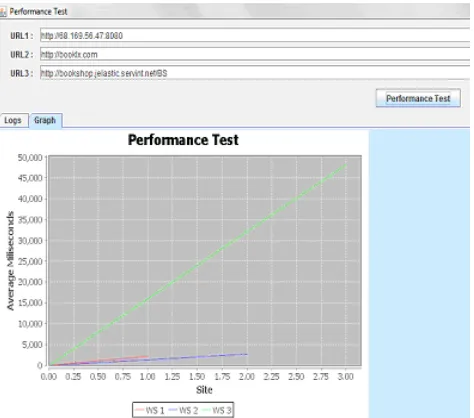
1) PERFORMANCE TEST: - This is used to check the performance of website with single hit, to check the average time required by a particular website.
[image:4.595.55.292.194.403.2]Here we will compare the performance all three website and check which website has better performance.
Fig 3 Graph of performance test for W1,WS2, WS3
From fig3 we can say that the order of performance is WS1 has highest performance its takes avg time of 3748 milliseconds then WS2 took 137736 milliseconds and last WS3 took 251907 milliseconds.
[image:4.595.55.297.536.743.2]2)
Stress Test :-The stress test will check whether how much stress i.e. how much hit a particular website can handle For the calculation of stress test we have taken hit interval as 10 sec uniformly for all three websites.Fig 4 Graph of stress test for WS1
From fig 4 shows that WS1 can handle 1500 hits at a time
Fig5:-Graph of Stress test for WS2
From fig 5 we can say that WS2 takes 600 hits at a time and it is 60% less than the WS1.
Fig6:-Graph of Stress test for WS3
Fig 6 shows that ws3 takes only 12 hits at a time. It is 98.2 % less of WS1 and 98%less of WS2.
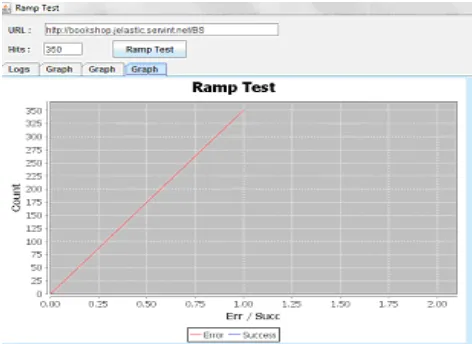
3)Ramp Test:-In Ramp test we check for the success and error and one value we take as the bench mark and check the performance of all sites.
Fig 7 Ramp Test of WS1
From above fig7 we can see that out of 350 hits there is 3 error hit and 347 success hit so its 99.15% success
Fig 8:-Graph of Ramp Test for WS2
From above fig8 we can say that 52 error hits and 298 success hits are there so it is 85.15% success.
Fig9:-Graph of Ramp Test for WS3
From fig9 we can say that it has 350 error hits and 0 success hits, it has 0% success
STEP 2 SECURITY MEASURE:- - In Security Measure we will check that how secure our website is for all three websites based on following parameters.
1)Dos Attack:-It is an attempt to make a computer resource unavailable to its intended users.
Fig10 Steps for Dos Attack
Step1 ping to the site on which we want to do the DoS Attack, to get the ip address
Step2 ping<space>ip address of site<space> -l 65500<space> –n 10000000<space>–w 0.00001
-l sent size of buffer ,-n the number of Dos attempt ,-w waiting time after one ping attack.
Step3 Wait for atleast one hour and check the website, we will not be able to use the resources.
When we attack on WS1, WS2 and WS3. WS2 and WS3 will down and WS1 will work properly.
[image:5.595.53.289.567.739.2]Fig11 shows that after the DoS attack we will not be able to use the website ,same will be the case with WS2,but WS1 will work properly.
2)
SQL Injection:- A SQL injection vulnerability can occur when a poorly-written program uses user-provided data in a database query without first validating the input. This is most-often found within web pages with dynamic content.Here in this we will write the SQL injection query in the login form and check whether we will be able to login with fake user or not, same query we will write for WS1,WS2 and WS3.The query that we have used
‘or’1’=’1
We will provide same query for username as well as password. The above query will always returns a value true so we will be able to login if the security is not there, we will login with any of the registered user.
Fig12 shows SQL injection on WS3
Fig 12 shows SQL injection on WS3 and we were able to login with the already registered user and same is the case with the WS2 , but in WS1 we will not be able to login like in fig 13
Fig13After SQL injection on WS3
3) Cross-Site Scripting:- Cross site scripting (also known as XSS) occurs when a web application gathers malicious data from a user. The data is usually gathered in the form of a hyperlink which contains malicious content within it or any popup box like click here and will take to some malicious content
Here we will write the below scripting in the search box of all three websites.
google<script>script('click here')</script>
Fig14:-WS3 after Cross-Site Scripting
Fig 14 shows that Cross-Site Scripting is possible in WS3 and same is the case with WS2, but its not possible in WS1 and we can see in Fig 15
Fig15:- WS1 after Cross-Site Scripting
4.
ANALYSIS
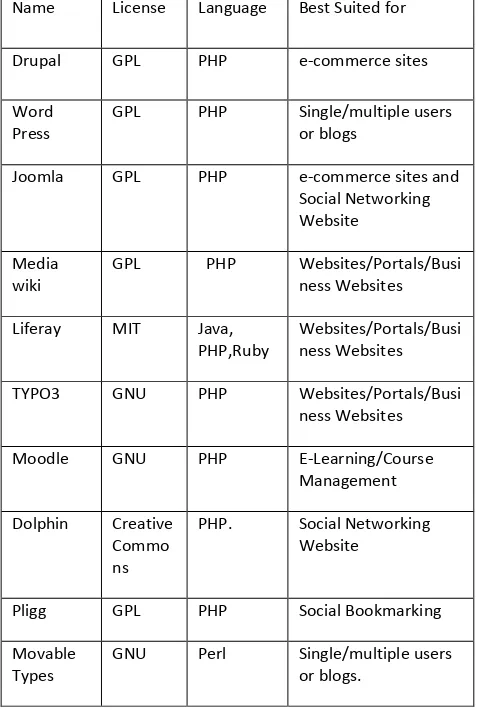
Table 1 COMPARISON of ECMS as per USE
From the above two tables we have analyzed that if we make any ECM site using Liferay it will be more secure and its performance will also be high, it supports many scripting language and lat it is open source.
5.
CONCLUSION
From the analysis of the implementation we can very easily conclude that the WS1:- developed using Liferay and MYSQL as database and its URL is http://68.169.56.47:8080
, is better then the WS2:- developed using JSP and MYSQL as database, this website we are hosting on paid hosting package its URL is http://www.booklx.comand WS3 developed using JSP and MYSQL as database, this website we are hosting on free hosting package and its URL is http://bookshop.jelastic.servint.net/BS. WS1 has performance time can handle much stress and no of hits are also much higher ,it is more secure against the Dos Attack, SQL Injection and Cross-Site Scripting. We can conclude that the Enterprise Content Management Using LIFERAY is having much High performance and also much more Secure.
6.
FUTURE SCOPE
[image:7.595.310.548.111.540.2]As with the increase in growth of no of documents and important data related to company or any big enterprise, the need of secure and much more reliable ECMS is needed and this project we can test many more parameter using the Web
Table 1 comparative table of Performance and Security measure
Stress tool and here as we have concentrated only on the main three types of attack , we can include more attacks to test it and with the increase in Demand of the type of changes or the security level, we can enhance the our present ECMS.
7.
REFERENCES
[1] Dr. JSR Subrahmanyam, FUTURE TRENDS OF CONTENT MANAGEMENT SYSTEMS (CMS) for e-Learning: “A Tool Based Database Oriented Approach” [2] Ulrich Kampffmeyer , ECM Enterprise Content
Management, Project Consult 2006, ISBN 13: 978–3– 936534–09–8re
[3] The Future of Enterprise Content Management Guidelines for transforming your ECM system to ECM 2.0 with SharePoint 2007 and DocAve
[4] Frank Gilbane, Global report- THE CLASSIFICATION & EVALUATION OF CONTENT MANAGEMENT SYSTEMS”, volume-11, No-2, March 2003
[5] What is ECMS, [online], Available http://www.aiim.org/What-is-ECM-Enterprise-Content-Management.
Name License Language Best Suited for
Drupal GPL PHP e-commerce sites
Word Press
GPL PHP Single/multiple users
or blogs
Joomla GPL PHP e-commerce sites and
Social Networking Website
Media wiki
GPL PHP Websites/Portals/Busi
ness Websites
Liferay MIT Java,
PHP,Ruby
Websites/Portals/Busi ness Websites
TYPO3 GNU PHP Websites/Portals/Busi
ness Websites
Moodle GNU PHP E-Learning/Course
Management
Dolphin Creative
Commo ns
PHP. Social Networking
Website
Pligg GPL PHP Social Bookmarking
Movable Types
GNU Perl Single/multiple users
or blogs.
Test WS1 WS2 WS3 Comments
Performance Measure 1)Performance Test 3748 millisec avg time 137736 millisec avg time 251907 millisec avg time WS1 takes less time than WS2 and WS3.
2)Stress Test 1500 hits
600 hits
12 hits WS1 can have maximum no of hit as than WS2 and WS3
3)Rapid Test 347-s
3-errors 298-success 52-error 0-success 350-error WS1 has least no of errors than WS2and WS3
Security Measure