1885
1. INTRODUCTION:
Long Term Evolution (LTE), or 3.9G systems, originally designed to achieve high data rates (50Mbit / s upstream Uplink and 100Mbit / s Downlink downstream in a band of 20 MHz), while allowing minimizing the latency by providing a flexible deployment bandwidth. It is designated as the successor of 3G networks. It allows the successful execution of emerging internet services in recent years. It uses packet switching just like 3G networks, with the difference that it uses time division multiplexing (TD) and frequency multiplexing (FD) at the same time, which is not the case, for example, with HSPA which does not performs the time-division multiplexing, this allows
us to have a rate of gain (in spectral efficiency) of about 40%. LTE uses OFDMA (Orthogonal Frequency Division Multiple Access), as a
downlink access method
(
eNodeB
UE
)
[1], it combines TDMA and FDMA. It is derived from the OFDM, but it allows multiple access by sharing radio resources among multiple users. Its principle is to divide the total band into multiple orthogonal sub-bands of narrow size, this process makes it possible to fight against the problem of frequency selective channels, ISI (Inter Symbol Interference), in addition, it allows for the same spectral width, a high bit rate due to its high spectral efficiency (number of bits transmitted per Hertz) in addition to its ability to maintain high throughput even in adverse environments with multipath echoes and radio waves [2]. For the upstream directionRESOURCE ALLOCATION OPTIMIZATION BASED ON
CHANNEL QUALITY FOR LONG TERM EVOLUTION
SYSTEMS (LTE)
1 SARA RIAHI, 2 AZZEDDINE RIAHI
1Department of Computer Science, Chouaib Doukkali University , Faculty of Sciences ,PO Box 20,
postcode 24000, El Jadida, Morocco
2 IMC Laboratory, Department of Physics Chouaib Doukkali University Faculty of Sciences, PO Box 20 ,
Postcode, 24000, El Jadida, Morocco
1 [email protected] , 2 [email protected]
ABSTRACT
In this paper we focus on an important task of the eNodeB in the architecture of LTE networks, the RRM (Radio Resource Management) its goal is to accept or reject network connection requests, ensuring optimum distribution of radio resources between UEs (Users equipment). It consists mainly of two elements AC (Admission Control) and PS (Packet Scheduling). In this work we will focus on the PS, which achieves an efficient allocation of radio resources in both directions is to say Uplink (considered in our case) and downlink. Several approaches and algorithms have been proposed in the literature to address this need (allocate resources effectively) this diversity and variety of algorithms is related to the factors considered for the optimal management of radio resource, specifically the type of traffic and requested QoS by the EU. In this paper a study of several scheduling algorithms proposed for LTE (uplink and downlink) is made. Therefore, we offer our evaluation and reviews. In this paper we are interested in the allocation of radio resources in LTE uplink (uplink) in particular with a comparative study between the scheduling algorithms flows that are: Round Robin (RR) Max Min Fair (MMF ), Maximum-Largest Weighted Delay First (M-LWDF) and Exponential Proportional Fair (PF EXP).We considered the real-time stream or RT (Video and VoIP), considering the QoS criteria: real-time, spectral efficiency and throughput. The results obtained show the advantages and disadvantages of using one algorithm over another.
1886 (Uplink), the method used is SCFDMA, a variant of the OFDMA, they have practically the same performances (flow, efficiency, etc.), but SC-FDMA transmits the sub-bands sequentially to minimize the PAPR (Peak -to-Average Power Ratio, OFDMA has a large PAPR) this is necessary because for the direction
(
UE
eNodeB
)
, the terminal equipment has a battery with a limited life.An important element in the LTE architecture, it is specifically in the eNB, the RRM (Radio Resource Management), consisting mainly of two tasks AC (Admission Control) and PS (Packet Scheduler)[3]. The CA is responsible for accepting and rejecting new requests, but the PS realizes the allocation of resources effectively to the various users already accepted by the CA. The CA processes the new requests for connection to the network, the decision to accept or reject a request depends on the network's ability to offer the QoS required by this request while ensuring the QoS of the requests already admitted in the system. The PS performs the UE-RB mapping; that is to say, select the
UEs
users who will use the channel by assigning them radio resourcesRBs
that allow them to maximize the performance of the system. There are several parameters to evaluate the performance of the system, for example we can mention: the spectral efficiency (total system throughput), the equity between theUEs
, and the waiting time of each UE before it is served. The variety of performance parameters allowed the creation of several types of schedulers. An important parameter in scheduler design is support for QoS. This forced the LTE network to distinguish between data flows and therefore we distinguish [4]:Conversational class: this is the most sensitive class delays and deadlines, it includes video conferencing and telephony. It does not tolerate delays because it assumes that on both ends of the connection is a human.
Streaming class: similar to the previous class, but it assumes that only one person is at the end of the connection, so it is less constraining in terms of delays and delays[5].
Interactive class: examples of this class can be: web browsing, access to databases ... etc. Unlike the previously mentioned types, the data must be delivered in a time interval, but this type of traffic focuses on the Packet Error Rate.
Class Background: Also known as Best Effort flow class, no QoS is applied; it tolerates the delays, the loss of the packets. Examples of this class: FTP, E-mail etc ...[6]
Two other parameters affect the design of scheduling algorithms in LTE Uplink. These two parameters are imposed by the access method SC-FDMA, are: the minimization of the power of transmission (to maximize the life of the batteries of the
UEs
), in addition, theRBs
allocated to a single UE must to be contiguous. This makes the allocation of radio resources for LTE Uplink more difficult than that for the downlink. The rest of the paper is organized as follows: in section 2, will be presented the mathematical modeling of the problem of radio resource allocation, in Section 3, a scheduling algorithms will be presented, we will evaluate the performance of these algorithms in section 4, then a conclusion and perspectives will be presented in section 5.2. CHARACTERISTICS OF THE SYSTEMS:
In this section we first give the architecture of LTE, and then present the mathematical formulation of the resource allocation problem [4].
2.1LTE architecture:
The general architecture of LTE behaves essentially the EPS (Evolved Packet System) which includes: the EPC network (Evolved Packet Core) and network radio part. EPC is a set of control elements: MME (Mobility Management Entity), HSS (Home Subscriber Server), S-GW and P-GW (Serving Gateway and Packet-data). The EPC is responsible for connecting with other 3GPP and non-3GPP networks [3]. The radio part of the network is composed of
eNodeB
(EnhancedNodeB
) and UE (User Equipment) (Figure 1).
1887
2.2Mathematical modeling:
Consider a LTE system where there are
N
SBs
(Scheduling Blocks is minimum resource allocated to a user is SB representing two consecutive resource block RB). With a powerful shared equally on allSBs
, in addition there areK
users and the minimum flow rate required by the k-th user isR
kMbit / s[7]. an SB is defined as a set of
N
s OFDM symbol in the time domain TD andN
sc subcarrier in the frequency domain FD, in addition, because of the control signals and other pilots, only d( )
sc
N
s
ofthe
N
sc subcarriers will be used to transmit data from the s-th OFDM symbol, where{1, 2,...,
s}
s
N
and d( )
sc sc
N
s
N
. Assuming asj {1, 2,..., J}
withJ
is the total number of MCS (Modulation and Coding Scheme) supported, then letR
( )cj be the code associated with the MCS
j
,M
j is the constellation MCSj
andT
s is the duration of the OFDM symbol, then the bit rate( )j
r
attainable by a single SB is [8]:
( ) 2 ( )
1
R log (
)
( )
s c N j j j d sc s s sM
r
N s
T N
(1)Now,
g
k n, is defined as the CQI (Channel Quality Indicator) of the userk
on the n-th SB. The CQI of the k-th user on theN
SBs
is,
,1
,
,2,....,
k Nk k k
g
g
g
g
for all users on allSBs
G
g g
1, ,....,
2g
K
. The CQI is definedaccording to the modulation scheme, channel coding.
g
k n, is returned by the userk
to the base station(
eNb
)
for the scheduler determines which MCS should be selected for the n-th SB associated with the userk
. For userk
, the maximum CQI value on allSBs
is [9]:
*
,
arg max(
k n n N)
n
g
(2)Subsequently,
* ,
,max ( )
{1, 2,..., J}
k n
k g
q
is defined as the largest value of the MCS reached by the userk
on the n-th SB for the CQI ,*k n
g
value, that is to say: * * , ( ),max( k n)
arg max(R log (
2)
,)
c
k g j j k n
q
M
g
(3)So we must not forget the fact that an SB is allocated to one and only one user, for this we define
k n, the resource allocation indicator for the userk
on the n-th SB, if
k n,
1
then theSBn
is allocated to the userk
and
k n',
0
for all'
k
k
. Letb
k j, be the MCS chosen by the userk
over all theSBs
allocated to it,b
k j,
1
means that MCSj
is chosen by the userk
. The flow rate attained by the userk
on one subframe is [10]:
,max( ,*)
( ) , , 1 1 k g k n q N j
k k n k j
n j
r
b r
(4)Therefore, the problem of radio resource allocation is aimed at maximizing user throughput under the following constraints:
, ,
1
max
k n k j
K k k b
r
(5)Under constraint :
k k
r
R
k
(6)
,
1,
',0
k n k n
k
k
'
(7)
,max( ,*)
, 1
1
k g k n q k j jb
(8)(4) is the objective function that aims to maximize throughput, (5) is a function for assured minimum flow for all users (ie provided some QoS), (6) provides that a SB can be attributed to a single user, (7) all
SBs
a user employs a single MCS (constraint on LTE networks) [5]. The problem (4) is an NP-complete problem; later several authors have proposed their algorithms which aim to solve it (4).1888 In this section, we present scheduling algorithms for both downlink and uplink directions [3]. These algorithms are based on mathematical formulations mentioned above, trying to achieve the allocation of radio resources to users in an efficient system.
3.1 Downlink scheduling algorithms:
The radio resource allocation algorithms are designed to improve system performance by increasing the spectral efficiency and fairness in the network [11]. It is therefore essential to find a compromise between efficiency (throughput increase) and fairness among users. Several families or categories of algorithms exist in the literature; usually each family contains a set of algorithms that have common characteristics (Figure 2) [12].
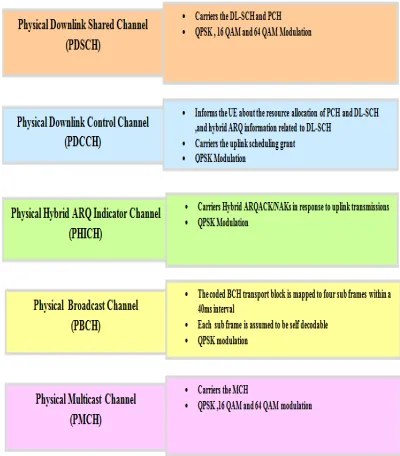
Figure 2: LTE Downlink channels
3.1.1The opportunistic algorithms:
This type of algorithm uses infinite queues; these queues are used in the case of non real-time traffic (Figure 3) [8]. The main purpose of this type of algorithm is to maximize the overall system throughput. Several algorithms use this approach as: PF (Proportional Fair) EXPPF (Exponential Proportional Fair) etc ...
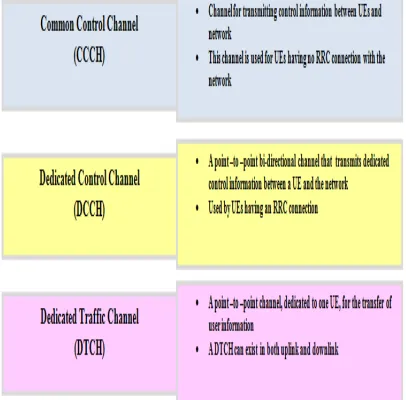
Figure 3 : LTE Downlink Logical Channels
Proportional Fair (PF) :
Its purpose is to try to maximize the overall throughput of the system by increasing the throughput of each user at the same time, it tries to ensure fairness between users [7], and the objective
function representing the PF algorithm is:
( )
i
d t
a
di
(9)( )
i
d t
Rate corresponding to the CQI of the useri
di
maximum rate supported by the RBExponential Proportional Fair (EXP-PF) :
This is an improvement of the PF algorithm that supports real-time stream (media), the fact it prioritizes real-time stream compared to other [9]. A user
k
is designated for the scheduling according to the following relation:
( )
( )
max
exp
1
i i i
i i
d t
aW t
X
k
a
di
X
(10)
1
( )
i i
i
X
N
a W t
1889
( )
i
W t
Time allowed by the flowi
a
Strictly positive parameter for alli
3.1.2 The fair algorithms:
Several research studies have focused on fairness among users in LTE networks (Figure 4); these algorithms generally have insufficient flow [13]. Note that equity does not mean equality [14].
Round Robin :
This is a classic strategy of allocating radio resources, the algorithm allocates the same amount of resource users by sharing time, therefore, throughput dramatically decreases, view, all users of the system use the following radio resources a quantum of time [12].
Max-Min Fair (MMF) :
The algorithm allocates resources between users successively to increase the throughput of each user. Once the user allocates the requested resources to reach his rate, we pass to the next user. The algorithm stops by resource depletion or that users are satisfied [11].
[image:5.612.317.517.429.657.2]
Figure 4: LTE Downlink Transport Channel
3.1. 3 Algorithms considering the delays:
This type of algorithm deals with delays in arriving and delivering packets. Designed primarily to handle real-time streams (multimedia and VoIP). If a packet exceeds these tolerated delay values, it will
be removed from the list of flows to schedule which significantly degrades the QoS. M-LWDF (Maximum-Largest Weighted Delay First) is an example of this family's implementation (Figure5)
[10].
M-LWDF :
This algorithm supports flows with different QoS requirements; it tries to balance the delays packets using the knowledge of the channel state, a time
t
, the algorithm chosen a userk
for scheduling via the formula [15]:
( )
max
i( )
i i i
d t
k
a
W t
di
(12)This is practically the same formula of the EXP-PF algorithm, except that
a
i
log( ) T
p
i i, withi
p
The probability that the delay is not respectedi
T
The delay that the useri
can tolerateThis algorithm is mainly aimed at the real-time flow which requires the respect of the deadlines, it gives good results in this context, by cons for non real time flows, it is really not a good choice because the delay really is not an important parameter [9].
Figure 5: LTE Downlink Physical Channels
3.1.4 Algorithms optimizing throughput:
1890 approach deals with real-time and non-real-time flows, the allocation of resources depends on the size of the queue of each user. Algorithm example of this family EXP Rule, Max-Weight etc [6].
3.1.5 The multi-class algorithms:
This approach considers flow classes where the treatment is different for each RT and NRT class. This type of algorithm favors real-time stream over non-real time, which makes it the most appropriate and effective for scheduling in LTE, for against equity is not really considered[4].
3.2 Uplink scheduling algorithms:
Unlike the downlink scheduling, the uplink side scheduling is much more complicated for several reasons, firstly, it is the UE that sends the data and we know very well that the UE is endowed with a source of limited energy, secondly, it is very difficult to predict the number of radio resources for an UE so that it can exchange data with the base station (Figure 6) [16]. Depending on the objective function taken into consideration and the classes of traffic passing over the radio channels, we have three main categories of schedulers: those treat the best-effort flows, those that take QoS into account and those that optimize the transmit power. In this part we will try to go around the main families of resource allocation algorithms in LTE uplink [13].
Figure 6: LTE Uplink channels
3.2.1Paradigms used:
For the allocation of radio resources in LTE uplink, the PS needs an association matrix between UE-RB input to be able to give as result the best combinations that improve the performances of the system. For the creation of this matrix, two major paradigms exist in the literature (Channel Dependent CD and Proportional Fairness PF). The first CD, in the process of creating the matrix (Figure 7), CSI (Channel State Information) or channel state is considered, so UEs that have the highest CSI values will have the chance to allocate more resources. While the PF, meanwhile, he takes the CSI rate report for each UE [17]. So fairness is proportional to the value of the CSI matrix.
Figure 7: LTE Uplink Logical Channels
3.2.2 LTE uplink system modeling:
The uplink scheduling algorithms take a matrix with
K
rows (number of activeUEs
) andM
[image:6.612.317.520.289.489.2]1891
Figure 8: LTE Uplink Transport Channel
3.2.3Best effort flow schedulers:
The main objective of this type of scheduler is to maximize the use of radio resources in the system and / or equity of resource sharing between
UEs
(Figure 9). As we have already said, each algorithm has an objective function to optimize, this type of algorithm uses a metric PF. Among the old existing work on this type of schedulers (best-effort), there are the greedy algorithms; they are very effective for this kind of traffic (best effort)[19].
Figure 9: LTE Uplink Physical Channels
This algorithm uses the PF metric and it tries to maximize the following objective function:
ln ( )
u U
U
R u
(13)( )
R u
Average rate ofUEu
at timet
. Using the logarithm function is to have a proportional fairness. In [20] the authors proposed three algorithms: FME (First Maximum Expansion),RME (Recursive Maximum Expansion) and MAD (Minimum Area Difference). These three algorithms belong to the same category (the one dealing with the best-effort flows), that's why they have the same objective function, but they differ in the way resources are allocated.
3.2.4 Schedulers considering QoS:
Two important parameters in the consideration of QoS are the tolerated time and QoS of the UE you want to serve and the
UEs
already served (depending on the type of flow). Among the proposed algorithms, there is PFGBR (Proportional Fair with Guaranteed Bit Rate). Since its name, there are two metrics PF and GBR, the metric PF is used to schedule theUEs
with non-GBR flow and for those with GBR flow, the algorithm changes the metric to be able to differentiate the UE (give priority toUEs
) [21].
*
*
( , )
exp( .(
( ))).
( )
( , )
( , )
( )
GBR
R u c
R
R u
R u
M u c
R u c
R u
GBR
non GBR
u U
u U
(14)( )
R u
Average rate of the useru
toTTIt
.*
( , )
R u c
Estimated rate of the useru
, on the Chunk Resourcec
(RC continuous set of RB) atTTIt
.The authors in [22] have proposed two algorithms that consider QoS. The used objective function is defined as follows:
,
max
u r.
ru U r RB
f
(15),
1
u r
IfRBr
is allocated toUEu
.r
f
is defined as follows:
max min
*
*
u i
r avg
i i
R
D
f
R
D
(16)u
R
Achievable throughput.min
i
R
Minimum rate of service classi
max
i
1892 avg
i
D
Average time of classi
The first algorithm is called SC-PS, Single Channel-Packet Scheduling, it realizes the allocation of a single RB for a given UE in a TTI
[23]. In the case where the number of
UEu
that request resources is less than the number of RB available, the scheduler distributes all theRBs
onthe EU equitably RB u
N
N
. Otherwise, it allocates aRB to the EU that has the wrong conditions (for example: the one with the maximum delay is almost reached) and so on. The main purpose of this algorithm is to allocate resources to those with more severe QoS constraints [24]. The second algorithm is called MC-PS Multiple Channel-Packet Scheduling, similar to the first, is the difference that this one allows the allocation of several
RBs
for a single UE [25]. This algorithm has the same behavior in the case where the number ofUEs
is less than the number ofRBs
available in the system [24]. If the number of UE is greater than the number of availableRBs
, then weallocate the
min
i
u
R
n
R
RBs
to theUEs
according to the values of
f
r (we start with those with the bad conditions), we first look for the RB that maximizes throughput and then look left and right of the RB to allocationn
RBs
.3.2.5 Schedulers processing signal strength:
The main purpose of this category of algorithms is to minimize the power of the transmitted signal, to try to extend the duration of activity of the UE, which coincides with the objective of the SC-FDMA access method. This approach has not been overly treated by researchers, so there are few algorithms in the literature. For example, the works
[26] and [27].
4. PERFORMANCE EVALUATION:
PF is a scheduler often used in 3G networks, as the throughput of this type of network is limited (Figure 10). For networks after 3G, an essential factor enters the game, it is the delay especially for the multimedia flows which represents the type of the most important flows in the networks after 3G, this factor is not taken into account by this algorithm, therefore, for non-real time stream it
works very well by cons for real-time stream is not preferable.
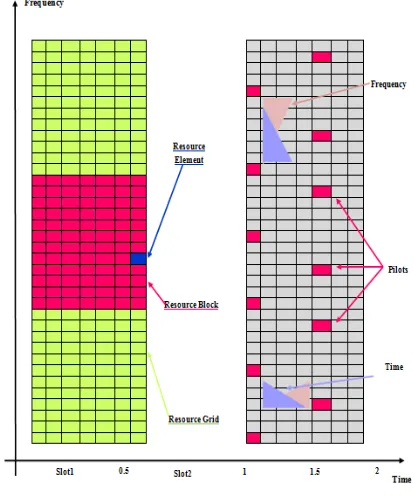
Figure 10: LTE implement OFDM
[image:8.612.314.521.141.391.2]1893
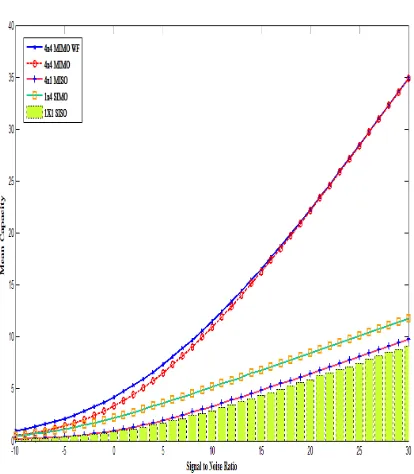
Figure 11: Mean capacity comparisons for MIMO
channels
This scenario is possible if the flows have practically the same delays for the different users. Regarding the RR, it does not consider the QoS, because the streams do not have the same needs (VoIP, Streaming etc.), in addition allocated the same amount of resources is not really fair because users do not necessarily have the same channel conditions (Figure 12), or the same types of flows etc. The networks after 3G, LTE specifically focuses on QoS of real-time flows, the cost used RR is really not the right choice.
Figure 12: WF gain in capacity Gain
Trying to satisfy all users in the MMF algorithm, gives the advantage to users with low requirements that they will often be served, however it penalizes users who request more resources. This approach does not take into account multi-user diversity and flows have different QoS requirements and equity does not mean equality. In summary, this algorithm is really not the right choice for scheduling in LTE.
5. CONCLUSION:
[image:9.612.93.300.101.338.2]1894
REFERENCES :
[1] Sara Riahi, Ali El Hore, Jamal El Kafi,” Analysis And Simulation Of Ofdm”, Ijsr, Issn Online: 2319-7064, Volume 3, Issue 3, Page No (405-409), March 2014.
[2] Sara Riahi, Ali El Hore, Jamal El Kafi,” Study And Analysis Of A Noisy Signal By Viterbi Decoding’’, Ijsr, Issn Online: 2319-7064, Volume 3 Issue 10, Page No (392-398), October 2014.
[3] Sara Riahi, Ali El Hore, Jamal El Kafi,’’ Performance Study Of The Ofdm Modulation For The Use In Wireless Communication Systems Of The 4g ‘’, E-Issn: 2395-0056, Www.Irjet.Net P-E-Issn: 2395-0072, Volume: 02 Issue: 06 | ,Page No(1219-1227),Sep-2015.
[4] Sara Riahi, Ali El Hore, Jamal El Kafi,’’ Optimization Of Resource Allocation In Wireless Systems Based On Game Theory’’, International Journal Of Computer Sciences And Engineering, Vol.-4(1), Pp (01-13) Jan 2016, E-Issn: 2347-2693.
[5] Azzeddine Riahi, Sara Riahi,’’ Study Of Dif Types Of Noise And Their Effects On D Communications’’, International Journal Advanced Research In Computer Communication Engineering, 10.17148/Ijarcce.2015.4968, Vol. 4, Issu September 2015.
[6] Sara Riahi, ’’ Performance Optimization O Wireless Multimedia Transmission System B On The Reduction Of Papr’’, Issn: 2395-International Journal Of Engineering Techniques - Volume 3 Issue 4, July-Aug 201 [7] Sara Riahi, Ali El Hore,’’ Application Of
Multicarrier Techniques For 4th Generation Telecommunications Systems’’, The International Conference On Science And Innovative Engineering (Icsie), Isbn- 978-93-86083-34-0, 2017, Iserd International Conference, Marrakech, Moroccom Page No 8-17 ,2017.
[8] H. Fattah, C. Leung, "An Overview Of Scheduling Algorithms In Wireless Multimedia Networks", Ieee Wireless Communications, Vol. 9, No. 5, Pp. 76-83, 2002.
[9] Zubair Md. Fadlullah, Chao Wei, Zhiguo Shi, Nei Kato, "Joint Optimization Of Qos And Security For Differentiated Applications In Heterogeneous Networks", Wireless Communications Ieee,
Vol. 23, Pp. 74-81, 2016, Issn 1536-1284. [10] W. Ajib, D. Haccoun, "An Overview Of
Scheduling Algorithms In Mimo-Based Fourth-Generation Wireless Systems", Ieee Network, Vol. 19, No. 5, Pp. 43-48, 2005. [11] Vincent Boussemart, Matteo Berioli,
Francesco Rossetto, "User Scheduling For Large Multi-Beam Satellite Mimo Systems", Signals Systems And Computers (Asilomar) 2011 Conference Record Of The
Forty Fifth Asilomar Conference On, Pp.
1800-1804, 2011, Issn 1058-6393.
[12] Andrea Baiocchi, Luca Chiaraviglio, Francesca Cuomo, Valentina Salvatore, "Joint Management Of Energy Consumption Maintenance Costs And User Revenues In Cellular Networks With Sleep Modes", Green Communications And Networking Ieee Transactions On, Vol. 1, Pp. 167-181, 2017, Issn 2473-2400.
[13] C. Rose, "Minimizing The Average Cost Of Paging And Registration: A Timer-Based Method", Acm/Baltzer J. Of Wireless Net., Vol. 2, Pp. 629-638, 1996.
[14] Mauricio Iturralde, Tara Ali Yahiya, Anne Wei, André-Luc Beylot, "Interference Mitigation By Dynamic Self-Power Control In Femtocell Scenarios In Lte Networks", Global Communications
Conference (Globecom) 2012 Ieee, Pp.
4810-4815, 2012, Issn 1930-529x.
[15] Requirements For Evolved Utra (E-Utra) And Evolved Ut-Ran (E-Utran)", 3gpp Technical Report Tr25.913 V7.3.0 (2006-03).
[16] H. Taoka, K. Dai, K. Higuchi, M. Sawahashi, "Field Experiments On Ultimate Frequency Efficiency Exceeding 30 Bit/Second/Hz Using Mld Signal Detection In Mimo-Ofdm Broadband Packet Radio Access", Proceedings Of Ieee Vtc2007-Spring
[17] Chung, J.-M.; Lee, D.; Song, W.J.; Choi, S.; C.; Yeoum, T.: Enhancements To Fpmipv6 Improved Seamless Vertical Handover Bet Lte And Heterogeneous Access Networks. Wirel. Commun. 20(3), 112–119 (2013) [18] Chen, T., Kunnari, E., & Ristaniemi
(2014). Device-To-Device Communication Fo
Advanced Network System. Jyväskylä, Fin
1895 [19] Yin, Rui, Guanding Yu, Huazi Zhang, Zhao
Zhang, And Geoffrey Ye Li. "Pricing-B Interference Coordination For Communications In Cellular Networks." Transactions On Wireless Communications 14 3 (2015): 1519- 1532.
[20] Su, S. T., Huang, B. Y., Wang, C. Y., Yeh, C. W., & Wei, H. Y, “Protocol Design And Game Theoretic Solutions For Device-To Device Radio Resource Allocation”, Ieee Transactions On Vehicular Technology, 2016
[21] Yuan Gx, Zhang X, Wang Wb, Yang Y (2010) Carrier Aggregation For Lteadvanced Mobile Communication Systems. Ieee Communications Agazine 48: 88-93
[22] Shueh F, Liu Ze, Chen Ws (200) A Fair, Eff And Exchangeable Channelization Assignment Scheme For Imt 2000. In Proc Of Ieee International Conference On Per Wireless Communications Pp: 429-433. [23] Wang Miao, Geyong Min, Yulei Wu, Ha
Wang, "Performance Modelling Of Preemp Based Packet Scheduling For Data Plan Software Defined Networks", S City/Socialcom/Sustaincom (Smartcity) 2015 International Conference On, Pp. 60-65, 2015 [24] Huda Adibah Mohd Ramli, Ahmad Fadzil
Ismail, Khaizuran Abdullah, Kumbesan Sandrasegaran, "Performance Analysis Of Two Component Carrier Selection Algorithms In The Downlink Lte-A", Communications (Micc) 2013 Ieee
Malaysia International Conference On, Pp.
145-150, 2013.
[25] Mr.Akshay Kumar M Kannur, Dr. S Abdulhayan,” Scheduler Throughput Of Dow Lte-Mac ”, Ijireeice Vol. 4, Issue 5, May 2016 (Online) 2321 – 2004 Issn (Print) 2321 – 5526 [26] M. Karpagam, N. Nagarajan, An Effe
Queuing Model Based Bandwidth Alloc Scheme For Fair Qos Provisioning In Lte Sys Journal Of Theoretical And Applied Inform Technology, Issn: 1992-8645, Vol. 65 No.2, 2 [27] Hussein A.Al Ofeishat, Auto-Optimization