Full Length Research Article
IMPROVING QUALITY OF WORK LIFE THROUGH HUMAN RESOURCE INFORMATION SYSTEM
*
Mansi Saxena Devyani Dubey
Management Education and Research Institute, Delhi, India
ARTICLE INFO ABSTRACT
Global impact, multi-tasking jobs, advancement of technology, changing demand patterns, upgradation of skills, meeting deadlines and unpredictable behavior inside and outside the organization bends our focus on improving the quality of work life (QWL) to invite opportunities and satisfaction among the employees. Human resource information system (HRIS) is a strategic integration of forecasting, planning, analysis and communication which gives a push to HR practitioners to manage talent, performance, career growth and retention of employees. Therefore, this study is an attempt to look towards improving QWL through HRIS with a mixed methodology to collect the data. A qualitative research has been done by exploring various corporate portals, magazines and websites. 16 employees of middle level management and 8 employees of top management of HR department ofNagarroSoftwares are questioned via face-to-face interaction, telephonic conversation and group discussion to analyse the contribution of HRIS in improving the QWL. The findings of the study suggests that, employees are able to work in more systematic manner, there was an easy exchange of information, hurdles and loops in completion of task are taken care off with client satisfaction. The management gets clarity on what has been done and what can be done…HR information system has actually stopped the poking nose of trouble creators of the organization by giving the clear picture on work done by the employees along with recognition and rewards for the deserving employees. The need is to inculcate the education and importance of HRIS among the employees with regular use of the system, so that every employee can take advantage.
Copyright © 2015 Mansi Saxena Devyani Dubey.This is an open access article distributed under the Creative Commons Attribution License, which permits unrestricted use, distribution, and reproduction in any medium, provided the original work is properly cited.
INTRODUCTION
Globalization and today’s changing environment initiated a change in the practices of the organization i.e. a change from work to work environment, from attitude to skills, from standard of living to expectations, from safety to security,
from performance to compensation…this all with
technological advancement added a pressure on organization which is shared with the employees also and made them feel powerless and socially isolated. This resulted in loss of productivity and adds stress which is taken to the personal lives also. Therefore, organization’s made an attempt to incorporate socio-psychological needs of employees as part of employee welfare schemes and the concept of quality of work life came into being. It is the strategy of H.R. practitioners to retain best working force, attract talent and work for the client and employee satisfaction. Today it is viewed as an umbrella under which employees feel fully satisfied with the working environment.
*Corresponding author: Mansi Saxena Devyani Dubey,
Management Education and Research Institute, Delhi, India.
Walton (1973) suggested that the neglected human and environmental values can be retained by focusing on quality of work life as it is playing an imperative role. The changing attitude and a competition to earn more and better every day, has made human an economic animal whose desires are getting confined with only wealth and health is deteriorating. Therefore, the need of an hour is to bring satisfaction and relaxed working environment, which is fully supported by QWL. Quality is variable but expectations from working life are more or less identifiable. Thus QWL strongly focus on working environment, individual satisfaction, career prospects, human relations, motivation, compensation, acknowledgement and appreciation. Sahni (2013) postulates, to see employees as humans who have lives inside and outside the organization will make a good organization. Technological advancement and innovation in the work environment foster higher productivity and quality. Therefore, HRIS, a system where HR functions and Information System are brought together to make HR practices effective and efficient. HRIS has undergone a change from complex structure to result oriented HR functions (Bussler and Davis 2001 /2002).
ISSN: 2230-9926
International Journal of Development Research
Vol. 5, Issue, 09, pp. 5611-5615, September, 2015
International Journal of
DEVELOPMENT RESEARCH
Article History:
Received 18th June, 2015
Received in revised form 21st July, 2015
Accepted 12th August, 2015
Published online 30th September, 2015
Key words:
An appreciated move has been made by HRIS in managing talent, employee needs, training, development, performance, compensation, learning, career growth and retaining the best workforce (Michael, 2012). QWL are affected by multiple factors i.e. nature of work, work involved, motivation, career growth, job satisfaction, social value, stress and derived
happiness (Warr et al. 1979). Self-direction and self-control in
decision making and problem solving results in upgrading QWL by fostering positive and significant relationship between work and efforts involved (Tag Ashoob, 2006).
HRIS is an information package which not only gives an overview on employee practice and organizations upcoming projects but also look upon the loopholes in the structure, system, resources and aspiration. HRIS, therefore, act as a support engine for QWL by initiating a twin goal of addressing employment opportunities with value of work and encouraging pleasant work environment with clarity of work objectives, work to be done and how the shortcoming can be taken care off.
Literature Review
US initiated the practice of QWL in 1970’s where humanization of work was determined through the quality of relationship between the work and the work environment. Every employee desires for healthy working environment, transparency of work objectives, fair wages, safety, minimum risk of illness and occupational disease, healthy relationship, opportunities for growth and recognition with rewards. When all this is supported by a system (HRIS) with the regular usage and transparency, helps the HR practitioners to look forward for employee development and satisfaction. Hackman and Oldham (1976) considered psychological growth needs are important for QWL.
These included variety of skills, task identity, task significance, autonomy and feedback and Taylor (1979) identified intrinsic and extrinsic factors as components of QWL which are, individual power, employee participation in management and self- development. Figure 1 depicts factors influencing QWL, where it is not only job, pay and relationship at work gives satisfaction but education, family and psychological factors have an equal contribution (Danna and Griffin, 1999).
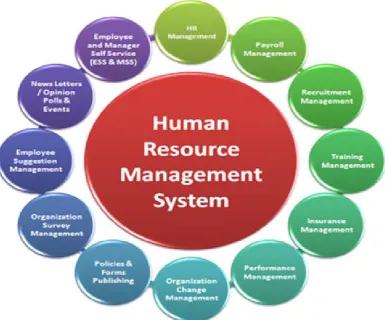
Employee satisfaction relies not only on quality of work and environment but also his willing attitude to put hundred percent in the task. It’s the employee efforts, job performance and willingness to work more and better and better with every task which derived from number of factors like work, work load, market value, society, family, and contentment (Kalra and Ghosh 1984; Kahn 1981; Seashore 1975). The need of the hour with the technological advancement to look upon the technical factors to improve the direction of work and efforts related to it. One such contribution in HR practices is through HRIS, which is not only managing talent, compensation, performance, retention, employee relation but also industrial relation, grievances, equity of work and pay. Figure 2 exhibits the functions of HRIS, and clarifies its importance in the industry to manage and maintain employees and resources to fetch maximum benefits in this competitive world.
The new derived role of HRIS is improving quality of work life as it covers almost all the aspects of working life of an employee, i.e. from work to stress, safety to security, insurance to benefits and management to maintenance. QWL
in the contemporary work environment, focus on
opportunities, abilities, individual involvement, self -direction and sense of pride (Serey 2006). Figure 3 exhibits the data of the employees from hid date of joining to the date of exit, which make transparency of his contribution to the organization and organization’s contribution to make better workforce with better environment and work towards the satisfaction.
MATERIALS AND METHODS
The research is executed with the objective of improving quality of work life through HRIS, to know the contribution of HRIS in meeting the employee satisfaction with their full commitment towards the organization and to know how organizations can meet the expectations of the employees by using HRIS. To meet the objective, a mixed methodology is adopted to collect the data. A qualitative research has been done by exploring various corporate portals, magazines and websites.
A descriptive research has been done with 16 employees of middle level management and 8 employees of top management of HR department of Nagarro Softwares. Focus group discussion is done with 9 employees of middle level management; structured in-depth interview was made to 5 middle level employees; 2 middle group employees were interviewed in detail and 8 top management employees were made to detailed telephonic conversation. All the middle and top management group were asked the same questions in same manner. Care was taken to ensure the privacy of the respondents and their confidentiality is assured.
RESULTS
The participation of males was 57% and female participation was 43%. People, 39 and above age were 43%, between the age of 33–38 were 48% and between the age of 27 – 32 were 9%.
Awareness and usage of the software: All the respondents were aware of the software; the usage in work life was even there but they lack systematic usage of the software. 38% their data in the morning of the next day, 43% dataonly on the work sheets, and 11% on weekends and sometimes some lack to understand where to put the critical information and then they use mailers to transmit the information.
Fig. 1. Depicts factors influencing Quality of Work Life
[image:3.595.88.506.417.720.2]Work and work environment: 88% employees agree that if they put some work related query on HRIS it’s immediately been answered and any issue regarding the environment is also taken care off. But 12% disagrees with the notion and they feel they need to act accordingly to understand the work or environment. Top management finds it easy to pass any critical information related to work through the system and can direct the employees accordingly to perform.
Compensation Management: All employees fully agree that HRIS gives the transparent picture of their compensation i.e. salary received, HRA, TA, DA, bonus, extra benefits, insurance, increment and also clarifies the taxation part.
Balance between work and family: when asked are you able to maintain a balance between work and life, the respondents had mixed opinions. 33% says mostly attains it but on too much work load it get disturbed, 57% says if there is festival or celebration it become difficult to manage both otherwise they are able to balance it out, 10% says if boss is happy work is balanced and if wife is happy home is balanced but when you are content both are balanced.
Motivation: 89% agrees that the clarity on HRIS makes their efforts visible and they are appreciated and motivated to work better with every new project. 11% are neutral as they say initially their efforts were recognized but as one grow up on the ladder all comes to one narrow thought.
Performance Management: 78% strongly agrees that there performance has shown a positive sign with the use of HRIS
perform and then makes necessary changes to meet the objectives. 16 % agrees the notion and 6% were neutral as they say sometimes they use the software so could not check the work progress.
Participation: HRIS has initiated the participation in 82% of employees by keeping the track of regular feedback and suggestions. All the employees feel that they are the part of management and the organization belongs to them.
Training: Through HRIS many employees are been identified for the training to improve the work performances and all employees strongly agrees that this system has not only helped them to improve the work and also helps them to move up in the career growth chart sometimes by training, sometimes motivating them to take up higher education and sometimes help them to have hands on practical aspect of the project.
[image:4.595.108.494.52.372.2]The finding shows that HRIS has most of the information required to make the employees satisfied. The dissatisfied employees are easily observed through their performances, regularity and participation in the organization. If all the employees make a habit of feeding all the information in the software then the transparency of work not only helps the management to face the challenges but also gives them strength to stand up with the best workforce who is ready to fight back. All falls in right place only when employees are rightly be educated in this direction and the importance of HRIS been realized properly. Organization get an advantage on what is done and what can be done…how employees are being motivated, what are their present requirement, are they
overburdened, security is intact, insurance is made for all and finally are they getting a right pay as per their efforts and market competition. This all contributes towards improving the quality of work life and focus that employees are satisfied by meeting many dimension of life.
Conclusion
The results depicts that HRIS takes care of employee records, performance management, compensation, time management, employee participation, relation with senior and subordinate, motivation, balancing work life with family life and ensures healthy work with healthy working environment, which directly contribute towards improving quality of work life.
REFERENCES
Aderman, M. and Tecklenburg, K. 1983. Effect of relaxation training on personal adjustment and perceptions of
organizational climate. Journal of Psychology:
Interdisciplinary and Applied, 115(2), 185-191. doi:
10.1080/00223980.1983.9915434.
Allen, T. D., Herst, D. E. L., Bruck, C. S. and Sutton, M. 2000. Consequences associated with work-to-family
conflict: A review and agenda for future research. Journal
of Occupational HealthPsychology, 5(2), 278-308.
Ashoob, Tag, 2006. “Study the relationship between Quality of Work Life and Organisational Commitment of the High schools of Gonbad-e-Kavus city”, master’s dissertation. Buchanan, D. A. and Boddy, D. 1982. “Advanced technology
and the quality of WorkLife” Journal of Occupational
Psychology, Vol.55, 1-11.
Busslar, L. and Davis, E. 2001 and 2002. “Information System: The quite revolution in human resource
management.” Journal of computer information system, p
7 -17.
Danna, K. and Griffin, R.W. 1999. “Health and Well-being in the Workplace: A review and synthesis of the literature”,
Journal of Management, 25, 357-384.
Datta, Tanmoy, 1999. Quality of Work Life: A Human Values
Approach‖, Journal of Human Values, Vol: 5, No. 2, (Oct),
pp. 135-145.
Hackman, J. and Oldham, G. 1974. The Job Diagnostic Survey, New Haven: Yale University
Havolovic, S.J. 1991. “Quality of Work Life and Human Resource Outcomes IndustrialRelations”, Vol.30, No.3, pp.469-479.
Kahn, R. 1981. Work and health, New York; Wiley.
Kalra, S. and Ghosh, S., 1984. “Quality of Work Life: A study
of associated factors”, The Indian journal of Social Work,
45 – 54
Michael, Kavanagh, Mohan, Thite, Richard, D. and Johnson
2012. “Human Resource Information System” (2nded.)
Sage Publication.
Sahni, 2013. “An Evaluation of Quality of Work Life Practices and Effectiveness in Software Industry of Delhi NCR”,
Journal of Commerce and Management, p. 1- 15.
Seashore, S. 1975. Defining and measuring quality of work life: In the quality of work life problems and prospects and state of art. No. 1.
Serey, T.T. 2006. “Choosing a robust quality of work life”, Business Forum, 27(2), pp7.
Taylor, J.C. Cooper and Mumford E. 1979. “The Quality of Work Life in Western and Eastern Europe”, ABP
Walton, R.E. 1973. “Quality of working life: what it is?”, Solan Management Review, Vol. 15, n.1, p.11-21.
Warr, P. and Wall, T. 1979. “Scales for the measurement of some work attitudes and aspects of psychological
well-being”, Journal of occupational psychology. 52, 129-148.