481
THE EFFECTS OF CUSTOMER SATISFACTION WITH
E-COMMERCE SYSTEM
1ALOTAIBI KHALID, 1OOK LEE, 2MINKYONG CHOI, 2*JONGCHANG AHN
1Co-first author, Department of Information Systems, Hanyang University, Republic of Korea
2Department of Information Systems, Hanyang University, Republic of Korea
*Corresponding author, Department of Information Systems, Hanyang University, Republic of Korea
E-mail: 1 [email protected], [email protected], 2[email protected], *[email protected]
ABSTRACT
With the rapid growth of e-commerce in Saudi Arabia, this country is the biggest e-commerce market in the Arab world. This paper aims to examine the degree of customer satisfaction with e-commerce system in Saudi Arabia using modified American customer satisfaction index (ACSI) model. The model was tested using 149 sample data obtained from online survey. The findings indicate that customer satisfaction with e-commerce system was affected by customer expectation, e-commerce service quality and perceived value. In addition, perceived value was affected by customer expectation and e-commerce service quality, while e-commerce service quality was affected by customer expectation. The findings suggest that e-commerce service quality is main key element affecting customer satisfaction with e-commerce system which is accordance with Saudi Arabian online customers who have more concerns on e-commerce service, particularly related to security and payment method.
Keywords: Customer expectation, Customer Satisfaction, E-commerce, Perceived quality, Service quality
1. INTRODUCTION
Saudi Arabia is one of the greatest countries in Middle East with strong economic system and purchasing power. Therefore, the increase of the Internet consumption has been attributed to the rise in the use of electronic commerce (e-commerce) system is booming globally and locally, leads to e-commerce spending in Saudi Arabia is the largest in the Arab world [1]. Although there is positive growth of e-commerce development, Saudi Arabia is facing several issues regarding information communication technology (ICT). Consequently, they may affect the e-commerce system satisfaction among its consumers. For example infrastructure problem related to ICT affects the online service, particularly, issues related security and payment method cause the dissatisfaction with e-commerce system [2].
In e-commerce context, customer satisfaction is one of the issues frequently discussed by researchers. Customer satisfaction with e-commerce system is crucial issue because of the fact business depends on its customers. Therefore, retaining and maintaining customer is inevitable due
to the fact customer means profit to the business [3]. In addition, Lin et al. [4] emphasized the important of satisfaction with e-commerce system, which is believed to influence customer to repeat purchasing via the system. Frequently examining and analyzing customer satisfaction with e-commerce system should be the main agenda included in business strategy for every e-commerce practitioners.
Although there are many discussions on examining the factors affecting customer satisfaction with e-commerce system, in context of Saudi Arabia, especially from the online customer’s perspective, a few have been found in discussing this issue. In particularly, this paper discusses the issue by adapting American customer satisfaction index (ACSI). Thus, this research takes an opportunity to examine the factors affecting customer satisfaction with e-commerce system using modified ACSI model.
482 previous research (e.g., [1, 5]) and the ACSI model were modified as a base and foundation for this research. Therefore, four important factors (customer expectation, e-commerce service quality, perceived value, and customer satisfaction) were defined for this research. As a result, the study model for this research was identified and developed. The hypotheses were developed to examine each identified relationship in the research model. Overall, this study is conducted to answer the research question: What are the factors influencing the customer’s satisfaction about e-commerce system in Saudi Arabia?
2. LITERATURE REVIEW
2.1 E-commerce and Customer Satisfaction E-commerce is a field of commerce with the use of different networks such as the Internet so that e-commerce provides online sales support operations and customer service. E-commerce can be liked with electronic market where sellers (suppliers, or companies, or shops), intermediaries (brokers) and buyers, continue in providing products and services in the virtual or digital format, and pay the money. In general, it is a comprehensive expression that means any type of business or commercial operations involving the exchange of goods and services at any time via electronic channels and using so-called electronic payment gateways. E-commerce can be achieved through connecting to the Internet, using the credit card and having an address for shipping.
E-commerce offers many benefits; it is not only for individuals but also for the community of people and institutions to the abundance of Internet access and easy access to website through secure electronic payment channels.
One of the primary goals of e-commerce is customer satisfaction. The interested companies in customer's satisfaction are the companies that have reputation and credibility of helping spread and breadth of their business. The customer is always looking for quality and price; therefore, companies seek to earn customer satisfaction by offering affordable prices and multiple services. According to the research [6], the definition of customer satisfaction has been widely debated as organizations increasingly attempt to measure it. Customer satisfaction can be experienced in a variety of situations and connected to both goods and services. It is a highly personal assessment that is greatly affected by customer expectations. Satisfaction also is based on the customer’s experience of both contact with the organization (the
“moment of truth” as it is called in business literature) and personal outcomes. Some researchers define a satisfied customer within the private sector as one who receives significant added value in brief with a definition that may apply just as well to public [6].
2.1.1 Study of e-commerce satisfaction
Because customer satisfaction is important for e-commerce; many researchers conducted researches to investigate the factors influencing customer satisfaction in e-commerce. Schaupp et al. [3] conducted a research to examine the factors influencing the website satisfactions of e-commerce and online community using DeLone and McLean information systems (IS) success model [7, 8] by adapting subjective norms to the model and found out that individual impacts and system quality have significant effects on website satisfaction with e-commerce. This finding indicated that services provided by website system influence on customer satisfaction with e-commerce, particularly timely and faster transaction and search for information. Nusair & Kandampully [9] discussed customers’ satisfaction through quality services in travel sites including quality service's weaknesses and strengths. In their studies, six important criteria in determining customers’ satisfaction (navigability, playfulness, information quality, trust, personalization, responsiveness) were identified based on online sites.
483 security privacy, convenient payment), and iii) post-purchase stage (safe and rapid delivery, customer services). Their findings have showed that only response time does not influence customers’ satisfaction and delivery and customer service play a critical role in Chinese customers’ satisfaction. To satisfy customers in today’s competitive electronic marketplace, online retailers must keep eye close on delivery and customer service.
In the case of Saudi Arabia, Eid [1] conducted a study to identify the factors that influence the extent to which Saudi Arabia consumers trust, are satisfied with and are loyal toward B2C e-commerce. The study indicated that quality of design and the quality of the information affected the satisfaction of customer loyalty in Saudi Arabia and the design quality that greatly helps in gaining the confidence of the customer loyalty. In addition, Algarni et al. [2] in their study about factors that determine customers’ satisfaction of electronic marketplace in Saudi Arabia between student and non-student found out that security, complementary services, strong infrastructures, reliability and regulatory requirements are the factors that determine customers’ satisfaction. In addition, electronic security is one of the most important issues that concerned by users of e-commerce in Saudi Arabia due to the nature of the conservative Saudi Arabia society, addressing the concerns related to electronic security, and this will give greater confidence in dealing with Internet safely.
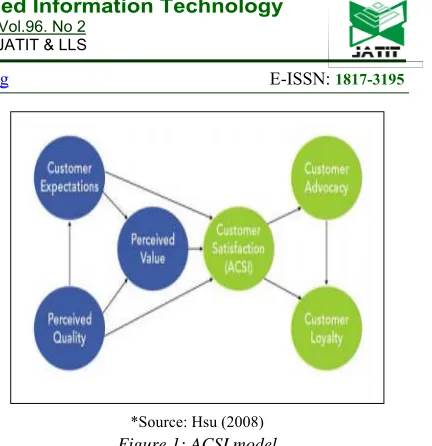
In addition to the factors stated herein above, some studies used ACSI to study customers’ satisfaction [5, 11]. Formally, ACSI is the index that measures the satisfaction of U.S. household consumers including the quality of products and services offered by both foreign and domestic firms that have a significant share in U.S. markets. The ACSI benefits business, researchers, policymakers, and consumers alike by serving as a national indicator of the health of the U.S. economy, as well as a tool for gauging the competitiveness of individual firms and predicting future profitability. The ACSI highlights several factors that influence customers’ satisfaction as can be shown in Figure 1.
[image:3.612.319.535.39.262.2]*Source: Hsu (2008) Figure 1: ACSI model
Hsu [5] adapted ACSI to figure out the electronic customer satisfaction index (e-CSI) which measures customer online shopping satisfaction in Taiwan. The main reason to modify ACSI to e-CSI is to fill the gap between traditional way of shopping and online way of shopping. Instead of customer expectations, trust was used, and the finding showed that all defined relationships in e-CSI have positive significant relationship. In addition, Shi and Zhao [11] adapted the ACSI to measure customers’ satisfaction with banking industry concluded that strong quality consciousness and recognizing ability to product quality, these are the premises of large-scale customer’s satisfaction. The successful of adaption of ACSI to measure customers’ satisfaction with online shopping motivates this study to be conducted.
2.2 E-commerce in Saudi Arabia
Saudi Arabia economy is the largest and strongest in the Arab region because of its location in the center of the world and holds the energy production, so that it's a great e-commerce market in the Arab. While e-commerce is an emerging industry in Saudi Arabia, it has exhibited yearly economic growth compared to more developed markets. The growth of e-commerce in world markets is mirrored in the Saudi market as a result of the growing use of the Internet and continuous improvements in the quality and speed of Internet service. The biggest demographic category of Internet users are young people who are also known for their desire and capacity to purchase goods and services.
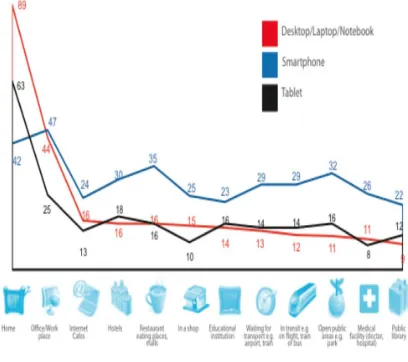
484 people shopping on the Internet today in the Middle East, and electronic trades will grow from $11.2 billion today to $15 billion in 2015. Of that $15 billion, the United Arab Emirates will likely make up the biggest share at $5.1 billion, Saudi Arabia will represent around $2.7 billion, and Qatar $1.25 million. In addition, PayPal Insight reported a large amount of this expenditure is due to trade through mobile devices ($1.5 billion in the United Arab Emirates, $700 million in Saudi Arabia, and $100 million in Qatar). Most of the shoppers in the UAE market depend on tablet devices [12]. Figure 2 shows where the Saudi Arabian making their purchases, indicating customers perform their e-commerce via desktop, smartphone and tablet. Figure 3 presents the sector which customers spend on via e-commerce, indicating travel is the largest, most profitable sector in e-commerce, with customers spending the equivalent of $1,521 per year. The second largest sector is electronics ($250 per client per year), followed by computers ($248), jewelry and watches ($222), and event tickets ($201).
[image:4.612.319.523.99.279.2]*Source: PayPal Insight report [12]
Figure 2: Where Saudi Arabians making their purchases
*Source: PayPal Insight report [12] Figure 3: Sector in Saudi Arabia e-commerce
E-commerce in Saudi Arabia faces some obstacles to prosper and grow including regulations, infrastructure, and the business environment. The Saudi government is still working on the infrastructure for the development of many areas. There is no doubt that information technology in general has evolved significantly the past few years, many obstacles have been treated and Saudi Arabia has become one of the most Middle East countries suited to the field of e-commerce. However, there are remaining observations and failures in some aspects. These are some of the most important obstacles and difficulties facing the development and growth of e-commerce sector in the Saudi Arabia. Below are some obstacles faced by the Saudi Arabia:
Internet access: The key to activating
e-commerce is widespread access to the Internet. Saudi Arabia Internet service fees are high compared with other countries, meaning that Internet service is not available in all public areas. The occasionally slow service also hinders user access to shopping sites. However, in the last five years, Internet service companies have emerged, and the increased competition has meant for better service at an affordable price.
Services Delivery: When purchasing goods
[image:4.612.92.296.414.595.2]485 corporations and other government facility addresses through the "national address".
Payment: The payment method is one of
the most important tools for e-commerce and often is accomplished through credit cards or electronic checks. While there are credit cards in Saudi Arabia, the high fees and other charges for those cards have discouraged the majority of people from using them, which hinders an important aspect in the basics of e-commerce: making payment safe and easy for both parties. There is also a lack of guaranteed bank protection for individuals in the case of piracy or fraud through the Internet. It is expected e-commerce market in Saudi Arabia of the total business transactions over the Internet in 2015 to grow by 8%. According to trend report [13], cash on delivery (COD) is one of the most common means of payment in Saudi Arabia, reflecting the lack of consumer confidence from the payment via the Internet. COD is a type of transaction in which payment for a good is made at the time of delivery. If the purchaser does not make payment when the good is delivered, then the good is returned to the seller.
Consumer Protection Laws: When all
aspects of e-commerce work properly, the consumer will receive the product or service, and naturally prefer the company for future transactions. But when the process breaks down, consumers need ways of enforcing their rights. Therefore, Saudi Arabia should enact special legislation regarding financial transactions through the Internet to protect consumers’ full rights and impose rigorous fines on those responsible for negative incidents. The fear of these fines and sanctions will keep companies providing goods and services responsibly.
3. RESEARCH METHODOLOGY
3.1 Research Model and Hypotheses Development
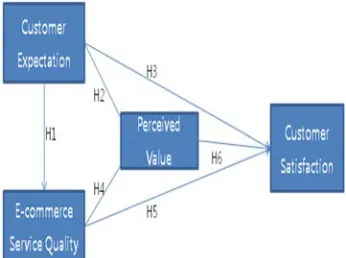
The research model for this research was developed based on the ACSI considering the successful application of the ASCI model to measure customers’ satisfaction with e-commerce [5] and related e-commerce area [11]. The ACSI model was modified in order to formulate the research model as in Figure 4. The main purpose of this research is to measure the customer satisfaction with e-commerce from the Saudi Arabian online customers’ perspective. Therefore, in this study customers’ satisfaction is defined as the degree of customers’ response related to their experience with all aspects of e-commerce system, suggesting that customers experience using e-commerce system surpass their
[image:5.612.350.523.267.396.2]expectation with the e-commerce website [1, 5]. In order words, satisfaction is the consequence of the customer’s experiences during various online purchasing process involves [4, 10], considering the e-commerce environment whereby customers rely on information, service provided through e-commerce system without the physical interaction or meeting between customers and sellers. It is believed that customer satisfaction has positive relationship with customer expectation, e-commerce service quality, and perceived value of the e-commerce system, meaning that those three mentioned factors have a positive significant effect on customer satisfaction with the system.
Figure 4: Research Model
In this research model, four main factors which are customer expectation, e-commerce service quality, perceived value and customer satisfaction were identified. Based on the mentioned factors, hypotheses were developed in order to examine the relationship among the factors. The factors and hypotheses are defined as the following:
Customer expectation – It refers to
expectations that combine customers’ experiences with e-commerce system including the product, services and information provided by e-commerce system at any stage of online shopping process. It is believed that customers’ expectations influence the evaluation of e-commerce service quality, perceived value and customer satisfaction with the e-commerce system [11]. Thus, the hypotheses as the following are suggested:
H1: Customer expectation has a significant effect on e-commerce service quality
H2: Customer expectation has a significant effect on perceived value
H3: Customer expectation has a significant effect on customer satisfaction
E-commerce service quality – It explains
486 with the e-commerce website, including all cues and encounters that occur before, during and after the online transaction [4, 5, 10]. Studies by [5] found out that e-commerce service quality has positive effect on e-commerce customer satisfaction. Furthermore, Eid [1] stated that e-commerce service quality with user interface quality and information quality characteristics has high significant effect on e-commerce customer satisfaction. Thus, the hypotheses below were set.
H4: E-commerce service quality has a significant effect on perceived value.
H5: E-commerce service quality has a significant effect on customer satisfaction.
Perceived value – Perceived value defines
as the costumer’s overall assessment of the utility of a product, based on perceptions of what is received and what is given, for example, the benefits the customer will get and the cost [5], relating to what is offered through the e-commerce can be obtained from the physical products. Lin et al. [4] mentioned that product attributes are one of the most important factors that likely affect the e-commerce customer satisfaction and this is accordance with the ASCI model which features the important of products from the perceived value aspect. It was found out that perceived value is significant effect on customer satisfaction [5, 11]. So that the below hypothesis was developed:
H6: Perceived value has a significant effect on customer satisfaction.
3.2 Data Sample and Data Collection Strategy In this research, data were collected from a sample of various customers with online shopping experience through e-commerce website in Saudi Arabia. Online survey questionnaires were published at several social networking sites as well as were e-mailed to targeted online customers. Data were collected from 2 February 2015 and until 4 March 2015. The questionnaire was prepared into two versions, Arabic and English. The questionnaire consists of two parts. First part is about respondents’ characteristics and respondents’ experiences using e-commerce website. Second part is about the questions on factors affecting customer satisfaction with e-commerce system. As the results, the questionnaire consists of 18 questions to measure the customer’s satisfaction.
3.3 Data Measurement and Analysis Strategy Four constructs (customer expectation, E-commerce service quality, perceived value and customer satisfaction) were identified in this
research. Four (4) items were assigned for each customer expectation and e-commerce service quality construct, and five (5) items were assigned for each perceived value and customer satisfaction construct. All items were measured using a five-point Likert-type scale ranging from “strongly disagree” (1) to “strongly agree” (5). The questionnaire was reviewed by 10 peoples (academic and people with online shopping experience) to ensure a logical arrangement of the questions includes the wording and understandable of the questions.
For data analysis, exploratory factor analysis (EFA) with principle components analysis (PCA) was used to examining the validity constructs. PCA is defined as a technique to emphasize variation and bring out strong patterns in a dataset, which is described by several inter-correlated quantitative dependents variables [14]. To examine the reliability of construct, Cronbach’s alpha was used. Cronbach’s alpha is used to measure the internal consistency, identifying how closely related a set of items are as group [14]. Lastly, multiple linear regressions were used to test the hypotheses [14]. The data analysis is conducted using IBM SPSS v.22 software.
4. RESULTS
4.1 Respondents’ Characteristics
A total 149 data sample collected from the online survey is used for data analysis. All the respondents are from the Saudi Arabia. The respondents’ characteristics are presented and discussed based on the gender, age, education level, employment status, income per month and online shopping experience.
Gender – The distribution of responds according to gender variable shows that 127 of responds are (female) representing (85.2%) of the respondents while 22 of responds were male representing 14.8% of the respondents.
Age – Majority of the respondents 106
(71.1%) of respondents are from the age range 20 to 29 years old, 24 (16.1%) respondents are from the age below 20 years old, 18 (12.1%) respondents are from age range 30 to 39 years old, and 1(0.7%) of respondents were from age range 40 to 49 years old.
Education level – 100 (67.1%) of the
487
Employment status - Mostly of the
respondents were students, which are 91 (61.1%) of respondents were students and 25 (16.8%) of respondents were working in public sector, while 15(10.1%) of respondents were working in private sector. 12(8%) of respondents were unemployed and 6(4%) of respondents were self-employed.
Income per month – 86(57.7%) of
respondents earned less than $1000, 22(14.8%) of respondents earned between $1001 – $2001, 21(14.1%) of respondents earned between $2001 – $3000, 7(4.7%) of the respondents earned between $3001-$4000, 4(2.7%) earned more than $4000. 9(6%) of responds specified the income as unspecified.
Online shopping experience – In this
research, most of the respondents had online shopping experience which are 132 (88.6%) of the respondents. The remaining respondents 17 (11.4%) did not have online shopping experience. For those who had online shopping experience, 99 (75%) of them shopping less than 3 times per month, 18 (13.6%) shopping 3 – 5 times per month, 5 (3.8%) shopping 6-9 times per month, and 10 (7.6%) shopping more than 10 times per months.
4.2 Data validity, Reliability and Correlation
Data validity - The data validity was
checked using PCA with varimax rotation. The Kaiser-Meyer-Olkin (KMO) and Bartlett’s Test of Sphericity was used to examine the sampling adequacy requirements that support inclusion of each item in factor analysis. Table 1 indicates that the value of KMO is above the recommended value 0.600 [14], which is 0.935 with significant p < 0.001 and the Bartlett’s Test of Sphericity was significant = 2320.224, p< 0.001. Therefore, the data fulfill the sampling adequacy requirement and can be used in future analysis.
Table 1: KMO and Bartlett’s Test KMO and Bartlett's Test
Kaiser-Meyer-Olkin Measure of Sampling Adequacy.
.935
Bartlett's Test of Sphericity
Approx. Chi-Square 2320.244
Df 171
Sig. .000
The communality for each item was examined before the data used in the next step of data analysis. Communality is used to check the extent for each item correlates with others items, as Field [14] recommends the communalities value should be above 0.500, value below 0.500 should be
eliminated. Table 2 shows that all the communality values are above 0.500, which is between 0.507 – 0.938, indicating all the extracted components represent the construct well. Thus, all items were used for further analysis.
Table 2: Communalities
Items InitialExtraction
ES1- E-commerce is always available for my commerce activity.
1.000 .675
ES2- E-commerce promptly responds to my requests.
1.000 .731
ES3- E-commerce provides relevant information.
1.000 .623
ES4- E-commerce has well organized appearance.
1.000 .648
CE1- E-commerce should be used easily and quickly.
1.000 .792
CE2- E-Commerce should be safe and protect customer information.
1.000 .938
CE3- E-commerce should function properly. 1.000 .895
CE4- E-commerce should fulfill its promises 1.000 .919
PV1- E-commerce is worth for my money (cheaper, save money).
1.000 .628
PV2- E-commerce is good value for time (save time).
1.000 .507
PV3- E-commerce is good value for product quality.
1.000 .665
PV4 E-commerce is good value for product choice.
1.000 .661
PV5- E-commerce is a convenience. 1.000 .658
CS1- I am satisfied with e-commerce. 1.000 .692
CS2- I am happy with e-commerce. 1.000 .775
CS3- Using E-commerce is a wise decision. 1.000 .663
CS4- E-commerce has met my expectations. 1.000 .730
CS5- I will continue to use e-commerce 1.000 .785
*Extraction Method: Principal Component Analysis.
488
Table 3: Rotation Matrix, Extracted Components
Items
Components (Constructs) E-commerce
service quality
Customer expectation
Perceived Value
Customer Satisfacti
on
ES1 .644
ES2 .648
ES3 .710
ES4 .700
CE1 .785
CE2 .985
CE3 .958
CE4 .975
PV1 .643
PV3 .742
PV4 .518
PV5 .594
CS1 .803
CS2 .832
CS3 .750
CS4 .886
CS5 .660
*Extraction Method: Principal Component Analysis.
Rotation converged in 13 iterations.
Data reliability – The reliability of the data
was examined using Cronbach’s Alpha. From the Table 4, it shows that all the reliability values are above 0.700, ranging from 0.747-0.960, meaning that all the constructs meet the reliability criteria. A construct with a Cronbach’s alpha value of 0.700 or above is considered to be accepted statistically [14].
Table 4: Data Reliability
Constructs Number
of items
Cronbach’s Alpha
E-commerce service
quality 4 0.845
Customer expectation 4 0.960
perceived value 4 0.747
customer satisfaction 5 0.923
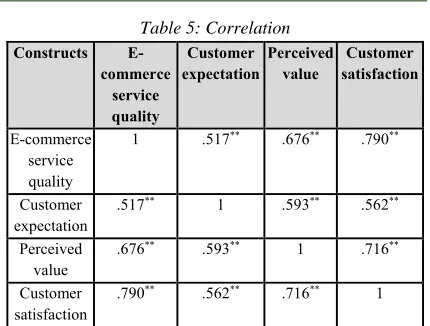
Data correlation – Table 5 presents the
correlation among constructs. The correlation values are in range 0.517 -0.790 with significant level p < 0.01, meaning that the constructs have moderate to high correlation.
Table 5: Correlation
Constructs
E-commerce service quality
Customer expectation
Perceived value
Customer satisfaction
E-commerce service quality
1 .517** .676** .790**
Customer expectation
.517** 1 .593** .562**
Perceived value
.676** .593** 1 .716**
Customer satisfaction
.790** .562** .716** 1
**. Correlation is significant at the 0.01 level (2-tailed).
4.3 Research Findings
The research findings are presented based on three parts named as model. Model 1 explains the relationship between customer expectation (independent variable) and e-commerce service quality (dependent variable). Model 2 explains the relationship between (independent variables; customer expectation, e-commerce service quality) and perceived value (dependent variable). Model 3 explains the relationship between (Independent variables; customer expectation, e-commerce service quality, perceived value) and customer satisfaction (dependent variable).
Model 1 - Overall the regression model for
the relationship between customer expectation and e-commerce service quality was significant at the p < 0.001 level (F: 53.605 with degree of freedom: 1), with adjusted R2 = 0.262) as presented in Table 6. Table 7 indicates that customer expectation had a significant positive effect on E-commerce service quality (β=0.517, t=7.322, p<0.001). Therefore, H1
is supported.
Model 2 - Overall the regression model was
significant at the p < 0.001 level (F: 84.896 with degree of freedom: 2), with adjusted R2 = 0.531) as presented in Table 6. The results of regression analysis as in Table 7 show that customer expectation (β=0.332, t=5.046, p<0.001) and
e-commerce service quality (β=0.505, t=7.676, p<0.001) have significant positive effect on
perceived value of e-commerce. Hence, the hypotheses H2 and H4 are supported.
Model 3 - Overall the regression model was
significant at the p < 0.001 level (F: 109.480 with degree of freedom: 3), with adjusted R2 = 0.687) as presented in Table 6. The results of regression analysis as in Table 7 show that customer expectation (β=0.116, t=1.995, p<0.05),
[image:8.612.90.298.97.342.2]489
p<0.001) have significant positive effect on
[image:9.612.316.526.130.436.2]customer satisfaction with e-commerce. Hence, the hypotheses H3, H5 and H6 are supported.
Table 6: Model 1 – Model Summary
Mod el
R R Squar e Adjuste d R Square Std. Error of the Estimat e Sum of Square d f Mean Squar e
F Sig
.
1 .51
7
.267 .262 3.08663 510.709 1 510.70
9
53.605 .00 0
2 .733 .538 .531 2.3301 846.640 2 423.320 84.896 .000
3 .83
3
.694 .687 2.59271 2207.82
6 3 735.94 2 109.48 0 .00 0 1. Dependent Variable: E-commerce service quality
[image:9.612.91.298.140.301.2]2. Dependent Variable: Perceived value 3. Dependent Variable: Customer satisfaction
Table 7: Coefficients – Regression Analysis Results
Model Unstandardized
Coefficients
Standardized Coefficients
t Sig.
B Std. Error Beta
1
(Constant) 4.968 1.348 3.685 .000
Customer Expectation
.528 .072 .517 7.322 .000
2
(Constant) 4.968 1.019 3.014 .003
Customer Expectation E-commerce service quality .308 .458 .061 .060 .332 .505 5.046 7.676 .000 000 3
(Constant) -.539 1.220 -.442 .659
Customer expectation E-commerce service quality Perceived value .153 .695 .402 .077 .082 .096 .116 .539 .283 1.995 8.473 4.185 .048 .000 .000
1. Dependent Variable: E-commerce service quality 2. Dependent Variable: Perceived value
3. Dependent Variable: Customer satisfaction
4.4 Summary of Hypotheses Testing
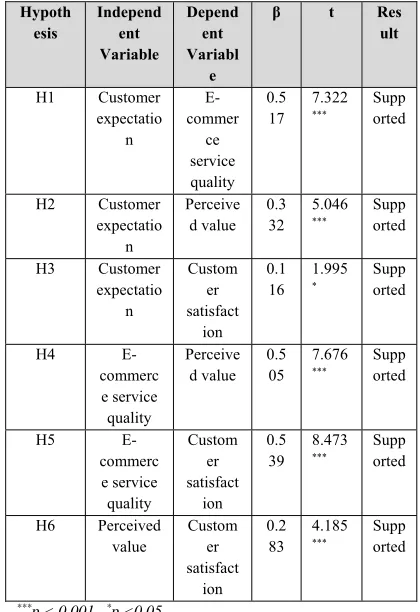
Table 8: Summary of Hypotheses Testing Results
Hypoth esis Independ ent Variable Depend ent Variabl e
β t Res
ult
H1 Customer
expectatio n E-commer ce service quality 0.5 17 7.322 *** Supp orted
H2 Customer
expectatio n Perceive d value 0.3 32 5.046 *** Supp orted
H3 Customer
expectatio n Custom er satisfact ion 0.1 16 1.995 * Supp orted
H4
E-commerc e service quality Perceive d value 0.5 05 7.676 *** Supp orted
H5
E-commerc e service quality Custom er satisfact ion 0.5 39 8.473 *** Supp orted
H6 Perceived
value Custom er satisfact ion 0.2 83 4.185 *** Supp orted
***p < 0.001, *p <0.05
Table 8 shows that all the six (6) research hypotheses were supported. Five (5) hypotheses; H1, H2, H4, H5 and H6 show very strong relationship between identified independent variables and dependent variable with significant level p < 0.001. Meanwhile, H3 was supported at significant level p < 0.05. These results conclude that customer expectation, e-commerce service quality and perceived value are the important elements for e-commerce customer satisfaction.
5. DISCUSSION
[image:9.612.90.299.329.543.2]490 The results indicated that there is strong positively significant relationship between e-commerce service quality and customer satisfaction. This result is consistent with previous studies [1, 4, 5, 10], implying that e-commerce service quality as the important factor must offer good quality of information, service (i.e., security, payment method), system, design and user interface to be emphasized in order to increase the customer satisfaction. This is accordance with Saudi Arabian online customers whereby they concern about security and payment method offer by e-commerce system [13]. Perceived value of e-commerce system also found to be had a significant positive relationship with customer satisfaction with e-commerce system, which is accordance with the previous study by Hsu [5] and Shi and Zhao [11], proving that customers concern with the value they might get from consuming e-commerce system. Therefore, the highest perceived value leads to highest customer satisfaction. As for customer expectation, the results indicated, customer expectation affects the customer satisfaction although the effect is not the strong as both e-commerce service quality and perceived value. This suggests that customer expectation has its own role. Particularly, customer expectation deals with customer anticipation about the service, benefit and product quality offered by e-commerce system, therefore positive expectation leads to customer satisfaction, with is accordance with finding by Shi and Zhao [11].
As for perceived value, the results indicated that customer expectation and e-commerce service quality affect perceived value of e-commerce system. These results are consistent with the study of Hsu [5] and Shi and Zhao [11] indicating, the highest good quality of e-commerce service and the positive customer expectation lead to the highest customer satisfaction. The finding of the customer expectation has a significant effect on perceived value is consistent with the finding of Shi and Zhao [11].
6. CONCLUSION
This research has examined customer satisfaction with e-commerce system in Saudi Arabia using modified ACSI model. Based on the modified ACSI model, the identified relationships among the constructs were examined and tested. The research findings indicated that all identified relationships are significant, explaining that customer satisfaction with e-commerce system was affected by perceived value, e-commerce service quality and customer expectation. In addition,
perceived value was affected by both customer expectation and commerce service quality, and e-commerce service quality was affected by customer expectation. Overall, the results conclude that customer satisfaction with e-commerce relates with customer expectation, e-commerce service quality and perceived value of e-commerce.
The research has its own contributions. In conceptual level, this research offers framework to understand the customer satisfaction with e-commerce system from the three main aspects of customer expectation, e-commerce service quality and perceived value of e-commerce system by giving empirical evidence and highlighting the relationship between customer satisfactions with those aspects. Furthermore, the research findings can contribute to practitioners, particularly provide them a way in what aspect they should emphasize in order to ensure customer satisfaction. These results also can be guideline for the practitioner, for them to develop and enhance their e-commerce strategy.
This research has its own limitations. First, the limitation is related to the sample. The sample consisted of 149 Saudi Arabian and majority of them were from age range 20 – 29 years old. In addition, the sample may be not representing the all areas of Saudi Arabia, because most of the respondents were from the big city of Saudi Arabia. The process of how the data collected using social networking site and e-mail may only reach the targeted sample maybe do not fully represent the all population of Saudi Arabia. Therefore, cautions need to be taken when generalizing these research findings. Second, e-commerce covers several business models. However, this research only covers the business to customer (B2C) context due to the individual customer as the target respondents, although there are some e-commerce business models involve individual as the customer. Lastly, this research modified ACSI model to examine the customer satisfaction with e-commerce system, hence, some e-commerce satisfaction antecedents mentioned in literature and other models were not included in this research.
491 satisfaction should be investigated not only covers the B2C context but other e-commerce business models.
REFERENCES:
[1] Eid, M. I., “Determinants of e-commerce customer satisfaction, trust, and loyalty in Saudi Arabia”, Journal of Electronic Commerce Research, Vol. 12, No.1, 2011, p. 78.
[2] Algarni, F., Cheung, Y., & Lee, V., “An empirical study of eMarketplaces customers' satisfaction: Evidence from Saudi Arabia”, In Service Systems and Service Management (ICSSSM), 2013 10th International Conference, IEEE, 2013, July,pp. 434-439.
[3] Schaupp, L. C., Bélanger, F., & Fan, W., “Examining the success of websites beyond e-commerce: An extension of the IS success model”, Journal of Computer Information Systems, Vol. 49, No. 4, 2009, pp. 42-52. [4] Lin, C. C., Wu, H. Y., & Chang, Y. F., “The
critical factors impact on online customer satisfaction”, Procedia Computer Science, Vol. 3, 2011, pp. 276-281.
[5] Hsu, S. H., “Developing an index for online customer satisfaction: Adaptation of American Customer Satisfaction Index”, Expert systems with Applications, Vol. 34, No. 4, 2008, pp. 3033-3042.
[6] Center for the Study of Social Policy, “Customer satisfaction improving quality and access to services and supports in vulnerable neighborhood”, 2007. Retrieved from http://www.cssp.org/publications/constituents-
co-invested-in-change/customer- satisfaction/customer-satisfaction-what-research-tells-us.pdf. 02/11/2015.
[7] DeLone, W.H. and E.R. McLean, “The DeLone and McLean model of information systems success: a ten-year update”, Journal of Management Information Systems, Vol. 19, No.
4, 2003, pp. 9-30.
[8] Petter, S., W. DeLone and E. McLean, “Measuring IS success: models, dimensions, measures, and interrelationships”, European Journal of Information Systems, Vol. 17, 2008,
pp. 236-263.
[9] Nusair, K., & Kandampully, J., “The antecedents of customer satisfaction with online travel services: a conceptual model”, European Business Review, Vol. 20, No. 1, 2008, pp. 4-19.
[10] Liu, X., He, M., Gao, F., & Xie, P., “An empirical study of online shopping customer satisfaction in China: a holistic perspective”, International Journal of Retail &
Distribution Management, Vol. 36, No. 11,
2008, pp. 919-940.
[11] Shi, B., & Zhao, G., “Introducing ACSI Model to Measure Customer’s Satisfaction for Banking Service”, In Proceedings of the 2007 International Conference on Management Science and Engineering, 2007, pp. 171-175. [12] Ghanem, E., “Connected commerce in the
Middle East”, Paypal Insights E-commerce in the Middle East 2012-2015, WAMDA, 2013.
[13] Al Anbari, H., “Cash on delivery why it does not help e-commerce”, Paypal Insights E-commerce in the Middle East 2012-2015, WAMDA, 2013.