6926
CONTRAST ENHANCEMENT FOR MULTI-MODALITY
IMAGE FUSION IN SPATIAL DOMAIN
1NADA JASIM HABEEB, 2ALI AL-TAEI, 3MOHAMMED FADHIL-IBRAHIM
1Middle Technical University, Technical College of Management, Baghdad, Iraq
2Reconstruction and Projects Office, Ministry of Higher Education and Scientific Research, Baghdad, Iraq
3Middle Technical University, Technical College of Management, Baghdad, Iraq
ABSTRACT
In some scenes that cover a large area, some of the cameras capture images that may be affected by weather conditions or illumination changes, this causes the exposure of these images to a lack of focus, blur, or/and noise. Multi-model image fusion is a significant technique in computer vision and image processing to solve these problems. In this paper, a multi-model image fusion is proposed and presented in three case studies. Each case has a different scheme and all cases have the same goal. The goal of the proposed algorithm is to enhance the source images in spatial domain before fusion process leading to increase the quality of fused image. The techniques, which are used in the proposed method, are Principle Component Analysis, Histogram Equalization; sharpen filter, and Weighted Averaging fusion. Comparison analysis is achieved using some focus measurements to test the performance of the proposed algorithm in the three cases comparing with the baseline fusion techniques. The experimental results showed that the proposed method obtains better performance in preserving gradation contrast and enhancing fused image quality.
Keywords: Multi-model image fusion, Histogram Equalization, sharpen filter, Principle Component Analysis, Weighted Averaging fusion, focus metrics
1. INTRODUCTION
Image fusion is used to improve the quality of image by the combining multiple registered images. Image fusion depends on two factors: (1) image registration and (2) fusing relevant features from the registered images. Image registration is the process which aligns two or more image data sets that are captured in the same scene by different sensors or at different viewpoints [1]. The goal of image fusion is to enhance human visual system, robotic visual system, computer vision, and image processing. Multi-focus images and infrared-visible images are examples of image modalities that are used for better situation awareness and visibility enhancement.
The Multi-modality image fusion
combines the information of registered multi-modality images of same scene. Many applications use multi-modality image fusion such as military applications, robotics, weather forecasting, and so on. In general image fusion is achieved in three levels: pixel-level, feature-level, and decision-level. The pixel-level fusion is the most common level. It is the lower level fusion in which the pixels of the
source images are fused directly. The benefit of this type of fusion is that the fused image contains high accuracy information and more detail information [2]. Compared with the other two levels, the pixel level fusion is computationally efficient, easy to implement and widely used. It can be performed in spatial domain, transform domain, or in both domains. Comprehensive survey of this fusion level can be found in [3].
6927 spatial domain based image fusion. However, some problems of poor image quality still exist [5]. Recent years, many image fusion techniques were proposed. To obtain high-resolution multispectral (MS) image, the panchromatic and MS images are fused in the spatial domain, in [6], the authors proposed a fusion method using non-subsample Shear-let transform (NSST) containing the following steps: First, color space transform using the intensity–hue–saturation transformation. Second, multi-resolution analysis based methods are used to solve the insufficiency of spatial de-tail in resulted images. Third, fusion rules are applied using a guided filter to obtain low-frequency coefficient and using Sum-Modified-Laplacian filter to obtain high-frequency coefficient. Finally, inverse NSST and IHS transform were performed to obtain the final fused image.
Image fusion for medical imaging is an important tool to enhance visual perception. The authors in [7] proposed an image fusion technique to localize anomalies in bone and vessel images. First, Karhunen-Loeve transformations and Rippled transforms are used. Second, the anisotropic diffusion filtering is used to remove noise and artefacts of the result. Finally, the fusion process is applied using Laplacian pyramid decomposition to fuse the obtaining mask and DSA images. In [8], the author presented multi-modality images fusion which exploits the ad-vantages of the transform and spatial domain techniques. First, the source images are decomposed using wavelet transform. Second, the transformed coefficients are fused based on the fusion rules. Third, the initial fused image is acquired using the inverse wavelet transform. Finally, to increase image reliability, the edges of the focused part of input images are extracted and replaced with edges in the initial fused image. The work in [9], the authors provided a fusion method for multi-spectral images by combining Block- DCT and PCA to provide quality enhancement with preserving the spatial resolution.
In [10] the author presented a multi-focus image fusion using combination of lifting DWT and PCA. In this paper. Lifting Wavelet Transform decomposed the input images into four sub-bands. Secondly, the of source images Principal Component Analysis is applied on each sub-band. The new sub-band is generated by selected maximum eigenvector. The fused image is created by performing the Inverse Lifting Wavelet Transform.
The work in [11] the author proposed a multi-sensor image fusion technique for hyperspectral images containing two stages of
guided filter in PCA domain. First, down-sampling is performed on the Higher Resolution of Colour image to the same spatial resolution of low resolution of hyperspectral image, and guided filter is ap-plied to transfer the image details of the down-sampled colour image to the original low resolution of hyperspectral image in the PCA domain. Second, upsampling is applied on the hyperspectral image resulted from the previous stage by using original high resolution of colour image and finally, the guided filter is applied in the PCA domain. The work in [12] proposed a feature level fusion for ear recognition system using PCA. The proposed algorithm divided the input image into blocks, and then PCA is applied on each block. The fusion process is achieved at feature and classification level.
For fusion of two types of medical images, CT-MRI and MRI images, the authors in [13] proposed Image fusion method to fuse the two images using DWT and PCA. DWT decomposes source images into multiscale inputs and then the principal components are evaluated for the coefficients. Weighted average is used as fusion rule to fuse the relevant decomposed elements. In [14], the author developed hybrid Multi-sensor image fusion technique using directional Discrete Cosine Transform and Principal Component Analysis. The input images are segmented into blocks. The fusion process is applied on the corresponding blocks. To achieve the fusion process on the corresponding coefficients between two images, three different fusion rules are used: averaging, choosing maximum energy and choosing maximum absolute value. Principle component analysis based fusion is used to obtain the final fused image.
6928 analysis. Furthermore, it produces dimensional reduction for source images.
The paper is organized as follows: section 2 presents the theory which is related the topics of this research. In section 3 the schemes of the proposed method are presented in three case studies. Section 4 describes the experimental results. Finally, conclusions are presented in section 5.
2. THEORY
2.1 Principle component Analysis
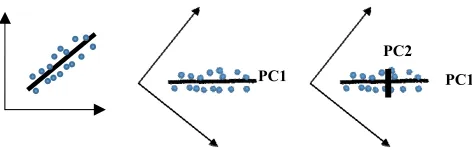
[image:3.612.177.413.449.524.2]The basic idea of Principle Component Analysis (PCA) was to reduce the dimensions of the data set consisting of a large number of variables while maintaining the variance in the data set. PCA transforms the correlated variables into linearly uncorrelated variables, which preserves most of the variation in all the original variables. In other words, a thick line on the left in Fig. 1 indicates to the largest variance, which represents the first component (PC1) and the new x-axis. Then, PCA algorithm searches the new y-axis (PC2) which is orthogonal to the x-axis. The two new dimensions hold the variation in the image data [15, 12].
Fig. 1. Searching Principle Components in 2D-data.
2.2 Histogram Equalization
Histogram Equalization is the most common techniques used for enhancement image contrast in a spatial domain by adjusting image intensities. The contrast is defined as the difference in intensity between two objects in an image. If the contrast is too low, it is impossible to distinguish between two objects and they are seen as a single object. The idea of HE is to spread out the displayed brightness levels in the peak areas and compressing other parts of the histogram [16]. This method is useful when an image has background and foreground are bright at the same time, or are dark at the same time. If there are grey values that
are different from each other in the image, then this method is not produce good results.
2.3 Weighted Averaging Fusion
Pixel weighted averaging based fusion is a simple technique and can be used to remove noise from the source images [17, 24]. The disadvantage of this technique is stressing the salient features of fused image, this will produce a low contrast images. Weighted Averaging of k images is used to solve this problem by using Eq. (1).
, (1)
where Wk is pre-selected weights.
2.4 Sharpen Filter
The main objective of sharpening the image is to increase the clarity of the fine details of the image such as the edges of the objects that suffer from the blur and lack of clarity. Sharpening process is considered as a pre-processing step to increase contrast between bright and dark areas for highlighting the edge features of the image [18].
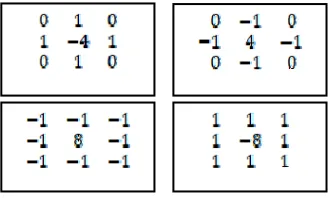
Laplacian operator is the most popular function for sharpening image. It is isotropic derivative operator, which can be defend by the following equations (Eq. (2) and Eq. (3)):
(2)
(3)
PC1 PC1
6929 From the above equations, the Laplacian can be represented as matrices, Fig.2 shows different Laplacian masks.
Fig. 2. Laplacian masks
2.5 Evaluation Metrics
A good result of fusion algorithm should have the following features:
i. The result of fusion algorithm should contain the important information from the input images.
ii. The fused image does not contain any visual artifacts and it should clear for the human observation system, computer vision, and image processing.
iii. The result of fusion algorithm should be empty from noise and blurriness.
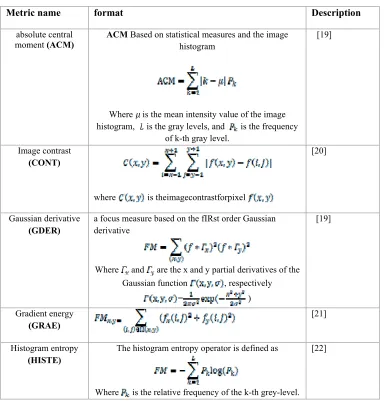
Estimating image focus is an essential problem in computer vision and image processing because a dimension of image is lost during the projection from the tree dimension image in real world to a two-dimension image in digital imaging [19]. In order to evaluate the results of proposed methods, some no-reference focus measure operators were selected. When the reference of the fused image is available, some full-reference quality metrics also were selected. Table 1 (Appendix section) illustrates no-reference focus metrics.
2.6 Proposed Image Fusion
In this work, different visible-infrared images that were captured on different scenes are used to test the proposed fusion method. The proposed method is represented in three case studies, which are presented to show which one
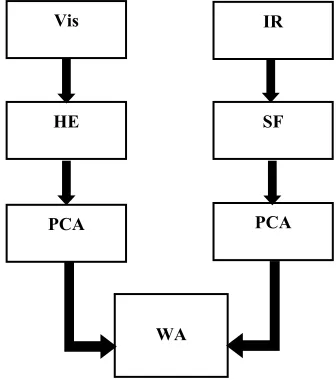
gives better results. The proposed fusion schemes are shown in Fig. 3, Fig.4, and Fig.5.
[image:4.612.123.288.158.257.2]The proposed algorithm in case study (1), Fig.3 can be illustrated as follows:
Firstly, PCA algorithm is applied on both source images (Visible image (Vis) and Infrared image (IR)); PCA plays an important role in dimensional reduction.
Secondly, Histogram Equalization (HE) is applied to the result of PCA for Vis image and Sharpen Filter (SF) is applied to the result of PCA for IR image. The purpose of using HE is to enhance Vis image, which has less quality, and the purpose of using SF is to increase the focus of IR image because in the nature infrared image suffers from blurriness.
[image:4.612.337.511.378.621.2]Finally, the new image is obtained by using pixel wise Weighted Averaging fusion, which fuses enhanced Vis image and focused IR image.
Fig. 3. The scheme of case study (1)
The proposed algorithm in case study (2), Fig.4, can be illustrated as follows: first, HE is applied on Vis image and SF is applied on IR image, then dimension reduction is performed by using PCA for both enhanced images. Finally, the
Vis IR
PCA PCA
HE SF
6930 new image is obtained by using Weighted Averaging fusion, which fuses enhanced Vis image and focused IR image.
Fig. 4. The scheme of case study (2)
[image:5.612.106.274.140.332.2]The proposed algorithm in case study (3), Fig.5, can be illustrated as follows: first, dimension reduction is performed by using PCA for both Vis and IR images, then enhancement of both images is achieved by using HE. Finally, the new image is obtained by using Weighted Averaging fusion to obtain a new image by fusing enhanced Vis and IR images.
Fig. 5. The scheme of case study (3)
3. EXPERIMENTAL RESULTS
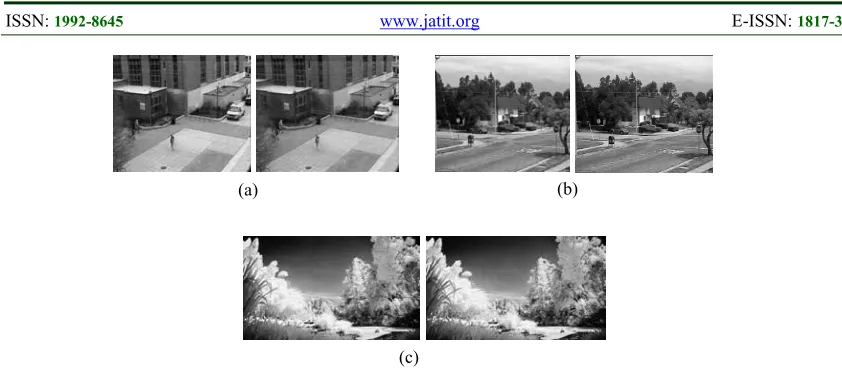
Three types of multi-model images, which are City, Street, and trees scenes (see Fig. 7), were used for testing the performance of the traditional and proposed image fusion methods. The traditional fusion methods that are used in this work are PCA based image fusion and image averaging based fusion.
[image:5.612.380.469.405.449.2]In case (1) and case (2), the fusion algorithm used sharpening Laplacian filter in one time and a proposed sharpen filter in another time to enhance the focus of infrared image. The fusion algorithm, which used the proposed sharpening mask, gives better results than using Laplacian mask. The proposed sharpen mask is illustrated in Fig. 6. An example in Fig. 8 shows the visual results of the proposed method in the case study (1). Table 1 – Table 10 show the numerical results of the comparison of the existing and the proposed methods on multi-model image based on the selected focus operators.
Fig. 6. The proposed sharpen mask
Fig. 7. The source images
Vis IR
PCA PCA
HE SF
WA
Vis IR
PCA PCA
HE HE
AW
(a)
(c)
[image:5.612.99.270.481.687.2]6931
[image:6.612.78.502.318.484.2]Fig. 8. The visual results of the proposed fusion in case study (1)
Table 2. Case (1): Comparison results of the existing and the proposed methods on multi-model image - city scene.
Metrics\Fusion Traditional Method-Averaging
PCA based
fusion with Laplacian filterProposed Method Proposed Method with proposed filter
ACM 3.2986e+04 3.7552e+04 2.9442e+04 3.0668e+04
CONT 36.5613 51.6139 50.0281 57.7596
GDER 174.4109 357.8977 271.7055 326.8693
GLVA 43.5358 61.5151 55.6946 60.8419
GRAE 52.8654 67.1034 72.3240 81.9375
HISE 7.2963 7.7013 7.6674 7.7922
Table 3. Case (1): Comparison results of the existing and the proposed methods on multi-model image - street scene.
Metrics\Fusion Traditional Method-Averaging
PCA based
fusion with Laplacian filterProposed Method with proposed filterProposed Method
ACM 3.3289e+04 3.1668e+04 3.1412e+04 3.1690e+04
CONT 45.6816 40.4842 61.3373 66.7657
GDER 374.6229 307.4507 531.6433 545.4374
GLVA 55.8392 50.0217 67.2259 68.1476
GRAE 58.1348 54.5973 74.4859 81.3452
HISE 7.5375 7.4376 7.9122 7.9299
(a) (b)
[image:6.612.83.506.549.715.2]6932
Table 5. Case (2): Comparison results of the existing and the proposed methods on multi-model image - city scene.
Metrics\Fusion Traditional Method-Averaging
PCA based
fusion with Laplacian filterProposed Method with proposed filterProposed Method
ACM 3.2986e+04 3.7552e+04 3.0102e+04 3.0701e+04
CONT 36.5613 51.6139 56.9112 61.2816
GDER 174.4109 357.8977 294.1329 326.6098
GLVA 43.5358 61.5151 58.3653 61.1399
GRAE 52.8654 67.1034 82.3599 87.9875
[image:7.612.82.507.325.490.2]HISE 7.2963 7.7013 7.7347 7.8011
Table 4. Case (1): Comparison results of the existing and the proposed methods on multi-model image - trees scene.
Metrics\Fusion Traditional Method-Averaging
PCA based
fusion Proposed Method with Laplacian filter Method with Proposed proposed filter
ACM 2.6633e+04 2.6070e+04 2.6472e+04 3.1872e+04
CONT 65.1876 68.5774 107.0621 94.4047
GDER 309.0124 326.7494 300.9039 380.2210
GLVA 59.1195 60.9893 62.4440 72.4164
GRAE 80.0923 81.5718 98.2378 95.9093
HISE 7.6014 7.6397 7.6480 7.9789
Table 6. Case (2): Comparison results of the existing and the proposed methods on multi-model image – street scene.
Metrics\Fusion Traditional Method-Averaging
PCA based
fusion with Laplacian filterProposed Method Proposed Method with proposed filter
ACM 3.3289e+04 3.1668e+04 2.4118e+04 3.1657e+04
CONT 45.6816 40.4842 148.6867 65.0061
GDER 374.6229 307.4507 309.2047 543.8330
GLVA 55.8392 50.0217 60.3118 68.0710
GRAE 58.1348 54.5973 114.2752 78.1101
[image:7.612.83.509.532.698.2]6933
Metrics\Fusion Traditional Method-Averaging
PCA based fusion
Proposed Method with Laplacian filter
Proposed Method with proposed filter
ACM 2.6633e+04 2.6070e+04 3.2081e+04 3.1850e+04
CONT 65.1876 68.5774 84.6064 90.5253
GDER 309.0124 326.7494 394.9926 382.2450
GLVA 59.1195 60.9893 72.7979 72.3497
GRAE 80.0923 81.5718 89.3464 93.5957
[image:8.612.83.522.60.259.2]HISE 7.6014 7.6397 7.9850 7.9837
Table 9. Case (3): Comparison results of the existing and the proposed methods on multi-model image – street
scene.
Metrics\Fusion Traditional Method-Averaging
PCA based fusion Proposed Method
ACM 3.3289e+04 3.1668e+04 3.5299e+04
CONT 45.6816 40.4842 67.5241
GDER 374.6229 307.4507 727.4722
GLVA 55.8392 50.0217 79.0589
GRAE 58.1348 54.5973 76.2235
[image:8.612.84.502.315.468.2]HISE 7.5375 7.4376 7.7476
Table 8. Case (3): Comparison results of the existing and the proposed methods on multi-model image –city scene.
Metrics\Fusion Traditional
Method-Averaging PCA based fusion Proposed Method
ACM 3.2986e+04 3.7552e+04 3.2413e+04
CONT 36.5613 51.6139 48.6591
GDER 174.4109 357.8977 1.0800e+03
GLVA 43.5358 61.5151 66.3982
GRAE 52.8654 67.1034 68.6524
[image:8.612.84.494.535.701.2]6934 For numerical comparative, some focus metrics (see Table (1)) were used. Table (2), Table (3), and Table (4) show the comparison analysis between the traditional and the proposed methods for case study (1)
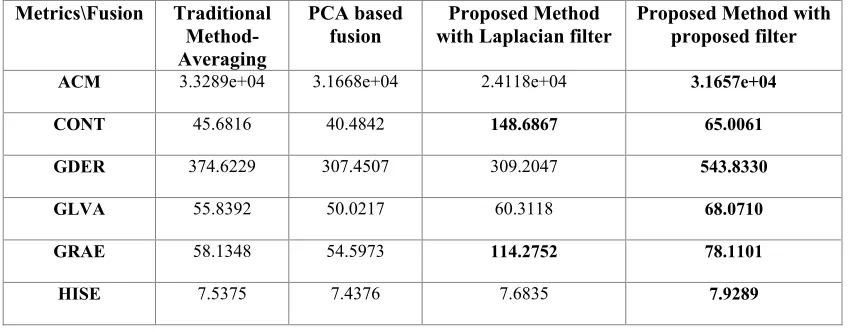
In Table (2), the proposed fusion that uses the proposed sharpen mask gives good quality results compared with the traditional Weighted Averaging fusion and the proposed method using Laplacian filter. Some metric values in PCA based fusion are higher than others in ACM, GDER, and GLVA. In Table (3), the proposed fusion using the proposed sharpen mask produces higher values compared with the others. Except ACM value for traditional Weighted Averaging fusion is highest value. In Table (4), Image contrast (CONT) and Gradient energy (GRAE) forproposed method that uses Laplacian filter indicated good results compared with the others.
Table (5), Table (6), and Table (7) show the numerical analysis between the traditional methods and the proposed methods for case study (2). In Table (5) Proposed Method with proposed sharpening mask gives good quality results, except ACM, GDER, and GLVA for PCA based fusion which produce higher values compared with others.
In table (6), higher quality values are produced by the proposed fusion with using proposed mask against the other fusion methods.
Proposed method with Laplacian filter gives best results in CONT and GRAE metrics and PCA
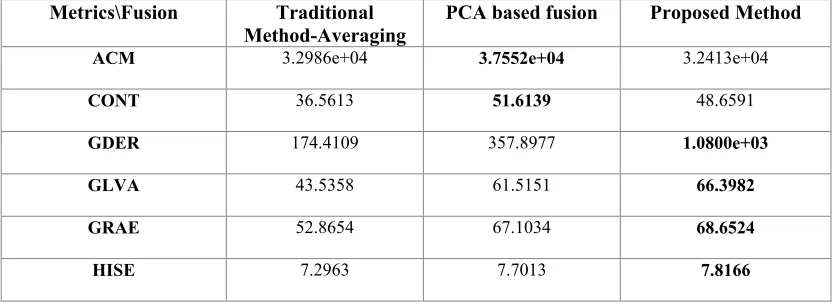
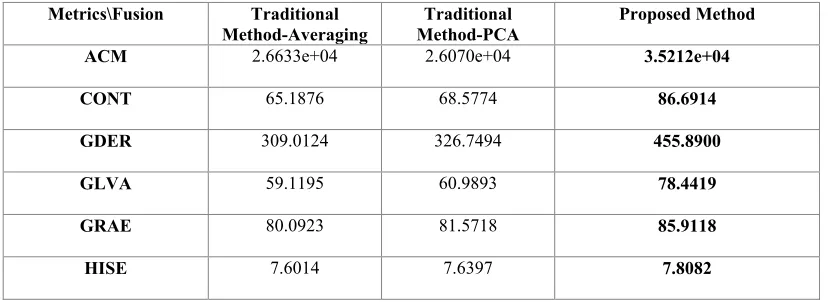
based image fusion also gives good quality value in ACM metric. In Table (7), the proposed fusion method using the proposed mask produces better results. The proposed method using Laplacian mask gives good results in GDER, GDER, and HISE metrics. Table (8), Table (9), and Table (10) show the numerical analysis between the traditional method and the proposed methods for case study (3). In this case, the proposed fusion algorithm produced better results compared with other algorithms, except in Table (8), PCA based fusion produces better results in ACM and CONT
metrics.
4. CONCLUSION
[image:9.612.83.497.141.292.2]In this paper, the proposed multi-model image fusion is presented in three case studies. The techniques that are used in the proposed algorithms are Histogram Equalization, sharpen filters, and Weighted Averaging fusion which is represented as a fusion rule. Histogram Equalization is used to enhance an image that has less contrast quality, while sharpen filters are used to increase the focus for blurry image. The contribution of this research is to enhance the contrast of source images before performing the fusion process. This gives better fusion results. The proposed algorithms were tested on three multi-model image datasets. Comparisons with other fusion approaches were performed using some selected focus metrics. The experimental results of the proposed method showed better results against some baseline approaches. The variation in results during the three cases depends on the features (color, size, texture, and so on) of the source image.
Table 10. Case (3): Comparison results of the existing and the proposed methods on multi-model image – tree scene.
Metrics\Fusion Traditional
Method-Averaging
Traditional Method-PCA
Proposed Method
ACM 2.6633e+04 2.6070e+04 3.5212e+04
CONT 65.1876 68.5774 86.6914
GDER 309.0124 326.7494 455.8900
GLVA 59.1195 60.9893 78.4419
GRAE 80.0923 81.5718 85.9118
6935
REFRENCES:
[1] James, Alex Pappachen, and Belur V. Dasarathy.
"Medical image fusion: A survey of the state of the art." Information Fusion19 (2014): 4-19.
[2] Li, Weisheng, Jia Zhao, and Bin Xiao. "Multimodal medical image fusion by cloud model theory." Signal, Image and Video Processing 12.3 (2018): 437-444. [3] Li, S., Kang, X., Fang, L., Hu, J., & Yin, H. (2017).
Pixel-level image fusion: A survey of the state of the art. Information Fusion, 33, 100-112.
[4] Nandal, Amita, and Hamurabi Gamboa Rosales.
"Enhanced image fusion using dIRectional contrast rules in fuzzy transform domain." SpringerPlus 5.1 (2016): 1846.
[5] Wu, Zhiliang, Yongdong Huang, and Kang Zhang.
"Remote Sensing Image Fusion Method Based on PCA and Curvelet Transform." Journal of the Indian Society of Remote Sensing (2018): 1-9.
[6] Wan, Weiguo, Yong Yang, and Hyo Jong Lee.
"Practical remote sensing image fusion method based on guided filter and improved SML in the NSST domain." Signal, Image and Video Processing (2018): 1-8.
[7] Dogra, Ayush, Bhawna Goyal, and Sunil Agrawal.
"Osseous and digital subtraction angiography image fusion via various enhancement schemes and Laplacian pyramid transformations." Future Generation Computer Systems (2018).
[8] Paramanandham, Nirmala, and Kishore Rajendiran.
"Multi sensor image fusion for surveillance
applications using hybrid image fusion
algorithm." Multimedia Tools and Applications (2017): 1-32.
[9] Saboori, Arash, and Javad Birjandtalab. "Remote
sensing image data fusion using spatial PCA and
average block-DCT." Signal Processing and
Communication Systems (ICSPCS), 2016 10th International Conference on. IEEE, 2016.
[10] Aymaz, Samet, and Cemal Köse. "Multi-focus image
fusion using Stationary Wavelet Transform (SWT) with Principal Component Analysis (PCA)." Electrical and Electronics Engineering (ELECO), 2017 10th International Conference on. IEEE, 2017.
[11] Liao, W., Huang, X., Van Coillie, F., Thoonen, G.,
Pižurica, A., Scheunders, P., & Philips, W. (2016, June). Two-stage fusion of thermal hyperspectral and visible RGB image by PCA and Guided filter. In Hyperspectral Image and Signal Processing: Evolution in Remote Sensing (WHISPERS), 2015 7th Workshop on (pp. 1-4). IEEE.
[12] Tharwat, A., Ibrahim, A., Hassanien, A. E., & Schaefer, G. (2015, June). Ear recognition using block-based principal component analysis and decision fusion. In International Conference on Pattern Recognition and Machine Intelligence (pp. 246-254). Springer, Cham. [13] Vijayarajan, R., and S. Muttan. "Discrete wavelet
transform based principal component averaging fusion for medical images." AEU-International Journal of Electronics and Communications 69.6 (2015): 896-902.
[14] Naidu, V. P. S. "Hybrid DDCT-PCA based multi
sensor image fusion." Journal of Optics 43.1 (2014): 48-61.
[15] SiIirtola, Harri, Tanja Säily, and Terttu Nevalainen.
"Interactive Principal Component Analysis."
Information Visualisation (IV), 2017 21st International Conference. IEEE, 2017.
[16] Russ, John C. The image processing handbook. CRC
press, 2016.
[17] Mönks, Uwe, et al. "Information fusion of conflicting input data." Sensors 16.11 (2016): 1798.
[18] Jeevakala, S. "Sharpening enhancement technique for MR images to enhance the segmentation." Biomedical Signal Processing and Control 41 (2018): 21-30.
[19] Pertuz, Said, Domenec Puig, and Miguel Angel Garcia.
"Analysis of focus measure operators for shape-from-focus." Pattern Recognition 46.5 (2013): 1415-1432. [20] Nanda, Harsh, and Ross Cutler. "Practical calibrations
for a real-time digital omnidIRectional camera." CVPR Technical Sketch 20 (2001).
[21] H. Xie, W. Rong, L. Sun, Wavelet-based focus measure
and 3-d surface reconstruction method for microscopy images, in: Proceedings of the IEEE/ RSJ International Conference on Intelligent Robots and Systems, 2006, pp. 229–234.
[22] Sun, Yu, Stefan Duthaler, and Bradley J. Nelson.
"Autofocusing in computer microscopy: selecting the optimal focus algorithm." Microscopy research and technique 65.3 (2004): 139-149.
[23] Huang, Wei, and Zhongliang Jing. "Evaluation of focus
measures in multi-focus image fusion." Pattern Recognition Letters 28.4 (2007): 493-500.
6936
APPENDIX
[image:11.612.116.500.197.601.2]Table 1 illustrates the focus operators that are used for testing the performance the algorithms in this work.
Table 1. No Reference Focus Metrics
Metric name format Description
absolute central
moment (ACM) ACM Based on statistical measures and the image histogram
Where is the mean intensity value of the image histogram, is the gray levels, and is the frequency
of k-th gray level.
[19]
Image contrast
(CONT)
where is theimagecontrastforpixel
[20]
Gaussian derivative
(GDER)
a focus measure based on the fIRst order Gaussian derivative
Where and are the x and y partial derivatives of the Gaussian function , respectively
= )
[19]
Gradient energy
(GRAE)
[21]
Histogram entropy
(HISTE)
The histogram entropy operator is defined as