
Journal of Chemical and Pharmaceutical Research, 2014, 6(11):59-69
Research Article
ISSN : 0975-7384
CODEN(USA) : JCPRC5
Comparison of DFT methods for molecular structure and vibrational
spectrum of pyrimidine molecule
Neha Shukla, Achchhe Lal, Vipin B. Singh and Devendra K. Singh
*Department of Physics, Udai Pratap Autonomous College, Varanasi, India
_____________________________________________________________________________________________
ABSTRACT
The effect of ten chosen Density Functional Theory (DFT) methods at various basis sets for predicting the molecular structure, vibrational frequencies and infrared intensities of pyrimidine molecule has been investigated. The exchange functionals DFT employed in this study include local (SVWN), Gradient corrected (BLYP, PW91PW91, mPWPW91, G96LYP, PBEPBE) and hybrid (B3LYP, B3PW91, mPW1LYP, mPW1PW91) and basis sets include Pople basis sets 311G(d,p), 311++G(d,p), 311G(2d,2p), 311++G(2d,2p), 311G(3d,3p) 6-311++G(3d,3p), 6-311G(2df,2pd) 6-311++G(2df,2pd), 6-311G(3df,3pd), 6-311++G(3df,3pd) and Dunning's correlation-consistent basis sets cc-pVDZ, aug-cc-pVDZ, cc-pVTZ and aug-cc-pVTZ. The results are compared with the available experimental data in the gas phase. Bond distances and bond angles computed at the PBEPBE/6-311G (3df, 3pd) level are in good agreement with the available experimental data. The results also indicate that for the vibrational spectrum of pyrimidine, B3LYP/6-311++G(d,p) result shows a good agreement with the experimental results than other DFT methods.
Keywords: DFT Methods, Vibrational Frequencies, Basis Sets, Molecular Structure, Pyrimidine.
_____________________________________________________________________________________________
INTRODUCTION
Pyrimidine (Pd) is the parent heterocyclic of a very important group of compounds that have been studied extensively because of their occurrence in living systems [1, 2]. Pyrimidine and its derivatives possess remarkable biological activity and they have been used widely in the fields ranging from medicinal to industrial applications. The pyrimidine ring system provides a potential binding site for metals and hence any information on their coordinating property is important for understanding the role of metal ions in biological systems, which are extremely vital for many life processes.
A large number of studies on the vibrational spectroscopy of pyrimidine reported after the publication of the papers by Ito et al [3] and Lord et al [4]. These reports describe investigations of the compound in the vapor phase [5], in the neat condensed phases and in solutions [6-9] as well as the results of theoretical predictions [10, 11]. The molecular structure of pyrimidine in the gas-phase was investigated using electron diffraction by Fernholt et al [12] and using rotational spectroscopy by Kisiel et al [13]. The crystal structure of the compound was solved much earlier by Wheatley [14].
another function, which in this case are the spatially dependent electron densities. Hence the name density functional theory comes from the use of functional of the electron density. DFT is among the most popular and versatile methods available in condensed-matter physics, computational physics, and computational chemistry. DFT has been very popular for calculations in solid-state physics since the 1970s. However, DFT was not considered accurate enough for calculations in quantum chemistry until the 1990s, when the approximations used in the theory were greatly refined to improve the exchange and correlation interactions modeling. In many cases the results of DFT calculations for solid state systems agree quite satisfactorily with experimental data. Computational costs are relatively low when compared to traditional methods, such as Hartree–Fock theory and its descendants based on the complex many-electron wave function. Since there are a large variety of DFT methods, choosing appropriate method and basis set are of crucial importance especially when dealing with large biological molecules with hetero-aromatic rings. Previous studies show that select and use of appropriate methods, computational tasks and basis sets are related to the structure under investigation [16, 17]. Numerous reports have been made citing the successes of density functional theory (DFT) compared to conventional methods, in computing molecular and chemical properties such as geometries, harmonic frequencies, and energies [15–17]. Therefore, the DFT method was chosen as the basic method in the present paper for calculating the geometries and vibrational frequencies of Pyrimidine. Yue Yang et al [18,19] and M. Malekzadeh [20] studied the comparative study of various DFT methods for chosen molecules.
The aim of this work is the comparison of a series of different DFT methods and higher basis sets than above studied in order to find a more suitable method and basis set in predicting geometry and vibration spectra of Pyrimidine.
EXPERIMENTAL SECTION
DFT methods can be divided into three groups on the basis of their exchange functional including local, gradient-corrected and hybrid methods. Local exchange functional assumes that exchange-correlation energy at any point in space is only a function of the electron density at that point in space and can be given by the electron density of a homogeneous electron gas of the same density. The only local exchange functional available in Gaussian is the Slater exchange functional (S) [21] which utilizes local VWN [22] correlation functional. Gradient corrected exchange functional assumes that exchange and correlation energies dependent not only on the density but also on the gradient of the density. The gradient-corrected exchange functionals studied include Becke88 (B) [23], Perdew-Wang (PW91)[24] , Modified Perdew-Perdew-Wang by Barone and Adamo (mPW)[25], Gill96 (G96) [26], Perdew-Burke-Ernzerhof (PBE) [27, 28] and the gradient-corrected correlation functionals include Lee, Yang, and Parr (LYP) [29], Perdew-Wang (PW91)[24], Perdew-Burke-Ernzerhof (PBE)[27, 28]. Aside from above "pure" DFT methods, another group of hybrid functionals exists, which include a mixture of Hartree-Fock exchange with DFT exchange-correlation. Hybrid-DFT is a very attractive alternative for the structural and thermo chemical applications due to the good performance and low cost. Becke Three Parameter Hybrid Functional (B3) [30], and one parameter hybrid modified Perdew-Wang (mPW1) exchange functionals of Adamo and Barone [25]. These functional have been proved to be a successful approach to obtain accurate molecular structures, vibrational frequencies and bond energies.
The molecular geometry optimization and frequency calculation of Pyrimidine were performed on the basis of the chosen ten density functional theory (DFT) methods with the program GAUSSIAN 09 [31]. For all computations the starting geometry of Pyrimidine was the same and all computations were carried out in gas phase. The geometries of Pyrimidine have been optimized through the application of ten chosen density functional theory methods including SVWN, BLYP, PW91PW91, mPWPW91, G96LYP, PBEPBE, B3LYP, B3PW91, mPW1LYP, mPW1PW91 with fourteen basis sets including 311G(d,p), 311++G(d,p), 311G(2d,2p), 311++G(2d,2p), 311G(3d,3p) 6-311++G(3d,3p), 6-311G(2df,2pd), 6-311++G(2df,2pd), 6-311G(3df,3pd), 6-311++G(3df,3pd), cc-pVDZ, aug-cc-pVDZ, cc-pVTZ and aug-cc-pVTZ. This was followed by harmonic frequency calculations at the same level of theory and compare the all the normal modes of pyrimidine e.g. ʋ16a, ʋ16b, ʋ6b, ʋ6a, ʋ4,ʋ10b,ʋ11,ʋ17a, ʋ5,ʋ1,ʋ18b,ʋ12,ʋ9a, ʋ15,ʋ3,ʋ14,ʋ19b,ʋ19a,ʋ8b,ʋ8a, ʋ13,ʋ2,ʋ20a, and ʋ7b in the notation of Lord et al [4]. The calculated vibration frequencies
______________________________________________________________________________
RESULTS AND DISCUSSION
The purpose of this calculation on pyrimidine molecule is to compare various DFT methods at 6-311 G(3df,3pd) basis set to calculate the exact level of optimized energy and dipole moment. The results are shown in Table 1. The pyrimidine molecule is found to be most stable at B3LYP level and least stable at SVWN level. Also the dipole moment is maximum at B3PW91 and mPW1PW91 which indicate that strongest intermolecular attraction in optimized structure is at B3PW91 and mPW1PW91.
Table:1 Parameters corresponding to optimized geometry calculated for Pyrimidine with various DFT Methods at 6-311G(3df,3pd) basis set
Sr. No. DFT Method Total Energy (Hartree) Dipole Moment (Debye) 1. SVWN -262.93750959 2.200 2. BLYP -264.32125142 2.159 3. PW91PW91 -264.30983452 2.151 4. mPWPW91 -264.37571362 2.157 5. G96LYP -264.30327111 2.178 6. PBEPBE -264.08422447 2.148 7. B3LYP -264.40970033 2.206 8. B3PW91 -264.30118360 2.207 9. mPW1LYP -264.27718279 2.205 10. mPW1PW91 -264.33811607 2.207
Fig.1. The chemical structure of pyrimidine
Fig.2. The optimized structure of Pyrimidine at B3LYP/6-311(3df,3pd) and number assigned for the atoms
3.1. Optimization parameters calculated with various methods at 6-311G(3df, 3pd) basis set
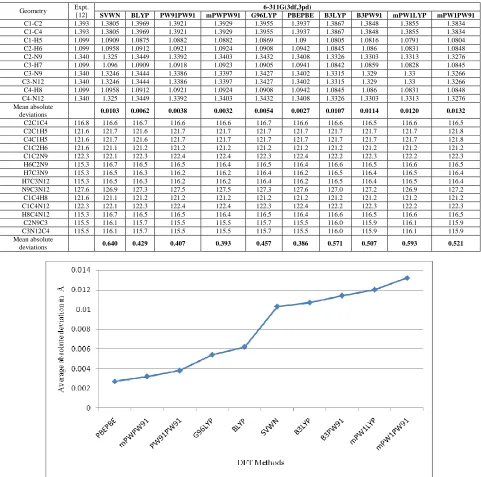
compare the bond lengths obtained from different DFT methods at 6-311G(3df, 3pd), the mean absolute deviations between the calculated and experimental value have been determined. It has been found that bond length calculated by SVWN, BLYP, PW91PW91, mPWPW91, G96LYP, PBEPBE, B3LYP, B3PW91, mPW1LYP and mPW1PW91 have mean absolute deviations of 0.0103 Å, 0.0062 Å, 0.0038 Å, 0.0032 Å, 0.0054 Å, 0.0027 Å, 0.0107 Å, 0.0114 Å, 0.0120 Å and 0.0132 Å respectively. Average absolute deviations for different DFT methods at 6-311G(3df, 3pd) have been shown in figure 3. We see that PBEPBE functional gives the best result in bond length calculation of pyrimidine. Figure 4 shows the correlation between the experimental [12] and calculated bond lenths with PBEPBE method at 6-311(3df,3pd) basis set.
Table 2 Comparison of bond lengths (in Å) and bond angles (in 0) calculated for pyrimidine with various DFT Methods at 6-311G(3df,3pd) basis set
Geometry Expt.
[12]
6-311G(3df,3pd)
SVWN BLYP PW91PW91 mPWPW91 G96LYP PBEPBE B3LYP B3PW91 mPW1LYP mPW1PW91
C1-C2 1.393 1.3805 1.3969 1.3921 1.3929 1.3955 1.3937 1.3867 1.3848 1.3855 1.3834
C1-C4 1.393 1.3805 1.3969 1.3921 1.3929 1.3955 1.3937 1.3867 1.3848 1.3855 1.3834
C1-H5 1.099 1.0909 1.0875 1.0882 1.0882 1.0869 1.09 1.0805 1.0816 1.0791 1.0804
C2-H6 1.099 1.0958 1.0912 1.0921 1.0924 1.0908 1.0942 1.0845 1.086 1.0831 1.0848
C2-N9 1.340 1.325 1.3449 1.3392 1.3403 1.3432 1.3408 1.3326 1.3303 1.3313 1.3276
C3-H7 1.099 1.096 1.0909 1.0918 1.0923 1.0905 1.0941 1.0842 1.0859 1.0828 1.0845
C3-N9 1.340 1.3246 1.3444 1.3386 1.3397 1.3427 1.3402 1.3315 1.329 1.33 1.3266
C3-N12 1.340 1.3246 1.3444 1.3386 1.3397 1.3427 1.3402 1.3315 1.329 1.33 1.3266
C4-H8 1.099 1.0958 1.0912 1.0921 1.0924 1.0908 1.0942 1.0845 1.086 1.0831 1.0848
C4-N12 1.340 1.325 1.3449 1.3392 1.3403 1.3432 1.3408 1.3326 1.3303 1.3313 1.3276
Mean absolute
deviations 0.0103 0.0062 0.0038 0.0032 0.0054 0.0027 0.0107 0.0114 0.0120 0.0132
C2C1C4 116.8 116.6 116.7 116.6 116.6 116.7 116.6 116.6 116.5 116.6 116.5
C2C1H5 121.6 121.7 121.6 121.7 121.7 121.7 121.7 121.7 121.7 121.7 121.8
C4C1H5 121.6 121.7 121.6 121.7 121.7 121.7 121.7 121.7 121.7 121.7 121.8
C1C2H6 121.6 121.1 121.2 121.2 121.2 121.2 121.2 121.2 121.2 121.2 121.2
C1C2N9 122.3 122.1 122.3 122.4 122.4 122.3 122.4 122.2 122.3 122.2 122.3
H6C2N9 115.3 116.7 116.5 116.5 116.4 116.5 116.4 116.6 116.5 116.6 116.5
H7C3N9 115.3 116.5 116.3 116.2 116.2 116.4 116.2 116.5 116.4 116.5 116.4
H7C3N12 115.3 116.5 116.3 116.2 116.2 116.4 116.2 116.5 116.4 116.5 116.4
N9C3N12 127.6 126.9 127.3 127.5 127.5 127.3 127.6 127.0 127.2 126.9 127.2
C1C4H8 121.6 121.1 121.2 121.2 121.2 121.2 121.2 121.2 121.2 121.2 121.2
C1C4N12 122.3 122.1 122.3 122.4 122.4 122.3 122.4 122.2 122.3 122.2 122.3
H8C4N12 115.3 116.7 116.5 116.5 116.4 116.5 116.4 116.6 116.5 116.6 116.5
C2N9C3 115.5 116.1 115.7 115.5 115.5 115.7 115.5 116.0 115.9 116.1 115.9
C3N12C4 115.5 116.1 115.7 115.5 115.5 115.7 115.5 116.0 115.9 116.1 115.9
Mean absolute
deviations 0.640 0.429 0.407 0.393 0.457 0.386 0.571 0.507 0.593 0.521
______________________________________________________________________________
[image:5.595.123.476.192.373.2]The calculated bond angles with various DFT methods are very closer to their experimental data. To compare the bond angles obtained from different DFT methods at 6-311G(3df, 3pd), the mean absolute deviations between the calculated and experimental value have been determined. It has been found that bond angle calculated by SVWN, BLYP, PW91PW91, mPWPW91, G96LYP, PBEPBE, B3LYP, B3PW91, mPW1LYP and mPW1PW91 have mean absolute deviations of 0.6360 , 0.4290, 0.4070 , 0.3930, 0.4570, 0.3860, 0.5710, 0.5070 0.5930 and 0.5210 respectively. We again see that PBEPBE functional gives the best result in bond angle calculation of pyrimidine.
Fig.4. Correlation between experimental [12] and PBEPBE/6-311(3df,3pd) calculated bondlength for pyrimidine, Equation: rexp =0.976 rcal+0.032, R2=0.999
3.2. Optimization parameters calculated with PBEPBE methods at various basis sets
Fig.5: Average absolute deviation from experimental value[12] in bond lenths (Å) for different Basis sets for PBEPBE Method
Table 3 Comparison of bond lengths (in Å ) and bond angles (0) calculated for Pyrimidine with PBEPBE method at different basis sets
Geometry Expt.
[12]
PBEPBE
A B C D E F G H I J K L M N
C1-C2 1.393 1.3972 1.3975 1.3945 1.3949 1.3955 1.3958 1.3938 1.3941 1.3937 1.394 1.4014 1.4014 1.3938 1.394
C1-C4 1.393 1.3972 1.3975 1.3945 1.3949 1.3955 1.3958 1.3938 1.3941 1.3937 1.394 1.4014 1.4014 1.3938 1.394
C1-H5 1.099 1.0917 1.0918 1.0898 1.0897 1.0902 1.0902 1.09 1.0898 1.09 1.0898 1.0994 1.0977 1.0898 1.0898
C2-H6 1.099 1.0956 1.0955 1.0939 1.0936 1.0944 1.094 1.0941 1.0937 1.0942 1.0938 1.104 1.1013 1.094 1.0938
C2-N9 1.340 1.3441 1.3442 1.3427 1.3428 1.3426 1.3429 1.3415 1.3416 1.3408 1.3411 1.3477 1.3477 1.3418 1.3418
C3-H7 1.099 1.0953 1.0952 1.0939 1.0934 1.0942 1.0938 1.0942 1.0936 1.0941 1.0936 1.104 1.1003 1.0939 1.0937
C3-N9 1.340 1.3434 1.3434 1.342 1.3420 1.342 1.3421 1.3406 1.3406 1.3402 1.3403 1.3473 1.347 1.3409 1.3409
C3-N12 1.340 1.3434 1.3434 1.342 1.3420 1.342 1.3421 1.3406 1.3406 1.3402 1.3403 1.3473 1.347 1.3409 1.3409
C4-H8 1.099 1.0956 1.0955 1.0939 1.0936 1.0944 1.094 1.0941 1.0937 1.0942 1.0938 1.104 1.1013 1.094 1.0938
C4-N12 1.340 1.3441 1.3442 1.3427 1.3428 1.3426 1.3429 1.3415 1.3416 1.3408 1.3411 1.3477 1.3477 1.3418 1.3418
Mean absolute deviations
0.0041 0.0042 0.0037 0.0039 0.0037 0.0040 0.0029 0.0032 0.0027 0.0030 0.0062 0.0053 0.0031 0.0032
C2C1C4 116.8 116.5 116.6 116.6 116.7 116.6 116.6 116.6 116.7 116.6 116.6 116.4 116.6 116.6 116.7
C2C1H5 121.6 121.7 121.7 121.7 121.7 121.7 121.7 121.7 121.7 121.7 121.7 121.8 121.7 121.7 121.7
C4C1H5 121.6 121.7 121.7 121.7 121.7 121.7 121.7 121.7 121.7 121.7 121.7 121.8 121.7 121.7 121.7
C1C2H6 121.6 121.2 121.2 121.1 121.2 121.2 121.2 121.1 121.2 121.2 121.2 121.1 121.2 121.2 121.2
C1C2N9 122.3 122.5 122.4 122.5 122.4 122.5 122.4 122.5 122.3 122.4 122.3 122.7 122.4 122.4 122.4
H6C2N9 115.3 116.3 116.3 116.4 116.4 116.4 116.4 116.4 116.5 116.4 116.5 116.3 116.4 116.4 116.5
H7C3N9 115.3 116.1 116.2 116.1 116.3 116.1 116.3 116.2 116.3 116.2 116.3 115.9 116.2 116.2 116.3
H7C3N12 115.3 116.1 116.2 116.1 116.3 116.1 116.3 116.2 116.3 116.2 116.3 115.9 116.2 116.2 116.3
N9C3N12 127.6 127.8 127.6 127.8 127.5 127.7 127.5 127.7 127.4 127.6 127.4 128.2 127.6 127.6 127.4
C1C4H8 121.6 121.2 121.2 121.1 121.2 121.2 121.2 121.1 121.2 121.2 121.2 121.1 121.2 121.2 121.2
C1C4N12 122.3 122.5 122.4 122.5 122.4 122.5 122.4 122.5 122.3 122.4 122.3 122.7 122.4 122.4 122.3
H8C4N12 115.3 116.3 116.3 116.4 116.4 116.4 116.4 116.4 116.5 116.4 116.5 116.3 116.4 116.4 116.5
C2N9C3 115.5 115.3 115.5 115.3 115.6 115.4 115.6 115.4 115.7 115.5 115.7 115.0 115.5 115.5 115.6
C3N12C4 115.5 115.3 115.5 115.3 115.6 115.4 115.6 115.4 115.7 115.5 115.7 115.0 115.5 115.5 115.6
Mean absolute deviations
0.42 0.37 0.41 0.41 0.41 0.42 0.44 0.44 0.39 0.44 0.53 0.39 0.39 0.43
In above table: A stands for 6-311G(d,p), B stands for 6-311++G(d,p), C stands for 6-311G(2d,2p), D stands for 6-311++G(2d,2p), E stands for 6-311G(3d,3p), F stands for 6-311++G(3d,3p), G stands for 6-311G(2df,2pd), H stands for 6-311++G(2df,2pd), I stands for 6- 311G(3df,3pd), J stands for 6-311++G(3df,3pd), K stands for cc-pVDZ, L stands for Aug-cc-pVDZ, M stands for cc-pVTZ and N stands for Aug-cc-pVTZ.
3.3 Vibrational spectra calculated with various methods at 6-311G(3df,3pd) basis set
[image:6.595.54.545.363.633.2]______________________________________________________________________________
ʋscale=(1.0087-0.0000163 ʋcal) ʋcal cm-1 (1)
The computed vibrational frequencies (scaled values) of the all normal modes of pyrimidine e.g. ʋ16a, ʋ16b, ʋ6b, ʋ6a, ʋ4, ʋ10b,ʋ11,ʋ17a, ʋ5,ʋ1,ʋ18b,ʋ12,ʋ9a,ʋ15,ʋ3,ʋ14,ʋ19b,ʋ19a,ʋ8b,ʋ8a, ʋ13,ʋ2, ʋ20a, and ʋ7b in the notation of Lord et al [4] of
pyrimidine with various DFT methods using 6-311G(3df,3pd) basis set are listed in Table 4. It should be noted that the calculated frequencies are generally higher than the observed frequencies due to observed frequencies contain anharmonic contributions. The anharmonicity of the fundamental frequencies is most often taken into consideration by scaling the calculated harmonic frequencies, and this procedure has been found to work well since the overestimation of vibrational frequencies is fairly uniform. Various scaled vibrational mode for pyrimidine with
SVWN, BLYP, PW91PW91, mPWPW91, G96LYP, PBEPBE, B3LYP, B3PW91, mPW1LYP and mPW1PW91
methods at 6-311G(3df,3pd) basis set are given in the table 4. In order to make a comparison between the experimental and theoretical wave numbers, we have calculated mean absolute deviation which is a frequently used measure of the differences between values predicted by a model and actually observed from the thing being modeled. The mean absolute deviation between the calculated harmonic and observed fundamental vibration frequencies for each method are also given in Table 3. The mean absolute deviation values with SVWN, BLYP, PW91PW91, mPWPW91, G96LYP, PBEPBE, B3LYP, B3PW91, mPW1LYP and mPW1PW91 methods at 6-311G(3df,3pd) basis set are 47 cm-1, 50 cm-1, 45 cm-1, 46 cm-1, 49 cm-1, 47 cm-1, 43 cm-1, 44 cm-1, 48 cm-1 and 49 cm-1 respectively. Average absolute deviations for different DFT methods at 6-311G(3df, 3pd) have been shown in figure 6. It is remarkable that the B3LYP method performs well for the calculation of vibrational frequencies with the mean absolute deviation less than those reported for the other DFT methods. Obviously, B3LYP functional give results in closest agreement with the observed frequencies over the other methods. Figure 7 shows the correlation between the experimental [12] and calculated frequencies with B3LYP method at 6-311++G(d,p) basis set.
Table 4 Comparison of frequencies (in cm-1 ) calculated for Pyrimidine and infrared intensitiesa (Km/mol) with various DFT Methods at 6-311G(3df,3pd) basis sets
Mode Expt.a SVWN BLYP PW91PW91 mPWPW91 G96LYP PBEPBE B3LYP B3PW91 mPW1LYP mPW1PW91
ʋ16b 344 313(3) 330(3) 321(3) 321(3) 328(3) 319(3) 355(3) 347(3) 361(3) 353(3)
ʋ16a 394 386(0) 391(0) 385(0) 385(0) 390(0) 384(0) 412(0) 406(0) 417(0) 410(0)
ʋ6b 567 614(12) 618(11) 613(11) 613(11) 618(11) 611(11) 636(12) 630(12) 640(12) 633(12)
ʋ6a 624 681(4) 676(3) 675(3) 674(3) 677(3) 673(3) 697(3) 694(3) 701(3) 698(3)
ʋ4 679 723(39) 722(34) 721(35) 721(35) 723(35) 720(35) 742(37) 740(38) 746(37) 744(39)
ʋ10b 722 805(2) 797(4) 797(3) 797(4) 799(4) 795(4) 828(5) 827(5) 833(5) 833(5)
ʋ11 806 952(0) 947(0) 947(0) 947(0) 949(0) 945(0) 986(0) 984(0) 993(0) 992(0)
ʋ
17a 870 962(0) 962(0) 963(0) 963(0) 965(0) 961(0) 1003(0) 1001(0) 1010(0) 1010(0)
ʋ5 980 992(0) 965(3) 975(4) 973(4) 967(4) 973(4) 1005(4) 1009(5) 1012(4) 1016(5)
ʋ1 991 994(6) 988(0) 988(0) 988(0) 990(0) 986(0) 1030(0) 1028(0) 1038(0) 1037(0)
ʋ18b 1021 1056(3) 1042(1) 1048(1) 1048(1) 1044(1) 1046(1) 1075(1) 1077(1) 1081(2) 1083(1)
ʋ
12 1066 1062(1) 1050(3) 1054(3) 1053(3) 1053(3) 1052(3) 1086(2) 1085(2) 1092(2) 1092(2)
ʋ9a 1141 1141(1) 1116(4) 1125(3) 1123(3) 1119(3) 1122(2) 1154(3) 1157(2) 1160(3) 1166(2)
ʋ15 1161 1197(9) 1164(1) 1190(7) 1189(6) 1171(6) 1188(7) 1198(4) 1216(7) 1199(4) 1223(8)
ʋ3 1227 1292(0) 1196(9) 1224(2) 1219(3) 1201(3) 1223(2) 1240(7) 1253(3) 1246(7) 1262(2)
ʋ
14 1371 1318(0) 1341(0) 1332(0) 1333(0) 1343(0) 1328(0) 1377(0) 1370(0) 1385(0) 1377(0)
ʋ19b 1402 1394(46) 1367(55) 1377(50) 1375(51) 1370(51) 1373(50) 1418(59) 1422(56) 1427(60) 1432(56)
ʋ
19a 1467 1432(5) 1426(4) 1427(5) 1427(5) 1429(5) 1423(5) 1475(7) 1474(8) 1484(7) 1484(8)
ʋ8b 1570 1571(77) 1512(68) 1535(71) 1533(70) 1517(70) 1533(70) 1582(80) 1596(81) 1594(83) 1611(84)
ʋ8a 1570 1577(48) 1513(27) 1536(34) 1534(33) 1519(33) 1534(34) 1583(40) 1596(44) 1594(42) 1613(48)
ʋ13 3001 2951(16) 2943(14) 2957(15) 2954(16) 2947(16) 2948(16) 3016(14) 3021(16) 3029(14) 3036(15)
ʋ
2 3048 2953(14) 2946(28) 2959(25) 2957(26) 2950(26) 2951(25) 3019(24) 3024(23) 3031(24) 3039(22)
ʋ20a 3083 2960(8) 2956(19) 2969(18) 2965(17) 2960(17) 2959(16) 3028(16) 3032(15) 3041(16) 3048(15)
ʋ7b 3095 3003(5) 2986(16) 3001(13) 3001(13) 2990(13) 2996(12) 3061(10) 3070(9) 3073(10) 3085(8)
Mean absolute
deviation 47 50 45 46 49 47 43 44 48 49
Fig. 6: Average absolute deviation from experimental value[12] in wavenumber (cm-1) for different DFT Methods at 6-311G(3df,3pd) basis
Fig.7. Correlation between experimental [12] and B3LYP/6-311++G(d,p) calculated (scaled) wavenumber for pyrimidine, Equation:
[image:8.595.123.476.391.615.2]______________________________________________________________________________
Fig. 8: Average absolute deviation from experimental value[12] in wavenumber (cm-1) for B3LYP Method at basis sets
Table:5: Comparison of frequencies (in cm-1 ) calculated for Pyrimidine and infrared intensitiesa (Km/mol) with B3LYP method at different basis sets
Mode Expt. A B C D E F G H I J K L M N
ʋ
16b 344 354(3) 348(3) 355(3) 353(4) 354(3) 352(3) 356(3) 355(4) 355(3) 353(4) 355(3) 352(3) 355(3) 354(3)
ʋ16a 394 410(0) 408(0) 411(0) 410(0) 410(0) 408(0) 412(0) 412(0) 412(0) 410(0) 408(0) 409(0) 412(0) 411(0)
ʋ
6b 567 635(11) 635(10) 638(12) 637(11) 636(12) 635(11) 635(13) 635(11) 636(12) 635(11) 630(12) 631(11) 635(12) 634(11)
ʋ6a 624 695(4) 694(3) 697(3) 695(3) 696(3) 694(3) 696(3) 694(3) 697(3) 695(3) 690(4) 689(3) 694(3) 694(3)
ʋ4 679 738(43) 731(44) 738(38) 736(42) 740(37) 736(41) 741(39) 738(41) 742(37) 738(40) 737(32) 734(42) 739(41) 739(40)
ʋ10b 722 824(5) 817(7) 823(3) 819(5) 824(5) 818(5) 827(3) 825(5) 828(5) 823(5) 820(3) 814(5) 826(4) 825(5)
ʋ
11 806 979(0) 969(0) 981(0) 978(0) 982(0) 975(0) 987(0) 985(0) 986(0) 981(0) 973(0) 973(0) 984(0) 985(0)
ʋ17a 870 994(0) 986(0) 998(0) 995(0) 999(0) 990(0) 1003(0) 1000(0) 1002(0) 995(0) 991(0) 992(0) 999(0) 1001(0)
ʋ5 980 1003(5) 1003(0) 1003(4) 1002(4) 1004(4) 1003(4) 1005(5) 1003(4) 1005(4) 1004(4) 1003(5) 1000(4) 1003(4) 1002(4)
ʋ1 991 1019(0) 1003(4) 1024(0) 1020(0) 1025(0) 1017(0) 1029(0) 1027(0) 1029(0) 1023(0) 1017(0) 1018(0) 1027(0) 1028(0)
ʋ
18b 1021 1070(2) 1069(1) 1075(2) 1073(1) 1072(2) 1070(1) 1074(1) 1072(1) 1074(1) 1073(1) 1071(1) 1068(1) 1074(1) 1073(1)
ʋ12 1066 1085(4) 1084(4) 1085(3) 1085(3) 1084(2) 1083(3) 1086(3) 1085(3) 1086(2) 1085(3) 1080(3) 1079(3) 1086(3) 1085(3)
ʋ9a 1141 1149(2) 1148(1) 1153(3) 1151(1) 1150(3) 1149(2) 1153(3) 1151(1) 1154(3) 1152(2) 1147(2) 1144(1) 1152(2) 1151(2)
ʋ15 1161 1200(4) 1202(5) 1191(3) 1193(4) 1195(4) 1196(5) 1198(4) 1198(5) 1199(4) 1200(5) 1212(7) 1208(9) 1200(4) 1198(5)
ʋ3 1227 1238(9) 1238(10) 1238(9) 1236(10) 1238(7) 1237(9) 1239(8) 1237(9) 1239(7) 1238(9) 1248(3) 1244(3) 1239(8) 1237(9)
ʋ14 1371 1373(0) 1373(0) 1381(0) 1380(0) 1377(0) 1377(0) 1377(0) 1378(0) 1377(0) 1376(0) 1360(0) 1364(0) 1378(0) 1377(0)
ʋ19b 1402 1414(61) 1414(59) 1417(61) 1416(61) 1416(59) 1415(59) 1419(60) 1418(60) 1419(59) 1418(59) 1408(54) 1409(54) 1417(61) 1417(59)
ʋ19a 1467 1470(8) 1469(6) 1477(8) 1475(6) 1474(7) 1472(7) 1475(7) 1473(5) 1474(7) 1473(6) 1465(7) 1462(5) 1475(7) 1473(6)
ʋ8b 1570 1581(42) 1580(85) 1580(79) 1578(83) 1580(80) 1578(44) 1582(81) 1579(85) 1583(80) 1580(45) 1590(43) 1583(45) 1582(42) 1580(84)
ʋ8a 1570 1581(82) 1580(46) 1581(38) 1579(42) 1581(39) 1579(83) 1583(41) 1580(45) 1583(40) 1580(84) 1591(79) 1583(83) 1582(83) 1580(44)
ʋ13 3001 3014(14) 3017(14) 3017(14) 3022(13) 3006(14) 3010(13) 3015(15) 3019(15) 3016(14) 3019(14) 3017(14) 3025(13) 3015(15) 3016(14)
ʋ2 3048 3017(25) 3020(18) 3020(25) 3025(17) 3008(24) 3014(17) 3017(25) 3022(18) 3018(24) 3022(18) 3019(26) 3027(18) 3017(23) 3018(18)
ʋ20a 3083 3027(18) 3031(14) 3031(18) 3036(13) 3019(17) 3025(13) 3027(17) 3032(12) 3028(16) 3034(13) 3027(18) 3039(14) 3027(16) 3028(13)
ʋ
7b 3095 3058(10) 3058(9) 3061(11) 3064(9) 3052(10) 3053(9) 3062(11) 3064(9) 3061(10) 3063(9) 3065(9) 3066(9) 3061(10) 3060(9)
Mean absolute deviation
41 38 42 40 42 40 43 42 43 41 41 39 43 42
In above table: A stands for 6-311G(d,p), B stands for 6-311++G(d,p), C stands for 6-311G(2d,2p), D stands for 6-311++G(2d,2p), E stands for 6-311G(3d,3p), F stands for 6-311++G(3d,3p), G stands for 6-311G(2df,2pd), H stands for 6-311++G(2df,2pd), I stands for 6- 311G(3df,3pd), J stands for 6-311++G(3df,3pd), K stands for cc-pVDZ, L stands for Aug-cc-pVDZ, M stands for cc-pVTZ and N stands for Aug-cc-pVTZ.
[image:9.595.21.579.404.655.2]3.4 Vibrational spectra calculated with B3LYP method at various basis sets
The calculated frequencies (scaled with WLS method) together with their intensities and the experimental frequencies given Table 5. It can be seen from Table 5 that the calculated frequencies yielded by B3LYP method at 6-311G(p,d) basis set are significantly overestimated whereas those calculated at 6-311G(3pd,3df) basis sets are closer to the experimental data. The mean absolute deviations between the calculated frequencies and experimental frequencies are 41 cm-1 for 6-311G(d,p), 38 cm-1 for 6-311++G(d,p), 42 cm-1 for 6-311G(2d,2p), 40 cm-1 for 6-311++G(2d,2p), 42 cm-1 for 6-311G(3d,3p), 40 cm-1 for 6-311++G(3d,3p), 43 cm-1 for 6-311G(2df,2pd), 42 cm-1 for 6-311++G(2df,2pd), 43 cm-1 for 6-311G(3df,3pd), 41 cm-1 for 6-311++G(3df,3pd), 41 cm-1 for cc-pVDZ, 39 cm-1 for Aug-cc-pVDZ, 43 cm-1 for cc-pVTZ and 42 cm-1 for Aug-cc-pVTZ. Average absolute deviations at different basis sets for B3LYP method have been shown in figure 8. It is remarkable that the B3LYP/6-311++G(d, p) level afforded the best quality to predict the vibration spectra of Pyrimidine.
CONCLUSION
In this paper, we have carried out DFT calculations on the molecular structure and vibration spectra of pyrimidine. Comparison between the calculated and experimental structural parameters indicates that the PBEPBE/6-311G(3df,3pd) level is clearly superior to all of the remaining DFT levels in predicting the structure of pyrimidine. Comparison between the calculated and experimental fundamental vibrational frequencies of pyrimidine indicate that the B3LYP/6-311G(3df,3pd) level shows better performance in the vibration spectra prediction of pyrimidine.
Acknowledgements
Authors are grateful to Principal, Udai Pratap Autonomos College Varanasi for providing necessary facilities. Neha Shukla and Achchhe Lal are grateful to Santosh Kumar Srivastava for fruitful discussions.
REFERENCES
[1] RK Murray; DK Granner; PA Mayes; VW Rodwell, Harpers Biochemistry, 22th Edition, Prentice Hall International Inc; London, 1990.
[2] SN Pandeya; D Sriram; G Nath; EDe Clercq; IL Farmaco, 1999, 54, 624-628. [3] M Ito; R Shimada; T Kuraishi; W Mizushima, J. Chem. Phys., 1956, 25, 597-598. [4] R Lord; A Marston; FA Miller, Spectrochimica Acta 9, 1957, 113-125.
[5] F Billes; H Mikosch; S Holly, Theochem, 1998, 423, 225-234. [6] JD Simmons; KK Innes, J. Mol. Spectrosc., 1964, 13, 435-437.
[7] G Sbrana; G Adembri; S Califano, Spectrochim. Acta, 1966, 22, 1831-1842. [8] KK Innes; IG Ross; WR Moomaw, J. Mol. Spectrosc., 1988, 132, 492-544.
[9] A Navarro; M Fernandez Go´mez; J.J.L. Gonzale´z; MP Fernandez Liencres; EM Martizez Torres; J Tomkinson; GI Kearley, J. Phys. Chem. A, 1999, 103, 5833-5840.
[10] A Navarro; J Va´zquez; M Montejo; JJL Gonza´lez; GJ Kearley, Chem. Phys. Lett., 2002, 361, 483-491. [11] KV Berezin; VV Nechaev; PM El’kin, Opt. Spectrosc., 2004, 97, 210-220.
[12] L Fernholt; C Romming, Acta Chem. Scand. A., 1978, 32, 271-273.
[13] Z Kisiel; L Pszczolkowski; JC Lopez; JL Alonso; A Maris; W Caminati, J. Mol. Spectrosc., 1999, 195, 332-339.
[14] PJ Wheatley, Acta Crystallogr., 1960, 13, 80-85. [15] K Capelle, Braz. J. Phy., 2006, 36, 1318-1343. [16] KJ Burke, Chem. Phy., 2012, 136, 150901-150901.
[17] JM Nedelec; LL Hench, J. Non-Cryst. Solids., 2000, 277, 106−113. [18] Yue Yang; Hongwei Gao, Spectrochimica Acta A., 2012, 85, 303– 309. [19] Yue Yang; Hongwei Gao, J. Mol. Structure.,2012,1013, 111–118.
[20] Maryam Malekzadeh; Emran Heshmati, J. Korean Chemical Society., 2013, 57, 20-24.
[21] JC Slater, The Self-Consistent Field for Molecular and Solids, Quantum Theory of Molecular and Solids, Vol. 4, McGraw-Hill, New York, 1974.
[22] S J Vosko; L Wilk; M Nusair, Can. J. Phys., 1980, 58, 1200-1211. [23] AD Becke, Phys. Rev. A., 1988, 38, 3098-3100.
[24] JP Perdew; P Ziesche and H. Eschrig (Akademie Verlag, Berlin), In Electronic Structure of Solids, 91th Edition,
1991, 11-20.
______________________________________________________________________________
[26] PMW Gill, Mol. Phys., 1996, 89, 433-445.
[27] JP Perdew; K Burke; M Ernzerhof, Phys. Rev. Lett., 1996, 77, 3865-3868. [28] JP Perdew; K Burke; M. Ernzerhof, Phys. Rev. Lett., 1997, 78, 1396-1396. [29] C Lee; W Yang; RG Parr, Phys. Rev. B., 1988, 37, 785-789.
[30] AD Becke, J. Chem. Phys., 1993, 98, 1372-1377.
[31] MJ Frisch; GW Trucks; HB Schlegel; GE Scuseria; MA Robb; JR Cheeseman; VG Zakrzewski; JA Montgomery; RE Stratmann; JC Burant; S Dapprich; JM Millam; AD Daniels; KN Kudin; MC Strain; O Farkas; J Tomasi; V Barone; M Cossi; R Cammi; B Mennucci; C Pomelli; C Adamo; S Clifford; J Ochterski; GA Petersson; PY Ayala; Q Cui; K Morokuma; DK Malick; AD Rabuck; K Raghavachari; JB Foresman; J Cioslowski; JV Ortiz; BB Stefanov; G Liu; A Liashenko; P Piskorz; I Komaromi; R Gomperts; RL Martin; DJ Fox; T Keith; MA Al-Laham; CY Peng; A Nanayakkara; C Gonzalez; M Challacombe; PMW Gill; BG Johnson; W Chen; MW Wong; JL Andres; M Head-Gordon; ES Replogle; JA Pople, Gaussian 09, Revision D.01, Gaussian Inc., Pittsburgh, PA 2003. [32] A Frisch; AB Nielsen; AJ Holder, GAUSSIANVIEW Users Manual, Gaussian Inc., Pittsburgh, PA, 2000. [33] H Yoshida; K Takeda; J. Okamura; A. Ehara; H. Matsuura, Journal of Physical Chemistry A., 2002, 106, 3580–3586.
![Fig.4. Correlation between experimental [12] and PBEPBE/6-311(3df,3pd) calculated bondlength for pyrimidine, Equation: r exp =0.976 rcal+0.032, R2=0.999](https://thumb-us.123doks.com/thumbv2/123dok_us/8763923.895397/5.595.123.476.192.373/fig-correlation-experimental-pbepbe-calculated-bondlength-pyrimidine-equation.webp)
![Fig.5: Average absolute deviation from experimental value[12] in bond lenths (Å) for different Basis sets for PBEPBE Method](https://thumb-us.123doks.com/thumbv2/123dok_us/8763923.895397/6.595.54.545.363.633/average-absolute-deviation-experimental-lenths-different-pbepbe-method.webp)
![Fig. 6: Average absolute deviation from experimental value[12] in wavenumber (cm -1) for different DFT Methods at 6-311G(3df,3pd) basis](https://thumb-us.123doks.com/thumbv2/123dok_us/8763923.895397/8.595.123.476.391.615/average-absolute-deviation-experimental-value-wavenumber-different-methods.webp)
![Fig. 8: Average absolute deviation from experimental value[12] in wavenumber (cm -1) for B3LYP Method at basis sets](https://thumb-us.123doks.com/thumbv2/123dok_us/8763923.895397/9.595.21.579.404.655/average-absolute-deviation-experimental-value-wavenumber-method-basis.webp)
