Bhatai, J.S. and Oaksford, Michael (2015) Discounting testimony with the
argument ad hominem and a Bayesian congruent prior model.
Journal
of Experimental Psychology: Learning, Memory, and Cognition 41 (5), pp.
1548-1559. ISSN 0278-7393.
Downloaded from:
Usage Guidelines:
Please refer to usage guidelines at or alternatively
1
Discounting Testimony with the Argument Ad Hominem
and a Bayesian Congruent Prior Model
Jaydeep Singh Bhatia & Mike Oaksford*
Department of Psychological Sciences
Birkbeck College, University of London, London UK
Running Head: Belief Change, Relevance, and Procedural Rules in Argumentation
Key Words: Bayesian argumentation, ad hominem argument, pragmadialectical theory,
persuasion, procedural approach, epistemic approach
*Corresponding Author: Mike Oaksford
Department of Psychological Sciences Birkbeck College, University of London Malet Street
London, WC1E 7HX, UK
E-mail: [email protected]
Tel: +44 (0) 20 7079 0879
Acknowledgements: We thank Denise Cummins and two anonymous referees for their very
Abstract
When directed to ignore evidence of a witness’ previous bad character because of a violation
of the rules of evidence, are jurors’ beliefs still affected? The intuition is that they will be
because in everyday argumentation, fallacies, like the ad hominem, are effective
argumentative strategies. An ad hominem argument (against the person) undermines a
conclusion by questioning the character of the proposer. This intuition divides current
theories of argumentation. According to pragmadialectical theory (e.g., Van Eemeren &
Grootendorst, 2004) procedural rules exactly like the rules of evidence are part of our
cognitive resources for evaluating arguments. If one of these rules is violated, an argument
should be treated as a fallacy and so it should not alter someone’s belief in the conclusion.
Some recent experiments investigating how reasonable these arguments are perceived to be
seem to support this account (Van Eemeren, Garssen, & Meufells, 2009). These experiments
are critiqued from the perspective of the relevance (Walton, 2008, 2009) and epistemic (Hahn
& Oaksford, 2006, 2007; Oaksford & Hahn, 2004) approaches to argumentation. An
experiment investigates the predictions of these approaches for a graded belief change
version of Van Eemeren et al.’s (2009) experiment and the results are modelled using a
Bayesian congruent prior model. These results cannot be explained by the pragmadialectical
approach and show that in everyday argument people are extremely sensitive to the epistemic
relevance of evidence. Moreover, it seems highly unlikely that this can be switched off in
In the court room, many factors affect how persuasive jurors find the arguments put forward
by counsel (Spellman & Schauer, 2012). The arguments presented in court are constrained by
strict procedural rules about, for example, admissible evidence, not asking leading questions
and so on. These procedural rules guarantee the quality of the arguments and evidence.
However, lawyers occasionally violate these rules, intentionally or unintentionally, in order to
influence the jury. For example, counsel may introduce evidence of a witness’ previous bad
character, e.g., media reports of drunkenness or wife abuse. In In the US, under the Federal
Rules of Evidence (2014) this may be inadmissible as irrelevant hearsay but only if the
opposing counsel objects will the judge rule on its admissibility. At this point, she can inform
the jury that the rules of evidence have been violated and direct them to ignore the evidence.
The goal of the arguments put forward in court is to bring about quantitative changes
in jurors’ degrees of belief, ultimately, in the guilt or innocence of the defendant. When the
judge points out that an argument, e.g., the witness abused his wife, violates a rule of
evidence does this affect jurors’ degrees of belief in the conclusions they are asked to
evaluate? Pointing out the violation is intended to remove any effect of the argument on
jurors’ degree of belief but once it has been introduced this seems an unrealistic expectation
(Steblay, Hosch, Culhane, & McWhethy, 2006). 1 Perhaps the most that can be hoped for by
pointing out the violation is that the argument will carry less weight than it would have done
had it been made without violating the rules of evidence.
1 This study is a meta-analysis of the effects of directing jurors to disregard inadmissible evidence, especially in mock jury studies. There is considerable doubt about the success of such attempts (Steblay, et al., 2006, p 470):
“Eichhorn (1989) reports that “the effectiveness of instructions to disregard evidence has historically been met with skepticism” (p. 342), and quotes Judge Learned Hand, who described such instructions to be “recommendation[s] to the jury of a mental gymnastic which is beyond, not only their powers, but anybody’s else” (Nash v. United States, 1932, p. 1007).”
An explanation of this intuition is that in everyday argument outside the courtroom
people are highly sensitive to evidence relevant to the reliability of testimony. Most of what
people know is learnt from the testimony of others rather than from direct experience and
children are very sensitive to factors, like the status of an informant (peer vs. teacher), that
can affect reliability (Harris, 2012). Consequently, it may be difficult to ignore evidence that
is treated as relevant in everyday argument when instructed to do so in the formal setting of
the courtroom.
While we would contend that this explanation is intuitively correct, it does divide
current theories of argumentation. One current theory proposes that procedural rules exactly
like the rules of evidence are part of our cognitive resources that we use to evaluate
arguments. This approach is the pragmadialectical approach (e.g., Van Eemeren &
Grootendorst, 2004). These rules apply at different stages of an argument. Just as the rule of
evidence dismissing inadmissible evidence of bad character may not apply during the stage in
proceedings when character witnesses are called. If one of these rules is violated, an
argument should be treated as a fallacy and so it should not alter someone’s belief in the
conclusion. Some recent experiments investigating how reasonable these arguments are
perceived to be in everyday contexts (science, politics, domestic) seem to support this
account (Van Eemeren, Garssen, & Meufells, 2009). In this paper, we critique these
experiments from the perspective of the relevance (Walton, 2008, 2009) and epistemic (Hahn
& Oaksford, 2006, 2007; Oaksford & Hahn, 2004) approaches to argumentation. We
investigate the predictions of these approaches for a graded belief change version of Van
Eemeren et al.’s (2009) experiment and model our results using a Bayesian congruent prior
model. These results cannot be explained by the pragmadialectical approach and show that in
Moreover, it seems highly unlikely that this can be switched off in more formal contexts such
as the courtroom.
The argument form we introduced in the first paragraph was the argument ad
hominem, i.e., the attempt to discount someone’s testimony on the grounds of their previous
bad behaviour. We now introduce this argument form, which we used in our experiment, and
the theories that have been put forward to explain when it is acceptable.
Theories of Argumentation and the Argument ad Hominem
Consistent with the courtroom situation,
“Argumentation is a verbal and social activity of reason aimed at increasing (or
decreasing) the acceptability of a controversial standpoint for a listener or reader, by
putting forward a constellation of propositions intended to justify (or refute) the
standpoint before a “rational judge.” (van Eemeren, Grootendorst, & Snoeck
Henkemans, 1996, p. 5).2
This definition applies to the critical discussion in which rationality is relevant. There are
other kinds of argument, like a quarrel, in which rationality, largely, goes out the window. In
this paper, we will be solely concerned with the critical discussion.
The attempt to undermine the credibility of a witness by pointing out their previous
bad character is an instance of the argument ad hominem, i.e., the argument against the
person, which is widely regarded as an argumentative fallacy. In this paper, we concentrate
on this informal argument form. There are three forms of the ad hominem argument and we
used all three in comprehensively testing our intuition about why people seem unable to
ignore evidence of this type.
Ad Hominem Argument Forms
Walton (2000, 2009), who has carried out the definitive work on the ad hominem, defines
three forms of this fallacy. He defines, “An ad hominem argument [as] the use of personal
attack in a dialogue exchange between two parties, where the one party attacks the character
of the other party as bad, in some respect…” (Walton, 2000, p. 102). Walton (2000) provides
the following examples of the different forms of the ad hominem.
The abusive ad hominem. (1) is an example of the abusive form of the ad hominem,
where B is arguing against the advice D has given to A:3
(1) B: Person D knows nothing about cars.
Therefore, D’s argument that you (A) should buy a Ford should not be
accepted.
Accusing someone of lack of knowledge without further substantiation is potentially abusive.
It implies D is of bad character because if D knows nothing about cars she should not be
offering advice on which car to buy.
The circumstantial ad hominem. (2) is an example of the circumstantial ad
hominem:
(2) Person D advocates using company X because it is the best.
D has married the daughter of the CEO of X and so may not be
objective about X being the best.
Therefore D is a bad person.
Therefore D's argument for employing X should not be accepted.
Here there is circumstantial evidence that D would advocate this argument even if A didn’t
personally believe it.
The tu quoque. The third form, is the tu quoque (you too) ad hominem, which is a
special case of the circumstantial which involves D (not) carrying out exactly the actions that
she is advocating other people should (not) carry out, e.g.,
(3) Person D advocates not smoking.
D smokes herself and so cannot be personally committed to not
smoking.
Therefore D is a bad person.
Therefore D’s argument for not smoking should not be accepted.
Logic and the Ad Hominem
The ad hominem argument, in all its guises, is widely regarded as an informal reasoning
fallacy because there is no logical relation between someone’s character and the arguments
they put forward (e.g., Copi & Burgess- Jackson, 1996). For example, you may get better
advice about the best car to buy from a criminal getaway driver than a car salesman. This lack
of a logical relation between evidence and the character of the witness providing it motivates
some of the rules of evidence. Many logic text books, at least since Hamblin (1970), have
also observed that there are many non-fallacious instances of informal fallacies such as the ad
hominem. However, logic cannot provide an analysis of why one instance of the ad hominem
is acceptable but another is not.
Theoretical Approaches to the Ad Hominem
Logic provides a normative theory of the relationship between the premises and conclusion of
an argument which can distinguish when an argument is valid, i.e., when it logically follows
from the premises by the laws of logic. Theories of informal argumentation attempt to
informal reasoning fallacies. We recently reviewed two of these normative theories, the
procedural and epistemic approaches (Hahn & Oaksford, 2012). Here we also consider the
relevance approach specifically to the argument ad hominem (Walton, 2008, 2009)
Procedural approaches. As we mentioned in the introduction, procedural
approaches, such as pragma-dialectical theory (Van Eemeren & Grootendorst, 2004), provide
procedural rules of engagement in a critical discussion like the rules of evidence in the
courtroom on which these theories are partly based. When the judge observes that a rule of
evidence has been violated jurors should treat the argument as a fallacy and reject it in an all
or nothing way just as logical arguments are valid or not. But this will depend on stage in the
proceedings. Counsel may employ exactly the same arguments non-fallaciously, should
character witnesses be called. At this stage in proceedings it is perfectly appropriate to rebut
positive arguments for someone’s character by appeal to evidence of previous bad character.
According to the pragmadialectical approach (Van Eemeren & Grootendorst, 2004),
the ad hominem is a fallacy when using it violates the freedom rule that “discussants may not
prevent each other from advancing standpoints or from calling standpoints into question”
(Van Eemeren, Garssen, & Meufells, 2009, p. 21). This rule can only be violated at the
confrontation stage of an argument when the parties in a critical discussion are agreeing on
the point of contention between them. In (1), according to Van Eemeren et al. (2009), if
person B simply dismisses D’s introduction of whether someone should buy a Ford by using
the abusive ad hominem, the discussion is effectively de-railed and no resolution of the issue
can be forthcoming. On the other hand, if in the subsequent argumentative stage A is
appealing to D as an authority on cars, it is appropriate for B to rebut this argument from
authority by using (1). In a series of experiments, Van Eemeren et al. (2009, 2012) compared
They found that the ad hominem arguments were always treated as less reasonable than the
control.
Van Eemeren et al. (2009) used a graded reasonableness scale as the dependent
variable. This scale should not be confused with the colloquial use of “reasonable”, as in “a
reasonable man” which may admit of degrees. Reasonableness was interpreted as conformity
to the rules of pragmadialectical theory by analogy with logical validity and like logical
validity this is an all or nothing, not a graded concept. However, Van Eemeren et al. (2009)
observed a range of graded effects not consistent with this interpretation of reasonableness.
The use of similar scales has been criticised (Hahn & Oaksford, 2007) in the study of circular
reasoning where again graded effects were observed (Rips, 2002). As for circular reasoning,
Van Eemeren et al.’s (2009) observation of graded effects provides evidence that more is
going on here than evaluating whether the freedom rule has been violated or not.
Relevance. Walton (2008, 2009) analyses the ad hominem as a fallacy of relevance.
He argues that one of the key questions one must ask about, e.g., (1) above, is, “is the
issue of character relevant in the type of dialogue in which the argument was used?” (Walton
2008, p. 4). We can immediately see the issue at stake by considering the stage in
proceedings in the courtroom example. The reason why there is a procedural rule discounting
testimony about the witness’ character is because at most stages of the proceedings it is
irrelevant. However, when character witnesses are called it is directly relevant to rebut
arguments for someone’s good character by appeal to evidence of previous bad character. In
formal settings like the courtroom the procedural rule is there to enforce the principle that
evidence is only admitted when it is relevant. That is, relevance comes first.
This proposal raises the possibility is that at least some pragmadialectical rules of
engagement may be confounded with relevance. An immediate example comes from the
stage of an argument, where the freedom rule is not violated. (4) is an slight adaption to the
format used in this experiment but in all essential details it is the same as in Van Eemeren et
al. (2009).
(4) Person A – “I believe him (D) when he asserts there is nothing to be remarked
about his integrity as a scientist; he has always performed research in an
honest and sound manner.”
Person B – “Do you really believe that? Twice now it has been apparent that
he has fiddled with the results of his research.”
In (4), it is clear that the conclusion in question directly concerns D’s integrity to which his
previous misbehaviour is directly relevant. This factor clearly distinguishes (4) from (1) to (3)
where the relevance of D’s bad character is less direct. It is also clear that nothing about (4)
marks it out as at the argumentative stage in contrast to (1) to (3) which are supposedly at the
confrontational stage in an argumentative dialogue. As we have observed before for other
argument forms (Hahn & Oaksford, 2007; Oaksford & Hahn, 2013), (4) seems like a better
argument than (1) – (3) completely regardless of the stage of the argument.
We conjecture that any attempt to operationalise the pragmadialectical conception of
when the freedom rule is not violated may be doomed to be conflated with when evidence is
relevant. This is because procedural rules in formal contexts, i.e., the courtroom, are
introduced precisely to ensure that jurors are only presented with evidence that is relevant in
the current stage of the proceedings and not at stages where it is irrelevant. However, we
doubt that the cognitive system employs such rules in everyday argumentation, rather than
directly assess relevance. As we suggested in the introduction, this may be why people ignore
the judge’s direction to ignore evidence that violates a rule of evidence: people carry over to
Walton is using “relevant” to mean epistemic relevance to changing our beliefs. This
point is embodied in a second question which, according to Walton (2008, p. 4) we need to
ask, i.e., is the argument that the conclusion (i.e., A should buy a Ford) should be dismissed
outright or simply that our belief in this proposition should be assigned a reduced credibility
against the background of other evidence for this proposition. The epistemic approach to
which we now turn provides a normative account of how credibility should vary in response
to evidence.
Epistemic approaches. Epistemic approaches suggest that the acceptability of a
fallacy is a matter of degree which depends on content and which is predictable using Bayes’
rule (Hahn & Oaksford, 2007, 2012; Korb, 2004; Oaksford & Hahn, 2004; Zenker, 2013).
People’s quantitative changes in degrees of belief in a conclusion, C, bought about by an
argument, a, is treated as Bayesian inference using Bayes’ rule:
( | ) ( | ) ( ) ( | ) ( ) ( | ) ( )
That is, the posterior degree of belief in the conclusion given the argument, Pr(C|a), is a
function of the likelihoods, Pr(a|C) and Pr(a|¬C), and the prior, Pr(C). There are two
measures of interest, argument strength, i.e., the posterior (Pr(C|a)), and argument force, i.e.,
the change in degree of belief from prior to posterior (Pr(C|a) – Pr(C)) (Hahn & Oaksford,
2007) which can also be indexed by the likelihood ratio (Pr(a|C)/Pr(a|¬C)).
The Bayesian approach to the ad hominen depends on the observation that most of
what we know comes from testimony (Spellman & Tenney, 2010) and consequently the
reliability of the source should affect our degrees of belief (Harris, Hsu, & Madsen, 2012;
Oaksford & Hahn, 2013). The abusive ad hominem in (1) suggests that A’s informant D is not
a reliable source of information about cars and so A should downgrade his degree of belief in
not an all or nothing endorse or not endorse prediction based on whether the freedom rule is
violated or not.
Together the relevance and epistemic approaches make some general predictions for
when participants are asked to evaluate Person A’s degree of belief in the conclusion before
(Prior) and after (Posterior) hearing Person B’s argument. First, they predict that peoples’
degree of belief in the conclusion should fall between prior and posterior dependent on how
epistemically relevant B’s assertion of D’s bad character is to the conclusion. Second, the
difference between prior and posterior should be greater in control conditions such as (4)
where B’s assertion of D’s bad character is directly relevant to the conclusion. The
pragmadialectical approach cannot make these predictions because controls like (4) provide
no manipulation of the stage of argumentative discourse, i.e., they do not establish that the
stage of the argument is the argumentative stage (see controls, in Materials in the
Supplemental Materials available on-line). If we observe similar effects using controls like
(4) this can only because the argument in the controls in more directly relevant to the
conclusion than for the ad hominem arguments. Moreover, the epistemic approach should be
able to provide a quantitative Bayesian model of the results. We now flesh out the details
both of these predictions and of the Bayesian model.
Introduction to the Current Experiment
In this experiment, participants were presented with arguments like (5), derived from Van
Eemeren et al. (2009):
(5) Person A – “I agree with him when he says that you have acted extremely
unethically, you did not tell your patients in advance what they would be
exposed to.”
We used a third person argument evaluation paradigm where participants rate the
degree of belief person A would have in a conclusion (you have acted extremely unethically)
before and after hearing Person B’s argument. We used this paradigm because we did not
want to confound participants’ own prior beliefs with those of A. We have shown in other
work that using these third person judgements successfully dissociates participants’
assessments of the beliefs of an interlocutor in the experimental dialogues from their own
prior beliefs (Karaslaan, Hohenberger, Demir, & Oaksford, 2014).4
Experimental Hypotheses
We now outline the specific hypotheses we tested which are based on Van Eemeren et al
(2009, 2012) materials. They investigated three specific predictions for reasonableness
judgements, which we reframe in testing the predictions of the relevance and epistemic
approaches for their effects on belief change:
1. All the ad hominem arguments should be less reasonable than the control, in
which the freedom rule is not violated (see, Procedural approaches).
In the controls we used, B’s assertion of D’s bad character is directly relevant to the
conclusion and there is no intimation that the argument is in the argumetation stage where the
freedom rule is not violated. Consequently, the prediction we tested was:
1'. All the ad hominem arguments should lead to a smaller decrease in degree of
belief than the control.
This hypothesis is directly analogous to the court room scenario as we now show by outlining
the forms of both arguments:
After hearing the witnesses (D’s) testimony the jury (A) believes the conclusion, C, to
degree x (BelA(C) = x).
After hearing counsel’s (B’s) argument (a) that the witness (D ) is of bad character,
the jury (A) should revise their degree of belief to degree y (BelA(C|a) = y), such that,
a. If a is not directly relevant to C , y < x
b. If a is directly relevant to C, y << x
On the relevance/epistemic approach y is still expected be significantly lower than x for the
ad hominem arguments (a.) but the difference should be less than when the argument is
directly relevant (b.). For these materials, the pragmadialectical approach can make no
predictions as the stage of the argumentative dialogue was not manipulated.
Pragmadialectical theory invokes elements of conversational pragmatics in providing
a theory of argumentation. In particular, van Eemeren et al. (2009) argued that politeness
(Brown & Levinson, 1987; Leech, 1983) may be a confounding factor. This factor might
account for variation in judgements of reasonableness, which led to van Eemeren et al.’s
(2009) second and third predictions. We take issue with these predictions arguing again that
what differences there are will be based on epistemic relevance rather than politeness.
2. Conversational pragmatics, here politeness, predicts an ordering in
reasonableness such that abusive < circumstantial < tu quoque.
The colloquial notion of being reasonable seems to subsume being polite. The abusive ad
hominem in particular may be felt to be impolite and so less reasonable in this sense.
However, in (5) politeness seems to have little to do with whether A should discount her
degree of belief that B has behaved unethically. Her initial informant’s (D) status, i.e., Doctor
or not, does seem relevant to D’s reliability as a source of information on this topic. The
other two ad hominem arguments seem even more relevant. The tu quoque suggests that the
informant is being hypocritical, e.g., a Doctor who smokes advising others to quit. The
circumstantial suggests the informant has a conflict of interest, e.g., a Doctor who advises
manufactures it. Whether D is being hypocritical or has a conflict of interest seems highly
relevant to whether A should accept his/her testimony. These factors affect D’s reliability as
a source of information. Consequently, we see no reason a priori for why politeness predicts
this ordering. Any differences are more likely to be related to how relevant in context a
particular argument is to discounting D’s testimony as deriving from an unreliable source.
Consequently, we would predict that the circumstantial and tu quoque would be regarded as
stronger arguments than the abusive. We report results of testing this suggestion in the
Results section.
As we mentioned in the introduction, Van Eemeren et al. (2009) used three different
contexts in their experiment. These were used to rule out a general politeness explanation of
the results.
3. People should regard fallacies in a scientific discussion to be less reasonable
than in the other two discussion contexts.
As the paradigmatic example of a critical discussion in which rationality is paramount, they
argued that the use of argumentative fallacies in a scientific context should be regarded as
less reasonable than in the domestic and political contexts. Moreover, if the ad hominem is
regarded as less reasonable in the science context, this cannot have anything to do with
politeness. The corresponding prediction in the current experiment is that argument force
should be lower for the fallacies in the scientific context compared to the other two contexts.
With respect to the reliability of a source we suspect that context will have more
nuanced effects. Relevance predicts that the main effects (2 & 3) are modified by an
interaction between ad hominem argument type and context. For example, conflicts of
interest seem particularly relevant in a scientific context. Intuitively, we would discount the
research centre because of the obvious potential for a conflict of interest. Thus we predict
that,
3'. In the scientific context the circumstantial ad hominem will lead to the
greatest change in belief.
In a political context, hypocrisy, saying one thing and doing another, would be highly
relevant to whether one trusts what a politician says. Consequently, an obvious prediction
based on epistemic relevance is that,
3''. In the political context the tu quoque ad hominem will lead to the greatest
change in belief.
A Bayesian Approach to Data Analysis and Modelling
We used Bayesian statistics in this paper to avoid the pitfalls of Null Hypothesis Significance
Testing (NHST).The NHST approach traditionally used in psychology to analyse data
presents a variety of problems (e.g., Cumming, 2014; Kruschke, 2010). For example, p values
are not uniquely defined for any particular data set. Moreover, being based on p values, the
confidence intervals that we can attribute to parameter estimates are ill-defined. There are a
variety of recommendations for surmounting these problems for the integrity of
psychological research (e.g., Cumming, 2014; Kruschke, 2010). Here we adopt the Bayesian
approach (Kruschke, 2010, 2011, 2013), which allows us to provide a statistical model
appropriate to the data and compute the posterior probabilities of relevant parameters that can
be used to test any hypothesis about the data in which we are interested (Kruschke, 2010).
The rating scale was converted to the 0 – 1 probability scale. The appropriate
distribution for summarising data on this scale is a Beta distribution, Beta(α, β).5 As the
parameters of the distribution, α and β, are unknown they are estimated from the data by
Bayesian inference by first assigning appropriate prior distributions to the unknown
parameters. As α and β can only take on positive, real values an uninformative Gamma
distribution is appropriate. In this experiment there were 3 × 4 cells in the design and two
measures were taken for each and so 48 parameters needed to be estimated in the full
descriptive model. The posterior values of these parameters can be computed using
hierarchical Bayesian modelling implemented in R (R Development Core Team, 2008) using
the JAGs software (Plummer, 2003).
In a previous model (Oaksford & Hahn, 2013) we modelled probabilities as point
values. Here we adopt a distributional approach. In the Results section, this approach will
enable us in to derive an explanatory model as a simple modification of the descriptive
Bayesian model we used to analyse the data.
Method
Participants
The sample of 142 participants were recruited on-line via the departmental sign up on SONA
systems or by the experimenter and all carried out the experiment on SurveyMonkey (76
females, 66 males; mean age = 29.83 yrs, SD = 11.18; 21.1% White British, 19% Asian
British, 11.3% Black British, 11.3% Black non-British, 11.3% Asian non-British, 7.7% White
non-British, 18.3% Other).
Prospective Bayesian power analysis was used to determine the sample size
(Kruschke, 2013; Meredith, 2014). The results of a previous experiment using pro and con
versions of the ad hominem were used in this analysis (Oaksford & Hahn, 2013). The
difference between degree of belief before and after hearing the argument in the strong prior
belief, con argument condition was used to generate simulated data with mean = -0.19, SD =
.5 SD units, i.e., the goal was to have sufficient power to see large effects. This analysis
indicated that a sample size of 140 would provide a .92 (credible interval = .87 to .97)
probability that the 95% HDI for the effect size would fall outside a .5 SD ROPE.
Design and Materials
The same materials used by Van Eemeren et al (2009) but adapted to a belief change format
were used. As we have seen, these materials consisted of the three argument forms plus a
control crossed with three different contexts, i.e., scientific, political and domestic (full
details are in Materials in the Supplemental Materials available on-line). In our scenarios,
there are always three parties in the discussion. The third party, D, is introduced in Person A’s
opening observation. So, for example, in the abusive, scientific argument, participants first
saw this opening claim in a dialogue between these three interlocuters:
Person A – “I agree with him when he says that you have acted extremely unethically,
you did not tell your patients in advance what they would be exposed to.”
They were then asked to rate on a 7 point scale (from extremely unconvinced to extremely
convinced), how convinced person A is by the third party’s (i.e., D, the referent of “ him” and
“he”) argument. On the next screen, the dialogue continued, i.e., Person B now comments
(Person A’s opening comment remains on screen):
Person B – “What does he know about ethics? He is not a Doctor at all.”
Participants where then asked to rate how convinced A should now be on the same scale. All
participants provided two such ratings for all combinations of argument type and context in a
2 (Rating: Prior vs. Posterior) × 3 (Context: Science vs. Political vs. Domestic) × 4
(Argument Type: Control vs. Abusive vs. Tu Quoque vs. Circumstantial) completely within
In these dialogues, Person A functions as the target of both D’s and B’s arguments,
i.e., it is A whom they are both trying to persuade. As we argued in the introduction, the
reason for constructing the arguments in this way was to try and divorce participants’
judgements as far as possible from their own prior beliefs by asking them to evaluate of how
convinced the third party, A, is by the arguments they both witness.
On completing the argument evaluation task, all participants also completed a ten
item personality inventory (TIPI). We speculated that personality may affect how persuaded
people were by the arguments. Contrary to the persuasion literature in social psychology, we
found no effects of the big five personality traits on argumentation using the ad hominem.
The rationale and results are discussed more fully in the Supplementary Materials:
Personality.
Analysis Strategy
Given the experimental design, it could be asked why did we not analyse the data using a
Bayesian version of a generalised linear model? The answer is straightforward: none of the
predictions under test assume any direct linear relationship between degrees of belief and the
independent variables of context and argument type.
A more involved issue concerns avoiding false alarms or Type 1 errors. In Bayesian
analysis the possibility of false alarms can be mitigated by using prior knowledge about
groups of parameters to define overarching distributions from which these parameters are
drawn. For example, the prior precision, α + β, for all conditions might be assumed to be
drawn from a common distribution as the same participants perform in each condition.
Implementing this assumption in the descriptive model creates shrinkage in the parameter
values toward the mean of the overarching distribution calculated over all the data (not just in
model allows that these parameters are highly content/context dependent, i.e., we would
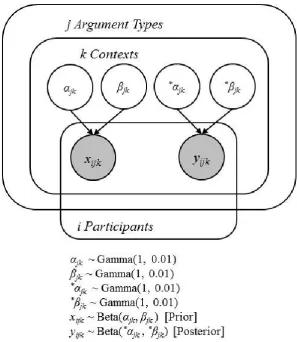
expect the means and precisions to vary between conditions. Figure 1 shows the descriptive
hierarchical Bayesian model used to analyse the data.
FIGURE 1 ABOUT HERE
Results
The rating scale ranges from extremely unconvinced to convinced. It could be argued that this
scale is ambiguous between anchoring the lower end at 0 (convinced not) and .5 uncertain.
We therefore opted for the latter interpretation but we analysed the data using both rescaling
methods and our results were not altered. Consequently, the ratings, x, on a 1 to 7 scale were
converted to probabilities using the conversion (x + 5)/12. Extreme values of 1 were recoded
as .999 to prevent division by zero in the Bayesian hierarchical modelling. The results of the
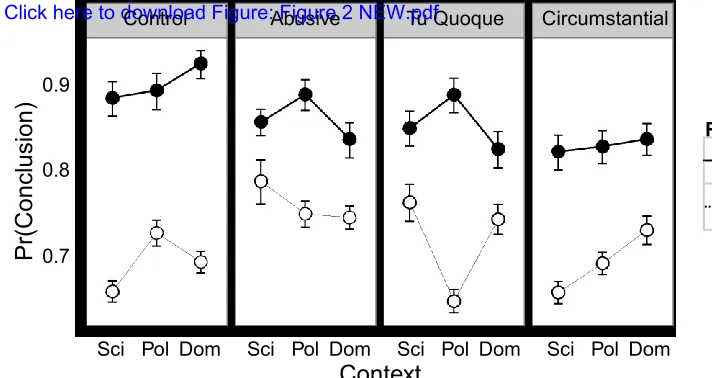
argument evaluation task, with the ratings converted to probabilities, are shown in Figure 2
showing the means of the relevant Beta distribution and the 95% highest density intervals
(HDI) derived from the posterior parameter estimates. Figure 3 shows the Beta density
functions for prior and posterior distributions for each condition with the parameter values
and means.
FIGURE 2 ABOUT HERE
Priors
We first analysed the priors because three expressions were used to express A’s degree of
belief after hearing D’s initial argument, “I think that…” (4), “I believe that…” (5), and “I
agree that…” (3) (number in brackets = no. of times used). This analysis showed that believe
seems to express a marginally stronger degree of belief in a proposition than think but not
agree. The difference between believe and think is small and unlikely to affect our results
(For results, see Appendix 1).
Predictions
We then tested the predictions of the epistemic/relevance approach. Argument force was
indexed as the difference between the posterior and prior means in each condition, which we
designate “Δμ.”6 All twelve of these differences showed large effect sizes. The smallest mean
difference was for the abusive argument in the scientific context (mean prior = .86, mean
posterior = .79), Δμ = .07 [.040, .101] (= 4.53 [2.58, 6.5]).̅𝐸̅̅𝑆̅ 7 All other comparisons showed
even greater effects. These results show that people are indeed highly sensitive to the
epistemic relevance of evidence of bad character in everyday contexts, which explains why in
the courtroom they find it so difficult to ignore inadmissible evidence even when directed to
do so.
Prediction 1. This prediction is that all the ad hominem arguments should lead to a
smaller decrease in degree of belief than the control. The controls are cases where D’s bad
character is directly relevant to the conclusion. Thus there should great prior – posterior
differences for the controls than for the ad hominem arguments. For each argument ad
hominem we compared the average of the means over the three contexts with the same
average for the control, e.g., control vs abusive: Δ𝑚̅ = (Δμ1 + Δμ 2 + Δμ 3)/3 – (Δμ 4 + Δμ 5 +Δμ
6)/3.8 For all comparisons, zero was not a credible value for the difference. For the control
(mean = 0.21) vs. abusive (mean = 0.10), Δ𝑚̅ = .11 [0.09, 0.13] (̅𝐸̅̅𝑆̅ = 10.30 [8.30, 12.20]);
for the control vs. tu quoque (mean = 0.138), Δ𝑚̅ = 0.072 [0.051, 0.093] (= 6.68 [4.71,̅𝐸̅̅𝑆̅
6.97]); for the control vs. circumstantial (mean = 0.137), Δ𝑚̅ = 0.073 [0.054, 0.093] (=̅𝐸̅̅𝑆̅
7.27 [5.33, 9.26]). The control, where the evidence was directly relevant to the conclusion,
led to a greater reduction in degree of belief than the ad hominem arguments, where the
6 The mean μ for each prior and posterior is α/(α + β), where α and β are the parameters of the relevant Beta distribution estimated from the data.
7 𝐸̅̅𝑆̅
evidence was less directly relevant to the conclusion. Consequently, while our results show
the same pattern as Van Eemeren et al (2008), pragmadialectical theory could not explain the
result as the control cannot be identified with the argumentative stage where the freedom rule
is not violated.
It could be argued that these differences are primarily due to differences in the prior
because floor effects are preventing the ad hominem arguments revealing their argumentative
force. However, Figure 1’s y-axis has a range of 0.6 to 0.9, which obscures the fact that there
was room at the floor of the scale (0.5) for participants to reveal reductions in degree of belief
as large as the control. Moreover, if we compare argument strength, rather than force, by
comparing the posterior means the control led to a lower mean posterior degree of belief than
both the abusive (Δ𝑚̅ = 0.068 [0.033, 0.082]; = 9.78 [7.83, 11.70]) and the tu quoque (̅𝐸̅̅𝑆̅ Δ𝑚̅
= 0.025 [0.012, 0.038]; = 3.74 [1.76, 5.67]), although not the circumstantial (̅𝐸̅̅𝑆̅ Δ𝑚̅ = 0.0002
[-0.011, 0.012]; ̅𝐸̅̅𝑆̅ = 0.04 [-1.92, 1.98]) for which zero was a credible value. Consequently,
except for the circumstantial, the results for argument strength replicated the results for
argument force. Moreover, for the circumstantial, there was sufficient room at the floor to
reveal greater force if it possessed it.
Prediction 2. The pragmadialectical prediction of an ordering in argument force such
that tu quoque > circumstantial > abusive fared less well. The circumstantial, Δ𝑚̅ =
0.036[0.015, 0.057] (̅𝐸̅̅𝑆̅ = 3.38 [1.43, 5.34]), and the tu quoque, Δ𝑚̅ = 0.037 [0.015, 0.059] (= 3.27 ̅𝐸̅̅𝑆̅ [1.33, 5.25]), were more forceful than the abusive. However, zero was a credible value for the difference between the circumstantial and the tu quoque, Δ𝑚̅ = -0.001 [-0.022,
0.020] (= -0.09 [-2.02, 1.88]). For argument force the complete ordering was̅𝐸̅̅𝑆̅
circumstantial = tu quoque > abusive. This ordering is consistent with the relevance/epistemic
prediction. As we saw in the introduction, conflicts of interest (circumstantial) and hypocrisy
However, the relevance/epistemic approach makes more nuanced predictions which modify
the effect of ad hominem type by the context of the argument.
Prediction 3. The pragmadialectical prediction that ad hominem arguments would be
less forceful in a scientific context was only partially confirmed. For science (mean = 0.13)
vs political (mean = 0.17), Δ𝑚̅ = 0.066 [0.045, 0.088] (= 6.03 [4.12, 8.03]), but for̅𝐸̅̅𝑆̅
science vs domestic (mean = 0.09), Δ𝑚̅ = -0.014 [-0.036, 0.008] (= -1.22 [-3.18, 0.74]).̅𝐸̅̅𝑆̅
For the last comparison, zero was a credible value for the difference. In sum, the use of an ad
hominem argument was regarded as less forceful in a scientific context than in the political
but not the domestic contexts. The relevance/epistemic approach makes more nuanced
predictions (3' and 3'').
Prediction 3', that the tu quoque, implying hypocrisy, is more relevant in the political
context than the abusive or circumstantial was confirmed. In this context, the tu quoque
(mean = .24) was more forceful than the abusive (mean = .14), Δ𝑚̅ = 0.10 [0.068, 0.137] (̅𝐸̅̅𝑆̅
= 5.85 [3.86, 7.78]) and the circumstantial (mean = 0.14), Δ𝑚̅ = 0.11 [0.072, 0.139] (̅𝐸̅̅𝑆̅ =
6.10 [4.13, 8.04]). Prediction 3'', that the circumstantial, implying a conflict of interest, is
more relevant in the scientific context than the abusive or tu quoque was also confirmed. In
this context, the circumstantial (mean = .17) was more forceful than the abusive (mean = .07),
Δ𝑚̅ = 0.10 [0.056, 0.134] (= 4.81 [2.83, 6.73]) and the tu quoque (mean = 0.09), ̅𝐸̅̅𝑆̅ Δ𝑚̅ =
0.08 [0.040, 0.117] (= 3.96 [2.00, 5.92]). It seems that when considering their effects on̅𝐸̅̅𝑆̅
people’s degrees of belief there is a more complex relationship between context and ad
hominem argument type than considered in van Eemeren et al (2009) but one which makes
A Bayesian Conjugate Prior Model
The explanatory model we propose is itself Bayesian. The two ratings collected for each
argument are participants’ evaluations of (i) interlocuter A’s prior degree of belief before
hearing interlocuter B’s argument and (ii) the posterior degree of belief Person A should now
have in the conclusion after hearing the argument. Our descriptive model computed the
parameters of separate Beta distributions for these two variables for each of the 3 × 4 cells of
the design without any assumption that they were related as prior to posterior distributions. 9
Our explanatory model incorporates this assumption and modifies the model to incorporate
further assumptions relevant to modelling argumentation.
The Beta distribution is a conjugate prior and so the posterior is also a Beta
distribution, Beta(α + α1, β+ β1), with altered shape parameters dependent on the likelihood.
The likelihood function for a Beta conjugate prior is the Bernoulli distribution. Consequently,
α and β correspond to the number of successes and failures respectively or, in terms of
argumentation, the amount of evidence for (α) and against (β) a conclusion. For example, A’s
initial degree of belief might be quite high at say .8, which would correspond to an expected
value of, for example, a Beta(4, 1) distribution because the mean of this distribution is α/(α +
β). Confidence or precision, i.e., α + β, is low. After hearing B, A revises her degree of belief,
to .5, i.e., she is now completely uncertain, which corresponds to the posterior, for example,
Beta(4, 4). That is, they may be uncertain but they are confident of their uncertainty. In this
example, notice that only the β parameter is updated. This is because the argument only
provides evidence against the conclusion and none for the conclusion. Consequently, given
the prior distribution Beta(α, β) the posterior distribution will be Beta(α, β+ β1). This
parameterization contrasts with the descriptive model in which the parameters of these
distributions were not constrained in this way.
In terms of argumentation, the model implies that B’s ad hominem argument has a
cumulative effect on judgements of what A should believe. The argument provides additional
evidence against the conclusion. This approach has the consequence that people should be
more confident, i.e., precision (α + β) should be higher, after hearing the argument. This can
be seen in Figure 3 where the precision (α + β) for the prior and posterior can be directly
compared. There is one exception, the abusive ad hominem in the scientific context, as we
suggest below, when we fit the model, this is probably an outlier. This finding argues against
an evidence retraction model of the ad hominem. In such a model the positive evidence for
the conclusion provided by A’s initial informant D, is retracted, that is, the new posterior
would go back to Beta(1, 1). Bayesian updating cannot account for retraction of evidence of
this sort (see, Kelly & Glymour, 2003).10 Because we first fitted the full descriptive model we
can discount this possibility.
This Bayesian conjugate prior model implies that people represent probabilities as
distributions so that they simultaneously represent their confidence, i.e., precision (α + β) or
more generally the variance, in the expected value, α/(α + β). It is unlikely that probabilities
are represented cognitively or neurally as point values and accounts of neural computation
assume a distributional approach (Doya, Ishii, Pouget, & Rao, 2006; Knill & Pouget, 2004).
Moreover, the parameters of the Beta distribution are interpreted as amounts of evidence,
perhaps counts or weighted counts, for (α) and against (β) the conclusion determined by A’s
initial statement (“I agree..”) and by the argument. These processes are individual
psychological processes. However, in the descriptive model used to test our hypotheses we
calculated the posterior parameter values at the group level. In part, this was a practical
choice: there was not sufficient data to support fitting to individual results. However, there is
a theoretical rationale. This strategy has a psychological interpretation in terms of the
explanatory model. In the absence of data on individual precisions, we assume that each
participant’s probability judgements are made by taking a very small sample, perhaps only
one, from the same underlying distribution. The best estimate of the mean and variance (or
precision, α + β) of this distribution will therefore be given at the group level, i.e., at the level
at which we would normally estimate the variance of any measured random variable.
Similarly, we analysed the explanatory model at the same level.
FIGURE 4 ABOUT HERE
To fit the explanatory model to the data we used the same hierarchical Bayesian
modelling procedure as we did for the descriptive model. That is, we estimated the posterior
parameters of the new model in which the prior is distributed as Beta(α, β) and the posterior
as Beta(α, β+ β1). In this model, β1 can be regarded as a directly estimated index of argument
force. As opposed to the 48 free parameters of the descriptive model, the explanatory model
had only 36 free parameters. Figure 4 shows the fit of the model to the data. Qualitatively, the
model seems to provide almost as good a fit as the full descriptive model but with fewer
parameters. We quantitatively assessed the fits using the Bayesian Information Criterion
(BIC) which penalises models for the number of parameters and is directly related to the
marginal likelihood of the data given the model (Schwarz, 1978).11 A better fit is indicated by
lower values of the BIC. BIC for the descriptive model was 54.27 and for the explanatory
model it was 16.13. Because of the relation to the marginal likelihood, the Bayes factor—the
ratio of marginal likelihoods for each model—can be approximated as (Kass &
Raferty, 1995). The Bayes factor shows that the explanatory model with 12 fewer parameters
was far more likely to have generated the data than the full descriptive model ( is a very
large number).
We also used the directly estimated index of argument force, i.e., β1, as the dependent
variable to assess Predictions 1 to 3. These analyses largely replicated our results using the
descriptive model. There were some inconsequential differences for the priors but the only
substantive change was for Prediction 2. The ordering in argument force was circumstantial >
tu quoque = abusive rather than circumstantial = tu quoque > abusive. The explanatory
model exaggerates the differences for the tu quoque. However, the primary prediction of the
relevance/epistemic account were the more nuanced predictions concerning the relevance of
the tu quoque in political contexts and the relevance of the circumstantial in the scientific
context. Both of these predictions were replicated using β1 as the dependent variable.
Discussion
We began this paper by considering what happens when a lawyer violates the rules of
evidence by pointing out a witness’ previous bad character. Consistent with the results on
disregarding inadmissible evidence (Steblay, et al., 2006), we suggested that even if the
violation is pointed out by the judge, people will nonetheless tend to discount the testimony
and so lower their degree of belief in the conclusion it is intended to support. This intuition
runs counter to procedural approaches which suggest that dialogical rules like the rules of
evidence are part of our cognitive resources for evaluating every day arguments. These rules
may be violated at different stages in an argumentative dialogue. With respect to the ad
hominem argument, the evidence for this position derives from experiments using
reasonableness as a dependent measure. As we noted, this is actually a binary concept but
Van Eemeren et al. (2009) observed graded effects. Moreover, the manipulation of the st age
2007, 2012). As we pointed out, relevance comes first and procedural rules in formal contexts
are there to ensure that only evidence relevant to the particular stage in the proceedings is
heard. We therefore replicated Van Eemeren et al.’s (2009) experiment using a graded belief
change paradigm with a control with no manipulation of the stage of the argument which was
compared with three forms of the ad hominem. The ad hominem arguments all lead to very
large changes in degrees of belief although smaller than in the control where the evidence
was directly relevant to the conclusion. The differences between the control and the ad
hominem arguments could not be explained by the pragmadialectical approach as there was
no manipulation of the stage of the argument. These results confirmed our conjecture that in
everyday argumentation people are highly sensitive to the relevance of information that can
discount somebody’s testimony. This is why it is difficult to ignore evidence in the formal
setting of the court room even when directed to do so by the judge.
There is a paucity of experimental research on the fallacies of informal
argumentation. As we have seen, the reasons for when these “fallacies” are acceptable and
when they are not have important consequences for real world contexts like the admissibility
of evidence in the courtroom. Previous work on the ad hominem has not examined the
different forms of the argument or sought to fully contrast different theoretical approaches
(Harris, Hsu, & Madsen, 2012; Oaksford & Hahn , 2013). People sensitivity to epistemic
relevance as revealed by these experiments general manifestation of our need to distinguish
good testimony from bad stop In a world where most of our knowledge is derived from
testimony from sources of differing reliability (Harris, 2012) people need to be sensitive to
arguments like the ad hominem that question the reliability of these sources and to the
contexts in which they are most effective.
We modelled the results using a Bayesian conjugate prior model which was a simple
people represent their degrees of belief as probability distributions as in the Bayesian brain
hypothesis (e.g., Doya et al, 2006). It also implies that the ad hominem argument has a
cumulative effect suggesting further negative evidence against a conclusion. This model
provided good fits the data. It is a distinct advantage of the epistemic approach that it can
provide quantitative models of the degree to which people should change their degrees of
belief in response to an argument. Further research will need to examine ways of
incorporating retraction into the model and ways of collecting data for parameter free fits
(i.e., collecting estimates of parameter values).
We have proposed an integrative theory taking into account relevance and epistemic
approaches. However, this does not mean that procedural rules are irrelevant in everyday
contexts. By assuming that rules similar to those found in formal settings like the courtroom
generalise to every argumentation, the pragmadialetical approach seems to put the dialogical
cart before the relevance horse. Nonetheless, there is probably a smooth continuum between
informal everyday contexts and formal contexts. For example as the number of people
involved in an argument increase more formal procedural rules may be transacted to guide
the ongoing discussion. It is conceivable that rules preventing proposals being rejected by ad
hominem attacks could evolve in such a context. This scenario would be consistent with
recent arguments that group reasoning may potentially de-bias human reasoning (Mercier &
Sperber, 2011). Consequently, we would envisage an integrative approach incorporating
some aspect of procedural rules. Other integrative approaches are being pursued in the
computational/artificial intelligence literature, which have not yet been explored empirically
(e.g., Paglieri & Castelfranchi, 2006).
These results provide support for a broadly Bayesian approach to the psychology of
reasoning (Elqayam & Over, 2013; Oaksford & Chater, 2001, 2007, 2009; Over, 2009).
change. These effects are appropriately measured by the Bayesian distinction between
argument strength, the degree of belief bought about by an argument, and argument force,
which can be measured by the likelihood ratio. Argument force has also been appealed to in
accounting for the conjunction fallacy (Tentori, Crupi, & Russo, 2013) and Rips (2001, p.
129, foonote 1) has also argued for the importance of an appropriate measure of change
between prior and posterior. In our explanatory model, this is the quantity indexed by β1.
In conclusion, we suggested that in the courtroom people will revise their degrees of
belief given evidence of bad character even when directed not to by the judge because in
everyday argumentation they regard this information to be highly relevant. Our experiment
confirmed this conjecture and produced results that could not be explained by the
pragmadialectical approach. Continued empirical research into everyday argument may also
References
Brown, P., & Levinson, S. (1987). Politeness: Some Universals in Language. Cambridge:
Cambridge University Press.
Copi, I. M., & Burgess-Jackson, K. (1996). Informal logic. Upper Saddle River, NJ: Prentice
Hall.
Cumming, G. (2014). The new statistics: Why and how. Psychological Science, 25, 7-29.
doi:10.1177/0956797613504966
Doya, K., Ishii, S., Pouget, A., & Rao, P. N. (2006). The Bayesian brain. Cambridge, Mass.:
MIT Press.
Eeemeren, F.H. van, Garssen, B., & Meufells, B. (2009). Fallacies and judgements of
reasonableness: Empirical research concerning pragmadialectical discussion rules.
Dordrecht: Springer.
Eemeren, F. H. van, Garssen, B., & Meuffels, B. (2012). The disguised abusive ad hominem
empirically investigated: Strategic maneuvering with direct personal attacks.
Thinking & Reasoning, 18, 344-364. doi:10.1080/13546783.2012.678666
Eemeren, F. H. van, & Grootendorst, R. (2004). A systematic theory of argumentation. The
pragma-dialectical approach. Cambridge, England: Cambridge University Press.
Eichhorn, L. (1989). Social science findings and the jury’s ability to disregard evidence under
the Federal Rules of Evidence. Law and Contemporary Problems, 52, 341–353.
Elqayam, S., & Over, D. E. (2013). New paradigm psychology of reasoning: An introduction
to the special issue edited by Elqayam, Bonnefon, and Over. Thinking & Reasoning,
19, 249-265. doi:10.1080/13546783.2013.841591
Evans, J. St.B. T., Barston, J. L., & Pollard, P. (1983). On the conflict between logic and
Federal rules of evidence. (2014). Retrieved October 10, 2014, from
http://en.wikibooks.org/wiki/Federal_Rules_of_Evidence.
Hahn, U. & Oaksford, M. (2007). The rationality of informal argumentation: A Bayesian
approach to reasoning fallacies. Psychological Review, 114, 704-732.
Hahn, U., & Oaksford, M. (2012). Rational argument. In K. Holyoak, & R. Morrison (Eds.),
The Oxford handbook of thinking and reasoning (pp. 277-299). Oxford: Oxford
University Press.
Harris, A. L., Hsu, A. S., & Madsen, J. K. (2012). Because Hitler did it! Quantitative tests of
Bayesian argumentation using ad hominem. Thinking & Reasoning, 18(3), 311-343.
doi:10.1080/13546783.2012.670753
Harris, P. L. (2012). Trusting what you're told: How children learn from others. Cambridge,
MA, US: Belknap Press of Harvard University Press.
Hesse, M. B. (1966). Models and analogies in science (Revised ed.). Notre Dame, Indiana:
Notre Dame University Press
Hitchcock, D., (2006). Informal logic and the concept of argument. In D. Jacquette (Ed.),
Philosophy of Logic (Volume 5, Handbook of the Philosophy of Science) (pp. 101–
129). Amsterdam: Elsevier.
Karaslaan, H., Hohenberger, A., Demir, H., & Oaksford, M. (2014). Bayesian argumentation
and morpho-syntactic evidentiality markers in Turkish. Manuscript submitted for
publication.
Kass, R. E., & Raftery, A. E. (1995). Bayes factors. Journal of the American Statistical
Association, 90, 773-795.
Kelly, K., & Glymour, C. (2003). Why Bayesian confirmation does not capture the logic of
scientific justification. Technical Report No. CMU-PHIL-138, Carnegie Mellon
Korb, K. (2004). Bayesian informal logic and fallacy. Informal Logic, 23, 41-70.
Kruschke, J. K. (2010). What to believe: Bayesian methods for data analysis. Trends in
Cognitive Sciences, 14, 293-300. doi:10.1016/j.tics.2010.05.001
Kruschke, J. K. (2011). Doing Bayesian data analysis. New York: Academic Press.
Kruschke, J. K. (2013). Bayesian estimation supersedes the t test. Journal of Experimental
Psychology: General, 142, 573-603. doi:10.1037/a0029146
Lakoff, R. T. (1989). The limits of politeness: Therapeutic and courtroom discourse.
Multilingua, 8, 101-129.
Leech, G. (1983). Principles of pragmatics. London, New York: Longman Group Ltd
Link, W. A., & Eaton, M. J. (2012). On thinning of chains in MCMC. Methods in Ecology
and Evolution, 3, 112-115.
Madsen, A. L., Jensen, F., & Kjærulff, U. (2005). The HUGIN tool for probabilistic graphical
models. International Journal of Artificial Intelligence, 14, 507-544.
Meredith, M. E. (2014). New R Package for BEST (Bayesian ESTimation supersedes the t
test).
http://doingbayesiandataanalysis.blogspot.co.uk/2013/06/new-r-package-for-best-bayesian.html.
Nash v. United States, 54 F.2d 1006 (2nd Cir. 1932).
Oaksford, M., & Chater, N. (2001). The probabilistic approach to human reasoning. Trends in
Cognitive Sciences, 5, 349-357.
Oaksford, M., & Chater, N. (2007). Bayesian rationality: The probabilistic approach to
human reasoning. Oxford: Oxford University Press.
Oaksford, M., & Chater, N. (2009). Precis of “Bayesian rationality: The probabilistic
approach to human reasoning.” Behavioral and Brain Sciences, 32, 69-120.
Oaksford, M., & Hahn, U. (2004). A Bayesian approach to the argument from ignorance.
Oaksford, M., & Hahn, U. (2013). Why are we convinced by the ad hominem argument?:
Bayesian source reliability and pragma-dialectical discussion rules. In F. Zenker
(Ed.). Bayesian argumentation (pp. 39-59). Dordrecht: Springer.
Over, D. E. (2009). New paradigm psychology of reasoning: Review of “Bayesian
Rationality.” Thinking & Reasoning, 15, 431-438. doi:10.1080/13546780903266188
Paglieri, F., & Castelfranchi, C. (2006). The Toulmin test: Framing argumentation within
belief revision theories. In D. Hitchcock & B. Verheij (Ed.s). Arguing on the
Toulmin model: New essays on argument analysis and evaluation (pp. 359-377).
Dordrect: Springer.
Plummer, M. (2003). JAGS: A program for analysis of Bayesian graphical models using
Gibbs sampling, Proceedings of the 3rd International Workshop on Distributed
Statistical Computing (DSC 2003), March 20–22, Vienna, Austria. ISSN 1609-395X
R Development Core Team (2008). R: A language and environment for statistical computing.
R Foundation for Statistical Computing, Vienna, Austria. ISBN 3-900051-07-0,
URL http://www.R-project.org.
Rips, L. J. (2001). Two kinds of reasoning. Psychological Science, 12,129–134.
doi:10.1111/1467-9280.00322
Rips, L. J. (2002). Circular reasoning. Cognitive Science, 26, 767-795. doi:10.1016/S0364-
0213(02)00085-X
Schwarz, G. E. (1978). Estimating the dimension of a model. Annals of Statistics, 6, 461–464.
doi:10.1214/aos/1176344136
Spellman, B. A. & Tenney, J. R. (2010). Credible testimony in and out of court. Psychonomic
Spellman, B. A., & Schauer, F. (2012). Legal reasoning. In K. J. Holyoak, R. G. Morrison
(Eds.) , The Oxford handbook of thinking and reasoning (pp. 719-735). New York,
NY, US: Oxford University Press.
Steblay, N., Hosch, H. M., Culhane, S. E., & McWethy, A. (2006). The impact on juror
verdicts of judicial instruction to disregard inadmissible evidence: A meta-analysis.
Law and Human Behavior, 30, 469-492. doi:10.1007/s10979-006-9039-7
Tentori, K., Crupi, V., & Russo, S. (2013). On the determinants of the conjunction fallacy:
Probability versus inductive confirmation. Journal of Experimental Psychology:
General, 142, 235-255. doi:10.1037/a0028770
Voss, J. F., & Van Dyke, J. A. (2001). Argumentation in psychology: Background comments.
Discourse Processes, 32, 89–111.
Walton, D. N. (2000). Case study of the use of a circumstantial ad hominem in political
argumentation. Philosophy and Rhetoric, 33, 101-115.
Walton, D. N. (2008). Formalization of the ad hominem argumentation scheme. Journal of
Applied Logic, 8, 1–21.
Walton, D. N. (2009). Ad hominem arguments. Tuscaloosa, AL: University of Alabama
Press.
Appendix 1: Priors
We looked at people’s prior degrees of belief by comparing the values of the parameters
sampled from the MCMC chains. Our primary reason to look at the priors was that three
expressions were used to express A’s degree of belief after hearing C’s initial argument, “I
think that…” (4), “I believe that…” (5), and “I agree that…” (3) (number in brackets = no. of
times used). In Figure 3, we show the actual prior and posterior Beta distributions and
parameter values for each argument and context for the descript ive model. We subscript
parameters by position in Figure 3, 1 – 3 correspond to the first row, 4 – 6 the second and so
on. So, for example, μ7 is the prior mean for tu quoque/scientific argument, where μ = α/(α +
β). We then calculated the average of the mean values for each expression and examined the
posterior distribution of the three differences between expressions, e.g., believe vs. think: (μ1
+ μ2 + μ5 + μ7 + μ11)/5 – (μ3 + μ6 + μ9 + μ12)/4. For think (mean = .855) vs. agree (mean =
.855), zero was a credible value for the difference (Δ𝑚̅ = 0.0003 [-0.014, 0.015]; = 0.005̅𝐸̅̅𝑆̅
[-1.91, 2.01]; Δ𝑚̅ = mean difference, = mean effect size, [ ] = 95% HDI). For ̅𝐸̅̅𝑆̅ believe
(mean = .868) vs. agree zero was also a credible value for the difference (Δ𝑚̅ = 0.013
[-0.001, 0.027]; ̅𝐸̅̅𝑆̅ = 1.83 [0.16, 3.76]). For believe vs. think there was a marginal effect (Δ𝑚̅ =
0.013 [0.00006, 0.027]; ̅𝐸̅̅𝑆̅ = 1.94 [0.009, 3.93]). This analysis shows that believe seems to
express a marginally stronger degree of belief in a proposition than think but not agree. The
difference between believe and think is small and unlikely to affect our results. First, the three
expressions were equally divided between the three ad hominem arguments. Second, we are
primarily concerned with prior—post differences as an index of argument force. Perhaps the
only concern is that two believe expressions were used in the control condition, which could
lead to greater prior—post differences. However, one instance of believe in the control only