Longo, Matthew R. and Mancini, F. and Haggard, P. (2015) Implicit body
representations and tactile spatial remapping. Acta Psychologica 160 , pp.
77-87. ISSN 0001-6918.
Downloaded from:
Usage Guidelines:
Please refer to usage guidelines at or alternatively
Implicit Body Representations and Tactile Spatial Remapping
Matthew R. Longo1, Flavia Mancini2, and Patrick Haggard3
1Department of Psychological Sciences, Birkbeck, University of London
2Department of Neuroscience, Physiology and Pharmacology, University College London
3Institute of Cognitive Neuroscience, University College London
Address correspondence to: Matthew R. Longo
Department of Psychological Sciences Birkbeck, University of London Malet Street
Abstract
The appropriate frame of reference for localising bodily sensations varies according to circumstances. When we have an itch on our hand, for example, we care primarily about where the itch is located on the surface of the body. In contrast, when we grope in a dark room looking for a light switch, we may be aware of which part of our hand has contacted the switch, but our primary aim is to localise the switch as an object in external space. A large recent literature has begun to investigate this ability to localise tactile stimuli in external space (e.g., Azañón & Soto-Faraco, 2008; Azañón, Camacho, & Soto-Faraco, 2010a; Azañón, Longo, Soto-Faraco, & Haggard, 2010b; Bolognini & Maravita, 2007; Buchholz, Jensen, & Medendorp, 2011; Heed & Röder, 2010; Heed, Backhaus, & Röder, 2012; Overvliet, Azañón, & Soto-Faraco, 2011; Schicke & Röder, 2006). External spatial
localisation requires that tactile information about the location of a stimulus in contact with the skin surface be integrated with proprioceptive or other information about body posture - a process know as tactile spatial remapping. While considerable research has studied the reference frames used for external spatial localisation, little research has investigated the specific representations of the body involved in these computations.
Information about body size and shape is critical for somatosensation. We have recently demonstrated that large distortions of the body representations underlie
somatosensory abilities (for review, see Longo, 2015). In particular, tactile localisation of stimuli on the skin surface appears to use a highly distorted representation (Mancini, Longo, Iannetti, & Haggard, 2011), as does localisation of the body in external space (Longo & Haggard, 2010, 2012a). Thus, both of the component processes of external spatial
localisation rely on highly distorted body representations. In the present study, we investigate the role of these body representations in remapping by investigating the extent to which these respective distortions appear when participants localise touch in external space.
In the case of position sense, proprioceptive afferent signals specify the extent to which each joint is flexed or extended (Proske & Gandevia, 2012). In order to perceive the absolute spatial location of a part of our body, however, this angular information is not sufficient, and needs to be combined with metric information about the length of segments between joints. Critically, however, information about body size and shape is not directly specified by any of the known somatosensory afferent signals, suggesting it must be provided by a stored representation of body size and shape. We termed this representation of the body’s metric properties the “body model”, and recently developed a “psychomorphometric” procedure to isolate and measure it (Longo & Haggard, 2010). Participants used a long baton to indicate the perceived location in external space of several landmarks of their occluded hand. By comparing the internal configuration of judgments of each landmark with respect to each other landmark, we constructed perceptual maps of represented hand shape and
compared them to actual hand shape. These perceptual maps were highly distorted in a stereotyped fashion, with the hand represented as wider than it actually is and the fingers represented as shorter. In contrast, when participants were explicitly asked to judge the perceived shape of their hand, responses were generally veridical, suggesting that the body model is a form of implicit body representation, distinct from the body image that underlies the conscious experience of our own body.
mapped in somatotopic maps in primary somatosensory cortex (Penfield & Boldrey, 1937; Kaas, Nelson, Sur, Lin, & Merzenich, 1979; Mancini et al., 2012). However, to localise the stimulus to a body part requires an additional linking function, which relates skin regions to the underlying body parts where they are located. This linking function resembles the classical superficial schema (Head & Holmes, 1911; Longo et al., 2010; Mancini et al., 2011). To investigate this linking function, we (Mancini et al., 2011) asked participants to localise a tactile stimulus by clicking the mouse cursor at the corresponding point on a silhouette of their own hand on a computer monitor. We found large and highly stereotyped distortions of the superficial schema. On the hairy skin of the hand dorsum, participants perceived touch as being located substantially more distally than it actually was. Intriguingly, this distal bias was highly similar regardless of which class of peripheral afferent fibre was stimulated (i.e., Aβ mediating touch, Aδ mediating first pain, C-fibers mediating second pain), suggesting that it reflects distortions of a supramodal representation of the body surface. In contrast, no such distal bias was found on the glabrous skin of the palm. This suggests that the superficial schema represents the body as a collection of distinct skin surfaces, rather than a coherent, volumetric object.
In sum, our recent research has demonstrated large, stereotyped distortions of body representations underlying both component processes that contribute to external spatial localisation of touch: namely, tactile localisation (Mancini et al., 2011) and proprioceptive localisation (Longo & Haggard, 2010). In this study, we investigated the implicit body representations underlying tactile spatial remapping. In particular, we studied how the different patterns of perceptual bias we described previously affect the perceived external spatial location of touch. In Experiment 1, we adapted our psychomorphometric paradigm for estimating body representations underlying position sense (Longo & Haggard, 2010) in order to investigate tactile spatial remapping. Rather than judging the location of verbally-specified landmarks, participants judged the perceived location in external space of touches applied to the back of their hand. In Experiment 2, we designed a series of tasks to isolate the effects of biases due to tactile localisation and of proprioceptive localisation. If tactile spatial
remapping reflects a simple sequential process of first localising touch on the skin, which is then localised on external space, the distortions characteristic of tactile localisation and position sense should add linearly. By investigating whether these distortions appear in external spatial localisation of touch, we can therefore investigate the role of implicit body representations in tactile spatial remapping.
Experiment 1
The first experiment aimed at unmasking implicit body representations underlying external spatial localisation of touch. To this purpose, we adapted the procedures we have previously developed to measure body representations underlying position sense (Longo & Haggard, 2010).
Twelve individuals (eight females) between 19 and 34 years of age participated. All but one were right handed as assessed by the Edinburgh Inventory (M: 74.88, range: -100 - +100). All procedures were approved by the local ethics committee.
Procedure
The procedure was similar to our previous studies using this paradigm (Longo, 2014; Longo & Haggard, 2010, 2012a, 2012b; Longo et al., 2012; Mattioni & Longo, 2014). Participants sat with their left hand resting on a table with the palm facing down. The hand rested flat on the table, with fingers completely straight. An occluding board (40 x 40 cm), resting on four pillars (6 cm high) was placed above the hand. A camera (Creative Live Webcam Voice) was suspended directly above the board, pointing straight down, and collected photographs of the participant’s hand or responses (JPEG images, 1280 x 960 pixels).
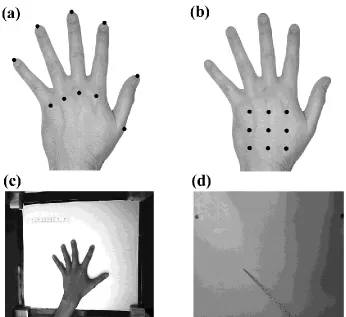
In separate blocks, participants made two types of localisation judgment. In the Verbal task, participants judged the location of either the knuckle or the tip of each finger by pointing with a long baton on a board placed above their hand (Figure 1), as in our previous studies. The critical new aspect of this experiment was to extend the logic of this paradigm to investigate continuous skin surfaces without relying on the presence of landmarks with verbal labels. Accordingly, in the Tactile task, participants were touched using a wooden stick at one of nine locations marked on their left hand dorsum in a 3-by-3 square grid (5 x 5 cm; see Figure 1b). Participants were required to point with a baton on an occluding board placed above their hand to the point which corresponded to the location of their tactile sensation. Note that because different sets of points were judged in the two tasks, they cannot be compared directly. The purpose of including both tasks was to replicate the distortions we have previously observed using the verbal task and then to investigate whether comparable distortions can be found for a continuous skin surface using the tactile task in the same participants.
There were two experimental blocks of each task, in an ABBA order, with the initial condition counterbalanced across participants. Within each block, there were three sequential mini-blocks, each with one trial of each landmark in random order. Before and after each block a photo was taken without the occluding board to obtain a measure of true hand position and to ensure that the hand had not moved during the block. A 10 cm ruler on the table appeared in these images, allowing conversion between pixels and cm.
Figure 1: The experimental procedure. The top panel shows the locations used in the Proprioceptive task (a) and the Remapping task (b). In the proprioceptive task, participants were verbally cued to judge the location of the knuckle or tip of each finger. In the remapping task, they were touched at one of nine locations on the dorsal hand surface and judged the location where they were touched. The bottom panel shows sample webcam images of actual hand position (c) and pointing responses (d). Participants responded in each condition by placing the tip of the baton on the occluding board directly above the perceived location of the landmark (proprioceptive task) or touch (remapping task).
Analysis
Fisheye distortion in the photographs was corrected using the Panotools plug-in (http://www.panotools.org/) for Adobe Photoshop CS2. The x-y pixel coordinates of each landmark on the images of the actual hand and the corresponding judged locations were coded using ImageJ (Abramoff, Magelhaes, & Ram, 2004).
We conducted two main analyses. First, to investigate whether external spatial
To visualise distortions of the internal configuration of responses, we used Procrustes alignment, a method for comparing the shape of configurations of homologous landmarks, removing differences in location, rotation, and overall size to isolate differences in shape (Rohlf & Slice, 1990; Bookstein, 1991). Maps of both actual and judged locations were put into Procrustes alignment using the CoordGen software, part of the Integrated Morphometric Program (IMP; David Sheets, Canisius College,
http://www.canisius.edu/~sheets/morphsoft.html).
Because the fingers are articulated and can move independently, we rotated the fingertips of each map to be in a constant posture, as in our previous study (Longo & Haggard, 2010). First, we calculated the average angle of each finger relative to the hand in the photos of each participant’s actual hands, defined as the angle between a line running through the knuckles of the index and little fingers and another line running through the knuckle and tip of each finger. These angles were 39.6°, 64.4°, 76.5°, 87.1°, and 108.8°, for the thumb through little fingers, respectively. Then for each experimental block and for each participant, the fingertip of each finger was rotated so that the fingers were at those angles (i.e., hand posture was matched across blocks and across participants).
As there were two experimental blocks for each task, maps from each participant were first put into Procrustes alignment so that an average map could be calculated for each participant for both actual location and judgments in each of the two tasks. Then a second-level generalized Procrustes analysis was conducted putting actual and judged maps from all participants into simultaneous alignment, separately for the two tasks. Finally, judgments for each task were shown as a deformation of actual location using thin-plate splines using tpsSplin 1.2 (F. James Rholf, SUNY Stony Brook,
http://life.bio.sunysb.edu/morph/index.html).
The second set of analyses aimed to reveal whether the location of judged landmarks is biased in a consistent way, relative to actual landmarks. In previous studies (Mancini et al., 2011; Margolis & Longo, 2015), we found stereotyped biases (i.e., constant errors) in the localisation of tactile stimuli on the hand dorsum. If these biases also influence tactile spatial remapping, they should appear in the present experiment when participants judge the spatial location of touch (which requires tactile localisation on the skin), but not when participants localise verbally-given landmarks (which does not require tactile localisation).
We used a two-point registration procedure (Bookstein coordinates) to assess
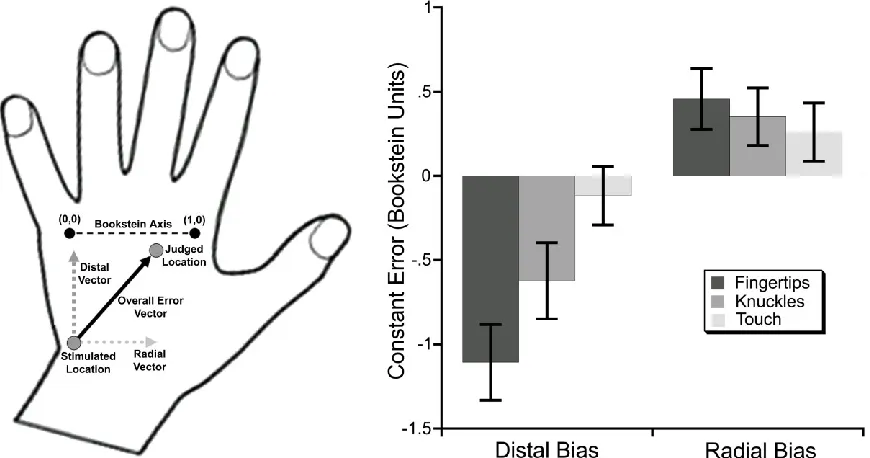
localisation biases (as in Azañón et al., 2010; Mancini et al., 2011; Margolis & Longo, 2015). In this procedure, two landmarks are designated as points (0,0) and (1,0), thus defining a two-dimensional coordinate system centred on and scaled to the two landmarks (Bookstein, 1991). As reference points, we selected tactile locations 7 and 9 from Figure 3. Thus, Bookstein coordinates result in a reference frame in which the x-axis is aligned with the medio-lateral axis of the hand and the y-coordinate with the proximo-distal axis. Thus, the constant error vector can be decomposed into two orthogonal vectors (see Figure 5), one in the proximo-distal axis (the difference in y-coordinates between the judged and actual locations) and the other in the medio-lateral axis (the difference in x-coordinates).
The main purpose of this experiment was to investigate whether tactile spatial
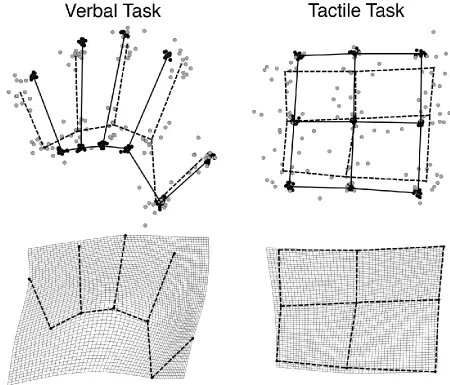
[image:9.595.67.517.188.573.2]remapping relies on a distorted body representation as we have previously found for a purely proprioceptive task. Figure 2 shows grand average maps in Procrustes alignment for the two tasks (top panel), and thin-plate splines showing how a rectangular grid superimposed on the actual hand would have to be stretched to transform actual hand shape into the shape revealed by the perceptual maps. In both tasks, there was a clear bias for distances across the width of the hand to be judged as farther apart than distances along the length of the hand.
Figure 2: Top panel: Actual locations (black circles, solid lines) and judgments (grey circles, dashed lines) from Exp. 1 placed into Procrustes alignment for the verbal (left) and tactile (right) tasks. Bottom panel: Judged locations shown as a deformation of actual locations using thin-plate splines for the verbal (left) and tactile (right) tasks.
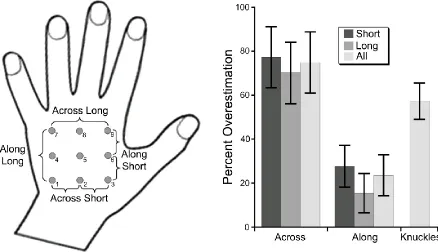
t(11) = 5.55, p < .0001, and long (70.1% overestimation), t(11) = 5.02, p < .0005, pairs. There was also overall overestimation of the proximo-distal distances (23.6% overestimation), t(11) = 2.54, p < .05, which was significant for short pairs (27.7% overestimation), t(11) = 2.91, p < .02, but did not reach significance for long ones (15.5% overestimation), t(11) = 1.74, p = .110. The overestimation of the medio-lateral distances was significantly larger than that of the proximo-distal distances overall, t(11) = 4.88, p < .001, and for both short, t(11) = 4.80, p < .001, and long, t(11) = 4.96, p < .001, distances separately.
[image:10.595.77.515.271.523.2]These results suggests that tactile spatial remapping relies on a representation of the hand which is fatter than actual hand shape, consistent with results reported previously for position sense (Longo & Haggard, 2010, 2012a; Longo et al., 2012) and tactile size perception (Canzoneri et al., 2013; Green, 1982; Le Cornu Knight et al., 2014; Longo & Haggard, 2011; Longo & Sadibolova, 2013; Miller, Longo, & Saygin, 2014).
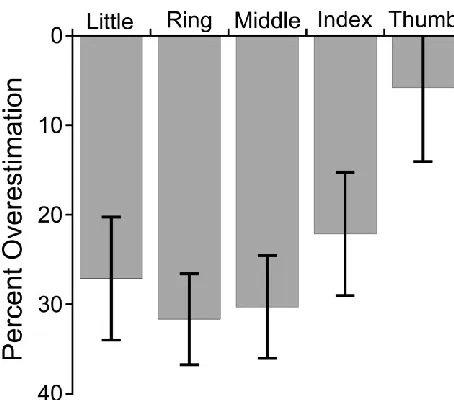
Figure 4: Percent overestimation of finger lengths in the verbal task of Exp. 1. Consistent with previous findings, clear underestimation was observed which increased from the radial to the ulnar side of the hand (i.e., from the thumb to the little finger. Error bars are ± 1 SEM.
Results from the Verbal task replicated the characteristic set of biases we have described previously (e.g., Longo & Haggard, 2010). There was an overall underestimation of finger length (23.4% underestimation), t(11) = -3.98, p < .005 (Figure 4). There was a significant radial-ulnar gradient of underestimation across the five fingers with
underestimation increasing from the thumb to little finger (mean ß = 5.2% underestimation / finger), t(11) = 2.99, p < .02. Finally, there was a clear overall overestimation of hand width, as measured by the distance between the knuckles of the index and little fingers (57.3% overestimation), t(11) = 6.94, p < .0001 (Figure 3, right panel).
Finally, we compared individual differences in the magnitude of these biases for the verbal and tactile tasks. Participants’ overestimation of hand width in the verbal task (i.e., distance between knuckles of index and little fingers) was significantly correlated with their overestimation of medio-lateral distances in the tactile task, r(11) = .621, p < .05. Similarly, though the absolute value of biases went in opposite directions for finger length in the verbal task (underestimated overall) and distance between proximo-distal distances in the tactile task (overestimated overall), these measures were nevertheless significantly correlated, r(11) = .759, p < .005: participants who underestimated finger length less in the verbal task showed more overestimation of proximo-distal distances in the tactile task.
Constant Errors
Given the clear underestimation of finger length, it is not surprising that proximal biases were larger for the fingertips than the knuckles, t(11) = 6.27, p < .0001. Importantly, the proximal bias on the dorsum in the Tactile task was significantly smaller than in the Verbal task, compared either to the fingertips, t(11) = -9.18, p < .0001, or to the knuckles, t(11) = -4.39, p < .002, though this comparison could reflect differences in the locations being localised or in the manner of cueing.
Figure 5: Left panel: Decomposition of the overall constant error vector into distal and radial components. The constant error of localisation is treated as a vector in two-dimensional Bookstein space in which unit distance along the x-axis (labelled here as the ‘Bookstein Axis’) is defined as the distance between tactile locations 7 and 9. The overall constant error vector is decomposed into: a distal component, perpendicular to the Bookstein axis, and quantified as the difference in the y-coordinates of the judged and actual stimulus locations; and a radial component, parallel to the Bookstein axis, and quantified as the differences in the x-coordinates of the judged and actual stimulus locations. Right panel: Constant errors in Exp. 1. For the bars on the left (‘Distal Bias’) positive numbers indicate distal bias and negative numbers proximal bias. For the bars on the right (‘Radial Bias’) positive numbers indicate radial bias (i.e., towards the thumb side of the hand) and negative numbers indicate ulnar bias (i.e., towards the little finger side of the hand). In the proximo-distal axis, modest proximal biases were observed, while in the medio-lateral axis, modest radial biases (i.e., towards the thumb) were observed. Error bars are ± 1 SEM.
Experiment 2
The first experiment showed clearly that the distorted body representations which we have previously showed to underlie position sense (Longo & Haggard, 2010, 2012a, 2012b) also underlie tactile spatial remapping. In contrast, there was less evidence that the distortions we have observed for tactile localisation on the skin (Mancini et al., 2011) influenced
remapping. This experiment was designed to isolate more directly each of the component processes underlying tactile remapping. We compared three different tasks, which involved tactile localisation alone, proprioceptive localisation alone, or both (i.e., external tactile localisation).
In the Skin Localisation Task, participants were touched and indicated the perceived location of touch by clicking on an outline image of their hand on the screen, as in our previous study (Mancini et al., 2011). Because there is no proprioceptive component to the Skin Localisation Task, it is a pure measure of biases underlying tactile localisation on the skin. In the Proprioceptive Task, participants were shown locations visually by a red dot which appeared on an outline image of their hand, and then indicated the perceived location of that part of their hand in external space. Because there is no tactile localisation component to the Proprioceptive Task, it is a pure measure of biases underlying position sense. In the Remapping Task, participants were touched and indicated the perceived location of the touch in external space, like in the Tactile condition of Exp 1. The Remapping Task requires both tactile localisation on the skin and proprioceptive localisation of the skin in external space, that is tactile spatial remapping.
The main aim of this experiment was to test the additive model of tactile spatial remapping, that remapping consists of sequential stages of tactile localisation on the skin and proprioceptive localisation of the skin in external space. On that model (shown in Figure 6), the constant errors of localisation (biases) observed for external tactile localisation
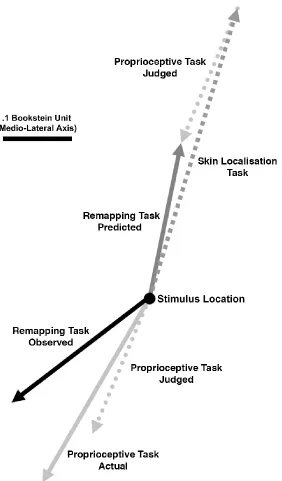
Figure 6: The additive model of tactile spatial remapping depicted in terms of constant error vectors. The Skin Localisation Task isolates biases produced by tactile localisation on the skin. The Proprioceptive Task isolates biases produced by proprioceptive localisation in external space. On the hypothesis that remapping is achieved through sequential stages of tactile and proprioceptive localisation, the biases seen for external spatial
localisation of touch (Remapping Task) should be the vector sum of those seen for tactile (Skin Localisation Task) and proprioceptive (Proprioceptive Task) localisation.
Method Participants
Twelve individuals (eight females) between 20 and 31 years of age participated. All were right handed as assessed by the Edinburgh Inventory (M: 96.78, range: 71.40 – 100).
Procedure
A picture of each participant’s hand with the nine stimulus locations and the five knuckles marked on it was taken at the beginning of the experiment. Next, silhouettes were created from these photos, removing all internal visual information and leaving only the hand outline.
Skin Localisation Task. The first task was similar to our previous study of tactile localisation (Mancini et al., 2011). The tactile stimuli consisted in a calibrated nylon filament attached to a wooden stick (von Frey hair, 2.41 gf bending weight, diameter 0.50 mm). Each stimulus was administered manually by the experimenter in a pre-marked location on the participant’s unseen hand.
Participants sat in front of a computer screen. On each trial, the participant was touched at one of the nine landmarks and moved a mouse cursor (a thin cross) to what they judged to be the corresponding point on the silhouette of their hand. When they clicked the mouse button, the x/y pixel coordinates were recorded. There were a total of 90 trials (10 for each stimulus location), in random order. The starting position of the mouse cursor was randomised on each trial to ensure independence of responses.
Proprioceptive Task. This task was similar to the tactile condition of Exp. 1, except that locations were cued by a red dot appearing on a silhouette of the participant’s hand on the monitor, rather than by touch. The participant’s hand was covered by a horizontal board, as in Exp. 1. Participants were required to point with a baton to the point of the board corresponding to the cued visual location.
Eighteen landmarks were used: the nine locations at which touch was presented in Task 1, and the corresponding locations at which touch was perceived as being located (i.e., the average response from the Skin Localisation Task). There were 10 judgments of the location of each of the 18 landmarks (i.e., 9 true locations and 9 locations as localised in the Skin Localisation Task), divided into 5 blocks of 36 trials. Within each block, there were two judgments of each landmark, in random order.
Remapping Task. The final task was similar to the tactile condition of Exp. 1. On each trial, the participant was touched at one of the nine landmarks on the hand dorsum.
their tactile sensation. There were a total of 90 trials (10 of each stimulus location), in random order.
A camera (Logitech Webcam Pro 9000) was suspended directly above the board, pointing straight down, and collected photographs of the participant’s hand or responses (JPEG images, 1600 x 1200 pixels). Unlike the one used in Exp. 1, this camera does not induce fisheye distortion, so no correction was necessary. Photographs without the occluder were taken before and after each block to code the true location of each landmark and to ensure that the hand had not moved.
Finally, half the participants in this experiment had their hands in the ‘normal’ posture (i.e., with fingers pointing directly away from the body), and the other half had theirs in a ‘rotated’ posture in all three tasks (i.e., with fingers rotated 90 deg). This between-subjects factor allowed us to control for possible biases in hand pointing movements or other unspecified biases defined in torso- or retina-centred reference frames. We used a similar control condition in previous studies of tactile localisation on the skin (Mancini et al., 2011), position sense (Longo & Haggard, 2010), and tactile size perception (Longo & Haggard, 2011).
Results and Discussion Internal Configuration of Responses
The Skin Localisation Task occurs in a purely skin-centred reference frame.
Participants judged the perceived location of touch on a photograph of their hand, meaning there was no proprioceptive component to the task at all. Thus, analyses of internal
configuration of landmarks focus on the Proprioceptive and Remapping Tasks. Proprioceptive Task. This task occurs in a purely external reference frame.
Participants were shown visually a location on their body and localise that point in external space, meaning there was no tactile component at all. First, we analysed the internal
Figure 7: Top panel: Actual locations (black circles, solid lines) and judgments (grey circles, dashed lines) from Exp. 2 placed into Procrustes alignment for the Actual Locations from the Proprioceptive Task (left), the Judged Locations from the Proprioceptive Task (centre), and the Remapping Task (right). Bottom panel: Judged locations shown as a deformation of actual locations using thin-plate splines for the same three conditions.
[image:16.595.142.460.421.690.2]Remapping Task. As in Exp. 1, in the Remapping Task stimuli have first to be
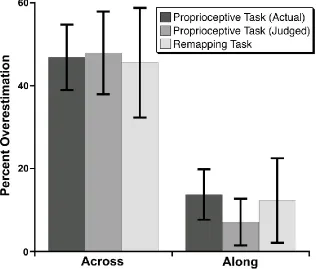
localised on the skin surface, and then remapped into external space based on proprioception. As in Exp. 1, clear distortions of the internal configuration of judged locations were observed (Figure 8). As with the Proprioceptive Task, the short and long distances were collapsed for simplicity. There was clear overestimation of the medio-lateral distance between locations (45.6% overestimation), t(11) = 3.45, p < .01. As for the Proprioceptive Task of Exps. 1 and 2, there was modest overestimation of the proximo-distal distance between locations (12.3% overestimation), though this did not reach statistical significance, t(11) = 1.21, n.s. Again, overestimation was significantly greater for medio-lateral than for proximo-distal distances, t(11) = 3.95, p < .005. Comparing the magnitude of distortions between the Proprioceptive and Remapping Tasks, there were no significant differences for either the medio-lateral, t(11) = -.16, n.s., or proximo-distal, t(11) = .46, n.s., orientations.
Effect of hand rotation. To investigate the effects of hand rotation, we conducted a 3-way ANOVA including hand rotation (normal vs. rotated) as a between-subjects factor and direction (proximo-distal vs. medio-lateral) and task (Proprioceptive Task vs. Remapping Task) as within-subjects factors. There was a clear main effect of direction, F(1, 10) = 37.97, p < 0.0001, but no main effect of task, or rotation, nor any interactions. For subsequent analyses, we therefore collapsed across the two tasks for simplicity. There was clear
overestimation of medio-lateral distances in both the normal (53.0% overestimation), t(5) = 3.42, p < .02; and rotated posture (40.5% overestimation), t(5) = 3.84, p < .02.
Overestimation of proximo-distal distances was more modest: normal posture: (15.1% overestimation), t(5) = 1.37, n.s.; rotated posture: 4.3% overestimation), t(5) = .93, n.s.. Overestimation was significantly larger for the medio-lateral than the proximo-distances, both for the normal, t(5) = 6.46, p < .005, and rotated, t(5) = 3.45, p < .02, postures. These results confirm that these distortions do not reflect direction-specific motor errors or other response biases.
In sum, we replicated the finding from Exp. 1 that tactile spatial remapping relies on a similarly distorted body representation as position sense. Together these findings suggest that common distorted body representation is engaged for proprioceptive tasks, whether locations are cued verbally (Exp. 1; Longo & Haggard, 2010, 2012a), visually (Exp 2: Proprioceptive Task), or tactually (Exp. 1; Exp. 2: Remapping Task).
Constant Errors
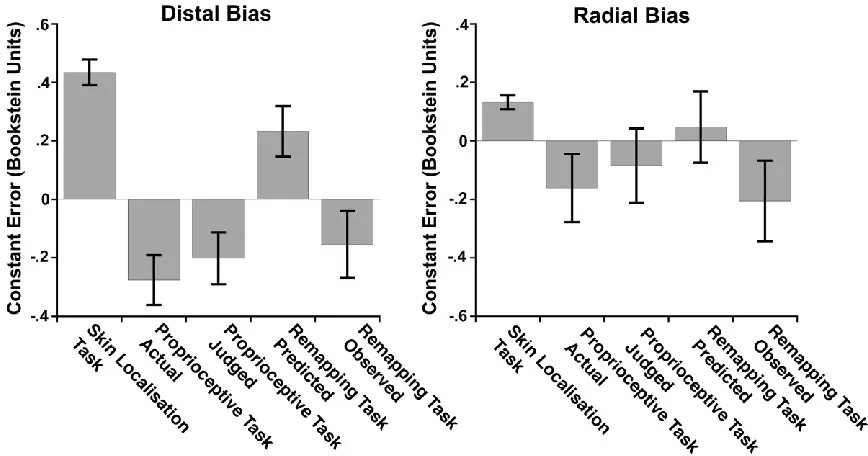
Figures 9 and 10 provide different ways of visualising and quantifying constant errors. Figure 9 shows the constant error vectors decomposed into distal and radial component vectors and shown as a bar graph. Figure 10 collapses across the different stimulus locations to depict constant errors as vectors centred on stimulus location. Though these figures look very different, the same data is depicted in each.
participants showing an overall distal bias and 11 showing an overall radial bias. The
[image:18.595.81.515.119.347.2]magnitude of these two biases was significantly correlated across participants, r(11) = .599, p < .05.
Figure 9: Constant errors from Exp. 2. Left panel: Distal biases for each of the three tasks. Positive values indicate distal bias, while negative values indicate proximal bias. Right panel: Radial biases for the three tasks. Positive values indicate radial bias, while negative values indicate ulnar bias. Predicted values for the
Figure 10: Constant errors in Exp. 2 depicted as vectors centred on stimulus location. The predicted constant error for the Remapping Task was calculated as the vector sum of constant errors for tactile localisation (Skin Localisation Task) and for proprioceptive localisation of the judged location of touch (Proprioceptive Task Judged). Note that the constant error for the Proprioceptive Task Judged is shown twice, once centred on actual stimulus location and once on the end of the Skin Localisation Task constant error. The constant error for tactile spatial remapping (Remapping Task Observed) is nothing at all like what would be predicted by the addition of biases observed separately for tactile localisation and proprioceptive from sequential stages of processing (Remapping Task Predicted), but is quite similar to biases associated with proprioceptive localisation alone.
statistically significant: actual locations from the Skin Localisation Task (-.161 Bookstein units), t(11) = -1.38, n.s.; judged locations (-.084 Bookstein units), t(11) = -.67, n.s.
The critical issue here concerns constant errors in the Remapping Task. We tested whether these could be predicted from the constant errors in the Skin Localisation and Proprioceptive, according to the logic of the additive model depicted in Figure 6, above. Predicted constant error vectors for the Remapping Task were calculated as the vector sum of constant errors in the Skin Localisation Task and the trials from the Proprioceptive Task involving localising the judged locations from the Skin Localisation Task. On the additive model, constant errors for the Remapping Task should equal the sum of constant errors from the Skin Localisation Task and the Proprioceptive Task. In contrast to this prediction,
observed biases in the Remapping Task differed significantly from predictions both in the proximo-distal axis (predicted distal bias: .232 Bookstein units; observed distal bias: -.155 Bookstein units), t(11) = -3.76, p < .005, and the medio-lateral axis (predicted radial bias: .048 Bookstein units; observed radial bias: -.205 Bookstein units), t(11) = -2.56, p < .05. Indeed, in both axes, observed constant errors were in the direction opposite to prediction. Importantly, observed constant errors in the Remapping Task did not differ significantly from those in the Proprioceptive Task alone, either in the proximo-distal axis, Remapping Task vs. Propripceotive Task Actual: t(11) = 1.39, n.s.; Remapping Task vs. Proprioceptive Task Judged: t(11) = .54, n.s., or the medio-lateral axis, Remapping Task vs. Proprioceptive Task Actual: t(11) = -.48, n.s.; Remapping Task vs. Proprioceptive Task Judged: t(11) = -1.22, n.s, (Figures 9-10).
General Discussion
Our study reveals strong distortions characteristic of position sense in tactile spatial remapping. These distortions indicate that, on the hand dorsum, both position sense and tactile spatial remapping rely on a representation of the hand as squat and wide. In contrast, we found no evidence that tactile remapping shares the biases for localisation on the skin we have previously reported (Mancini et al., 2011) and that we replicate here (Exp. 2, Skin Localisation Task). Thus, while tactile spatial remapping logically requires both tactile localisation on the skin and proprioceptive localisation in external space, only biases
associated with the latter appear to characterise tactile spatial remapping. These results have important implications for understanding the nature of both tactile localisation and implicit body representations underlying position sense, which we will discuss in turn.
Implications for Tactile Localisation on the Skin
When participants judge where tactile stimuli are located in a hand-centred reference frame, they show large distal biases on the hairy skin of the hand (Mancini et al., 2011) and arm (Azañón et al., 2010b). The results from the Skin Localisation Task of Experiment 2 in the present study are clearly consistent with this evidence. In striking contrast, when
participants in the current study judged the position of tactile stimuli in an external reference frame, no such distal biases were observed. This pattern indicates that biases in localisation on the skin, though highly general across different qualities of stimuli (e.g.,
It is worth noting that the biases in tactile localisation on the skin are not simply due to a response bias. This is supported by three lines of evidence (Mancini et al., 2011). First, we demonstrated that they equally occur when participants respond by pointing on a fake rubber hand. Second, biases towards the knuckles occur also when the hand is rotated 90° relative to the rest of the body, suggesting they are defined in a hand-centred frame of
reference. Third, the biases are specific to the hairy skin, being absent on the glabrous skin of the palm.
What do our findings imply for tactile localisation and its relation to tactile spatial remapping? We have previously argued that tactile localisation on the skin surface serves as an input to a subsequent stage of processing underlying tactile spatial remapping (Azañón et al., 2010b; Longo et al., 2010). The present results require reinterpretation of this claim, since any perceptual biases of tactile localisation as an input should be preserved in subsequent processing stages.
Azañón and Soto-Faraco (2008) found that in the immediate period (~100 ms) after tactile stimulation, visuo-tactile interactions are found for visual stimuli located close to the typical location of the touched skin surface, rather than its actual location. This suggests a rapid and implicit form of tactile spatial remapping using a representation of prototypical body posture, rather than real-time proprioception (cf. Yamamoto & Kitazawa, 2001). Thus, it is possible that the nervous system does not rely on an overt representation of stimulus location in a hand-centred frame of reference. Instead, the nervous system seems to directly calculate the location of touch in external space on the basis of tactile and proprioceptive afferent signals (first prototypical, then actual), without explicit calculation of the location of a tactile stimulus in a hand-centred frame of reference. According to this interpretation, the distal biases of explicit tactile localisation we have described (Mancini et al., 2011; this study: Skin Localisation Task of Exp. 2) arise from a processing stage that does not form an input to processes of tactile spatial remapping, even though it is based on the same tactile afferent signals. Accordingly, in Figure 11 we propose a revision of the model of
Figure 11: Revision of Longo, Azañón, and Haggard’s (2012) model of somatoperceptual information processing. Grey arrows are retained from the original form of the model, while the black arrow is new. In the original model, tactile localisation on the skin (‘Somatic Localisation of Touch’) and proprioceptive localisation of the body in space (‘Spatial Localisation of the Body’) both formed inputs to tactile remapping (‘Spatial Localisation of touch’). The current form of the model suggests that tactile remapping and tactile localisation are parallel, rather than serial processes.
A number of authors argued for a serial organization of tactile detection and
localization, in which localization follows detection (Harris, Thein, & Clifford, 2004; Harris, Karlov, & Clifford, 2006). The present results suggest that there may be different classes of tactile localization, with different dependencies on other classes of somatosensory
processing. It is possible that explicit tactile localisation, as studied by Harris and colleagues, is subsequent to detection, while the form of localisation used for tactile remapping is not. This idea is consistent with the findings of Nicolelis and colleagues (1998) that information encoding tactile localization on the skin is encoding simultaneously in multiple regions of the monkey somatosensory system. More generally, these results may be consistent with the proposal that there may be parallel processing streams within the somatosensory system (Dijkerman & de Haan, 2007), analogous to the dorsal and ventral visual pathways (Milner & Goodale, 1995).
Implications for Body Representations underlying Position Sense
The present results also have important implications for understanding the nature of the distorted body representations underlying position sense, which we have described previously (Longo, 2014; Longo & Haggard, 2010, 2012a, 2012b; Longo et al., 2012). In our previous studies, participants were instructed to localise landmarks based on verbal
instructions. It is possible that in such situation, localisation errors might reflect semantic misinterpretation by participants, rather than actual perceptual distortion. For example, we have quantified overall hand width as the distance between the knuckles of the index and little fingers, finding substantial overestimation of this distance in the body model underlying position sense. One possible interpretation of this result is that rather than actually judging the location of the knuckles (as instructed), participants (perhaps implicitly) judge the edges of the hand, which are farther apart than the knuckles. Critically, such misinterpretation should not affect localisation of a tactile stimulus, nor localisation of a visually-cued landmark (as in Task 2 of Exp. 2). Mattioni and Longo (2014) showed largely similar distortions when participants localised the knuckles and fingertips cued either by verbal instruction or by touch. The present results generalise those findings, showing that analogous distortions can be obtain by asking people to localise touch without lexically-coded names. We have found similar overestimation of hand width for proprioceptive localisation whether responses are cued verbally (Longo & Haggard, 2010; this study, Exp. 1), tactually (Mattioni & Longo, 2014; this study, Exps. 1 & 2), or visually (this study, Exp. 2). This provides strong evidence that the overestimation of hand width does not merely reflect
misunderstanding of task instructions.
hypothetically distort the perception of objects located within this space, such as the hands. We consider this possibility unlikely for three reasons. First, if distortions reflect the representation of external space (rather than of the hand being localised), then they should change systematically when the hand is rotated relative to the rest of the body in external space. In fact, we found highly similar distortions when the hand was rotated 90˚, both in our original study (Longo & Haggard, 2010) and in the present study (Exp 2). This clearly demonstrates that the distortions are defined with respect to the hand being localised, and not with respect to the hand doing the pointing, the torso, the eyes, or peripersonal space. Second, we have found highly similar distortions regardless of the length of the tool used for pointing (see Mattioni & Longo, 2014), though these ought to differentially extend peripersonal space. Moreover, we found the same effect even when judgments were made by giving verbal commands to a naive experimenter who held the stick (Longo et al., 2012), though admittedly that was only tested with a single individual. Finally, while it is easy to see how extension of peripersonal space could affect constant errors of localisation (e.g., by shifting all responses distally), it is much harder to see how it could affect the internal configuration of judgments, which our analysis focuses on. Specifically, to account for our results, extension of
peripersonal space by tool use would have to produce systematically different constant error biases for localisation of each location on the skin surface.
Conclusions
References
Abramoff, M. D., Magelhaes, P. J., & Ram, S. J. (2004). Image processing with ImageJ. Biophotonics International, 11, 36-42.
Azañón, E., & Soto-Faraco, S. (2008). Changing reference frames during the encoding of tactile events. Current Biology, 18, 1044-1049.
Azañón, E., Camacho, K., & Soto-Faraco, S. (2010a). Tactile remapping across space. European Journal of Neuroscience, 31, 1858-1867.
Azañón, E., Longo, M. R., Soto-Faraco, S., & Haggard, P. (2010b). The posterior parietal cortex remaps touch into external space. Current Biology, 20, 1304-1309.
Banks, M. S. (1988). Visual recalibration and the development of contrast and optical flow perception. In A. Yonas (Ed.), The Minnesota symposia on child psychology Vol 20 (pp. 145-196). Hillsdale, NJ: Erlbaum.
Bolognini, N., & Maravita, A. (2007). Proprioceptive alignment of visual and somatosensory maps in the posterior parietal cortex. Current Biology, 17, 1890-1895.
Bookstein, F. L. (1991). Morphometric tools for landmark data: Geometry and biology. Cambridge: Cambridge University Press.
Buchholz, V. N., Jensen, O., & Medendorp, W. P. (2011). Multiple reference frames in cortical oscillatory activity during tactile remapping for saccades. Journal of Neuroscience, 31, 16864-16871.
Canzoneri, E., Ubaldi, S., Rastelli, V., Finisguerra, A., Bassolino, M., & Serino, A. (2013). Tool-use reshapes the boundaries of body and peripersonal space representations. Experimental Brain Research, 228, 25-42.
Clifton, R. K., Gwiazda, J., Bauer, J. A., Clarkson, M. G., & Held, R. M. (1988). Growth in head size during infancy: Implications for sound localization. Developmental
Psychology, 24, 477-483.
Dijkerman, H. C., & de Haan, E. H. F. (2007). Somatosensory processes subserving perception and action. Behavioral and Brain Sciences, 30, 189-239.
Farnè, A., & Làdavas, E. (2000). Dynamic size-change of hand peripersonal space following tool use. NeuroReport, 11, 1645-1649.
Green, B. E. (1982). The perception of distance and location for dual tactile pressures. Perception and Psychophysics, 31, 315-323.
Harris, J. A., Thein, T., & Clifford, C. W. G. (2004). Dissociating detection from localization of tactile stimuli. Journal of Neuroscience, 24, 3683-3693.
Harris, J. A., Karlov, L., & Clifford, C. W. G. (2006). Localization of tactile stimuli depends on conscious detection. Journal of Neuroscience, 26, 948-952.
Head, H., & Holmes, G. (1911). Sensory disturbances from cerebral lesions. Brain, 34, 102- 254.
Heed, T., & Röder, B. (2010). Common anatomical and external coding for hands and feet in tactile attention: Evidence from event-related potentials. Journal of Cognitive
Neuroscience, 22, 184-202.
Heed, T., Backhaus, J., & Röder, B. (2012). Integration of hand and finger location in external spatial coordinates for tactile localization. Journal of Experimental Psychology: Human Perception and Performance, 38, 386-401.
use by macaque postcentral neurones. NeuroReport, 7, 2325-2330.
Kaas, J. H., Nelson, R. J., Sur, M., Lin, C. S., & Merzenich, M. M. (1979). Multiple representations of the body within the primary somatosensory cortex of primates. Science, 204, 521-523.
Le Cornu Knight, F., Longo, M. R., & Bremner, A. J. (2014). Categorical perception of tactile distance. Cognition, 131, 254-262.
Longo, M. R. (2014). The effects of immediate vision on implicit hand maps. Experimental Brain Research, 232, 1241-1247.
Longo, M. R. (2015). Implicit and explicit body representations. European Psychologist, 20, 6-15.
Longo, M. R., & Haggard, P. (2010). An implicit body representation underlying human position sense. Proceedings of the National Academy of Sciences, USA, 107, 11727-11732.
Longo, M. R., & Haggard, P. (2011). Weber's illusion and body shape: Anisotropy of tactile size perception on the hand. Journal of Experimental Psychology: Human Perception and Performance, 37, 720-726.
Longo, M. R., & Haggard, P. (2012a). A 2.5-D representation of the human hand. Journal of Experimental Psychology: Human Perception and Performance, 38, 9-13.
Longo, M. R., & Haggard, P. (2012b). Implicit body representations and the conscious body image. Acta Psychologica, 141, 164-168.
Longo, M. R., & Lourenco, S. F. (2006). On the nature of near space: Effects of tool use and the transition to far space. Neuropsychologia, 44, 977-981.
Longo, M. R., & Sadibolova, R. (2013). Seeing the body distorts tactile size perception. Cognition, 126, 475-481.
Longo, M. R., Azañón, E., & Haggard, P. (2010). More than skin deep: Body representation beyond primary somatosensory cortex. Neuropsychologia, 48, 655-668.
Longo, M. R., Long, C., & Haggard, P. (2012). Mapping the invisible hand: A body model of a phantom limb. Psychological Science, 23, 740-742.
Mancini, F., Longo, M. R., Iannetti, G. D., & Haggard, P. (2011). A supramodal representation of the body surface. Neuropsychologia, 49, 1194-1201.
Mancini, F., Haggard, P., Iannetti, G. D., Longo, M. R., & Sereno, M. I. (2012). Fine-grained nociceptive maps in primary somatosensory cortex. Journal of Neuroscience, 32, 17155-17162.
Margolis, A. N., & Longo, M. R. (2015). Visual detail about the body modulates tactile localisation biases. Experimental Brain Research, 233, 351-358.
Mattioni, S., & Longo, M. R. (2014). The effects of verbal cueing on implicit hand maps. Acta Psychologica, 153, 60-65.
Miller, L. E., Longo, M. R., & Saygin, A. P. (2014). Tool morphology constrains the effects of tool use on body representations. Journal of Experimental Psychology: Human Perception and Performance, 40, 2143-2153.
Milner, A. D., & Goodale, M. A. (1995). The visual brain in action. Oxford: Oxford University Press.
al. (1998). Simultaneous encoding of tactile information by three primate cortical areas. Nature Neuroscience, 1, 621-630.
Overvliet, K. E., Azañón, E., & Soto-Faraco, S. (2011). Somatosensory saccades reveal the timing of tactile spatial remapping. Neuropsychologia, 49, 3046-3052.
Penfield, W., & Boldrey, E. (1937). Somatic motor and sensory representation in the cerebral cortex of man as studied by electrical stimulation. Brain, 60, 389-443.
Proske, U., & Gandevia, S. C. (2012). The proprioceptive senses: Their roles in signalling body shape, body position and movement, and muscle force. Physiological Reviews, 92, 1651-1697.
Rohlf, F. J., & Slice, D. E. (1990). Extensions of the Procrustes methods for the optimal superimposition of landmarks. Systematic Zoology, 39, 40-59.
Schicke, T., & Röder, B. (2006). Spatial remapping of touch: Confusion of perceived stimulus across hand and foot. Proceedings of the National Academy of Sciences, USA, 103, 11808-11813.
Acknowledgments