978-1-4577-1884-7/11/$26.00 ©2011 IEEE
Goh Hui Hwang
Department of Electrical Power Faculty of Electrical and Electronic Universiti Tun Hussein Onn Malaysia 86400 Parit Raja, Batu Pahat, Johor, Malaysia[email protected] 012-7120303
Kok Boon Ching
Department of Electrical Power Faculty of Electrical and Electronic Universiti Tun Hussein Onn Malaysia 86400 Parit Raja, Batu Pahat, Johor, MalaysiaLee Sian Wei
Faculty of Electrical and Electronic Universiti Tun Hussein Onn Malaysia 86400 Parit Raja, Batu Pahat, Johor, Malaysia
[email protected] 016-7121023
Ng Suan Lin
Faculty of Electrical and Electronic Universiti Tun Hussein Onn Malaysia 86400 Parit Raja, Batu Pahat, Johor, Malaysia
Abstract—Deciding the key location to build a wind farm is an essential element in order to obtain optimum energy production with the least cost of resources possible. A strategic location is crucial as it will ensure that turbine foundations, access roads and construction areas be provided at a reasonable cost. The location selection will also enable the authorities to predict the environmental impact to the wind farm surroundings. In this research, the AHP and Fuzzy AHP method are utilized to evaluate the priority of criteria in selecting a location for wind farm. A case study is also carried out to evaluate the wind potential on two locations, thus, implementing the TOPSIS method to choose the best wind site. The paper is arranged in five important sections that include introduction, methodology, results and analysis, discussion and conclusion as well as recommendation.
Keywords- Wind farm allocation; AHP; Fuzzy AHP; TOPSIS; MCDM
I. INTRODUCTION
Wind power planning involves many parts and is undertaken by various parties. For international treaties, Kyoto Protocol for example has objectives like reducing carbon dioxide emissions, addressing threat of global climate change and replacing fossil fuels with renewable energy sources, one of which is wind power.
Wind power will play an important role in the 21st century. Therefore, the development of its technology will continue to improve and its systems will be further explored to provide optimum energy. In order to select the best wind site, many factors have to be considered. This is an important issue as it will involve many parties such as the political groups and private associations.
This project will feature the important criteria that a developer should consider when choosing a location to build wind turbines. The priority of the criteria will be determined using various Multi-Criteria Decision Making methods. It will be used to evaluate the essentiality and weight of each criterion for the location selection. The set of data obtained will be used as a sample to justify the workability of the model. Some of the factors to be considered include wind power density, wind speed, and environmental impacts such as noise.
The methods used to evaluate the criteria are Analytic Hierarchy Process (AHP) and Fuzzy AHP (FAHP). The Analytic Hierarchy Process (AHP) was developed by Saaty in the 1970s and has been refined. Among all the other approach in the multi-criteria decision making methods, the AHP has captured considerable interests of researches and practitioners in the recent years. It is an analysis methodology that enables both qualitative and quantitative factors to be considered in specifically what is needed. This analysis method helps solve problems that are involved with multiple criteria simultaneously [1].
Chen et al. [2] utilized AHP to develop critical success criteria to help select a suitable wind farm project. However, considering its positive and negative criteria, Chen et al. implemented a further proposed method by Saaty to deal with the benefits, opportunities, costs and risks which is known as the BOCR merits.
On the other hand, the Fuzzy AHP is an enhancement from the conventional analytic hierarchy process method. Before the fuzzy AHP is carried out, the usual steps in the AHP will
Wind Farm Allocation In Malaysia Based On
be carried out. The fuzzy AHP generally begins with the following steps:
• triangular fuzzy number with lower, upper and medium limits
• a pair wise comparison between the limits
• the construction of judgment matrix
• Calculation for the degree of individual elements. According to Yumei Chen [3], a major contribution of the fuzzy set theory is that, it can represent the vague data. The author commented that the conventional AHP did not truly reflect the human cognitive problems especially the “fuzzy” problems. It is said that the fuzzy Analytic Hierarchy Process is designed to an alternative selection and justification of problems by adapting the concept of fuzzy set theory and hierarchical structure. The advantage of the fuzzy AHP is that, it can solve uncertain problems and rank excluded factors according to their weight ratios.
The wind potential of two locations is studied and the parameters analyzed are mean wind speed, wind power density and air density. A forecast for higher altitude is also analyzed. Having done that, another MCDM method is implemented in order to choose the best site among those two locations as a wind site. Thus, the TOPSIS method or Technique of Order Preference by Similarity to Ideal Solution is utilized. The TOPSIS method is an effective method in ranking the best alternatives [4]. The author used TOPSIS and entropy weight method to rank and select the information system from a finite number of competing vendors. The results showed that the proposed method is practical and useful whereby it is more flexible and simple. It is very suitable for real-world applications.
II. RESEARCHMETHODOLOGY
A. Overall Process Flowchart
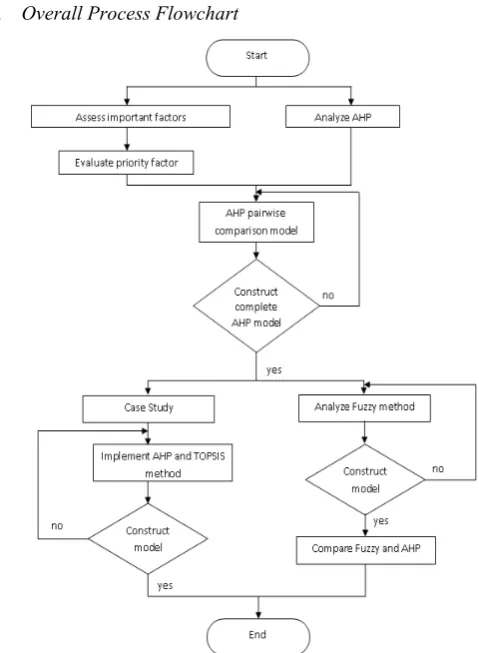
Fig. 1 shows the overall process for the research. The research begins with literature studies on wind power and its important parameters in choosing a best location for a wind site. The list of important factors and ratings are then evaluated with AHP and fuzzy AHP. The research proceeds with case study of two locations which are Kudat and Kota Bharu. Its wind potential is studied through the mean wind speed, air density and power density. The forecasted results at 60m are then implemented into the combined method of AHP and TOPSIS in order to evaluate the best site for wind farm.
B. Analytic Hierarchy Process
The Analytic Hierarchy Process (AHP) was first proposed by Thomas Saaty in 1980. It is a simple, flexible and is mathematically based structured decision making method in order to solve complex, unstructured and multi-attribute problems. The main characteristic of AHP is its pair wise comparison judgments. In this research, the AHP used involves the finding of the nth root of product of the pair wise comparison matrix before normalizing the root of product in order to obtain the corresponding weights.
Choosing a suitable location for a wind power farm is crucial because are there are many factors to be considered along the way. However, in this research, the factors focused are only on four of the many criteria without any alternative levels. These four main criteria only cover the initial stage of choosing a suitable location. Table I shows the ratings for the four criterions considered here.
The first step is to create the ratings for each of the criteria. The pair wise comparison is shown below:
CR1 denotes wind power density; CR2 denotes wind speed; CR3 represents terrain;
CR4 represents noise restriction.
The pair wise comparison matrix is shown in Fig. 2:
The step-by-step guide in the methodology is applied and the overall result of AHP is seen as Table II:
[image:2.595.329.543.377.475.2]Figure 1. Flowchart of research process
TABLE I. RATINGS OF CRITERIA
No. Criteria Rating
1 Wind power density 10.000
2 Wind speed 9.000
3 Terrain 8.000
4 Noise restriction 5.000
TOTAL 32.000
[image:2.595.44.284.442.769.2] [image:2.595.338.523.570.637.2]The priority vector results show that, the wind power density has a weightage of 0.313, followed by wind speed with 0.281. Third in line is terrain with 0.250 and finally, noise restriction with 0.156. The overall pie chart is shown in the Fig. 3.
C. Fuzzy AHPAnalytic Hierarchy Process
The first step in Fuzzy AHP is to determine the fuzzy number for four criterions. The fuzzy pair wise matrix calculation is calculated. The calculated pair wise matrix is shown below:- CFR 1 denotes Wind Power Density;
CFR 2 denotes Wind Speed; CFR 3 denotes Terrain; and CFR 4 represents Noise Restriction.
The pair wise comparison for the fuzzy number and it is also shown in the Table III:
From the calculated fuzzy performances, the total for all the limits – lower, medium and upper were calculated. The total for fuzzy numbers was calculated by adding all the fuzzy numbers of the criterions for each limit. Hence, the total limits for all the four criterions are shown in the table IV. The reciprocal for each of the limit can be obtained by dividing 1 with the total of each limit.
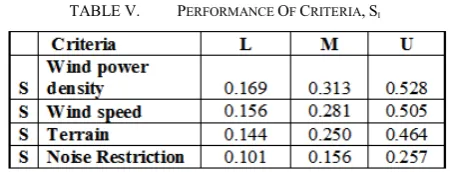
The next step is done to obtain the performances for each criterion. Hence, the performances of the criteria SCFR1 until SCFR4 is obtained and is shown in the table V.
Then, the performance of Si is compared and the values for the highest intersection point d(Ai) and weight vectors are obtained. After obtaining the weight vector, W’, the normalized weight are obtained in order to evaluate the selection of a suitable wind farm location through the four criterions. From the calculation, it is known that wind power density has the most importance with 0.323, followed by wind speed with 0.295. The next one is terrain, which has a priority of 0.266 and finally, noise restriction with the least priority with a weight of 0.116. The normalized weight is summarized in the table VI and Fig. 4 shows the percentage of criteria.
TABLE II. OVERALL RESULT OF AHP
Figure 3. Chart for AHP result
TABLE III. PAIR WISE COMPARISON FOR FUZZY AHP
[image:3.595.44.284.63.189.2]TABLE IV. TOTAL LIMIT FOR FUZZY AHP
TABLE V. PERFORMANCE OF CRITERIA,SI
[image:3.595.44.282.250.406.2] [image:3.595.323.550.347.433.2]Figure 4. Percentage of criteria
The overall percentage of the criterions considered in the research is shown in the figure above. Wind power density has the highest percentage of 32%, followed by the wind speed with 29%. The terrain effect comes third with 27% while the least importance is the noise restriction with only 12%. From the graph shown, it is similar with the graph obtained by using the AHP method. However, its percentage and normalized vectors have different values of priority.
D. TOPSIS
Selecting the best location to build a wind farm is crucial as there are many factors to consider. One of the most important factors to consider while choosing a site is the wind resources. Hence, in this section, the Analytic Hierarchy Process (AHP) and Technique for Order Preference by Similarity to Ideal Solution (TOPSIS) method is both combined and applied to choose the best wind site between Kudat and Kota Bharu. Nevertheless, only two factors will be considered which are the mean wind speed and the wind power density. The AHP method is used to create the pair wise comparison model while the TOPSIS method is implemented to rank the best site with the most potential to build a wind farm. Step one is to obtain the decision matrix and it can be seen in the table VII:
Next, to obtain the normalized decision matrix, the data in the decision matrix is divided by the square root of the total in each column. The criteria is squared and followed by the square root of summation by columns. This step is to obtain a normalized ratio of the column Y and Z, before obtaining the normalized value for the criteria. The normalized decision matrix of TOPSIS is shown below:
⎟⎟ ⎠ ⎞ ⎜⎜ ⎝ ⎛ = ⎟⎟ ⎠ ⎞ ⎜⎜ ⎝ ⎛ 494 . 0 069 . 0 870 . 0 766 . 0 22 21 12 11 r r r r
Step 3 uses the AHP method to obtain the weight of each criterion. The single pair wise comparison method is first created, and the normalized values are calculated. Before that, the average of values across the normalized decision matrix is
calculated. When the weights are obtained, the weighted decision matrix can be obtained. It is given by,
⎟⎟ ⎠ ⎞ ⎜⎜ ⎝ ⎛ = ⎟⎟ ⎠ ⎞ ⎜⎜ ⎝ ⎛ 049 . 0 062 . 0 087 . 0 689 . 0 v v v v 22 21 12 11
In step four, the ideal alternatives and negative ideal alternatives solution is determined. From the previous step, w11 and w21 belongs to the beneficial criteria while w12 and w22 belongs to the non-beneficial criteria group. Hence, PIS and NIS are determined as:
} 087 . 0 , 062 . 0 { NIS } 049 . 0 , 689 . 0 { PIS = =
Step five is carried out to calculate the distance between the alternatives with positive and negative ideal solutions. First, the separation from ideal alternative, SI is carried out, next the separation from negative ideal alternative, SNI is calculated. The separation from the ideal solution,
⎟⎟ ⎠ ⎞ ⎜⎜ ⎝ ⎛ = 000 . 0 627 . 0 038 . 0 000 . 0 SI
From here, it is deduced that, S1 = 0.038, while S2 =0.627. The separation from non-ideal solution is given by,
⎟⎟ ⎠ ⎞ ⎜⎜ ⎝ ⎛ = 038 . 0 0.000 000 . 0 0.627 SNI , ⎟⎟⎠ ⎞ ⎜⎜ ⎝ ⎛ = ⎟⎟ ⎠ ⎞ ⎜⎜ ⎝ ⎛ 038 . 0 627 . 0 SN SN 2 1
Hence, it is known that, the SN1 = 0.627 while SN2 = 0.038.
The final step, which is step 6 is to calculate and find the best alternative. The numerical value calculated will be from 0 to 1 for each alternative. Hence, based on TOPSIS method, the higher or the closer the alternative is to 1, it will be the best alternative among all. Therefore, from the calculation, it showed that Kudat is a best site compared to Kota Bharu. The relative closeness coefficient is shown below:
[image:4.595.36.282.53.191.2]⎟⎟ ⎠ ⎞ ⎜⎜ ⎝ ⎛ = ⎟⎟ ⎠ ⎞ ⎜⎜ ⎝ ⎛ 500 . 0 944 . 0 KB Kudat
Fig. 5 is generated by using Microsoft excel when calculating the AHP and TOPSIS methods. Based on the figure, Kudat has a priority of 0.944 while Kota Bharu has a priority of 0.500. From the calculation in excel, Kudat holds 65% priority compared to Kota Bharu which is only 35%. Hence, it can be deduced that Kudat is a more suitable location compared to Kota Bharu as a wind site. The calculation is based on both the sites’ mean wind speed and wind power density.
TABLE VII. DECISION MATRIX FOR TOPSIS
[image:4.595.56.272.512.546.2] [image:4.595.314.554.627.766.2]III. DISCUSSION
The results and analysis were divided into three main parts which are AHP, Fuzzy AHP and Case study. In the multi-criteria decision making methods of AHP and Fuzzy AHP, the importance or priority of the criteria were evaluated by using the pair wise comparison model. From the results obtained, the priority vector for wind power density, wind speed, terrain and noise restriction were similar. In both decision making models, the AHP and fuzzy AHP showed that wind power density is positioned first, followed by wind speed. Third in line was terrain while the last one was, noise restriction. However, there was slight difference whereby the priority value of fuzzy AHP was higher than AHP. This could be due to the accuracy of the model whereby the fuzzy AHP is more accurate compared to AHP. In the case study, two locations were chosen to evaluate its wind potential. The mean wind speed, air density and power density were analyzed for both Kudat and Kota Bharu. A forecasted wind speed and power density analysis at 60 meters above ground was also carried out. The TOPSIS method was used to evaluate the best wind site among those two locations and results showed that Kudat was a better location compared to Kota Bharu as the priority vector for Kudat was higher and closer to 1.
IV. CONCLUSION AND RECOMMENDATION
The pair wise comparison model of AHP and fuzzy AHP was developed and evaluated. From the results, the developed critical success criteria model was successful as both methods showed similar results to rank the priority of criteria. The research included a case study of two locations which are Kudat and Kota Bharu, whereby its wind potential was analyzed.. In addition to it, the TOPSIS approach was implemented so that the integrated framework of MCDM was used to choose a strategic location based on the wind speed and wind power density for both the studied site. The results showed that Kudat was more suitable as a wind site.
From the results obtained, it is known that the objectives were achieved. The AHP, Fuzzy AHP and TOPSIS method used provided practical results which are useful for feasibility analysis. Moreover, the MCDM is flexible, simple and effective in solving problems for decision making. For future research, more criteria, alternatives and more data should be included in order to develop a better pair wise comparison model. In addition to it, building software which can be utilized for many types of MCDM can help in the study. This can render a more accurate feasibility study for wind site. In addition to it, it will also increase the usefulness for all parties. As for the case study, more data and more locations can be analyzed so that the analysis of wind potential in Malaysia can be maximized.
ACKNOWLEDGMENT
The authors are grateful and would like to acknowledge the support of the staff in the Electric Power Laboratory, UTHM, for their valuable contributions towards the success of the research.
REFERENCES
[1] Douligeris, C. & Pereira I.J. “A Telecommunications Quality Study Using the Analytic Hierachy Process,” IEEE Journals On Selected Areas In Communications, 12(2), pp. 241-250, 1994.
[2] Amy H.I. Lee, Hsing Hung Chen & He-Yau Kang., “Multi-criteria Decision Making on Strategic Selection of Wind Farms,” Renewable Energy, 34(2009), pp. 120-126, 2008.
[3] Yumei Chen., “Fuzzy AHP – Based for Project Risk Assessment,” 7TH
International Conference Fuzzy System And Knowledge Discovery (FSKD), 2010. Yantai. IEEE. p.1249, 2010.
[4] Jingwen Huang, “Combining Entropy Weight and TOPSIS Method for Information System Selection,” IEEE Conference On Cybernetics And Intelligent Systems, 2008. Chengdu. IEEE. p. 1281, 2008.
[5] C.L. Yang, S.P. Chuang, R.H. Huang & C.C. Tai., “Location Selection Based on AHP/ANP Approach,” IEEE International Conference On Industrial Engineering And Engineering Management. Singapore. IEEE. pp.1148-1153, 2008.
[6] Krystal Ramoutar & Chanan S. Syan, “An AHP-based Study of WCM Implementation Factors in ISO 9001 Certified Manufacturing Organizations in Trinidad and Tabago,” Proceedings Of The World Congress On Engineering 2009. LONDON.
[7] Mohammad A. Mustafa., “Project Risk Assessment Using the Analytic Hierachy Process,” IEEE Transactions On Engineering Management, 38(1), pp. 46-52, 1991.
[8] Hua Bai., “A Fuzzy AHP-Based Evaluation Method for Vendor-Selection,” 4th IEEE International Conference On Management Of
Innovation And Technology, 2008. Bangkok. IEEE. p. 1077.
[9] Wang Lijian, Wang Bin & Peng Yongjun., “A New Risk Assessment Quantitative Method Based on Fuzzy AHP,” IEEE International Conference On Information And Financial Engineering, 2010. Chongqing. IEEE. p.822.
[10] Shi Yu, Kou Gang, Li Youyuan et al., “FMCDM: A Fuzzy Multi-Criteria Decision-Making Hybrid Approach to Evaluate the Damage Level of Typhoon: Integration of Fuzzy AHP and Fuzzy TOPSIS,” 3RD
International Conference On Information Sciences And Interaction Sciences, 2010. Chengdu. IEEE. p. 666.
[11] Yan Ge & Qi Xu., “The Design and Application of a Generic AHP Evaluation System,” 4th International Conference On Wireless Communications, Networking And Mobile Computing, 2008. Dalian: IEEE. pp. 1-4
[12] B.G. Kumaraswamy, B.K. Keshavan & Suresh H. Jangamshetti, “A Statistical Analysis of Wind Speed Data in West Central Part of Karnataka Based on Weibull Distribution Function,” IEEE Electrical Power And Energy Conference, Montreal: IEEE. pp. 1-4, 2009. [13] Gokcek M., Bayulken A. & Bekdemir S., “Investigation of Wind
Characteristics and Wind Enery Potential in Kirklareli, Turkey,”Renewable Energy, 32 (2007) , pp. 1739- 1752, 2007.
[14] R.D. Prasad, R.C. Bansal & M. Sauturaga., “Some of the Design and Methodology Considerations in Wind Resource Assessment,” IET Renewable Power Generation, 3(1), pp. 53-64, 2009.
[15] Ucar A. & Balo F., “Investigations of Wind Characteristics and Assessment of Wind Generation Potentiality in Uludağ-Bursa, Turkey,” Applied Energy, 86 (2009) , pp. 333-339.
[16] Lackner M.A., Rogers A. L. & Manwell J.F., “The Round-Robin Site Assessment Method: A New Approach to Wind Energy Site Assessment,” Renewable Energy, 33(2008) , pp. 2019-2026.
[17] Soon-Duck Kwon, “Uncertainty Analysis of Wind Energy Potential Assessment,” Applied Energy, 87 (2010) , pp. 856-865.
[18] Gonzales J.S., Rodriguez A.G.G., Mora J.C., Santos J.R. & Payan M.B., “Optimization of Wind Farm Turbines Layout Using an Evolutive Algorithm,” Renewable Energy, 35(2010) , pp. 1671-1681.
[19] Magoha P., “Footprints in the Wind,: World Renewable Energy Congress VII. Cologne, 2002.
[21] Wizelius T., Developing Wind Power Projects, United Kingdom: Cromwell Press, 2007.
[22] Stankovic S., Campbell N., & Harries A., Urban Wind Energy. United Kingdom: Scotprint, 2009.
[23] Burton T., Sharpe D., Jenkins N. & Bossanyi E., Wind Energy Handbook. United Kingdom: John Wiley, 2001.
[24] Nelson V., Wind Energy: Renewable Energy and the Environment. Boca Raton: CRC Press, 2009.