http://dx.doi.org/10.4236/jssm.2015.81017
A Study on the Relationship among
Transformational Leadership,
Organizational Identification and Voice
Behavior
Dongbo Hu, Binbin Zhang, Meng Wang
Management School, Jinan University, Guangzhou, China Email: [email protected]
Received 5 January 2015; accepted 25 February 2015; published 28 February 2015
Copyright © 2015 by authors and Scientific Research Publishing Inc.
This work is licensed under the Creative Commons Attribution International License (CC BY).
http://creativecommons.org/licenses/by/4.0/
Abstract
This paper investigates the relationship between transformational leadership and voice behavior under Chinese cultural background. It also examines the mediating effects of organizational iden-tification in the relationship between transformational leadership and voice behavior. We use multiple linear regression analyses to validate our hypotheses. The results of the empirical study showed that: Transformational leadership has a significant positive influence on voice behavior; transformational leadership and its four dimensions have a significant positive influence on orga-nizational identification; orgaorga-nizational identification has a significant positive influence on voice behavior. Organizational identification plays a part intermediary role between transformational leadership and voice behavior.
Keywords
Leadership Theory, Transformational Leadership, Organizational Identification, Voice Behavior
1. Introduction
More and more enterprises begin to focus on voice behavior. Chiabum (1998) proved voice behavior is benefi-cial to enhance organizational vitality and innovation. Scholars study voice behavior from two respects includ- ing individual factors and organizational situation factors [1].
(1985) believes that the most important task for transformational leaders is to make employees understand the necessity to finish the job and let them realize the responsibility to bear. They also should motivate employees to pursuit high level of fame and pay attention to enhance the organization’s overall performance to complete team target brilliantly [3].
LePine (2001) defines the voice behavior is a contributing and challenging initiative behavior, including con-structive and change-oriented communication to improve the situation [4]. Ashforth (1989) believes that orga-nizational identification can be viewed as a special case of social identity, which belongs to the category of group consciousness [5]. Weiling Xu (2002) thinks that organizational identification is a process of individual self-defined, while self-concept and organization belonging play a role [6]. Jun Wei (2004) believes tional identification is a kind of subjective feelings which is produced in the individual’s absorption of organiza-tional factors [7].
As an important style of leadership, transformational leadership has an important influence on the formation of corporate culture; its impact and mechanism on employee voice behavior have not been deeply studied. In one organization, improving employees’ organizational identification plays a very important role to promote em-ployees’ satisfaction and performance. In addition to meeting its own employee development, the relationship among transformational leadership, organizational identification and voice behavior is a question worth consi-dering.
Rooted in the context of Chinese culture are not currently in-depth research, relevant empirical research is lacking. Voice behavior under Chinese cultural background has certain challenges and risks; it may touch the interests of certain colleagues or leadership causing tension in the relationship. Under the influence of Chinese traditional thought, the Chinese company’s employees are more inclined to obey superiors’ decisions or to re-main silent while they face to practical problems. Therefore, it is very necessary to research the relationship be-tween transformational leadership and voice behavior by using scale which is more in line with the actual situa-tion of Chinese enterprises. Based on the above background, this paper adopts empirical methods to explore re-lationship among transformational leadership, organizational identification and voice behavior.
2. Literature Review and Hypothesis
Many scholars have confirmed that transformational leadership has a significantly positive correlation with or-ganizational citizenship behavior, while voice behavior is one of employee extra role behaviors. We believe that transformational leadership can promote the voice behavior. Milliken (2003) finds that transformational leader-ship can inspire employees to pay beyond the expectations of efforts by establishing mutual trust, while voice behavior is one of the behaviors beyond the organizations’ expectations to employees [8]. Piccolo verifies a sig-nificant relationship between transformational leadership and organizational citizenship behaviors. Long-zeng Wu (2011) finds that transformational leadership has a significant positive correlation with voice behavior through empirical research [9].
Based on the analysis above, this paper puts forward the following hypothesis:
H1: Transformational leadership has a significant positive correlation with voice behavior.
H1-1: Transformational leadership has a significant positive correlation with promotive voice behavior; H1-1a: Virtue has a significant positive correlation with promotive voice behavior;
H1-1b: Incentive vision has a significant positive correlation with promotive voice behavior; H1-1c: Personalized care has a significant positive correlation with promotive voice behavior; H1-1d: Charisma has a significant positive correlation with promotive voice behavior;
H1-2: Transformational leadership has a significant positive correlation with prohibitive voice behavior; H1-2a: Virtue has a significant positive correlation with prohibitive voice behavior;
H1-2b: Incentive vision has a significant positive correlation with prohibitive voice behavior; H1-2c: Personalized care has a significant positive correlation with prohibitive voice behavior; H1-2d: Charisma has a significant positive correlation with prohibitive voice behavior.
extra role behaviors to enhance customer perception of quality and service [10]. Ying Cai Zhai (2010) finds that all the three dimensions of organizational identification can motivate employees to produce extra role behaviors [11]. Lu Wang (2011) has found occupation identification and team identification have a positive correlation with voice behavior [12].
Based on the analysis above, this paper puts forward the following hypothesis:
H2: Organizational identification has a significant positive correlation with voice behavior;
H2-1: Organizational identification has a significant positive correlation with promotive voice behavior; H2-2: Organizational identification has a significant positive correlation with prohibitive voice behavior. We can find that transformational leadership has a positive impact on employees’ behavior from other scho-lars’ studies. Ashforth first puts forward the hypothesis that transformational leadership may impact the organi-zational identification. Epitropaki thinks organiorgani-zational identification stems from the pursuit of higher goals, while the leader plays the role of incentives in the process. Kark (2003) believes transformational leadership enables to build mutual trust and respect between the leaders and employees, to establish the employees’ orga-nizational identification by transforming the leader’s values and goals into self-pursuit [13]. XinYi Mao (2009) finds that transformational leadership has a significant correlation with organizational identification [14]. LiangDing Jia finds that transformational leadership has a significant positive impact on employee organization-al commitment.
Based on the analysis above, this paper puts forward the following hypothesis:
H3: Transformational leadership has a significant positive correlation with organizational identification; H3-1: Virtue has a significant positive correlation with organizational identification;
H3-2: Incentive vision has a significant positive correlation with organizational identification; H3-3: Personalized care has a significant positive correlation with organizational identification; H3-4: Charisma has a significant positive correlation with organizational identification.
Transformational leadership can greatly enhance the employees’ organizational identification and responsibil-ity. Organizational identification can stimulate employees’ sense of responsibility and mission, believing them having the responsibility and ability to promote the development of the organization performing voice behavior more. Therefore, we hypothesize:
H4: Organizational identification plays an intermediary role between transformational leadership and voice behavior.
3. Research Methodologies
3.1. Research Sample
This research data mainly acquired through on-site questionnaire. In this survey, 300 questionnaires are distri-buted, 233 valid questionnaires are recovered, and the effective recovery rate is 77.7%. The survey sample comes from different industry employees, including financial, manufacturing, retail, communications industry and so on, covering the areas of Guangdong Province, Anhui Province, Shandong Province and so on. The staff level distribution is as follows, general staff accounting for 27.9%, first-line managers accounting for 55.8%, middle managers accounting for 16.3%. The ratio of male and female is 126:107. The sample education contains high school diploma and below accounting for 4.3%, college diploma accounting for 24.5%, bachelor degree accounting for 71.2%. The staff age distribution is as follows, below 20 accounting for 14.2%, 20 - 30 account-ing for 40.8%, above 30 accountaccount-ing for 45%. Workaccount-ing years, below 2 years accountaccount-ing for 19.3%, 2 - 5 years accounting for 25.3%, 5 - 10 years accounting for 23.6%, above 10 years accounting for 31.8%.
3.2. Measurement Tools
In this study, we take the Likert Five Points Scale for all three scales, each question item are made of the posi-tive points, that is, from “1—totally inconsistent” to “5—fully consistent”. The questionnaire is divided into four parts: basic personal information, transformational leadership scale, voice behavior scale and organizational identification scale.
6,6 and 6 items. Internal consistency coefficients of the four dimensions are above 0.8, indicating that the scale has good reliability. Using revised two-dimensional voice behavior scale by Liang and Farh, promotive and pro-hibitive voice behavior has 5 items respectively in original scale. In this study, the organizational identification scale used is a three-dimensional scale revised by Miller, the scale includes 3 subscales, namely cognitive, af-fective, evaluative, respectively contain 5, 4 and 3 items. The reliability of each scale is larger than 0.75, which means that the research data obtained has good reliability.
3.3. Procedure
This paper tests the reliability of the questionnaire through reliability analysis, and uses correlation analysis me-thod to analyze the correlation among transformational leadership, organizational identification and voice beha-vior, finally explores the linear relationship between variables by linear regression analysis.
4. Data Analysis and Results
4.1. Correlation Analysis of Variables
Using SPSS19.0 to analyze the correlation, as Table 1 shows, we can draw the following conclusions: 1) The correlation coefficient between transformational leadership and two dimensions of voice behavior (promotive, prohibitive) are 0.769, 0.731, 0.669, namely there are a significant positive correlation in P < 0.01 level. H1, H1-1, H1-2 are verified; 2) The correlation coefficient between organizational identification and two dimensions of voice behavior (promotive, prohibitive) are 0.747, 0.877, 0.627, namely there are a significant positive corre-lation in P < 0.01 level. H2, H2-1, H2-2 are verified; 3) The correcorre-lation coefficient between transformational leadership and organizational identification is 0.764, H3 is verified.
4.2. Regression Analysis
4.2.1. Regression Analysis between Transformational Leadership and Organizational Identification
In regression analysis, we first use the four dimensions of transformational leadership as the independent varia-ble and the three dimensions of organizational identification as dependent variavaria-bles. From Table 2, we know that significant positive correlation exist between virtue and all the three dimensions of organizational identifi-cation in P < 0.05 level, and the regression coefficients are 0.181, 0.116, and 0.046 respectively. Therefore, H3-1 sets up. The regression coefficients between incentive vision and the three dimensions of organizational identification are 0.314, 0.294, 0.142 respectively, it indicate that incentive vision can deepen employees’ orga-nizational identification. H3-2 is verified. We can also know that personalized care and charisma are in signifi-cant linear correlation with three dimensions of organizational identification. H3-3, H3-4 are verified.
Table 1.Correlations.
1 2 3 4 5 6 7 8 9
1 Virtue 1
2 Incentive vision 0.460** 1
3 Personalized care 0.338** 1
4 Charisma 0.300** 1
5 Transformational leadership 0.795** 0.718** 0.651** 0.620** 1
6 Organizational identification 0.560** 0.621** 0.577** 0.390** 0.764** 1
7 Promotive voice behavior 0.534** 0.584** 0.601** 0.139 0.731** 0.877** 1
8 Prohibitive voice behavior 0.467** 0.589** 0.564** 0.093 0.669** 0.627** 0.533** 1
9 Voice behavior 0.601** 0.605** 0.615** 0.331** 0.769** 0.747** 0.635** 0.855** 1
**
4.2.2. Regression Analysis between Organizational Identification and Voice Behavior
We use the organizational identification as the independent variable and the two dimensions of voice behavior as dependent variables. From Table 3, we know that organizational identification on promotive and prohibitive voice behavior has significant positive effects, the standardization regression coefficients are 0.889 and 0.116, significant at 0.001 level. Therefore, H2-1 and H2-2 support.
4.2.3. Regression Analysis between Transformational Leadership and Voice Behavior
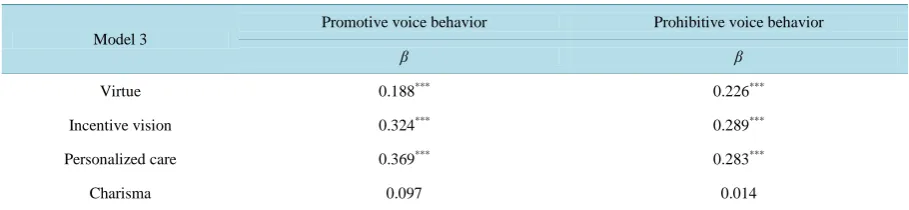
We use the four dimensions of transformational leadership as the independent variable and use the promotive and prohibitive voice behavior as dependent variables. As Table 4 shows, virtue, incentive vision, personalized care has significant correlation with promotive and prohibitive voice behavior. H1-1a, H1-1b, H1-1c, H1-2a, H1-2b, and H1-2c are verified. However, charisma has no significant correlation with promotive and prohibitive voice behavior, H1-1d and H1-2d don’t set up.
4.2.4. Testing the Intermediary Role of Organizational Identification
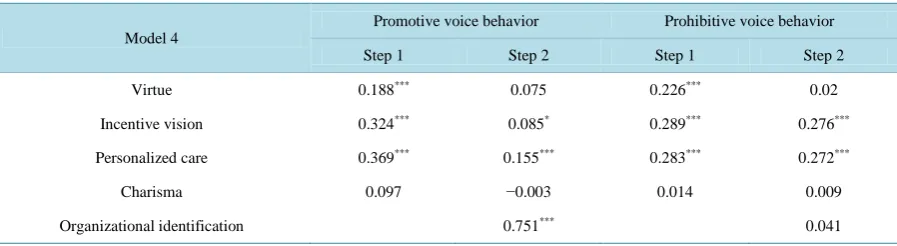
[image:5.595.87.539.362.469.2]In this study, we adopt Baron and Kenny (1986) method to test the mediating effect of organizational identifica-tion. We use transformational leadership as the independent variable and use the promotive and prohibitive voice behavior as dependent variables. The first step is to examine the effect of the four dimensions of transfor-mational leadership on the promotive and prohibitive voice behavior, the second step is to examine the effect after considering the intermediary variable. As can be seen from Table 5, the effect of virtue on voice behavior changes from a significant correlation to no significant correlation after organizational identification is included in the regression equation; Correlation between the incentive vision, personalized care and voice behavior
Table 2.Regression analysis result between transformational leadership and organizational identification.
Model 1
Cognitive Affective Evaluative
β β β
Virtue 0.181*** 0.116*** 0.046*
Incentive vision 0.314*** 0.294*** 0.142*
Personalized care 0.371*** 0.193*** 0.077*
Charisma 0.093* 0.115* 0.133*
*p < 0.05; **p < 0.01; ***p < 0.001.
Table 3. Regression analysis result between organizational identification and voice behavior.
Model 2
Promotive voice behavior Prohibitive voice behavior
β β
Organizational identification 0.889*** 0.116***
*p < 0.05; **p < 0.01; ***p < 0.001.
Table 4.Regression analysis result between transformational leadership and voice behavior.
Model 3
Promotive voice behavior Prohibitive voice behavior
β β
Virtue 0.188*** 0.226***
Incentive vision 0.324*** 0.289***
Personalized care 0.369*** 0.283***
Charisma 0.097 0.014
*
[image:5.595.85.540.599.704.2]Table 5. Testing the intermediary role of organizational identification.
Model 4
Promotive voice behavior Prohibitive voice behavior
Step 1 Step 2 Step 1 Step 2
Virtue 0.188*** 0.075 0.226*** 0.02
Incentive vision 0.324*** 0.085* 0.289*** 0.276***
Personalized care 0.369*** 0.155*** 0.283*** 0.272***
Charisma 0.097 −0.003 0.014 0.009
Organizational identification 0.751*** 0.041
*
p < 0.05; **p < 0.01; ***p < 0.001.
significantly weaken. Therefore, we think that Organizational identification plays a part intermediary role be-tween transformational leadership and voice behavior. H4 is partially verified.
5. Conclusion and Suggestion
5.1. Conclusion
Through empirical research, this paper examines the relationship among transformational leadership, organiza-tional identification and voice behavior. The results of the empirical study showed that:
1) Transformational leadership has a significant positive influence on voice behavior, and the influence on promotive voice behavior is much stronger than on prohibitive voice behavior.
2) Transformational leadership and its four dimensions have a significant positive influence on organizational identification.
3) Organizational identification has a significant positive influence on both promotive voice behavior and prohibitive voice behavior.
4) Organizational identification plays an intermediary role between transformational leadership and voice be-havior.
5.2. Suggestion
Based on the conclusions of this study, we propose the following management recommendations:
Enterprise leaders should treat promoting transformational leadership as a strategic goal. They must make employees understand the purpose and significance to implement transformational leadership. Specifically, managers should enhance leadership skills, and constantly enrich and improve the theoretical knowledge, to im-press and influence people through personal charm. They should convince employees to obey the leaders, being willing to follow the leadership together to complete organizational goals. It requires managers to be able to de-scribe the organization’s future direction and strategic planning, stimulate employees’ enthusiasm and spirit clearly, motivating staffs to complete the ambitious goals of the organization and struggle constantly. Managers should also observe and analyze the characteristics of subordinates, using individualized leadership to provide staff with customized care and to enhance the psychological sense of belonging to the organization staff.
In the context of Chinese culture, leaders should pay attention to morality and character self-cultivation using moral power to influence and appeal of employees. Organizations should improve employees’ organizational identification. This research shows that employees who have a stronger organizational identification are more likely to exhibit higher levels of voice behavior. If leaders want to hear the real voices of employees, they must let employees have a right to speak, to let them participate in making decisions. Only employees being involved in decision-making, they can identify problems in the implementation of decisions and suggest improvements. So to build a sound mechanism is the first step to ensure employees voice behavior.
man-agers should respect for employees, even if the unreasonable proposal should be given full respect. Leaders’ at-titude will largely determine those who offer advice and suggestions.
In the specific business management operations, enterprises should actively expand the staff suggestions channels, through the game, seminars, presentations, surveys, e-mail suggestions to encourage staff in various ways; through corporate Web site, OA office systems, weekly magazine, employee suggestions should be pub-lished way out and reward high-quality advice for good results; enterprise should establish review panels and review the recommendations regularly; various departments should establish a common processes to implement voice behavior, establishing a closed-loop system and promoting the high feasibility suggestions into productiv-ity.
References
[1] Janssen, O., De Vries, T. and Cozijnzen, A.J. (1998) Voicing by Adapting and Innovating Employees: An Empirical Study on How Personality and Environment Interact to Affect Voice Behavior. Human Relations, 51, 945-967. http://dx.doi.org/10.1177/001872679805100705
[2] Burus, J.M. (1978) Leadership. Harper and Row Press, New York.
[3] Bass, B.M. (1985) Leadership and Performance beyond Expectations. Free Press, New York, 3-342.
[4] Lepine, J.A. and Vandyne, L. (2001) Voice and Cooperative Behavior as Contrasting Forms of Contextual Perfor-mance: Evidence of Differential Relationships with Big Five Personality Characteristics and Cognitive Ability. Journal of Applied Psychology, 86, 326-336. http://dx.doi.org/10.1037/0021-9010.86.2.326
[5] Ashforth, B.E. and Mael, F. (1989) Social Identity Theory and the Organization. Academy of Management Review, 14, 20-39.
[6] Xu, W.L. and Zheng, B.X. (2002) Organizational Identification: A Preliminary Exploration of the theory and the Na-ture. Analysis of ZhongShan Management Review, 11, 45-64.
[7] Wei, J., Chen, Z.Y. and Zhang, M. (2007) The Basic Theory, Measurement and Related Variables of Organizational Identification. Advances in Psychological Science, 26, 948-955.
[8] Milliken, F.J., Morrison, E.W. and Hewlin, P.F. (2003) An Exploratory Study of Employee Silence: Issues That Em-ployees Don’t Communicate Upward and Why. Journal of Management Studies, 40, 1453-1476.
http://dx.doi.org/10.1111/1467-6486.00387
[9] Wu, L.Z., Cao, K.P., Chen, Y.Y., et al. (2011) A Study on Transformational Leadership Behavior Impact on Employee Voice Behavior. Journal of Management, 8, 61-80.
[10] Bell, S.J. and Menguc, B. (2002) The Employee-Organization Relationship, Organizational Citizenship Behaviors, and Superior Service Quality. Journal of Retailing, 78, 131-146. http://dx.doi.org/10.1016/S0022-4359(02)00069-6 [11] Zhai, Y.C. (2010) The Core Employee Organizational Identification. An Empirical Study of the Impact on
Organiza-tional Citizenship Behavior of Soochow University.
[12] Wang, L. and Gao, P. (2011) An Empirical Study on Occupation Identity, Team Identification Effect on Employee Voice Behavior. Practice and Understanding of Math., 41, 129-137.
[13] Kark, R., Shamir, B. and Chen, G. (2003) The Two Faces of Transformational Leadership: Empowerment and Depen-dency. Journal of Applied Psychology, 88, 246-255. http://dx.doi.org/10.1037/0021-9010.88.2.246