
423
Effect of bacteria calcite precipitation on compressive strength of
general concrete cubes
Kunal. R. Patil, B. P. Waghere, R. R. Salve, B. K. Ahire, K. S. Patel.
Professor: P H Bhoir, Akshay Thakare
JE Student, Department of Civil Engineering, SMES Institute Nashik, University of Mumbai, Maharashtra,
India.
Abstract:concrete is an absolutely leading component of construction material used in infrastructure and most building. This research given information about the aim at increasing the strength and total durability of the concrete this research carry out one some sate of concrete cube which are subjected to bacterial precipitation (MICP) by different bacterial stain (bacillus pasturii and bacillus spharicus) 7,28 days of bacterial treatment the improvement compressive strength, self-healing of cracks and porous by means of MICP( Microbiological Induced Calcite precipitation ) that’s is calcium carbonate ( CaCOR3R) precipitation bacteria is investigation in this project. A comparison study was made with general
concrete cubes subjected to compressive strength test with and without bacteria. It was found there was high in cringing in compressive strength.
Keyword : Bacterial Concrete, MICP, Compressive Strength, Concrete Cube.
I.INDRODUCTION
Concrete which forms major component in the Construction Industry as it is cheap, easily available and convenient to cast. But drawback of these materials is it is weak in tension. So, it cracks under sustained loading. In concrete, cracking is a common phenomenon due to the relatively low tensile strength and Durability.
These materials is that it cracks under sustained loading and due to aggressive environmental agents which ultimately reduce the life of the structure which are built using these materials. This process of damage occurs in the early life of the building structure and also during its life time.
But, they are not compatible, costly, reduce aesthetic appearance and need constant maintenance. Therefore bacterial induced Calcium Carbonate (Calcite) precipitation has been proposed as an alternative and environment friendly crack remediation and hence improvement of strength of building materials.
Recently, microbiologically induced calcium precipitation (MICP) resulting from metabolic activities of some specific microorganisms in concrete to improve the overall behavior of concrete has begun to attract interest of researchers. Previous studies with aerobic microorganism (Bacillus pasteurii and Bacillus sphaericus) showed a significant improvement in compressive strength of cement mortar.
The technique can be used to improve the compressive strength and stiffness of cracked concrete specimens
“The process can occur inside or outside the microbial cell or even some distance away within the concrete. Often bacterial activities simply trigger a change in solution chemistry that leads to over saturation and mineral precipitation. Use of these Bio mineralogy concepts in concrete leads to potential invention of new material called ―Bacterial Concrete”. Research leading to microbial Calcium carbonate precipitation and its ability to heal cracks of construction materials has led to many applications like crack remediation of concrete, sand consolidation, restoration of historical monuments and other such applications. Integrated bacteria would thus represent an internal self-healing agent which autonomously decreases
Matrix permeability upon crack formation. , save manual repair and moreover increase structure Durability thereby saving both money and the environment as less maintenance and use of Environmental unfriendly repair material is needed.
A) MICROBIALLY INDUCED CALSITE PRICIPITATION
Microbial mineral precipitation involves various microorganisms.
424
Ca2+ + Cell → Cell-Ca2+ ….…… …… (1) Cl- + HCO3- + NH3 → NH4Cl + CO32- ………(2) Cell-Ca2+ + CO32- → Cell-CaCO3↓ ………..(3)
A novel technique for the remediation of damaged structural formations has been developed by employing a selective microbial plugging process in which microbial metabolic activities promote precipitation of calcium carbonate in the form of calcite [Gollapudi et al. 1995]. As a microbial sealant, CaCO3 exhibited its positive potential to selectively consolidate simulated fractures and surface fissures in granites and sand plugging [Zhong and Islam 1995; Achal et al. 2009a]. The present work deals with the compressive strength and concrete permeability using water absorption test, which are the most important parameters influencing the durability of concrete and finally its performance
.
B) MECHANISM OF BACTIRIAL CONCRETE AND BIO- BASED REPAIR SYSTEMS
The microorganism used for manufacturing of microbial concrete should able to process long term effective crack sealing mechanism during its life time serviceable. The bio based repair system developed in this study is a liquid based system which transport which bio based agent into concrete. The bio based repair agent consist of bacteria and feed which produce calcite based minerals decreasing concrete matrix porosity. The bio based system is composed of tree compartment (fig. no. )
1. Transport solution, 2) bacteria, 3) nutrient. Each compartment should be wisely choose in order to keep properties of the to others optimum. 1) Transport solution:- The transport solution insure the transport bacteria and nutrients in to the concrete. Via the cracks of porosity. The pH of the transport solution should permit bacteria development and prevent premature precipitation of nutrients 2) bacteria: - Bacteria can metabolically convert dissolve precursor nutrient into calcite based minerals. 3) Nutrient: - To produce calcite based minerals bacteria need organic carbon and calcium source. The nutrient source should be chosen in order to promote optimum bacteria activities. The principal behind bacterial cracks haling mechanism is that the bacteria should abled to transport soluble organic nutrient in soluble organic calcite crystal which sales the cracks.
C) HOW DOES BACTERIA REMEDIATE CRACKS?
Microorganism (cell surface change in negative) draw actions including CaP 2
P
From the environment to deposit on the cell surface. The following equation summarize the role of bacterial cell as a nucleation site.
CaP 2 +
P
+ Cell → Cell - CaP 2+
Cell → CaP 2+
P
+ COR3RP 2-
P
→Cell - CaCOR3
The bacteria can thus act as a nucleation site which facilities in precipitation of calcite which can eventually plug the pores and cracks in concrete.
II. MATERIAL AND METHOD
A) Material
:
(Cement ,sand, water, aggregate )a) Cement: - Ordinary Portland cement (OPC) of 53 Grade available in local market is used in investigation. The cement used has been tested for various properties as per IS : 4031 – 1988
b) Sand: used the natural river sand confirming to the requirement of IS : 383 – 1970 the rivers and washed and screened to eliminate unwanted deleterious material and over size particle.
• Fineness modules : 4.02
425 c) Water; - water is an extremely important part of concrete and drinking quality water is usually required, or
water from an approved source free from impurities.
d) Course aggregate: - The course aggregate of 20 mm ware used. The aggregate free form deleterious substance. Care was taken that the aggregate to not contain high concentration of flaky, elongated shapes and organic impurities which might affect the strength or durability of the concrete.
• Fineness modules : 7.075
e) Bacterial Source: - Microorganism Bacillus pesteurii (NCL – 2477) and bacillus spehaericus (NCL 2478) Ware obtained from National Chemical Laboratory (NCL), Pune. Bacteria is first cultured in solid media (agar) are then transferred to liquid media (Nutrient Broth) which is sterile and kept in shaking incubator (to ensure uniform growth) for 48 hours .
f) Composition of nutrient broth (500 ml)
Peptone =1gm, Sodium Chloride = 0.5 gm, Meat Extract = 0.3 gm, Distilled Water = 100 ml, pH = 7 to 7.2.
B) Method : Method are using Bacterial precipitation
a) By addition of Bacteria in concrete: Concrete of specimen was prepared by manually mixing. Proportion of concrete was taken for concrete grade M20. Therefore first of all 20 mm and 10 mm sized aggregate ware placed in tray, then fine aggregate and cement is placed in tray according to quantity of materials required for one batch mixing. The material was allowed to mix in dry state until the material is mixed uniformly. Now as per w/c ratio quantity of water required was poured in entire mix. Also with the water Bacterial solution is and in the concrete mix. The mixing of material was continued fill the concrete appeared well mixed.
b) Curing of cube in Bacterial NBU Solution:
Fig No. 1 Nutrient broth solution Fig No. 2 immersion of Sample in Precipitation of Media
• How dose made nutrient broth solution (NBU)?
In the early 1900’s, the American Public Health Association (APHA) suggested the formula of Nutrient Agar as a standard culture medium used in water testing.1 Nutrient Broth is the same formulation as Nutrient Agar, only Agar has been omitted.
Nutrient Broth is used as a pre-enrichment medium when testing certain foods and dairy products for Salmonella spp. In dried or processed foods, salmonellae may be sub lethally injured and in low numbers. The presence of other bacteria and food sample components may hinder growth and recovery of Salmonella spp. Pre-enrichment in a nonselective substances, and provides a nutritional advantage to Salmonella over other bacteria.2 Nutrient Broth is included in many standard methods procedures for testing food, dairy products, and other materials.2-6
Principles of the Procedure:
The nitrogen, carbon, vitamins, and amino acids in Nutrient Broth are provided by Enzymatic Digest of Gelatin and Beef Extract.
Formula / Liter
Enzymatic Digest of Gelatin ... 5 g Beef Extract ... 3 g Final pH: 6.8 ± 0.2 at 25 C
426 C) Cube Designation :
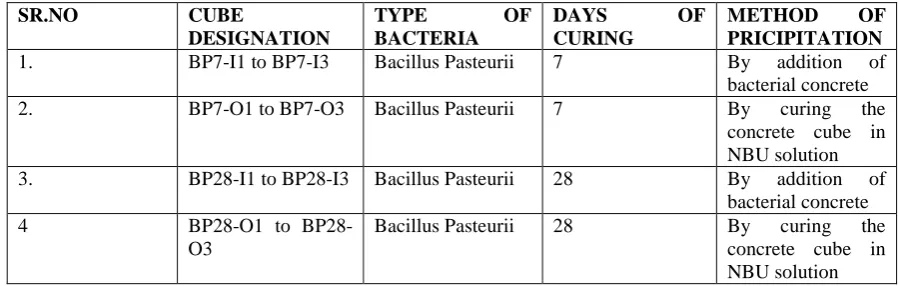
a) Table No.1: Designation of Bacillus Pasturii concrete cube specimen.
SR.NO CUBE
DESIGNATION
TYPE OF BACTERIA
DAYS OF CURING
METHOD OF PRICIPITATION
1. BP7-I1 to BP7-I3 Bacillus Pasteurii 7 By addition of bacterial concrete 2. BP7-O1 to BP7-O3 Bacillus Pasteurii 7 By curing the
concrete cube in NBU solution
3. BP28-I1 to BP28-I3 Bacillus Pasteurii 28 By addition of bacterial concrete 4 O1 to
BP28-O3
Bacillus Pasteurii 28 By curing the concrete cube in NBU solution
b) Table No.2: Designation of Bacillus Spharicus concrete cube specimen.
c) Table No.3: Designation of controlled concrete cube specimen.
SR.NO CUBE DESIGNATION DAYS OF CURING
1. C7-1 to C7-3 7
2. C28-1 to C28-3 28
III. RESULTES
The test result showed the significant difference or improvement in the specimen tested, with, and without bacteria and curing in bacteria. Here are the tables which will give clear information about compressive test results.
a) Table No.4: Compressive strength of control concrete cube (Mpa).
SR. NO CUBE DESIGNATION DAYS OF CURING COMPRESSIVE
STRENGTH (N/mmP 2
P
)in average P
1. C7-1 to C7-3 7 41.18
2. C28-1 to C28-3 28 54.07
SR.NO CUBE
DESIGNATION
TYPE OF BACTERIA
DAYS OF CURING
METHOD OF PRICIPITATION
1. BS7-I1 to BS7-I3 Bacillus Sphaericus 7 By addition of bacterial concrete 2. BS7-O3 to BS7-O3 Bacillus Sphaericus 7 By curing the
concrete cube in NBU solution
3. BS28-I1 to BS28-I3 Bacillus Sphaericus 28 By addition of bacterial concrete 4. O1 to
BS28-O3
427
Fig No. 3 Compression Testing Machine. (CTM) Fig.No 4 Precipitation on Surface of Concrete Cube.
b) Table No.5: Compressive strength reading of Bacillus Pasteurii concrete cube specimen. (by NBU curing method) (Mpa).
SR. NO CUBE
DESIGNATION
TYPE OF BACTERIA
DAYS OF CURING
COMPRESSIVE STRENGTH (N/mmP
2
P
)in average P
1. BS7-O3 to BS7-O3 Bacillus Pasteurii 7 47.55 2. O1 to
BS28-O3
Bacillus Pasteurii 28 60.48
c) Table No.6 :Compressive strength reading of Bacillus Shpaericus concrete cube specimen. (by NBU curing method) (Mpa).
SR. NO UBE
DESIGNATION
TYPE OF BACTERIA
DAYS OF CURING
COMPRESSIVE STRENGTH (N/mmP
2
P
)in average P
1. BS7-O3 to BS7-O3 Bacillus Sphaericus 7 43.40 2. O1 to
BS28-O3
Bacillus Sphaericus 28 63.99
d) Table No. 7: ompressive strength reading of Bacillus Paseturii concrete cube specimen. (by casting method) (Mpa).
SR. NO UBE
DESIGNATIONC
TYPE OF BACTERIA
DAYS OF CURING
COMPRESSIVE STRENGTH (N/mmP
2
P
)in average P
1. BP7-I1 to BP7-I3 Bacillus Pasteurii 7 46.95 2. BP28-I1 to BP28-I3 Bacillus Pasteurii 28 56.14
e) Table No. 8: Compressive strength reading of Bacillus Sphaericus concrete cube specimen. (by casting method) (Mpa).
SR. NO UBE
DESIGNATIONC
TYPE OF BACTERIA
DAYS OF CURING
COMPRESSIVE STRENGTH (N/mmP
2
P
)in average P
428
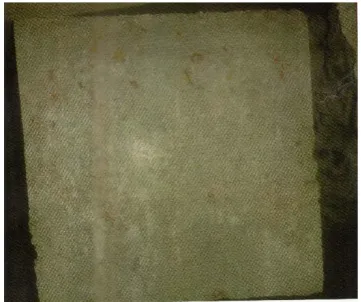
Fig no. 5 Precipitation on Surface of Concrete Cube.
IV.DISCUSSTION
Bacterial concrete should be able to heal or seal porous, voids, cracks and increase the compressive strength by filler material formation, freshly formed porous voids and cracks inhibit ingress of water and other chemicals which could course preliminary degradation of the concrete materials matrix or embedded reinforcement. In this study we investigated the bio mineral production capacity in concrete specimen in which bacteria ware incorporated as healing agent. The integrated bacteria applied in this work are spore forming species of bacillus. Bacteria of this group and particularly their think welled spores. Ware previously shown to able to survive in concrete. Table no .5,6,7,8 summarized the 7 days and 28 days compressive strength of the mortar cubes containing different cell concentration of alkaliphilic microorganism (Bacillus Pasteurii and Bacillus Sphaericus ). The greatest improvement in compressive strength occurs at cell concentration in compressive strength is due to deposition of on the microorganism cell surface and within the pores of the cement sand matrix, which plug the pores within the mortar. The extra cellular growth produced by the microorganism is expected to contribute more to strength of cement mortar with a longer incubation period and thus the strength improvement is found to be more at 28 days. The curing of cubes in bacterial (Bacillus Pasteurii and Bacillus Sphaericus ) nutrient broth solution is the greatest improvement in compressive strength with compared to by addition of bacteria in concrete method.
Graph No. 1 Compressive Strength of 7 & 28 Days They are to deferent Method indicated.
Va
lu
e O
f C
omp
re
ss
iv
e
St
re
ng
th
in
0 10 20 30 40 50 60 70
Control Cubes
specimen NBU SolutionMethod with Bascillus Pasteurii
NBU Solution Method with Bascillus Sphaericus
Casting Method of Bascillus Pasteurii
Bacteria
Casting Method of Bascillus sphaericus
429 V.CONCLUSION
This experiment is examined to find that the bacteria are able increase the strength of concrete and auto crack/porous healing. Form all the above experimental result we found that microbes proved to be efficient in enhancement of concrete prosperities by acquiring more compressive strength that conventional concrete in same days of curing. And thus we can conclude that the calcium carbonate precipitation by bacteria has filled some porous and voids as well as thereby making the texture more dense and compact. Also it makes the structure resistive to seepage/water permeability and ultimately increase the compressive strength of concrete.
VI.ACKNOWLEDGEMENT
Many lives and destinies are destroyed due to the lack of proper guidance, directions and opportunities. It is in this respect we feel that we are in much better condition today due to continuous process of motivation and focus provided by our parents and teachers in general. The process of completion of this research was a tedious job and requires care and support at all stages. We would like to highlight the role played by individuals towards this.
VII.REFERENCES
1) Stoks Fischer S, Galinat J K, Bang S S,(1999),”Microbiological Precipitation of CaCO Biology Biochemistry, Vol. 31, pp. 1563-1571.
2) Meldrum F C (2003), “Calcium carbonate in biomineralisation and biomimetic chemistry”, International Materials Reviews, Vol. 48, No.3, pp. 187-224.
3) Gollapundi U K, Knutson C L, Bang S S, and Islam M R, (1995), “A new Method For controlling Leaching through permeable channels” , Chemosphere, Vol. 30, pp. 695-705.
4) R V Bang, Sookie S, Galinat Johnna K, Johnna K. Galinat, V Ramakrishnam, (2001), “Calcite Precipitation Induced By Polyurethane Immobilized Bacillus Pasteurii Enzyme and Microbial Technology, vol. 28, pp. 404-409.
5) De Muynck W, De Belie N, Verstraete W, (2010), “Microbial carbonate Precipitation in construction Materials: A review”, Ecol Engg, Vol.36, No.2, pp. 118-136.
6) J L Day, A V Ramakrishnam, and S S Bang (2003), “Microbiologically Induced Sealant For Concrete Crack Remediation”, Quality Assurance, pp. 1-8.
7) Bachmeier K L, Williams A E, Warmington J R, Bang S S, (2002), “Urease Activity in Microbiologically-induced calcite precipitation.” J. Biotechnology, Vol. 93, pp. 171-181.
8) Muynck De, and De Belie, (2007), “improvement of Concrete Durability with Aid of Bacteria”, Microbial Ecology, April, pp. 1-11.
9) S Al-thawadi and R. Cord-Ruwisch, (2012), “Calcium Carbonate Crystals Formation by Ureolytic Bacteria Isolated form Australian Siol and Sludge,” Journal of Advanced Sience and Engineering Research 2, Vol. 2, pp. 12-16.
10) “Studies on the characterization of Biosealant properties of Bacillus Sphaericus”, International Journal of Engineering Science and Technology, Vol. 2 no. 3, pp. 270277.
11) Varenyam Achal, (2010), “Microbial Remediation of Defects in Building Materials and Structures.” Biotechnology Dept, Thapar University, Patiala, Punjab (india).
Kunal R. Patil , Diploma Engineering in Civil SMES Institute of Technical, polytechnic, Nashik (2012-2015)
![Tb3+ PVC Membrane Sensor Based on 1,4 bis[o (furan 2 carboxamidophenyl)] 1,4 dithiobutane as a sensing material](data:image/gif;base64,R0lGODlhAQABAIAAAP///wAAACH5BAEAAAAALAAAAAABAAEAAAICRAEAOw==)