OncoTargets and Therapy 2018:11 1787–1799
OncoTargets and Therapy
Dove
press
submit your manuscript | www.dovepress.com 1787
R e v i e w
open access to scientific and medical research
Open Access Full Text Article
Prognostic value of increased integrin-beta 1
expression in solid cancers: a meta-analysis
Quanwu Sun1,*
Chuan Zhou2,*
Ruofei Ma3
Qianhong Guo4
Haiyun Huang1
Jie Hao1
Hong Liu1
Rong Shi1
Bo Liu1
1Department of Breast Surgery, The People’s Hospital of Gansu Province, Lanzhou City, Gansu, China; 2Department of Urology/institute of Urology, west China School of Medicine/west China Hospital, Sichuan University, Chengdu, China; 3Department of Abdominal Surgery, Gansu Tumor Hospital, Lanzhou City, Gansu, China; 4Department of Oncological Surgery, The First People’s Hospital of Tianshui City, Tianshui City, Gansu, China
*These authors contributed equally to this work
Abstract: Integrin-beta 1 (ITGB1) is aberrantly overexpressed or downregulated in solid cancers; however, its prognostic value remains controversial. Therefore, we conducted a meta-analysis to explore whether ITGB1 expression is correlated with overall survival (OS) and the clinicopathological characteristics of patients with solid cancers. We systematically searched the PubMed, Embase, and Web of Science databases for eligible studies published up to June 1, 2017. In total, 22 studies involving 3,666 patients were included. A sensitivity analysis was performed to assess the validity and reliability of the pooled OS. Among the 22 studies, 7 focused on lung cancer, 3 focused on colorectal cancer, 6 focused on breast cancer, 3 involved melanoma, and 3 involved pancreatic cancer. The pooled results showed that high ITGB1 expression was
significantly associated with worse OS in lung cancer (pooled hazard ratio [HR]=1.78, 95%
CI: 1.19–2.65, p0.05) and breast cancer (pooled HR=1.88, 95% CI: 1.46–2.42, p0.01).
In addition, a significant association was observed between high ITGB1 expression and
disease-free survival in breast cancer (pooled HR=1.63, 95% CI: 1.17–2.25, p0.001) and pancreatic
cancer (pooled HR=2.49, 95% CI: 1.35–4.61, p0.001). However, high ITGB1 expression was
not related to OS in colorectal cancer, pancreatic cancer, or melanoma. The pooled HRs used to evaluate the prognostic value of increased ITGB1 expression in lung cancer, breast cancer, and pancreatic cancer were not significantly altered, which indicates that the pooled results were robust. The results of this study indicate that the prognostic value of decreased ITGB1 expression varies among solid cancers.
Keywords: ITGB1, solid cancer, prognosis, meta-analysis
Introduction
Cancer is a major cause of death worldwide; in 2012, 14.1 million new cancer cases and 8.2 million cancer-related deaths were reported across the world.1 Currently, several therapeutic strategies, including radical operation, chemotherapy, and radiotherapy, are available for primary solid tumors and metastatic cancers. Nevertheless, the thera-peutic response differs significantly in patients. Therefore, it is imperative to develop effective and clinically applicable biomarkers to accurately evaluate the therapeutic effect and prognosis of patients with cancer.
Integrins are a family of transmembrane receptors that generally consist of non-covalently linked alpha and beta subunits. Integrins have a variety of functions in cell adhesion and contact, and anchorage-dependent cell survival, and regulate various cellular processes including tissue healing, hemostasis, immune response, cell differ-entiation, division, growth, recognition, and migration.2–4 Recent evidence suggests that integrins are involved in many processes associated with tumor cell adhesion to the extracellular matrix, including migration, invasion, and metastasis.5–7 Moreover, previous studies have shown that integrins play an important role in the regulation of Correspondence: Haiyun Huang
Department of Breast Surgery, The People’s Hospital of Gansu Province, No 204 Donggang west Road, Lanzhou City, Gansu 730000, China Tel +86 093 1828 1293
email [email protected]
Journal name: OncoTargets and Therapy Article Designation: Review
Year: 2018 Volume: 11
Running head verso: Sun et al
Running head recto: Increased integrin-beta 1 expression in solid cancers DOI: 155279
OncoTargets and Therapy downloaded from https://www.dovepress.com/ by 118.70.13.36 on 25-Aug-2020
For personal use only.
Dovepress
Sun et al
tumor angiogenesis.8,9 Additional investigations indicate that integrins can interact with tyrosine kinase receptors, such as epidermal growth factor receptor and vascular epidermal growth factor receptor, to promote cancer cell proliferation, survival, and differentiation.10
Integrin-beta 1 (ITGB1), also known as CD29, is a member of the integrin family and is composed of alpha and beta transmembrane subunits that form at least 24 distinct heterodimeric receptors.7,11 The role of ITGB1 in malignant phenotypes of cancers has gained a lot of attention.12 Previ-ous studies have suggested that ITGB1 is the predominantly expressed integrin in normal and tumor cells and controls various developmental processes including angiogenesis, tumor progression, and metastasis.13–17 Other studies have also shown that, in many cancer types, ITGB1 may induce resistance to radiotherapies, chemotherapies, and targeted therapies.18–22 On the basis of these findings, ITGB1 has been studied extensively in terms of the biology of solid tumors, and its aberrant expression at the protein or RNA level has been shown to correlate with poor prognosis in several types of cancer, including lung cancer,23–26 gastric cancer,27 breast cancer,28–30 prostate cancer,31 pancreatic carcinoma,32,33 and colorectal cancer,34,35 making it a potential target for antitu-mor therapies. Nevertheless, the prognostic significance of ITGB1 expression in patients with cancer remains inconsis-tent. For instance, some studies have reported that decreased ITGB1 protein expression is associated with more aggressive breast cancer types,30,36 but the conclusion was different in other studies.28,37 Some studies could not verify a significant correlation between ITGB1 protein expression and survival of patients with breast carcinoma.29,38
Thus far, no meta-analyses of studies focusing on the investigation of the prognostic and clinicopathological significance of ITGB1 in patients with solid tumors have been performed. Furthermore, conclusions made from most studies published so far are limited by small sample sizes. Therefore, we conducted a meta-analysis to estimate the prognostic and clinicopathological value of ITGB1 in patients with solid cancers.
Materials and methods
Literature search strategy and study
selection
We searched the PubMed, Embase, and Web of Science databases to identify all relevant studies that assessed the association between ITGB1 expression and survival outcome in patients with solid cancers published up to June 1, 2017. The search terms included the following terms: (“ITGB1”
or “Integrin β1”), (“cancer” or “tumor” or “malignancy” or “carcinoma”), and (“prognos*”). The publication language was limited to English.
Studies were included in the analysis if they met the following inclusion criteria: 1) the studies investigated the association between ITGB1 and overall survival (OS) or disease-free survival (DFS) among patients with primary solid cancers or metastasis; 2) relevant clinicopathological characteristics were presented; 3) tumor tissues from patients with solid cancers were used for the determination of ITGB1 expression; 4) patients were grouped into high and low expression groups according to the ITGB1 protein or RNA level; and 5) sufficient information and data were available to calculate hazard ratios (HRs) with 95% CIs. The exclusion criteria were as follows: 1) studies that were published as reviews, abstracts, case reports, letters, or comments, as well as duplicate studies; 2) studies in which human cell lines or animals were used; and 3) studies that failed to provide the HRs with 95% CIs or Kaplan–Meier survival curves used to calculate the OS and DFS.
Data extraction and quality assessment
All the candidate publications were reviewed, and the data were extracted by 2 independent investigators. The third investigator was responsible for reconciling disagreements when the results were controversial. The following infor-mation was extracted: cancer type, first author’s name, publication year, region, number of patients, patients’ ages, test method, rate of high ITGB1 expression, clinical and pathological features, follow-up duration, OS, and DFS. If the results of both the univariate and multivariate analyses were provided in the studies, only the latter were extracted owing to their higher accuracy, since multivariate analyses account for confounding factors. Moreover, the selection of participants, comparability, and ascertainment of out-comes were assessed. The study quality was assessed using the standard Newcastle–Ottawa Scale, which ranges from 0 (minimum) to 9 (maximum). If the final score of a study was higher, it indicated that the study’s methodological quality was better. A study with a score of 6 or higher was defined as “high-quality.”Statistical analysis
The meta-analysis was performed using Stata SE12.0 (Stata Corp., College Station, TX, USA). HRs and 95% CIs were used to assess the prognostic value of ITGB1, and odds ratios (ORs) with 95% CIs were used to evaluate the association between ITGB1 expression and
OncoTargets and Therapy downloaded from https://www.dovepress.com/ by 118.70.13.36 on 25-Aug-2020
Dovepress increased integrin-beta 1 expression in solid cancers
clinicopathological features of solid cancers. A sensitivity analysis was performed to assess the validity and reliability of the pooled OS in patients with lung cancer, breast cancer, and pancreatic cancer. Chi-square-based Q-tests and I 2 statistics were applied to evaluate study heterogeneity, with I 250% and p0.05 indicating statistical heterogeneity. If no large statistical heterogeneity was detected, a fixed-effects model was used to assess the pooled HRs; otherwise, a random-effects model was used. Egger’s test and Begg’s test should have been applied to investigate publication bias, but the tests were not conducted owing to the small number of included studies used to assess the specific outcomes of interest.
Results
Study selection and study characteristics
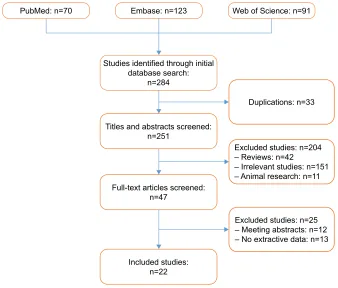
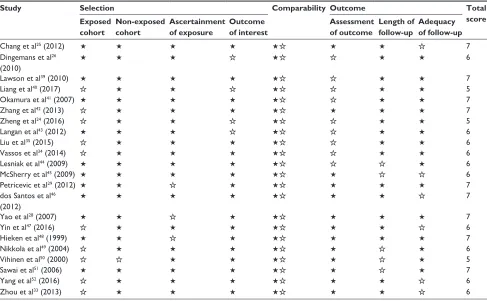
A total of 284 articles were primarily identified, 70 of which were from PubMed, 123 from Embase, and 91 from Web of Science. After duplicate publications were removed and the remaining abstracts and full texts meticulously reviewed, 22 publications were finally determined to be eligible for the present pooled analysis;24–26,28,29,33–35,39–52 the inclusion of the publications in the analysis was based on the selection criteria mentioned above. The detailed selection process is shown in Figure 1.The basic characteristics of the included studies are sum-marized in Table 1. In all, 22 studies involving 3,666 patients were included in the current meta-analysis, the sample size of which ranged from 30 to 959. All the included studies were published in English. The recruitment period of patients ranged from 1974 to 2014. Among the 22 studies, 7 focused on lung cancer,24–26,39–42 3 focused on colorectal cancer,34,35,43 6 focused on breast cancer,28,29,44–47 3 involved melanoma,48–50 and 3 involved pancreatic cancer.33,51,52 Moreover, 7 studies were performed in China and 3 studies were performed in the USA. The majority of the studies used immunohistochem-istry to detect ITGB1 protein levels, while 3 studies used real-time quantitative reverse transcription polymerase chain reaction (Table 1). The study quality scores ranged from 5 to 7, which indicated that the quality of the included studies was moderate to high (Table 2).
High iTGB1 expression and OS in
solid cancers
The pooled result revealed that high ITGB1 expression was significantly associated with worse OS in patients with lung cancer (pooled HR=1.78, 95% CI: 1.19–2.65, p0.05) (Figure 2) and breast cancer (pooled HR=1.88, 95% CI: 1.46–2.42, p0.01) (Figure 3). In addition, no significant
6WXGLHVLGHQWLILHGWKURXJKLQLWLDO GDWDEDVHVHDUFK
Q
7LWOHVDQGDEVWUDFWVVFUHHQHG Q
)XOOWH[WDUWLFOHVVFUHHQHG Q
,QFOXGHGVWXGLHV Q
([FOXGHGVWXGLHVQ ±5HYLHZVQ
±,UUHOHYDQWVWXGLHVQ ±$QLPDOUHVHDUFKQ
'XSOLFDWLRQVQ
([FOXGHGVWXGLHVQ ±0HHWLQJDEVWUDFWVQ ±1RH[WUDFWLYHGDWDQ :HERI6FLHQFHQ (PEDVHQ
3XE0HGQ
Figure 1 Flow diagram of study selection.
OncoTargets and Therapy downloaded from https://www.dovepress.com/ by 118.70.13.36 on 25-Aug-2020
Dovepress
Sun et al
Table 1
Baseline characteristics of studies included in the meta-analysis
Cancer type
First author (year)
Region
Time of recruitment No of patients Age (years), median (range) Test method Rate of high ITGB1 expression
(%)
Survival outcomes (HR, 95% CI), H/L Follow-up (months), median NOS score
Small cell lung cancer
Chang et al
25 (2012) Korea 2000–2008 112 66 (42–88) iHC 57.1
OS: 0.98 (0.66–1.45)
61
7
Non-small cell lung cancer Dingemans et al
26 (2010)
the Netherlands
1995–1999
68
69.1 (44.5–90.2)
Real-time qPCR
NR
OS: 2.11 (1.21–3.69); DFS: 1.53 (0.87–2.70)
93
6
Small cell lung cancer
Lawson et al
39 (2010)
UK 1998–2005 151 67.34 (9.93) iHC 70.2
OS: 1.67 (1.09–2.56)
72
7
Non-small cell lung cancer
Liang et al
40 (2017) China NR 134 NR iHC NR
OS: 1.56 (0.96–2.53)
NR
5
Non-small cell lung cancer Okamura et al
41 (2007)
Japan 1997–2000 118 65 (41–79) iHC 66.9
OS: 1.41 (0.80–2.49)
71.0
7
Lung adenocarcinoma
Zhang et al
42 (2013) China 2004–2006 108 NR iHC 32.4
RFS: 6.592 (4.106–10.584); OS: 6.183 (3.851–9.929)
60
7
Non-small cell lung cancer
Zheng et al
24 (2016) China NR 959 67 (38–90)
TCGA RNASeq database
NR
OS: 1.31 (1.10–1.55)
NR
5
Colorectal cancer
Langan et al
43 (2012)
USA NA 30 56 (35–76) iHC NR
OS: 0.28 (0.06–1.27)
113
6
Colorectal cancer
Liu et al
35 (2015) China 2001–2013 582 NR iHC 52.6
OS: 1.537 (1.147–2.059)
100
6
Colorectal liver metastases
v
assos et al
34 (2014)
Germany 1995–2010 81 NR iHC 45.7
OS: 1.23 (0.44–3.43); DFS: 0.95 (0.44–2.01)
55
6
H
eR-2-positive
metastatic breast cancer Lesniak et al
44 (2009)
Canada 1998–2002 78 NR iHC 29.5
OS: 2.82 (1.52–4.24)
28
6
Breast cancer
McSherry et al
45 (2009)
ireland 1988–1992 272 NR iHC NR
OS: 1.16 (0.62–2.19)
NR
6
Breast cancer
Petricevic et al
29 (2012)
Croatia 2002–2003 133 NR iHC 36.4 NR 60 7 Breast cancer
dos Santos et al
46 (2012)
Brazil 1994–2010 225 55 iHC 32.9
DSS: 2.51 (1.24–3.7); DFS: 1.38 (0.86–2.23); MFS: 1.94 (1.07–3.52)
NR
7
Breast cancer
Yao et al
28 (2007) USA 1974–1999 149 NR iHC 10.1
OS: 1.73 (1.22–2.44); DFS: 1.88 (1.20–2.95)
60
7
Breast cancer
Yin et al
47 (2016) China NR 67 51 iHC 43.3
OS: 2.772 (1.011–7.600)
NR
6
Melanoma
Hieken et al
48 (1999)
USA 1976–1995 111 53 iHC 32.4
OS: 3.10 (0.9–10.73)
105
7
Melanoma
Nikkola et al
49 (2004)
Finland 1989–1995 55 47 iHC 10.7
DFS: 3.36 (2.03–5.54)
NR
6
OncoTargets and Therapy downloaded from https://www.dovepress.com/ by 118.70.13.36 on 25-Aug-2020
Dovepress increased integrin-beta 1 expression in solid cancers
association was found between high ITGB1 expression and OS in colorectal cancer (pooled HR=1.06, 95% CI: 0.48–2.32, p0.001) (Figure 4), pancreatic cancer (pooled HR=1.41, 95% CI: 0.76–2.61, p0.0001) (Figure 5), or melanoma (pooled HR=0.79, 95% CI: 0.06–11.08, p=0.01) (Figure 6).
High iTGB1 expression and DFS in
solid cancers
The pooled result revealed that high ITGB1 expression was significantly associated with worse DFS in patients with breast cancer (pooled HR=1.63, 95% CI: 1.17–2.25,
p0.001) (Figure 7) and pancreatic cancer (pooled HR=2.49, 95% CI: 1.35–4.61, p0.001) (Figure 8). In addition, no significant association was found between high ITGB1 expression and DFS in lung cancer (pooled HR=3.20, 95% CI: 0.77–13.40, p0.01) (Figure 9) or melanoma (pooled HR=0.88, 95% CI: 0.06–13.25, p0.05) (Figure 10).
High iTGB1 expression and
clinicopathological factors in lung cancer
Considering that the biology, pathology, clinical courses, and treatments vary enormously among different types of solid cancers, we assessed the associations between high ITGB1 expression and clinicopathological characteristics in lung cancer, breast cancer, and pancreatic cancer. However, high expression of ITGB1 was not evaluated in colorectal cancer and melanoma owing to limited data on the clini-copathological features. Six studies reported a relationship between high ITGB1 expression and clinicopathological factors in lung cancer, including 2 studies that investigated tumor differentiation, N stage, T stage, and age (Table 3). Except for T stage (I 2=0, p=0.50) and age (I 2=5%, p=0.305), significant heterogeneity was observed between high ITGB1 expression and tumor differentiation (I 2=85%, p=0.01) and N stage (I 2=74.7% p=0.047). The pooled analysis showed no significant association between high ITGB1 expression and tumor differentiation (OR=0.69, 95% CI: 0.10–4.98, p=0.712), N stage (OR=0.40, 95% CI: 0.16–1.01, p=0.053), or age (OR=0.98, 95% CI: 0.70–1.37, p=0.921) (Table 3), while high ITGB1 expression showed a strong association with worse T stage (OR=0.64, 95% CI: 0.41–0.98, p=0.041) (Table 3).High iTGB1 expression and
clinicopathological factors in breast
cancer
A total of 6 studies identified an association between ITGB1 expression and clinicopathological factors in breast cancer.
Melanoma
v
ihinen et al
50 (2000)
Finland NR 38 NR iHC 28.9
OS: 0.43 (0.12–1.59); DFS: 0.21 (0.07–0.60)
NR
5
Pancreatic cancer
Sawai et al
51 (2006) Japan NR 78 65.1 iHC NR
Training set OS: 0.909 (0.569–1.410); validation set OS: 0.782 (0.505–1.355)
17.6
7
Pancreatic ductal adenocarcinoma
Yang et al
52 (2016) China 2012–2014 63 NR iHC 54.0
OS: 2.375 (1.186–5.194); RFS: 2.488 (1.197–5.170)
NR
6
Pancreatic cancer
Zhou et al
33 (2013) China 2008–2012 54 56 RT-PCR 50
OS: 3.2 (1.2–6.7); DFS: 2.5 (0.7–6.8)
NR
6
Note:
H/L is high
iTGB1 expression vs low
iTGB1 expression. Abbreviations: iTGB1, integrin-beta 1; NOS, Newcastle–Ottawa Scale; H eR, human epidermal growth factor receptor; iHC, immunohistochemistry; qPCR, quantitative polymerase chain reaction; TCGA, The Cancer Genome Atlas; RT-PCR, reverse transcription polymerase chain reaction; OS, overall survival; DFS, disease-free survival; RFS, recurrence-free survival; DSS, disease-specific survival; MFS, metastat ic-free survival; NR, not reported; NA, not applicable;
HR, hazard ratio.
OncoTargets and Therapy downloaded from https://www.dovepress.com/ by 118.70.13.36 on 25-Aug-2020
Dovepress
Sun et al
Table 2 Methodological quality assessment (risk of bias) of included studies by the Newcastle–Ottawa Scale
Study Selection Comparability Outcome Total
score Exposed
cohort
Non-exposed cohort
Ascertainment of exposure
Outcome of interest
Assessment of outcome
Length of follow-up
Adequacy of follow-up
Chang et al25 (2012) 7
Dingemans et al26 (2010)
6
Lawson et al39 (2010) 7
Liang et al40 (2017) 5
Okamura et al41 (2007) 7
Zhang et al42 (2013) 7
Zheng et al24 (2016) 5
Langan et al43 (2012) 6
Liu et al35 (2015) 6
vassos et al34 (2014) 6
Lesniak et al44 (2009) 6
McSherry et al45 (2009) 6
Petricevic et al29 (2012) 7
dos Santos et al46 (2012)
7
Yao et al28 (2007) 7
Yin et al47 (2016) 6
Hieken et al48 (1999) 7
Nikkola et al49 (2004) 6
vihinen et al50 (2000) 5
Sawai et al51 (2006) 7
Yang et al52 (2016) 6
Zhou et al33 (2013) 6
Notes: For each domain, either a “star” or “white star” is assigned, with a “star” indicating that the study design element was considered adequate and less likely to introduce bias. A maximum of 2 stars could be given for Comparability. A study could receive a maximum of 10 stars.
&KDQJHWDO
'LQJHPDQVHWDO
/DZVRQHWDO
/LDQJHWDO
2NDPXUDHWDO
=KDQJHWDO
=KHQJHWDO
2YHUDOO, S
6WXG\,'
±
±
±
±
±
±
±
± +5&,
ZHLJKW
Figure 2 Results of pooled hazard ratios of overall survival of patients with high integrin-beta 1 (iTGB1) expression level in lung cancer.
Note: weights are from random effects analysis.
Abbreviation: HR, hazard ratio.
No significant heterogeneity was identified between high ITGB1 expression and N stage (I 2=2%, p=0.36), tumor grade (I 2=0, p=0.636), T stage (I 2=0, p=0.639), metastasis (I 2=0, p=0.357), estrogen receptor (ER) (I 2=14.8%, p=0.279),
progesterone receptor (PR) (I 2=43.6%, p=0.183), or human epidermal growth factor receptor (HER) (I 2=29.9%,
p=0.232); therefore, a fixed-effects model was used for the analysis (Table 3). The pooled analysis revealed no
OncoTargets and Therapy downloaded from https://www.dovepress.com/ by 118.70.13.36 on 25-Aug-2020
Dovepress increased integrin-beta 1 expression in solid cancers
<DQJHWDO
=KRXHWDO
6DZDLHWDO
6DZDLHWDO
2YHUDOO, S
6WXG\,'
±
±
±
±
± +5&,
ZHLJKW
Figure 5 Results of pooled hazard ratios of overall survival of patients with high integrin-beta 1 (iTGB1) expression level in pancreatic cancer.
Note: weights are from random effects analysis.
Abbreviation: HR, hazard ratio.
6WXG\,'
/HVQLDNHWDO
0F6KHUU\HWDO
<DRHWDO
<LQHWDO
2YHUDOO, S
ZHLJKW
± +5&O
±
±
±
±
Figure 3 Results of pooled hazard ratios of overall survival of patients with high integrin-beta 1 (iTGB1) expression level in breast cancer.
Abbreviation: HR, hazard ratio.
ZHLJKW
6WXG\,'
/DQJDQHWDO
/LXHWDO
9DVVRVHWDO
2YHUDOO, S
±
±
±
± +5&O
Figure 4 Results of pooled hazard ratios of overall survival of patients with high integrin-beta 1 (iTGB1) expression level in colorectal cancer.
Note: weights are from random effects analysis.
Abbreviation: HR, hazard ratio.
OncoTargets and Therapy downloaded from https://www.dovepress.com/ by 118.70.13.36 on 25-Aug-2020
Dovepress
Sun et al
+LHNHQHWDO 6WXG\,'
9LKLQHQHWDO
2YHUDOO, S
+5&,
±
±
±
ZHLJKW
Figure 6 Results of pooled hazard ratios of overall survival of patients with high integrin-beta 1 (iTGB1) expression level in melanoma.
Note: weights are from random effects analysis.
Abbreviation: HR, hazard ratio.
<DRHWDO 6WXG\,'
GRV6DQWRVHWDO
2YHUDOO, S
+5&,
±
±
±
ZHLJKW
Figure 7 Results of pooled hazard ratios of disease-free survival of patients with high integrin-beta 1 (iTGB1) expression level in breast cancer.
Abbreviation: HR, hazard ratio.
<DQJHWDO 6WXG\,'
=KRXHWDO
2YHUDOO, S
+5&,
±
±
±
ZHLJKW
Figure 8 Results of pooled hazard ratios of disease-free survival of patients with high integrin-beta 1 (iTGB1) expression level in lung cancer.
Note: weights are from random effects analysis.
Abbreviation: HR, hazard ratio.
OncoTargets and Therapy downloaded from https://www.dovepress.com/ by 118.70.13.36 on 25-Aug-2020
Dovepress increased integrin-beta 1 expression in solid cancers
'LQJHPDQVHWDO
=KDQJHWDO
2YHUDOO, S
6WXG\,'
±
±
±
+5&, ZHLJKW
Figure 9 Results of pooled hazard ratios of disease-free survival of patients with high integrin-beta 1 (iTGB1) expression level in pancreatic cancer.
Note: weights are from random effects analysis.
Abbreviation: HR, hazard ratio.
1LNNRODHWDO
9LKLQHQHWDO
2YHUDOO, S
6WXG\,'
±
±
±
+5&, ZHLJKW
Figure 10 Results of pooled hazard ratios of disease-free survival of patients with high integrin-beta 1 (iTGB1) expression level in melanoma.
Note: weights are from random effects analysis.
Abbreviation: HR, hazard ratio.
significant relationship between increased ITGB1 expres-sion and N stage (OR=0.79, 95% CI: 0.52–1.19, p=0.262), tumor grade (OR=1.20, 95% CI: 0.74–1.94, p=0.462), T stage (OR=0.78, 95% CI: 0.51–1.19, p=0.25), ER (OR=1.45, 95% CI: 0.90–2.35, p=0.462), PR (OR=1.15, 95% CI: 0.74–1.80,
p=0.527), or HER (OR=1.70, 95% CI: 0.98–2.93, p=0.057), while high ITGB1 expression demonstrated a strong associa-tion with metastasis (OR=1.99, 95% CI: 1.18–3.38, p=0.010) (Table 3).
iTGB1 expression and clinicopathological
factors in pancreatic cancer
Only 2 studies reported a relationship between ITGB1 expression and age in pancreatic cancer. No significant het-erogeneity was detected in the studies regarding age (I 2=0,
p=0.459); therefore, a fixed-effects model was applied. The pooled results showed that high ITGB1 expression was
not significantly correlated with age (OR=1.35, 95% CI: 0.65–2.80, p=0.417) (Table 3).
Sensitivity analysis
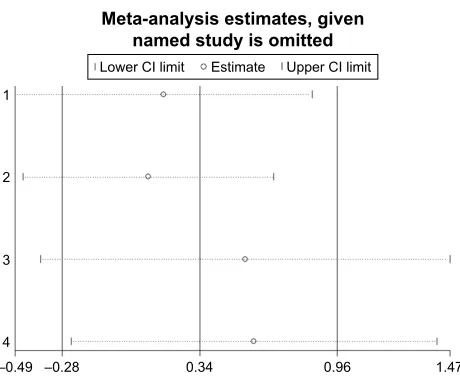
Sensitivity analyses were performed to evaluate the stability of the pooled results for OS in lung cancer (Figure 11), breast cancer (Figure 12), and pancreatic cancer (Figure 13). The results of the sensitivity analyses showed that the pooled HRs for OS did not change substantially, which indicates that the conclusions from our meta-analysis were relatively reliable.
Publication bias
Begg’s and Egger’s tests were used to assess publication bias in our meta-analysis. The results revealed that there was no significant bias in the pooled HRs for OS in lung cancer (Begg’s test, z=1.05, p=0.293; Egger’s test, t-bias=1.10,
OncoTargets and Therapy downloaded from https://www.dovepress.com/ by 118.70.13.36 on 25-Aug-2020
Dovepress
Sun et al
Table 3 Meta-analysis results of the associations of integrin-beta 1 with clinicopathological parameters
Clinicopathological parameter
No of studies
Reference no
OR (95% CI) p-value Heterogeneity
test
I2 (%) p-value
Lung cancer
Tumor differentiation (moderate–well vs poor) 2 637 0.69 (0.10–4.98) 0.712 85.0 0.010
N stage (N0 vs N+) 2 663 0.40 (0.160–1.01) 0.053 74.7 0.047
T stage (T1–2 vs T3–4) 2 663 0.64 (0.41–0.98) 0.041 0.0 0.5
Age (60 vs 60 years) 2 665 0.98 (0.70–1.37) 0.921 5.0 0.305
Breast cancer
N stage (N0 vs N+) 3 399 0.79 (0.52–1.19) 0.262 2.0 0.360
Tumor grade (i–ii vs iii–iv) 3 424 1.20 (0.74–1.94) 0.462 0.0 0.636
T stage (T1 vs T2–3) 3 424 0.78 (0.51–1.19) 0.250 0.0 0.639
Metastasis (yes vs no) 2 292 1.99 (1.18–3.38) 0.010 0.0 0.357
eR (+ vs -) 2 352 1.45 (0.90–2.35) 0.126 14.8 0.279
PR (+ vs -) 2 352 1.15 (0.74–1.80) 0.527 43.6 0.183
HeR (+ vs -) 2 357 1.70 (0.98–2.93) 0.057 29.9 0.232
Pancreatic cancer
Age (60 vs 60 years) 2 117 1.35 (0.65–2.80) 0.417 0.0 0.459
Abbreviations: eR, estrogen receptor; PR, progesterone receptor; HeR, human epidermal growth factor receptor; OR, odds ratio.
0HWDDQDO\VLVHVWLPDWHVJLYHQ QDPHGVWXG\LVRPLWWHG
8SSHU&,OLPLW /RZHU&,OLPLW (VWLPDWH
Figure 11 Sensitivity analysis of pooled hazard ratios of overall survival of patients with high integrin-beta 1 (iTGB1) expression level in lung cancer.
0HWDDQDO\VLVHVWLPDWHVJLYHQ QDPHGVWXG\LVRPLWWHG
8SSHU&,OLPLW /RZHU&,OLPLW (VWLPDWH
Figure 12 Sensitivity analysis of pooled hazard ratios of overall survival of patients with high integrin-beta 1 (iTGB1) expression level in breast cancer.
p=0.320). Publication bias was not observed when assess-ing for potential bias in the pooled HRs for the correlation between high ITGB1 expression and DFS, owing to the limited number of studies investigating this relationship.
Discussion
Studies have shown conflicting results regarding the role of ITGB1 in the carcinogenesis of solid cancers;28–30 therefore, its prognostic value in patients with solid cancers is also inconsistent and remains unknown. Although several previ-ous studies reported that ITGB1 could induce resistance to chemotherapy and radiation in several human cancers,53,54 the impact of increased ITGB1 expression on the prognosis
of patients with solid cancers has not been fully explored. Hence, we combined 22 publications involving 3,666 patients to perform the first meta-analysis that evaluated the associa-tion between ITGB1 and OS and DFS in patients with solid cancers. In addition, we explored the relationship between low ITGB1 expression and the clinicopathological features of solid cancers.
The pooled results of the meta-analysis revealed that high ITGB1 expression was significantly associated with worse OS in lung cancer and breast cancer. Moreover, the results showed that high ITGB1 expression was not related to OS in colorectal cancer, pancreatic cancer, or melanoma. In addi-tion, the pooled result revealed that high ITGB1 expression
OncoTargets and Therapy downloaded from https://www.dovepress.com/ by 118.70.13.36 on 25-Aug-2020
Dovepress increased integrin-beta 1 expression in solid cancers
Figure 13 Sensitivity analysis of pooled hazard ratios of overall survival of patients with high integrin-beta 1 (iTGB1) expression level in pancreatic cancer.
±
±
0HWDDQDO\VLVHVWLPDWHVJLYHQ QDPHGVWXG\LVRPLWWHG
8SSHU&,OLPLW /RZHU&,OLPLW (VWLPDWH
was significantly associated with worse DFS in breast cancer and pancreatic cancer. The sensitivity analyses demonstrated that the pooled HRs used to evaluate the prognostic value of increased ITGB1 expression in lung cancer, breast cancer, and pancreatic cancer were not significantly altered, which indicates that the pooled results were robust. Considering the above findings, we believe that the prognostic value of increased ITGB1 expression varies according to cancer type in patients with solid cancer.
In addition, we investigated the relationship between ITGB1 expression and clinicopathological characteristics to further validate the pooled results of the association between OS and ITGB1 expression. Increased ITGB1 expression was significantly associated with worse T stage in lung cancer. However, the results showed no significant association between high ITGB1 expression and tumor differentiation and N stage. In addition, high ITGB1 expression strongly cor-related with metastasis in breast cancer. Similarly, the results revealed no significant relationship between increased ITGB1 expression and N stage, tumor grade, T stage, ER, PR, or HER in breast cancer. This result should be interpreted with caution. On the one hand, the prognostic value and associa-tion between ITGB1 expression and the clinicopathological features of lung cancer and breast cancer may vary with the subtype of cancer. On the other hand, the included sample size was relatively small, which may have led to statistical bias. Previous studies have verified that ITGB1 overexpres-sion promoted lymph-node metastasis in lung cancer.42,55 Bredin et al found that ITGB1 was involved in lung cancer cell migration in vitro,56 and upregulation of ITGB1 was identified as an important factor for gefitinib resistance in
a lung cancer cell line.57 In addition, the overexpression of ITGB1 was found to promote the invasion and metastasis of lung cancer.25 In addition, Klahan et al reported that knockdown of ITGB1inhibited the migration and invasion of breast cancer cells. Therefore, to date, the published literature supports the notion that the effects of ITGB1 on the biological functions of solid cancer cells vary according to the type of malignant cells, which is consistent with the results of our meta-analysis.
Our study had several significant limitations; therefore, the results should be interpreted with caution. First, only English language publications were included in this meta-analysis, which may have introduced publication bias. Second, only 3 studies on colorectal cancer, melanoma, and pancreatic cancer were included; therefore, it was difficult to accurately assess the association between ITGB1 expres-sion and survival in these 3 cancer types. Third, although the HRs with 95% CIs in most of the included studies were calculated via a multivariate analysis, the variables added into the Cox proportional hazard models varied across studies. Fourth, all the included studies failed to carefully describe the location of the ITGB1 expression in the tumor specimens; therefore, further studies should be performed to determine whether the increased ITGB1 expression appears at cell-matrix attachment sites or in the epithelial or stromal regions. Fifth, this meta-analysis did not explore the correlation between increased ITGB1 expression and ER+/HER2+ and triple-negative breast cancers owing to the unavailability of data. Sixth, our study failed to determine whether high ITGB1 expression was associated with the type of metastasis. Last but not least, the sample size and the number of the included studies for the pooled estimate of clinicopathological parameters were rather small, which may have affected the reliability of the pooled ORs for the associations between high ITGB1 expression and clinico-pathological parameters.
Conclusion
The prognostic significance of increased ITGB1 expression varies according to cancer type. Overall, high ITGB1 expres-sion was significantly associated with a worse OS in lung cancer and breast cancer and a worse DFS in breast cancer and pancreatic cancer. However, high ITGB1 expression was not related to OS in colorectal cancer, pancreatic cancer, or melanoma. Further high-quality clinical studies that over-come the aforementioned limitations need to be performed to validate the prognostic value of increased ITGB1 expression in patients with solid cancer.
OncoTargets and Therapy downloaded from https://www.dovepress.com/ by 118.70.13.36 on 25-Aug-2020
Dovepress
Sun et al
Disclosure
The authors report no conflicts of interest in this work.
References
1. Torre LA, Bray F, Siegel RL, Ferlay J, Lortet-Tieulent J, Jemal A. Global cancer statistics, 2012. CA: Cancer J Clin.2015;65(2):87–108. 2. Hynes RO, Zhao Q. The evolution of cell adhesion. J Cell Biol.
2000;150(2):F89–F96.
3. Chung J, Kim TH. Integrin-dependent translational control: implication in cancer progression. Microsc Res Tech.2008;71(5):380–386. 4. Schwartz MA, Ginsberg MH. Networks and crosstalk: integrin
signal-ling spreads. Nat Cell Biol.2002;4(4):E65–E68.
5. Naci D, Vuori K, Aoudjit F. Alpha2beta1 integrin in cancer develop-ment and chemoresistance. Semin Cancer Biol.2015;35:145–153. 6. Scales TM, Parsons M. Spatial and temporal regulation of integrin
signal-ling during cell migration. Curr Opin Cell Biol.2011;23(5):562–568. 7. Hynes RO. Integrins: bidirectional, allosteric signaling machines.
Cell.2002;110(6):673–687.
8. Friedlander M, Brooks PC, Shaffer RW, Kincaid CM, Varner JA, Cheresh DA. Definition of two angiogenic pathways by distinct alpha v integrins. Science.1995;270(5241):1500–1502.
9. Brooks PC, Clark RA, Cheresh DA. Requirement of vascular integrin alpha v beta 3 for angiogenesis. Science.1994;264(5158):569–571. 10. Hehlgans S, Haase M, Cordes N. Signalling via integrins: implications
for cell survival and anticancer strategies. Biochim Biophys Acta. 2007;1775(1):163–180.
11. Rintoul RC, Sethi T. The role of extracellular matrix in small-cell lung cancer. Lancet Oncol.2001;2(7):437–442.
12. Kenny PA, Lee GY, Myers CA, et al. The morphologies of breast cancer cell lines in three-dimensional assays correlate with their profiles of gene expression. Mol Oncol.2007;1(1):84–96.
13. Guo G, Gong K, Wohlfeld B, Hatanpaa KJ, Zhao D, Habib AA. Ligand-independent EGFR signaling. Cancer Res.2015;75(17):3436–3441. 14. Fujita S, Watanabe M, Kubota T, Teramoto T, Kitajima M. Alteration
of expression in integrin beta 1-subunit correlates with invasion and metastasis in colorectal cancer. Cancer Lett.1995;91(1):145–149. 15. Hu C, Ni Z, Li BS, et al. hTERT promotes the invasion of gastric cancer
cells by enhancing FOXO3a ubiquitination and subsequent ITGB1 upregulation. Gut.2017;66(1):31–42.
16. Zhou P, Erfani S, Liu Z, et al. CD151-alpha3beta1 integrin complexes are prognostic markers of glioblastoma and cooperate with EGFR to drive tumor cell motility and invasion. Oncotarget.2015;6(30): 29675–29693.
17. Williams KC, Coppolino MG. SNARE-dependent interaction of Src, EGFR and β1 integrin regulates invadopodia formation and tumor cell invasion. J Cell Sci.2014;127(Pt 8):1712–1725.
18. Fedorenko IV, Abel EV, Koomen JM, et al. Fibronectin induction abrogates the BRAF inhibitor response of BRAF V600E/PTEN-null melanoma cells. Oncogene.2016;35(10):1225–1235.
19. Hirata E, Girotti MR, Viros A, et al. Intravital imaging reveals how BRAF inhibition generates drug-tolerant microenvironments with high integrin β1/FAK signaling. Cancer Cell.2015;27(4):574–588. 20. Damiano JS. Integrins as novel drug targets for overcoming innate drug
resistance. Curr Cancer Drug Targets.2002;2(1):37–43.
21. Cordes N, Beinke C. Fibronectin alters cell survival and intracellular signaling of confluent A549 cultures after irradiation. Cancer Biol Ther. 2004;3(1):47–53.
22. Huang C, Park CC, Hilsenbeck SG, et al. β1 integrin mediates an alternative survival pathway in breast cancer cells resistant to lapatinib.
Breast Cancer Res.2011;13(4):R84.
23. Guo L, Zhang F, Cai Y, Liu T. Expression profiling of integrins in lung cancer cells. Pathol Res Pract.2009;205(12):847–853.
24. Zheng W, Jiang C, Li R. Integrin and gene network analysis reveals that ITGA5 and ITGB1 are prognostic in non-small-cell lung cancer.
Onco Targets Ther.2016;9:2317–2327.
25. Chang MH, Lee K, Lee KY, Kim YS, Kim YK, Kang JH. Prognostic role of integrin β1, E-cadherin, and rac1 expression in small cell lung cancer. APMIS.2012;120(1):28–38.
26. Dingemans AM, van den Boogaart V, Vosse BA, van Suylen RJ, Griffioen AW, Thijssen VL. Integrin expression profiling identifies integrin alpha5 and beta1 as prognostic factors in early stage non-small cell lung cancer. Mol Cancer.2010;9:152.
27. Zhao ZS, Wang YY, Chu YQ, Ye ZY, Tao HQ. SPARC is associated with gastric cancer progression and poor survival of patients. Clin Cancer Res.2010;16(1):260–268.
28. Yao ES, Zhang H, Chen YY, et al. Increased beta1 integrin is associated with decreased survival in invasive breast cancer. Cancer Res.2007; 67(2):659–664.
29. Petricevic B, Vrbanec D, Jakic-Razumovic J, et al. Expression of Toll-like receptor 4 and beta 1 integrin in breast cancer. Med Oncol.2012;29(2): 486–494.
30. Lanzafame S, Emmanuele C, Torrisi A. Correlation of α2β1 integrin expression with histological type and hormonal receptor status in breast carcinomas. Pathol Res Pract.1996;192(10):1031–1038.
31. Pontes-Júnior J, Reis ST, Bernardes FS, et al. Correlation between Beta1 integrin expression and prognosis in clinically localized prostate cancer. Int Braz J Urol.2013;39(3):335–342; discussion 343. 32. Böttger TC, Maschek H, Lobo M, Gottwohl RG, Brenner W, Junginger T.
Prognostic value of immunohistochemical expression of beta-1 integrin in pancreatic carcinoma. Oncology.1999;56(4):308–313.
33. Zhou G, Chiu D, Qin D, et al. Expression of CD44v6 and integrin-β1 for the prognosis evaluation of pancreatic cancer patients after cryosurgery.
Diagn Pathol.2013;8:146.
34. Vassos N, Rau T, Merkel S, et al. Prognostic value of β1 integrin expres-sion in colorectal liver metastases. Int J Clin Exp Pathol.2014;7(1): 288–300.
35. Liu QZ, Gao XH, Chang WJ, et al. Expression of ITGB1 predicts prognosis in colorectal cancer: a large prospective study based on tissue microarray. Int J Clin Exp Pathol.2015;8(10):12802–12810. 36. Gonzalez MA, Pinder SE, Wencyk PM, et al. An immunohistochemical
examination of the expression of E-cadherin, alpha- and beta/gamma-catenins, and alpha2- and beta1-integrins in invasive breast cancer.
J Pathol.1999;187(5):523–529.
37. Klahan S, Huang WC, Chang CM, et al. Gene expression profiling combined with functional analysis identify integrin beta1 (ITGB1) as a potential prognosis biomarker in triple negative breast cancer.
Pharmacol Res.2016;104:31–37.
38. Berry MG, Gui GP, Wells CA, Carpenter R. Integrin expression and survival in human breast cancer. Eur J Surg Oncol.2004;30(5): 484–489.
39. Lawson MH, Cummings NM, Rassl DM, et al. Bcl-2 and β1-integrin predict survival in a tissue microarray of small cell lung cancer. Br J Cancer.2010;103(11):1710–1715.
40. Liang Z, Kong R, He Z, et al. High expression of miR-493-5p positively correlates with clinical prognosis of non small cell lung cancer by targeting oncogene ITGB1. Oncotarget.2017;8(29):47389–47399. 41. Okamura M, Yamaji S, Nagashima Y, et al. Prognostic value of
inte-grin β1-ILK-pAkt signaling pathway in non-small cell lung cancer.
Hum Pathol.2007;38(7):1081–1091.
42. Zhang PF, Zeng GQ, Yi LZ, et al. Identification of integrin β1 as a prog-nostic biomarker for human lung adenocarcinoma using 2D-LC-MS/MS combined with iTRAQ technology. Oncol Rep.2013;30(1):341–349. 43. Langan RC, Mullinax JE, Ray S, et al. A pilot study assessing the
potential role of non-CD133 colorectal cancer stem cells as biomarkers.
J Cancer.2012;3:231–240.
44. Lesniak D, Xu Y, Deschenes J, et al. Beta1-integrin circumvents the antiproliferative effects of trastuzumab in human epidermal growth factor receptor-2-positive breast cancer. Cancer Res.2009;69(22): 8620–8628.
45. McSherry EA, McGee SF, Jirstrom K, et al. JAM-A expression positively correlates with poor prognosis in breast cancer patients. Int J Cancer.
2009;125(6):1343–1351.
OncoTargets and Therapy downloaded from https://www.dovepress.com/ by 118.70.13.36 on 25-Aug-2020
OncoTargets and Therapy
Publish your work in this journal
Submit your manuscript here: http://www.dovepress.com/oncotargets-and-therapy-journal
OncoTargets and Therapy is an international, peer-reviewed, open access journal focusing on the pathological basis of all cancers, potential targets for therapy and treatment protocols employed to improve the management of cancer patients. The journal also focuses on the impact of management programs and new therapeutic agents and protocols on
patient perspectives such as quality of life, adherence and satisfaction. The manuscript management system is completely online and includes a very quick and fair peer-review system, which is all easy to use. Visit http://www.dovepress.com/testimonials.php to read real quotes from published authors.
Dovepress
Dove
press
increased integrin-beta 1 expression in solid cancers
46. dos Santos PB, Zanetti JS, Ribeiro-Silva A, Beltrão EI. Beta 1 integrin predicts survival in breast cancer: a clinicopathological and immuno-histochemical study. Diagn Pathol.2012;7:104.
47. Yin HL, Wu CC, Lin CH, et al. β1 Integrin as a prognostic and pre-dictive marker in triple-negative breast cancer. Int J Mol Sci.2016; 17(9):1432.
48. Hieken TJ, Ronan SG, Farolan M, Shilkaitis AL, Das Gupta TK. Molecular prognostic markers in intermediate-thickness cutaneous malignant melanoma. Cancer.1999;85(2):375–382.
49. Nikkola J, Vihinen P, Vlaykova T, Hahka-Kemppinen M, Heino J, Pyrhonen S. Integrin chains beta1 and alphav as prognostic factors in human metastatic melanoma. Melanoma Res.2004;14(1):29–37. 50. Vihinen P, Nikkola J, Vlaykova T, et al. Prognostic value of beta1
integrin expression in metastatic melanoma. Melanoma Res.2000;10(3): 243–251.
51. Sawai H, Okada Y, Funahashi H, et al. Integrin-linked kinase activity is associated with interleukin-1 alpha-induced progressive behavior of pancreatic cancer and poor patient survival. Oncogene.2006;25(23): 3237–3246.
52. Yang D, Shi J, Fu H, et al. Integrinβ1 modulates tumour resistance to gemcitabine and serves as an independent prognostic factor in pancreatic adenocarcinomas. Tumour Biol.2016;37(9):12315–12327.
53. Aoudjit F, Vuori K. Integrin signaling inhibits paclitaxel-induced apoptosis in breast cancer cells. Oncogene.2001;20(36):4995–5004. 54. Nam JM, Chung Y, Hsu HC, Park CC. Beta1 integrin targeting to
enhance radiation therapy. Int J Radiat Biol.2009;85(11):923–928. 55. Han JY, Kim HS, Lee SH, Park WS, Lee JY, Yoo NJ.
Immunohis-tochemical expression of integrins and extracellular matrix proteins in non-small cell lung cancer: correlation with lymph node metastasis.
Lung Cancer.2003;41(1):65–70.
56. Bredin CG, Sundqvist KG, Hauzenberger D, Klominek J. Integrin dependent migration of lung cancer cells to extracellular matrix com-ponents. Eur Respir J.1998;11(2):400–407.
57. Ju L, Zhou C, Li W, Yan L. Integrin beta1 over-expression associates with resistance to tyrosine kinase inhibitor gefitinib in non-small cell lung cancer. J Cell Biochem.2010;111(6):1565–1574.
OncoTargets and Therapy downloaded from https://www.dovepress.com/ by 118.70.13.36 on 25-Aug-2020