Review Article
CODEN: IJPNL6
ETHNOBOTANICAL SURVEY OF PLANTS USED AS MEMORY ENHANCER AND
ANTIAGING IN ONDO STATE, NIGERIA
Cyril –Olutayo Christiana Mojisola
1, Adekunle Tajudeen Oladele
2*and Taiwo Olayemi
Elufioye
31
Drug Research and Production Unit, Obafemi Awolowo University, Ile – Ife, Nigeria
2
Department of Forestry and Wildlife Management, University of Port Harcourt, Nigeria
3
Department of Pharmacognosy, University of Ibadan, Nigeria
*Corresponding author e-mail: [email protected]
ABSTRACT
In traditional medicine, numerous plants have been used for cognitive disorders, including memory loss and antiaging. We document the medicinal plants used by people in Ondo State of Nigeria to alleviate memory loss and aging. Three hundred and twenty six persons (326) were randomly selected and interviewed on their knowledge of medicinal plants used in treating aging and memory loss. Respondents were recruited across the three vegetation types in the state, Okitipupa in swamp rain forest (113), Akoko in southern guinea savannah (110) and Ifedore in tropical rain forest (103). Occupations of the respondents were 30.4% herbalist, 19.9% herb sellers and others 49.7%. Results obtained from the ethnobotanical survey revealed 14 plants species commonly used as memory enhancer and 20 species as antiaging. Trees (61.8%) are used more than other plant forms, Herbs (17.7%), Shrubs (11.8%) and Climbers (5.9%). Further pharmacological work is recommended for the identified plant species for possible development of affordable anticholinesterate and neuro-protective drugs especially in a depressed economy like Nigeria.
Keywords: Medicinal plants, Memory loss, Antiaging, Ondo state and Ethnobotany
INTRODUCTION
Utilization of plants in disease remedy dates back to man’s creation. Forest based rural populations have relied on medicinal plants for centuries to meet their health care needs. The non-availability of modern healthcare delivery system in most rural communities of sub Saharan Africa has propelled the people to depend on plants to solve various health challenges from simple to complex situations. In Nigeria, about 80% of the population live in rural areas and rely on herbal and traditional medicine for their health care needs1.
The efficacies of some of these plants have been validated by scientific findings2 though the toxicity of many is yet to be determined. There are numerous bioactive compounds used in Western medicine that have been directly isolated from plants, or are
derivatives of compounds from plant sources3. Vinca alkaloids used in cancer treatment (Vimblastine and Vincristine) are isolated from Catharanthus roseus, Vinpocetine and Huperzine A are chemicals derived
from Vinca minor and Huperzia serrata. Like
caffeine and cocaine, huperzine A is a medicinally active plant derived chemical that belongs to the class known as alkaloids. Vinpocetine and Huperzine A are sold over the counter as dietary supplement, treatment for memory loss and mental impairment4-5.
Memory is the ability of an individual to record sensory stimuli, events and information; retain them over short or long periods of time and recall the same at a later date when needed6. Cognitive disorders like Alzheimer’s disease, amnesia, depression and schizophrenia are associated with impairments in
learning and memory7. Poor memory, lower
retention, and slow recall are common problems in
International Journal of Pharmacy
today’s stressful and competitive world, especially with associated ageing process. Alzheimer’s disease (AD) is frequent in elderly people, as a result of malfunctioning of different biochemical pathways8, aging represents the most important risk factor for (AD)9. Age , stress, emotions are conditions that may lead to memory loss, amnesia, anxiety, high blood pressure, dementia, or to more omnious threats like schizophrenia and Alzheimer’s disease6.
The National Institute of Health predicts, if the current trend continues, there will be more than 8.5 million AD patients by the year 2030 in USA alone10. The drugs currently available in market for the treatment of various learning and memory disorders are associated with several side effects indicating need of substitute medication from alternative system of medicine11. In traditional practices of medicine, numerous plants have been used to treat cognitive disorders, including neurodegenerative diseases such as Alzheimer's disease (AD) and other memory related disorders. The use of complementary medicines such as plant extracts in dementia therapy varies according to the different cultural traditions12.
Medicinal plants such as Bacopa monniera, Acrorus calamus, Cellastrus paniculata, Convolvulus microphyllus, Azadirachta indica, Albizia lebbeck, Occimum sanctum and Evolvulous alsinoides13-16 have been used for centuries in India to alleviate memory loss. Acetone fraction of petroleum ether
extract of Lawsonia inermis leaves has shown
nootropic activities17.
Aging is one of the factors leading to the dysfunction of the normal cellular regulation, affecting both central nervous and immune systems18. Recently, caloric restriction and hormonal supplementation are used for anti-aging purpose19. Recent studies suggest that development of antiaging drugs from medicinal herbs may be one of the possible interventions20-22. The purified aqueous extract of the fruit of Lycium barbarum popularly used as anti-aging in Chineese traditional medicine possess neuroprotective agents against neuronal degeneration which established its
system related disorders such as anxiety, aging and memory loss. Scientific reports on plants with antiaging and memory loss activities with particular reference to Nigeria is sparse hence; this work is aimed at documenting plants used in memory loss and antiaging by the people of Ondo state in Nigeria who basically belong the Yoruba stock.
METHODS
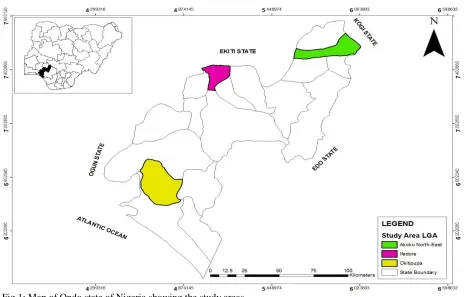
Study area: Ondo state is primarily an agricultural state and has many rural areas largely of subsistence farmers and peasant fishermen. The state lies on latitude 50451 and 70 521N, longitude 40 201 and 60 51E, (Fig.1). People of the state belong to the Yoruba folk and speak same language. The vegetation covers from mangrove to rainforest in the south and savannah in the north. Okitipupa, Ifedore and Akoko south local government areas were selected in each of the vegetation zones (Mangrove, Rainforest and Savannah).
Data collection: Structured questionnaires were
administered among the traditional medicine
practitioners (TMPs) and knowledgeable people on the utilization of medicinal plants. A total of 326 respondents were randomly selected in the three local governments’ areas. Plant specimens were carefully collected and identified at the herbarium of Botany Department of Obafemi Awolowo University, Ile-Ife, where specimens were deposited.
RESULTS
knowledge of such parents on plants used as memory enhancer was also documented. Herbalist/Traditional healers and herb sellers are known to be repository of knowledge on the use of medicinal plants.
Our assessment on the occupation of the respondents revealed 30.4% herbalist, 19.9% herbsellers and other occupations such as student, farming, artisan and civil servants account for 49.7%.Results obtained from the ethnobotanical survey of plants used in memory enhancing and antiaging in Ondo State, Nigeria was conducted in which 14 plants species were identified as commonly used as memory enhancer and 20 plants species used as antiaging, (Table 2).
The plants were distributed into 24 families and 32genera, Apocynaceae have the highest occurrence among plants used for memory enhancer and antiaging with a value of 8.8%. Tree plant species are used more than other plant forms, diversity of plants showed Trees (61.8%), Herbs (17.7%), Shrubs (11.8%) and Climbers (5.9%),The result corroborate the findings of 25which found that trees form 51.6% and 44.1% of plants collected from the wild and bought from herb sellers respectively by traditional healers in Osun State (adjacent to the study site). Leaves and aerial parts are frequently used in memory enhancing and antiaging preparations with 67.7%, Flowers, Fruits and Seeds (23.5%), Stem bark
(20.6%) and Roots (17.7%). S. abyssinicus, M.
sapientum, C. acuminata and B. floribunda were the most popular among the memory enhancing plants while H. madagascariensis, C. nucifera, A. digitata and S. mombin rated highest among the antiaging plants.
DISCUSSION
Man has been using herbs and plants products for combating diseases since times immemorial. So far, the outcomes with available Food and Drug Administration-approved medications for Alzheimers Disease (AD) are often unsatisfactory, and there is a
place for alternative medicine, in particular herbal
medicine26.As a result of adverse effects of
nootropics agents like piracetam and donepezil which limits their usage, 27suggested the exploration of the utilization of traditional medicines in the treatment of various cognitive disorders.
Bacopa floribunda is prominent among the commonly used memory enhancer by the people in the study area, other species from the genus, Bacopa monniera has been reported in Ayurvedic medicine and in traditional treatments for a number of disorders, particularly those involving anxiety, intellect, and poor memory28. Extracts of Bacopa monniera showed improvement in spatial learning performance and enhanced memory retention in rats29. Several other works have established the use of Bacopa species and other plants as memory enhancers30-32.
A number of medicinal plant have been used which
demonstrate the properties of anti-aging. H.
madagascariensis was used to help in alleviating poor pancreatic function in Cameroun and blood enrichment plant in Nigeria33-34. According to the traditional theory, these herbs can help us to maintain the level of vital energy in our body; and they have multiple neuro-protective mechanisms that enable them to be used in different health stages for disease prevention and even curing30.
CONCLUSION
In traditional system of medicines, various plants have been used for treatment of various disorders related to learning and memory. Result from this
survey revealed plants with potential
anticholinesterase and neuroprotective actions for
pharmacological evaluation. Further studies
Fig.1: Map of Ondo state of Nigeria showing the study areas.
Table 1: Demographic factors of the respondents
Okitipupa Akoko south Ifedore Total Frequency % Frequency % Frequency % Frequency %
Gender
Male 73 64.6 80 72.7 91 88.4 244 74.8
Female 40 35.4 30 27.3 12 11.7 82 25.2
Total 113 100 110 100 103 100 326 100 Age (years)
10 – 30 13 11.5 9 8.2 19 18.4 41 12.6
31 – 50 30 26.5 48 43.6 47 45.6 125 38.3
51 – 70 59 52.2 47 42.7 29 28.2 135 41.4
Above 70 11 9.7 6 5.5 8 7.8 25 7.7
Total 113 100 110 100 103 100 326 100 Marital Status
Married 98 86.7 105 95.5 82 79.6 285 87.4
Single 14 12.4 05 4.5 20 19.4 39 12.0
Others 01 0.9 - - 01 1.0 02 0.6
Table 2: Plants used as Memory enhancer (ME) and Antiaging (AA) in Ondo State, Nigeria
No Name Family Local Name (Yoruba)
Plant form
Parts used Uses
11 Bacopa floribunda (R.Br)Wettst Scrophuliaceae Ewe Oniyemuye Herb Aerial parts ME
4 Carica papaya Linn Caricaceae Ibepe Tree Leaves and root ME
14 Cola acuminata (P. Beav) Schott and End
Sterculiaceae Obi abata Tree Seeds ME
3 Detarium microcarpum Guill. &Perr. Caesalpiniaceae Ariran Tree Stem and leaves ME
5 Dichapetlum toxicarium Bail (G.Don) Dichapetalaceae Itakun WoodyCli
mber
Leaf and twigs ME
6 Dioscorea mangenotiana J. Miège Dioscoreaceae Esusu Climber Leaves ME
9 Musa sapientum Linn Musaceae Ogedewewe Tree Stem ME
1 Picralima nitida Stapf Th. & H. Dur Apocynaceae Abeere Tree Fruits and seeds ME
12 Quassia undulata (Guill. &Perr.) D.Dietr.
Simaroubaceae Oriji Tree Leaves ME
10 ScopariadulcisL Scrophulariaceae Olomuyinrin,
Omisinminsingogo ro
Shrub Leaves ME
2 Senecio abyssinicus A.Rich Asteraceae Amunimuye Herb Aerial parts ME
13 Solanum incanum L Solanaceae Ikan, Igba Herb Leaves, fruits
and roots
ME
8 Tetrapleura tetraptera (Schumm. &Thonn.) Taub
Mimosaceae Aridan Tree Fruits ME
7 Uraria picta (Jacq.) DC
Leguminosae-Papilionoideae
Alupayida Climber Leaves ME
18 Adansonia digitata Linn Bombacaceae Oshe Tree Leaves and stem
bark
AA
32 Aframomum melegueta K Schum Zingiberaceae Atare Herb Seed AA
17 Alstonia boonei De Wild Apocynaceae Ahun Tree Leaves AA
29 Bambusa vulgaris Schrad. ex J.C. Wendl Poaceae Oparun Shrub Young leaves AA
28 Baphia nitida Lodd. Papilinionaceae Owiwi, Iyereosun Shrub Leaves, stem
bark, wood and root
AA
27 Cocos nucifera Linn Palmae Agbon Tree Roots AA
19 Cordia millenii Bak. Boraginaceae Omoh Tree Stem bark AA
26 Elaeis guineensis Jacq. Palmae Ope Tree Young leaves AA
24 Ficus capensis Thunb Moraceae Opoto, Odan Tree Leaves AA
20 Garcinia kola Heckel Gutiferae Orogbo Tree Seed AA
21 Harungana madagascariensis Lam. ex Poir
Harungaceae/ Clusiaceae
Arunje, Asunje Tree Leaves AA
22 Khaya ivorensis A. Chev Meliaceae Oganwo Tree Stem and root
bark
AA
25 Lophira alata Banks ex Gaertn. f Ochnaceae Eki Tree Seed, root,
leaves and stem bark
AA
23 Milicia excels Welw C.C. Berg Moraceae Iroko Tree Fruits AA
16 Montandra guineensis L Apocynaceae Asifirin Tree Roots AA
15 Spondias mombin L Anacardiaceae Iyeye, Okika,
Ekikan
Tree Leaves AA
31 Tectona grandis L.f Verbanaceae Agala Tree Young leaves AA
30 Zea mays Linn Poaceae Agbado Shrub Leaves AA
33 Aran Leaves AA
REFERENCES
1. Cunningham, AB. African Medicinal Plants: Setting Priorities at the interface between Conservation and Primary Healthcare. People and Plants, Working Paper 1, 1993; Paris.
2. Kothiyal P and Rawat MSM. Comparative Nootropic Effect of Evolvulus alsinoides and Convolvulus pluricaulis. Int. J. Pharm. Bio Sci., 2011; (2)1
3. Howes MJ, Perry NS, Houghton PJ. Plants with traditional uses and activities relevant to the management
of Alzheimer's disease and other cognitive disorders. Phytotherap. Res., 2003; 17(1):1-18.
4. Weinstock M. Selectivity of cholinesterase inhibition: Clinical implication for the treatment of Alzheimer's Disease. CNS Drugs. 1999; 12: 307-303
5. Shahin A,Abbasi SH.Herbal medicine in the treatment of Alzheimer's disease. Am. J. Alzheimer's Disease
and Other Dementias.2006;(21)2
6. Devi WB, Sengottuvelu S, HajaShrief S, Lalitha V,Sivakumar T. Memory enhancing activities of
Ficusreligiosa leaves in Rodents, Int. J. Res. Ayurveda Pharm., 2011;2(3) 834-8.
7. Reddy DS.Assessment of nootropic and amnestic activity of centrally acting agents. Indian J.
Pharmacol.,1997; 29: 208-21.
8. Ferreira A, Proenca C, Serralheiro MLM, Ara´ujo MEM. The in vitro screening for acetylcholinesterase inhibition and antioxidant activity of medicinal plants from Portugal. J. Ethnopharmacol., 2006; 108: 31-7. 9. Eckert GP. Traditional used Plants against Cognitive Decline and Alzheimer Disease. Front Pharmacol.,
2010; 1:138.
10. Doody RS, Stevens JC, Beck RN, Dubinsky RM, Koye JA, Gwyther L. Practice parameters: Management
of dementia (an evidence based review)-report of the quality standards subcom-mittee of the American Academy of Neurology. Neurology 2001; 56:1154-66.
11. Pattewar AV, Katedeshmukh RG, Vyawahare NS, Kagathara VG. Phytomedicines and Cognition. Int. J. Pharm. Sci. Res., 2011; 2(4): 778-91.
12. Perry EK, Pickering AT, Wang WW, Houghton PJ, Perry NS. Medicinal plants and Alzheimer's disease:
From Ethnobotany to Phytotherapy. J. Pharm. Pharmacol., 1999; 51(5):527-34.
13. Jaiswal AK, Battacharya SK, Acharya SB. Anxiolytic activity of Azadirachtaindica leaf extracts in rats, Indian J. Exp. Boil., 1994; 32: 489-91.
14. Rodrigues V, Rao MS, Karmath S, Rao GM. Effect of Ocimum sanctum plant extract on learning behavior
of stressed rats. Indian J. Pharmacol., 1999; 31(1): 69.
15. Chintawar SD, Somani RS, Kasture VS, Kasture SB. Nootropic activity of Albizia lebbeck in mice. J. Ethnopharmacol., 2002;81: 299-305.
16. Shivakumar L, Gouda ST, Venkat RN, Shalam and Verma R. Evaluation of memory enhancing activity of
SR-105 in Experimental animals. Int. J. Ayurved Pharm., 2011; 2(3) 973-7.
17. Iyer MR, Pal SC, Kasture VS, Kasture SB. Effect of Lawsonia inermis on memory and behaviour mediated
via monoamine neurotransmitters. Indian J. Pharmacol., 1998; 30:181-5.
18. Kawakami K, Kadota J, Iida K, Shirai R, Abe, K, Kohno, S,. Reduced immune function and malnutrition in
the elderly. Tohoku J. Exp. Med.1999; 187: 157-71.
19. Chiba T, Yamaza H, Higami Y, Shimokawa I,. Anti-aging effects of caloric restriction: involvement of neuroendocrine adaptation by peripheral signaling. Microsc. Res. Tech. 2002; 59: 317-24
25. Oladele AT, Alade GO,Omobuwajo OR. Medicinal plants conservation and cultivation by traditional medicine practitioners (TMPs) in Aiyedaade Local Government Area of Osun State, Nigeria. Agric. Biol. J. North Am., 2011; 2(3): 476-87.
26. Schulz V, Hansel R, Tyler V. Rational Phytotherapy: A Physician’s Guide to Herbal Medicine. 3rd ed. Berlin, Germany: Springer-Verlag; 1998:107-23
27. Hanumanthachar J, Navneet K,Jyotibala C. Evaluation of Nootropic Effect of Argyreiaspeciosa in Mice. J.
Health Sci., 2007; 53(4) 382-8.
28. Singh HK,Dhawan BN. Neuropsychopharmacological effects of the Ayurvedicnootropic Bacopa monniera
Linn. (Brahmi). Indian J. Pharmacol., 1997; 29: 359-65.
29. Vollala VR, Upadhya S, Nayak S. Effect of Bacopa monniera Linn. (Brahmi) extract on learning and memory in rats: A behavioral study. J. Vet. Beha., 2010; 5: 69-74
30. Singh AK, Gupta A, Mishra AK, Gupta V, Bansal P, Kumar S.Medicinal Plant for Curing Alzheimer’s disease. Int. J. Pharm. Biol. Arch., 2010; 1(2):108-14.
31. Sudharani D, Krishna KL, Deval K, Safia AK,Priya.Pharmacological Profiles of Bacopa monniera : A Review. Int. J. Pharm., 2011;1(1):15-23,
32. Deval K, Vaibhav S, Krishna KL. Effect of Bacopaon Memory Deficit Produced by Chronic
Administration of Topiramatein Rats. Int. J. Pharm., 2011; 1(2): 118-24.
33. Prajapati, ND, Purohit SS, KumarT. A Handbook of Medicinal Plants. Agrobios, India: A Complete Source
Book, 2003.
34. Kuete V,Efferth T. Cameroonian medicinal plants: pharmacology and derived natural products. Frontiers in