e- ISSN: 2278-067X, p-ISSN: 2278-800X, www.ijerd.com
Volume 14, Issue 9 (September Ver. I 2018), PP.26-33
Effects Of Some Selected Processing Conditions On The Yield
And Quality Of Shea Butter Produced From Sun Dried Shea
Kernels
Saba, A. M., Tsado, D.G. And Adamu M.
Chemical Engineering Department,The Federal Polytechnic Bida, Niger State. Nigeria.
Corresponding author:Saba, A. M.
ABSTRACT:
The focus of this study was to investigate the effects of some selected processing conditions on the yield and quality of shea butter produced from sun dried shea kernels. Fresh shea fruit werecollected de-pulped, boiled, sun dried, cooked, ground, kneaded and oil collected. Thefresh shea nuts were subjected to boiling times of 0,15,30,45 and 60 minutes. The nuts were then sun dried. The drying stage was preceded by milling, kneading and curd boiling to obtain shea oil. Physicochemical properties of the shea oil such as density, yield, iodine value, free fatty acid, peroxide value, melting point, percentage impurities, refractive index, and moisture content, absorbance at 600 nm, saponification value and unsaponifiable fractions were determined. The results obtained for some of these parameters like refractive index, density and moisture content, show some consistency with standard literature values and are in the range as follows; refractive index( 1.465-1.4682),density (0.894-0.980 g/cm3), moisture content (0.247-0.960%), however some other key
parameters like saponification value, free fatty acid, Iodine value and peroxide value were found to be at variance, and their results are in the range; saponification value(178.12-293.31mgKOH/g), free fatty acid (3.99-6.91%),iodine value (23.65-34.685 g/kg), peroxide value (2.42-5.20meq/100g). The percentage impurity was found to be high(1.0-2.10%) necessitating further treatment either by activated carbon, steaming or refining.
KEY WORDS: physicochemical properties, shea butter, sun drying, shea butterquality
--- --- Date of Submission: 01-10-2018 Date of acceptance: 13-10-2018 ---
---I.
INTRODUCTIONShea butter is a versatile plant fat extracted from kernels of shea nuts, seeds of shea trees (Vitellaria paradoxa). It is also a mixture of fatty acids consisting of oleic, stearic, palmitic, linoleic and arachidic acids but oleic and stearic acids predominate and constitute about 85% of the fatty acid content of shea butter. Shea butter has long been used in sub-Saharan Africa for medicinal, culinary, and other applications and serves as a cocoa butter equivalent in the manufacture of chocolate as well as an ingredient in cosmetics. Shea butter, rich in unsaturated fatty acids undergoes hydrolytic and oxidative degradation during postharvest processing and storage, resulting in inconsistent and degraded quality and limited shelf-life(AAK Global, 2012 and Walter et al., 2003).
dissolved impurities. Traditional processing techniques involve numerous uncontrolled and non-scientific practices. These factors lead to low yield, poor and inconsistent quality of shea butter from this method of production and consequently affect the export potentials of Shea butter from Africa and Nigeria in particular (Loveth , 2004; Njoku, 2006; Megananou et al., 2012 and Obibuzor et al., 2014).
It is reported that Shea butter has wide range of applications in the pharmaceutical, cosmeceutical (Alander, 2004 and AAK Global, 2012), nutraceuticals, etc industries as well as in the folk medicine. The health benefits of the shea butter are attributed to the influence of the constituents of the unsaponifiable. Source of oil, geographic, climate, agronomic parameters for growth, processing and storage conditions all play vital role in dictating the quality of fats and oils(Shahidi, 2005). For shea butter production in particular, the fruits are collected from the ground but must not be allowed to stand for long on the ground as they germinate quickly. This is because the shea fruit has no dormancy period as it germinates within few days of dropping from the tree because it is fully matured (Jøker, 2000). This means that is for high quality butter, prompt processing is an important requirement but currently neglected by the local processors due to the difficulties associated with fruit collection. The process of germination is capable of modifying the lipid composition by the endogenous enzymes leading to poor understanding of the state of the nut, prior to processing.
Therefore, the focus of this work is to carry out a preliminary study on effects of some selected processing conditions on the yield and quality of shea butter routes for the production of shea butter. This might be achieved by an investigation of the effects of shea nut boiling time and cooking/roasting temperature on the yield and quality of shea butter.
II.
MATERIALS AND METHODSFreshly de-pulped shea nut were collected from Lemuta, Somajigi and Ekota villages in Doko district of Lavun, local government area of Niger State, Nigeria. The nuts from these locations were mixed and sprouted ones were sorted out manually and discarded. From the remaining nuts, 500 Kg was weighed using Diamond weighing balance and subsequently divided into five groups of 100 Kg each. Each group was boiled in water for 0, 15, 30, 45 and 60 minutes respectively using aluminum pot. Each of the boiled nuts was sun dried on a wire mesh bed. The shell of the dried nuts was then removed to obtain fresh kernel. The fresh kernels were exposed to sunlight to further reduce the moisture content to between 7-8 %. 5 kg of each of the dried kernels was respectively cooked at 30 0C (room temperature, no cooking) and 100 0C boiling point of water. The cooked kernels were severally milled using 15 KW atlas milling machine to obtain a fine homogeneous paste. The paste obtained was then kneaded with occasional addition of cold water as kneading progresses to facilitate the separation of the curd with the sludge. The curd which floats on the water was carefully collected and boiled at between 85 0C and 90 0C over water for 50 minutes. The oil collected was again washed with water, kept for about 6hrs to separate and the clean oil was collected and allowed to congeal, packaged, refrigerated and then analyzed in Central Laboratory, National Cereals Research Institute (NCRI) Badeggi, Nigeria.
III.
CHARACTERISATIONThe effects of shea nut boiling time, kernel cooking temperature on the physicochemical properties (such as density, yield, iodine value, free fatty acid, peroxide value, melting point impurities, refractive index, moisture content, saponification value and unsaponifiable fractions on shea butter was determined using AOAC and other relevant scientific methods.
IV.
RESULTS AND DISCUSSIONThe shea butter obtained from each of the kernels was analysed for the following parameters: Yield, Density, Iodine value, Free Fatty Acid, Peroxide Value, Melting Point, Refractive index, Absorbance, Saponification value, Unsaponifiable fraction and Acid Value.
For both the cooked and the uncooked kernels, the yield falls within the range of 20-32%. With sun dried, uncooked kernel and village/uncontrolled sample recording the lowest yield (20%) while sun dried, uncooked, 45min and 60 min boiled ones having the highest yield (32%) as can be seen in Figure 1.
Key:
Figure 1: Yield (%) of Shea butter from different shea nut samples at varying boiling times
The high yield recorded for the SDC sample boiled for 45 and 60 was probably because of the cooking at 1000C and longer boiling time. The butter obtained here may have the drawback of longer drying period as a result more moisture absorbed during boiling which may result in formation of more peroxides. Also, the effect of high temperature cooking and no cooking at all on the sun dried kernel, showed an inconsistent yield. This may be due to uncontrolled processing variable, especially picking period and cooking temperatures.
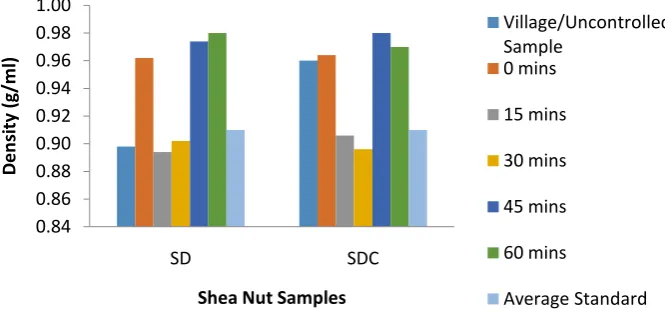
The density values obtained shows similar inconsistent trend with the yield of shea butter obtained. It was observed that for both cooked and uncooked sun dried kernels, samples boiled for 45 and 60 minutes have higher density compared to samples boiled for shorter times. This indicates higher values than the average standard density value of shea butter (see figure 2).
Figure 2: Density (g/cm3) of Shea butter from different shea nut samples at varying boiling times
This may be due to longer boiling time, more moisture absorbed and more interaction between the oil molecules and moisture content. With these differences the values of densities obtained for all the shea butter samples boiled above 45 minutes have densities higher than the recommended range of 0.89 to 0.93 g/cm3. Equally, samples not boiled at all also have densities above this range. This implies that boiling may have influence on the density of shea butter.
The melting point of all the shea butter samples obtained fall within 28 –330C, with shea butter obtained from sun dried kernels (SD) not boiled (0 min) and boiled 15minutes recording the highest melting point of 330C and Shea butter from SDC no boiling and 15 minutes and village/uncontrolled samplehaving the lowest melting point of 300C. It should be noted that these values are in agreement with literature values of 30-400C as shown in Figure 3.
0 10 20 30 40
SD SDC
Yi
e
ld
(
%
)
Shea Nuts
Village/Uncontrolled Sample
0 mins
15 mins
30 mins
45 mins
60 mins
Average Standard
0.84 0.86 0.88 0.90 0.92 0.94 0.96 0.98 1.00
SD SDC
D
e
n
si
ty (g/m
l)
Shea Nut Samples
Village/Uncontrolled Sample
0 mins
15 mins
30 mins
45 mins
60 mins
Figure 3: Melting Point (oC) of Shea butter from different shea nut samples at varying boiling times
This also shows that there is little or no adulteration in the shea butter samples produced and that shea nut cooking has little or no effect on the melting point of shea better. Melting point determination is also one of the methods of determining purity levels in shea butter.
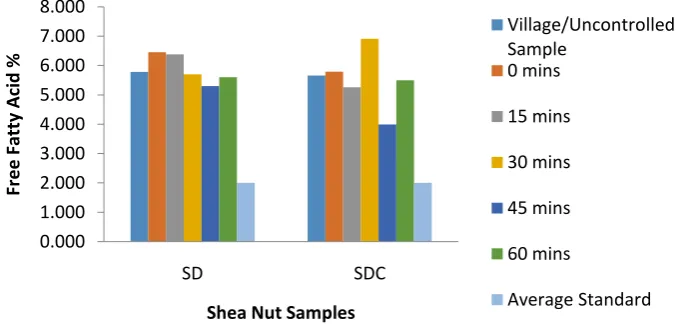
Free fatty acid (FFA) is a very important parameter in characterising shea butter internationally. Shea butter with low free fatty acid attracts higher premium in international markets. Figure 4.4 shows the distribution of free fatty acid in all the shea butter samples.
Figure 4: Free Fatty Acid (%) of Shea butter from different shea nut samples at varying boiling time
Shea butter obtained from SDC and boiled for 30minutes has FFA of 6.8% and then closely followed by SD not boiled with FFA of 6.6%. These two figures are very high when compared with recommended range of 1-3% (African Standard for Shea butter (unrefined), 2011). These high values may be due to the quantity of heat the kernels were exosed in the case SDC and probably longer drying time to the kernels were exposed to before extraction and possibly the time the shea paste were exposed to before kneading (Harris, 1999).
The higher the peroxide value in oil, the higher or faster the oil gets oxidised and hence rancid. The values obtained from the shea butter samples showed that shea kernel boiled for 60 minutes has the highest peroxide value of 5.2 meq/100 g , even though the figures are lower than the recommended average. especially rotary dried and sun dried have high peroxide value of 5.21 and 5.2 meq/100 g respectively, This is shown in Figure 5
27.00 28.00 29.00 30.00 31.00 32.00 33.00 34.00 35.00 36.00
SD SDC
M
e
lting Po
in
t
(o
C)
Shea Nut Samples
Village/Uncontrolled Sample
0 mins
15 mins
30 mins
45 mins
60 mins
Average Standard
0.000 1.000 2.000 3.000 4.000 5.000 6.000 7.000 8.000
SD SDC
Fr
e
e
Fatt
y Ac
id
%
Shea Nut Samples
Village/Uncontrolled Sample
0 mins
15 mins
30 mins
45 mins
60 mins
Figure 5: Peroxide Value (mEq/100g) of Shea butter from different shea nut samples at varying boiling times
The longer the nuts are boiled in water, the more moisture it absorbs and the longer it takes to dry, this leads to more formation of peroxides and subsequently rancidity (Miraliakbari, 2007).
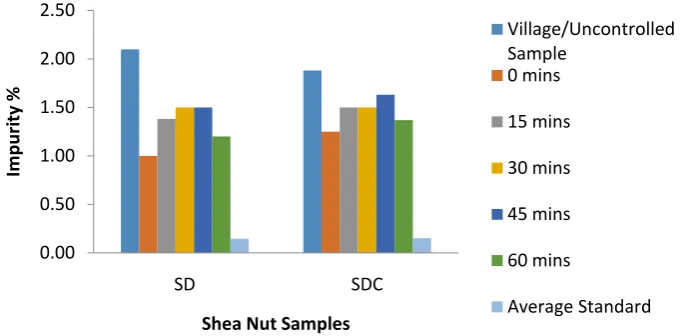
In this preliminary study, the highest impurity levels were recorded from village/uncontrolled samples (between 1.88-2.00%) while all other treatments fall below 1.63%. See figure 6
Figure 6: Impurity (%) of Shea butter from different shea nut samples at varying boiling times
Generally, the impurity levels for all the treatment are higher than the recommended standard 0.09 - 0.2%. Figure 6 shows the impurity level of all the shea butter samples. To obtain a purer shea butter, the levels of impurity must be reduced by either filtration, adsorption or refining.
The refractive index falls between 1.4650-1.4689. This implies that all the shea butter samples produced are closely related in terms of color and treatment method (cooking temperature and boiling time) has no
0 2 4 6 8 10 12 14
SD SDC
Per
o
xi
d
e
Val
u
e
(
m
Eq
/100g
)
Shea Nut Samples
Village/Uncontrolled Sample
0 mins
15 mins
30 mins
45 mins
60 mins
Average Standard
0.00 0.50 1.00 1.50 2.00 2.50
SD SDC
Im
p
u
ri
ty
%
Shea Nut Samples
Village/Uncontrolled Sample
0 mins
15 mins
30 mins
45 mins
60 mins
Figure 7: Refractive Index of Shea butter from different shea nut samples at varying boiling times
Significant influence on the refractive index of shea butter produced. As all the values obtained are in reasonable agreement with the standard (1.4620-1.4650) see Figure 7 above.
The value of iodine value for the shea butter sample produced ranged from 23-34 g/100g. The values obtained are mostly lower than the African regional standard for unrefined shea butter (30-75g/100g). This shows that the shea butter samples produced have low double bonds or are saturated. The value of iodine value for oil is supposed to be constant if production parameters are controlled. The result obtained as shown in Figure 8, do not show this consistency hence the need to regulate and optimize the parameters been studied
Figure 8: Iodine value (g/kg) of Shea butter from different shea nut samples at varying boiling times
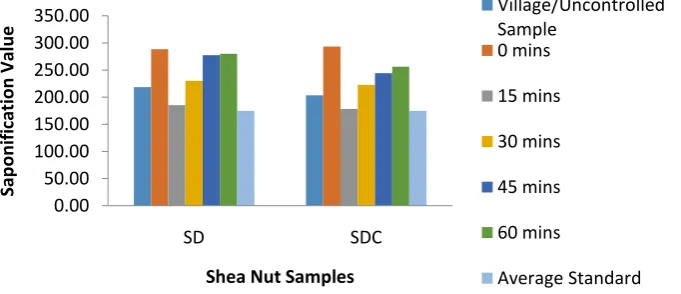
For the shea butter samples produced, the saponification value falls between 154 and 293 mgKOH/g as shown in Figure 9.
1.461 1.462 1.463 1.464 1.465 1.466 1.467 1.468 1.469
SD SDC
R
e
fr
ac
tiv
e
In
d
e
x
Shea Nut Samples
Village/Uncontrolled Sample
0 mins
15 mins
30 mins
45 mins
60 mins
Average Standard
0.00 10.00 20.00 30.00 40.00 50.00 60.00
SD SDC
Iod
in
e
Val
u
e
Shea Nut Samples
Village/Uncontrolled Sample
0 mins
15 mins
30 mins
45 mins
60 mins
Average Standard
0.00 50.00 100.00 150.00 200.00 250.00 300.00 350.00
SD SDC
Sap
o
n
ifi
cation
Value
Village/Uncontrolled Sample
0 mins
15 mins
30 mins
45 mins
Shea butter samples from the two treatments without boiling have the highest (293 mgKOH/g) saponification value while 15 minutes boiling for both treatment having the lowest (180 mgKOH/g) saponification values. These values obtained are slightly at variance with African regional standards for unrefined shea butter (170-190 mgKOH/g). The seemingly high saponification value shows that the mean weight of fatty acids present is higher than those obtained by other researchers. This also means that more potassium hydroxide may be required to produce soap from these samples with higher saponification value.
The unsaponifiable fractions of shea butter even though small compared to the triglyceride component of shea butter is responsible for the healing properties of shea butter. They dissolve in fat and are insoluble in aqueous solution but soluble in organic solvent after saponification as reported by Hamilton and Rosell, (1986). Figure 10 shows the variations of unsaponifiable fractions of the various shea butter samples produced in relation to the average standard.
Figure 10: Unsaponifiable Fraction (g/kg) of Shea butter from different shea nut samples at varying boiling times
This property of shea butter depends on the sample species but it can be influenced by processing method. The unsaponifiable matter for all the samples produced varies from 4.0-9.31%. These figures fall within the recommended range of 0-12% (Lovett, 2004). Figure 10 reveals that SD and SDC not boiled at all have higher unsaponifiable fraction 8.2 and 8.4% respectively, while SDC and boiled for 15 minutes having the lowest unsaponifiable fraction of 4.3%.The higher the unsaponifiable fraction the higher the demand and hence the premium.
V.
CONCLUSIONShea butter is an underutilised resource in Nigeria and well sought after in Europe, USA and Asian countries like China and India especially in the grades A and B category. The Nigerian traditional method of shea butter production which constitute about 85 – 90% shea butter produced in Nigeria is of poor, inconsistent and uncontrolled parameter quality and as such not reproducible. The preliminary study conducted in this report used three nut treatments i.e. sundried, oven dried and rotary dried nuts were parboiled for 0, 15, 30, 45, and 60 minutes and each subjected to different conditions of cooking i.e room temperature and cooking at boiling point (1000C) respectively. The results show some consistency in the physical properties like refractive index, density, moisture content. However, properties like saponification value, free fatty acid, iodine value and peroxide value are not consistent. The preliminary study also brings to fore the need to carefully investigate also the effects of shea nut picking period and more cooking temperatures.
REFEREENCES
[1]. AAK Global (2012) Lipex® Shea butter family.Technical bulletin AarhusKarlshamn Lipids care. AarhusKarlshamn. Retrieved
from http://www.integrityingredientscorp.com/resources/Shea+Butter+family.pdf
[2]. Alander, J. (2004). Shea butter- a multifunctional ingredient for food and cosmetics. Lipid Technology. 16(9), 202-205
[3]. Esiegbuya, D. O., Osagie, J. I., & Okungbowa, F. I. (2014). Fungi Associated With the Post harvest Fungal Deterioration of Shea nuts and Kernels. Internatoinal Journal of Agriculture and Forestry, 4(5), 373-379.
[4]. Hamilton, R., & Rosell, J. (1986). Analysis of Oil and Fats. Elsevier Applied Science New York, 1-5.
0 2 4 6 8 10 12
SD SDC
Unsap
o
n
ifi
cab
le
fr
ac
tion
(g/kg)
Shea Nut Samples
Village/Uncontrolled Sample
0 mins
15 mins
30 mins
45 mins
60 mins
[10]. Munir, S. M.; Umar, M.; Zinat, A.; Mohammed, I. A.; Aliyu, A. M.; Yahaya, S. (2012). Extraction and Characterisation of Nigerian Shea Butter Oil. Journal of Science, Technology and Education(JOSTMED), 8(2), 66-73.
[11]. Njoku, 0. N. (2006). Quality and Compliance to Standard for Shea Products. Paper Presented for Stakeholders in the Shea Industry held at, Central Bank of Nigeria, Minna.
[12]. Obibuzor, J. U., Omamor, I., & Omoriyekemwen, V. O. (2014). A Two Year Seasonal Survey of the Quality of Shea butter Produced in Niger State, Nigeria. African Journal of Food Science, 8(2), 64-74.
[13]. Shahidi, F., 2005. Quality Assurance of Fats and Oils. In: Bailey's Industrial Oil and Fat Products, Shahidi, F. (Ed.). 6th Edn., John Wiley and Sons Inc., USA.
[14]. Walter, S., Cole, D., Kathe, W., & Loveth, P. P. (2003). Impact of certification on the sustainable use of NWFP: Lessons learnt from three case studies.(Paper submitted for Presentation at the International Conference on Rural Livelihoods, Forest and Biodiversity. Bonn, Germany).