ISSN: 2322 - 4827, Volume 1, Issue 4, 2013: 382-397 Available online at http://www.ijabbr.com
Corresponding Author E-mail:[email protected] 382 | Page
Using Simulated Annealing (SA), Evolutionary Algorithm To Determine
Optimal Dimensions of Clay Core in Earth Dams
Marzieh Mohammadi *1, Gholam-Abass Barani 2, Kourosh Qaderi 3
1
Department of Water Engineering, Shahid Bahonar University, P.O.BOX 76169133, Kerman, Iran, 2 Professor, Department of Civil Engineering, Shahid Bahonar University, Kerman, Iran, 3 Assist Professor, Department of Water Engineering, Shahid Bahonar University, Kerman, Iran.
ABSTRACT
Earth dam is a structure as homogeneous or non-homogeneous forms for raising water level or water supply. Earth dam consist of different parts that one of the main parts is clay core. Choosing an optimal non permeable core which causes reduction of seepage through dam body and also being stable is necessary. The objective of this research is to optimize the geometry of earth dam clay core such that, beside of reduction of seepage through dam body, the volume of core material is minimized. For access of this objective a consolidated model consist of a simple model which obtained by linear regression and SA algorithm were used, to optimize the Birjand Hesar Sangi dam. Optimal parameters such as seepage through dam body, hydraulic gradient and safety factor of stability access from model compared by the values access from the direct run of the software modeling that show a good agreement. Also the result of access by modeling have been compared by actual dimensions of Birjand Hesar Sangi dam, that cause reduction of material volume for construction core dam and shell dam about 21 and 8 percent, respectively. Result show that the consolidated model has successful operations and a general optimal plan design of clay core dimensions in stable condition can be achieved.
Key words: Simulated Annealing Algorithm (SA), optimization, earth dam, seepage, clay core.
INTRODUCTION
385 | Page METHODOLOGY
One of the key aims of this study is to develop the numerical model for measuring seepage through dam, stability factor and hydraulic gradient based on materials and geometry specification of earth dams. Figure1 shows the sample model of problem.
Figure1. Sample model of problem
Theoretical principles of Simulated Annealing Algorithm
386 | Page maximize functions that are difficult or impossible to otherwise optimize. This is demonstrated in the next section with the test problems.
Simulated annealing
Simulated annealing is a computational stochastic technique for obtaining near global optimum solutions to combinatorial and function optimization problems. The method is inspired from the thermodynamic process of cooling (annealing) of molten metals to attain the lowest free energy state Kirkpatrick et al. (1983) but this idea was first inspired by Metropolis et al., in 1953 who involved in publishing industry. When molten metal is cooled slowly enough it tends to solidify in a structure of minimum energy. This annealing process is mimicked by a search strategy. The key principle of the method is to allow occasional worsening moves so that these can eventually help locate the neighborhood to the true (global) minimum. The associated mechanism is given by the Boltzmann probability:
= − ∆ (1)
where ∆ is the change in the energy value from one point to the next, KB the Boltzmann’s constant and T the temperature (control parameter). For the purpose of optimization the energy term .∆ , refers to the value of the objective function and the temperature, T, is a control parameter that regulates the process of annealing. The consideration of such a probability distribution leads to the generation of a Markov chain of points in the problem domain. The acceptance criterion given by Eq. (1) is popularly referred to as the Metropolis criterion (Metropolis et al., 1953). Another variant of this acceptance criterion (for both improving and deteriorating moves) has been proposed by Galuber (1963) and can be written as:
=
∆
∆ (2)
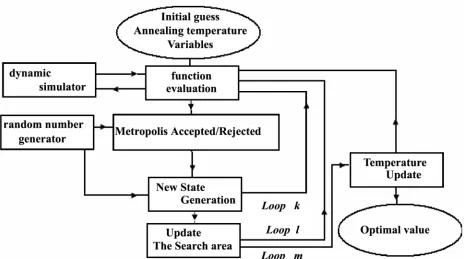
387 | Page Figure 2. Basic flowchart of simulated annealing (Faber et al., 2005).
Modeling
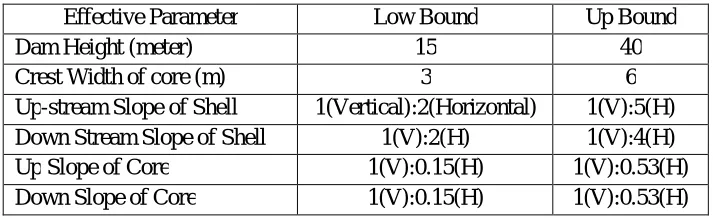
388 | Page Table 1. Up and down limit of effective parameters
Effective Parameter Low Bound Up Bound
Dam Height (meter) 15 40
Crest Width of core (m) 3 6
Up-stream Slope of Shell 1(Vertical):2(Horizontal) 1(V):5(H)
Down Stream Slope of Shell 1(V):2(H) 1(V):4(H)
Up Slope of Core 1(V):0.15(H) 1(V):0.53(H)
Down Slope of Core 1(V):0.15(H) 1(V):0.53(H)
Seepage Model
The model obtained in this research is based on modeling 150 assumed section with different materials and dimensions by SEEP/W. In this model, geometric parameters and materials characteristics are independent variables and seepage rate is dependent variable. Independent variables coefficient is recognized as a partial regression coefficient. It indicates increasing in dependent variables against adding a one unit to independent variables. The final results obtained by running SPSS model that show the best regression model, As it can be easily seen, the amounts of R and Std. Error are about 0.93 and 0.067 respectively. It is clear that there is a high accuracy and appropriate correlation in this model.
= (2.167 - 0.958 )×
×
(3)
Where q = Seepage in unit of dam length (m3 / s /m); k = Permeability coefficient of core (m/ s); l = Water height in dam reservoir (m); h = Dam height (m); d = Core width on foundation (m).
Slope stability Model
The model obtained in this research is based on modeling 150 assumed section with different materials and dimensions by SLOPE/W. In this model, geometric parameters and materials characteristics are independent variables and seepage rate is dependent variable. The final results obtained by running SPSS model that show the best regression model, As it can be easily seen, the amounts of R and Std. Error are about 0.909 and 0.0098 respectively. It is clear that there is a high accuracy and appropriate correlation in this model.
=0.354+1.548
+
0.033
+
2.194
(4)
389 | Page Hydraulic Gradient Model
The model obtained in this research is based on modeling 150 assumed section with different materials and dimensions by SEEP/W. In this model, With pay attention to this note in Non homogeneous earth dams that permeability in shell is more than core. When this difference become very much, shall is ignored to calculate the seepage rate and core is assumed as a homogeneous dam, Goldin et al (1992) and also assume that seepage line is as a direct line. The final results obtained by running SPSS model that show the best regression model, As it can be easily seen, the amounts of R and Std. Error are about 0.92 and 0.0098 respectively. It is clear that there is a high accuracy and appropriate correlation in this model.
= 0.76 – 1.625 (5)
= (6)
Where i = hydraulic gradient; s = leak line length (m); b = crest width of core (m).
Optimization
In order to reduce the volume of the clay core dam to a minimum size and to prevent leaking from the dam’s body, considering mentioned constraints, its model is established in MATLAB (version 7.8) that uses SA algorithms to optimize. During performing this operation, problem constrains the stability safety factor and hydraulic gradient were investigated.
Variables design
390 | Page Objective Function
Water flow through the dam is one of the basic problems for geotechnical engineers. In this paper presents simple expressions to predict the total (saturated and unsaturated) seepage flow rate through a homogeneous embankment and discusses precautions to be taken. The physical and geometric factors of dam such as permeability, upstream and downstream slope of the dam slop (amplitude) are considered, and Cost estimation are developed based on the best available information at the time, the cost estimating based on mentioned information should be considered remarkably in terms of high accuracy and confidence. The purpose of this study is to reduce seepage through dam and volume of earth dam material. Hence the objective functions expressed as follow:
Volume of materials in unit of dam length
For minimizing the level of core materials and it’s stability in terms of dam geometry we can use below function. Since stability bind is a function of dam body parameters, in addition to optimization of core dimensions suitable slope obtained for dam.
(7)
Where F is the volume of the earth material (m3 / m), h = Dam height (m); w= width of the dam crest (m).
Seepage through dam body
For minimizing of seepage through dam body equation (3) as objective function used in problem and determined as follow
(8)
Constrains design
Here for reduction of objective function based on designing variables, constraints presented as follows:
391 | Page i=0.76–1.625
(9)
Where s is the length of the phreatic line that is calculated using Eq. (6).
Case study
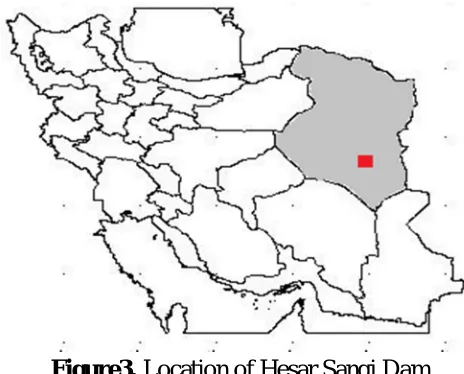
The Hesar Sangi dam is a earth dam with vertical clay core as a nutrition –storage in Birjand. It has with storage capacity of two million cubic meters of water that was constructed in 2003. Also, it is located 120 kilometers northern of Birjand and five kilometers up of the Hesar Sangi village (latitude 32053’ , longitude 59013’), across the Dahaneh river. Figure 3. shows the location of this earth dam. Dam material properties and geometries are presented in Table 2 and 3, respectively.
Figure3. Location of Hesar Sangi Dam
Table 2.Dam material properties Core Shell
Parameters
30 40
Ø
2080 2260
( )
10000 10000
( )
0.3 0.05
(kg/cm2)
0.06 182.28
392 | Page Table 3.geometries properties
RESULTS AND DISCUSSION
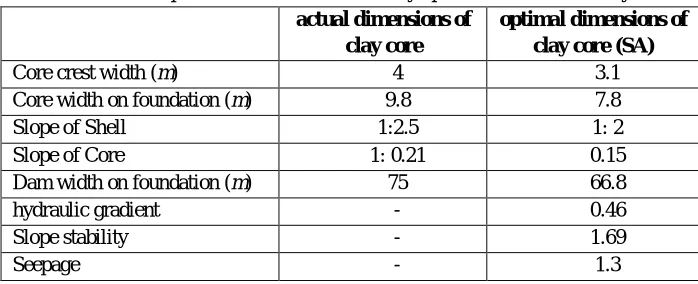
In this modeling the material properties of Hesar Sangi earth dam and a series of known parameters such as the height and the width of the dam’s crest is used. Table (4) presents a comparison of the results of the proposed model with optimum clay core dimensions and actual dimensions.
Table 4. Comparison of actual dimension by optimal dimension of clay core optimal dimensions of
clay core (SA) actual dimensions of
clay core
3.1 4
Core crest width (m)
7.8 9.8
Core width on foundation (m)
1: 2 1:2.5
Slope of Shell
0.15 1: 0.21
Slope of Core
66.8 75
Dam width on foundation (m)
0.46
-hydraulic gradient
1.69
-Slope stability
1.3
-Seepage
In this study, new regression models including seepage, hydraulic gradient and stability safety factor was developed to calculate the designing variables. After determining the designing variables, constraints and objective functions, models based on combining of SA and new linear regression models were presented to optimize the core of the Hesar Sangi dam. Optimal parameters of the dam’s geometry and stability factor, the body seepage and hydraulic gradient were calculated. The results indicated the high performance of developed technique based on SA for optimization of clay core dimensions.
250 Crest length(m)
6 Crest width(m)
15 Dam height (m)
4 core crest width (m)
9.8 Core width on foundation (m)
1:2.5 Slope of Shell
1: 0.21 Slope of Core
393 | Page Model Evaluation
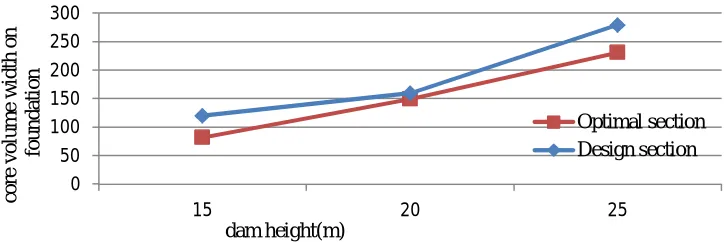
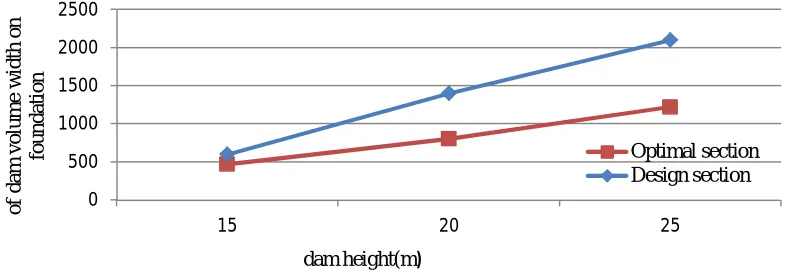
To consider the function of model in determination of primary optimized dimension of clay core rather than designing of core section based on engineering idea, the section dimension of homogenous earth dam for this three heights: 15, 20 and 25 calculated based on engineering idea and developed model. The result of calculation of both designs represented in figure (4) to (7).
Figure 4. comparison of core width on foundation in optimized section rather than engineering design.
Figure 5. comparison of dam width on foundation in optimized section rather than engineering design.
Figure 6. comparison of core volume width on foundation in optimized section rather than engineering design. 0
50 100 150 200
15 20 25
da m w idt h o n fo un da ti o n (m ) dam height(m) Optimal section Design section 0 50 100 150 200 250 300
15 20 25
co re v o lum e w idt h o n fo un da ti o n dam height(m) Optimal section Design section 0 5 10 15 20
15 20 25
394 | Page Figure 7. comparison of dam volume width on foundation in optimized section rather than engineering design.
From the above figures dimension and volume that obtained from designing by use of model are lower than their values in engineering design. That indicated that core and shell dimensions decreased rather than previous dimensions. As result core volume and affected by that, shell volume decreased. The volume of hesar sangi core dam was obtained 103.5 m3 in length unit whereas after determination of optimized dimension, this volume decreased to 81.75 m3 in length unit. That in fact 21 percent of it’s primary volume decrease. Decrease of volume of clay core cause the volume of functional operations, compact operations and operational costs of dam decreased. Thus the operation volume of core construction (preparation, carry and operate) decrease from 25875 to 2037.5 and affected the shell operations that decrease in 12.3 percent rather than primary costs.
Cost of operation of Hesar Sangi Dam body
Cost of operation of shell and core of Hesar Sangi dam body based on designed dimension by consultant and developed model, represented in table (5) and (6).
Table5. Costs of operation of shell and core of Hesar Sangi dam based on designed dimensions. Unit Unit price Amount Price Operation of shell dam M3 14706 126000 1852956000 Operation of core dam M3 36580 25875 946507500
Sum 2799463500
Table6. costs of operation of shell and core of Hesar Sangi dam based on optimized dimensions. Unit Unit price Amount Price Operation of shell dam M3 14706 116062.5 1706815125 Operation of core dam M3 36580 20437.5 747603750
Sum 2454418875
As it indicated from table(5) and (6) of current costs for construction of core and a dam shell that design with optimization program decreased to 345044625 and costs, in comparison with past,
0 500 1000 1500 2000 2500
15 20 25
o
f
da
m
v
o
lum
e
w
idt
h
o
n
fo
un
da
ti
o
n
dam height(m)
395 | Page decreased 12.3 percent. We can conclude that, here minimizing the dimensions of clay core by providing suitable conditions such as: seepage, hydraulic gradient and earth dam stability caused decrease in costs that is the most important characteristic of selection of a good plan. Also because of polar effect between different regions of dam. Decrease of core dimensions affected the other components of dam and may result in decrease of these components volume and operational costs. There for consideration of the effect of core dimensions decrease on each components of zone dam and analysis of current conditions are essential that need extensive study. For considering the accuracy of model safety stability factor, hydraulic gradient and seepage calculated from program with the similar obtained values from direct operation of software models, for several section of dam with height of 15, 20, 25 and 42 compared. Table (7) as it observed calculated values from program operation and operation of Geo Studio software models for dam section s with different height, relatively near and there isn’t significant parameters between them.
Table7. Safety stability factor, Hydraulic gradient and Seepage calculated from MATLAB and Geo Studio software models for several section of Hesar Sangi Dam.
Dam height(m) Hydraulic gradient Seepage(m3/year.m) Stability factor
15
Geo studio 0.5 1.3 1.68
MATLAB 0.46 1.3 1.68
20
Geo studio 0.56 1.82 1.69
MATLAB 0.53 1.8 1.69
25
Geo studio 0.6 2.33 1.69
MATLAB 0.59 2.3 1.69
42
Geo studio 0.67 4.02 1.69
MATLAB 0.66 4 1.69
Conclusion
396 | Page REFERENCE
Abdul Hussain, I., Deepak Kashyap, A. and Hari Prasad. K. S. (2007). Seepage Modeling Assisted Optimal Design of a Homogeneous Earth Dam: Procedure Evolution. Irrigation and Drainage Engineering. 133(2), 116-130.
Akyuz, A. and Merdun, H. (2003). Seepage through an Earth Dam on Impervious Base with Hele-Shaw Viscous Liquid Physical Model. EJGE.
Aniruddha, S. and Anup, U.,( 2009). Locating the Critical Failure Surface in a Slope Stability by Genetic Algorithm. Applied Soft Computing. 9(1), 387-392.
Aubertin, M., Bussière, B., Aachib, M., Chapuis, R.P., and Crespo, R., (1996).Unemodélisation numériquedes écoulements non saturésdans les couverture smulti couches en sols. Hydrogéologie. 96(1), 3–13.
Benmebarek, N., Benmebarek, S. and Kastner, R., (2005). Numerical Studies of Seepage Failure of Sand within a Cofferdam. Computers and Geotechnics. 32(4), 264-273.
Boger, M.,(1998). Three-Dimensional Analytical Solutions for Unsaturated Seepage Problem. Hydrologic Engineering, ASCE. 3(3), 193-202.
Ersayin, D., (2006). studying seepage in a body of earth fill dam by (Artificial Neural Networks)ANNs. M.Sc. Thesis, College of Engineering, izmir Institute of Technology. Galuber, R. J., (1963). Time dependent statistics of the using model. Mathematical Physics. Goldin, A. L. and Rasskazove, L. N.,(1992). Design of earth dams, A.A.Balkema, Netherlands. Griffiths, D. V., and Fenton, G. A., (1997). Three-Dimensional Seepage through Spatially Random Soil. Geotechnical and Geo environmental Engineering, ASCE, 123(2), 153-160.
Hadi, A. A., (1978). Seepage through Embankments into Adjacent Drains. M.Sc. Thesis, College of Engineering, University of Baghdad, Iraq.
Harr, M. E., (1962). Groundwater and Seepage. McGraw-Hill Book Company, New York.
Hillo, A. N.,(1993). Finite Elements for Seepage below Hydraulic Structure on Anisotropic Soil Foundation. M.Sc. Thesis, College of Engineering, University of Basrah, Iraq.
Hitoshi, F., Hideaki, H., Eiichi, W., Taro, T. and Hiroyuki, M.,(1996). Application of Genetic Algorithm to Aesthetic Design of Dam Structures. Advances in Engineering software. 25(2-3), 185-195.
397 | Page Irzooki, R. H.,(1998). Investigation and Analysis of Seepage Problems on the Left Side of Al-Qadisiya Dam. Ph.D. Thesis, Dept. of Building and Construction Eng., College of Engineering, University of Technology, Iraq.
Ishaq, M. B.,(1989). Effect of Anisotropy on Exit Gradient in Hydraulic Structures. M.Sc. Thesis, Department of Irrigation and Drainage Engineering, University of Baghdad, (cited by Khsaf, 1998).
James, L.B., (1968). Failure of Baldwin Hill reservoir, Los Angeles, California. Engineering Geology Case Histories, Division of Engineering Geology. Geological Society of America. (6), 1-11.
Khsaf, S. I., (1998). Numerical Analysis of Seepage Problems with Flow Control Devices underneath Hydraulic Structures. Ph.D. Thesis, Dept. of Building and Construction Eng., College of Engineering, University of Technology, Iraq.
Kirkpatrick, S., Gelatt, C., D Jr and Vecchi, M. P., (1983). Optimization by Simulated Annealing. Science. 220(4598), 671-680.
Metropolis, N., Rosenbluth, A., Rosenbluth, M., Teller, A., and Teller, E.,(1953). Equations of state calculations by fast computing machines. Chemical Physics. 21(6).
Nazari Giglou, A. and Zeraatparvar, A., (2012). Seepage Estimation through Earth Dams. Basic and Applied Scientific Research. 2(8), 7861-7865.
Oglivy, A.A., Ayed, M.A., and Bogoslovsky, V.A., (1969). Geophysical studies for water leakages from reservoirs. Geophysical Prospecting. (17), 36-62.
Pavlovsky, N. M., Collected Works., (1956). Akad. Nauk USSR, Leningrad (cited by Harr,1962). Prilot, M., (1996). General local search method. European Journal of Operation Research. 92, 493.
Singh, B., and Varshney, R. S.( 1995) . Engineering for Embankment Dams, A.A. Balkema publishers, Brockfield, USA.
Song, X., Tang, L., Lv, X., Fang, H.,and Gu, H.,. (2012). Shuffled complex evolution approach
for effective and efficient surface wave analysis. Computers & Geosciences. (42), 7–17.
U.S.Army Corps of Engineering.,. (2003). Engineering and Design Stability of earth and rock fill dams. Department of the Army, Engineer Manual EM, 1110-1902.
Faber R, Jockenh T, Tsatsaronis G 2005. Dynamic optimization with simulated annealing. Computer Chemical Engineering. ( 29) 273-290.
Corana, A., M. Marchesi, C. Martini and S. Ridella. 1987. "Minimizing Multimodal Functions of Continuous Variables with the ’Simulated Annealing’ Algorithm." ACM Transactions on