Page 83
ICT IN THE EDUCATION OF PUPILS WITH SPECIAL EDUCATIONAL NEEDS Petr Adamus
University of Ostrava, Faculty of Education, Department of Special Pedagogy, Czech Republic
Abstract
The paper presents information from the research, which is focused on the use of multimedia technology in education for children with autistic spectrum disorder (ASD). Partial research survey was carried out in special schools in Ostrava, in the framework of the research project dealing with education of students with autism in the special schools in the educational institutions of Moravian-Silesian region. The paper presents the use of digital technologies (PC), including information and communication technologies, for pupils with special educational needs (SEN) in special schools.
Key words: mental disability, multiple disabilities, autism spectrum disorders, specifics of education, information and communication technologies, interactive whiteboard, educational programs
1. INTRODUCTION
The paper is a partial outcome of a faculty research investigation Inclusive education in the context of transformation of Czech educational system (SGS01/PdF/16).
Nowadays the area of information and communication technology (ICT) belongs to a rapidly developing sector. Extensive changes, which we note in recent years in this field, are related to all areas of human life. These ongoing changes also have an impact on the area of educational process at all levels. The usage of digital technology and computer nowadays is a common part of education of pupils with special educational needs and appropriate placement of computers in the classroom has important influence on their practical involvement in the educational action of the teacher. As a part of constant development in this area it is necessary to equip the pedagogical workers with essential knowledge and technical competences, which should be systematically and regularly deepened with regard to the fastest growing area (Adamus, 2015).
In today’s information society the pupils with disability and special educational needs are one of the groups that most frequently face obstacles in access and usage of ICT. This is an essential argument of the United Nations Convention on the Rights of Persons with Disabilities (UNCRPD), which obliges the contractual states to support “the access for people with disability to new information and communication technology and systems including internet” (2006, Article 9). The health disability is for a person lifelong disadvantage, which manifests itself in the cognitive, emotional, social and conative sphere. Special educational needs of pupils with disabilities can be significantly influenced by the means of modern information technology. The incorporation of such technology into the educational process of pupils with health disability also brings certain difficulties arising from the specifics of this group (comp. Adamus, 2014, 2015, Kaleja, (Ed.) 2014; Zezulková, 2013).
Page 84
pedagogical reasons which mingle with the social ones and where the ICT can significantly change the process of learning (Zounek, Šeďová, 2009).
For effective usage of ICT the equipment of school facilities with the technology is important. The quality and range of hardware and software equipment of individual schools is of high influence on possible quality and effectiveness of lessons. The term information and communication technology contains everything regarding computer technology, such as networks, hardware, software and wide range of existing and potential information and communication technologies used almost everywhere, it covers computers, tablets, mobile phones, personal communication devices, didactic techniques, didactic programmes, digital video and audio systems, data projectors, interactive whiteboards, television, e-mails, internet and other means. If the implementation of modern information technologies into practice, or more precisely into the educational system, well thought and prepared in advance, the technologies will become not only an effective tool for fulfilment of educational aims, but they can also serve as a means to increase the quality and effectiveness of education. Therefore, they can be a significant means in the sphere of special-pedagogical support of pupils with special educational needs and they can contribute significantly to balance their disadvantage and thus their integration into society (comp. Zikl, 2011; Davison, 2005; Dostál, 2009).
Advantages of usage ICT in education pupils with special educational needs
Individualization of lessons – technology in the lesson enables teachers to pay attention to all pupils at the same time while individually he / she can plan the lesson for individual pupils with various educational needs. The children can work independently on prepared materials in advance or directly in electronic environment, if the school allows it.
Compensation of common activities is due to the usage of ICT more effective. Pupils, who cannot do common school activities by the help of standard didactic tools, have thanks to various programmes and devices an opportunity to compensate their handicap. For example, with physically disabled children the computer programme can substitute the child’s inability to write in a typical way.
Re-education are special educational procedures on the basis of which the improved performance in impaired function takes place. Usage of special programmes or audio-visual technology enables teachers to work effectively with individuals within the group, for pupils the usage of technology in the lessons is attractive and very often amusing. Thanks to the diversity of available technologies, the interactive perception of schoolwork through multiple senses is enabled to children, and also understanding of a problem and memorising the taught subject is made easier.
Motivation is a crucial argument for usage ICT within the educational process of children with special educational needs. For many handicapped pupils the usage of technology is the only possibility to perform activities that are for the majority of us absolutely ordinary. On the other hand, the usage of technology can be also motivation for teachers (Zikl, 2011).
2. THE AIMS AND METHODS OF THE RESEARCH
The research investigation was focused on the usage of modern information technologies in pupils educating according the Framework Educational Programme for Special Primary School, i.e. pupils with moderate mental disability. Main objectives of the research project were to analyse usage of modern information technologies in educating pupils in special primary school.
Page 85
To determine the research sample on the basis of a deliberate choice the primary schools educating pupils according to the Framework Educational Programme for Special Primary School in Moravian-Silesian Region, district Ostrava – City were addressed. In total 123 questionnaires were distributed. Their return rate reached 68 %, which is 84 questionnaires.
3. ANALYSIS AND INTERPRETATION OF A PART OF RESEARCH DATA
The research project focused on four mutually connected spheres. The obtained data were subject to in-depth analysis. The following interpretation of a part of empirical findings is in compliance with the research investigation and it is described in four basic lines:
Research line A contains description of the usage of interactive whiteboard in special primary school
Research line B contains description of the usage of tablets in special primary school
Research line C contains qualitative recording from observation of the usage of interactive whiteboard in a morning study group in the classroom of special primary school
Research line D contains description of used educational programmes of IT in special primary school.
In this article the lines A and C will be interpreted.
3.1. Research line A
To process the evaluation within the research line A 69 questionnaires are used.
The obtained results show that the interactive whiteboard is used during lessons once or twice a week by 21 respondents (30 %). Fifteen (22 %) marked the category once a month and only one less, i.e. fourteen (20 %) marked the category every day. Ten respondents (15 %) do not work with the interactive whiteboard at all, eight from the total number (12 %) use it once in two weeks. In one questionnaire (1 %) no possibility was marked.
Page 86
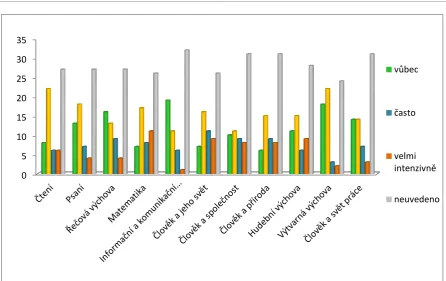
Graph 1. Subjects of 1st part of the Framework Educational Programmed for Special Primary School
Table 1. Subjects of 1st part of the Framework Educational Programmed for Special Primary School Not at all Sometimes Often Very intensively Not stated
Reading 8 22 6 6 27
Writing 13 18 7 4 27
Speech Education 16 13 9 4 27
Math 7 17 8 11 26
ICT 19 11 6 1 32
Humans and Their World 7 16 11 9 26
Human and Society 10 11 9 8 31
Human and Nature 6 15 9 8 31
Music 11 15 6 9 28
Art 18 22 3 2 24
Human and World of Work 14 14 7 3 31
In connection to the previous item the intensity of the usage of interactive whiteboard is also evaluated in pupils with severe mental disability and in pupils with multiple disabilities. The interactive whiteboard is very intensively used according to the highest number of respondents in music, in other subjects the answer is sometimes. The most marked possibility not at all was reached in work experience education. The detailed results are stated in the table.
0 5 10 15 20 25 30 35
vůbec
často
velmi intenzivně
Page 87
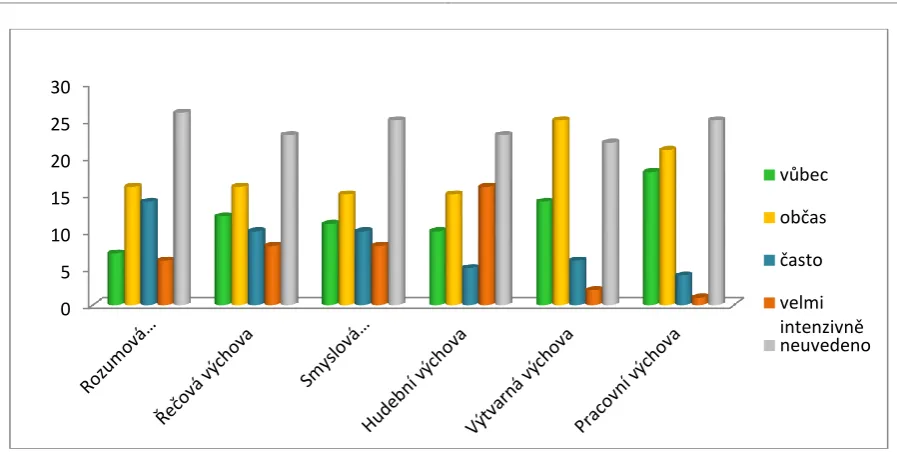
Graph 2. Subjects of 2nd part of the Framework Educational Programmed for Special Primary School (pupils with several mental disability)
Table 2. Subjects of 2nd part of the Framework Educational Programmed for Special Primary School (pupils with several mental disability)
Not at all Sometimes Often Very intensively Not stated
Intellectual Education 7 16 14 6 26
Speech Education 12 16 10 8 23
Sensory Education 11 15 10 8 25
Music 10 15 5 16 23
Art 14 25 6 2 22
Work Experience Education 18 21 4 1 25
The research investigation shows that the interactive whiteboard is mostly used for motivation to activity (37), to interactivity of a pupil in the lesson (34). Twenty-one marks were done of possibility to displaying text, the least respondents 14 chose the answer of voice output. The answer to this question was stated by 58 respondents in their questionnaire.
motivation to activity
interactivity of a pupil in the lesson
displaying text voice output
Graph 3. Purpose of the usage of the interactive whiteboard
0 5 10 15 20 25 30
vůbec
občas
často
velmi intenzivně neuvedeno
0 5 10 15 20 25 30 35
40 37 34
21
14
motivace k činnosti
interaktivita žáka ve výuce
zobrazení textu
Page 88
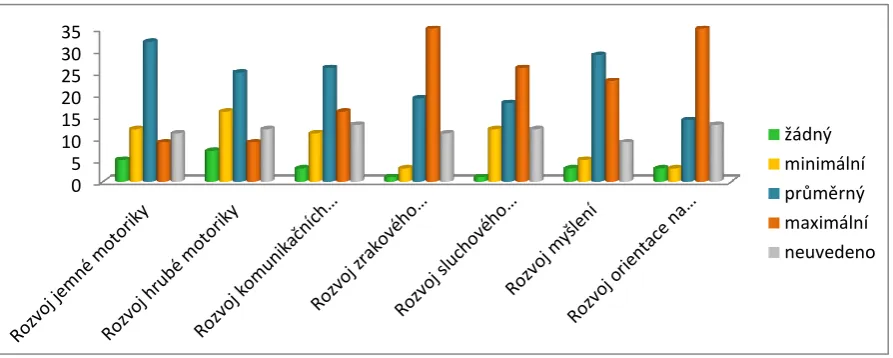
The maximum benefit of the usage of the interactive whiteboard is according to the respondents in the area of development of the orientation on the desktop, development of visual and auditory perception. In the remaining areas the majority of respondents point to average usage. The highest number of minimal benefit is connected to the gross motor development. Not stated answers were also shown in this question. The general overview is in the table.
Graph 4. Benefits of the interactive whiteboard
Table 3. Benefits of the interactive whiteboard
None Minimal Average Maximal Not stated
Development of Fine Motor Skills 5 12 32 9 11
Development of Gross Motor Skills 7 16 25 9 12 Development of Communicative Skills 3 11 26 16 13
Development of Visual Perception 1 3 19 35 11
Development of Auditory Perception 1 12 18 26 12
Development of Thinking 3 5 29 23 9
Development of Orientation on the Desktop 3 3 14 36 13
The aim of the given questions was to evaluate the benefits and limits which are connected to the interactive whiteboard. The wide spectrum of answers was categorized and ordered according to the most frequently stated answers.
Advantage of the interactive whiteboard: motivation, clearness, interesting lesson, entertainment, suitable screen size, interactivity of a pupil, different form of work, development of visual, auditory perception, development of speech abilities, fine and gross motor skills, fast searching of needed information on internet, repeated usage of created materials, projection of pictures and texts, variability in usage, saving of time, easier way to keep attention, stimulation of a pupil.
Weaknesses of the interactive whiteboard: engagement of maximum two pupils, demanding working with more pupils, technical issues, shadows casting, insufficient number of interactive whiteboards, difficult orientation on large desktop, difficult access to the whiteboard by the pupil on a wheelchair, elimination of the number of used tools, incompatibility with PC, increased pedagogical supervision – the possibility of damage of the whiteboard by pupils, time-consuming, placing classic books into the
0 5 10 15 20 25 30 35
Page 89
background – bad orientation in a book, no general development of a personality, due to disabilities of pupils is the usage of the interactive whiteboard almost unreal.
3.2. Research line C
Direct nonparticipating observation took place during 4 months in special primary school in Ostrava. The additional information about the usage of interactive whiteboard in classrooms was obtained through interview with class teachers – special education teachers. The facility is attended by pupils with moderate to profound mental retardation with various forms of cerebral palsy in combination with sensory limitation, autism and epilepsy. The education in the classroom is provided by up to three pedagogical workers in parallel – special education teacher and teacher’s assistants. The education is divided into individual blocks, in groups or individually in accordance with school educational programme “Škola plná zážitků” School full of experiences. By diverse offer of supportive therapeutic activities the teachers contribute to the complex development of a child. During the educational process the concept of Basal stimulation, elements of alternative and augmentative communication, elements of music therapy, drama therapy, art therapy are used. The school has two fully equipped multifunctional rooms. They are for group or individual educational activities, and for structured thematic lessons. The lessons are complemented by rehabilitation activities, e.g. placing the body into vertical position, positioning, rehabilitation exercise on balls and rollers, balling, facial and orofacial stimulation, water rehabilitation, rock tapes, method of PANat and individual physiotherapy. Canine therapy and hippotherapy are frequently arranged.
In class A there are seven pupils, four boys and three girls aged 5 to 14. One girl is educated at home, depending on her health condition the class teacher visits here once a month. Two children are placed in preparatory level of special primary schools, the other children are educated according to the Framework Educational Programme for special primary school, 2nd part. This is largely about pupils who are immobile with severe mental retardation and with occurrence of cerebral palsy, autism spectrum disorder, visual impairments and epilepsy.
Table 4. List of Pupils in Class A
Name Year Diagnosis
Jan Preparatory level Severe Mental Retardation, Pelizaeus Merzbacher Marek Preparatory level Severe Mental Retardation, Childhood Autism
Daniela 3rd Severe Mental Retardation, Aicardi syndrome, Spastic Quadriplegia Form of Cerebral Palsy, visual impairment
David 4th Severe Mental Retardation, Spastic Quadriplegia form of Cerebral Palsy
Eva 6th Severe Mental Retardation, Atypical Autism
Vojtěch 7th Severe Mental Retardation, Hypotonic Cerebral Palsy, Tracheostomy
Nikola 7th Severe Mental Retardation, Rett Syndrome
Page 90
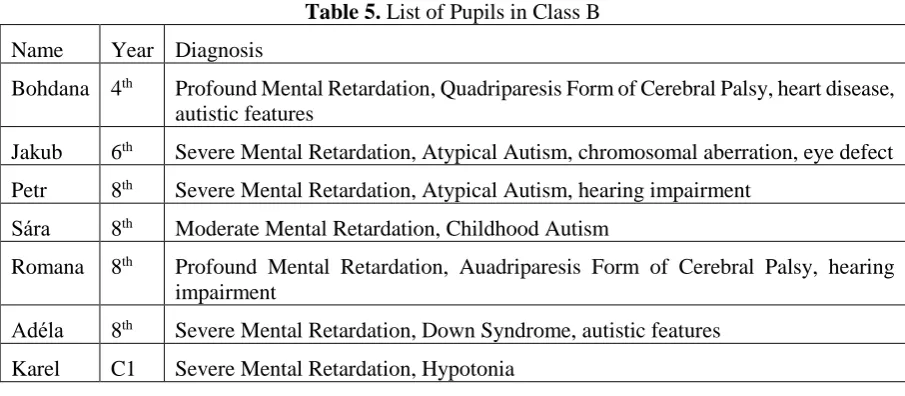
Table 5. List of Pupils in Class B Name Year Diagnosis
Bohdana 4th Profound Mental Retardation, Quadriparesis Form of Cerebral Palsy, heart disease, autistic features
Jakub 6th Severe Mental Retardation, Atypical Autism, chromosomal aberration, eye defect Petr 8th Severe Mental Retardation, Atypical Autism, hearing impairment
Sára 8th Moderate Mental Retardation, Childhood Autism
Romana 8th Profound Mental Retardation, Auadriparesis Form of Cerebral Palsy, hearing impairment
Adéla 8th Severe Mental Retardation, Down Syndrome, autistic features
Karel C1 Severe Mental Retardation, Hypotonia
In individual classes heterogeneous groups of pupils with various levels and types of disability are educated. To this the equipment and arrangement of the classroom have to be fully adopted. Each classroom has a place for individual or group activities, relaxation and dining. The diversity of the environment offers adequate stimulation for the development of the personality of the pupil. Although the observation took place repeatedly in the classrooms, the usage of interactive whiteboards in the daily routine remained unchanged. Therefore, the following text contains all observed activities, which were during the supervisions very frequently realized with minimal changes.
In the classroom A the lessons began with sc. morning circle, when pupils were seated in front of the interactive whiteboard on mechanical wheelchairs, bean bags or adjustable seats for children. By darkening the room, drawing back the blinds and switching the light off, the attention of pupils was concentrated to the light surface of the interactive whiteboard. In one child of the preparatory level it caused unrest and shouting. The programme “Passive watching” was played to primarily attract attention. The task of penetrating figures was based on animation of simple black and white contrastive patterns, e.g. vertical, horizontal lines, concentric circles moving in different directions. For training of observation of changes Discovering was used. Randomly placed objects were shown in it in regular intervals. Gradual representation of transparent objects (cat, flying balloon, smiling face, cow, horse) was accompanied by appropriate sounds. Composition of pictures (lorry, butterfly, flying dragon, telephone) was based on gradual addition of particular parts finished by a short animation.
Page 91
The morning study group of class B was commenced by a mutual greeting. The pupils were seated on chairs in semicircle and with the help of pedagogical workers they learnt the day of the weak, month, season and current weather conditions. Everything was on cards which the pupils in turns placed in an appropriate place. After identification of pictures of present pupils and teachers the moment of compiling the schedule of planned activities took place. On the carpet surface of the wall under their picture the pupils added pictograms of activities that they expected on that day. The communication was rather one-sided, only a girl with moderate mental retardation actively responded. Subsequently the pedagogical workers approached individual pupils and stimulated the orofacial area with a brush. The blowing out the flame of the candle was preceded by everyday listening of favourite song. For stretching and physical activities of pupils other rhythmical songs were played most frequently on the interactive whiteboard. These rhythmical songs accompanied by cartoon images were an effective motivation to move for the pupils. The end of the morning study group was signalled by a bell.
The activity of detection faces of classmates was created in a programme SMART Notebook. The goal of the activity is to recognize a face of a friend whose face is hidden behind colourful squares. The pupils moved individual squares to the white part of the interactive board so as they can identify the photographs of the classmates. Similar task was based on gradual clicking on colourful fields instead of which the photograph or picture of tram was shown. The pupils emotionally showed joy from the discovered with laughter and clapping hands, especially when they saw themselves. Some of them were attracted by the sound of clicking more than by the image itself.
The passive usage of the interactive whiteboard was noticed during introducing pupils the musical instruments of Prague Castle and the president of the Czech Republic. The interactive whiteboard was used as a basis for the theoretical presentation of the teacher.
Drawing, graphomotor exercises, combining geometrical shapes and colours were also a part of the lessons. Some of the pupils were repeatedly fascinated by the fact that they left marks on the desktop by their finger, others were not attracted to this activity, and they stopped working after the first touch on the interactive whiteboard.
4. SUMMARY OF THE RESEARCH RESULTS
The interactive whiteboard is a part of everyday lessons. However, it is mainly used for passive observation (listening of songs, watching fairy tales, presentation of supportive materials). Despite the wide range of educational programmes for the target group of pupils mainly own interactive materials created on the basis of images and individual needs of pupils are used. Although they draw inspiration from freely accessible digital educational materials, their preparation is time-consuming. The application of the interactive whiteboard is mainly in subjects of sensory education, music and physical education, in mathematics, for development of graphomotor skills and during relaxing activities. The benefit is in motivation, attracting attention and lengthening it, in amusement and also in the fact that the work is more interesting. Very successful are especially the activities when pupils work with e.g. their own photographs, photographs of their classmates or for the close objects. Certain disadvantages are by the pedagogical workers seen in accessibility and limited manipulation possibilities of individual pupils on interactive whiteboard. Therefore, for certain pupils a tablet is more suitable. Attending specialized seminar did not contribute to gaining necessary knowledge for special education practice. According to the statements given by the respondents the course introduced to participants general information focused on the usage of interactive whiteboard in ordinary primary school. Special programmes and possible usage for pupils with disabilities were not addressed at all. Therefore, it depends on the activity of the teacher, his / her creativity and interest for integration of interactive board into the lessons.
Page 92
individual needs of pupils are the basis of most realized activities. Inspiration from internet, working with digital learning materials contribute to the ease of preparation and save time.
The research did not prove one-sided evaluation. The opinions of teachers and teacher’s assistants include both positives and also negatives of the interactive whiteboard. The motivational character, illustrative nature, more interesting content and amusement of lessons together with activation of pupils are appreciated. On the other hand, limited number of involved individuals, technical problems, and time-consuming preparation of lesson are considered disadvantages of the interactive whiteboard. Despite many limitations the observed information technologies are generally considered a suitable tool for the education of pupils with mental and combined disability.
Based on the observations and interviews it was found that the pupils do not show increased interest in activities on the interactive board. Although teachers mainly encounter positive reactions, some of the pupils refuse to work with the interactive whiteboard. The pupils can for a long time watch fairy tales, listen to songs, however, direct activities are most frequently short-term. The manipulation with object is very difficult for pupils.
According to the answers of the respondents the interactive board is used with each pupil, at least for passive monitoring. Active work is obviously influenced by the individual abilities of individuals. The biggest benefit is in motivation, attracting attention and lengthening it. Work with various applications also influence pupils’ interest in learning new words, which they memorized quite quickly. Attractiveness of individual applications then visibly increased interest in given subject in all observed pupils. The biggest difference in motivation to perform a task was in the area of development of graphomotor skills, vocabulary, counting and visual stimulation and differentiation.
5. CONCLUSION
Page 93 REFERENCES
1. ADAMUS, Petr, Petr FRANIOK, Martin KALEJA a Eva ZEZULKOVÁ. 2015. Vzdělávací strategie v edukaci vybraných skupin žáků se speciálními vzdělávacími potřebami. 1. Ostrava: Ostravská univerzita v Ostravě, Pedagogická fakulta. ISBN 9788074647987.
2. ADAMUS, Petr. Metodika hodnocení kvality inkluzivní školy. Opava: CEV, FVP Slezské univerzity v Opavě, 2015. ISBN 978-80-7510-163-1.
3. ADAMUS, Petr. Profesní příprava a možnost pracovního uplatnění osob se středně těžkým mentálním postižením. In KALEJA, Martin (Ed.) Inkluzivní dimenze primárního a sekundárního vzdělávání ve speciální pedagogice. Ostrava: PdF OU, 2014. ISBN 978-80-7464-692-8.
4. DOSTÁL, Jiří. (2009). Interaktivní tabule ve výuce. Journal of Technology a Informační výchova, 1 (3 s 12).
5. Evropská agentura pro rozvoj speciálního vzdělávání. Klíčové principy zlepšování kvality inkluzívního vzdělávání – Doporučení pro praxi. Odense: Evropská agentura pro rozvoj speciálního vzdělávání. 2011. ISBN: 978-87-7110-275-8.
6. Evropská agentura pro speciální a inkluzivní vzdělávání, 2014. Pět klíčových poselství pro inkluzivní vzdělávání. Uvedení teorie do praxe. Odense, Dánsko: Evropská agentura pro speciální a inkluzivní vzdělávání. 2014. ISBN 978-87-7110-496-7.
7. KALEJA, Martin. Etopedická propedeutika v inkluzivní speciální pedagogice Ostrava: PdF Ostravské univerzity v Ostravě, 2013, ISBN 978-80-7464-396-5.
8. KALEJA, Martin. Nepřipravený pedagog a žák z prostředí sociální exkluze. Opava: CEV, FVP Slezské univerzity v Opavě, 2015.
9. ZEZULKOVÁ, Eva. Jazyková a komunikativní kompetence dětí s mentálním postižením. Ostrava: PdF, OU, 2011. ISBN 978-7368-991-9.
10. ZEZULKOVÁ, Eva. Rozvoj komunikační kompetence žáků s lehkým mentálním postižením. 1. vyd. Ostrava: OdF OU, 2013. 171 s. ISBN 978-80-7464-395-8.
11. ZIKL, P. Využití ICT u dětí se speciálními vzdělávacími potřebami. Praha: Grada Publishing, a.s., 2011, 128 s., 80 – 2477 – 7096.