IJEDR2001041 International Journal of Engineering Development and Research (www.ijedr.org) 216
To provide Secure Message authentication in
Wireless Sensor Network using RC6
1Ms. Sonam Arunsingh Bais, 2Ms. Snehal Shrirang Mandhare 1Assistant Professor, 2Assistant Professor
1Karmaveer Bhaurao Patil College, Vashi, India, 2Karmaveer Bhaurao Patil College, Vashi, India
_____________________________________________________________________________________________________
Abstract - Message authentication is the most efficient ways to prevent unauthorized and corrupted messages from being forwarded in wireless sensor networks (WSNs). That's the reason, numerous message authentication proposals have been developed based on either symmetric-key cryptosystems or public-key cryptosystems. Many cases , have the restrictions of high computational and communication overhead in addition to lack of scalability and resilience to node compromise attacks. Wireless Sensor Networks (WSN) are being very popular day by day, however one of the main concern in wireless sensor network (WSN) is its limited resources.This paper the message authentication and source privacy in wireless sensor environment by using Rivest cipher version 6 (RC6) algorithm. It also compare various feature in terms of computational overhead, energy consumption, message delay, memory consumption.
keywords - Message authentication, Symmetric-key cryptosystem, Public-key cryptosystem, simulation, wireless sensor networks (WSNs), RC6 algorithm (Rivest cipher version 6).
_____________________________________________________________________________________________________
I. INTRODUCTION
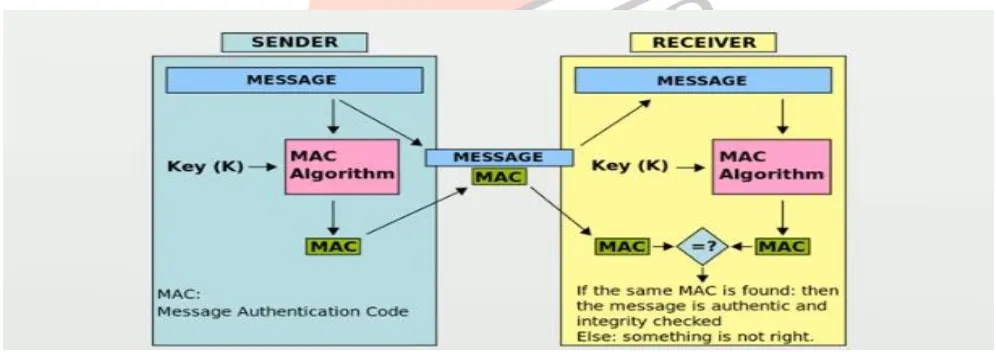
In Secure transformation, Message authentication play a very important role in thwarting unauthorized ,corrupted messages from being delivered in networks to save the valuable sensor energy [8]. That’s why, Many authentication schemes have been proposed in literature to offering message authenticity & integrity verification for wireless sensor network environment (WSNs) [3]–[8]. These approaches are separated into two categories: public-key based approaches and symmetric-key based approaches [1]. The approach of Symmetric-key cryptography necessitates composite key management, lacks of scalability, not flexible to large numbers of node compromise attacks ,Therefore the message sender and the receiver have to share a secret key. In Cryptosystems, the shared key is managed by the sender to produce a message authentication code (MAC) for each transmitted message [8]. The process of the authenticity and the integrity of the message can only be confirmed by the node with the shared secret key, which is usually shared by a group of sensor nodes [2].
Fig 1: message authentication code
IJEDR2001041 International Journal of Engineering Development and Research (www.ijedr.org) 217
II LITERATURE REVIEW Wireless sensor networks
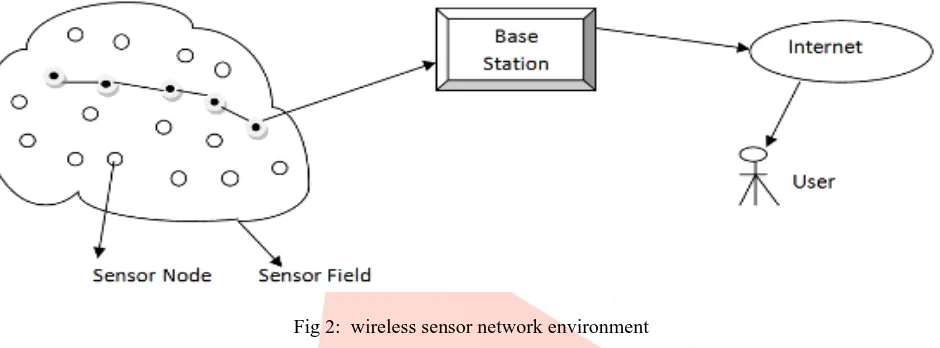
Wireless Sensor Network (WSN) is the collection of different sensor nodes deployed in an area to monitor the environmental and physical conditions parameters like temperature, pressure, movement of objects, light etc[6]. In a wireless sensor network sink node is known as base station. The fast development of wireless sensor networks is motivated by military applications[5]. Sensor nodes in Wireless Sensor network is very important to gather information from atmosphere and transmit it to a base station. Information sent by all the senor nodes in the network gathers at base station and from there this collected information is sent to the user through internet.
Fig 2: wireless sensor network environment
Generally, The base station is more powerful in terms of resources than the sensor nodes. The sensor node is equipped with low-power batteries due to its small sizes, Which limits the ability of the sensor node in various terms of processing, storage & transmission[8]. In this paper we propose hop by hop message authentication and source privacy using RC6 algorithm.
NS-2
Network simulation is used to simulate the networks such as in MANETs, VANETs etc. It provides simulation for routing and multicast protocols for both wired and wireless networks terminology. NS is licensed for use under version 2 of the (GNU) General Public License and is popularly known as NS2 (Network simulation version 2). It is an object-oriented, discrete event-driven simulator written in C++ language, Otcl/tcl. NS-2 is used to implement Network protocols as TCP and UPD, Traffic source behavior as FTP, Telnet, Web, CBR and VBR, Router queue management mechanism as Drop Tail, RED and CBQ, routing algorithms and many more. In working of ns2, C++ is used for detailed protocol implementation and Otcl is used for the setup[7].
In propose scheme we used OTcl for message authentication ,source privacy and When providing encryption and decryption by using Rivest Cipher Version 6 then C++ language is used.
III PROPOSED APPROACH
Our proposed message authentication scheme aims at achieving the following goals:
• Message authentication:Message authentication ensures that, The message has been sent by a genuine identity and not by a imposter[7]. The service is used provide message authentication is a Message Authentication Code (MAC).
• Hop-by-hop message authentication: Each an every forwarder path on the routing path should be able to verify the authenticity and integrity of the messages upon recipient[1].
• Efficiency: The proposed work should be efficient in terms of both computational and communication overhead[4].
Rivest Cipher 6
RC6 is an evolutionary improvement over RC5, Designed to meet the requirements of the Advanced Encryption Standard (AES). Like the RC5, RC6 makes essential use of data-dependent rotations. Various new features of RC6 includes the use of four working registers instead of two register, The inclusion of integer multiplication as a additional primitive operation[4]. The uses of multiplication greatly increases the diffusion achieved each round , allowing for great security, fewer rounds, and increased throughput.
Details of rc6
IJEDR2001041 International Journal of Engineering Development and Research (www.ijedr.org) 218
▪ a + b= The integer addition modulo 2^w
▪ a – b = The integer subtraction modulo 2^w
▪ a @ b = The bitwise exclusive-or of w-bit words
▪ a * b = The integer multiplication modulo 2^w
▪ a <<< b = The rotate the w-bit word a to the left by the amount given by the least significant lgw bits of b ▪ a >>> b= The rotate the w-bit word a to the right by the amount given by the least significant lgw bits of b
Encryption with RC6-
Decryption with RC6-
IV COMPARE VARIOUS FEATURE BY USING GRAPHICAL FORMATE
IJEDR2001041 International Journal of Engineering Development and Research (www.ijedr.org) 219 Fig 2: Number of communication verses Delay
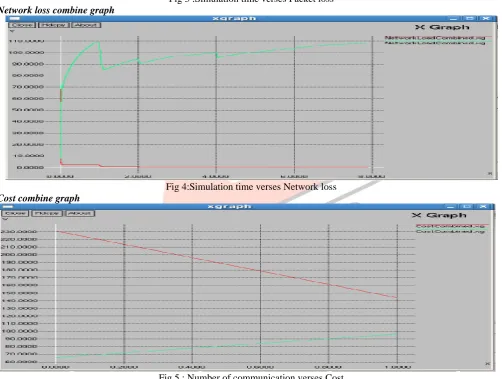
Packet loss combine graph
Fig 3 :Simulation time verses Packet loss Network loss combine graph
Fig 4:Simulation time verses Network loss Cost combine graph
Fig 5 : Number of communication verses Cost
V ACKOWLGEMENT
To provide hop-by-hop message authentication, the disadvantages of the built in threshold of the polynomial-based scheme . We propose a hop-by-hop message authentication scheme based on the Rivest Cipher Version 6. Comparing both theoretical and simulation based results show that, Our proposed scheme is most efficient than the polynomial-based scheme in terms of Computational overhead, Energy consumption, Message delay and Memory consumption.
VI REFERENCES
[1] Jian Li Yun Li Jian Ren Jie Wu, ―Hop-by-Hop Message Authentication and Source Privacy in Wireless Sensor Networks‖, IEEE Transactions On Parallel And Distributed Systems, pp 1-10, 2013
[2] Syed Rafiul Hussain∗ , Mitziu Echeverria† , Omar Chowdhury† , Ninghui Li, and Elisa Bertino, “Privacy Attacks to the 4G and 5G Cellular Paging Protocols Using Side Channel Information”
IJEDR2001041 International Journal of Engineering Development and Research (www.ijedr.org) 220 [4] M. Albrecht, C. Gentry, S. Halevi, and J. Katz, ―Attacking cryptographic schemes based on ‖perturbation polynomials‖,‖ Cryptology ePrint Archive, Report 2009/098, 2009, http://eprint.iacr.org.
[5] Dunfan Ye,DaoliGong,WeiWang ―Application of Wreless Sensor Networks in Environmental Monitoring‖, 2009 2nd International Conference on Power Electronics and Intelligent Transportation System.
[6] Ling Tan, Shunyi Zhang, and Yanfeng Sun, Jing Qi ―Application of Wireless Sensor Networks in Energy Automation‖, Sustainable Power Generation and Supply, 2009. Supergen ’09. International conference