IJEDR1703160
International Journal of Engineering Development and Research (
www.ijedr.org
)
1132
Multi-Level Soft Frequency Reuse Using Fast
Convergence Optimization for LTE Network
1Sunita Choudhary,2Manwinder Singh
1,2Department of Electronics & Comm. and Engineering, 1,2Rayat Bahara Institute of Technology, Ropar, India
________________________________________________________________________________________________________
Abstract: One of the foremost challenges in today’s communication technology is Inter Cell Interference (ICI). The new technologies in cellular systems are currently being developed. These systems require reduction in ICI and increase in the channel capacity. Therefore, one of the aims of these systems is to increase performance of users at the cell edge that typically suffer from significant Inter Cell Interference. Due to the presence of Orthogonal frequency division multiple access in which the sub-carriers are arranged orthogonally to each other, the intra cell interference is not present. Whereas, the Inter-cell interference is one of the de-limiting factors in the ML-SFR. To overcome this, a new method using Particle Swarm Optimization (PSO) has been proposed to reduce the Inter cell interference and the results in the support are provided in the results section. The analysis has also been discussed further.
KEYWORDS: MLSFR, SFR, FCPSO, LTE, Optimization
________________________________________________________________________________________________________
I. INTRODUCTION
In the multi-level frequency reuse, it defines a network-level framework for resource allocation in each cell. Generally, a UE can be assigned the resources in the frequency band that covers it. However, allocating resources is suggested to user equipment in the bands with the possible smallest coverage to optimize the system performances. First of all, a coverage area is determined for each of the frequency bands according to their PDLs. The relationship between the PDL and coverage is an implementation problem which operators would optimize based on the realistic scenarios. When allocating resources used to user equipment, the allocator search the band with the smallest coverage in the list for available resources.
To deal with the increased users endorsement of the new wireless communication services, the Third Generation Partnership Project (3GPP) has presented the Carrier Aggregation (CA) concept as one of the Long Term Evolution-Advanced (LTE-A) features in order to fulfill the 5th Generation (5G) requirements. The CA technology permits the aggregation of multiple LTE-supported carriers, known as component carriers, to form a greater carrier. This aggregation should be in a backward compatible way such that both LTE-A a capable user equipment (UE) and legacy LTE release 8 UE are served simultaneously. One of the restraining factors that disturb the performance of the cellular LTE orthogonal frequency division multiplexing (OFDM) system is the inter-cell interference (ICI) between users in different cells being assisted in the same physical resource block. Although the aggressive spectrum reuse achieves the highest system capacity, it causes the largest degradation in signal-to-interference-plus-noise ratio (SINR) due to ICI, especially at the cell edge. This causes the difference to widen between the performance of cell-center and cell-edge users. Several interference management solutions are made to improve the cell edge throughput including the frequency reuse concept which reduces the interference levels significantly at the expense of the reduction in the available bandwidth. To strike a balance between the need of a high system throughput and sufficient cell-edge spectral efficiency, the concept of soft frequency reuse (SFR) is presented. Using this concept, some of the available physical resource blocks are assigned to the cell-center users, whereas the rest are divided between the edge users of the adjacent cells. An ML-SFR scheme is introduced in that divides the resources between the cell-center and the cell-edge region not only by frequency sub-bands but into multi-level power density. The performance of SFR in communication networks under different load and power setups will be discussed in. In the presence of multiple carriers and users with different capabilities, CA deployed as a capacity-boosting. Orthogonal frequency division multiplexing (OFDM) is a popular multi-carrier modulation scheme. It provides immunity to inter symbol interference and frequency selective fading by dividing the frequency band into a group of mutually orthogonal subcarriers, each having a much lower bandwidth than the coherence bandwidth of the channel. In a multi-user environment, multiple access of OFDM can be achieved by employing Time Division Multiple Access (OFDM-TDMA) or Code Division Multiple Access (OFDM-CDMA). Orthogonal Frequency Division Multiplexing (OFDM) is introduced as one of solutions to enable bandwidth efficiency and robustness due to inters ymbol inteference (ISI) in the consequence of multipath fading environment. The principle of OFDM is dividing high rate data stream into parallel low rate data streams using Fast Fourier Transform (FFT).OFDM is combined by modulation with more bits per symbol to increase data transmission throughput. OFDM is multiplexing scheme which divide data stream became more narrowband data channel to share the bandwidth available. Narrowband channel is called subcarrier which transmit phase or amplitude modulated data signal. Different with Frequency Division Multiplexing (FDM), OFDM have subcarrier that orthogonally. This orthogonally can reduce inteference between subcarrier and increase spectrum efficiency utilization.
IJEDR1703160
International Journal of Engineering Development and Research (
www.ijedr.org
)
1133
A.K.M Fazlul Haque1 et al. [1] proposed the performances of frequency reuse schemes in mobile cellular environment have been simulated and evaluated in this paper. The result demonstrated that proposed approach performs better as compared to other the traditional schemes.
Martin Taranetz et al. [2] in this paper, a conventional Reuse-1 scheme has been proposed. The simulation results show significant improvements in terms of average- and peak performance, while achieving a cell-edge performance comparable to a conventional Reuse-3 scheme in comparison with existing approaches.
Chandra Thapa et al. [3] proposed the FFR provide better probability of coverage and probability of acceptance rate than Traditional frequency reuse 1 and reuse. The result demonstrated that proposed approach performs better as compared to other the traditional schemes.
Yang, Xuezhi et al. [4] proposed multilevel soft frequency reuse (ML-SFR) scheme and a resource allocation methodology for wireless communication systems. The proposed scheme is used in current 4 generation systems. In order to attaining good interference pattern for proposed ML-SFR scheme, there will be 2N power density levels. In this paper, proposed scheme shows improved overall data rate and cell edge as compared with 2- level SFR scheme. Additionally, 8 levels SFR scheme has also been designed in this paper. The result indicates that efficiency of cell edge spectrum is increased to 5 times of that of reuse1 and efficiency of overall spectrum is improved by 31%.
Qian, Manli et al. [5] proposed Inter-cell interference coordination by using adaptive soft frequency reuse in 4G networks. Basically, frequency reuse schemes in LTE network are only used to improve the system capacity. The proposed scheme is used to develop the capacity of SFR scheme by combining the power allocation and optimizing subcarrier in multi-cell LTE network. Result indicates that the proposed scheme performs better as compared to existing SFR scheme and FFR schemes.
Jiming, Chen et al. [6] proposed a novel adaptive SFR scheme in the dense Femtocell networks. in the paper many dense femtocells are categorized in to different groups according to the dominant interference strength to others. Femtocell networks have appeared as a chief technology in residential, office building or hotspot deployments which may considerably accomplish high data demands in order to offload indoor traffic from outdoor macro cells. Simulation results demonstrates that the proposed scheme provide great performance gains in terms of the spectrum efficiency relative to the legacy soft frequency reuse and universal frequency reuse.
Gonzalez, David et al. [7] proposed novel multi-objective algorithm. The proposed approach is used to achieve effective optimization of SFR implementations. Result indicates that the proposed algorithm succeeds in finding good-quality SFR configurations improving at the same time network capacity and cell edge performance while decreasing energy consumption with respect to baseline designs and previous proposals
Novlan, Thomas et al. [8] proposed an analytic model for calculating SFR and FFR scheme depending on the spatial poisson point process. The result indicates that proposed approach produce tractable expression that may be utilized for system and also capture for the non-uniformity of heterogeneous deployments. Additionally, in the context of multi-tier networks with closed access in some tiers, the proposed framework shows the impact of cross-tier interference on closed access FFR, and informs the selection of key FFR parameters in open access.
Dahrouj, Hayssam et al. [9] proposed soft frequency reuse based systems. Additionally, this paper also examines the advantages of coordinated scheduling in SFR based systems. Auction method has been used to solve the problem of proposed scheme. Moreover, this paper also presented heuristic methods with lower computational complexity. the result indicates that coordinated scheduling provides best performance improvement as compared to non-coordinated systems.
Bilios, Dimitrios et al. [10] this paper presents a scheme which chooses the best FFR approach depending on the user throughput and user satisfaction. Proposed mechanism chooses the optimal size of inner and outer region for every cell as well as the optimal frequency allocation among these regions that either maximizes the mean user throughput or the user satisfaction. The system is calculated through more than a few simulation states of affairs.
III. PROPOSED METHODOLOGY
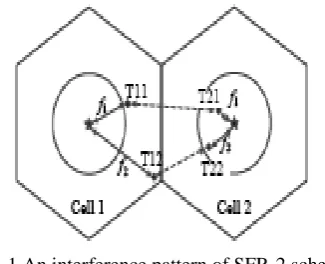
An interference pattern of SFR-2 scheme can be considered. Two UEs are available in cell edge area of the Cell 1 which is denoted as T11 and T12 to communicate with base station while using the frequency f1 and f2 in the primary band, either in the downlink or uplink. Two UEs are available in cell centre area of the Cell 2 which is denoted as T21 and T22 to communicate with base station on frequency f1 and f2. According to SFR definition, f1 and f2 can be in secondary band of the Cell 2. So, interference pattern is, T11 make the interference with T21 and T12 make interference with T22.
Fig. 1 An interference pattern of SFR-2 scheme
IJEDR1703160
International Journal of Engineering Development and Research (
www.ijedr.org
)
1134
vulnerable than T11 which is an appropriate to pair this with T21 that contain smaller interfering power than T22. With this pattern, UE is most cell edge that can achieve larger data rate at cost of the lower data rate of UE at most cell centre. It is desirable for the operators; therefore user complains may effectively decreased by prolongs the data rate of most vulnerable UEs.Therefore, SFR-2 will not give the constraints to realize better interference pattern. In the 2-cell scenario better pattern may achieved with chance of 50% through random resource allocation. In the 7-cell scenario, a central cell plus 6 surrounding to the cells, chance of the random allocation to realize optimal pattern falls to (1=2) 6 = 1=32. To optimize interference pattern, the multi-level of soft frequency reuse has been displayed.
Fig. 2 Power density upper limit and the coverage of SFR-4 method
In ML-SFR method, the entire frequency band has been split into N parts on of every separate SFR-2 method is worked. In the Cell i, the PDLs of secondary and primary bands of part n € [1,N] that are denoted as hn(i) and l n(i) respectively,
l 1(i) ≤ l 2(i)≤….. ≤ lN(i)≤ h N(i) ≤ ……. ≤ h 2(i) ≤ h 1(i)
A SFR-4 method has been displayed. It has been noticed the particular PDL setting in the largest PDL pairs with lowest, in this second largest pairs with second lowest, and so on. In the SFR-2 method, the entire cell has been quantized into two areas, cell edge and cell centre. It is relative coarse framework for the resource allocation. In the ML-SFR method, there are 2N PDL levels divide the entire cell into the 2N areas and creating a refined framework.
Cellular network contains 13 cells with the radius r. In this, ML-SFR scheme can be used the primary band of the Cell 0 which has also primary band of the Cell 7-12, and secondary band of Cell 1-6.
A. Algorithm
Steps :
1) maximum iteration (Tmax) = 40 where t =1, 2, . . . , Tmax; 2) swarm size (N) = 50 where i = 1, 2, 3, . . . , N;
3) initial velocity vi,d(0) = 0;
4) initial position xi,d(0) = Pf ∼ 2+U[0, 1]; 5) inertial weightw= 0.01;
6) initial personal best position pBesti,d= xi,d; 7) acceleration constant c1=c2=0.7
For each iteration, the following parameters are evaluated:
𝑣𝑖(𝑡 + 𝑑𝑡) = 𝑤 ∗ 𝑣𝑖(𝑡) + 𝑐1∗ 𝑟1∗ (𝑝𝑏𝑒𝑠𝑡𝑖(𝑡) − 𝑥𝑖(𝑡)) + 𝑐2∗ 𝑟2(𝑔𝑏𝑒𝑠𝑡(𝑡) − 𝑥𝑖(𝑡))
𝑥𝑖(𝑡 + 𝑑𝑡) = 𝑥𝑖(𝑡) + 𝑣𝑖(𝑡 + 𝑑𝑡)
IV. RESULT
IJEDR1703160
International Journal of Engineering Development and Research (
www.ijedr.org
)
1135
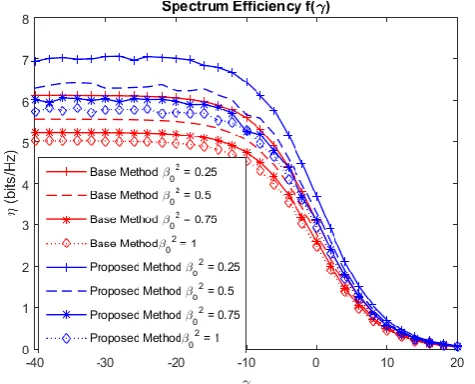
Fig.3 Spectrum efficiency as a function of gamma (γ)Fig.4 Spectrum efficiency as a function of Beta with γ=0
Fig.5 Spectrum efficiency as a function of Beta with γ = -2.4
IJEDR1703160
International Journal of Engineering Development and Research (
www.ijedr.org
)
1136
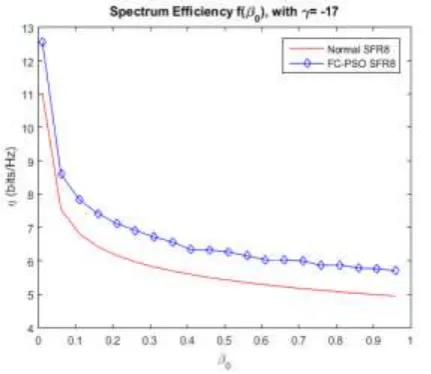
Fig 7 Spectrum efficiency as a function of Beta with γ = -17The cell edge spectral efficiency as in the SFR-8 base method is found to be 2.475 dBm/Hz and for that of the proposed method, it is 2.975 which is a 20% improvement from the base method.
V. CONCLUSION
In this work, a new method for optimizing the Inter Cell Interference (ICI) to increase the channel capacity of the system or the throughput has been proposed. The proposed algorithm has higher channel capacity than the previous method without optimized inter Cell interference. This is because the proposed algorithm takes optimizes the loads into consideration when allocating resources to different cells and maximizes system throughput by reducing the effective interference. However, in SFR, the subcarrier and power allocation in each cell is pre-determined beforehand and not adapted to the changes in network traffic. This is because the proposed algorithm effectively reduces ICI by dynamically adjusting the major and minor subcarriers’ transmit power in each cell while in SFR-8 both inner and outer cell users experience the highest interference from adjacent cells. In second figure the cell edge user performance of the two schemes. The proposed algorithm guarantees cell edge user data rate requirement when allocating resources. It adjusts the number of major subcarriers and transmits power according to cell edge data rate requirements. However in other scheme, the resource allocated to each cell region is predefined. When the cell edge traffic load is high the achieved system throughput in each iteration of the proposed algorithm for each cell region may not be enough to serve all its users which will lead to the outage of cell edge users. Therefore, the proposed can be a better option in order to reduce the ICI.
The future work may involve the reduction in the complexity of the system. This is because the current system based on PSO may be a bit complex in terms of implementation because of the algorithm’s iterative structure. Hence, a further research can be to reduce the complexity and improve the timing performance of the algorithm
REFERENCES
[1] A.K.M Fazlul Haque1, A.F.M. Shahen Shah, Md “High Performance Analysis of Frequency Reuse Schemes in Cellular Mobile Environment” March 2011 International Journal of Latest Trends in Computing (E-ISSN: 2045-5364) 29 Volume
[2] Martin Taranetz, Josep Colom Ikuno, Markus Rupp “Capacity density optimization by Fractional Frequency partitioning” 45th Annual Asilomar Conference on signals, system, and computers (ASILOMAR 2011)
[3] Chandra ThapaandChandrasekhar.C “Comparative evaluation of fractional Frequency reuse (FFR) and traditional Frequency reuse in 3gpp-lte downlink” August 2012, International Journal of Mobile Network Communications &Telemetric (IJMNCT) Vol.2, No.4.
[4] Yang, Xuezhi. "A multilevel soft frequency reuse technique for wireless communication systems." IEEE Communications Letters 18, no. 11 (2014): 1983-1986.
[5] Qian, Manli, Wibowo Hardjawana, Yonghui Li, Branka Vucetic, Jinglin Shi, and Xuezhi Yang. "Inter-cell interference coordination through adaptive soft frequency reuse in LTE networks." In Wireless Communications and Networking Conference (WCNC), 2012 IEEE, pp. 1618-1623. IEEE, 2012.
[6] Jiming, Chen, Wang Peng, and Zhang Jie. "Adaptive soft frequency reuse scheme for in-building dense femtocell networks." China Communications 10, no. 1 (2013): 44-55.
[7] Novlan, Thomas David, Radha Krishna Ganti, Arunabha Ghosh, and Jeffrey G. Andrews. "Analytical evaluation of fractional frequency reuse for heterogeneous cellular networks." IEEE Transactions on Communications 60, no. 7 (2012): 2029-2039. [8] Dahrouj, Hayssam, Wei Yu, Taiwen Tang, Jerry Chow, and Radu Selea. "Coordinated scheduling for wireless backhaul networks with soft frequency reuse." In Signal Processing Conference (EUSIPCO), 2013 Proceedings of the 21st European, pp. 1-5. IEEE, 2013.