316 | P a g e
DESIGN AND IMPLEMENTATION OF LOGIC GATES
USING FINFET TECHNOLOGY
G.Saranya
1, S.Jakkammal@Malarvizhi
2,K.Kalarani
31, 2
PG Scholar,
3.Assistant Professor, Department of VLSI Design,
Theni Kammavar Sangam College of Technology, Tamilnadu, (India)
ABSTRACT
Scaling as one of the most important challenges from the technology viewpoint. The channel length of Field Effect Transistors (FETs) has passed from micrometers to tens of nano meters. However, drawbacks of scaling have the increase of short channel, parasitic, reliability and variability effects. To overcome the problems related to scaling, new transistor architectures have to be investigated. FinFET is the most promising double-gate transistor architecture to extend scaling over planar device. Multiple gates have better control over the SCEs. Particularly the FinFET technology provides superior scalability of the DG-MOSFETs compared to the planar MOSFET. Fin-FETs are predicted as one of the best possible candidates to replace the bulk MOSFETs. The FinFET technology power consumption compare with the CMOS technology. The two gates of a FinFET can either be shorted for higher performance or independently controlled for lower leakage or reduced transistor count. Analyzed different type of operation mode like Shorted Gate, Independent gate, and Low power mode.
Keywords: FinFET, Short Channel Effects (SCEs), Power Consumption, Logic gates, Different modes
of operation
I.
INTRODUCTION
The FinFET has been developed to overcome the problems faced by MOSFET. It is basically a multi gate Field
Effect Transistor which has been scaled further of MOSFET. It has all properties similar to a transistor, but has some
advantages on CMOS. As you can see the above figures, multiple drains and multiple sources, we can also use each
pair of source and drain can be considered as a single transistor hence increasing the no of transistors in one
FinFET.
MOSFET has some technical problems like i) short channel effects and ii) Corner Effect Corner .Effects has
following problems: -
317 | P a g e
b) Leakage enhancement is especially strong, if the gate electrode wraps around the corner of the active areac) Corner effect leads to a not complete switching-off of the STI MOS transistors and worsens the transistor
performance.
So to overcome the difficulty faced by traditional MOSFET, FinFET came into role and to make the transistors more
efficient. Wider FinFET devices are built utilizing multiple parallel fins between the source and drain. Independent
gating of the FinFET’s double gates allows significant reduction in leakage current.
II MOSFET
Metal-Oxide-Semiconductor Field Effect Transistor is a three terminal device used for a variety of applications as
per the requirement in different fields of electronics. It is used for amplifying or switching electronic signals. In
MOSFETs, a voltage on the oxide-insulated gate electrode can induce a conducting channel between the two other
contacts called source and drain. The channel can be of n-type or p-type and is accordingly called an nMOSFET or a
pMOSFET (also commonly NMOS, PMOS).
Fig.2.1 Symbols of NMOS & PMOS
G=GATE D= DRAIN S=SOURCE B = BULK
2.1 Operation of MOSFET
A traditional metal–oxide–semiconductor (MOS) structure is obtained by growing a layer of silicon dioxide (SiO2)
on top of a silicon substrate and depositing a layer of metal or polycrystalline silicon (the latter is commonly used).
As the silicon dioxide is a dielectric material, its structure is equivalent to a planar capacitor, with one of the
electrodes replaced by a semiconductor.
When a voltage is applied across a MOS structure, it modifies the distribution of charges in the semiconductor. If we
consider a P-type semiconductor (with NA the density of acceptors, p the density of holes; p = NA in neutral bulk),
a positive voltage, VGB, from gate to body creates a depletion layer by forcing the positively charged holes away
from the gate insulator/ semiconductor interface, leaving exposed a carrier-free region of immobile, negatively
charged acceptor ions. If VGB is high enough, a high concentration of negative charge carriers forms in an inversion
318 | P a g e
Unlike the MOSFET, where the inversion layer electrons are supplied rapidly from the source/drain electrodes, inthe MOS capacitor they are produced much more slowly by thermal generation through carrier generation and
recombination centers in the depletion region. Conventionally, the gate voltage at which the volume density of
electrons in the inversion layer is the same as the volume density of holes in the body is called the threshold voltage.
This structure with P-type body is the basis of the N-type MOSFET, which requires the addition of an N-type source
and drain regions.
Fig.2.2: Operation of MOSFET
2.2 DG – MOSFET Structure
Currently standard CMOS technology can be replaced by DG MOSFETs technology to increase the integration
capacity of silicon technology in the near future [5]. A DGSOI Structure consists, basically, of a silicon slab
sandwiched between two oxide layers shows in Fig.2.3. The salient features of the DG MOSFETs are control of
short-channel effects by device geometry, as compared to bulk FETs, where the short-channel effects are controlled
by doping concentration; and a thin silicon channel leading to tight coupling of the gate potential with the channel
potential. These features provide potential DG MOSFET advantages are reduced short channel effects which allows
for a larger gate overdrive for the same power supply and the same off-current and better carrier transport as the
channel doping is reduced.
319 | P a g e
Basically there are 2 kinds of DG-FETs: (1) Symmetric: - In Symmetric DG-FETs have identical gate electrodematerials for the front and back gates means gate electrode material is same for both gate. When symmetrically
driven, the channel is formed at both the surfaces. (2) Asymmetric: - In an asymmetric DG-FET, the top and bottom
gate electrode materials can different. Channel is formed only in one surface.
There are three ways to fabricate the DG-FET
Planar DGMOSFET
Vertical DGMOSFET
FinFET
Types 1 and 2 suffer most from fabrication problems, viz. it is hard to fabricate both gates of the same size and that
too exactly aligned to each other. Also, it is hard to align the source/drain regions exactly to the gate edges. Further,
in Type 1 DG-FETs, it is hard to provide a low-resistance, area-efficient contact the bottom gate, since it is buried.
III PROPOSED METHOD
3.1 FINFET Structure Analysis
Type 3 is called as a FinFET because the silicon resembles the dorsal fin of a fish. It is referred to as a quasi-planar
device (3D schematic diagram in Fig: 3.8). [14]In the FinFET the silicon body has been rotated on its edge into a
vertical orientation so only source and drain regions are placed horizontally about the body, as in a conventional
planar FET. The separate biasing in DG device easily provides multiple threshold voltages
Fig.3.1 Planar MOSFET & FinFET
A gate can also be fabricated at the top of the fin, in which case it is a triple gate FET. The width of a FinFET is
quantized due to the vertical gate structure. The fin height determines the minimum transistor width (Wmin). With
the two gates of a single-fin FET tied together, W min is
W
min = 2 × Hfin + Tfin (3.1)
H
fin. is the height of the fin and Tfin is the dominant component of the transistor width since Tfin is typically much
smaller than H
fin. ` Since Hfin is fixed in a FinFET technology, multiple parallel fins are utilized to increase the width
of a FinFET. The total physical transistor width (W
320 | P a g e
Wtotal = n × Wmin = n× (2 × Hfin + Tfin) (3.2)
FinFETs are designed to use multiple fins to achieve larger channel widths. Source/Drain pads connect the fins in
parallel. As the number of fins is increased, the current through the device increases [8].
Main features of FinFET are follows:
(1) Ultra thin Si fin for suppression of short channel effects
(2) Raised source/drain to reduce parasitic resistance and improve current drive
(3) Gate last process with low V
T, high k gate dielectrics
(4) Symmetric gates yield great performance,but can built asymmetric gates that target V.
The two vertical gates of a FinFET can be separated by depositing oxide on top of the silicon fin is shown in Fig:
3.1, thereby forming an independent-gate FinFET.
Fig.3.2 Independent-Gate FinFET
3.2 Construction of FinFET
The basic electrical layout and the mode of operation of a FinFET do not differ from a traditional field effect
transistor. There is one source and one drain contact as well as a gate to control the current flow [5]. In contrast to
planar MOSFETs the channel between source and drain is billed as a three dimensional bar on top of the silicon
substrate, called fin. The gate electrode is then wrapped around the channel, so that there can be formed several gate
electrodes on each side which leads to reduced leakage effects and an enhanced drive current. The manufacture of a
bulk silicon-based multi gate transistor with three gates (tri gate) is described below.
Construction of a Bulk Silicon-based FinFET
1. Substrate: Basis for a FinFET is a lightly p-doped substrate with a hard mask on top (e.g. silicon nitride) as
well as a patterned resist layer.
2. Fin Etch: The fins are formed in a highly anisotropic etch process. Since there is no stop layer on a bulk
wafer, the etch process has to be time based.
3. Oxide Deposition: To isolate the fins from each other a oxide deposition with a high aspect ratio filling
321 | P a g e
4. Planarization: The oxide is planarized by chemical mechanical polishing. The hard mask acts as a stoplayer.
5. Recess Etch: Another etch process is needed to recess the oxide film to form a lateral isolation of the fins.
6. Gate Oxide: On top of the fins the gate oxide is deposited via thermal oxidation to isolate the channel from
the gate electrode. Since the fins are still connected underneath the oxide, a high-dose angled implant at the
base of the fin creates a dopant junction and completes the isolation.
7. Deposition of the Gate: Finally a highly n+-doped poly silicon layer is deposited on top of the fins, thus up
to three gates are wrapped around the channel. one on each side of the fin, and - depending on the thickness
of the gate oxide on top - a third gate above. The influence of the top gate can also be inhibited by the
deposition of a nitride layer on top of the channel. Since there is an oxide layer on an SOI wafer, the
channels are isolated from each other anyway. In addition the etch process of the fins is simplified as the
process can be stopped on the oxide easily.
3.3 Three Modes of FINFET
3.3.1 Shorted Gate
The two gates are connected together, leading to a three-terminal device [1]. This can serve as a direct replacement
for the conventional bulk-CMOS devices.
Fig.3.3 Shorted Gate for Both N-Type & P-Type
3.3.2 Independent Gate
The top part of the gate is etched out, giving way to two independent gates [2]. Because the two independent gates
can be controlled separately, IG-mode FinFETs offer more design options.
Fig.3.4 Independent-Gate for N-Type& P-Type
322 | P a g e
A low voltage to n-type FinFET and high voltage to p-type FinFET. This varies the threshold voltage of the deviceswhich reduces the leakage power dissipation at the cost of increased delay [1]. A hybrid IG/LP-mode is a
combination of LP and IG modes.
3.4 FINFET Logic
3.4.1 Inverter
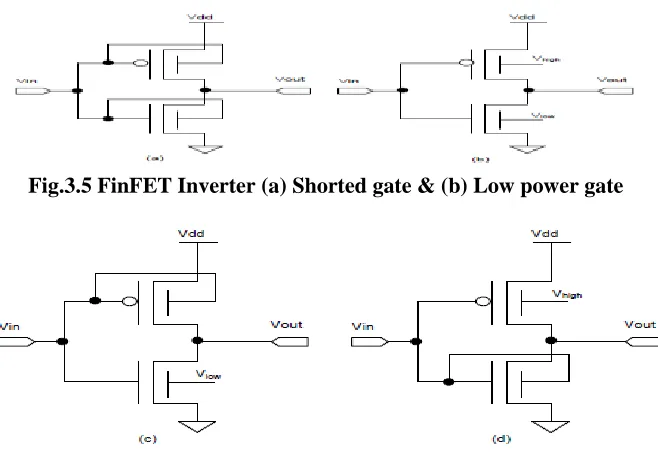
There are four possible configurations of an INV based on how SG and IG FinFETs are combined to
implement them. They are called SG, low-power (LP), IGn, and IGp INV. Their schematic diagrams are
shown in Figure 3.22&3.23. As suggested by its name, an SG INV has SG n/p FinFETs. It has a highly
compact layout. The other three configurations use at least one IG FinFET. The back-gate of an IG p
FinFET (n FinFET) is tied to a
V
HIGH (
𝑉
LOW) signal. When these signals are reverse-biased, for
example, when
V
HIGH is 1V above
𝑉
DD and
𝑉
LOW is 0 V below ground, there is a significant
reduction in
𝐼
off. [1]The presence of an IG FinFET also leads to a more complex layout, resulting in 36%
area overhead relative to that of an ×2 SG INV (that is double the size of a minimum-sized SG INV).
Table 2 compares the normalized area, delay, and leakage of the various INVs. Clearly, SG INV is the
best in area and propagation delay (
𝑇
𝑝
), but incurs much higher leakage current than LP INV. [9]
However, LP INV performs poorly in area and propagation delay. IGn INV, however, looks promising
based on its intermediate area, delay, and leakage.
Fig.3.5 FinFET Inverter (a) Shorted gate & (b) Low power gate
323 | P a g e
3.4.2 NAND
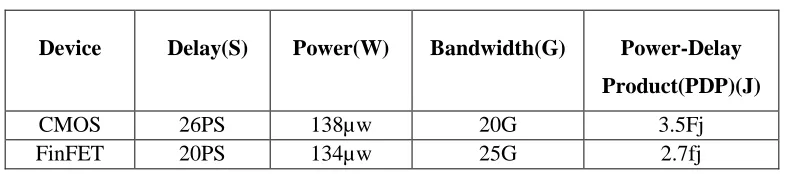
Similar to INVs, NAND2 gates also have SG (LP) configurations in which all transistors are SG (IG) FinFETs. [9]
Since there are more transistors in a NAND gate than in an INV, there are more opportunities available for
combining SG and IG FinFETs.
Fig.3.24: FinFET NAND circuit (a) Shorted gate & (b) Low power gate
Fig.3.25: FinFET NAND (C) Independent gate & (b) Hybrid mode (IG/LP)
IV. ANALYSIS OF PERFORMANCE CHARACTERISTICS
Table.4.1 Performance Comparison of CMOS & FinFET Inverter
Device
Delay(S)
Power(W)
Bandwidth(G)
Power-Delay
Product(PDP)(J)
CMOS
8PS
69µw
16.8G
552AJ
324 | P a g e
Table 4.1 shows that Performance comparison of CMOS & FinFET Inverter. Analysis describes that compare toCMOS; FinFET has fast switching speed and power delay product also reduced. Leakage also reduced.
Table.4.2 Performance Comparison of CMOS & FinFET NAND
Device
Delay(S)
Power(W)
Bandwidth(G)
Power-Delay
Product(PDP)(J)
CMOS
26PS
138µw
20G
3.5Fj
FinFET
20PS
134µw
25G
2.7fj
Table 4.2 shows that Performance comparison of CMOS & FinFET NAND. Analysis describes that compare to
CMOS; FinFET has fast switching speed and power delay product also reduced. Leakage also reduced.
Table.4.3 Performance Comparison of different modes in FinFET Inverter
Device
Delay(S)
Power(W)
Bandwidth(G)
Power-Delay
Product(PDP)(J)
Shorted
7PS
72 µw
19G
504AJ
Low power
13PS
34 µw
11G
442AJ
Independent-P Type
6PS
65 µw
10G
394AJ
Independent-n Type
14PS
55 µw
20G
770AJ
Table 4.3 shows that Performance comparison different modes of FinFET Inverter. Analysis describes that Shorted
gate for high performance, Low power gate for greater driving strength, Independent gate for two different signals.
Compare to Shorted gate, Low power and Independent gate has low power consumption.
Table 4.4 shows that Performance comparison different modes of FinFET Inverter. Analysis describes that Shorted
gate for high performance, Low power gate for greater driving strength, Independent gate for two different signals.
325 | P a g e
Table.4.4 Performance Comparison of different modes in FinFET NAND
Device
Delay(S)
Power(W)
Bandwidth(
G)
Power-Delay
Product (PDP)(J)
Shorted
20PS
134 µw
25G
2.7f
Low power
30PS
71 µw
20.5G
2.1f
Independent
18PS
83 µw
21G
1.4f
Independent/LP
28PS
68 µw
21G
1.9f
V.
CONCLUSION
FinFET is a promising substitute for bulk CMOS for meeting the challenges being posed by the scaling of
conventional MOSFETs. Due to its double-gate structure, it offers innovative circuit design styles. Logic gates are
implemented in SG-, LP-, IG-, and IG/LP-mode of FinFET.FinFET offer faster switching speed and reduces the
leakage current. Logic gates net lists are simulated using HSpice simulator. From the simulation result propagation
delay, power consumption, bandwidth, and power delay product can be obtained. The future work will address the
implementation of Adder circuit and memory device using FinFET because of its high performance.
REFERENCES
[1]. Ajay N.Bhoj and Niraj K.Jha, “Design of Logic Gates and Flip-Flops in High-Performance FinFET
Technology” VLSI, IEEE Transactions on Volume:21
[2]. A. Muttreja, N. Agarwal, and N. K. Jha, "CMOS logic design with independent gate FinFETs," in Proc. Int.
Conf. Computer Design, Oct. 2007, pp. 560–567.
[3]. Animesh Datta,Ashish Goal ,”Modeling & circuit synthesis for independently controlled double gate FinFET
devices” IEEE Transcation, VOL 26,NO 11,2007
[4]. Dipanjan Sengupta and Resve Saleh ,”Generalized power-delay metrics in deep submicron cmos design”,IEEE
transaction ,VOL 26,2007.
[5] D. Bhattacharya and N. K. Jha, “FinFETs: From Devices to Architectures” Volume 2014
326 | P a g e
[7] International Technology Roadmap For Semiconductors 2007 Edition Emerging Research Materials”[8] J. P. Colinge, FinFETs and other Multi-Gate Transistors Springer, 2007.
[9] Lu.Z and J. G. Fossum, "Short-Channel Effects in Independent-Gate FinFETs," IEEE ELECTRON DEVICE
LETTERS, vol. 28, no. 2, February 2007.
[10] Mohammad Yousefarei,”modeling symmetrical independent gate finfet using predictive technology model”IEEE transaction, 2013
[11] M. Rostami, and K. Mohanram, "Dual Vth independent gate FinFETs for low-power logic circuits," IEEE
Trans. CAD of Int. Circuits and Systems, vol. 30, no. 3, March 2011.
[13] Predictive Technology model website Yu (Kevin) Cao, “Nano scale integration and modeling”
(www.ptm.asu.edu)
[14] Roy K, Mukhopadhyay, S. ; Mahmoodi-Meimand, H. 2003,”Leakage current mechanisms and leakage
reduction techniques in deep-submicrometer cmos circuits” IEEE transaction VOL 91,2003.
[15] Vaidy Subramanian, Bertrand Parvais, Jonathan Borremans, Abdelkarim Mercha,” Planar Bulk MOSFETS versus FinFETs,” IEEE TRANSACTIONS ON ELECTRON DEVICES, VOL. 53, NO. 12, 2006
BIOGRAPHICAL NOTES
MS.G.SARANYA is presently pursuing M.E final year in Electronics and Communication Engineering Department
(specialization in VLSI design) from Theni Kammavar Sangam College of Technology, Theni, Tamilnadu, India.
MS.S.JAKKAMMAL@MALARVIZHI is presently pursuing M.E final year in Electronics and Communication
Engineering Department (specialization in VLSI design) from Theni Kammavar Sangam College of Technology,
Theni, Tamilnadu, India.
MS.K.KALARANI is working as an Assistant Professor in Electronics and Communication Engineering