Volume 2008, Article ID 345047,14pages doi:10.1155/2008/345047
Research Article
Design and Evaluation of a Pressure-Based Typing Biometric
Authentication System
Wasil Elsadig Eltahir,1M. J. E. Salami,1Ahmad Faris Ismail,1and Weng Kin Lai2
1Faculty of Engineering, International Islamic University (IIUM), Jalan Gombak, Kuala Lumpur 53100, Malaysia 2Centre for Advanced Informatics, MIMOS Berhad, Technology Park Malaysia, Kuala Lumpur 57000, Malaysia
Correspondence should be addressed to Wasil Elsadig Eltahir,[email protected]
Received 2 July 2007; Revised 3 November 2007; Accepted 16 May 2008
Recommended by C. Vielhauer
The design and preliminary evaluation of a pressure sensor-based typing biometrics authentication system (PBAS) is discussed in this paper. This involves the integration of pressure sensors, signal processing circuit, and data acquisition devices to generate waveforms, which when concatenated, produce a pattern for the typed password. The system generates two templates for typed passwords. First template is for the force applied on each password key pressed. The second template is for latency of the password keys. These templates are analyzed using two classifiers. Autoregressive (AR) classifier is used to authenticate the pressure template. Latency classifier is used to authenticate the latency template. Authentication is complete by matching the results of these classifiers concurrently. The proposed system has been implemented by constructing users’ database patterns which are later matched to the biometric patterns entered by each user, thereby enabling the system to accept or reject the user. Experiments have been conducted to test the performance of the overall PBAS system and results obtained showed that this proposed system is reliable with many potential applications for computer security.
Copyright © 2008 Wasil Elsadig Eltahir et al. This is an open access article distributed under the Creative Commons Attribution License, which permits unrestricted use, distribution, and reproduction in any medium, provided the original work is properly cited.
1. INTRODUCTION
Although a variety of authentication devices to verify a user’s identity are in use today for computer access control, passwords have been and probably would remain the pre-ferred method. Password authentication is an inexpensive and familiar paradigm that most operating systems support. However, this method is vulnerable to intruder access. This is largely due to the wrongful use of passwords by many users and to the unabated simplicity of the mechanism. This simplicity makes such system susceptible to unsubstantiated intruder attacks. Methods are needed, therefore, to extend, enhance, or reinforce existing password authentication tech-niques.
There are two possible approaches to achieve this, namely by measuring the time between consecutive keystrokes “latency” or measuring the force applied on each keystroke. The pressure-based biometric authentication system (PBAS) has been designed to combine these two approaches so as to enhance computer security.
PBAS employs force sensors to measure the exact amount of force a user exerts while typing. Signal processing is then carried out to construct a waveform pattern for the password entered. In addition to the force, PBAS measures the actual timing traces “latency.” The combination of both information “force pattern and latency” is used for the biometric analysis of the user.
As compared to conventional keystroke biometric authentication systems, PBAS has employed a new approach by constructing a waveform pattern for the keystroke pass-word. This pattern provides a more dynamic and consistent biometric characteristics of the user. It also eliminates the security threat posed by breaching the system through online network as the access to the system is only possible through the pressure sensor reinforced keyboard “biokeyboard”.
Figure 1shows PBAS block diagram. The operation of the system relies on constructing a users’ database and then processing this information online through data classifiers.
[User ID]+ [password]+
[keystroke pattern]
Biokeyboard
User ID and password
Keystroke pattern
Data capture system
Data base
User interface Dynamic keystroke data classifier Registration mode (user repeats keying
the password 10–20 times) Figure1: PBAS block diagram.
associate users with distinctive typing characteristic models. PBAS has been tested with combination of two classifiers, namely:
(1) autoregressive classifiers, (2) latency classifiers.
These classifiers have been tested and the results obtained from the experimental setup have shown that these classifiers are very consistent and reliable.
2. DESIGN OF PRESSURE-BASED TYPING BIOMETRIC
AUTHENTICATION SYSTEM (PBAS)
Keystroke authentication systems available in the market are mostly software-based. This is due to the ease of use as well as the low cost of the mechanism. Any new keystroke authentication system has to consider these factors in the design. Likewise, the system designed for PBAS uses simplified hardware which minimizes the cost of production. The system is designed to be compatible with any type of PC. Moreover, it does not require any external power supply. In general, the system components are low cost and commonly available in the market.
The operation of the system is depicted in Figure 1. System starts by prompting user to enter his/her user ID and password. The alphanumeric keyboard (biokeyboard) extracts the pressure template for the password entered. At the same time, the system calculates the latency pairs for the entered password and accompanies it with pressure template in a single data file. This data file is transferred to the system’s database.
In the learning mode, the user is required to repeatedly key in the password for several times (10–20) to stabilize his/her keystroke template.
In the authentication mode, the user is requested to enter his/her ID and password. The resulting pressure template and latency vector are compared with those modeled in the database using the AR and latency classifiers. Depending on the results of this comparison, the user will be either granted or denied access to the system.
2.1. System hardware components
As illustrated inFigure 2, the main hardware components of PBAS are as follows:
CPU unit
BNC connector
Analog interface
Alphanumeric keyboard
Figure2: Integration of PBAS components.
(1) alphanumeric keyboard (biokeyboard) embedded with force sensors to measure the keystroke pressure while typing;
(2) data acquisition system consisting of the following components:
(a) analog interface box (filtering and amplification of signal),
(b) DAQ PCI card fitted into the PC.
(3) PC/central processing unit (CPU) for running the PBAS program using Windows XP operating system.
2.2. Pressure sensitive alphanumeric keyboard (biokeyboard)
A special keyboard was manufactured to acquire the alphanumeric password and the keystroke pressure template of the user. The biokeyboard layout is identical to normal commercial keyboard. This is crucial to maintain an intrinsic system that does not alter user typing habits.Figure 3shows the biokeyboard front, back, and side views.
To measure the keystroke pressure, ultra thin flexible force sensors are fixed below each keyboard key. A plastic spring is fixed between the key and the sensing area to ensure that it does not get dislodged. This is necessary to avoid erroneous readings.
Figure3: Pressure sensitive alphanumeric keyboard (biokeyboard).
Central processing unit (CPU)
Internal bus
NI PCI-6024E (A/D and D/A)
Voltage supply Analog keystroke signal (amplified and filtered)
Analog interface (amplification and signal filtering)
Keystroke action Alphanumeric keyboard with
additional force sensors
Figure4: Operation of data acquisition system.
2.3. Data acquisition system
The force sensors are connected in parallel and then to the sensor drive circuit. The drive circuit is contained inside the analogue interface box (see Figure 2). The connection between the keyboard and the analogue interface box is made through a cable. Figure 4shows the connection and operation of the data acquisition system.
The analogue interface box passes the keystroke pressure template from the biokeyboard to the PC through the DAQ PCI card. It contains amplification and filtering circuit to improve the voltage acquired from the biokeyboard. The analogue interface box also contains two knobs to adjust the sensitivity of the voltage (and hence keystroke pattern) by changing the amplification gain of the drive circuit.
Some further signal processing procedures are used to concatenate keystroke signals of different keys pressed when typing a password. This concatenation forms a continuous pattern for each keystroke password.
−3
−2
−1 0 1 2 3 4
2nd
p
rincipal
component
−5 −4 −3 −2 −1 0 1 2 3
1st principal component User 1
User 2 User 3 User 6
User 8 User 11 User 12
Figure5: PCA for latency.
2.4. Validation of keystroke force approach
An experiment has been conducted to evaluate the sig-nificance of force analysis in the classification of users keystroke typing biometrics. In this experiment a group of 12 professional typists were asked to type a common password
tri-msn4. The system acquired the latency and peak force for each character of the password entered by users. Each subject was required to type the same password 10 times. Here, each typed password consists of seven latency and eight peak force features, resulting in fifteen features for each user.
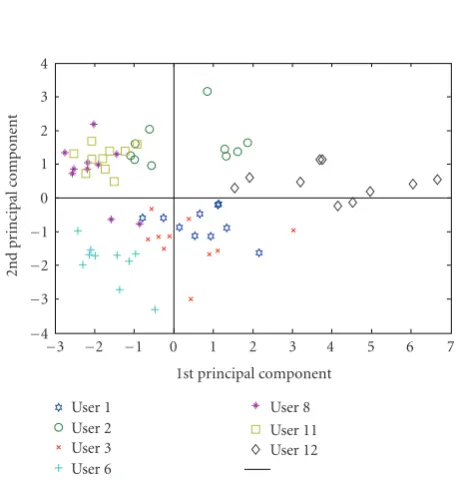
Principle component analysis (PCA) was then applied to analyze the dataset over first two dominant principal compo-nents axis. Three different classification cases were examined, namely: (a) classification by latency, (b) classification by peak force, (c) and lastly classification by combining latency and peak force.
Latency features were similar as seen inFigure 5. This is logical for consistent typists because they use the same hand and wrist lateral positions when typing and hence they tend to type with almost the same speed.
The results inFigure 5 show that users 11 and 8 have distinctive latencies while users 1, 3, and 6 exhibit high similarities that can be considered as a group. User 12 on the other hand has a relatively high variation.
In Figure 6 it is apparent that peak force has better classification as compared to that of latency. This is justified by the fact that the typing force varies for different typists. However, similarities amongst each single user’s data points are somehow lower than that of latency. Thus, we conclude that keystroke force is comparatively higher in variation than latency.
−2
−1.5
−1
−0.5 0 0.5 1 1.5 2 2.5 3
2nd
p
rincipal
component
−3 −2 −1 0 1 2 3 4 5 6 7
1st principal component User 1
User 2 User 3 User 6
User 8 User 11 User 12
Figure6: PCA for peak force.
−4
−3
−2
−1 0 1 2 3 4
2nd
p
rincipal
component
−3 −2 −1 0 1 2 3 4 5 6 7
1st principal component User 1
User 2 User 3 User 6
User 8 User 11 User 12
Figure7: PCA for latency and peak force.
necessary to design two classifiers to measure (or evaluate) them.
3. DYNAMIC KEYSTROKE CLASSIFIERS
Dynamic keystroke template results from a distinctive keystroke action. When a user enters a password, a single keystroke is applied on each key pressed.
Figure 8shows a typical pressure template acquired for a password of six characters. The template is for user “MJE1” and the password used is “123asd.”
This diagram shows that the pressure template points are interrelated in time and are of random nature. This would
0 1 2 3 4 5 6 7 8 9 10
V
1 6 11 16 21 26 31 36 41 46
Points Pat 1
Pat 2 Pat 3 Pat 4 Pat 5
Pat 6 Pat 7 Pat 8 Pat 9 Pat 10
Figure8: Keystroke pattern for single-user six-character password.
suggest that statistical signal analysis may be useful to classify these templates.
AR classifier based on stochastic signal modeling has been developed for the classification of the keystroke pressure template. As for the keystroke latency, a separate classifier has been developed based on the key down action. This classifier is used together with the AR-based keystroke pressure classifier. These classifiers are discussed in detail in the following sections.
3.1. Latency classifier
Keystroke authentication using time digraphs (latency) has been investigated thoroughly with many researchers [6–10]. Many useful methodologies have been presented and are in use with the current latency keystroke authentication systems available in the market.
Joyce and Gupta discussed the design of identity verifier based on four input strings (login name, password, 1st name, and last name). The verification is done by comparing the mean reference signature “M” with a test signature “T.” The normM−Tis computed and if this norm is less than the threshold for the user, the attempt is accepted; otherwise it is flagged as an imposter attempt [7].
Though this approach produces relatively satisfactory results, it requires relatively lengthy input string. A modified approach has been devised here for PBAS latency authen-tication. PBAS uses the password string only for latency verification.
3.1.1. Creating mean reference latency vector
(2) Data treatment is applied on the data files to remove outliers and erroneous values.
(3) An average latency vector is calculated using the user trial sample. This results in a single file containing the mean latency vector (R) for npassword trials. This file is used as reference which will be used for latency authentication.
3.1.2. Calculating suitable threshold
Thresholding is used to decide an acceptable difference margin between the reference latency vector (R) and the latency vector provided by the user upon verification (V). The threshold is computed based on the data files saved in the database. A threshold is set for each user based on the variability of his latency signatures. A user that has little variability in his latencies would have a small threshold. User with high variability should have larger threshold. Standard deviation is the variability measure used.
Standard deviation between the mean (R) latency vector and the user sample is measured. A threshold based on the standard deviation is used for authentication based on the following rule:
m−1
k=1
Rk−Vk≤c∗d, (1)
wheremis the password length,Rkis thekth latency value
in the reference latency vector, Vk is the kth latency value
in the user-inputted latency vector,cis an access threshold that depends on the variability of the user latency vector, anddis the distance in standard deviation units between the reference and sample latency vectors.
In order to classify user attempt, we define the latency scoreSLfor the user attempt to be
SL= m−1
k=1Rk−Vk
c∗d . (2)
Therefore, depending on the value ofSL, the classifier output
will be
SL ⎧ ⎨ ⎩
≤1, accept template,
>1, reject template. (3)
Table 1 shows the reference latency vector for user “MJE1” which was calculated by the above mentioned method for a sample of 10 trials. Five latency vectors are used to test the threshold c for this reference profile (see Table 1). The standard deviation was calculated to be Sy = 46.5357 milliseconds and a threshold of 2 standard deviations above the mean(c =2) resulted in the following variation interval 253.9748 ≥ R −V ≥ 67.83189. This threshold takes in all 5 trials of the user. However, this is a relatively high threshold value and in many practical situations such values would only be recommended for unprofessional users who are usually not very keen typists. The user here is a moderate typist. This is evident by his relatively high standard deviation. High standard deviation
0 0.1 0.2 0.3 0.4 0.5 0.6 0.7 0.8 0.9 1
0 1 2 3 4 5
FAR FRR EER
Figure9: Latency threshold versus FAR and FRR rates.
is also a measure of high variability in the users’ latency pattern; this usually indicates that the user template has not yet stabilized, perhaps due to insufficient training.
Table 2shows the variation of threshold valuesc(from 0.5 to 2.0) and its effect on accepting the user trials.
For this user, a threshold value that is based on standard deviation of 2.0 provides an acceptance rate of 100% (after eliminating outliers). However, a high threshold value would obviously increase the imposter pass rate. Therefore for normal typists, the threshold values should only be within the range of 0.5 to 1.5.
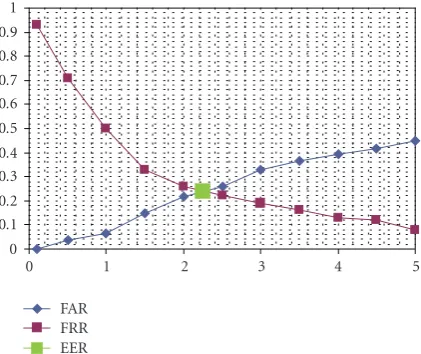
An experiment was conducted to assess the effect of varying the latency threshold value on the FAR and FRR rates. In this experiment, an ensemble for 23 authentic users and around 50 intruders were selected randomly to produce authentic and intruder access trials. Authentic users were given 10 trials each and intruders were given 3 trials per account. All trials were used for the calculations and no outliers were removed. The graphical user interface used was normal (seeFigure 18).Figure 9shows that the equal error rate (EER) for the FAR and the FRR rates was 24% and it occurred at a threshold value of 2.25. This relatively high FAR rate is expected since the password strings used were mainly short in length and weak in strength.
3.2. AR-Burg classifier
The AR algorithm uses the notion of signal analysis to reproduce the users’ keystroke pressure template. The repro-duced template is then compared with the keystroke template produced by the alleged intruders. Based on this comparison an authentication decision is made.
A signal model approach is advocated here since the pressure template points are interrelated across time. The AR signal model is defined as follows:
y(n) +a(1)y(n−1) +a(2)y(n−2) +· · ·+a(p)y(n−p)
=x(n),
Table1: Reference latency tested against 5 authentic user trials.
Password (asd123)
Reference
latency vector T 1 T 2 T 3 T 4 T 5
a-s 201.9231 203 187 172 203 235
s-d 162.8571 156 188 171 156 93
d-1 316.2308 235 187 219 188 250
1-2 185.2000 187 203 203 187 203
2-3 108.5714 110 110 110 94 79
Table2: Effect of threshold value on user acceptance rate.
Standard
deviation Upper limit Lower limit Acceptance percentage
0.5 184.1712 137.6355 40
1.0 207.439 114.3676 60
1.5 230.7069 91.09975 80
2.0 253.9748 67.83189 100
where n is the time index, y(n) is the output,x(n) is the input, andpis the model order.
For signal modeling y(n) becomes the signal to be modeled and thea(i) coefficients need to be estimated based on the signal’s characteristics.
If we use the above equation to predict future values of the signaly(n), the equation becomes
y(n)= −a(1)y(n−1)
−a(2)y(n−2)− · · · −a(p)y(n−p). (5)
Now, we define the error from e(n) to be the difference between the predicted and the actual signal point. Therefore e(n) can be defined as
y(n) +a(1)y(n−1) +a(2)y(n−2) +· · ·+a(p)y(n−p)
=e(n).
(6)
The total squared error (TSE) for predicted signal is
TSE= N−1
n=1
e2n. (7)
The AR model is used most often because the solution equations for its parameters are simpler and more developed than those of either moving average (MA) or autoregressive moving average (ARMA) models [1,2].
Burg method has been chosen for this application because it utilizes both forward and backward prediction errors for finding model coefficients. It produces models at lower variance (S2
p) as compared to other methods [1].
Authentication is done by comparing the total squared error TSE percentage of the users in the database with that generated by the linear prediction model. Previous experiments proved that authentic users can achieve TSE margin of less than 10% [3].
3.2.1. Identifying optimum pressure template for AR modeling
An algorithm was developed in Matlab to identify the best pressure template in the user sample. This pattern is used for estimating the AR model parameters of the user keystroke pressure. The algorithm uses the correlation technique to calculate the accumulative correlation index (ACI) which is the accumulation of the correlation between each pressure pattern and the whole sample. The pattern with the highest ACI is chosen for the model.
3.2.2. Identifying the optimum TSE acceptance margin
The TSE relative prediction error (RPE) is calculated by the following equation:
Relative Prediction Error=TSEm−TSEs
TSEm , (8)
where TSEm is the TSE calculated for the user’s AR-Burg
model in database. TSEsis the TSE for the pressure pattern
of the user.
Classification of user attempt is done by comparing RPE to thresholdTaccording to the following:
RPE
⎧ ⎨ ⎩
≤T, accept template,
> T, reject template, where, 0< T≤1. (9)
Based on previous research experiments [3], it was reported that authentic users can achieve up to 0.1 RPE while intruders exhibit unbounded fluctuating RPE that can reach above 3.0 [3].
0 0.1 0.2 0.3 0.4 0.5 0.6 0.7 0.8 0.9 1
0 20 40 60 80 100
(%) FAR
FRR EER
Figure10: TSE threshold versus FAR and FRR rates.
The AR modeling algorithm has been implemented in the following order.
(1) The user is prompted to enter the password several times (20 times).
(2) The optimum pattern for modeling the user is identified using the ACI values obtained from the sample.
(3) The best AR model order is determined based on the final prediction error (FPE) and the Akaike’s information criteria(AIC).
(4) The AR model is constructed and model coefficients are saved for user verification.
(5) Using AR model coefficients, the linear prediction model is constructed to predict the original template from the pattern entered by the user.
(6) Using the linear prediction model TSEmis calculated
for user’s template in database. The RPE score is used to discriminate between authentic and intruder attempts.
(7) If RPE ≤T, user is authentic, whereas if RPE > T, then user is intruder.
3.3. Receiver operating curve for TSE and latency classifiers
The receiver operating characteristic curve (ROC) is used to assess the effect of the threshold value on the FAR and FRR rates. ROC curve assesses the trade-off between low intruder pass rate and high authentic pass rate as the decision threshold value varies. Figure 11 shows that the latency classifier has slightly better separation than the AR classifier. In addition to that, the latency classifier has better intruder rejection rate whereas AR classifier has a higher true pass rate. The graph also shows that the performance of both classifiers at the EER points is very similar; therefore, it is expected that by combining both algorithms the overall
0 0.1 0.2 0.3 0.4 0.5 0.6 0.7 0.8 0.9 1
0 0.2 0.4 0.6 0.8 1
Latency TSE
EER EER
Figure11: ROC showing performance of latency and TSE classi-fiers.
system performance will be improved. The operating range for the AR classifier is between 0.1 and 1.0 threshold values of Tcorresponding to very low FAR and FRR rates, respectively. The operating range for the latency classifier is between 0.1 and 5.0 threshold values ccorresponding to very low FAR and FRR rates, respectively.
4. SYSTEM ALGORITHMS AND
PROGRAM STRUCTURES
With the integration of software and hardware, the PBAS algorithm was designed to have two main operation modes.
(1) Training users and creating biometric template pro-files; at this stage the user is requested to key in his/her ID and the user trains his/her password.
(2) Authenticating existing users based on the identity they claim; users provide ID and password which are compared with the biometric profiles of the users in the database.
Figure 12shows the flow graph for the overall PBAS training and authentication process. The authentication mode con-sists of two phases.
(1) Normal authentication, which involves the password combination and its compliance with the one saved in the database.
(2) Biometric authentication, which is done by the combination of latency along with the AR classifiers.
Welcome window
Choose mode of operation
Mode 1
Existing user
User inputs ID and password
Maximum number to attempt password exceeded?
No
No
No User ID,
password pair match database
record?
Yes
Biometric identity match
database record?
No 3 trials Yes exceeded?
Yes
Yes
Access granted!!
Intruder access denied!!
Mode 2
Training user
User is prompt to choose ID a convenient password
Repeat key in password for 10–20 times
Training complete!, save to database, then reinitialize all to
default
Thank you for registering
Exiting process
Figure12: PBAS main algorithm flowchart.
the beginning. The use of backspace key is not allowed as it disrupts the biometric pattern. When registration is done, system administrator uses these training samples to model user keystroke profiles. The design of user profiles is done offline. After that, the administrator saves the users’ keystroke template models along with the associated user ID and password in the access-control database.
In the authentication mode, the access-control system requests the user to type in the login ID and a password. Upon entering this information the system compares the alphanumeric password combination with the information in the database. If the password does not match, the system will reject the user instantly and without authenticating his keystroke pattern. However, if the password matches then the user keystroke template will be calculated and verified with the information saved in the database. If the keystroke template matches the template saved in database, the user is granted access.
If the user ID and alphanumeric password are correct, but the new typing template does not match the reference
template, the security system has several options, which can be revised occasionally. A typical scenario might be that PBAS advises a security or network administrator that the typing pattern for a user ID and password is not authentic and that a security breach might be possible. The security administrator can then closely monitor the session to ensure that the user does nothing unauthorized or illegal.
Another practical situation applies to automatic teller machine (ATM) system. If the user’s password is correct but the keystroke pattern does not match, the system can restrict the amount of cash withdrawn on that occasion to minimize any damages made by possible theft or robbery.
5. EXPERIMENTS ON PBAS PERFORMANCE USING
COMBINED LATENCY AND AR CLASSIFIERS
Figure13: Choosing mode of operation.
Figure14: Registering new user.
Figure15: Training user password.
Figure16: Validation mode.
Figure17: Guided validation (experiment 1).
EER calculated earlier. As for the latency threshold c, it is recommended to use a threshold value between 2.0 and 2.25 for unprofessional typists and 1.0 to 1.5 for professional typists.
5.1. Experimental variables
The experimental variables that are assumed to play role in the performance of the system are as follows: (1-) user disposition, (2-) intruder knowledge of the authentic keystroke latency, (3-) sensitivity of the data acquisition system, (4-) strength of user password, (5-) sampling rate of the data acquisition system, and (6-) threshold values of the AR and latency classifiers.
In the experiment, four variables were fixed and two were varied for analysis. These variables were
(1) intruder knowledge of the authentic keystroke latency,
(2) threshold values of the AR classifier.
By varying these two variables, we will be able to answer two important questions.
(2) What is the effect of increasing the TSE percentage on the FAR rate?
The following section will try to answer these questions. In addition, we will try to analyze the user passwords and identify possible reasons behind any successful intruder attacks.
Two experiments were conducted with a population of 23 users. Eleven of the participants were females and 12 were males. Participants were of different ages (18 to 50). One participant “user3” was left handed. Training and authentication for each user password were done on two different occasions (at least not on the same day).
All users participating in the experiments were briefed thoroughly about the operation of PBAS. They were also told about the purpose of the experiment to ensure maximum interaction from users.
At the beginning, users were asked to choose an ID and password, “ID up to eight characters and password not less than six characters”. The users trained their password for twenty trials. The administrator created AR-keystroke model and latency vector for each user and saved it in the system database.
All 23 users participated in the first experiment. However, only successful hackers were inducted to the second experi-ment.
In both experiments, a simple program with interactive GUI would first ask the user to key in his/her ID, and then the computer would create a random list of 10 accounts “five male and five female” for the user to attempt hacking.
To calculate the FAR in both experiments, users were asked to repeat keying the password for 10 times. The results were evaluated online by recording the instances of acceptance and rejection for each user.
5.2. Experimental procedure
The two experiments were arranged as follows.
5.2.1. Experiment 1: “guided authentication”
In this experiment hackers were allowed to see the users’ reference latency vector along with their own pressure template, a GUI window was fixed with two indicator lights “one for latency and one for pressure” that flashes green when either latency or pressure is within the acceptance margin. TSE thresholdTwas set to 0.15.
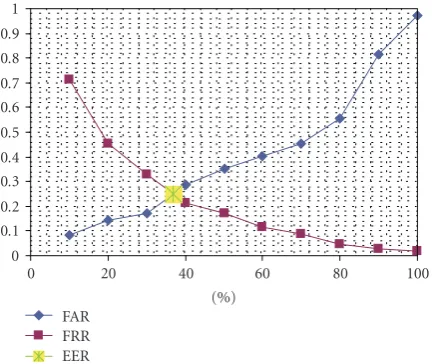
Authentic users were given ten attempts per account whereas intruders were given four hacking attempts per account. Twenty three registered users participated in this experiment generating a total of 230 authentic attempts, 19 of these users participated as intruders generating a total of 760 intruder attacks. According toFigure 10, it is expected that the FRR will be as high as 60% and that the FAR will be as low as 11% (knowing that the tests are different).
Figure18: Normal validation (experiment 2).
5.2.2. Experiment 2: “normal authentication”
In this experiment GUI window was restricted not to show any information about user pressure or latency vectors. RPE threshold T was set to 0.4; this increase was made to reduce the FRR rate as recommended from the ROC curve (Figure 11). Authentic users were given 10 attempts whereas intruders were given 3 hacking attempts per account. All 23 authentic users participated in this experiment generating a total of 230 authentic attempts. As for the intruder attempts, only 8 users “successful hackers of experiment 1” participated in this experiment generating a total of 240 intruder attacks. According toFigure 10, it is expected that the FRR will be as high as 21% and that the FAR will be as low as 28% (knowing that the tests are diff er-ent).
5.3. Experimental results
While the computer security society recommends that a safe password should be a combination of alphabets, numeric, and special characters, almost 80% of users have chosen passwords that do not conform to the standard measures of password safety. Some users chose their login ID as the password; some used standard words, com-bination of repeated letters, or comcom-bination of adjacent keyboard keys with no special characters. All of these factors have rendered the users’ passwords very vulnera-ble with respect to the password security standards. Our assumption is that PBAS will improve the performance of weak passwords by combining the latency and AR classifiers. Table 4 shows the results for the experiments conducted.
The FRR for the first experiment was 10.43% which is very much less than the maximum expected FRR of 60%. This could be attributed to the improved typing efficiency of the users which minimizes the occurrence of outliers during the experiment.
It is noticed that the increase in AR thresholdTfrom 0.15 to 0.4 has reduced the FRR by 70% while increasing the FAR by 138%.
Table3: FAR and FRR for experiments 1 and 2.
User ID Password User attempts Intruder attempts Experiment 1 Intruder attempts Experiment 2
FAR% FRR% FAR% FRR%
∗1+1User 1(m) 123asd 10 44 2.272 10 15 6.666 10
User 2(m) dadn4tay 10 52 0 0 15 0 0
User 3(m) alshaijiy 10 48 0 20 12 0 0
∗1User 4(m) mmu123 10 64 1.562 20 3 0 10
∗1User 5(m) tigna12 10 48 2.083 10 15 0 0
User 6(m) mohammedhasan44 10 48 0 0 9 0 0
∗2User 7(f) tastas13 10 48 4.166 0 9 0 0
User 8(f) dowrita- 10 52 0 20 9 0 10
User 9(m) nanana 10 20 0 20 6 0 20
User 10(m) lrtvib 10 56 0 0 3 0 0
User 11(m) obahja1313 10 32 0 0 12 0 0
User 12(m) sal12sal 10 36 0 20 15 0 0
User 13(m) alrubataby 10 20 0 0 12 0 0
User 14(m) hussam44 10 20 0 0 6 0 0
∗3+3User 15(f) fardusa 10 44 6.818 0 15 20 0
User 16(f) salah1 10 48 0 10 6 0 0
User 17(f) ktwon123 10 48 0 10 15 0 0
∗2User 18(f) alkontabbad 10 44 4.545 30 3 0 10
User 19(f) suli00 10 32 0 0 15 0 0
User 20(f) asma23 10 48 0 10 15 0 0
∗1+4User 21(f) fathiya 10 32 3.125 20 18 22.22 0
∗1+1User 22(f) faduma 10 20 5 20 12 8.333 10
User 23(f) subway 10 16 0 20 6 0 0
∗Denotes hacked logins in 1st experiment, superscript is number of hacks.
+Denotes hacked logins in 2nd experiment, superscript is number of hacks.
Table4: Total FAR and FRR for experiments 1 and 2.
Experiment
Number of authentic participants
Number of intruder participants
Number of attacks Number of successful attacks FAR% FRR%
I 23 19 760 12 1.57 10.43
II 23 8 240 9 3.75 3.04
Table5: Comparing FRR for successful hackers in experiments 1 and 2.
Experiment
Number of intruder participants
Number of attacks
Number of successful attacks
FAR%
I 8 320 12 3.75
II 8 240 9 3.75
FAR rate; this means that the removal of feedback canceled the effect of increasingT threshold. Hence, there is some correlation between knowledge of the verifier and the ability of an imposter to match the reference signature of another user.
Table 6 shows a comparison between results obtained here and previous research efforts. A comparison is not statistically valid as these systems use different sample
size with different parameters and methodologies to mea-sure the keystroke. It is important to note that earlier research emphasized on the strength of the password string and as a result, the users had to use either lengthy strings (sometimes 4 strings) or strong strings (combina-tion of alphanumeric keys and special characters). PBAS, however, does not require lengthy or strong password strings. Consequently, it is more user friendly, but on the other hand this makes it more susceptible to intruder attacks.
5.3.1. Statistical significance of experimental results
Table6: Comparison of our results with previous efforts.
Research Number of participants Training samples Password string FAR% FRR%
Legget and Williams (1988) [6] 36 12 large 5.00 5.50
Joyce and Gupta [7] 33 8 4 13.30 0.17
De Ru and Eloff[8] 29 Varies (2 to 10) 1 2.80 7.40
Haider et al. [9] Not mentioned 15 1 6.00 2.00
Ara ´ujo et al. [10] 30 10 1 1.89 1.45
Our research 23 20 1 3.75 3.04
To calculate the variance for the FRR rate we use the following:
p=1
n
pi=
1 mn
ai,
V(p) =
pi−p 2
n(n−1) = 1 (n−1)
a2i
m2n −p 2
,
(10)
where n is the number of enrolled volunteers; m is the average number of samples per volunteer;aiis the number
of false nonmatches for theith volunteer;pi =ai/mi is the
proportion of unmatched samples for theith volunteer;pis the observed FRR for all volunteers;V(p) is the estimated variance of the observed FRR rate.
For experiment 2, FRR = 0.0304. The variance was calculated to be 1.357×10⁻⁴.
To find the 95% confidence interval, we substitute for the variance in the following:
p±z(1−α/2)
V(p), (11)
where z() is the area under standard normal curve with mean zero. For 95% confidence,z(0.975) is 1.96. The 95% confidence interval for the true error rate (p) is 0.0075 ≤
p≤0.0532.
To calculate the confidence interval for the FAR rate, we use the following [5].
If the product N∗p ≥ 10, (where N is number of independent trials andpis the observed FAR rate) then we may use the normal distribution curve to approximate the 95% confidence interval as follows:
p−2σp≤p≤p+ 2σp, (12)
wherepis the true FAR rate,σpis the maximum likelihood estimator which is defined as
σp= 1 N
e
1− e
N
, (13)
whereeis the number of successful intruder attacks. The estimated FAR rate recorded for experiment was 0.0375 the 95% confidence interval for the true FRR rate is calculated as follows:
0.01626≤p≤0.05844. (14)
5.3.2. Recommendations on test size
To improve the statistical significance and accuracy of our results, we recommend the following.
(1) Firstly, the number of enrolled users should be increased to at least 100 users.
(2) Then, collect 15 genuine samples per user to produce a total of 1500 genuine samples. This is above the requirement of the rule of 30.
(3) Use cross comparison with 10 users per intruder attack allowing 3 trials per attack. This will produce 3000 intruder attacks. This is above the requirement of 30.
(4) To minimize the dependency of the intruder attacks by the same person, it is recommended to collect these data in two sessions.
(5) Finally, once the data has been collected and ana-lyzed, the uncertainty in the observed error rates would be estimated in order to ascertain the size of the test data.
5.4. Discussion of results
The following observations can be inferred fromTable 3.
(i) Since the computer-generated attack list was random, the number of intruder attacks per user account was variable. Nevertheless, all accounts have been tested for intrusion.
(ii) Users who chose passwords identical to their user name (user 15, 21, and 22) suffered highest rate of successful intruder attacks.
(iii) Users 1, 4, 7, and 9 had substantially weak passwords. As expected, users 1, 4, and 7 were susceptible to successful intruder attacks. However, user 7 repelled all intruder attacks and after investigation, it was found that user 7 had a highly distinctive keystroke pressure template.
(iv) Users who chose standard passwords that comply with security measures achieved maximum protec-tion and were able to better resist intruder attacks. (v) In the experiment, there was one left-handed user,
while right-handed users exerted more pressure typing on right side keys of the keyboard, this left-handed user exerted more pressure on the left side keys and hence his pressure template was distinctive from right-handed intruders.
(vi) The decrease in latency threshold reduces the FRR rate.
(vii) Users with low latency standard deviation were able to better repel intruder attacks. This is logical since low standard deviation suggests that the users typing pattern is more stable and hence the corresponding pressure template almost match that of the user.
(viii) The increase of AR threshold from 0.15 to 0.40 has decreased the FRR rate significantly.
(ix) The intruder knowledge has some effect on his ability to succeed in attacking other user accounts.
6. CONCLUSION
In the course of the last 30 years, keystroke biometrics has emerged as a quick and user-friendly solution for access control systems.
Several commercial keystroke biometric algorithms have been introduced in the market.
However, most of these algorithms merely use the time information (latency) of the keystroke action and thus utilize only one information aspect of the keystroke action. It neglects the force applied in the keystroke action. PBAS has successfully acquired both information, time frame and applied force. Furthermore, the application of force (F) over time (Δt) has produced significant information in the form of a signal (pressure template); this approach is more dynamic and characteristic of user keystroke pattern.
Preliminary tests on PBAS indicated apparent success in the performance of the system. However, performance can be further enhanced to produce more accurate and reliable results.
Furthermore, the experiments have proved that force is highly distinctive to users typing keystroke. Although some users may have similar latency profiles, their keystroke pres-sure templates were easily discriminated. The reinforcement of pressure sensors to measure the keystroke force has many advantages such as:
(i) a password obtained by an imposter does not neces-sarily mean that the imposter can access the system;
(ii) a user’s typing biometric is difficult to steal or imitate;
(iii) an imposter cannot obtain a user’s typing biometrics by peeking at the user’s typing;
(iv) the hardware reinforcement can be integrated to any password-based security system, because it works in conjunction with normal password mechanisms;
(v) the system administrator has the option of turning on/offthe biometric reinforcement at anytime to use normal password authentication only.
Due to the fact that keystroke dynamics are affected by many external factors (position of hands while typing, fatigue, hand injuries, etc.), it is somehow difficult to ensure a typical pattern for a user’s password every time. This inherent difficulty favors other biometric authentication techniques such as fingerprint and retina scan over keystroke biometrics. In order to overcome this difficulty, dynamic data classifiers are used with a suitable threshold to accommodate for the variability in user keystroke pattern.
The combination of AR and latency classifiers allows for an increase in latency threshold value to decrease the FRR rates. This increase does not have great effect on the FAR rates as the AR classifier would reject intruders based on their pressure templates, on the contrary it will make the system more user friendly without compromising the security.
AR technique uses AR-coefficients to reconstruct user pressure templates. This approach provides a more compre-hensive user identity. Moreover, it is very easy to reconstruct the user pressure template for user authentication.
ACKNOWLEDGMENTS
The authors would like to thank IIUM and MIMOS for providing all the necessary resources to make this joint project successful. IIUM and MIMOS acknowledge the financial support from the Malaysian Ministry of Science, Technology and Innovation under Grant no. (IRPA-04-01-04-0006-EA 001) which has, in part, produced this paper.
REFERENCES
[1] R. Shiavi, Introduction to Applied Statistical Signal Analysis, Aksen Associates, Homewood, Ill, USA, 1991.
[2] M. H. Hayes,Statistical Digital Signal Processing and Modeling, John Wiley & Sons, New York, NY, USA, 1996.
[3] W. E. Eltahir, M. J. E. Salami, A. F. Ismail, and W. K. Lai, “Dynamic keystroke analysis using AR model,” inProceedings of the IEEE International Conference on Industrial Technology (ICIT ’04), vol. 3, pp. 1555–1560, Hammamet, Tunisia, December 2004.
[4] A. J. Mansfield and J. L. Wayman, “Best practices in testing and reporting performance of biometric devices,” Tech. Rep., National Physical Laboratory, Middlesex, UK, August 2002, version 2.01.
[5] J. E. Porter, “On the 30 error criterion,” inNational Biometric Test Center Collected Works 1997–2000, J. L. Wayman, Ed., pp. 51–56, National Biometric Test Center, San Jos´e State University, San Jose, Calif, USA, 2000.
[6] J. Leggett and G. Williams, “Verifying Identity via Keystroke Characteristics,”International Journal of Man-Machine Stud-ies, vol. 28, pp. 67–76, 1988.
[7] R. Joyce and G. Gupta, “Identity authentication based on keystroke latencies,”Communications of the ACM, vol. 33, no. 2, pp. 168–176, 1990.
[8] W. G. de Ru and J. H. P. Eloff, “Enhanced password authentication through fuzzy logic,”IEEE Expert, vol. 12, no. 6, pp. 38–45, 1997.
Man and Cybernetics (SMC ’00), vol. 2, pp. 1336–1341, Nashville, Tenn, USA, October 2000.