SHOPPING APP PROTOTYPE FOR RETAIL
MARKETING: AN ANALYSIS ON THE SYSTEM
FEATURES AND DATA FLOW
J F Jith
1,
R Rajesh
2 1,2Department of Mechanical Engineering,
Rajiv Gandhi Institute of Technology, Kottayam, Kerala, (India)
ABSTRACT
Today, mobile phones are no longer devices for one-to-one communication through voice and text messaging services. This phenomenon has increase the awareness to the new dynamic market environment which caused many business entities or companies constantly looking for ways and means of expanding and retaining their market share. Many marketing experts consider that the mobile device is an extremely promising marketing tool to overcome the major challenges of getting time and the attention of consumers. The sheer amount of available apps allows users to customize smartphones to match their personalities and interest. The application of mobile apps in shopping markets is being increasing with time. In this paper, the system features and data flow of a supermarket app is described, which aim to solve the problem of finding obscure items, locating them and optimizing routes through the store to create a proficient experience. The app targets both the planner and the spontaneous shoppers. The planner creates a list for their one-time shopping experience as they think of needed items throughout the week. The spontaneous shopper might need a specific item that they cannot find. They can enter said item into the list database to quickly locate it in the store’s map-view. An outlook on the near future is provided, remarking that mobile marketing and mobile recommender systems can greatly take advantage of being run natively on devices, making it desirable for businesses to invest on designing mobile apps.
Keywords
:
Data flow diagram
,
Proximity Marketing, System Features.
I. INTRODUCTION
Today’s retail executives are contending with a highly disruptive and swiftly shifting business environment. Many retailers are struggling to drive incremental growth, and some don’t have enough capital to fund all of the initiatives they want to pursue. Meanwhile, customer attitude is changing profoundly—principally due to the ways that technology is now being used as part of the shopping process. Consumer adoption of mobile is growing at an exponential rate, and your competitors are exploiting this trend to enter the four walls of your store. Acceptance of mobile devices by consumers is growing by leaps and bounds. Retailers consider developing new or improved mobile apps that provide key tools and information to help and influence shoppers at each stage of the decision-making process—especially while in the store. Also, retailers recognize that consumer needs vary by product and shopping trip, and customize mobile app capabilities accordingly. Smartphones are most likely to be used for store-related shopping when the customer is close to or at the point of making a purchase, rather than as a passive shopping device. This idea has been the key drive for the work made in the paper. The paper contains the system features and data flow diagram for a smartphone application which can augment the shopping involvement of a customer while in the store.
II.SYSTEM DESIGN
The major sought of this paper is to create an android application that is integrated to a Beacon system
arrangement which would augment the efficiency of a shopper’s experience in a retail setting. Proxi Shopping is
the name of the product. Proxi shopping allows a user to create a shopping list, search for products available in
gathering items for checkout. Proxy shopping also provides real time offers as well as product by product offer
with the help of a beacon and server. The application solves the problem of finding obscure items, locating them
(possibly in an unfamiliar store) and optimizing routes through the store to create an efficient experience. Proxy
shopping targets both the planner and the spontaneous shoppers. The planner creates a list for his/her one-time
shopping experience as they think of needed items throughout the week. The application has the ability to
specify which items are in the stores. The spontaneous shoppers are made satisfied with the daily top
promotions and also personalized offers specified to them with the help of beacons. Figure 4.7 details the
fundamental features added in the application.
Fig1: System Features of the Application
2.1 System Features
By generating an idea of what tasks should be performed by using proxy shopping, it was able to decide on
which features best serve the market interest and would be the most beneficial to include in the application.
2.1.1 Shopping list
The Shopping list is made from a Shopping database ―backend‖ to help categorize and populate results. A
learning algorithm might be implemented here, so that the database has the potential to be updated and
augmented by search optimization - similar to that of a search engine. When users add items, the ―backend‖
guesses what the user is likely to type, and allows the user to tap the suggestion instead of typing the entire item
The customer can prepare the shopping list before coming into the store with the create shopping list option.
While in the store all the customer need to do is to click the ―sync shopping list‖ option where the added items
in the item list automatically synced with the server product list.
2.1.2 Recommendations
The top promotions of the day are exhibited to the customer through the slider bar shaped in the application. The
spontaneous customers are highly benefited from the option. The recommendations are revised daily from the
backend of the application.
2.1.3 Product Location and Details
The role of beacons is exposed in this feature evidently. The customer has the option to search for an item he
desires and if its available a popup showing get directions is given away. By clicking the popup, the customer
gets the location content of the desired product. Also the details of the product are obtained while the customer
is near to the product with the server – beacon- application integration. Beacon technology has turned out to
possess immense potential to, actually, enhance the shopping experience for the customers and it also, makes it
quicker and more convenient for them to have accessibility to the exact information and products that they are
looking for.
2.1.4 Product Offers
Personalized offers are delivered to the user using the proxy shopping application. While the customer is near to
a particular product he is also in the proximity of the beacon associated to the particular product. If the customer
holds sometime within the range of the beacon secluded offer is being sent to the application.
III. DATA FLOW DIAGRAM OF THE PROXIMITY APPLICATION
Data flow diagrams (DFDs) reveal relationships among and between the various components in a program or
system. DFDs are an important technique for modelling a system’s high-level detail by showing how input data
is transformed to output results through a sequence of functional transformations.
3.1 Context DFD
The First design shows a context Data Flow Diagram that is drawn for proximity application. It contains a
process (shape) that represents the system to model, in this case, the " Proximity application ". It also shows the
participants who will interact with the system, called the external entities. In this example, there is only one
external entity, which is the Customer. In between the process and the external entity, there is a bi-directional
connector, which indicates the existence of information exchange between customer and the app, and the
information flow is bi-directional.
Context DFD is the entrance of a data flow model. It contains one and only one process and does not show any
data store, which makes the diagram simple.
3.2 Level 1 DFD
Level 1 DFD, which is the decomposition (i.e. break down) of the Proximity App process that is shown in the
context DFD.
Fig: 3: Level 1 Data flow Diagram of the Application.
The Proximity App Data Flow Diagram at level 1 contains five processes, one external entity and three data
stores. The Processes are put in the middle and data stores and external entities on the sides to make it easier to
comprehend.
Based on the diagram, the Customer can receive Hot Promotion news from the Check Latest Promotions process
and the news is provided by the Company database. The Customer is given the provision to build Shopping List
by providing Items details and the details will be stored in the Shopping Cart database. The Warehouse database
will also provide the items details required to complete the process. The Customer can receive Shopping list
details from the View Shopping List process and such details is provided by the Shopping Cart database. The
Customer can receive Items details by performing the Search Items process.
He/she must provide an Item name for searching and the item details are returned from the Warehouse database
after searched. Finally, the Customer can receive Products physical location details by performing Check
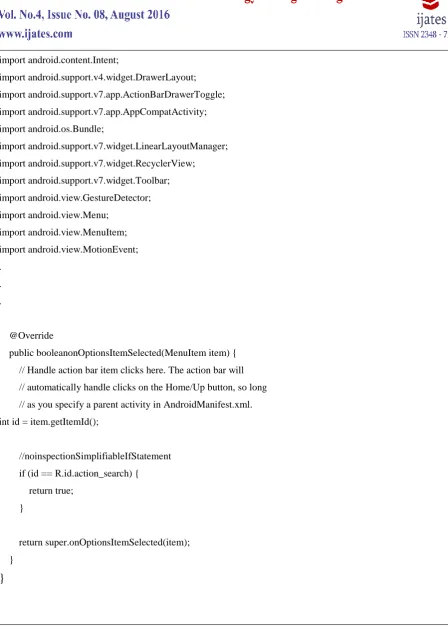
Fig 3: Fragment of product details code class in the application
import android.content.Intent;import android.support.v4.widget.DrawerLayout;
import android.support.v7.app.ActionBarDrawerToggle;
import android.support.v7.app.AppCompatActivity;
import android.os.Bundle;
import android.support.v7.widget.LinearLayoutManager;
import android.support.v7.widget.RecyclerView;
import android.support.v7.widget.Toolbar;
import android.view.GestureDetector;
import android.view.Menu;
import android.view.MenuItem;
import android.view.MotionEvent;
.
.
.
@Override
public booleanonOptionsItemSelected(MenuItem item) {
// Handle action bar item clicks here. The action bar will
// automatically handle clicks on the Home/Up button, so long
// as you specify a parent activity in AndroidManifest.xml.
int id = item.getItemId();
//noinspectionSimplifiableIfStatement
if (id == R.id.action_search) {
return true;
}
return super.onOptionsItemSelected(item);
}
IV. PROTOTYPING AND IMPLEMENTATION OF THE APPLICATION
With the aid of data flow diagram, application was started developing using android platform. Every platform
technology uses different terminology to describe its application components. The three most important classes
on the Android platform are Context, Activity and Intent. While there are other, more advanced, components
developers can implement, these three components form the building blocks for each and every Android
application.
4.1 Designing application features
The design of the proxy shopping smartphone application has four screens:
Splash - This screen acts as a start-up screen, with the application logo and version.
Menu - On this screen, a user can choose from search and shopping list. Also this page contains a slider bar which shows the daily promotions of the market.
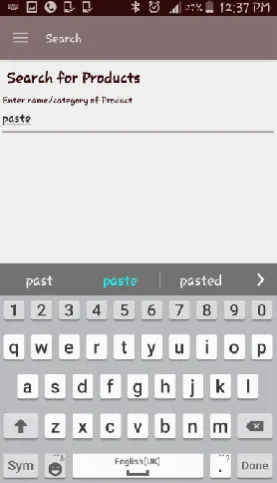
Search- The screen aids in searching different products in the store.
Shopping list – The shopping list can be created in this page.
4.2 Determining application activity requirements
Splash Activity - This activity serves as the default activity to launch. It simply displays a layout for
several seconds and then launches Menu Activity.
Menu Activity - This activity is pretty straightforward. Its layout has Two buttons, each corresponding
to a feature of the application. The on Click () handlers for each button trigger cause the associated
activity to launch. The menu activity comprises a slider bar also.
Search Activity - The real application guts are implemented here. This activity needs to draw stuff
onscreen, handle various types of user input, keep the data and a strong backend support.
Shopping list Activity - This activity is similar to search activity; where the back end portion carries a
crucial role to be played.
Each activity class should have its own corresponding layout file stored in the application resources The
application context is the central location for all top-level application functionality. You use the application
context to access settings and resources shared across multiple activity instances
Figure 5.8: Shopping list of the application Figure 5.9: Search screen of the application
V. CONCLUSION
The paper showcases about the system features and data flow of the features for a mobile application intended to increase the customer shopping experience to the next level. The application was built over thorough literature survey and holds good for its stance. The major applications of the smartphone application can be seen in retail markets where customers find time for shopping. The paper work should be validated and for that a survey should be carried out after implementing the application in a retail market and proper comparison should be made afterwards.
REFERENCES
[1] Cruceru, Anca Francisca, and Daniel Moise, Customer Relationships through Sales Forces and Marketing
Events,Procedia-Social and Behavioral Sciences 109 (2014): 155-159.
[2] Arora, Ashish, and Chris Forman, Proximity and software programming: IT Outsourcing and the local
market. System Sciences, 2007. HICSS 2007. 40th Annual Hawaii International Conference on. IEEE,
2007.
[3] Parra, Octavio J. Salcedo, Samuel Sabogal, and Lilia Castellanos, A Based BlueTooth Tourist Service
Prototype,2012 IEEE/ACIS 11th International Conference on Computer and Information Science. IEEE,
2012.
[4] Hu, Haiyan, and Cynthia R. Jasper. A qualitative study of mall shopping behaviors of mature
consumersJournal of Shopping Center Research 14.1 (2007): 17-38.
[5] Malhan, Puja, An Empirical Study of Customers Expectations and Perceptions of Service Quality; A
[6] Chien, S. H., J. J. Wu, and H. F. Lai, Market orientation and strategies in e-commerce
companies, Industrial Informatics, 2008. INDIN 2008. 6th IEEE International Conference on. IEEE,
2008.
[7] Papandrea, Michela, Proximity marketing solution tailored to user needs. World of Wireless Mobile and
Multimedia Networks (WoWMoM), 2010 IEEE International Symposium on a. IEEE, 2010.
[8] Namiot, Dmitry, and Manfred Sneps-Sneppe, Wireless networks sensors and social streams, Advanced
Information Networking and Applications Workshops (WAINA), 2013 27th International Conference on.
IEEE, 2013.
[9] Sane, Vivek, and Komal Chopra. Analytical study of shopping motives of young customers for selected
product categories with reference to organized retailing in select metropolitan select cities of
India. Procedia-Social and Behavioral Sciences 133 (2014): 160-168.
[10] Nasution, Reza Ashari, The customer experience framework as baseline for strategy and implementation
in services marketing, Procedia-Social and Behavioral Sciences 148 (2014): 254-261.
[11] Soliman, HishamSayed, Customer Relationship Management and Its Relationship to the Marketing
Performance, International Journal of Business and Social Science 2.10 (2011): 166-182.
[12] Handa, Ms Vidushi, And Mr Navneet Grover, Retail SectorIn India: Issues & Challenges, International
Journal of Multidisciplinary Research 2.5 (2012): 244-264.
[13] Arora, Ashish, and Chris Forman. Proximity and software programming: IT Outsourcing and the local
market. System Sciences, 2007. HICSS 2007. 40th Annual Hawaii International Conference on. IEEE,
2007.
[14] Vanini, Salvatore,User-profiled platform with advanced navigation support, World of Wireless, Mobile
and Multimedia Networks (WoWMoM), 2012 IEEE International Symposium on a. IEEE, 2012.
[15] Sundin, Erik, MattiasLindahl, and Winifred Ijomah. Product design for product/service systems: design
experiences from Swedish industry, Journal of Manufacturing Technology Management 20.5 (2009):
723-753.
[16] Tsai, Yi-Hsueh, Proximity-Based Service beyond 4G Network: Peer-Aware Discovery and
Communication Using E-UTRAN and WLAN, Trust, Security and Privacy in Computingand
Communications (TrustCom), 2013 12th IEEE International Conference on. IEEE, 2013.
[17] Hung, Hui-Ju, De-Nian Yang, and Wang-Chien Lee, Social influence-aware reverse nearest neighbor
search, Data Science and Advanced Analytics (DSAA), 2014 International Conference on. IEEE, 2014.
[18] Choi, Kae, Dimas Wiriaatmadja, and Ekram Hossain, Discovering Mobile Applications in Cellular
Device-to-Device Communications: Hash Function and Bloom Filter-Based Approach, (2015).
[19] Li, Lingjun, Xinxin Zhao, and GuoliangXue, A Proximity Authentication System for Smartphones
[20] Grewal, Dhruv, Michael Levy, and V. Kumar. Customer experience management in retailing: An
organizing framework, Journal of Retailing 85.1 (2009): 1-14.
[21] Akinbode, MosunmolaOluwafunmilayo. Influence of Mobile Marketing on Consumer Purchase
Behaviour in Organized Institutions in Lagos State, Nigeria. Diss. Covenant University, 2014.
[22] Kumar Velayudhan, Sanal., Outshopping in rural periodic markets: a retailing opportunity, International
[23] Ziliani, Cristina, and Marco Ieva., Retail shopper marketing: the future of promotional
flyers, International Journal of Retail & Distribution Management, 43.6 (2015).
[24] Lee, Yang-Im, and Peter RJ Trim,Entering the South Korean market: a marketing-planning process
model for marketers based in overseas companies. Business Strategy Series,9.5 (2008): 272-278.
[25] Hsu, Yen, Design innovation and marketing strategy in successful product competition. ,Journal of
Business & Industrial Marketing, 26.4 (2011): 223-236.
[26] Salmi, Asta, and Elmira Sharafutdinova,Culture and design in emerging markets: the case of mobile
phones in Russia,Journal of Business & Industrial Marketing, 23.6 (2008): 384-394.
[27] Spiekermann, Sarah, Matthias Rothensee, and Michael Klafft, Street marketing: how proximity and
context drive coupon redemption, Journal of Consumer Marketing 28.4 (2011): 280-289.
[28] Ha, Sung Ho, Sung Min Bae, and Sang Chan Park, Customer's time-variant purchase behavior and
corresponding marketing strategies: an online retailer's case, Computers & Industrial Engineering, 43.4
(2002): 801-820.
[29] Mulhern, Francis J, Retail marketing: from distribution to integration, International Journal of Research