Abstract: In 2011, the Government made a commitment to the introduction of universal General Practitioner (GP) care, which they equated to the removal of fees for GP care. The aim of this paper is to quantify the potential cost implications of implementing universal GP care in Ireland. The analysis finds that universal GP care would add between 2 and 3.5 per cent to overall public healthcare expenditure and up to 1.2 per cent to total healthcare expenditure. While the introduction of universal GP care in Ireland would go some way to addressing limitations of the current system, other reforms may be required before universality can be achieved.
93
POLICY PAPER
Universal GP Care in Ireland: Potential Cost
Implications
Sheelah Connolly*
Economic and Social Research Institute
Anne Nolan
Economic and Social Research Institute
Brendan Walsh
Economic and Social Research Institute
Maev-Ann Wren
Economic and Social Research Institute
Acknowledgements: Financial support for the research presented in this paper was provided by the Depart-ment of Health, Ireland. The funder has no role in the writing of this paper or in the decision to submit the article for publication. The views expressed in this paper are those of the authors and not necessarily those of the Department of Health.
I INTRODUCTION
T
he use of out-of-pocket payments to finance General Practitioner (GP) care by the majority of the population in Ireland is unusual in the European context (Evetovits et al., 2012). In 2011, the Irish Government committed to removing fees for GP care (Department of the Taoiseach, 2011). In July 2015, free GP visits for all children aged under six years and all adults aged 70 years and over were introduced; the following year a new government committed to the introduction of free GP care to under 18s (Department of the Taoiseach, 2016). An all-party parliamentary committee (Houses of the Oireachtas Committee on the Future of Healthcare) was established with the aim of achieving a single long-term vision for healthcare and the direction of health policy in Ireland. One of the recommendations of the Committee’s final Sláintecare Report, published in May 2017, was the introduction of universal GP care, which was equated to “access to GP care without cost” (Houses of the Oireachtas Committee on the Future of Healthcare, 2017: 65). In the context of these policy changes and policy recommendations, the aim of this analysis is to quantify the potential cost implications of implementing universal GP care free at the point of use in Ireland.A major reform of this financing system and associated public healthcare entitlement structure was proposed in 2011, including the introduction of a single-tier system supported by universal health insurance (UHI) and covering both hospital and primary care (Department of Health, 2014). The government committed to strengthening primary care and to ensuring that every member of the population should be registered with, and have universal access to, a comprehensive multi-disciplinary primary care team. In addition, it was noted that the highest risk healthcare users would be entitled to formal healthcare management support, while other members of the population who met certain clinical criteria would be entitled to chronic disease management (Department of Health, 2014). However, following publication of a report examining the cost implications of the proposed model of UHI, the Minister for Health announced that “the high costs for the particular model of health insurance … are not acceptable, either now or any time in the future” (Department of Health, 2015a) and subsequently UHI was no longer on the political agenda. Though, as detailed above, some progress has been made in introducing GP care free at the point of use.
Research from the US and Europe has highlighted the benefits of strong primary care systems including better population health, lower costs, lower rates of unnecessary hospitalisation and relatively lower socioeconomic inequality (Kringos et al., 2013b; Starfield, 1994). A key component of a strong primary care system is accessibility (including addressing issues of availability, affordability and acceptability) (Kringos et al., 2010). With regard to affordability, Ireland performs relatively poorly, having the highest formal co-payments for primary care among 31 European countries examined (Kringos et al., 2013a).
(i) To identify different methods that might be used to set a reimbursement price for universal GP care in Ireland;
(ii) To apply these alternative methods to estimate the impact of universal GP care on public and total healthcare expenditure in Ireland.
The analysis identifies and uses three alternative scenarios to assess the cost implications of universal GP care in Ireland in terms of public and total healthcare expenditure. The scenarios are based on the likely approaches that Government may use to reimburse GPs for the services they would provide under universal GP care. In all scenarios, it is assumed that GPs would be paid predominately via a capitation system (rather than fee-for-service), with GPs being reimbursed for each patient registered with their practice rather than for each service provided. Currently in Ireland GPs receive an annual capitation payment for each patient holding a medical or GP visit card on their list; while they receive a fee-for-service for each service received by Category II patients. In addition to capitation payments, GPs receive some additional fees and allowances for their treatment of cardholders. The analysis will predominantly focus on the cost implications of extending free GP visits to those who previously paid at the point of use; however, in some of the scenarios, the cost for existing medical and GP visit cardholders will also change.
II MATERIALS AND METHODS
2.1 Methodology
2.2 Three Scenarios
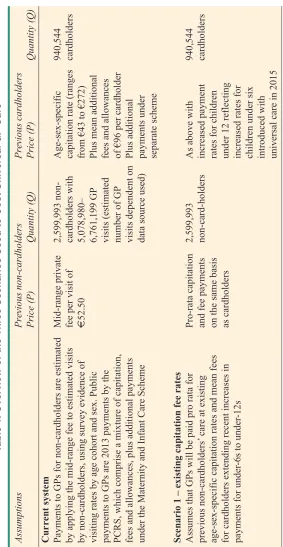
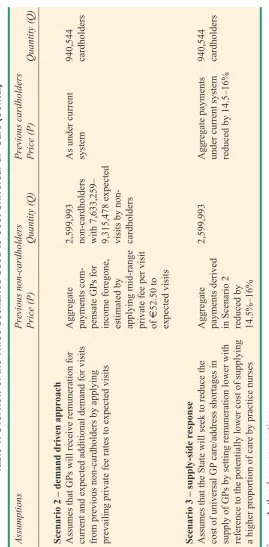
Table 1 details the current system of reimbursing GPs in Ireland and the three alternative scenarios used in this analysis to assess the potential cost implications of universal GP care. A variety of methods and data sources were used with further detail provided in Wren et al. (2015). As there is no national administrative database recording the number of GP visits in Ireland, a number of surveys were used to estimate visiting rates.
Scenario 1 assumes that the capitation rates for GPs’ provision of care free at the point of use will apply existing GP capitation rates and mean addi-itional payments for cardholders’ care. Scenario 2 assumes that remuneration rates will take into account increased demand for universal GP services among previous non-cardholders. Scenario 3 assumes that the State will seek to reduce costs by encouraging a supply-side response to change skill-mix in general practice.
Scenario 1: Existing Capitation Rates
In Scenario 1 it is assumed that GPs would receive for each previous non-cardholder the age and gender-specific capitation rate for existing medical and GP visit cardholders, plus the mean fee of some of the other fees and allowances including out-of-hours, secretarial/nursing and annual leave. Other fees (such as dispensing and asylum seekers) are specific to certain practices and do not extend to the total population and are therefore not included in our analysis. This scenario does not adopt any assumption about utilisation of GP care by previous non-cardholders who are now entitled to free GP care at the point of use. However, this approach to costing in effect has an implicit assumption that GPs would receive an equivalent level of remuneration for the care of previous non-cardholders, who have in general better health status than the cardholder group and might be expected to have lower visiting rates.
T
able 1: Overview of the Thr
ee Scenarios Used to Cost Universal GP Car
e Assumptions Pre vious non-cardholders Pr evious cardholders Price (P) Quantity (Q) Price (P) Quantity (Q) Cur rent system
Payments to GPs for non-cardholders are estimated
Mid-range private
2,599,993
Age-sex-specific
94
0,544
by applying the mid-range fee to estimated visits
fee per visit of
cardholders with
capitation rate (ranges
cardholders
by non-cardholders, using survey evidence of
€
52.50 5,078,980–
from €43 to €272)
visiting rates by age cohort and sex. Public
6,761,199 GP
Plus mean
additional
payments to GPs are 2013 payments by the
visits (estimated
fees and allo
wances
PCRS, which comprise a mixture of capitation,
number of GP
of €96 per card
holder
fees and allowances, plus additional payments
visits dependent on
Plus additional
under the Maternity and Infant Care Scheme
data source used)
payments under separate scheme
Scenario 1 – e
xisting capitation fee rates
Assumes that GPs will be paid pro rata for
Pro-rata capitation
2,599,993
As above with
940,544
previous non-cardholders’
care at existing
and fee payments
non-card-holders
increased payment
cardholders
age-sex-specific capitation rates and mean fees
on the same basis
rates for chil
dren
for cardholders extending recent increases in
as cardholders
under 12 r
eflecting
payments for under
-6s to under
-12s
increased rates for
children under six
introduced with
universal care in 2015
T
able 1: Overview of the Thr
ee Scenarios Used to Cost Universal GP Car
e (Contd.) Assumptions Pre vious non-cardholders Pr evious cardholders Price (P) Quantity (Q) Price (P) Quantity (Q)
Scenario 2 – demand dri
v
en approach
Assumes that GPs will receive remuneration for
Aggregate
2,599,993
As under current
940,544
current and expected additional demand for visits
payments
non-cardholders
system
cardholders
from previous non-cardholders by applying
pensate GPs for
with 7,633,259–
prevailing private fee rates to expected visits
income foregone,
9,315,478 expected
estimated by
visits by
applying mid-range
cardholders
private fee per visit of
€
52.50 to
expected visits
Scenario 3 – suppl
y-side response
Assumes that the State will seek to reduce the
Aggregate
2,599,993
Aggregate payment
s 940,544
cost of universal GP
care/address shortages in
payments derived
under current
system
cardholders
supply of GPs by setting remuneration lower with
in Scenario 2
reduced by 14.
5–16%
reference to the potentially lower cost of supplying
reduced by
a higher proportion of care by practice nurses
14.5%–16%
Source:
Authors’
Scenario 2: Demand Driven Approach
As it is expected that the removal of GP fees at the point of use would result in an increase in the demand for GP visits, it is assumed that GPs would seek to secure remuneration from the State for current visits and this additional visiting, at rates reflecting the fees that they would have received for these visits on the private market. Therefore this scenario was chosen to reflect a remuneration method which would capture the anticipated increase in demand.
Previous research in Ireland has derived estimates of the expected increase in demand associated with receipt of a full medical or GP visit card (Table 2).
Table 2: Impact of Gaining a Medical or GP Visit Card on Number of GP Visits
Cohort Additional GP visits per annum Source
9 months–3 years 0.7 Layte and Nolan (2016) 9 years–13 years 0.4 Layte and Nolan (2016) 16–49 years 0.9-1.3 Nolan (2008)
50+ years 1.1-1.3 Ma and Nolan (2016)
These estimates of additional demand were applied to age-specific GP visiting rates for the non-cardholder population. Given the absence of administrative data on GP visiting in Ireland, three different surveys were used to estimate GP visiting rates; the Quarterly National Household Survey Health Module 2010 for adults and GUI 2007-2009 for children were used to arrive at an estimate of the number of overall visits for the period around 2010 (Wren et al., 2015), while Healthy Ireland data were used to derive visiting rates for the adult population for 2015. Estimated visiting rates from each survey were applied to the 2013 population.
In this scenario, expected increases in demand among those who become eligible for free GP visits informs the approach adopted by the State to remunerate GPs. It is assumed that the State would reimburse GPs for income foregone for current visits by non-cardholders and for the additional expected visits at the prevailing mid-range private fee of €52.50 in 2008 (The Competition Authority, 2009), which is assumed to have remained constant in the subsequent years based on survey evidence from 2011 and 2015 (Brick et al., 2015; WhatClinic.com, 2015). It is assumed that GPs would be reimbursed by the current public system of capitation combined with some fees and allowances.
Scenario 3: Supply-Side Responses
care to practice nurses in instances when such care does not require medical doctor expertise. It is therefore anticipated that the introduction of universal GP care with a change in reimbursement from fee-for-service to capitation for previous non-cardholders may result in a supply response by GPs. To reflect the probability that the State will seek to reduce costs by encouraging such a supply response, we consider the effect on the cost of care of the State building such an assumed response into its price-setting for universal GP care. An additional motivation for examining this scenario is that this supply-side response may be required in the event of a shortfall in the number of GPs required to supply universal care free at the point of use.
Unfortunately there is relatively little evidence about what such supply-side responses might be. One area for consideration is the skill-mix in primary care and in particular the potential to reduce unit costs of GP care by greater employment of practice nurses. In recent research, GPs noted that practice nurses were central to the delivery of high quality care and to ensure GP time is spent efficiently (O’Dowd et al., 2017). Previous Irish research has found that there is a weak negative correlation between the number of practice nurses per capita and GPs per capita suggesting that in some areas shortages of GPs may be compensated for by greater utilisation of practice nurses to provide services (Teljeur et al., 2014).
Although lacking reliable evidence, it appears that there is lesser use of practice nurses in Ireland compared to other countries. For example one study found that among patients with coronary heart disease (CHD), the average annual number of GP visits in the Republic of Ireland was 5.6, compared to 4.4 in Northern Ireland. Conversely, the average number of practice nurse visits among the CHD patients was 1.6 in the Republic of Ireland and 2.1 in Northern Ireland (Cupples et al., 2008). While based on one disease group, the proportion of primary care patients seen by the practice nurse in Northern Ireland in this study (approximately 32 per cent) is similar to that observed across a sample of the total population in England (34 per cent) (Hippisley-Cox et al., 2007) and compares to a 22 per cent practice nurse share in the Republic (Cupples et al., 2008). More recent analysis has found that across the population in the Republic of Ireland, practice nurse visits accounted for 25 per cent of GP and practice nurse visits combined in 2015 (Wren et al., 2017). In 2015, there were an estimated 1,800 practice nurses in Ireland with 82 per cent of GP practices employing a practice nurse (O’Kelly et al., 2016).
reduction in GP costs if there were a change to the proportionate use of nursing staff in Northern Ireland in the Cupples et al. study (Wren et al., 2015). Since it appears that the proportion of care delivered by practice nurses has subsequently increased, a further estimate adjusts for the 2015 share of practice nurse visiting which is closer to the NI share and therefore convergence to the NI rate yields the lesser 14.5 per cent reduction in GP costs. These reductions were applied to the total cost of GP care estimated in the demand driven approach (Scenario 2).
2.3 Estimating Baseline Healthcare Expenditure
In order to determine the impact of universal GP care on current healthcare expenditure it is necessary to determine total healthcare expenditure in Ireland. For the purpose of this analysis, estimates of public expenditure on GP services, private expenditure on GP services, public healthcare expenditure and total healthcare expenditure were derived from a published report which provides estimates of healthcare expenditure for 2013 (Table 3).
Table 3: Healthcare Expenditure Estimates for Ireland, 2013
Category Public Private Total public Total public and payments payments healthcare private healthcare to GPs to GPs expenditure expenditure
€m 471 267 14,602 19,216
Source: Wren et al. (2015).
III RESULTS
Impact on public healthcare expenditure
Table 4 shows the impact on public healthcare expenditure of the introduction of universal GP care free at the point of use using the three alternative methods of reaching a reimbursement price for universal GP care identified above. For previous non-cardholders, the cost to the State of introducing free GP visits is €492 million per annum for Scenario 1 (existing capitation rates), €401 million to €489 million per annum for Scenario 2 (demand driven approach – which found that GP visiting by former non-cardholders would increase by 2.55 million, implying an overall increase in GP-visiting of between 16.7 and 18.7 per cent), and €337- €418 million for Scenario 3 (supply-side response).
The overall increase in total healthcare expenditure of introducing universal GP care ranges from €262 million per annum to €500 million per annum depending on the method used to reach a price for universal GP care, representing an increase of between 1.8 and 3.4 per cent of public health expenditure in 2013.
Table 4: The Impact on Public Healthcare Expenditure of Extending Free GP Care to the Full Population, 2013
Cost for Cost for Increase Percentage previous previous in public increase non- cardholders health public cardholders expenditure health @m @m @m expenditure Current 0 471 Scenario 1 – existing capitation rates 492 479 500 3.4% Scenario 2 – demand driven approach 401–4891 471 401–489 2.7–3.3%
Scenario 3 – Supply-side response 337–4182 396–403 262–350 1.8–2.4%
Source: Authors’ own calculations.
Notes:1 – The range reflects different visiting rates emerging from different surveys. 2 – Skill-mix savings applied to the estimated cost of universal GP care estimated from Scenario 2 (demand driven approach).
Impact on Total Healthcare Expenditure
Table 5 shows the impact on total healthcare expenditure of extending free GP care to the total population. Under the current system, non-cardholders are estimated to spend between €267 million and €355 million per annum on GP visits. The impact
Table 5: The Impact on Total Healthcare Expenditure of Extending Free GP Care to the Full Population, 2013
Cost for Cost for Increase Percentage previous previous in total increase non- cardholders health total cardholders expenditure health @m @m @m expenditure Current 267–3551 471
Scenario 1 – existing capitation rates 492 479 233–145 1.2%–0.8% Scenario 2 – demand driven approach 401–489 471 134 0.7% Scenario 3 – Supply-side response 337–4182 396–403 –5 0 %
Source:Authors’ own calculations.
on total healthcare expenditure of introducing universal GP care is less than on public healthcare expenditure because a significant proportion of the cost to the State reflects payments that were previously made out-of-pocket by individuals (and therefore included in the calculation of total healthcare expenditure). The additional cost to total healthcare expenditure (ranging from 0 to 1.2 per cent) therefore largely reflects the additional demand for GP visits arising from a drop in price at the point of use.
IV DISCUSSION
Introduction of universal GP care free at the point of use in Ireland would result in
an additional cost to the State of up to €500 million per annum. However, a
significant proportion of this additional cost reflects a shift in spending from private individuals paying out-of-pocket at the point of use to the State paying for GP visits under a capitation scheme. Therefore much of the additional expenditure does not reflect a net cost to society but rather a change in how contributions for healthcare services are made.
While public healthcare expenditure in Ireland has increased in the past number of years (Department of Health, 2017), this rise is in the context of a prolonged period of austerity characterised by significant cuts to public healthcare expenditure
(Thomas et al., 2014). Furthermore, there are many competing priorities for
resources and it is not yet clear if funding universal GP care is a priority. The introduction of universal GP care may also involve structural changes within primary care (for example, the development of new methods of reimbursing GPs and a change in staff-mix) and associated set-up costs, which have not been included in the analysis, putting further pressure on limited additional resources.
services is only one of the necessary reforms to achieving a strong primary care system. In Ireland other factors such as the availability of GPs in rural and deprived areas may also act as barriers to accessing GP services and should be considered in future research.
In 2015, more than 92 per cent of GPs signed up to the contract providing for free GP visits for the under sixes (Department of Health, 2015b); however, the scheme was opposed by a new representative organisation for GPs, the National Association of General Practitioners (NAGP), although the terms of the contract were negotiated by the Irish Medical Organisation (IMO), the traditional GP trade union. Some of the NAGP opposition related to the introduction of free GP care based on age rather than income (Goodey, 2015); a concern which would be addressed if universal GP care were introduced. However, concerns were also raised about the potential impact of additional demand on an under-resourced primary care system. Recent research estimates that 4.5 per cent of healthcare expenditure
in 2014 was spent on general medical practice, equating to €858.6 million
(O’Dowd et al., 2017); of this €453 million related to payments for cardholders, €90 million for other State fees and €315.6 million for private out-of-pocket care. While these expenditure estimates do not include private payments for practice nurse visits and the out-of-pocket payment estimate is lower than the €355 million estimated for the analysis presented in this paper using the Healthy Ireland Survey, the proportion of healthcare expenditure spent in general practice remains low by international standards (O’Dowd et al., 2017).
A further concern relates to the inadequacy of the supply of GPs in Ireland. Recent estimates suggest there are 64.4 GPs per 100,000 population in Ireland, significantly lower than the European average of 91 GPs per 100,000 (Teljeur et al., 2014). Further it is anticipated that that the demand for GP services will increase at a time when there will be a reduction in the number of GPs. Demographic change including an increase in the number of people in the population, as well as an increase in the number of older people, will result in a significant increase in demand, regardless of changes in policy towards universal GP care (Wren et al., 2017). A high proportion of GPs over the age of 55 will likely result in a large number of retirements in the next ten years, reducing the supply of GPs, a situation potentially exacerbated by a high proportion of current trainees expecting to leave Ireland after training (Health Service Executive, 2015b). However, there is evidence that the number of trainee GPs is increasing and the ICGP currently trains 172 GPs per year (Irish College of General Practitioners, 2017). Therefore, while the actual cost of providing free GP visits at the point of use may not be significant in terms of the overall healthcare budget, initiatives will likely be required to address GP supply shortfalls before universal GP care and associated changes are fully implemented (Teljeur et al., 2010).
survey data to estimate GP visiting rates. Different surveys have provided different estimates of the number of GP visits; to account for this variation, the analysis used a range of visiting rates. An essential component of the analysis presented in this paper involved predicting behavioural change following a change in policy. On the demand side, the introduction of free GP care is expected to increase demand for GP visits. While there is some Irish evidence available to estimate how gaining a medical or GP visit card may impact on the demand for GP visits (Nolan, 2008; Ma and Nolan, 2016), there is much uncertainty on how the introduction of universal GP care would impact on the supply side. In this analysis we considered the potential cost implications of substituting GP visits with practice nurse visits under the assumptions that (i) existing practice nurses may be able to meet some of the additional demand generated from the introduction of universal GP care and (ii) may be able to do so at a reduced cost relative to GPs. While previous research for Ireland has found that increased nurse substitution offers the best long-term prospects of addressing GP shortages (Teljeur et al., 2010), the ability to reduce healthcare costs depends on the particular context of care. Doctors’ workload may remain unchanged either because nurses are deployed to meet previously unmet patient need or because nurses generate demand for care where previously there was none. Savings in cost depend on the magnitude of the salary differential between doctors and nurses, and may be offset by the lower productivity of nurses compared to doctors (Laurant et al., 2005).
The three scenarios identified in this analysis about how Government might approach reimbursing GPs for the services they would provide under universal GP care are certainly not the only methods which could be used, but rather reflect recent policy and evidence in an Irish context. A number of other scenarios could be considered including a combination of Scenarios 1 and 2 where information on lower GP visiting rates among existing non-cardholders is used to set a capitation rate proportionally lower than that used for existing cardholders. Also on the supply side, alternative skill-mix possibilities could be explored including consideration of the increased role of community pharmacists.
V CONCLUSIONS
policy can be comprehensively implemented, especially around the adequate resourcing (both financial and staffing) of the primary care system. A long-term perspective is required to strengthen primary care in Ireland to ensure maximum benefits including improved population health.
REFERENCES
Brick, A., A. Nolan, J. O’Reilly and Smith, 2010. Resource Allocation, Financing and Sustainability in Health Care: Evidence for the Expert Group On Resource Allocation and Financing in the Health Sector,Dublin, Ireland: The Economic and Social Research Institute.
Brick, A., C. Normand, S. O’Hara and S. Smith, 2015. Economic Evaluation of Palliative Care in Ireland, Dublin, Ireland: Trinity College Dublin.
Central Statistics Office, 2016. Ireland’s System of Health Accounts, Annual Results 2014, Dublin, Ireland: Central Statistics Office.
Competition Authority, 2009. “Competition in Professional Services – General Practitioners – Part 1: Overview of the GP profession”, Dublin: The Competition Authority.
Connolly, S. and M. Wren, 2017. “Unmet Healthcare Needs in Ireland: Analysis Using the EU-SILC Survey”, Health Policy, Vol. 121, pp. 434-441.
Cupples, M. E., M. C. Byrne, S. M. Smith, C. S. Leathem and A. W. Murphy, 2008. “Secondary Prevention of Cardiovascular Disease in Different Primary Healthcare Systems With and Without Pay-For-Performance”, Heart,Vol. 94, pp. 1594-600.
Department of Health, 2014. The Path to Universal Healthcare: White Paper on Universal Health Insurance, Dublin, Ireland: Department of Health.
Department of Health, 2015a. Statement by Minister Varadkar following Cabinet discussion on UHI, Dublin, Ireland: Department of Health.
Department of Health, 2015b. Press Release – Over 163,000 Children and 23,000 People over 70s sign-up for GP Care [Online]. Department of Health. Available: http://health.gov.ie/blog/press-release/over-163000-children-and-23000-people-over-70s-sign-up-for-gp-care.
Department of Health, 2015c. Press Release – Ministers Welcome Agreement with IMO on Free GP Care for Under-6s. http://health.gov.ie/blog/press-release/ministers-welcome-agreement-with-imo-on-free-gp-care-for-under-6s/: Department of Health.
Department of Health, 2017. Health in Ireland: Key Trends 2017, Dublin, Ireland: Department of Health.
Department of the Taoiseach, 2011. A Programme for Government, Dublin, Ireland: Department of the Taoiseach.
Department of the Taoiseach, 2016. A Programme for a Partnership Government, Dublin, Ireland: Department of the Taoiseach.
Evetovits, T., J. Figueras, M. Jowett, P. Mladovsky, A. Nolan, C. Normand and S. Thomson, 2012.
Health System Responses to Financial Pressures In Ireland: Policy Options in An International Context, Brussels: European Observatory on Health Systems and Policies.
Friedberg, M. W., K. L. Coltin, S. D. Pearson, K. P. Kleinman, J. Zheng, J. A. Singer and E. C. Schneider, 2007. “Does Affiliation of Physician Groups With One Another Produce Higher Quality Primary Care?”, Journal of General Internal Medicine, Vol. 22, pp. 1385-1392. Goodey, C. 2015. Why GPs Oppose Free Care for Children Under 6 [Online]. National Association
Health Service Executive, 2015a. “2015 Medical Card and GP Visit Card Income Guidelines”, Dublin, Ireland: HSE.
Health Service Executive, 2015b. “Medical Workforce planning: Future Demand for General Practitioners 2015-2025”, Dublin, Ireland: Health Service Executive.
Hippisley-Cox, J., J. Fenty and M. Heaps, 2007. Trends in Consultation Rates in General Practice 1995 to 2006: Analaysis of the QRESEARCH database: Final Report to the Information Centre and Department of Health, Leeds: The Information Centre.
Houses of the Oireachtas Committee on the Future of Healthcare, 2017. Slaintecare Report, Dublin, Ireland: Houses of the Oireachtas.
Hudson, E. and A. Nolan, 2015. “Public Healthcare Eligibility and the Utilisation of GP Services By Older People in Ireland”, The Journal of the Economics of Ageing,Vol 6, pp. 24-43.
Irish College of General Practitioners, 2017. Briefing Document to the Joint Oireachtas Committee on Health: Manpower and General Practice, Dublin, Ireland: Oireachtas.
Keegan, C., S. Connolly and M. Wren, 2017. “Measuring Healthcare Expenditure: Different Methods, Different Results”, Irish Journal of Medical Science, epub 2017/06/02.
Kringos, D. S., W. G. Boerma, Y. Bourgueil, T. Cartier, T. Hasvold, A. Hutchinson, M. Lember, M. Oleszczyk, D. R. Pavlic, I. Svab, P. Tedeschi, A. Wilson, A. Windak, T. Dedeu and S. Wilm, 2010. “The European Primary Care Monitor: Structure, Process and Outcome Indicators”, BMC Family Practice, Vol. 11, p. 81.
Kringos, D., W. Boerma, Y. Bourgueil, T. Cartier, T. Dedeu, T. Hasvold, A. Hutchinson, M. Lember, M. Oleszczyk, D. Rotar Pavlic, I. Svab, P. Tedeschi, S. Wilm, A. Wilson, A. Windak, J. Van Der Zee and P. Groenewegen, 2013a. “The Strength of Primary Care in Europe: An International Comparative Study”, British Journal of General Practice, Vol,63, e742-50.
Kringos, D. S., W. Boerma, J. Van Der Zee and P. Groenewegen, 2013b. “Europe’s Strong Primary Care Systems are Linked to Better Population Health But Also to Higher Health Spending”,
Health Aff (Millwood),Vol. 32, pp. 686-694.
Laurant, M., D. Reeves, R. Hermens, J. Braspenning, R. Grol and B. Sibbald, 2005. “Substitution of Doctors by Nurses in Primary Care”, Cochrane Database of Systematic Reviews, CD001271. Layte, R. and A. Nolan, 2016. Understanding Use of General Practitioner Services Among Children
in Ireland: Evidence from the Infant Cohort of the Growing Up In Ireland Survey, Dublin, Ireland: Growing up in Ireland.
Ma, Y. and A. Nolan, 2016. “Public Healthcare Entitlements and Healthcare Utilisation Among the Older Population in Ireland”, Health Economics, Vol. 26, pp. 1412-1428.
Nolan, A. 2008. “Evaluating the Impact of Eligibility for Free Care On the Use of General Practitioner (GP) Services: A Difference-in-Difference Matching Approach”, Social Science and Medicine,
Vol. 67, pp. 1164-1172.
O’Dowd, T., J. Ivers and D. Handy, 2017. A Future Together Building a Better GP and Primary Care Service, Dublin, Ireland: Trinity College Dublin.
O’Kelly, M., C. Teljeur, F. O’Kelly and A. Ní Shuilleabhain, 2016. Structure of General Practice in Ireland 1982-2015, Dublin, Ireland: Irish College of General Practitioners.
Ring, E. 2015. “Deal on Free GP Care for U-6s follows 81% Payment Hike”, April 10 2015, Irish Examiner, http://www.irishexaminer.com/ireland/deal-on-free-gp-care-for-u-6s-follows-81-payment-hike-323164.html
Smith, S. and C. Normand, 2011. “Equity in Health Care: The Irish Perspective”, Health Economics, Policy and Law, Vol 6, pp. 205-217.
Starfield, B. 1994. “Is Primary Care Essential?”, Lancet,Vol 344, pp. 1129-1133.
Starfield, B., L. Shi and J. Macinko, 2005. “Contribution of Primary Care to Health Systems and Health”, Milbank Quarterly, Vol. 83, pp. 457-502.
Teljeur, C., S. Thomas, F. O’Kelly and O’Dowd, 2010. “General Practitioner Workforce Planning: Assessment of Four Policy Directions”, BMC Health Services Research,Vol. 10, p. 148. Thomas, S., S. Burke and S. Barry, 2014. “The Irish Health-Care System and Austerity: Sharing the
Pain”, Lancet, Vol. 383, pp. 1545-1546.
Whatclinic.com, 2015. “Nine in Ten (91%) Irish GPS Think Free Care Scheme for Children Under Six is a Bad Idea”, WhatClinic.com [Online].
World Health Organisation, 2015. News Release: WHO Lays Out Plans for Financing New Global Health Goal: To Ensure Healthy Lives and Promote Well-Being for All at All Ages [Online]. Available: http://www.who.int/mediacentre/news/releases/2015/health-financing/en.
Wren, M., C. Keegan, B. Walsh, A. Bergin, J. Eighan, A. Brick, S. Connolly, D. Watson and J. Banks, 2017. Projections of Demand for Healthcare in Ireland, 2015-2030: First Report from the HIPPOCRATES Model, Dublin, Ireland: The Economic and Social Research Institute. Wren, M., S. Connolly and N. Cunningham, 2015. An Examination of the Potential Costs of Universal