ISSN: 2231-5381
http://www.ijettjournal.org
Page 1801Study of Various EBG Based Micro strip Filter
Structures
Anchal Chugh1, Dr. Rajesh Khanna2
1
Student, Department of Electronics and Communication Engineering, Thapar University, Patiala
2
Professor, Department of Electronics and Communication Engineering, Thapar University, Patiala
Abstract: In this paper, a planar EBG based microstrip filter structure is formed by etching circles in the ground plane and using a modulated microstrip line. These planar EBG microstrip structure provides a wide stopband with high attenuation with high ripples in the passband due periodicity of EBG structure. Windows are used to eliminate the ripples in the passband caused by the periodicity. The coefficients of window distribution function are used for determining the radius of the circles etched in the ground plane. In this paper, a comparison of planar EBG microstrip filter structure using fixed window distribution is done. A comparison of effect of different window distribution on passband and stopband performance is presented. It is found that the Riesz distribution gives the largest bandwidth of 7.18GHz with maximum stopband attenuation of 50dB but with large ripples in the passband while the Poisson distribution gives small ripples in both the lower and upper passband but with smallest bandwidth of 4.77GHz and stopband attenuation of 27.68dB.
Keywords- Electromagnetic Bandgap Structure, CST Microwave Studio, Modulated Microstrip Line, Photonic Bandgap Structure, Tapering Function
I. INTRODUCTION
Filtering of undesired frequencies can be done by using shunt stubs and stepped impedance lines. This technique is typically narrow band and requires large circuit area [1]. One possible way to reject a band of frequencies is to use Electromagnetic Bandgap Structure [2].
Electromagnetic Bandgap Structure is a term that is widely used now-a-days for artificial periodic structures that prohibit the propagation of electromagnetic waves at microwave and millimeter wave frequency. The 3-D periodic structures at Optical frequency are known as photonic bandgap structures [3].
EBG structures can be applied as a substrate of patch antennas to suppress the surface wave excitation [4] or as planar EBG structure by etching periodic patterns in the ground plane [5]. The planar EBG structures have the advantage of ease of fabrication and are capable of controlling the propagation of wave. These structures are compatible with microstrip structure thus making them attractive as microstrip filters.
The main aim of this work is to design a filter with wide stopband and reduced ripples in the passband. In this paper, EBG based microstrip filter structure is formed by etching circles in the ground plane and using a modulated microstrip line. Study of various Window distributions is presented for use on EBG structures. Window distributions are applied to improve the passband and stopband performance and a comparison of effect of different fixed window distribution on the structure is presented.
II. EBG BASED MICROSTRIP FILTER STRUCTURE
ISSN: 2231-5381
http://www.ijettjournal.org
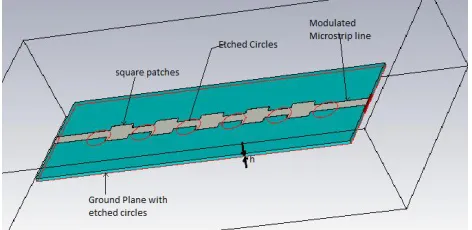
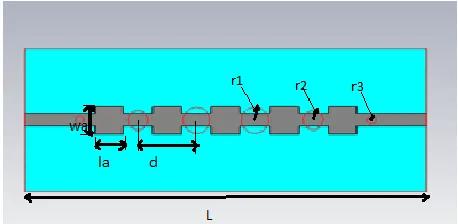
Page 1802of length la and width wa of 5mm in the microstrip line of width (w) 2.29mm.
Fig.1(a) Schematic of EBG based Microstrip Filter Structure (Top View)
Fig. 1(b) Schematic of EBG based Microstrip Filter Structure (Bottom View)
Fig. 1(c) Schematic of EBG base Microstrip Filter Structure (Side View)
The period of the structure d is defined by the distance between the centers of two adjacent circles. According to Bragg reflection condition [6], the period is given by:
, (1)
where β is the guided wavenumber.
The guided wavenumber is:
√ , (2)
where is the center frequency of the stopband, c is the speed of light in free space and is the effective permittivity of the substrate material [7].
√
, (3)
The period equals half the guided wave length:
(4)
A single column of n circles are etched in the ground plane, however, in this paper we have designed the structure with n = 6. The radius (r) of the circle is uniform. The ratio of r and d is called filling factor which indicate the relative size of EBG cell to the period of the structure. For no overlap between any circles it ranges from 0 to 0.5. The optimum value of r/d is found to be 0.25 [8]. Using the 0.25 filling factor the radius of the circles in the ground is found to be 2.59mm.
ISSN: 2231-5381
http://www.ijettjournal.org
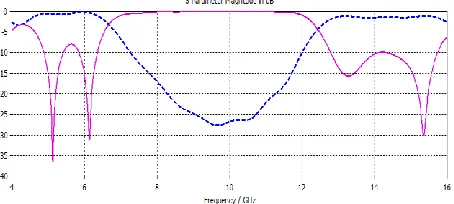
Page 1801Fig. 2(a) Simulated S11 parameter of EBG based Microstrip Filter Structure
Fig. 2(b) Simulated S21 parameter of EBG based Microstrip Filter Structure
The ripples in the passband are caused by the periodicity of the EBG structure. Various techniques are used to reduce the ripples such as Chebyshev array, binomial array [9] and Taylor array. In this paper, we have used different Window distribution functions to taper the dimensions of the etched circles. There by for changing the radius of the circles following relationship is used:
, (5)
where i is an integer ranging from 1 to n/2 when n is even and from 1 to (n+1)/2 when n is odd number. is the radius of the ith circle and is the radius of the center circle. T(x) is the tapering function and x is given as:
, (6)
where is the distance between the center of the ith circle and the center of microstrip line and L is the total length of the structure.
Fig. 3 Schematic of EBG based Microstrip Filter with Tapered Circles
Table1 shows different window distributions adopted to taper the radius of etched circles. It results in corresponding radius r1, r2 and r3.
TABLEI
PARAMETER OF PROPOSED FILTER
Window Distrib-ution
T(x) r1 r2 r3
Triangular 2.34 1.75 0.78
Hanning 2.48 1.69 0.36
Hamming
2.49 1.79 0.82
Blackman
n (
)
2.42 1.35 0.25
Poisson ( ) 1.8 0.87 0.42
Riesz 2.54 2.17 1.07 Bohmann * + * +
* +
2.39 1.45 0.128
ISSN: 2231-5381
http://www.ijettjournal.org
Page 1802The return loss and insertion loss S11 (solid line) and S21 (dotted line) parameters were calculated and the simulated results are shown in Fig 4(a)-4(h).
Fig. 4(a) Simulated S11 (solid line) and S21 (dotted line) for Triangular Window
Fig. 4(b). Simulated (solid line) and (dotted line) for Hanning window
Fig. 4(c) Simulated S11 (solid line) and S21 (dotted line) for Hamming window
Fig. 4(d) Simulated S11 (solid line) and S21 (dotted line) for Blackmann window
Fig. 4(e) Simulated S11 (solid line) and S21 (dotted line) for Riesz window
Fig. 4(f) Simulated S11 (solid line) and S21 (dotted line) for Bohman window
ISSN: 2231-5381
http://www.ijettjournal.org
Page 1803TABLEII
COMPARISON OF EFFECT OF WINDOW DISTRIBUTIONS
Window
Distrib-ution
Band-width (GHz)
Stopband Attenu-ation(dB)
Ripple Level
Lower Upper
Triangular 6.5 40 1.81 2.23 Hanning 6.7 41.47 1.24 3.15
Hamming 6.8 45.2 1.1 2.9
Blackmann 6.35 35.9 2.4 2.7
Riesz 7.18 50 2.7 3.15
Bohmann 6.41 37.45 1.24 2.37 Poisson 4.77 27.68 0.9 1.7
In Table 2, the comparison of tapering functions is done which shows that the ripple in the passband of Poisson Window function is much reduced while the bandwidth is less. The Riesz tapering function has the highest bandwidth and attenuation, but with large ripple level in the passband.
IV. CONCLUSION
In this paper, the design of EBG based microstrip filter structure is presented. This structure provides a large bandwidth of 7.68dB and high attenuation but ripple level is 4.18dB in lower and 7.8dB in upper passband. The ripple level in the passband is tailored by adopting the window distributions. It is found that the Riesz distribution gives the largest stopband of 7.18dB and attenuation of 50dB and Poisson distribution gives the smallest ripples in both the lower and upper passband. The tapered EBG structure exhibit an excellent transmission in the passband. The proposed structure can be employed with other circuits to meet the requirements of passband and stopband performance.
REFERENCES
[1] Ian Rumsey, Melinda Piket-May, P. Kelly, “Photonic Bandgap Structures used as Filters in Microstrip Circuits”, IEEE Microw. and Guided Wave Lett., vol. 8, no. 10, pp. 336-339, Oct. 1998.
[2] M. A. G. Laso, T. Lopetegi, M. J. Erro, D. Benito, M. J. Garde, and M. Sarolla, “Multi-frequency- tuned photonic bandgap microstrip structures”, IEEE Microwave Guided Wave Lett., vol. 10, pp. 357-360, Jun. 2000.
[3] G. Kurizki and A. Z. Genack, “Suppression of molecular interactions in periodic dielectric structure”, Phys. Rev. Lett., vol. 61, no. 19, pp. 2269-2271, Nov. 1988.
[4] R. Gonzalo, P. D. Maagt, and M.Sorolla, “Enhanced patch-antenna performance by suppressing surface waves using photonic-bandgap substrates”, IEEE Trans. Microw. Theory Techn., vol.47, no. 11, pp. 2131-2138, Nov. 1999. [5] V. Radisic, Y. Qian, R. Coccioli, and T. Itoh, “Novel 2-D photonic bandgap structure for microstrip lines”, IEEE Microw. Guided Wave Lett.,vol. 8, no. 2, pp. 69-71, Feb. 1998.
[6] F. Falcone, T. Lopetegi and M. Sorolla, “1-D and 2-D photonic bandgap microstrip structure”, Microwave Opt. Technol. Lett., vol. 22, no. 6, pp. 411-412, Sep. 1999.
[7] C. Balanis, Antenna Theory Analysis and Design. New York: Wiley, 1997, 2nd edition.
[8] Shao Ying Huan and Yee Hui Lee, “Compact U-Shaped Dual Planar EBG Microstrip Low-Pass Filter”, IEEE Transaction on Microwave Theory and Techniques, vol. 37, no. 19, pp. 3799-3805, Dec. 2005.