R E S E A R C H
Open Access
An analysis of secular trends in
method-specific suicides in Japan, 1950
–
1975
Eiji Yoshioka
1,2*, Yasuaki Saijo
1and Ichiro Kawachi
2Abstract
Background:In Japan, a dramatic rise in suicide rates was observed in the 1950s, especially among the younger population, and then the rate decreased rapidly again in the 1960s. The aim of this study was to assess secular trends in method-specific suicides by gender and age in Japan between 1950 and 1975. We paid special attention to suicides by poisoning (solid and liquid substances), and their contribution to dramatic swings in the overall suicide rate in Japan during the 1950s and 1960s.
Methods:Mortality and population data were obtained from the Vital Statistics of Japan and Statistics Bureau, Ministry of Internal Affairs and Communications in Japan, respectively. We calculated method-specific age-standardized suicide rates by gender and age group (15–29, 30–49, or 50+ years).
Results:The change in the suicide rate during the research period was larger in males than females in all age groups, and was more marked among people aged 15–29 years compared to those aged 30–49 years and 50 years or over. Poisoning by solid and liquid substances overwhelmingly contributed to the dramatic change in the overall suicide rates in males and females aged 15–49 years in the 1950s and 1960s. For the peak years of the rise in poisoning suicides, bromide was the most frequently used substance.
Conclusions:Our results for the 1950s and 1960s in Japan illustrated how assessing secular trends in method-specific suicides by gender and age could provide a deeper understanding of the dramatic swings in overall suicide rate. Although rapid increases or decreases in suicide rates have been also observed in some countries or regions recently, trends in method-specific suicides have not been analyzed because of a lack of data on method-specific suicide in many countries. Our study illustrates how the collection and analysis of method-specific data can contribute to an understanding of dramatic shifts in national suicide rates.
Keywords:Suicide, Epidemiology, Secular trends, Poisoning due to solid or liquid substances
Background
Suicide is a significant yet preventable public health problem. In 2012, suicide accounted for 1.4% of all deaths worldwide, making it the 15th-leading cause of death [1]. Although the global estimate of the age-standardized suicide rate fell 26% (23% in men and 32% in women) during the 12-year period from 2000 to 2012 [1], very different patterns were seen by country or re-gion. For example, large decreases in the age-standardized suicide rates from 2000 to 2012 were
observed in China and Russia, while huge increases were observed in South Korea and Morocco [1]. However, the reason why the changes in suicide rates varied over the 12-year period has been unknown.
Although social, economic, cultural, and psychological factors are significant contributors to transitions of sui-cide rates, there is good evidence that the availability and popularity of lethal methods is also important [2, 3]. The increased use of pesticides in many agrarian soci-eties during the second half of the 20th century, domes-tic coal gas in the 1920s and 1930s in the UK, and motor vehicles in the 1970s and 1980s in the UK were associated with an increase in suicides [4–6]. These find-ings indicate that analyzing trends in method-specific suicides may help to understand the background of the * Correspondence:[email protected]
1
Department of Social Medicine, Asahikawa Medical University, Midorigaoka-higashi 2-1-1-1, Asahikawa, Hokkaido, Japan
2Department of Social and Behavioral Sciences, Harvard T.H. Chan School of
Public Health, 677 Huntington Avenue, Kresge Building 7th Floor, Boston, MA, USA
recent trends in overall suicides rates in some countries where rapid changes have recently been observed; how-ever, many countries unfortunately do not collect data on the methods used in suicide [1]. Only 76 of the 194 WHO member states reported data on methods of sui-cide in the WHO mortality database between 2005 and 2011, and this means that the methods used in 72% of global suicides are unclear [1].
In Japan, a dramatic rise in a suicide rate was observed in the 1950s, and then the rate decreased just as rapidly in the 1960s [7, 8]. The rate in Japan was one of the highest worldwide in the 1950s [9]. It has been suggested that this change may be associated with the traumatic or difficult experiences of Japanese people during and after World War II and socioeconomic factors, such as un-employment rates, in the 1950s and 1960s in Japan [7, 8, 10, 11]. Concerning suicide methods used frequently during these periods in Japan, Araki et al. reported that suicide rates due to poisoning by solid and liquid sub-stances in young people changed markedly in this period, and that these means were responsible for the rapid change [12]. However, little is known about how much impact the change in poisoning suicide rates dur-ing this period had on the overall suicide rate and what kind of solid and liquid substances were commonly used for suicide during this period.
In this research, we assessed secular trends in method-specific suicides by gender and age in Japan between 1950 and 1975. Specifically, we investigated the contri-bution of different methods of suicide to the overall sui-cide rate for males and females in Japan from 1950 to 1975 for three age groups (15–29, 30–49, and 50+) and compared the contribution of specific types of poisons to the overall suicide rate in these gender-age-specific cohorts when the national suicide rate was at its peak (1958–1960) to their contribution after the national sui-cide rate had dropped dramatically (1965–1967). By examining historical data we seek to illustrate how the analysis of trends in method-specific suicides can help to explain (and possibly prevent) the rapid changes that have recently been observed in other countries, e.g., South Korea and China [1].
Methods
Gender-specific suicide mortality data for Japan between 1950 and 1975, by year in 5-year age bands, were ob-tained from the Vital Statistics of Japan [13]. Mid-year population estimates by gender and in 5-year age bands for Japan were provided by the Statistics Bureau, Minis-try of Internal Affairs and Communications in Japan [14]. In this research, we divided age into three groups (15–29, 30–49, and 50+ years) and compared their trends. Data on suicide victims 14 years old or younger were not analyzed in this study. We calculated
age-standardized suicide rates within each of these three age bands using the world population structure as a standard [15]. All suicide death rates in the figures were expressed as numbers of deaths per 100,000 men or women. Three-year moving averages that were centered on the last year of each 3-year period were then calculated to smooth the annual rates. And thus, although we ob-tained suicide mortality data between 1950 and 1975, the suicide rates based on the 3-year moving averages were restricted to the period from 1952 to 1975.
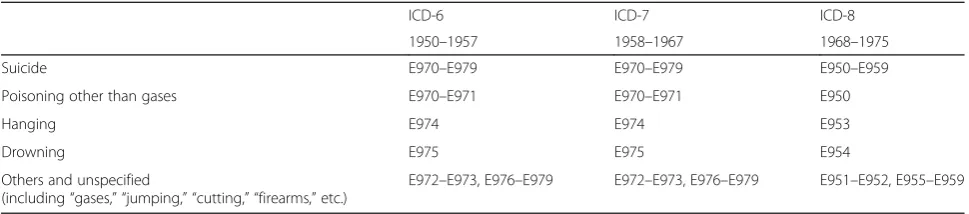
To identify the method of suicide, the underlying causes of death according to the ICD (International Classification of Diseases) codes were used (Table 1). We combined“Gases,” “Jumping,” “Cutting,” “Firearms,” etc. into the “Other and unspecified” category because the number of suicides using these methods was com-paratively small during the research period. Moreover, we could obtain detailed information on what kind of solid or liquid substances were used for poisoning sui-cides in the years 1958–1967. The data between 1958 and 1967 were based on detailed items from the ICD-7 categories E970 (analgesic and soporific substances) and E971 (other solid and liquid substances) [13]. The E970 category consisted of four items: “morphine (morphine and other opium derivatives),” “barbiturate (barbiturate and its derivatives),” “bromide,” and “other analgesics (other and unspecified analgesic and soporific substances).” The E971 category also con-sisted of four items: “cyanide (cyanide compounds),” “pesticides (organic phosphorus preparations for agri-cultural chemicals),” “other phosphates (other phos-phorus preparations)” and “other substances (other and unspecified solid and liquid substances).” For the remaining years, we could not obtain detailed infor-mation on solid or liquid substances which were used for poisoning suicides.
clarify how each of the specified suicide methods played a role when the overall suicide rate decreased.
Results
Figures 1 and 2 show secular trends in age-standardized suicide rates by age and method used in Japan during
the research period for males and females, respectively. For males and females aged 15–29 years, suicide rates for poisoning increased in the early 1950s, reached a peak in the late 1950s, and then decreased from the 1960s onward. In this age group, poisoning was the overwhelmingly dominant method in both genders from
Table 1ICD codes used for methods of suicide in Japan
ICD-6 ICD-7 ICD-8
1950–1957 1958–1967 1968–1975
Suicide E970–E979 E970–E979 E950–E959
Poisoning other than gases E970–E971 E970–E971 E950
Hanging E974 E974 E953
Drowning E975 E975 E954
Others and unspecified
(including“gases,” “jumping,” “cutting,” “firearms,”etc.)
E972–E973, E976–E979 E972–E973, E976–E979 E951–E952, E955–E959
the early 1950s through the early 1960s. Dramatic changes in overall suicide rates were also observed in the 1950s and 1960s, and the overall suicide rates were almost paral-lel to the poisoning rates during this period. Although the overall (as well as) poisoning suicide rates of males were much higher than those of females, the secular trends showed similar tendencies between males and females in this age group. For males and females aged 30–49 and 50 + years, similar changes in poisoning suicide rates in the 1950s and 1960s were observed, although they were less marked than the trends among 15–29 year olds. Hanging was by far the most common method in those aged 50+ years during the research period.
Figure 3 show distribution of suicide methods by gen-der and age in the years 1958–1960 and 1965–1967. For males and females aged 15–29 years, proportions of poi-soning in overall suicides decreased markedly from
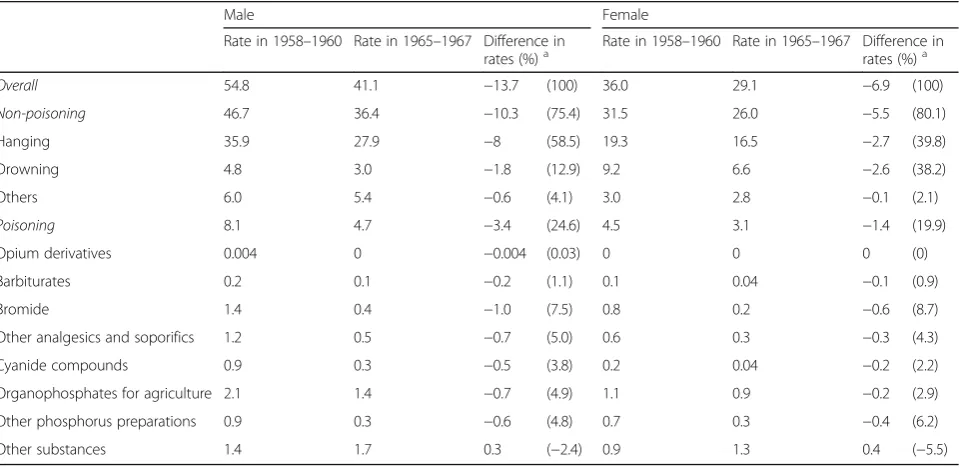
period was much smaller in males and females aged 50+ years than those aged 15–29 and 30–49 years. For males and females aged 50 years or over, hanging was the greater contributor to the change in the overall suicide rate. Of the solid/liquid substances used as suicide methods, bromides were the most commonly used in 1958–1960 in both males and females aged 15–29 years, followed by other analgesics and pesticides. Bromides were also the most common poi-soning substances in males and females aged 30–49 years,
while organophosphates (used in agriculture) were the most common for those aged 50+ years. Suicide rates due to nearly all forms of poisoning decreased between 1958– 1960 and 1965–1967.
Discussion
Main findings
In this research, we investigated the method-specific sui-cide trends by age and gender in Japan in the 1950s and Fig. 3Distribution of suicide methods by gender and age in Japan in 1958–1960 and 1965–1967
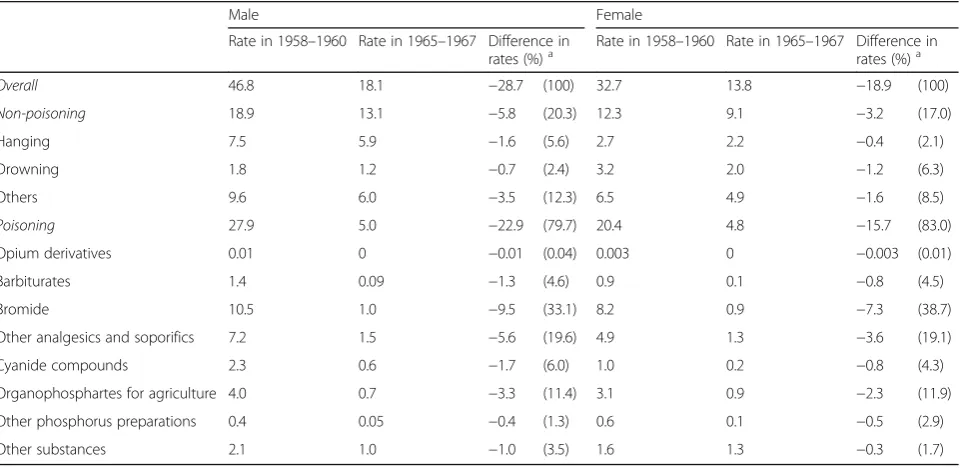
Table 2Age-standardized suicide rates (per 100,000 population) and changes in rates by method used between 1958–1960 and 1965–1967 for males and females aged 15–29 years, Japan
Male Female
Rate in 1958–1960 Rate in 1965–1967 Difference in
rates (%)a Rate in 1958–1960 Rate in 1965–1967 Difference inrates (%)a
Overall 46.8 18.1 −28.7 (100) 32.7 13.8 −18.9 (100)
Non-poisoning 18.9 13.1 −5.8 (20.3) 12.3 9.1 −3.2 (17.0)
Hanging 7.5 5.9 −1.6 (5.6) 2.7 2.2 −0.4 (2.1)
Drowning 1.8 1.2 −0.7 (2.4) 3.2 2.0 −1.2 (6.3)
Others 9.6 6.0 −3.5 (12.3) 6.5 4.9 −1.6 (8.5)
Poisoning 27.9 5.0 −22.9 (79.7) 20.4 4.8 −15.7 (83.0)
Opium derivatives 0.01 0 −0.01 (0.04) 0.003 0 −0.003 (0.01)
Barbiturates 1.4 0.09 −1.3 (4.6) 0.9 0.1 −0.8 (4.5)
Bromide 10.5 1.0 −9.5 (33.1) 8.2 0.9 −7.3 (38.7)
Other analgesics and soporifics 7.2 1.5 −5.6 (19.6) 4.9 1.3 −3.6 (19.1)
Cyanide compounds 2.3 0.6 −1.7 (6.0) 1.0 0.2 −0.8 (4.3)
Organophosphartes for agriculture 4.0 0.7 −3.3 (11.4) 3.1 0.9 −2.3 (11.9)
Other phosphorus preparations 0.4 0.05 −0.4 (1.3) 0.6 0.1 −0.5 (2.9)
Other substances 2.1 1.0 −1.0 (3.5) 1.6 1.3 −0.3 (1.7)
a
1960s. A rapid rise in suicide rate was observed in the 1950s, and then the rate decreased just as rapidly in the 1960s. The change in the suicide rate during this period was more marked among people aged 15–29 years com-pared to those aged 30–49 and 50 years or over. Poison-ing by solid and liquid substances overwhelmPoison-ingly contributed to the dramatic change in the overall suicide rates in males and females aged 15–49 years in the
1950s and 1960s. For the peak years of the rise in poi-soning suicides, bromide was the most frequently used substance. The results of our research show that asses-sing secular trends in method-specific suicides by gender and age can contribute to a deeper understanding of the dramatic increase and decrease in the overall suicide rate in Japan in the 1950s and 1960s. Although rapid in-creases or dein-creases in suicide rates have been also
Table 3Age-standardized suicide rates (per 100,000 population) and changes in rates by method used between 1958–1960 and 1965–1967 for males and females aged 30–49 years, Japan
Male Female
Rate in 1958–1960 Rate in 1965–1967 Difference in rates (%)a
Rate in 1958–1960 Rate in 1965–1967 Difference in rates (%)a
Overall 23.3 16.9 −6.4 (100) 15.7 10.6 −5.1 (100)
Non-poisoning 13.4 13.1 −0.3 (4.3) 9.4 7.8 −1.6 (30.8)
Hanging 7.5 7.5 0.0 (0.1) 3.8 3.1 −0.7 (13.7)
Drowning 1.4 1.1 −0.3 (5.2) 2.8 1.7 −1.0 (20.5)
Others 4.4 4.5 0.1 (−1.0) 2.8 2.9 0.2 (−3.3)
Poisoning 10.0 3.9 −6.1 (95.7) 6.3 2.8 −3.5 (69.2)
Opium derivatives 0.003 0 −0.003 (0.04) 0.005 0 −0.005 (0.1)
Barbiturates 0.5 0.1 −0.5 (7.4) 0.3 0.04 −0.3 (5.2)
Bromide 2.8 0.5 −2.2 (34.9) 1.8 0.4 −1.4 (28.4)
Other analgesics and soporifics 2.1 0.7 −1.3 (21.0) 1.3 0.5 −0.8 (15.7)
Cyanide compounds 1.2 0.4 −0.8 (12.2) 0.4 0.2 −0.2 (4.5)
Organophosphates for agriculture 2.0 0.9 −1.1 (16.8) 1.4 0.7 −0.7 (13.7)
Other phosphorus preparations 0.3 0.1 −0.3 (4.1) 0.4 0.1 −0.2 (4.9)
Other substances 1.0 1.1 0.1 (−0.8) 0.7 0.9 0.2 (−3.4)
a
“%”represents a percentage of the difference between rates of a specified suicide method and that of overall suicides
Table 4Age-standardized suicide rates (per 100,000 population) and changes in rates by method used between 1958–1960 and 1965–1967 for males and females aged 50 years or above, Japan
Male Female
Rate in 1958–1960 Rate in 1965–1967 Difference in
rates (%)a Rate in 1958–1960 Rate in 1965–1967 Difference inrates (%)a
Overall 54.8 41.1 −13.7 (100) 36.0 29.1 −6.9 (100)
Non-poisoning 46.7 36.4 −10.3 (75.4) 31.5 26.0 −5.5 (80.1)
Hanging 35.9 27.9 −8 (58.5) 19.3 16.5 −2.7 (39.8)
Drowning 4.8 3.0 −1.8 (12.9) 9.2 6.6 −2.6 (38.2)
Others 6.0 5.4 −0.6 (4.1) 3.0 2.8 −0.1 (2.1)
Poisoning 8.1 4.7 −3.4 (24.6) 4.5 3.1 −1.4 (19.9)
Opium derivatives 0.004 0 −0.004 (0.03) 0 0 0 (0)
Barbiturates 0.2 0.1 −0.2 (1.1) 0.1 0.04 −0.1 (0.9)
Bromide 1.4 0.4 −1.0 (7.5) 0.8 0.2 −0.6 (8.7)
Other analgesics and soporifics 1.2 0.5 −0.7 (5.0) 0.6 0.3 −0.3 (4.3)
Cyanide compounds 0.9 0.3 −0.5 (3.8) 0.2 0.04 −0.2 (2.2)
Organophosphates for agriculture 2.1 1.4 −0.7 (4.9) 1.1 0.9 −0.2 (2.9)
Other phosphorus preparations 0.9 0.3 −0.6 (4.8) 0.7 0.3 −0.4 (6.2)
Other substances 1.4 1.7 0.3 (−2.4) 0.9 1.3 0.4 (−5.5)
a
observed in some countries or regions recently (e.g., South Korea, China), trends in method-specific suicides have not been analyzed because of a lack of data on method-specific suicide in many countries. Our study il-lustrates how the collection and analysis of method-specific data can contribute to an understanding of dra-matic shifts in national suicide rates.
Limitations
The study had several limitations that deserve discus-sion. First, although the data used in this analysis are based on data from official death certificates, complete-ness of suicide death recording may have changed over time as stigma associated with suicide could have chan-ged. Moreover, changes occurred in the ICD classifica-tion system over the time period studied. However, visual inspection of the figures revealed no obvious dis-continuities in the overall and method-specific suicide rates in the years when successive revisions of the ICD were implemented in Japan. We think that these changes could not fully explain the dramatic change in the sui-cide rates among young Japanese in the 1950s and 1960s. Second, we obtained data on the specific solid/li-quid substances used in suicides for only a limited set of years. However, since we obtained data for the years be-tween 1958 and 1967, we were able to observe a sharp decrease in the rate of poisoning suicides from the peak. Therefore, we clarified what kind of solid/liquid sub-stances were the most frequently used in the peak years and how the mortality rate due to each of the substances changed. Last, the study was descriptive in design, and the delineation of the complex relationships among risk factors for suicide was beyond the scope of this study.
Context of dramatic change in suicide rate in 1950s and 1960s in Japan
Motohashi examined the effects of socioeconomic fac-tors on secular trends in suicide rates in Japan for the period 1953–1972 [10], and the result was that the sui-cide trends were almost parallel to those of unemploy-ment rates in both men and women. However, if the socioeconomic factors in the 1950s and 1960s had influ-enced all method-specific suicides, all of the rates would have changed in a similar way. Actually, the changes in all method-specific suicide rates other than solid and li-quid poisoning were less marked during this period. Thus, we think that socioeconomic factors do not fully explain why the drastic changes in overall suicides were observed in the 1950s and 1960s.
Bromide was the most frequently used substance of all liquids/solids among males and females aged 15–29 and 30–49 years in the peak years of the poisoning suicide rates. In Japan, bromide, the product name of which was “Calmotin,” had been available as an over-the-counter
medicine by the early 1930s at the latest, and was com-monly used as a hypnotic and sedative [16, 17]. Thus, easy access to this drug could lead to a large number of suicides due to this drug. Other analgesics were the second-most frequently used substance category among males aged 15–29 and 30–49 years and females aged 15–29 years in the late 1950s. Meprobamate was a car-bamate derivative used as an anxiolytic drug and in-cluded in the category “other analgesics.”This drug was sold as an over-the-counter medicine in Japan starting in 1957 [18]. It was suggested that drug companies’ adver-tisements and mass media reporting could lead to an in-crease in users of the drug and suicides due to the drug [18]. This social circumstance, combined with the socio-economic crisis after the war, might have led to the dra-matic increase in poisoning suicides in the 1950s.
The Pharmaceutical Affairs Law (Act No. 145 of 1960), which was a law regulating the manufacturing, importation, and sale of drugs and medical devices in Japan, went into effect in February 1961 [19]. This law classified most hypnotics and sedatives, including bro-misoval (Calmotin) and meprobamate, as habit-forming drugs and regulated the sale of these drugs. In addition, the Agricultural Chemicals Control Act (Act No. 82 of 1948) and Poisonous and Deleterious Substances Con-trol Act (Act No. 303 of 1950) were promulgated in July 1948 and December 1950, respectively. These acts were established for the purpose of strengthening regulations on the production, import, sale, and handling of pesti-cides, cyanide, or other poisonous substances. These reg-ulations may have been effective in the prevention of misuses of these substances only after the mid-1950’s and thus may have contributed to a decrease in suicides by these substances.
The changes in suicide rates due to poisoning by solid and liquid substances during the 1950s and 1960s were much more marked for younger Japanese than for older groups. One explanation for this age difference is that youth are more likely to imitate societal trends and to attempt copycat suicides. For example, there was a major rise in hanging suicides in young Australian men and women in the 1980s [2].
Implications for suicide prevention
shaped and circumscribed by the norms, traditions, and moral attitudes of their culture. There is good evidence that changing the physical availability of lethal methods is an important contributor to suicide rates [2, 3]. Previ-ous research has shown that method-specific suicide rates decreased after firearm control legislation, restric-tions on pesticides, and detoxification of domestic gas [5, 21–23]. In countries where a particular method is common, restriction of that means could also lead to lower overall suicide rates [3, 24]. Means restriction is most effective when the method is common and highly lethal [3]. Although substitution of one method with an-other does happen, people who attempt suicide with less lethal means have an increased chance of survival when reduced access to a highly lethal method is possible. The present study revealed that in Japan during the 1950s and 1960s, the legal restrictions on access to medical drugs and poisonous substances resulted in dramatic falls in suicide rates, especially among the young popula-tion, and confirmed that modification of the environ-ment to restrict access to lethal means was a key element of suicide prevention efforts [1, 3, 24]. Since de-vising appropriate restriction policies requires a detailed understanding of the methods of suicide used in the community (as well as of the method preferred by differ-ent demographic groups within the community) [1], detailed research on the descriptive epidemiology of suicide will continue to be relevant.
Conclusions
Overall suicide rates increased dramatically in young Japanese men and women in the early 1950s, reached a peak in the late 1950s, and then decreased sharply again in the 1960s. Poisoning by solid/liquid substances over-whelmingly contributed to the dramatic change in the overall suicide rates. Bromide was used in about 40% of the poisoning suicides among younger people in the years 1958–1960, representing the peak of the poisoning epidemic. Our results for the 1950s and 1960s illustrate how assessing secular trends in method-specific suicides by gender and age can provide a deeper understanding of the dramatic swings in overall suicide rate. Although rapid increases or decreases in suicide rates have been also observed in some countries or regions recently (e.g., South Korea, China), trends in method-specific suicides have not been analyzed because of a lack of data on method-specific suicide in many countries. Our study il-lustrates how the collection and analysis of method-specific data can contribute to an understanding of dra-matic shifts in national suicide rates.
Abbreviation
ICD:International Classification of Diseases
Acknowledgments
Not applicable.
Funding
This work is supported by a Grant-in-Aid for scientific research from the Min-istry of Education, Culture, Sports, Science and Technology of Japan (Award Number 15 K08798). The funding body has no role in the design of the study or collection, analysis, and interpretation of data, or in writing the manuscript.
Availability of data and materials
All data generated or analyzed during this study are included in Vital Statistics of Japan, 1899–1997 [CD-ROM] (Health, Labor and Welfare Statistics Association).
Authors’contributions
EY contributed conception, design, acquisition of data, and analysis and interpretation of data, and drafted the article and approved the final version to be published. YS contributed analysis and interpretation of data, and revised it critically for important intellectual content and approved the final version to be published. IK contributed analysis and interpretation of data, and he revised it critically for important intellectual content and approved the final version to be published.
Competing interests
The authors declare that they have no competing interests.
Consent for publication
Not applicable.
Ethics approval and consent to participate
Not applicable.
Publisher’s Note
Springer Nature remains neutral with regard to jurisdictional claims in published maps and institutional affiliations.
Received: 16 July 2016 Accepted: 30 March 2017
References
1. World Health Organization. Preventing Suicide: A Global Imperative. http:// www.who.int/mental_health/suicide-prevention/world_report_2014/en/. Accessed 27 Dec 2016.
2. Cantor CH, Baume PJM. Access to methods of suicide: what impact? Aust N Z J Psychiatry. 1998;32:8–14.
3. Yip PS, Caine E, Yousuf S, Chang SS, Wu KC, Chen YY. Means restriction for suicide prevention. Lancet. 2012;379:2393–9.
4. Gunnell D, Eddleston M. Suicide by intentional ingestion of pesticides: a continuing tragedy in developing countries. Int J Epidemiol. 2003;32:902–9. 5. Kreitman N. The coal gas story. United Kingdom suicide rates, 1960–71. Br J
Prev Soc Med. 1976;30:86–93.
6. Thomas K, Chang SS, Gunnell D. Suicide epidemics: the impact of newly emerging methods on overall suicide rates - a time trends study. BMC Public Health. 2011;11:314.
7. Cabinet Office of Japan. 2015 White paper on Suicide Prevention in Japan. http://dl.ndl.go.jp/info:ndljp/pid/10226219. Accessed 3 Apr 2017. 8. Ohara K, Xie D, Matsunaga T, Sano H, Miyasato K. The middle‐aged
generation is at high risk for suicide in Japan. Acta Psychiatr Scand. 1994;90:14–5.
9. Cheng ATA, Lee C-S. Suicide in Asia and the far East. In: Hawton K, Heeringen K, editors. The International Handbook of Suicide and Attempted Suicide. Chichester: Wiley; 2000. p. 29–48.
10. Motohashi Y. Effects of socioeconomic factors on secular trends in suicide in Japan, 1953–86. J Biosoc Sci. 1991;23:221–7.
11. Kageyama T, Naka K. Longitudinal change in youth suicide mortality in Okinawa after World War II: a comparative study with mainland Japan. Psychiatry Clin Neurosci. 1996;50:239–42.
13. Ministry of Health, Ministry of Health, Labour and Welfare, Japan. Vital Statistics of Japan, 1899–1997 [CD-ROM] (in Japanese). Tokyo: Health, Labour and Welfare Statistics Association; 1999.
14. Population estimates by gender and in 5-year age bands, Statistics Bureau, Ministry of Internal Affairs and Communications in Japan (in Japanese). Available from: http://www.e-stat.go.jp/SG1/estat/List.do?bid= 000000090004&cycode=0. Accessed 3 Apr 2017.
15. Ahmad OB, Boschi-Pinto C, Lopez AD, Murray CJL, Lozano R, Inoue M. Age standardization of rates: a new WHO standard. World Health Organization. 2001. http://www.who.int/healthinfo/paper31.pdf. Accessed 21 May 2016. 16. Inoue Y. Suiminyaku (Sleep Medication). In: Japanese Society of Sleep
Research (ed) Suimingaku (Sleep Research). Tokyo: Asakura Publishig Co., Ltd; 2009. p. 657–61. in Japanese.
17. Kakuta S, Hayakawa Z, Matsuba K. Report on three cases of acute“Calmotin” poisoning. Syokakibyougaku (Journal of The Japanese Society of
Gastroenterology). Tokyo: The Japanese Society of Gastroenterology; 1937;2: 325–29 (in Japanese). http://doi.org/10.11405/nisshoshi1936.2.325. Accessed 3 Apr 2017.
18. Matsueda A. Tranquilizars in Vogue: Grounds and Progress of the Control of Over-the-counter Psychotropic Drugs. Core Ethics. 2010;6:385–99. (in Japanese). http://www.ritsumei.ac.jp/acd/gr/gsce/ce/2010/ma01.pdf. Accessed 21 May 2016.
19. Lester D, Abe K. The effect of controls on sedatives and hypnotics on their use for suicide. J Toxicol Clin Toxicol. 1989;27:299–303.
20. Florentine JB, Crane C. Suicide prevention by limiting access to methods: a review of theory and practice. Soc Sci Med. 2010;70:1626–32.
21. Gunnell D, Fernando R, Hewagama M, Priyangika WD, Konradsen F, Eddleston M. The impact of pesticide regulations on suicide in Sri Lanka. Int J Epidemiol. 2007;36:1235–42.
22. Loftin C, McDowall D, Wiersema B, Cottey TJ. Effects of restrictive licensing of handguns on homicide and suicide in the District of Columbia. N Engl J Med. 1991;325:1615–20.
23. Gagne M, Robitaille Y, Hamel D, St-Laurent D. Firearms regulation and declining rates of male suicide in Quebec. Inj Prev. 2010;16:247–53. 24. Mann JJ, Apter A, Bertolote J, Beautrais A, Currier D, Haas A, et al. Suicide
prevention strategies: a systematic review. JAMA. 2005;294:2064–74.
• We accept pre-submission inquiries
• Our selector tool helps you to find the most relevant journal
• We provide round the clock customer support
• Convenient online submission
• Thorough peer review
• Inclusion in PubMed and all major indexing services
• Maximum visibility for your research
Submit your manuscript at www.biomedcentral.com/submit