How Managers Direct Subordinates
Using Applications Of Controls And
Demonstrations Of Their Trustworthiness
Chris P. Long, Georgetown University, USA
ABSTRACT
This paper refines and extends ideas about trust-control relationships by describing a theory of managerial action that outlines how managers combine their efforts to apply controls and demonstrate their trustworthiness. Findings from two surveys and one experiment provide support for hypotheses that managers systematically integrate their control and trustworthiness-promotion activities by combining: applications of outcome controls with demonstrations of credibility, applications of behavior controls with demonstrations of capability, and applications of clan controls with demonstrations of consideration. The paper concludes with a discussion of how this perspective advances research on organizational control, organizational trust, and trust-control relationships.
Keywords: Control; Trust; Trustworthiness
1. INTRODUCTION
raditional perspectives in the organizational literature identify relationships between control and trust as fundamental and managers who concurrently foster these outcomes as hallmarks of effective organizations (Bradach and Eccles, 1989; Adler, 2001). Managers use controls to measure and monitor their subordinates’ work to ensure that they achieve performance goals and objectives (Fayol, 1949; Ouchi, 1979). Managers’ efforts to promote trust describe how they attempt to promote “a psychological state comprising the intention to accept vulnerability based upon positive expectations of the(ir) intentions or behavior[s]” among their subordinates (Rousseau, Sitkin, Burt, and Camerer, 1998: p. 395).
For managers, the benefits of promoting both control and trust are significant. As Arrow (1974: 23) argues, “trust is an important lubricant” of relationships within organizational systems that increases the extent to which individuals are willing to cooperate with one another. When managers promote both control and trust, they decrease the amount of time and effort they need to spend actively measuring and monitoring their employees’ task efforts while they increase their subordinates’ work attitudes and commitment (Ouchi, 1980).
Despite these documented benefits, integrating their efforts to promote control and trust can be challenging for managers who must effectively reconcile significant, persistent, and dynamic tensions between these activities (Long and Sitkin, 2006). The key challenge that managers face in balancing their efforts to promote control and trust is that while they need controls to effectively direct their subordinates, too much control constrains and undermines subordinate endorsement of their actions. At the same time, subordinate endorsement of their actions may also be undermined if managers focus too much on accommodating their subordinates’ interests and too little on using controls to direct their work activities (Spreitzer and Mishra, 1999; Long, 2010).
(Sitkin and Roth, 1993; Weibel, 2007), scholars are currently able to provide only limited guidance to managers on how they can direct their subordinates’ work efforts while building positive relationships with them.
To examine how managers address this fundamental dilemma and generally expand our understanding of control-trust dynamics, this research evaluates whether systematic relationships exist between the efforts managers make to implement controls and demonstrate trustworthiness towards their subordinates (Costa and Biljsma-Frankema, 2007; Long, 2010; Nooteboom, 2002). It begins with a theoretical discussion that hypothesizes systematic relationships between managers’ efforts to apply controls and demonstrate their trustworthiness. These ideas are then evaluated using two survey studies and a scenario-based experiment. The results obtained from these investigations provide consistent views of managers’ efforts to direct their subordinates’ work through the integration of the efforts they make to apply controls and demonstrate their trustworthiness. This investigation concludes with a discussion about how the relationships observed here extend organizational control and organizational trust research as well as research on the joint consideration of these activities.
2. THEORY
Organizational controls comprise a fundamental set of mechanisms that managers use to address agency dilemmas in organizations by fostering collaborative relationships with subordinates who may be unwilling or unable to fully cooperate with them in the pursuit of organizational objectives. Forms of organizational controls are commonly differentiated by the portion of the production process to which they are applied. Managers apply outcome controls to establish, measure, and monitor the outcomes employees produce to ensure that their subordinates meet prescribed performance standards. Managers employ behavior controls to examine whether subordinates use prescribed production methods in performing organizational tasks. Finally, managers apply clan controls by, for example, socializing and training employees in ways that foster strong values and common skill sets (Ouchi, 1977; Snell, 1992).
While the efforts they make to apply controls comprise essential managerial actions, researchers have also observed that a manager’s capacity to promote superior-subordinate cooperation through applications of controls alone is limited (Sitkin, 1995, Long and Sitkin, 2006). This is because controls often require extensive time and effort to effectively apply and because subordinates often resist managers’ control efforts when they perceive that those actions excessively restrict their actions and decisions (Spreitzer and Mishra, 1999).
Long (2010) contends that, because of these concerns, managers direct their subordinates’ work by integrating their control choices with efforts to create conditions where subordinates will willingly comply with the controls that they have selected to implement. He observes that demonstrations of trustworthiness comprise one primary mechanism that managers use to achieve this. As Whitener, Brodt, Korsgaard and Werner (1998) describe, managers demonstrate their trustworthiness when they communicate an ability to fulfill their subordinates’ expectations and a willingness to act reliably in their subordinates’ interests. Consistent with the work of Mayer and colleagues’ (1995) who suggest that subordinates evaluate the integrity, ability and benevolence of their managers in determining the extent to which they trust them, Long and Sitkin (2006) observe that managers also demonstrate their trustworthiness along three dimensions. The research presented in this paper builds from these observations to suggest that managers demonstrate their trustworthiness by demonstrating their credibility, capability, and consideration. These dimensions are consistent with those identified in subordinate-focused research but reflect specific considerations that managers maintain in superior-subordinate relationships.
subordinates how those interests might be accommodated, and respectfully displaying how they would protect and further those interests (Mayer, Davis, Schoorman, 1995; Mishra, 1996; Whitener, et al., 1998).
Overall, efforts to apply controls and demonstrate their trustworthiness serve two distinct but related purposes for managers who seek to foster effective work relationships. Through their efforts to apply controls, managers communicate to their employees what their work responsibilities are by specifying the outcomes those subordinates need to achieve, the behaviors they need to use and the values they need to develop and maintain (Merchant, 1985). In contrast, managers’ efforts to demonstrate their trustworthiness describe a set of mechanisms that managers use to build positive relationships with their subordinates by communicating to those subordinates how they will protect their interests both within and outside of the context of the controls they apply (Long and Sitkin, 2006).
Long (2010) contends that, because their efforts to apply controls and demonstrate their trustworthiness often require significant time and energy, managers will attempt to efficiently direct their subordinates’ work by focusing their efforts to demonstrate their trustworthiness in ways that are directly related to the controls they apply. Specifically, managers use their knowledge of the control-based demands they place on their subordinates to attempt to demonstrate the specific and related forms of trustworthiness that will mitigate the risks their subordinates perceive in complying with particular forms of controls. Through efforts to integrate their applications of controls and demonstrations of their trustworthiness, managers seek to increase their subordinates’ confidence that they will receive the rewards they desire and expect for cooperating with them in performing work. The specific details of these relationships are outlined below.
2.1 Outcome Controls
While managers’ applications of outcome controls provide them with efficient ways to ensure that their subordinates achieve key objectives, outcome controls increase the production risks that subordinates face by requiring them to wait for their compensation until after they complete often significant amounts of work. For these managers to motivate their subordinates to exert high levels of effort throughout production processes, they make efforts to demonstrate their credibility in order to provide their subordinates with tangible evidence that their intentions to accurately compensate them can be trusted. For example, by making extra efforts to fulfill promises and generally delivering on their subordinates’ expectations of instrumental feedback or rewards [e.g., fulfilling promises to provide feedback at key temporal points], managers attempt to increase their subordinates’ confidence that they will benefit from the efforts they expend pursuing the directives and goals their managers specify (Long, 2010; Ouchi, 1980).
Hypothesis 1a: Managers’ efforts to apply outcome controls are positively associated with their efforts to demonstrate their credibility.
Hypothesis 1b: Managers’ efforts to demonstrate credibility are more positively affected by their efforts to apply outcome controls than by their efforts to apply behavior or clan controls.
2.2 Behavior Controls
Managers who use behavior control mechanisms such as procedural manuals or SOPs (standard operating procedures) to specify the components of subordinates’ production efforts and ensure that subordinates perform their tasks in a prescribed manner. In order to enhance the perceived validity of their task directives and provide subordinates with confidence that they “know what they are talking about,” managers demonstrate their performance-based knowledge and overall capability in managing key organizational tasks (Sitkin, 1995; Sitkin and Roth, 1993). For example, managers demonstrating their capability will communicate with their subordinates how they themselves (and the organizations from which they derive their authority) possess an abundance of relevant knowledge and experience about the tasks their subordinates perform. They may do this by, for example, relaying stories from their experiences in the work-related feedback they provide to their employees (Pfeffer, 1981).
Hypothesis 2a: Managers’ efforts to apply behavior controls are positively associated with their efforts to demonstrate their capability.
Hypothesis 2b: Managers’ efforts to demonstrate capability are more positively affected by their efforts to apply behavior controls than by their efforts to apply outcome or clan controls.
2.3 Clan Controls
Managers who apply clan controls actively work to get their employees to accept organizational values and to assume an identity congruent with the organization (Ouchi, 1980). Managers do this through employee socialization processes and job training that help ensure their employees are motivated to improve their skill sets and accept organizational norms. In order to motivate subordinates in these ways, managers who use clan controls actively demonstrate their consideration for subordinates. Through their efforts to demonstrate their consideration, managers attempt to increase subordinate confidence in their intentions, enhance the perception of shared values between themselves and their subordinates, and, thus, increase employees’ motivations to develop their skills and abilities to assist the organization. By expressing consideration and concern about their needs and interests, managers work to increase the quality and quantity of their interpersonal interactions with employees. At the same time, they attempt to instill subordinates with a greater level of faith that, if they align their identity with the organization, the members of the organization will look out for them and take care of their personal needs.
Hypothesis 3a: Managers’ efforts to apply clan controls are positively associated with their efforts to demonstrate their consideration.
Hypothesis 3b: Managers’ efforts to demonstrate consideration are more positively affected by their efforts to apply clan controls than by their efforts to apply outcome or behavior controls.
3. EFA: MANAGERS’ DEMONSTRATIONS OF TRUSTWORTHINESS
Because research on managers’ efforts to demonstrate their trustworthiness is limited, measures of these constructs needed to be developed for use in subsequent studies. Thirteen items describing various managerial actions to promote trustworthiness were developed from accounts in the literature describing perceived trustworthiness. An exploratory factor analysis (EFA) was then used on data obtained from a sample of 300 managers obtained on MTurk who reported on how they direct their subordinates’ work activities. This analysis is presented in Table 1.
Factors obtaining eigenvalues over 1.0 were retained (maximum likelihood extraction method). In addition, items loading over .40 on one factor were retained and evaluated for credibility with other items that loaded onto that same factor (equamax rotation).
Table 1. Exploratory Factor Analysis of Managers’ Efforts to Demonstrate Their Trustworthiness
Items Factors
Demonstrate
Credibility Consideration Demonstrate Demonstrate Capability I am extremely careful to keep my words and actions consistent .78
I make sure that my subordinates know that I would never cheat them .72
I am extremely careful to fulfill all of my promises to my subordinates .71
I make sure I fulfill my subordinates’ expectations of me .70 I make absolutely sure my subordinates receive the rewards they are
owed .67
I promote my subordinates’ interests any chance I get .72
I actively promote my subordinates' sense of individual dignity .68 I actively demonstrate to my subordinates that I have their interests in
mind .65
I let my subordinates know that I would not knowingly do anything to
hurt them .65
I actively encourage my subordinates to freely share their ideas, feelings
and hopes with me .50
I often use my specialized skills or knowledge to persuade my
subordinates .71
I often tell my subordinates that they will be successful if they take my
direction. .64
I actively demonstrate my managerial capabilities to my subordinates. .44
Eigenvalues 6.4 1.4 1.0
Reliabilities (Cronbach’s Alpha Values) .90 .85 .65
Three studies were then used to evaluate Hypotheses 1a-3b. In Study 1, these hypotheses were examined with a cross-sectional survey of practicing managers. In Study 2, an experiment is used to evaluate whether the use of controls stimulate related efforts to demonstrate trustworthiness. Study 3 confirms the results obtained in the first two studies using a survey of subordinates who report on their managers’ actions.
4. STUDY 1
248 managers were solicited through MTurk and were asked to participate in a study. These participants’ averaged 35.1 years old (s.d., 10.3 years), were 58% male and averaged 3.7 years (s.d., 3.2 years) of experience in the work units they described in the survey. 84% had completed at least an associates’ degree.
4.1 Measures
Demonstrating Trustworthiness. Scales developed through the EFA procedures above were used to examine managers’ efforts to demonstrate their trustworthiness. The Cronbach’s alphas for these three scales were: demonstrate credibility: .88; demonstrate capability: .81, and demonstrate consideration: .88. Survey items are presented in Appendix A.
The overall measurement model used in this research was also examined using confirmatory factor analyses (CFA). The fit statistics suggest that the six-factor measurement model utilized in this study provides a good fit with the data: Chi-square/df = 2.01, CFI = .90, IFI = .90, RMSEA = .064 (.056; .071).
4.2 Analyses
Hypotheses 1a-3b were examined using multiple ordinary least squares (OLS) regression procedures. Planned contrast tests were used to evaluate the relative strength of the association between various control and trustworthiness-promotion activities. Several factors that impact the extent to which managers make efforts to promote trustworthiness were controlled for in each regression equation. Specifically, alternative forms of control and managers’ efforts to demonstrate their trustworthiness, unit experience, and gender (0=male; 1 =female) were entered into each regression equation. Because the quality of managers’ current relationships with subordinates might impact their tendencies to promote trust (Whitener, et al., 1998), managers were also asked to report on the extent to which “My subordinates and I have personality clashes” and the extent to which “My subordinates often challenge the directions I give them.” In addition to controlling for managers’ efforts to build trust simply to curry affiliation with their subordinates, managers were asked about the extent to which: “I try to get my subordinates to like me.”
Because both predictor and criterion variables were obtained from the same respondents, the Harman one-factor test was used to assess the potential influence of common method variance (Podsakoff and Organ, 1986). Consistent with established procedures, all constructs were entered into a principal components factor analysis. Of the multiple factors that were generated, the first factor accounted for only 30.1% of the variance which indicates that common method variance exerts a small effect on this analysis.
Additional recommendations from Podsakoff and colleagues (2003) were used to further confirm that common methods variance did not unduly influence these results. The six-factor model was again analyzed using a CFA that included a seventh, latent methods factor that was connected to each of the observed variables. The measure chosen for this was Patterson and colleagues’ (2005) five-item “effort” measure (alpha = .90) that was modified to reflect managers’ attempts to motivate their subordinates (e.g., “It is important to me that my subordinates are enthusiastic about their work”). A comparative analysis confirmed that this model fit the data less well than the primary measurement model (chi-squared/df = 2.16, ICI = .88, CFI = .88, RMSEA = .068) indicating that common methods variance did not account for the reported findings.
4.3 Results
The results obtained from these analyses show that managers’ efforts to apply outcome controls are positively associated with their efforts to demonstrate credibility (β=.22; p<.001), supporting Hypothesis 1a. Managers’ efforts to apply behavior controls are positively associated with their efforts to demonstrate their capability (β=.38; p<.001), supporting Hypothesis 2a. Managers’ efforts to apply clan controls are positively associated with their efforts to demonstrate consideration (β=.41; p<.001), supporting Hypothesis 3a.
Table 2a. Correlations among Predictor and Criterion Variables in Study 1
Mean S.D. 1. 2. 3. 4. 5. 6. 7. 8. 9. 10. 11.1.
1. Task Standardization 5.42 1.32
2. Work Experience 3.65 3.21 .10
3. Subordinates Challenge Directions 2.52 1.36 -.24*** -.01
4. Sup.-Sub. Personal Conflict 2.42 1.36 -.20** -.03 .62*** 5. Develop Sup.-sub. Relationships 4.58 1.39 .06 -.04 -.07 -.07
6. Gender N/A N/A .03 .03 -.02 -.02 -.00
7. Outcome Control 5.42 .85 .21*** -.08 -.26*** -.23*** .10 -.13
8. Behavioral Control 5.18 .99 .47*** .02 -.15* -.09+ .17* .07 .22***
9. Clan Control 5.05 .92 .30*** .13* -.13* -.18** .53*** -.02 .30*** .38*** 10. Demonstrate Credibility 6.01 .71 .24*** -.00 -.42*** -.38*** .14* .02 .45 .26*** .36*** 11. Demonstrate Capability 4.77 1.26 .27*** -.07 .02* .01 .36*** -.09 .22** .48*** .38*** .12
12. Demonstrate Consideration 5.69 .89 .22*** -.01 -.25*** -.36*** .33*** .04 .35+ .25*** .59*** .60*** .18*** *** 0.001; **0.01; *0.05; +.10
Table 2b. Relationships between Managerial Controls and Managers’ efforts to Demonstrate Their Trustworthiness in Study 1
Variables Demonstrate Credibility Demonstrate Capability Demonstrate Consideration
β β β
1. Task Standardization .01 .09 .00
2. Work Experience .01 -.08 -.06
3. Subordinates Challenge Directions -.23*** .12 .10
4. Sup.-Sub. Personal Conflict -.01 .01 -.19***
5. Develop Sup.-sub. Relationships -.05 .25*** .07
6. Gender -.02 -.10 .05
7. Demonstrate Credibility -.03** .41***
8. Demonstrate Capability -.03 -.05
9. Demonstrate Consideration .47*** -.08
10. Outcome Control .22*** .11 .03
11. Behavioral Control .08 .38*** -.00
12. Clan Control -.01 .12 .41***
4.4 Discussion of Study 1
By testing these relationships using a survey of individuals with managerial experience, this study provides evidence that the relationships described in Hypotheses 1a-3b exist in managerial practice. Although these results are compelling, this cross-sectional examination of managers’ actions leave open questions about causality and whether subordinates experience dynamics that are similar to those managers report. Issues related to causality are examined in Study 2. Subordinate experiences are examined in Study 3.
5. STUDY 2
In Study 2, the analyses presented above are extended by examining relationships between managerial controls and the efforts they make to demonstrate their trustworthiness (i.e., Hypotheses 1a-3b) within a controlled experiment. Participation was solicited from 99 business students at a university in the eastern United States who were members of the school’s study pool. 42% percent of participants were female. Participants averaged 19.8 years (s.d., .1.3 years) old, had completed 2.9 college semesters (s.d., 1.2 semesters), and had an average of 2.1 years (s.d., 2.1 years) of work experience.
5.1 Procedure
Study participants were told, “You are going to read a description of a managerial situation. Please imagine that this is your job and picture yourself in this context. Try to appreciate all of the characteristics that are described as you think about how you would feel, what you would care about and what might concern you if you were in this situation.” Participants were then asked to put themselves in the place of a university senior and a manager of a group tasked with completing a project in a fictitious organizational management course. Their assignment as project manager was to direct a unit of six sophomore student employees who work as customer service representatives for a student-run business. Portions of scenario texts are presented in Appendix B.
To direct employees to think about their implementation of controls, participants were instructed to prepare for a conversation with their employees about their work motivation. The study examined how much participants anticipated that they would attempt to demonstrate their credibility, their capability, or their consideration of subordinates in these conversations.
Participants encountered one of four conditions that varied in terms of the managerial controls that were used to monitor and guide their employees’ efforts. In the three control-based scenarios, employee performance was directly related to the controls that managers applied. In the outcome control scenario (n=26), managers emphasized that employees performed well when they achieved high customer service ratings. In the behavior control scenario (n=22), managers emphasized that employees performed well when they followed standard operating procedures and their managers’ directions for handling customer complaints. In the clan control scenario (n=25), managers emphasized how employees performed well when they demonstrated a motivation to train and participate in socialization activities. In the autonomy (low control) condition scenario (n=26), managers focused on informally chatting with their employees and trying not to control how their subordinates performed their work. Participants were then instructed to rate twelve perceived managerial control items and nine demonstrate trustworthiness items described below on seven-point Likert scales (1=strongly disagree ; 7=strongly agree).
5.2 Measures
Task controls. Control items from the scales described above were used to check the control manipulations. The Cronbach alphas for the outcome, behavior and clan control scales were .95, .94, and .90, respectively.
5.3 Analyses
Multivariate analyses of variance (MANOVAs) were used to examine Hypotheses 1a, 2a, and 3a. Specifically, the extent to which participants would demonstrate forms of trustworthiness in each of the three task control conditions was compared with the extent to which participants would demonstrate a form of trustworthiness in the autonomy (low control) condition. Hypotheses 1b, 2b, and 3b, were evaluated by comparing across control conditions the extent to which participants anticipated demonstrating their trustworthiness in various ways.
Table 3a. Correlations among Predictor and Criterion Variables in Study 2
Variables Mean S.D. 1. 2. 3. 4. 5. 6.
1. Outcome Control Scenario N/A N/A
2. Behavior Control Scenario N/A N/A -32**
3. Clan Control Scenario N/A N/A -.35** -.31**
4. Low Control Scenario N/A N/A -.36** -.32** -35**
5. Demonstrate Credibility 5.65 1.20 .15 -.07 .12 -.20*
6. Demonstrate Capability 3.98 1.50 .01 .28* -.08 -.21* .16
7. Demonstrate Consideration 4.62 1.72 -.03 -.23* .34** -.08 .54*** .27** *** 0.001; **0.01; *0.05
Table 3b. Levels of Demonstrating Trustworthiness across Study 2 Managerial Control Conditions Levels of Trustworthiness-Promotion
Managerial Control Condition Demonstrate Credibility Demonstrate Capability Demonstrate Consideration
Outcome Control Condition 5.9 4.2 4.6
Behavior Control Condition 5.5 5.1 3.9
Clan Control Condition 5.9 3.7 5.7
Autonomy (Low Control) Condition 5.3 3.2 4.4
*Standardized betas reported ***p< 0.001;**p< 0.01;*p<.05
Study manipulations were checked using independent sample t-tests. Participants in the outcome control scenario emphasized outcome controls more than individuals in the other conditions (mean difference = 3.2, p <
.001). Individuals within the behavior control scenario emphasized behavior controls more than individuals in the other conditions (mean difference = 3.0, p < .001). Individuals within the clan control scenario emphasized clan
controls more than individuals in the other conditions (mean difference = 1.8, p < .001).
MANOVA tests yielded significant effects for the scenario conditions (Wilks’ Lambda =.577; F (9, 227) = 6.48, p<.001). Comparison-of-means tests support Hypotheses 1a, 2a, and 3a. Participants in the outcome control condition reported demonstrating credibility at higher levels when compared with the autonomy condition (mean difference = .69, p < .05). Participants in the behavior control condition report demonstrating capability at levels higher than participants in the autonomy condition (mean difference = 1.87, p < .001). Participants in the clan control condition report demonstrating consideration at levels higher than participants in the autonomy condition (mean difference = 1.23, p < .01).
Comparison-of–means tests do not support Hypothesis 1b but do support Hypotheses 2b and 3b. Specifically, participants in the outcome control condition do not report demonstrating credibility at higher levels when compared with participants in the behavior control condition (mean difference = .45, p > .05) or the clan control condition (mean difference = .06, p > .05). However, participants in the behavior control condition do report demonstrating capability at higher levels when compared with participants in the outcome control condition (mean difference = .92, p < .05) and clan control condition (mean difference = 1.39, p < .001). In addition, participants in the clan control condition report demonstrating consideration at higher levels when compared with participants in the outcome control condition (mean difference = 1.39, p < .05) and behavior control condition (mean difference = 1.74, p < .001).
5.4 Discussion of Study 2
By testing these relationships in a controlled experiment, this study supports the general proposition that the controls managers apply motivate them to demonstrate their trustworthiness in ways consistent with Hypotheses 1a-3b. Interestingly, this study also provides evidence that managers’ applications of clan controls are also positively associated with their efforts to demonstrate their credibility at a level just above statistical significance (mean difference = .64, p=.058). One explanation for this finding may be that because managers who devote time and attention to selection, training, and socialization are challenging their subordinates to alter core aspects of their identities, they may also want to signal that they will reliably protect and promote those subordinates’ interests.
One potential limitation of this study is that it was administered to a sample of participants who generally do not possess extensive amounts of managerial experience. However, this factor could also be viewed as a strength of this study’s findings. Because support for several of the hypotheses was found even within this population, this would suggest that these associations may comprise fundamental issues considered by individuals holding authority positions at various levels.
6. STUDY 3
While the first two studies provide evidence supporting the general perspective that managers integrate their efforts to promote control and trustworthiness, it is also important to examine these questions from the perspectives of subordinates. Because subordinates are ultimately impacted by their managers’ actions, the goal of the third study was to evaluate subordinates’ observations about their managers’ efforts to apply controls and demonstrate their trustworthiness. If subordinates report similar relationships to those reported above, that would provide additional, confirmatory evidence that Hypotheses 1a-3b accurately reflect how managers integrate their task control and trustworthiness-promotion activities.
To examine this, approximately sixty professional and daytime MBA students at a university in the southeastern United States were invited to participate in a brief survey study. The forty-nine participants (82%) who consented to participate were asked to answer questions about various demographic factors as well as how their most recent or current manager directed them using various control and trustworthiness-promotion activities.
6.1 Subordinate Measures
Measures for this study were consistent with those in Studies 1 and 2 but were modified to reflect subordinates’ evaluations of their managers’ actions. The measures for outcome control, behavior control and clan control obtained Cronbach’s alphas of .70, .83, and .74 respectively. The Cronbach’s alphas for demonstrating credibility, demonstrating capability, and demonstrating consideration were .88, .66, and .73 respectively. Survey items are presented in Appendix C.
6.2 Regression Analyses
Because both predictor and criterion variables were obtained from the same respondents, the Harman one-factor test was used to assess the presence of common method variance (Podsakoff and Organ, 1986). This analysis generated multiple factors with the first factor accounting for only 31.4% of the variance which indicates that common method variance exerted a small effect on this analysis.
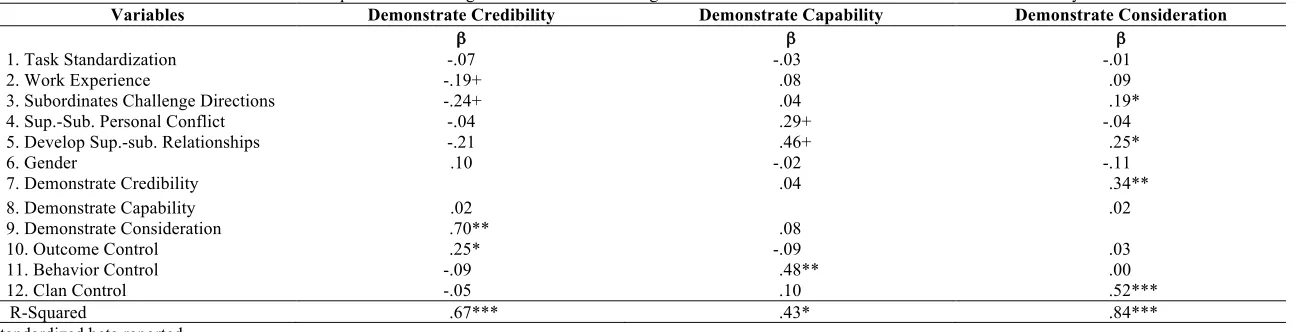
Results from these analyses provide support for Hypothesis 1a, 2a, and 3a. Specifically, managers’ efforts to apply outcome controls are positively associated with the efforts they make to demonstrate their credibility (β=.25; p<.05). Managers’ efforts to apply behavior controls are positively associated with the efforts they make to
demonstrate their capability (β=.48; p<.01). Managers’ efforts to apply clan controls are positively associated with
the efforts they make to demonstrate consideration (β=.52; p<.001).
Table 4a. Correlations among Predictor and Criterion Variables in Study 3
Mean S.D. 1. 2. 3. 4. 5. 6. 7. 8. 9. 10. 11.1.
1. Task Standardization 3.98 1.55 2. Work Experience 3.04 4.98 -.12
3. Subordinates Challenge Directions 3.69 1.49 -.05 .16
4. Sup.-Sub. Personal Conflict 2.69 1.68 -.01 -.04 .28+ 5. Develop Sup.-sub. Relationships 4.71 1.60 -.13 .00 -.01 -.37
*
6. Gender N/A N/A -.07 -.03 .01 -.15 .09
7. Outcome Control 4.22 1.16 -.02 .03 -.03 -.18 .14 -.17 8. Behavioral Control 2.99 1.25 .27
+
-.16 -.00 .27 +
-.24 .11 -.23 9. Clan Control 4.40 1.08 .27 -.02 -.38** -.43
*
.52*** -.04 .35 *
-.23 10. Demonstrate Credibility 4.69 1.24 -.03 -.16 -.36 -.30
*
.29* -.04 .53 ***
-.21 .10 11. Demonstrate Capability 3.89 1.17 .09 -.09 .05 -.06
* .35* .06 -.09 * .35 .52**** -.03 12. Demonstrate Consideration 4.58 1.10 .07 .06 -.16 -.38
** .61*** -.15 ** .44 * -.29 .73*** .68*** .18 *** 0.001; **0.01; *0.05
Table 4b. Relationships between Managerial Controls and Managers’ efforts to Demonstrate Their Trustworthiness in Study 3
Variables Demonstrate Credibility Demonstrate Capability Demonstrate Consideration
β β β
1. Task Standardization -.07 -.03 -.01
2. Work Experience -.19+ .08 .09
3. Subordinates Challenge Directions -.24+ .04 .19*
4. Sup.-Sub. Personal Conflict -.04 .29+ -.04
5. Develop Sup.-sub. Relationships -.21 .46+ .25*
6. Gender .10 -.02 -.11
7. Demonstrate Credibility .04 .34**
8. Demonstrate Capability .02 .02
9. Demonstrate Consideration .70** .08
10. Outcome Control .25* -.09 .03
11. Behavior Control -.09 .48** .00
12. Clan Control -.05 .10 .52***
R-Squared .67*** .43* .84***
6.3 Discussion of Study 3
This study provides confirmatory evidence supporting managers’ reports of their efforts to integrate their control and trustworthiness-promotion activities. The findings are very consistent with Studies 1 and 2 and suggest that subordinates observe that managers integrate their efforts to promote control and trust in ways that reflect those provided by managers. Thus, the ideas described and tested in this paper present both managers’ intentions and specific and observable sets of managerial behaviors.
7. GENERAL DISCUSSION
This paper refines and extends ideas about relationships between control and trust in several important ways. First, the observations presented suggest that demonstrating trustworthiness comprises an important set of managerial activities. Second, these studies collectively identify three ways that managers integrate their efforts to apply controls and promote trustworthiness. Third, by outlining how controls direct managers in their efforts to promote trustworthiness, this paper refines theoretical notions of managerial attention and action and extends research on trust and control as well as work in several, related domains.
The findings of these studies suggest that managers attempt to forge effective, positive working relationships with their subordinates in three distinct ways: efforts to: apply outcome controls and demonstrate their credibility, apply behavior controls and demonstrate their capability, and apply clan controls and demonstrate their consideration. Collectively, these results explain important dynamics regarding relationship development as well as outline how managers focus their trustworthiness-promotion efforts within the parameters of the controls they apply and in ways that enable them to augment their authority and capacity to elicit subordinate cooperation (Long 2010).
7.1 A Focus on Authority
This research specifies how managers actually utilize trust to promote higher levels of motivation and performance. In contrast to previous treatments of trust development (e.g., Bradach, and Eccles, 1989), managers do not necessarily assume that trust will just “evolve” through repeated interactions. Instead, managers appear to be actively engaged in trying to cultivate subordinate perceptions of their trustworthiness as they relate directly to their approaches for managing work.
Overall, the results presented Studies 1-3 suggest that models which attempt to predict subordinate trust development from managers’ applications of organizational controls in isolation may be mis-specified because they ignore critical, systematic efforts that managers make to recognize and enact complementarities between their efforts to apply those controls and demonstrate their trustworthiness. As such, this paper refines our understanding of
managerial attention as it relates to control and trust issues by describing how managers conceptualize controls as ways of guiding their relationship-building efforts with subordinates. The general prescription for scholars that emerges from this work is that, in examining control-trust relationships, they should incorporate in their models (or at least control for) the efforts managers take to demonstrate their trustworthiness.
This paper also extends views of managerial action previously adopted in control-trust research. By presenting arguments that managers integrate their efforts to apply controls and demonstrate their trustworthiness, this paper generally supports those who how managers use these activities to respond to various contextual factors and accomplish a range of performance objectives. (Cardinal et al., 2004) that investigates how managers concurrently use multiple mechanisms to direct their subordinates’ task efforts (Long, 2010).
An important implication of this research then is that managers view the controls they apply as more than merely mechanisms that they can use to force, direct, or coerce their subordinates to execute their will. Even though managers may sometimes use controls to achieve these ends, controls also help them guide how they develop positive working relationships with their subordinates. Specifically, managers use their applications of controls to help them clarify their responsibilities as organizational authorities and focus their trustworthiness-promotion efforts in ways that are relevant to the work their subordinates perform.
7.2 Control-Trust Dynamics
By outlining how managers attempt to develop trusting relationships with their subordinates, this paper advances organizational trust research in several ways. By focusing on managers’ perspectives, this paper moves scholars past using subordinates’ evaluations only of what actions managers “should” undertake to promote trust. Instead, because this paper provides insights into how managers actually attempt to integrate control and trust in their organizations, it should lead researchers to more closely examine the challenges and opportunities that managers face in forging positive work relationships with their subordinates (Spreitzer and Mishra, 1999). It is hoped that this research may assist scholars in better understanding why managers promote effective (i.e., or ineffective) forms of control and take actions that foster the development of related forms of subordinate trust or distrust.
For example, this work refines earlier research that identifies trust either as a form of control (e.g., Bradach & Eccles, 1989) or as a substitute for control (Spreitzer and Mishra, 1999) by showing how managers’ efforts to demonstrate their trustworthiness comprise a distinct category of managerial activities that can be both distinguished from but combined with the controls they apply to direct their subordinates’ work efforts.
In addition, while existing theories effectively outline managers’ control activities (Ouchi 1979; 1980), the observations presented in this paper suggest that examinations of control applications in isolation provide a relatively narrow and incomplete perspective on managerial attention and action. Specifically, the findings reported in this paper suggest that in order to develop a more accurate understanding of control-trust dynamics, researchers may want to focus more of their attention on how managers direct their subordinates’ work efforts by crafting integrated solutions to critical organizational problems. Core elements of these processes are managers’ ongoing efforts to integrate their applications of organizational controls with their efforts to demonstrate their trustworthiness.
However, because managers tend to focus on particular or even singular forms of control over time (Cardinal, Sitkin, and Long, 2004) relationships between managers’ efforts to promote specific forms of trustworthiness and their control applications that are observed here raise questions about how managers can cultivate the multiple forms of trustworthiness that are necessary to build robust forms of trust (Mayer and Davis 1999). Thus, one important question that emerges from this research involves how managers build the broad and deep forms of trust that characterize strong interpersonal relationships.
7.3 Directions for Future Research
AUTHOR INFORMATION
Chris P. Long is an Assistant Professor in Management at the McDonough School of Business, Georgetown
University. In his research, he examines the actions that leaders take within complex and dynamic business environments to accomplish a variety of key performance objectives. He has worked with multi-national corporations on issues of leadership, organizational design, and organizational change. He holds PhD in Management from Duke University. E-mail: [email protected]
REFERENCES
Adler, P. S. (2001). Market, hierarchy, and trust: The knowledge economy and the future of capitalism. Organization Science, 12, 215-234.
Arrow, K. (1974). The limits of organization. New York, Norton.
Biljsma-Frankema, K. M., & Costa, A. (2010). Consequences and antecedents of managerial and employee legitimacy interpretations of control: A natural system approach. in Sitkin, S. B. Cardinal, L B. & Bijlsma-Frankema, K. (Eds.), Organizational control (pp. 396-433) Cambridge, UK: Cambridge University Press. Bradach, J. L., & Eccles, R. (1989). Price, authority and trust: From ideal types to plural forms. Annual Review of
Sociology, 15, 97-118.
Cardinal, L. B., Sitkin, S. B., & Long, C. P. (2004). Balancing and rebalancing in the creation and evolution of organizational control. Organization Science, 15, 411-431.
Challagalla, G. N., & Shervani, T. A. (1997). A measurement model of the dimensions and types of outcome and behavior control: An empirical test of a sales-force context. Journal of Business Research, 39, 159-172. Costa, A., & Biljsma-Frankema, K. M. (2007). “Trust and control interrelations: New perspective on the trust
control nexus. Group & Organization Management, 32, 392-406.
Fayol, H. (1949). General and Industrial Management, New York, NY: Pitman Publishing,.
Jaworski, B. J., & MacInnis, D. J. (1989). Marketing jobs and management controls: Toward a framework. Journal of Marketing Research, 26, 406-419.
Khodyakov, D. M. (2007). The complexity of trust-control relationships in creative organizations: insights from a qualitative analysis of a conductor-less orchestra. Social Forces, 86, 1-22.
Long, C. P. (2010). Control to cooperation: Examining the role of managerial authority in portfolios of managerial action. in Sitkin, S. B., Cardinal, L. B., & Bijlsma-Frankema, K. (Eds.), Organizational control (pp. 365-395). Cambridge, UK: Cambridge University Press.
Long, C. P., & Sitkin, S. B.(2006). Trust in the balance: How managers integrate trust-building and control. In R. Bachmann, A. Zaheer, (Eds.), Handbook of trust research (pp. 87-106). Cheltenham, UK: Edward Elgar. Mayer, R. C., & Davis, J. H. (1999). The effect of the performance appraisal system on trust for management: A
quasi-field experiment. Journal of Applied Psychology, 84, 123-136.
Mayer, R. C., Davis, J. H. & Schoorman, D. (1995). An integrative model of organizational trust. Academy of
Management Review, 20, 709-734.
Mishra, A. K. (1996). Organizational responses to crises: The centrality of trust. in Kramer, R. M., & Tyler, T. R. (Eds) Trust in organizations: Frontiers in theory and research (pp. 261-287). Thousand Oaks, CA: Sage Publications.
Mollering, G. (2005). The trust/control duality. International Sociology, 20, 283-305.
Nooteboom, B. (2002). Trust: Forms, foundations, functions, failures and figures, Northhampton, MA: Edward Elgar Publishing.
Ouchi, W. G. (1977). The relationship between organizational structure and organizational control. Administrative Science Quarterly, 22, 95-113.
Ouchi, W. G. (1979). A conceptual framework for the design of organizational control mechanisms. Management Science, 25, 833-848.
Ouchi, W. G. (1980). Markets, bureaucracies, and clans. Administrative Science Quarterly, 25, 129-141.
Patterson, M. G., West, M. A., Shackleton, V. J., Dawson, J. F., Lawthom, R., Maitlis, S., Robinson, D., & Wallace, A. M. (2005). Validating the organizational climate measure: links to managerial practices, productivity and innovation. Journal of Organizational Behavior, 26(4), 379-408.
Pfeffer, J. (1981). Management as symbolic action: The creation and maintenance of organizational paradigms.
Podsakoff, P. M., & Organ, D. W. (1986). Self-reports in organizational research: Problems and prospects. Journal
of Management, 12, 531-544.
Podsakoff, P. M., MacKenzie, S. B., Lee, J. Y., & Podsakoff, N. P. (2003). Common method biases in behavioral research: a critical review of the literature and recommended remedies. Journal of Applied Psychology,
88(5), 879.
Rousseau, D. M., Sitkin, S. B. Burt, R. S., & Camerer, C. (1998). Not so different after all: A cross-discipline view of trust. The Academy of Management Review, 23, 393-404.
Sitkin, S. B. (1995). On the positive effect of legalization on trust. Research on Negotiations in Organizations, 185-217.
Sitkin, S. B., & Roth, N. L. (1993). Explaining the limited effectiveness of legalistic remedies for trust/distrust.
Organization Science, 4, 367-392.
Snell, S. A. (1992). Control theory in strategic human resource management: The mediating effect of administrative information. Academy of Management Journal, 35, 292-327.
Spreitzer, G., & Mishra, A. (1999). “Giving up control without losing control: Trust and its substitutes’ effects on managers’ involving employees in decision-making. Group & Organization Management, 24, 155-187. Weibel, A. (2007). Formal control and trustworthiness; Shall the twain never meet? Group & Organization
Management, 32, 500-517.
Whitener, E. M., Brodt, S. E., Korsgaard, M. A. & Werner, J. A. (1998). Managers as initiators of trust: An exchange relationship framework for understanding managerial trustworthy behavior.” Academy of
APPENDIX A: Study 1 Control and Demonstrate Trustworthiness Scales
Organizational Controls Outcome Control
1. My performance evaluations of subordinates place primary weight on the results they achieve.
2. Differences in pay among my subordinates primarily represent differences in achieved outcomes/results. 3. I link my subordinates’ rewards to the concrete results they achieve.
4. I judge my subordinates’ performance based on results they achieve.
Behavioral Control
1. I closely monitor the extent to which my subordinates follow established procedures. 2. I clearly specify to my subordinates how I would like them to perform their tasks.
3. I monitor the extent to which my subordinates follow my directions when performing their tasks
4. I modify the procedures my subordinates use in performing their work when they fail to obtain desired results
Clan Control
1. I try hard to make relationships with my relationships feel like a family.
2. I take explicit steps to align my subordinates’ work values with my work values. 3. I reward employees who get along with their co-workers.
4. I evaluate whether my subordinates get along with each other.
5. I go to great lengths to ensure that my employees use high quality production material.
Demonstrate Trustworthiness Demonstrate Credibility
1. I am extremely careful to keep my words and actions consistent
2. I make absolutely sure my subordinates receive the rewards they are owed. 3. I make sure I fulfill my subordinates’ expectations of me.
4. I am extremely careful to fulfill all of my promises to my subordinates. 5. I make sure my subordinates know I would never cheat them.
Demonstrate Capability
1. I often have to demonstrate my managerial capabilities to my subordinates. 2. I often have to use my specialized skills or knowledge to persuade subordinates. 3. I often tell my subordinates that they will be successful if they take my direction.
Demonstrate Consideration
1. I actively demonstrate to my subordinates that I have their interests in mind. 2. I promote my subordinates’ interests any chance I get.
3. I actively promote my subordinates’ sense of individual dignity.
APPENDIX B: Study 2 Scenario Texts.
General Text
Introduction (Common for all conditions)
Imagine that you are a (university name omitted) senior and a project manager of a group tasked with completing a project in your Organizational Management course. The Organizational Management is a capstone course that lasts for 12-weeks and is one of the five required classes that you are taking this semester.
Your Job
For this course, you must manage a unit of six, sophomore student employees who work as customer service representatives for a student-run business. These students work to resolve customer complaints about the services provided by the business. Business school sophomores work in this role because it can be good experience for them. In your role, you manage them. For their participation, students can earn extra credit points to put towards business school classes of their choosing.
The work that these students perform is fairly straightforward. .
You believe that this will be very important experience for you. In managing this unit you may utilize several of the functional skills (accounting, marketing, organizational behavior, etc….) you have gained during your undergraduate business education.
Outcome Control Condition
Your Management Approach
Your grade for this course depends on the overall customer service ratings that members of your unit achieve. As a result, you are very “results-oriented” in your management approach and seek to motivate your student employees through the customer service ratings they achieve.
This means that you believe the best way to motivate your employees is to provide them with a performance rating system that is:
1.! Clear and unambiguous 2.! Transparent
3.! Based on the results or outcomes that employees achieve.
4.! Developed from the ratings included in customer satisfaction surveys. .
Because it does not align with your “results-oriented” approach, you explicitly DO NOT concern yourself at all with training your employees. You also do not have the time to directly monitor the specific methods and processes that your employees use to do their work.
Instead, your primary focus is on making sure that your employees know what results they need to achieve and are strongly motivated to achieve those results.
To direct your employees, you provide them with information about the customer service ratings you expect them to achieve and three dates when you will evaluate their progress. You also informed your employees that you will provide them with your evaluations of their work and their expected performance ratings for the course on those dates.
To achieve your goals using your "results-oriented” approach, you need to ensure that you strongly motivate each of your employees to achieve high customer service ratings.
Behavioral Control Condition
Your Management Approach
Your grade for this course depends entirely on how well your student employees follow your directions for handling customer concerns.
As a result, you are very “process-oriented” in your management approach and seek to motivate your student employees through the customer service behaviors they exhibit.
This means that you direct your employees to closely follow your instructions when addressing customer concerns. You try hard to make your instructions clear and unambiguous. In addition, to ensure that your employees are following your instructions, you monitor their in-person and phone-based conversations with customers.
.
Because it does not align with your “process-oriented” approach, you explicitly DO NOT concern yourself at all with training your employees. You also do not have the time to directly evaluate the customer service ratings your employees receive.
Instead, your primary focus is on making sure that your employees follow your instructions for handling customer complaints.
To help your employees, you provide them with a manual of standard operating procedures (SOPs) that you have developed. You also informed your employees that you will be monitoring whether they utilize these SOPs.
You have informed your student employees that you will base your performance ratings of them on how closely they follow your instructions and the policies and procedures you have developed.
To achieve your goals using your "process-oriented” approach, you need to ensure that each of your employees implements the correct policies and procedures in the way you prescribe
Clan Control Condition
Your Management Approach
Your grade for this course depends entirely on how much your employees learn from the experience with you and how well they feel like they have been assimilated and accepted into your team.
As a result, you are very “development-oriented” in your management approach and seek to motivate your employees to learn and become integral members of your team.
This means that you believe that the best way to motivate your employees to focus on learning is to make sure that you:
1.! Select student employees whom you think will work well within your group. 2.! Provide these employees with the training they need,
3.! Get them the material resources (e.g., computers, telephones) they need to do their jobs. 4.! Encourage them to get to know other members of the group.
To help your employees, you sent them to a one-day course where they learned the basics of providing customer service. You also made sure that they were introduced to the other members of your work group. Your hope is that they would bond and learn job skills from their co-workers.
You have informed your student employees that you will base your performance ratings of them on how motivated they are to learn about their jobs and how well they get along with the other members of your group.
To achieve your goals using your "development-oriented” approach, you need to ensure that each of your employees takes full advantage of their learning opportunities. Because this will help motivate their learning, you also want to make sure that each of your employees feels like an integral, accepted, and well-liked member of your work group.
Autonomy (Low Control) Condition
Your Management Approach
As long as you simply agree to continue to participate as a manager in this program, you will earn an excellent grade in this course.
As a result, you are very “hands-off” in your management approach and don’t want to influence or control how your employees do their jobs.
You want to keep yourself out of controlling your employees in their work.
You do not rate their work. In addition, you do not specify for them how they should perform their jobs and you do not see a need to train them to perform their jobs.
.
Because it does not align with your “hands-off” approach, you try not to control or influence your employees’ work activities in any way.
Your primary focus is on making sure that do not get involved in any way with controlling your employees in the performance of their work activities.
Your employees will receive a number extra credits just for agreeing to participate in this program.
APPENDIX C: Study 3 Task Control and Demonstrate Trustworthiness Scales
Organizational Controls Outcome Control
1.! I am evaluated primarily on the results I achieve.
2.! Differences in compensation between me and my co-workers primarily represent differences in our achieved performances.
3.! The rewards I receive are determined by the only by the results I achieve 4.! My manager makes sure I achieve sufficient results.
Behavioral Control
1.! My manager closely monitors the extent to which I follow established procedures. 2.! My manager specifies for me how he/she wants to complete my job tasks. 3.! My manager specifies to me how I should perform my job tasks.
4.! I am evaluated primarily on how closely I follow my manager’s directions
Clan Control
1.! My manager tries to help me build strong emotional bonds with him/her. 2.! My manager takes steps to align my work values with his/her work values. 3.! My manager tries to help his/her employees fit into their unit.
4.! My manager attempts to help me feel part of a team.
5.! My manager attempts to ensure that I am fully prepared to perform all aspects of my job.
Demonstrate Trustworthiness Demonstrate Credibility
1.! My manager tries to keep his/her words and actions consistent. 2.! My manager works to ensure that I receive the rewards I am owed. 3.! My managers tries to fulfill my expectations of him/her.
4.! My manager tries to fulfill his/her obligations to me.
5.! My manager attempts to make sure that my rewards accurately reflect the efforts I put into my work.
Demonstrate Capability
1.! My manager attempts to influence me by referring to his knowledge of or capacity to do my job. 2.! My manager uses his/her specialized skills or knowledge to try to influence me.
3.! My manager often tells me that I will be successful if I take his/her direction.
Demonstrate Consideration
1.! My manager often tells me that he/she has my interests in mind. 2.! My manager tries to promote my interests.
3.! My manager attempts to promote my individual dignity.