948
Extracting Text Features Using
Learning-To-Rank-Methods From The Perspective Of Information
Retrieval
YellepeddiVijayalakshmi, B. Arun Kumar, G. K. D. PrasannaVenkatesan
Abstract: In recent times, retrieving relevant information from a huge amount of data has gained the attention of researchers. Diverse search systems are offered for this purpose; however, it should have the ability to attain the most appropriate search outcomes in accordance withuser query that fulfils user needs. Various techniques are also provided to retrieve information. Generally, in conventional search engines, text content is considered and images in the content may be violated. However, images in web pages are utilized for retrieving other appropriate images by evaluating their visual and textual content. Also, in conventional text-based search engines, appropriate images are retrieved with visual features by providing a textual query. Diverse search engines and systems are presented for easy access and retrieval of relevant multi-media content on a ranking basis. This ranking approach is based on textual content that is phrased from huge data with visual contents. So, this study provides an effectual ranking approach based on Text parsing from Multi-Source document (R-TPM) producing information retrieval by eliminating redundancy. Simulation is carried out in MATLAB environment; the proposed model shows better trade-off in contract with the existing IR approaches based on ranking.
Key terms: Information retrieval, Ranking, Text parsing, visual content, textual content
—————————— ——————————
I INTRODUCTION
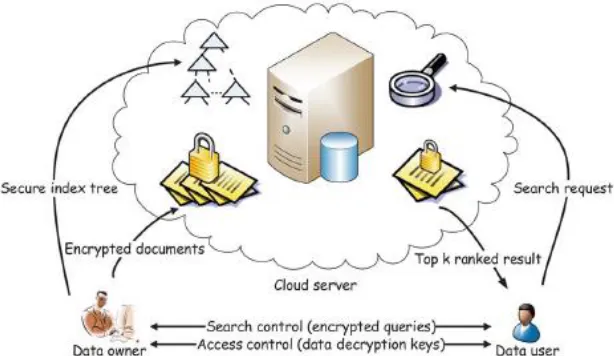
n recent times, research over web-content-retrieval has raised its potential, which makes it complex for investigators to capture the information they need from huge content. So,in order to meet this requirement more effectually, information retrieval (IR) approaches are modeled for retrieving textual information by concentrating on how to effectually retrieve essential information [1]. When a query is generated by the user, an IR system has to search for its appropriate documents and rank them based on their relevance based on the query [2]. Unlike conventional IR, text IR faces major challenges in certain domains, and most of these difficulties are due to the terminology [3]. Documented contents use various terminologies to specify similar content, and as an outcome, two relevant text documents for the same query may change a lot [4]. To overcome this drawback, text information should be more Complete, IR system should handle all relevant documents in all aspects, where these aspects are measured as relevance documents‘ subset related to similar terminologies [5].
Henceforth, text IR systems not only concentrate on attaining the most appropriate documents based on a user query. However, this also emphasizesquery-related factors‘ coverage on the text-based rank list, which is specified as the diversity of searching results [6]. To illustrate this diversity in detail, consider an instance of a user query, ―What is the necessity of performing IR on the web page?‖ A query is provided by the user, where its related documents are retrieved based on queries‘ closeness after these appropriate documents are
divided into multiple groups. Every group has its unique labeling, such as ―user need‖, ―stemming‖, ―ranking‖, ―domain-specific‖,etc.Everytext here reflects the aspects of query content and comes under document ranking list specifying diversity of degree result. The ultimate goal is to retrieve the most appropriate text document that covers all the factors as much as possible. In recent times, various conventional IR systems have been initiated for text-based document ranking to attain better results. Learning from this ranking process, as a review of IR techniques, has been proven more effectual in diverse IR tasks, which resolves ranking problems with machine learning approaches with diverse features and numerous learning models to ranking methods as in [7]. Moreover, a few investigations try to employ learning approaches to rank methods for enhancingdiversity-oriented text information retrieval. Learning diverse ranking information can be systematically dealt with by the ranking approach. Ranking information can be either a feature-oriented or statistical textual feature [8]. In the former, features are attained from conventional IT models like vector space model, whereas in the latter term frequency will be considered. Subsequently, the training phase for learning to rank approaches iteratively diminishes ranking loss value (that is, the difference between ground truth ranking and predicted ranking) until an optimal ranking model is eventually attained [9]. Henceforth, it is considered promising to enhance information retrieval with feature parsing to rank methods [10]. In this study, a novel framework based on text parsing to rank methods is anticipated to analyzewhether parsing to rank methods would be advantageous for text information retrieval for user queriesand to heighten both diversity of results and relevance. In this framework, three novel ranking strategies sreperformed to capture aspect information of relevant text documents, therefore considering parsing text with redundant text elimination. In the meantime, a text document is presented to provide a query as a feature vector by scoring documents with diverse conventional IR models. Thus, an effectual ranking model is constructed with these feature vectors as training data to enhance retrieval performance. At last, for newer queries, document ranking with the parsing model is predicted.
I
————————————————
Mrs. Yellepeddi Vijayalakshmi is currently pursuing Doctoral degree program in Computer Science & engineering, Karpagam Academy of Higher Education (Deemed to be University), India, PH- 8281768366. E-mail: [email protected]
Dr.B.ArunKumar is currently serving as Associate Professor in Computer Science & engineering, Karpagam Academy of Higher Education (Deemed to be University), India.
949 Fig 1: Web-based User Query and Information retrieval
The significance of this study is listed below:
1. A parsing framework is anticipated to merge parsing based ranking methods into text information retrievaland to computeanticipated model performance with numerous prevailing approaches to rank methods with this framework.
2. Here, three parsing strategies: one concentrates on the optimality of ranking the target document and the other is based on redundancy elimination to rank the model.
3. The efficiency of the anticipated framework on uncertain text dataset is examined and compared with the performance of various ranking methods. The remainder of this study is structured as given below: Section II, reviews prevailing approaches,Section III depicts problem formulation and motivation for this investigation, Section IV elaborates on the anticipated parsing based ranking approach, Section V explains experimental results and corresponding analysis and Section VI gives the conclusion with direction for future research.
II RELATED WORKS
This study presents the related work based on information retrieval and ranking approach in detail and shows how the anticipated model varies from previous works. The significant objective of word classes, indeed of other information, is to grasp informative text as generally provided, and specific informative word with other words. Also, word classes depict finite and small sets of classified by making them more appropriate to execute IR tasks. In general, investigators utilize all words (adverbs, verbs, adjectives, and nouns) in text retrieval.However,itnot obvious if the specific word class is more effectual than others. Certain investigations determine that nouns are finest for document content indicators. In some fields like advertisement or biology, it is emphasized that there isadifference amongst properties and things;thus, adjectives are more important. Some applications like music are mostlyadverb-rich; here adverbs‘ role is more crucial. In [11], the author performed a comprehensive investigation for evaluating events-profiling of news articles as verb type function. It is also determined that stop words are more resourceful. However, for projecting significance of word-class during retrieval, in [12] the author anticipatesan
algorithm for enhancing the original IR algorithm termed POS weighted algorithm. Ittakesquery term POS into consideration and allocates diverse weights correspondingly. Empirical outcomes prove that it attains extremely positive outcomes. In [13], a novel term for weighting is evaluated from POS n-gram statistics. This weighting specifies how informative terms are general, sourced on the POS context that generally happens in languages. Experimental outcomes demonstrate that merging this POS-sourced term weight to IR provides upto 33.8% enhancement over baseline approaches in background study. In [14], explain how to extendtheintegration of word classes with clinical information retrieval. It determines that retrieval includes word classes with optimal weights that outperform retrieval based on consistent weights. Various determinantsinthe Persian language specify that word classes may hold only the least impact ontheefficacy of retrieved outcomes. However, when information is merged with stemming, precision enhances more significantly. In [15], the author uses word classes to enhance index storage overhead and usual retrieval system speed with minimal effect over recall and precision measurement. The author reveals that Arabic information retrieval systems have more appropriate word classes which are nouns. Outcomes of this investigation based on experimentation are carried out as far as possible in the English language.
III
PROBLEM
FORMULATION
AND
MOTIVATIONS
950 contains implicit text information. The provided implicit text
information of text documents generally can be processed via the pre-processing step. Pre-processing frequently involves automatic text recognition and redundancy removal processing. Moreover, the quality of extracted text data is generally rather poor owing to its long-standing complexity of feature recognition over natural text and contents. Even then text can be extracted from the finest quality of content like well-structured text document that is poor in some instances. The nature of text-based information retrieval makes this process to be more challenging than the conventional information retrieval task. Certain challenges consist of the following factors:
1) The text description of query content has to be quite small. This offers a challengefor searching text documents by text over redundant text transcripts extracted from text.
2) Merely a small amount of positive visual samples will be offered. Collecting diverse labeled visual instances from users would be costly in practice. 3) There are diverse resources from multiple modalities,
comprising text transcripts from text datasets, lower text content and redundancy and so on. A combination of diverse resources is still an open crisis.
4) The amount of text content can be extremely huge. It is crucial while developing a ranking strategy with both superior scalability performance and retrieval performance towards large scale text-based applications.
So as to deal with the above confronts, in this investigation, a multi-sourced ranking framework has been anticipated for handling these issues in a unified manner, which can drastically influence the efficacy of retrieval tasks while significantly diminishing computational cost. The significant concept for resolving these challenging problems are summarized as below: 1) To deal merely with small user queries, this work
alleviates this problem in text-based information retrieval by using Pre-processing with text parsing. 2) To resolve small instance-based learning problems,
this work suggests a parsing-based ranking model in the multi-sourced document by applying a ranking approach, in which ‗samples‘ are engaged for information retrieval.
3) To merge resources from numerous modalities, parsing is done with redundancy elimination and decision process by smoothly fusing multi-modal resources over text.
4) To make this ranking approach to be practical in large scale text retrieval, the multi-sourced ranking framework is merged with the parsing approach in a cascaded manner, which drastically diminishes computational cost and maintains superior retrieval performance.
IV PROPOSED METHODOLOGY
This section formally presents a Ranking algorithm based on Text parsing in a multi-sourced document from an uncertain dataset. This work initially describes a preliminary idea behind this model. Initially, for provided query content, text pre-processing with respect to parsing the query topic is established. As an outcome, the text ranking task can be formulated with text parsing based on filtering and reduction in order to look into a smooth ranking algorithm. The value of text at every level can be measured as a relevance score of text with respect to the user query. Moreover, this ranking approach succeeds in probabilistic interpretation from the perspective of a random walk. Suppose, a query is generated from random walk behavior.The functional value ofa searching text can be obtained from the probability of text that hits a document through queries. Now, the text ranking problem becomes crucial to show how to learn ranking function over parsing. As the query generated by the user is traced as a labeled node and searching text from datasetsisdetermined as unlabelled nodes, parsing based ranking problems can be considered to be equivalent to a learning problem. In this investigation, the parsing-based ranking method is used to resolve our ranking issues, which has been depicted effectually for text retrieval applications. Consider that other emerging ranking approaches can be investigated to resolve the ranking crisis in the anticipated framework.
a. Data source
Consider an uncertain dataset ‗D‘ which can only be accessedviathe Boolean-based query interface and it does not provide direct access over underlying text document. Query interface examines ‗Boolean-based Query‘ and turns text documents to be ranked with non-desirable ranking function, for instance, any English language parsing. For example, if user text query is ‗T‘ [information, retrieval, text], then it can be submitted to data source queries as ‗T1‘ [information AND retrieval AND text], ‗T2‘ [information AND retrieval AND NOT text], ‗T3‘ [information OR text] and so on. The attained results are found to match Boolean conditions; however, documents are not matched to be ranked in any resourceful manner. Here, a framework has to be designed for retrieving from ‗T‘ form ranking of documents according to parsed query content. The trivial solution has to transmit an extremely broad disjunctive query, returning all documents that have non-zero scores. After that, information can be retrieved from documents, and the contents are analyzed and the content rerankedlocally before offering outcomes to users. Regrettably, it is a somewhat time-consuming approach. Henceforth, the ultimate objective of this work is to model as query a series of Boolean queries that can be submitted to the database to retrieve afew documents as possible and include all documents that are in
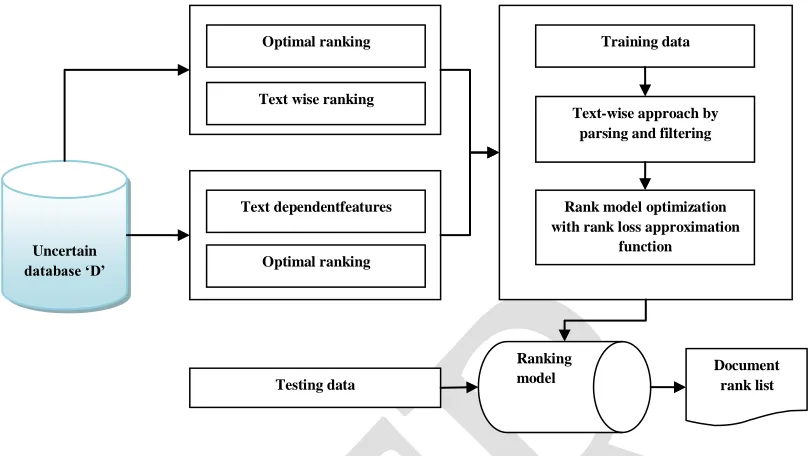
951 Fig 2: Flow diagram of the proposed Ranking model
b. Text parsing
After considering uncertain datasets, text parsing has to be generated with a comprehensive list of child phrases by hauling out resourceful parts from sentences of tree structures. For every sentence, the tree can be divided into sub-trees, and then each tree can develop new branches with verb phrases and noun phrases in addition to pre-positional phrases and merge these leaves to sub-tree labeling either as noun phrases or verb phrases to produce child phrase as in Fig. 2. Indeed, every child phrase holds the list of query tag that will be extracted from the corresponding sub-tree that will be used in subsequent phases. The descriptions of these query tags based on part-of-speech tags used here are provided in Table I based on background study. To attain an effectual list of children‘s features, returned children‘s phrases have to undergo a text-based filtration process, which is performed in the next step.
c. Filtering children’s phrases
In general, the filtering process contributes a lot to system performance; therefore it is an essential stage in children based feature extraction. The list attained from children‘s phrases is filtered with certain heuristic rules determined based on observations. Consider children areincluded in the final list of the candidate as in fulfills significant heuristic rules. These rules are utilized to attain a list of resourceful and syntactically appropriate children‘s phrases. Here, the length of children‘s phrase (that is, words) has to lie within contextual cradle size, where contextual cradle size is considered as cut off level for the length of children‘s phrase with highest recall value that is attained from datasets. This contextual cradle size is experimentally determined by changing it from 5 to 10. Even though, the key to handle this cradle comprises less than 8 words that include stop words too; in this work, the children carry contextual information for key concepts.
1) Henceforth, the maximum length of children‘s phrases is bounded by the contextual cradle.
2) Subsequently, children‘s phrase length is the sum of the actual length of user text it specifies and also the length of contextual information.
3) Children should not terminate with stop words. 4) Children should not hold a punctuation mark. 5) Children are directed to hold ASCII codes only.
d. Redundant child based query tag elimination
The filtered list alsoconsistsof redundant phrases; this is because one phrase may be part of another phrase. Therefore, the next step has to concentrate on redundant text phrases to attain a desirable comprehensive list of candidate features by eliminating overlap occurrence between phrases. The children‘s phrase list attained from the previous step is iterated and redundant phrases will be eliminated with conditions given below:
1) If the verb-based children‘s phrase is part of , both belong to a similar sentence therefore eliminate
2) If a noun basedchildren‘s phrase is part of , both belong to a similar sentence therefore eliminate
e. Ranking based on Text parsing
After filtering the redundant phrases, the ranking has to be done. Here, the text-wise approach is openly utilized to resolve the ranking task. The text-wise extraction model intended to identify the appropriate relevance of every child clause to provide the meaning of the search. Loss based on the ranking is achieved based on differences amongst predicted and ground truth levels;itis diminished by optimization. Text-wise loss wise approximation can be designed as follows in Eq. (1):
( ( ) ) ∑( ( ) ) (1)
Uncertain database ‘D’
Optimal ranking
Text wise ranking
Text dependentfeatures
Optimal ranking
Testing data
Training data
Text-wise approach by parsing and filtering
Rank model optimization with rank loss approximation
function
Ranking
model Document
952 Here, is ranking model, ( ) is predicted the score of
child clause by ranking model, is measured as ground truth labeling of a clause. From Eq. (1), it is depicted that the total loss of the text-wise method is the summation of loss function over the entire clauses.
Text-wise ranking approximation is depicted as ranking loss based on preferences to text order of every two child clauses and it optimizes the loss by determining the number of incorrectly classified child clause pairs. Consider ‗Rankboost‘ as a sample. Rank boosting merges preferences sourced in boosting scheme in learning approaches. It makes use of an object with samples in the training processthatis rounded to merge weaker learning, each of them being feebly correlated to target ranking. Rankboosting is an ensemble model of weaker learners as in Eq. (2):
( ( ) ( ) )
∑ ( ( )( ( ) ( ))
(2)
Equation (2) is loss function approximation of the ranking model, where is a ranking model, ( ) and ( ) is predicted the score of clause and clause and is a ranking preference among two clauses sourced on ground truth labels.Eq. (2), it identifies that total loss for text-wise approximation is loss summation of the overall clause from text pairs.
Algorithm 1:
Input: Input text from ‗uncertain dataset‘
Output: Text retrieval based on ranking
Step 1: Begin
Step 2: Initialize input parameters from uncertain ‗dataset‘
Step 3: While is not reached do Step 4: Identify text to be retrieved from the user query
Step 5: Activate Text parsing Step 6: Repeat
Step 7: For every sentence in check stop word text
Step 8: Partition tree to sub-tree
Step 9: If sub-tree cannot include more input text document
Step 10: Sub-trees are branched to children‘s phrase
Step 11: Filter Verb phrase, Noun Phrase Step 12: Update contextual text cradling
Step 13: Determine actual length with contextual text length
Step 14: Filter redundant text Step 15: End
Step 16: End
Step 17: For all ranking computation do Step 18: Use metrics for ranking approximation Step 19: End
Step 20: Till approximation termination
Step 21: Increase Text-wise ranking
approximation as in Eq. (1) Step 22: End
Step 23: Update Rank-boosting for attaining best text IR from generated user query as in Eq.(2) Step 24: If loss function approximation is lesser then
Step 25:Text IR is superior Step 26: Else
Step 27: Ranking preferences based on two clauses sourced on ground truth label as in Eq. (3).
Step 28: End
Step 29: Return best IR text after regression Step 30: Compute Accuracy
Step 31: end
Text-wise approximation provides ranking openly fitting predicted and ideal list of ranking clauses. Text-wise approximation makes this ranking approximation for model optimization. Lambdamart approximation [16] is a Text-wise approximation, an ensemble based on tree-children ranking by executing Lambdarank with multiple additive regression trees. Lambdamart utilizes mart to handle Newton step and suitable gradients to attain minimal loss function, and after that evaluates outputted children‘s node value in every regression tree. Lambdamart initiates the parameter for loss function gradient replacement. Withranking,thelist clause attains contributions from clauses for similar text as trails in Eq. (3):
∑ ∑ ( ) ( )
(3)
Here, lambdamart changes the gradient of the loss with ranking variation via swapping ranking two clauses position, where is ranking loss by changing clause and
position.Itutilizes gradient loss function andboosted regression trees to reduce iterations of ranking loss.
This work depicts the learning rank structure for text information extraction. Here, child clauses are used for provoking text as feature vectors. Vector of child clauses included diverse kinds of text-independent and dependent features in accordance withrankingmodels. This work treats text representations as input learning asarank for developing text-oriented clause ranking approximation. This investigation shows three methods to learn to rank the text extraction task. It is illustrated as 97% of text signifying a single child clause. Considering rank clause in every text for retrieving text information and parsing the rank of a text with ranking optimization, the multi-source documents will be identified in the future works.
V Experiments and Analysis
953 adverbs, adjectives and parts of speech, length of text
specifies feature set devoid of feature embedding, reduction, redundancy, Query tagging, text length based features correspondingly. These features specify complete feature sets. This work adopts commonly attained evaluation metrics anticipated by [17] to evaluate feature extraction performance. These metrics are extensively utilized in the performance evaluation of text feature extraction. Here, recall, precision, F-measureand its computations are performed using Eq. [4], [5] & [6]. In these performance metrics, if recognized features cover the annotated clause, extraction is measured appropriate. Recall (R), Precision (P), F-measure (F) for Text-based feature extraction are depicted as trails in Eq. [4], [5] & [6]:
∑
∑ (4)
∑
∑ (5)
(6)
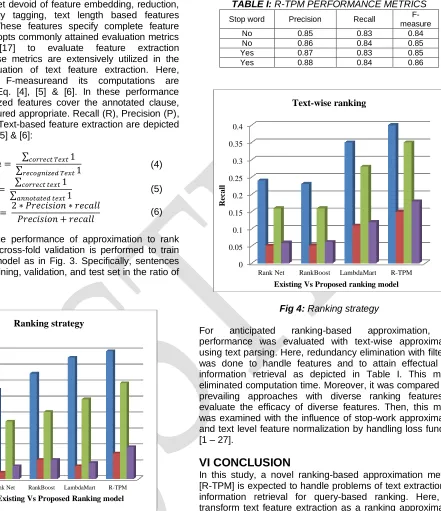
To acquire average performance of approximation to rank approaches, here cross-fold validation is performed to train the Text ranking model as in Fig. 3. Specifically, sentences are divided into training, validation, and test set in the ratio of 3:1:1.
Fig 3: Ranking strategy
Text ranking, following standard partition scheme utilized in an uncertain dataset, is an extensively-utilized approximation to rank datasets. Here, a training set is used to train the ranking approach, validation to choose factors for diverse ranking approximation,andatest set foringtheidentityof new text. This work shows experimental outcomes sourced on average performance on entire folds for the finest comparison as in Fig. 4.
TABLE I: R-TPM PERFORMANCE METRICS
Stop word Precision Recall F-measure
No 0.85 0.83 0.84
No 0.86 0.84 0.85
Yes 0.87 0.83 0.85
Yes 0.88 0.84 0.86
Fig 4: Ranking strategy
For anticipated ranking-based approximation, the performance was evaluated with text-wise approximation using text parsing. Here, redundancy elimination with filtering was done to handle features and to attain effectual text information retrieval as depicted in Table I. This model eliminated computation time. Moreover, it was compared with prevailing approaches with diverse ranking features to evaluate the efficacy of diverse features. Then, this model was examined with the influence of stop-work approximation and text level feature normalization by handling loss function [1 – 27].
VI CONCLUSION
In this study, a novel ranking-based approximation method [R-TPM] is expected to handle problems of text extraction for information retrieval for query-based ranking. Here, we transform text feature extraction as a ranking approximation from the perspective of information retrieval. Then, this work defines and hauls out huge amounts of text-dependent and text-independent features for ranking approximation. Here, three approaches are investigated to ranking construction based on parsing and filtering. This model is evaluated based on a publicly accessible dataset for text feature extraction. Experimental outcomes demonstrate that the projected model is effectual in recognizing the text for information retrieval. This model outperforms prevailingapproacheswith F-measure, Recall, precision. This work may develop resourceful ranking approaches by ranking feature-construction for text feature extraction. Here, this work attempts to optimize ranking-sourced extraction by recognizing linguistic and semantic information of text for fine-grained text analysis.
0 0.05 0.1 0.15 0.2 0.25 0.3 0.35 0.4
Rank Net RankBoost LambdaMart R-TPM
P
re
cis
io
n
Existing Vs Proposed Ranking model Ranking strategy
0 0.05 0.1 0.15 0.2 0.25 0.3 0.35 0.4
Rank Net RankBoost LambdaMart R-TPM
R
ec
al
l
954
REFERENCES
[1] Y.Cao, J.Xu, T.Y.Liu, H. Li,Y. Huang, and H.W.Hon, ―Adapt-ing Ranking SVM to Document Retrieval,‖In Proceedings of the 29th annual international ACM SIGIR conference on re-search and development in information retrieval (pp. 186-193). ACM, 2006.
[2] T.Y. Liu,‖Learning to Rank for Information Retrieval,‖Founda-tions and Trends in Information Retrieval, 3(3), 225-331, 2009.
[3] Q. Wu,C.J.Burges, K.M. Svore,and J.Gao, ―Ranking, Boost-ing, and Model Adaptation,‖TecnicalReport, MSR-TR-2008-109, 2008.
[4] X. Yin, J.X.Huang, Z.Li, and X.Zhou, ―A Survival Modeling Approach to Biomedical Search Result Diversification Using Wikipedia,‖IEEE Transactions onKnowledge and Data Engi-neering, 25(6), 1201-1212, 2013.
[5] Y. Chen, X.Yin, Z.Li, X.Hu, and J.X.Huang, ―Promoting Rank-ing Diversity for Biomedical Information Retrieval based on LDA,‖In Bioinformatics and Biomedicine (BIBM), 2011 IEEE International Conference on (pp. 456-461). IEEE, 2011.
[6] X. An, and J.X.Huang, ―Boosting Novelty for Biomedical In-formation Retrieval Through Probabilistic Latent Semantic Analysis,‖In Proceedings of the 36th international ACM SIGIR conference on Research and development in information re-trieval (pp. 829-832). ACM, 2013.
[7] J. Sun, S.Wang, B.J. Gao, and J.Ma, ―Learning to Rank for Hy-brid Recommendation,‖In Proceedings of the 21st ACM inter-national conference on Information and knowledge manage-ment (pp. 2239-2242). ACM, 2012. [8] Lin, H.Lin, Z.Ye, S.Jin, and X.Sun, ―Learning to Rank with
Groups,‖In Proceedings of the 19th ACM international confer-ence on Information and knowledge management (pp. 1589-1592). ACM, 2010.
[9] Vargas, P. Castells, andD. Vallet, ―Explicit RelevanceModels in Intent-Oriented Information Retrieval Diversification,‖In Proceedings of the 35th international ACM SIGIR conference on Research and development in information retrieval (pp. 75-84). ACM, 2012.
[10] C. J. Burges, ``From ranknet to lambdarank to lambdamart: An overview,'' Learning, vol. 11, p. 81, Jun. 2010.
[11] C. J. Burges, R. Ragno, and Q. V. Le, ``Learning to rank with nonsmooth cost functions,'' in Proc. Adv. Neural Inf. Process. Syst., 2007, pp. 193_200.
[12] Y. Kim, ``Convolutional neural networks for sentence classi_cation,'' in Proc. Empirical Methods Natural Lang. Process., 2014, pp. 1746_1751.
[13] X. Cheng, Y. Chen, B. Cheng, S. Li, and G. Zhou, ``An emotion cause corpus for chinese microblogs with multiple-user structures,'' ACM Trans. Asian Low-Resource Lang. Inf. Process., vol. 17, no. 1, p. 6, 2017. [14] L. Gui, D. Wu, R. Xu, Q. Lu, and Y. Zhou, ``Event-driven
emotion cause extraction with corpus construction,'' in Proc. Conf. Empirical Methods Natural Lang. Process., 2016, pp. 1639_1649.
[15] L. Gui, J. Hu, Y. He, R. Xu, Q. Lu, and J. Du, ``A question answering approach to emotion cause extraction,'' in Proc. Conf. Empirical MethodsNatural Lang. Process., 2017, pp. 1593_1602.
[16] Rajendran T et al, ―Recent Innovations in Soft Computing Applications‖, Current Signal Transduction Therapy, Vol. 14, No. 2, pp. 129 – 130, 2019.
[17] Emayavaramban G et al, ―Indentifying User Suitability in sEMG based Hand Prosthesis for using Neural Networks‖, Current Signal Transduction Therapy, Vol. 14, No. 2, pp. 158 – 164, 2019.
[18] Rajendran T & Sridhar K P, ―Epileptic seizure classification using feed forward neural network based on parametric features‖. International Journal of Pharmaceutical Research, 10(4): 189-196, 2018.
[19] Hariraj V et al, ―Fuzzy multi-layer SVM classification of breast cancer mammogram images‖, International Journal of Mechanical Engineering and Technology, Vol. 9, No.8, pp. 1281-1299, 2018.
[20] Muthu F et al, ―Design of CMOS 8-bit parallel adder energy efficient structure using SR-CPL logic style‖, Pakistan Journal of Biotechnology, Vol. 14, No. Special Issue II, pp. 257-260, 2017.
[21] Yuvaraj P et al, ―Design of 4-bit multiplexer using Sub-Threshold Adiabatic Logic (STAL)‖, Pakistan Journal of Biotechnology, Vol. 14, No. Special Issue II, pp. 261-264, 2017.
[22] Keerthivasan S et al, ―Design of low intricate 10-bit current steering digital to analog converter circuitry using full swing GDI‖, Pakistan Journal of Biotechnology, Vol. 14, No. Special Issue II, pp. 204-208, 2017.
[23] Vijayakumar P et al, ―Efficient implementation of decoder using modified soft decoding algorithm in Golay (24, 12) code‖, Pakistan Journal of Biotechnology, Vol. 14, No. Special Issue II, pp. 200-203, 2017.
[24] Rajendran T & Sridhar K P, ―Epileptic Seizure-Classification using Probabilistic Neural Network based on Parametric Features‖, International Journal of Scientific & Technological Research, Vol.9, No. 3, 2020 (Accepted for Publication).
[25] Rajendran T et al, ―Performance analysis of fuzzy multilayer support vector machine for epileptic seizure disorder classification using auto regression features‖, Open Biomedical Engineering Journal, Vol. 13, pp. 103-113, 2019.
[26] Rajendran T et al, ―Advanced algorithms for medical image processing‖, Open Biomedical Engineering Journal, Vol. 13, 102, 2019.