Chain Based Routing Algorithm Using Hybrid
Optimisation For Wireless Sensor Network
Rohini, Dr. Kanika Sharma
Abstract: WSNs are spatially distributed, self-regulating sensors to track the physiological objects or observe the ecological information and gather the information to the main controller. WSN contains radio trans-receiver, micro-controller and sensor devices. A sensor device contains various applications that can be utilised in various fields. Different sensor devices are categorised on the basis of the inclines for the deployment of the fields that focused in term of economical, engineering, price and scalability. In wireless sensor network the system is controlled by the main controller and utilised to acquire information from various fields. Some of the applications of WSN is agriculture, monitoring of environment, Healthcare and transport services, authentication and surveillance, industrial uses. Wireless sensor network has the key restraint on power of sensor hops that is single hops contains a definite amount of energy. Hence, WSN may contain a robust energy reduced technique as key issue on the basis of energy. In present research, routing protocol utilise Power efficient gathering in sensor information systems (PEGASIS) is routing convention that depends on chain based and greedy approach. The sensors hops are arranged in form of the chain. In case any hop fails in between then the chain is rebuilt to bypass the failed hop. CH is allocated and transfers the information to the controller or sink hop. Performance metrices was analysed with packet delivery ratio to achieve the value up to 80%.In proposed research, a routing method for WSN is developed to improve the network lifetime, packet delivery ratio and energy consumption with help of number of rounds. The novel method has designed hybridization with GA+ALOA algorithm to resolve the issues in the network. GALO (Genetic-Ant Lion Optimization) is developed to improve the performance of the network. Simulation analysis is done using MATLAB. It is analysed that packet delivery ratio is improved up to 85%. Hence, the packet loss value is 9 bits and reduce energy is 0.9 joules.
Keywords: Wireless Sensor Network, Routing Protocol, Ant Lion Optimization and Genetic Optimization Algorithm in WSN. ————————————————————
1.
INTRODUCTION
Wireless sensor network is a system that consists of the smaller devices that worked as hops and deployed on geographical region that can sense the environment situations and convert electric signal collected form observed field through wireless connections [1] [2]. The information is forwarded from multiple nodes to the sink or the controller. Due the advent in electrical services, wireless connections, there has been increased use of the wireless sensor network [3]. The spatial scattered sensor hops gathered the data from physical environment is wireless sensor network [4]. It helps in monitoring of the atmospheric situations like as high temperature, moisture, noise and weight. The battery replacement becomes a difficult task so ,WSN functions for restricted period of time [5] [6]. WSN has been utilised in the variety of the applications such as army services for monitoring enemies, health services, environmental situations and so forth. An efficient routing in WSN has become an essential approach. Routing in wireless sensor system includes severe power saving and accumulative system lifetime [7]. The main goal of routing is selection of the route and forwarding information from sender and receiver through intermediate hops. The best path is selected among source and sink hop. The communication is done by choosing nearest node to forward information towards to selected path.
The main goal of routing is to acquire minimum overhead, increased lifetime and throughput [8] [9]. The strategy and establishment of routing protocol for wireless sensor network is essential approach for system administration. The maximum energy is required at the time of the transmitting information as compared to receiving of information. Hence, power consumed disturbs the life period of the whole system. Due to complex system, the replacement of battery is not easy [10] [11]. Hence, system requires maximum power for wireless sensor system to save energy. It is essential for establishment of the reliable routing protocol for wireless sensor network lifetime and decrease route overhead. Wireless sensor network has become an active area of research among various researchers [12]. In given figure, maximum amount of the hops are deployed in the system and gathered data is recognised by sensor hop and transfers to sink node. Sensor hops interconnects to other sensor hops and also to the controller through wireless connection [13]. The controller forwards data to sensor hops and sensor hops perform operation with each other. After gathering data , it is sent back to controller. A controller works as simple information processing and forwards data to user using internet after getting information form sensor hop. If every sensor hop is connected to controller, it is called as single node network system [14][15].
Fig. 1 Architecture of WSN
_______________________
ME(Scholar),Assistant Professor Department of ECE
NITTER, Chandigrah, Punjab(India). [email protected],
1757 In existing research, they developed an energy reliable
routing method by using particle swarm optimisation and genetic algorithm. They established a four routing method which are , shortest route method, PSO, GA and PSO-GA method for small and large sized system. Simulation outcome analysed that hybrid PSO-GA performs better compared to other methods. The hybrid PSO-GA improved the lifetime of the system and packet delivery ratio compared to other proposed methods. In proposed research, they implemented a routing technique to enhance the lifetime of the system, packet delivery ration and energy dissipation through number of rounds. The new technique has demonstrated hybridization with GA+ALOA algorithm to solve the issues of the network. In addition, Genetic-ALO (genetic-ALO) method is established to enhance the performance of the system. Experimental analysis is done using MATLAB. Moreover, the packet delivery rate of genetic-ALO is 85%, packet loss is 9 bits and reduced energy is 0.9 joules. The sections are described as follows-section I explained the overview of the wireless sensor networks. Section II studied the related works of WSN, Section III demonstrated the experimental and comparison analysis where the results are compared. Section IV conclude the research and also explained the future scope of WSN.
2.
RELATED WORK
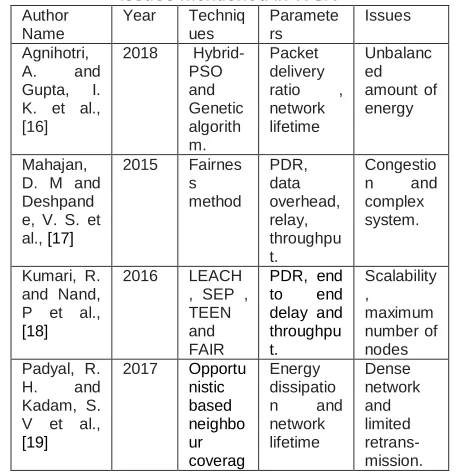
Agnihotri, A. and Gupta, I. K. et al., 2018 [16] developed research on the power efficient routing protocol that depends on the optimised methods namely PSO(Particle swarm optimisation) and GA(Genetic algorithm). The established four routing conventions are short route method, PSO, GA and hybrid PSO-GA methods for small and large size system. Simulation outcome detects hybrid PSO-GA improved the life period pf the shortest path method, PSO and GA approach for the large area system. Mahajan, D. M and Deshpande, V. S. et al.,2015 [17] proposed research on the effect of the resource distribution and avoids congestion that was based on the fairness method of the routing protocols. In wireless network, there may be congestion due the dense system so distribution of the assets becomes necessary. This research explained the performance investigation of the present routing conventions for change in traffic flow of the WSN. Simulation outcome described the appropriate convention for the grid structure with parameters metrices like as packet delivery ratio(PDR), delay, throughput and data overhead. Singh,O and Rishiwal, V et al., 2017 [18] measured five protocols namely LEACH, SEP, TEEN, SEP and EAMMH to determine the scalability feature of the protocol. The scalability was developed in form of the quantity with condition of sensor hops on network more than 1000 in every convention. The performance was evaluated through simulation in MAYLAB. The outcome demonstrate the common approach period FAIR protocol superior than LEACH, SEP, TEEN and EAMMH for measuring the metrices like as failed hops reduced and generation of the clusters, generation of CH and enhancement in packet delivery rate. Kumari, R. and Nand, P et al., 2016 [18] analysed the performance of the different routing conventions in wireless sensor network (WSN) and wireless body area system. The performance was
determined in complex and simple network. Some of the protocols were AODV, DSDV, DSR and AOMDV using metrices packet delivery rate, end to end delay and throughput. It was noted that PDR and throughput value, and also delay rate of AOMDV was better as compared to other protocols. Experimental analysis suggested that the performance of the protocols in WBAN is reduced as compared to wireless sensor network. Padyal, R. H. and Kadam, S. V et al., 2017 [19] invented an adaptable based neighbour coverage routing. The node to node adaptable routing was done by choosing a forwarding hop on the base of the present load on the hop, power and neighbour coverage data. During the selection of the reliable hop in the route , it depends on the loading data table. The planned method decreases the power consumption and improves the performance of the system as compared to existing routing convention. Masoud, M. Z and Jaradat, Y. et al., 2019 [20] developed a novel hybrid cluster routing protocol (HCP). The protocol contains two stages , creation of cluster and forwarding information. At the initial stage, sensor hops were selected to forward the road traffic to cluster head (CH). The amount of the sensor hops in the network may be lesser and distributed, and no cluster formation took place. The simulation of the HCP was done to recognise the performance of the LEACH and LEACH-T. Experimental outcome demonstrated that there is decrease in the power consumed and improvement in the life time up to 30%. Alageswaran, R. and Usha, R., et al.,2012 [21] established a reliable technique for searching optimised location of sink hop utilising PSO(particle swarm optimisation). In this research, optimum controller was searched in two tier structure by locating application hops that depends on eucledian distance and selection possibility. The technique was tested through development of the communication among the hops and sink hop by application hops utilising query driven approach of wireless sensor system. In resultant outcomes, the power consumed, sending and processing of the query was analysed.
Table I: Various techniques, performance parameters and issues mentioned in WSN
Author Name
Year Techniq ues
Paramete rs
Issues
Agnihotri, A. and Gupta, I. K. et al., [16]
2018 Hybrid-PSO and Genetic algorith m. Packet delivery ratio , network lifetime
Unbalanc ed amount of energy
Mahajan, D. M and Deshpand e, V. S. et al., [17]
2015 Fairnes s method PDR, data overhead, relay, throughpu t. Congestio n and complex system.
Kumari, R. and Nand, P et al., [18]
2016 LEACH , SEP , TEEN and FAIR
PDR, end to end delay and throughpu t. Scalability , maximum number of nodes Padyal, R.
H. and Kadam, S. V et al., [19]
e routing Masoud,
M. Z and Jaradat, Y. et al., [20]
2019 novel hybrid cluster routing protocol
Energy dissipatio n and network lifetime.
Data traffic and maximum consume d energy. Alageswar
an, R. and Usha, R., et al., [21]
2012 Search optimis ation and PSO techniq ue.
Energy consumpti on.
Limited energy, multi hop functionali ty.
3.
EXPERIMENTAL ANALYSIS
The main aim of this research work is to establish a routing technique in wireless sensor network to enhance the number of rounds and packet delivery ratio. In addition, a chain based method (PEGASIS) using genetic and ant lion optimisation algorithm to improve the lifetime of the network.
A. Performance Parameters
Energy Consumption: It is the amount of the average energy consumed to amount of the received data packets. It is expressed as,
Energy =
Packet Losses in WSN : It is defined as the proportionality of the amount of the missing packets to the amount of the sent data packets. Every packet has a time limit before the execution process and the scheduler capable to decrease the amount of lost data packets because of the deadline time limit.
Packet Loss =
Packet Delivery Rate : Packet delivery rate is the proportionality of the data packets forwarded from source to destination.
Packet delivery rate = B. Result Discussions
In this section, elaborate the research work with genetic and ant lion optimization algorithm based performance such as packet delivery rate, packet losses and energy consumption in WSN (Wireless Sensor Network).
Fig 2. Network Deployment
Above figure 2 shows the network deployment with network length, network width in WSN (Wireless Sensor Network). The plot the sensor nodes in the WSN and coverage set designed in all the nodes are covered in the network. In WSN sensor nodes identity are assigning in random pattern which is 1,2,3….n(num_of_sensor_nodes).
(i)
(ii)
Fig 3 (i) Chain Formation and (ii) Cluster Head Deployment
Above fig 3 (i) and (ii) shows the cluster head deployment with the help of the sensor node location and position in the network. Source sent the request session to the other intermediate nodes in the WSN. Then Chain formation creating to the final transmission processed in the network. In this chain formation done by PEGASIS protocol to recover the loss of the network and increase the packet delivery rate and reduces the network load (WSN).
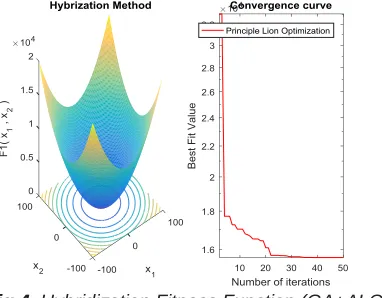
Fig 4. Hybridization Fitness Function (GA+ALO)
1759
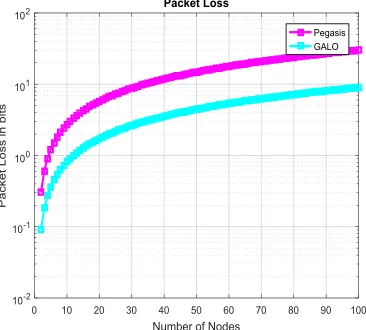
Fig 5. Comparison – Packet Loss (Pegasis and GALO).
Above figure 5. and below table 1 shows the comparison between pegasis protocol and genetic ant lion optimization algorithm with Packet Loss in bits. In protocol performance high packet losses in network and GALO Optimization is a proposed method to reduce the packet loss rate and minimum losses.
Table II. Comparison between proposed and existing parameters (Packet Loss)
Parameters Pegasis Protocol Genetic-Ant Lion Optimization
Packet Loss in bits 30 9
Fig 6. Comparison – Energy Consumption (Pegasis and GALO).
Above figure 6 and below table III show the comparison between proposed and existing performance parameter which is energy consumption. In pegasis protocol consume high energy and GALO reduces the energy factor in joules. Proposed energy value is 0.93 and existing energy value is 1.1 joules.
Table III: Comparison between proposed and existing parameters in energy consumption
Parameters Pegasis Protocol Genetic-Ant Lion Optimization Energy Consumption
(Joules)
1.1 0.93
Fig 7 Comparison Analysis (Packet Delivery Rate).
Above figure 7 and below table III show the comparison between proposed, pegasis and existing GA-PSO routing protocol in packet delivery rate. In proposed GALO packet delivery rate value is 85% , Pegasis Protocol PDR value is 30% and GA-PSOA value is 80%.
In proposed GALO optimization algorithm has achieved high delivery rate as compared with the existing routing and optimization methods in WSN (wireless sensor network).
Table IV. Comparison between proposed and existing parameter in Packet Delivery Rate
Parameter PEGASIS GA-PSOA
GA-ALOA Packet
Delivery Rate
30 % 80% 85%
4. CONCLUSION AND FUTURE SCOPE
delivery ratio,packet loss and energy consumption using PEGASIS, GA-PSOA and GA-ALOA. In comparison analysis, GA-ALOA achieves PDR up to 85%, energy consumption 0.3 in joules and packet loss is 9 in bits. It can implement an enhance energy based routing protocol used in WSN (Wireless Sensor Network). In this scope will design protocol based on energy dissipation and improve the network throughput rate in network. It will help to improve the communication one hop to another hop. It can improve the network performance, lifetime and network speed in the WSN (Wireless Sensor Network).Future work will evaluate the performance parameters are:
1) Throughput Rate
2) Routing Overhead and
3) Network Lifetime.
REFERENCES
[1]
Lazarescu, M. T. (2013), “Design of a
WSN platform for long-term environmental
monitoring for IoT applications” , IEEE
Journal on emerging and selected topics
in circuits and systems, vol.3(1), pp.
45-54.
[2]
Đurišić, M. P., Tafa, Z., Dimić, G. and
Milutinović, V. (2012), “ A survey of
military applications of wireless sensor
networks” , In 2012 Mediterranean
conference on embedded computing
(MECO) ,pp. 196-199. IEEE.
[3]
Murillo, A. F., Peña, M. and Martínez, D.
(2012), Applications of WSN in health and
agriculture” , In 2012 IEEE Colombian
Communications Conference (COLCOM) ,
pp. 1-6, IEEE.
[4]
Bera, S., Misra, S., Roy, S. K and
Obaidat, M. S. (2016), “ Soft-WSN:
Software-defined
WSN
management
system for IoT applications” , IEEE
Systems Journal, vol. 12(3),
pp.2074-2081.
[5]
Alcaraz, C., Lopez, J., Roman, R. and
Chen, H. H. (2012), “ Selecting key
management
schemes
for
WSN
applications” , Computers & Security, vol.
31(8),pp. 956-966.
[6]
Yick, J., Mukherjee, B., and Ghosal, D.
(2008), “ Wireless sensor network survey”
, Computer networks, vol. 52(12),pp .
2292-2330.
[7]
Ye, W., Heidemann, J. and Estrin, D.
(2002), “ An energy-efficient MAC protocol
for wireless sensor networks” , In
Proceedings. Twenty-First Annual Joint
Conference of the IEEE Computer and
Communications Societies , vol. 3, pp.
1567-1576, IEEE.
[8]
Sohrabi, K., Gao, J., Ailawadhi, V., and
Pottie, G. J. (2000), “ Protocols for
self-organization of a wireless sensor network”
, IEEE personal communications, 7(5),
16-27.
[9]
Doherty, L.and El Ghaoui, L. (2001), “
Convex position estimation in wireless
sensor networks” , In Proceedings IEEE
INFOCOM
2001.
Conference
on
Computer Communications. Twentieth
Annual Joint Conference of the IEEE
Computer and Communications Society
(Cat. No. 01CH37213) ,Vol. 3, pp.
1655-1663, IEEE.
[10]
Chang, J. H. and Tassiulas, L.
(2004), “ Maximum lifetime routing in
wireless sensor networks” , IEEE/ACM
Transactions on networking, vol.12(4),
pp.609-619.
[11]
Huang, C. F and Tseng, Y. C.
(2005), “The coverage problem in a
wireless sensor network” ,Mobile networks
and Applications, vol. 10(4), pp.519-528.
[12]
Herbert, J., O'Donoghue, J., Ling,
G., Fei, K and Fok, C. L. (2006), “ Mobile
agent architecture integration for a
wireless sensor medical application” , In
2006
IEEE/WIC/ACM
International
Conference on Web Intelligence and
Intelligent Agent Technology Workshops,
vol 2(1) ,pp. 235-238, IEEE.
[13]
Omeni, O., Wong, A. C. W.,
1761