Learning the Structure of Task-driven Human-Human Dialogs
Srinivas Bangalore AT&T Labs-Research
180 Park Ave Florham Park, NJ 07932 [email protected]
Giuseppe Di Fabbrizio AT&T Labs-Research
180 Park Ave Florham Park, NJ 07932 [email protected]
Amanda Stent Dept of Computer Science
Stony Brook University Stony Brook, NY [email protected]
Abstract
Data-driven techniques have been used for many computational linguistics tasks. Models derived from data are generally more robust than hand-crafted systems since they better reflect the distribution of the phenomena being modeled. With the availability of large corpora of spo-ken dialog, dialog management is now reaping the benefits of data-driven tech-niques. In this paper, we compare two ap-proaches to modeling subtask structure in dialog: a chunk-based model of subdialog sequences, and a parse-based, or hierarchi-cal, model. We evaluate these models us-ing customer agent dialogs from a catalog service domain.
1 Introduction
As large amounts of language data have become available, approaches to sentence-level process-ing tasks such as parsprocess-ing, language modelprocess-ing, named-entity detection and machine translation have become increasingly data-driven and empiri-cal. Models for these tasks can be trained to cap-ture the distributions of phenomena in the data resulting in improved robustness and adaptabil-ity. However, this trend has yet to significantly impact approaches to dialog management in dia-log systems. Diadia-log managers (both plan-based and call-flow based, for example (Di Fabbrizio and Lewis, 2004; Larsson et al., 1999)) have tradition-ally been hand-crafted and consequently some-what brittle and rigid. With the ability to record, store and process large numbers of human-human dialogs (e.g. from call centers), we anticipate that data-driven methods will increasingly influ-ence approaches to dialog management.
A successful dialog system relies on the syn-ergistic working of several components: speech recognition (ASR), spoken language understand-ing (SLU), dialog management (DM), language generation (LG) and text-to-speech synthesis (TTS). While data-driven approaches to ASR and
SLU are prevalent, such approaches to DM, LG and TTS are much less well-developed. In on-going work, we are investigating data-driven ap-proaches for building all components of spoken dialog systems.
In this paper, we address one aspect of this prob-lem –inferring predictive models to structure
task-oriented dialogs. We view this problem as a first
step in predicting the system state of a dialog man-ager and in predicting the system utterance during an incremental execution of a dialog. In particular, we learn models for predicting dialog acts of ut-terances, and models for predicting subtask struc-tures of dialogs. We use three different dialog act tag sets for three different human-human dialog corpora. We compare a flat chunk-based model to a hierarchical parse-based model as models for predicting the task structure of dialogs.
The outline of this paper is as follows: In Sec-tion 2, we review current approaches to building dialog systems. In Section 3, we review related work in data-driven dialog modeling. In Section 4, we present our view of analyzing the structure of task-oriented human-human dialogs. In Section 5, we discuss the problem of segmenting and label-ing dialog structure and buildlabel-ing models for pre-dicting these labels. In Section 6, we report ex-perimental results on Maptask, Switchboard and a dialog data collection from a catalog ordering ser-vice domain.
2 Current Methodology for Building Dialog systems
Current approaches to building dialog systems involve several manual steps and careful craft-ing of different modules for a particular domain or application. The process starts with a small scale “Wizard-of-Oz” data collection where sub-jects talk to a machine driven by a human ‘behind the curtains’. A user experience (UE) engineer an-alyzes the collected dialogs, subject matter expert interviews, user testimonials and other evidences (e.g. customer care history records). This hetero-geneous set of information helps the UE engineer to design some system functionalities, mainly: the
semantic scope (e.g. call-types in the case of call routing systems), the LG model, and the DM strat-egy. A larger automated data collection follows, and the collected data is transcribed and labeled by expert labelers following the UE engineer recom-mendations. Finally, the transcribed and labeled data is used to train both the ASR and the SLU.
This approach has proven itself in many com-mercial dialog systems. However, the initial UE requirements phase is an expensive and error-prone process because it involves non-trivial de-sign decisions that can only be evaluated after sys-tem deployment. Moreover, scalability is compro-mised by the time, cost and high level of UE know-how needed to reach a consistent design.
The process of building speech-enabled auto-mated contact center services has been formalized and cast into a scalable commercial environment in which dialog components developed for differ-ent applications are reused and adapted (Gilbert et al., 2005). However, we still believe that ex-ploiting dialog data to train/adapt or complement hand-crafted components will be vital for robust and adaptable spoken dialog systems.
3 Related Work
In this paper, we discuss methods for automati-cally creating models of dialog structure using di-alog act and task/subtask information. Relevant related work includes research on automatic dia-log act tagging and stochastic diadia-log management, and on building hierarchical models of plans using task/subtask information.
There has been considerable research on statis-tical dialog act tagging (Core, 1998; Jurafsky et al., 1998; Poesio and Mikheev, 1998; Samuel et al., 1998; Stolcke et al., 2000; Hastie et al., 2002). Several disambiguation methods (n-gram models, hidden Markov models, maximum entropy mod-els) that include a variety of features (cue phrases, speaker ID, word n-grams, prosodic features, syn-tactic features, dialog history) have been used. In this paper, we show that use of extended context gives improved results for this task.
Approaches to dialog management include AI-style plan recognition-based approaches (e.g. (Sidner, 1985; Litman and Allen, 1987; Rich and Sidner, 1997; Carberry, 2001; Bohus and Rudnicky, 2003)) and information state-based ap-proaches (e.g. (Larsson et al., 1999; Bos et al., 2003; Lemon and Gruenstein, 2004)). In recent years, there has been considerable research on how to automatically learn models of both types from data. Researchers who treat dialog as a se-quence of information states have used reinforce-ment learning and/or Markov decision processes to build stochastic models for dialog management
that are evaluated by means of dialog simulations (Levin and Pieraccini, 1997; Scheffler and Young, 2002; Singh et al., 2002; Williams et al., 2005; Henderson et al., 2005; Frampton and Lemon, 2005). Most recently, Henderson et al. showed that it is possible to automatically learn good dia-log management strategies from automatically la-beled data over a large potential space of dialog states (Henderson et al., 2005); and Frampton and Lemon showed that the use of context informa-tion (the user’s last dialog act) can improve the performance of learned strategies (Frampton and Lemon, 2005). In this paper, we combine the use of automatically labeled data and extended context for automatic dialog modeling.
Other researchers have looked at probabilistic models for plan recognition such as extensions of Hidden Markov Models (Bui, 2003) and proba-bilistic context-free grammars (Alexandersson and Reithinger, 1997; Pynadath and Wellman, 2000). In this paper, we compare hierarchical grammar-style and flat chunking-grammar-style models of dialog.
In recent research, Hardy (2004) used a large corpus of transcribed and annotated telephone conversations to develop the Amities dialog sys-tem. For their dialog manager, they trained sepa-rate task and dialog act classifiers on this corpus. For task identification they report an accuracy of 85% (true task is one of the top 2 results returned by the classifier); for dialog act tagging they report 86% accuracy.
4 Structural Analysis of a Dialog
We consider a task-oriented dialog to be the re-sult of incremental creation of a shared plan by the participants (Lochbaum, 1998). The shared plan is represented as a single tree that encap-sulates the task structure (dominance and prece-dence relations among tasks), dialog act structure (sequences of dialog acts), and linguistic structure of utterances (inter-clausal relations and predicate-argument relations within a clause), as illustrated in Figure 1. As the dialog proceeds, an utterance from a participant is accommodated into the tree in an incremental manner, much like an incremental syntactic parser accommodates the next word into a partial parse tree (Alexandersson and Reithinger, 1997). With this model, we can tightly couple language understanding and dialog management using a shared representation, which leads to im-proved accuracy (Taylor et al., 1998).
subtask labeling (Section 5).
Dialog
Task
Topic/Subtask Topic/Subtask
Task Task
Clause
Utterance Utterance
Utterance
Topic/Subtask
[image:3.595.111.249.85.236.2]DialogAct,Pred−Args DialogAct,Pred−Args DialogAct,Pred−Args
Figure 1: Structural analysis of a dialog
4.1 Utterance Segmentation
The task of ”cleaning up” spoken language utter-ances by detecting and removing speech repairs and dysfluencies and identifying sentence bound-aries has been a focus of spoken language parsing research for several years (e.g. (Bear et al., 1992; Seneff, 1992; Shriberg et al., 2000; Charniak and Johnson, 2001)). We use a system that segments the ASR output of a user’s utterance into clauses. The system annotates an utterance for sentence boundaries, restarts and repairs, and identifies coordinating conjunctions, filled pauses and dis-course markers. These annotations are done using a cascade of classifiers, details of which are de-scribed in (Bangalore and Gupta, 2004).
4.2 Syntactic Annotation
We automatically annotate a user’s utterance with supertags (Bangalore and Joshi, 1999). Supertags encapsulate predicate-argument information in a local structure. They are composed with each other using the substitution and adjunction oper-ations of Tree-Adjoining Grammars (Joshi, 1987) to derive a dependency analysis of an utterance and its predicate-argument structure.
4.3 Dialog Act Tagging
We use a domain-specific dialog act tag-ging scheme based on an adapted version of DAMSL (Core, 1998). The DAMSL scheme is quite comprehensive, but as others have also found (Jurafsky et al., 1998), the multi-dimensionality of the scheme makes the building of models from DAMSL-tagged data complex. Furthermore, the generality of the DAMSL tags reduces their util-ity for natural language generation. Other tagging schemes, such as the Maptask scheme (Carletta et al., 1997), are also too general for our purposes. We were particularly concerned with obtaining
sufficient discriminatory power between different types of statement (for generation), and to include an out-of-domain tag (for interpretation). We pro-vide a sample list of our dialog act tags in Table 2. Our experiments in automatic dialog act tagging are described in Section 6.3.
[image:3.595.307.527.277.355.2]5 Modeling Subtask Structure
Figure 2 shows the task structure for a sample di-alog in our domain (catdi-alog ordering). An order
placement task is typically composed of the
se-quence of subtasksopening, contact-information,
order-item, related-offers, summary. Subtasks can
be nested; the nesting structure can be as deep as five levels. Most often the nesting is at the left or right frontier of the subtask tree.
Opening
Order Placement
Contact Info
Delivery Info Shipping Info
Closing Summary
[image:3.595.309.524.408.451.2]Payment Info Order Item
Figure 2: A sample task structure in our applica-tion domain.
Contact Info Order Item Payment Info Summary Closing
Shipping Info Delivery Info Opening
Figure 3: An example output of the chunk model’s task structure
The goal of subtask segmentation is to predict if the current utterance in the dialog is part of the cur-rent subtask or starts a new subtask. We compare two models for recovering the subtask structure – a chunk-based model and a parse-based model. In the chunk-based model, we recover the prece-dence relations (sequence) of the subtasks but not dominance relations (subtask structure) among the subtasks. Figure 3 shows a sample output from the chunk model. In the parse model, we recover the complete task structure from the sequence of ut-terances as shown in Figure 2. Here, we describe our two models. We present our experiments on subtask segmentation and labeling in Section 6.4.
5.1 Chunk-based model
This model is similar to the second one described in (Poesio and Mikheev, 1998), except that we use tasks and subtasks rather than dialog games. We model the prediction problem as a classifica-tion task as follows: given a sequence of utter-ances
in a dialog
subtask label vocabulary
, we need to predict the best subtask label sequence "!
#
%$ as shown in equation 1. &('*)+-,/.10/23,/4
5 6 798 &:';<*=
(1)
Each subtask has begin, middle (possibly ab-sent) and end utterances. If we incorporate this information, the refined vocabulary of subtask la-bels is ">
@? BA $ /BC ED -FG . In our experiments, we use a classifier to assign to each utterance a refined subtask label conditioned on a vector of local contextual features (H ). In
the interest of using an incremental left-to-right decoder, we restrict the contextual features to be from the preceding context only. Furthermore, the search is limited to the label sequences that re-spect precedence among the refined labels (begin
I
middle I
end). This constraint is expressed in a grammar G encoded as a regular expression (JKML ON /BA $ ! /BC
! ). However, in order
to cope with the prediction errors of the classifier, we approximate J3ML
with an P -gram language
model on sequences of the refined tag labels:
&:' )
Q
+R,/.S0/2K,4 5 61T 5 6ST1U VWYX[Z
798 &(' Q ;<*= (2) \ ,/.S0/2K,4 5 6 T
5 6ST1U VWYX[Z
] ^`_ 798baBc _ ;d= (3)
In order to estimate the conditional distribution
e D H
we use the general technique of choos-ing the maximum entropy (maxent) distribution that properly estimates the average of each feature over the training data (Berger et al., 1996). This can be written as a Gibbs distribution parameter-ized with weights f , where g is the size of the
label set. Thus,
798ba%c
_
;d=+ h`i1jlkbmonp qsr
tvuxw:y h i1jlk%np
(4)
We use the machine learning toolkit LLAMA (Haffner, 2006) to estimate the con-ditional distribution using maxent. LLAMA encodes multiclass maxent as binary maxent, in order to increase the speed of training and to scale this method to large data sets. Each of the g
classes in the set z{>
is encoded as a bit vector such that, in the vector for class|, the|B}~ bit is one
and all other bits are zero. Then, g one-vs-other
binary classifiers are used as follows.
798x
;=+ 798
;=+ h i1n
h
i n9
h
i n
+ h iS n (5) where f
is the parameter vector for the
anti-label and f f f
. In order to compute
e D H
, we use class independence assumption and require that
and for all
| . 798ba%c _ ;=+ 798x _ ;= r ^ ¡`¢ w _ 798x ¡ ;=
5.2 Parse-based Model
As seen in Figure 3, the chunk model does not capture dominance relations among subtasks, which are important for resolving anaphoric refer-ences (Grosz and Sidner, 1986). Also, the chunk model is representationally inadequate for center-embedded nestings of subtasks, which do occur in our domain, although less frequently than the more prevalent “tail-recursive” structures.
In this model, we are interested in finding the most likely plan tree (e
) given the sequence of
utterances:
7
' ) +-,/.S0/2K,/4
£
6 798¤7 'z;<*=
(6)
For real-time dialog management we use a top-down incremental parser that incorporates bottom-up information (Roark, 2001).
We rewrite equation (6) to exploit the subtask sequence provided by the chunk model as shown in Equation 7. For the purpose of this paper, we approximate Equation 7 using one-best (ork-best) chunk output.1
7
'*)¥+ ,/.S0/2K,4 £ 6 ¦
5 6 798 &(';<*= 798¤7 ';&('= (7) \ ,/.S0/2K,4 £ 6 798¤7
';&('
)
=
(8)
where &(' ) +-,/.S0/2K,/4
5/6 798 &:';<*=
(9)
6 Experiments and Results
In this section, we present the results of our exper-iments for modeling subtask structure.
6.1 Data
As our primary data set, we used 915 telephone-based customer-agent dialogs related to the task of ordering products from a catalog. Each dia-log was transcribed by hand; all numbers (tele-phone, credit card, etc.) were removed for pri-vacy reasons. The average dialog lasted for 3.71
minutes and included 61.45 changes of speaker. A single customer-service representative might par-ticipate in several dialogs, but customers are rep-resented by only one dialog each. Although the majority of the dialogs were on-topic, some were idiosyncratic, including: requests for order cor-rections, transfers to customer service, incorrectly dialed numbers, and long friendly out-of-domain asides. Annotations applied to these dialogs in-clude: utterance segmentation (Section 4.1), syn-tactic annotation (Section 4.2), dialog act tag-ging (Section 4.3) and subtask segmentation (Sec-tion 5). The former two annota(Sec-tions are domain-independent while the latter are domain-specific.
6.2 Features
Offline natural language processing systems, such as part-of-speech taggers and chunkers, rely on
both static and dynamic features. Static features
are derived from the local context of the text be-ing tagged. Dynamic features are computed based on previous predictions. The use of dynamic fea-tures usually requires a search for the globally op-timal sequence, which is not possible when doing incremental processing. For dialog act tagging and subtask segmentation during dialog management, we need to predict incrementally since it would be unrealistic to wait for the entire dialog before decoding. Thus, in order to train the dialog act (DA) and subtask segmentation classifiers, we use
onlystaticfeatures from the current and left
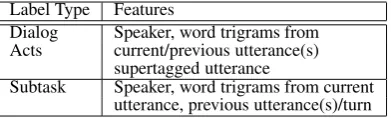
con-text as shown in Table 1.2 This obviates the need for constructing a search network and performing a dynamic programming search during decoding. In lieu of the dynamic context, we use larger static context to compute features – word trigrams and trigrams of words annotated with supertags com-puted from up to three previous utterances.
Label Type Features
Dialog Speaker, word trigrams from Acts current/previous utterance(s)
supertagged utterance
[image:5.595.308.526.438.590.2]Subtask Speaker, word trigrams from current utterance, previous utterance(s)/turn
Table 1: Features used for the classifiers.
6.3 Dialog Act Labeling
For dialog act labeling, we built models from our corpus and from the Maptask (Carletta et al., 1997) and Switchboard-DAMSL (Jurafsky et al., 1998) corpora. From the files for the Maptask cor-pus, we extracted the moves, words and speaker information (follower/giver). Instead of using the
2We could use dynamic contexts as well and adopt a greedy decoding algorithm instead of a viterbi search. We have not explored this approach in this paper.
raw move information, we augmented each move with speaker information, so that for example,
theinstructmove was split intoinstruct-giverand
instruct-follower. For the Switchboard corpus, we
clustered the original labels, removing most of the multidimensional tags and combining together tags with minimum training data as described in (Jurafsky et al., 1998). For all three corpora, non-sentence elements (e.g., dysfluencies, discourse
markers, etc.) and restarts (with and without
re-pairs) were kept; non-verbal content (e.g., laughs, background noise, etc.) was removed.
As mentioned in Section 4, we use a domain-specific tag set containing 67 dialog act tags for the catalog corpus. In Table 2, we give examples of our tags. We manually annotated 1864 clauses from 20 dialogs selected at random from our cor-pus and used a ten-fold cross-validation scheme for testing. In our annotation, a single utterance may have multiple dialog act labels. For our ex-periments with the Switchboard-DAMSL corpus, we used 42 dialog act tags obtained by clustering over the 375 unique tags in the data. This cor-pus has 1155 dialogs and 218,898 utterances; 173 dialogs, selected at random, were used for testing. The Maptask tagging scheme has 12 unique dialog act tags; augmented with speaker information, we get 24 tags. This corpus has 128 dialogs and 26181 utterances; ten-fold cross validation was used for testing.
Type Subtype
Ask Info
Explain Catalog, CC Related, Discount, Order Info Order Problem, Payment Rel, Product Info Promotions, Related Offer, Shipping Convers- Ack, Goodbye, Hello, Help, Hold, -ational YoureWelcome, Thanks, Yes, No, Ack,
Repeat, Not(Information)
Request Code, Order Problem, Address, Catalog, CC Related, Change Order, Conf, Credit, Customer Info, Info, Make Order, Name, Order Info, Order Status, Payment Rel, Phone Number, Product Info, Promotions, Shipping, Store Info
YNQ Address, Email, Info, Order Info, Order Status,Promotions, Related Offer
Table 2: Sample set of dialog act labels
[image:5.595.85.281.540.599.2]Maptask and 200K utterances for DAMSL). The error rates for the Switchboard-DAMSL data are significantly better than previously pub-lished results (28% error rate) (Jurafsky et al., 1998) with the same tag set. This improvement is attributable to the richer feature set we use and a discriminative modeling framework that supports a large number of features, in contrast to the gener-ative model used in (Jurafsky et al., 1998). A sim-ilar obeservation applies to the results on Maptask dialog act tagging. Our model outperforms previ-ously published results (42.8% error rate) (Poesio and Mikheev, 1998).
In labeling the Switchboard data, long utter-ances were split into slash units (Meteer et.al., 1995). A speaker’s turn can be divided in one or more slash units and a slash unit can extend over multiple turns, for example:
sv B.64 utt3: C but, F uh – b A.65 utt1: Uh-huh. /
+ B.66 utt1: – people want all of that /
sv B.66 utt2: C and not all of those are necessities. / b A.67 utt1: Right . /
The labelers were instructed to label on the ba-sis of the whole slash unit. This makes, for ex-ample, the dysfluency turn B.64 a Statement opin-ion (sv) rather than a non-verbal. For the pur-pose of discriminative learning, this could intro-duce noisy data since the context associated to the labeling decision shows later in the dialog. To ad-dress this issue, we compare 2 classifiers: the first (non-merged), simply propagates the same label to each continuation, cross turn slash unit; the sec-ond (merged) combines the units in one single ut-terance. Although themergedclassifier breaks the regular structure of the dialog, the results in Table 3 show better overall performance.
Tagset current + stagged + 3 previous utterance utterance (stagged)
utterance
Catalog 46.3 46.1 42.2
Domain
DAMSL 24.7 23.8 19.1
(non-merged)
DAMSL 22.0 20.6 16.5
(merged)
[image:6.595.308.530.61.128.2]Maptask 34.3 33.9 30.3
Table 3: Error rates in dialog act tagging
6.4 Subtask Segmentation and Labeling
For subtask labeling, we used a random partition of 864 dialogs from our catalog domain as the training set and 51 dialogs as the test set. All the dialogs were annotated with subtask labels by hand. We used a set of 18 labels grouped as shown in Figure 4.
Type Subtask Labels
1 opening, closing
2 contact-information, delivery-information, payment-information, shipping-address,summary 3 order-item, related-offer, order-problem
discount, order-change, check-availability 4 call-forward, out-of-domain, misc-other, sub-call
Table 4: Subtask label set
6.4.1 Chunk-based Model
Table 5 shows error rates on the test set when predicting refined subtask labels using word P
-gram features computed on different dialog con-texts. The well-formedness constraint on the re-fined subtask labels significantly improves predic-tion accuracy. Utterance context is also very help-ful; just one utterance of left-hand context leads to a 10% absolute reduction in error rate, with fur-ther reductions for additional context. While the use of trigram features helps, it is not as helpful as other contextual information. We used the dialog act tagger trained from Switchboard-DAMSL cor-pus to automatically annotate the catalog domain utterances. We included these tags as features for the classifier, however, we did not see an improve-ment in the error rates, probably due to the high error rate of the dialog act tagger.
Feature Utterance Context Context
Current +prev +three prev utt/with DA utt/with DA utt/with DA Unigram 42.9/42.4 33.6/34.1 30.0/30.3
(53.4/52.8) (43.0/43.0) (37.6/37.6) Trigram 41.7/41.7 31.6/31.4 30.0/29.1
[image:6.595.310.522.401.478.2](52.5/52.0) (42.9/42.7) (37.6/37.4)
Table 5: Error rate for predicting the refined sub-task labels. The error rates without the well-formedness constraint is shown in parenthesis. The error rates with dialog acts as features are sep-arated by a slash.
6.4.2 Parsing-based Model
We retrained a top-down incremental parser (Roark, 2001) on the plan trees in the training dialogs. For the test dialogs, we used the § -best (k=50) refined subtask labels for each
utterance as predicted by the chunk-based classi-fier to create a lattice of subtask label sequences. For each dialog we then created P -best sequences
(100-best for these experiments) of subtask labels; these were parsed and (re-)ranked by the parser.3 We combine the weights of the subtask label sequences assigned by the classifier with the parse score assigned by the parser and select the top
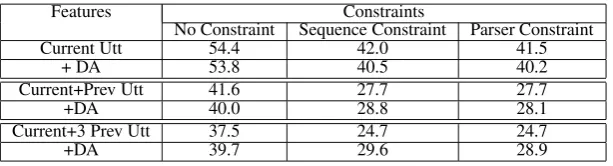
[image:6.595.75.290.541.637.2]Features Constraints
No Constraint Sequence Constraint Parser Constraint
Current Utt 54.4 42.0 41.5
+ DA 53.8 40.5 40.2
Current+Prev Utt 41.6 27.7 27.7
+DA 40.0 28.8 28.1
Current+3 Prev Utt 37.5 24.7 24.7
[image:7.595.146.453.61.144.2]+DA 39.7 29.6 28.9
Table 6: Error rates for task structure prediction, with no constraints, sequence constraints and parser constraints
scoring sequence from the list for each dialog. The results are shown in Table 6. It can be seen that using the parsing constraint does not help the subtask label sequence prediction significantly. The chunk-based model gives almost the same accuracy, and is incremental and more efficient. 7 Discussion
The experiments reported in this section have been performed on transcribed speech. The audio for these dialogs, collected at a call center, were stored in a compressed format, so the speech recognition error rate is high. In future work, we will assess the performance of dialog structure prediction on recognized speech.
The research presented in this paper is but one step, albeit a crucial one, towards achieving the goal of inducing human-machine dialog systems using human-human dialogs. Dialog structure in-formation is necessary for language generation (predicting the agents’ response) and dialog state specific text-to-speech synthesis. However, there are several challenging problems that remain to be addressed.
The structuring of dialogs has another applica-tion in call center analytics. It is routine practice to monitor, analyze and mine call center data based on indicators such as the average length of dialogs, the task completion rate in order to estimate the ef-ficiency of a call center. By incorporating structure to the dialogs, as presented in this paper, the anal-ysis of dialogs can be performed at a more fine-grained (task and subtask) level.
8 Conclusions
In order to build a dialog manager using a data-driven approach, the following are necessary: a model for labeling/interpreting the user’s current action; a model for identifying the current sub-task/topic; and a model for predicting what the system’s next action should be. Prior research in plan identification and in dialog act labeling has identified possible features for use in such models, but has not looked at the performance of different feature sets (reflecting different amounts of con-text and different views of dialog) across different
domains (label sets). In this paper, we compared the performance of a dialog act labeler/predictor across three different tag sets: one using very de-tailed, domain-specific dialog acts usable for inter-pretation and generation; and two using general-purpose dialog acts and corpora available to the larger research community. We then compared two models for subtask labeling: a flat, chunk-based model and a hierarchical, parsing-chunk-based model. Findings include that simpler chunk-based models perform as well as hierarchical models for subtask labeling and that a dialog act feature is not helpful for subtask labeling.
In on-going work, we are using our best per-forming models for both DM and LG components (to predict the next dialog move(s), and to select the next system utterance). In future work, we will address the use of data-driven dialog management to improve SLU.
9 Acknowledgments
We thank Barbara Hollister and her team for their effort in annotating the dialogs for dialog acts and subtask structure. We thank Patrick Haffner for providing us with the LLAMA machine learning toolkit and Brian Roark for providing us with his top-down parser used in our experiments. We also thank Alistair Conkie, Mazin Gilbert, Narendra Gupta, and Benjamin Stern for discussions during the course of this work.
References
J. Alexandersson and N. Reithinger. 1997. Learning dia-logue structures from a corpus. InProceedings of Eu-rospeech’97.
S. Bangalore and N. Gupta. 2004. Extracting clauses in di-alogue corpora : Application to spoken language under-standing. Journal Traitement Automatique des Langues (TAL), 45(2).
S. Bangalore and A. K. Joshi. 1999. Supertagging: An approach to almost parsing. Computational Linguistics, 25(2).
A. Berger, S.D. Pietra, and V.D. Pietra. 1996. A Maximum Entropy Approach to Natural Language Processing. Com-putational Linguistics, 22(1):39–71.
D. Bohus and A. Rudnicky. 2003. RavenClaw: Dialog man-agement using hierarchical task decomposition and an ex-pectation agenda. InProceedings of Eurospeech’03.
J. Bos et al. 2003. DIPPER: Description and formalisation of an information-state update dialogue system architecture. InProceedings of SIGdial.
H.H. Bui. 2003. A general model for online probabalistic plan recognition. InProceedings of IJCAI’03.
S. Carberry. 2001. Techniques for plan recognition. User Modeling and User-Adapted Interaction, 11(1–2).
J. Carletta et al. 1997. The reliability of a dialog structure coding scheme.Computational Linguistics, 23(1).
E. Charniak and M. Johnson. 2001. Edit detection and pars-ing for transcribed speech. InProceedings of NAACL’01.
M. Core. 1998. Analyzing and predicting patterns of DAMSL utterance tags. In Proceedings of the AAAI spring symposium on Applying machine learning to dis-course processing.
M. Meteer et.al. 1995. Dysfluency annotation stylebook for the switchboard corpus. Distributed by LDC.
G. Di Fabbrizio and C. Lewis. 2004. Florence: a dialogue manager framework for spoken dialogue systems. In IC-SLP 2004, 8th International Conference on Spoken Lan-guage Processing, Jeju, Jeju Island, Korea, October 4-8.
M. Frampton and O. Lemon. 2005. Reinforcement learning of dialogue strategies using the user’s last dialogue act. In Proceedings of the 4th IJCAI workshop on knowledge and reasoning in practical dialogue systems.
M. Gilbert et al. 2005. Intelligent virtual agents for con-tact center automation. IEEE Signal Processing Maga-zine, 22(5), September.
B.J. Grosz and C.L. Sidner. 1986. Attention, intentions and the structure of discoursep. Computational Linguistics, 12(3).
P. Haffner. 2006. Scaling large margin classifiers for spoken language understanding.Speech Communication, 48(4).
H. Hardy et al. 2004. Data-driven strategies for an automated dialogue system. InProceedings of ACL’04.
H. Wright Hastie et al. 2002. Automatically predicting dia-logue structure using prosodic features. Speech Commu-nication, 36(1–2).
J. Henderson et al. 2005. Hybrid reinforcement/supervised learning for dialogue policies from COMMUNICATOR data. InProceedings of the 4th IJCAI workshop on knowl-edge and reasoning in practical dialogue systems.
A. K. Joshi. 1987. An introduction to tree adjoining gram-mars. In A. Manaster-Ramer, editor,Mathematics of Lan-guage. John Benjamins, Amsterdam.
D. Jurafsky et al. 1998. Switchboard discourse language modeling project report. Technical Report Research Note 30, Center for Speech and Language Processing, Johns Hopkins University, Baltimore, MD.
S. Larsson et al. 1999. TrindiKit manual. Technical report, TRINDI Deliverable D2.2.
O. Lemon and A. Gruenstein. 2004. Multithreaded con-text for robust conversational interfaces: Concon-text-sensitive speech recognition and interpretation of corrective frag-ments. ACM Transactions on Computer-Human Interac-tion, 11(3).
E. Levin and R. Pieraccini. 1997. A stochastic model of computer-human interaction for learning dialogue strate-gies. InProceedings of Eurospeech’97.
D. Litman and J. Allen. 1987. A plan recognition model for subdialogs in conversations.Cognitive Science, 11(2).
K. Lochbaum. 1998. A collaborative planning model of in-tentional structure.Computational Linguistics, 24(4).
M. Poesio and A. Mikheev. 1998. The predictive power of game structure in dialogue act recognition: experimental results using maximum entropy estimation. In Proceed-ings of ICSLP’98.
D.V. Pynadath and M.P. Wellman. 2000. Probabilistic state-dependent grammars for plan recognition. InIn Proceed-ings of the 16th Conference on Uncertainty in Artificial Intelligence (UAI-2000).
C. Rich and C.L. Sidner. 1997. COLLAGEN: When agents collaborate with people. InProceedings of the First Inter-national Conference on Autonomous Agents (Agents’97).
B. Roark. 2001. Probabilistic top-down parsing and lan-guage modeling.Computational Linguistics, 27(2).
K. Samuel et al. 1998. Computing dialogue acts from fea-tures with transformation-based learning. InProceedings of the AAAI spring symposium on Applying machine learn-ing to discourse processlearn-ing.
K. Scheffler and S. Young. 2002. Automatic learning of di-alogue strategy using didi-alogue simulation and reinforce-ment learning. InProceedings of HLT’02.
S. Seneff. 1992. A relaxation method for understanding spontaneous speech utterances. InProceedings of the Speech and Natural Language Workshop, San Mateo, CA.
E. Shriberg et al. 2000. Prosody-based automatic segmenta-tion of speech into sentences and topics. Speech Commu-nication, 32, September.
C.L. Sidner. 1985. Plan parsing for intended response recog-nition in discourse.Computational Intelligence, 1(1).
S. Singh et al. 2002. Optimizing dialogue management with reinforcement learning: Experiments with the NJFun sys-tem.Journal of Artificial Intelligence Research, 16.
A. Stolcke et al. 2000. Dialogue act modeling for automatic tagging and recognition of conversational speech. Com-putational Linguistics, 26(3).
P. Taylor et al. 1998. Intonation and dialogue context as constraints for speech recognition.Language and Speech, 41(3).